
Aster DEX fees (checked October 15, 2026): Aster perps cost 0% maker / 0.04% taker (VIP 1), falling to 0.016% taker at VIP 6 — VIP needs 14-day volume and an ASTER holding. Group B pairs: 0.1% taker. RWA (gold, oil, stocks): 0.0125% taker at every tier. Spot: 0.005% / 0.04%, 5% off when paid in ASTER (spot only). 1001x: 0.08% open and close below 500x. Funding: every 8h on BTC/ETH, 4h or 1h on many alts. Deposits free; withdrawals cost a destination-chain fee (0.11 USDT to BNB Chain). Where it goes: 99% of daily platform fees buy back ASTER.
Trade Aster perps at 0% maker
Sign up with referral code DTLpLc (open the link before your first connection) and get 5% of your fees back.
We earn a commission when you sign up through our links; it never raises your fees.
Aster fees vs Hyperliquid and Lighter
The three perp DEXs most traders compare, at the entry tier (no volume, no staking), from each venue’s official fee page:
| Aster | Hyperliquid | Lighter | |
|---|---|---|---|
| Maker fee | 0% | 0.015% | 0% Standard · 0.004% Premium |
| Taker fee | 0.04% (VIP 1) | 0.045% (tier 0) | 0% Standard (300 ms delay) · 0.028% Premium |
| $10,000 market round trip | $8.00 | $9.00 | $0 Standard · $5.60 Premium |
| Top-tier taker | 0.016% (VIP 6: $1B + ASTER held) | 0.024% (tier 6), less with HYPE staking | Standard is already 0% |
| Funding | BTC/ETH every 8h; many alts 4h or 1h | Every hour | Every hour |
| Referral code | DTLpLc: 5% of fees back | HOLYGRAIL: 4% off your first $25M | 718610TD: first week of Premium fees rebated |
Reading it: Aster’s 0% maker and 0.04% taker beat Hyperliquid’s entry tier. Lighter Standard is cheaper still (nothing on either side, but taker orders wait 300 ms), and Lighter Premium’s 0.028% taker undercuts Aster although its maker is 0.004%. Hyperliquid has the deepest books and drops below Aster’s VIP 1 taker from its tier 2 (0.035%). Binance and the full table are in section 13; the full three-way comparison beyond fees: Hyperliquid vs Lighter vs Aster; deeper fee dives: Hyperliquid fees and Lighter vs Aster fees.
1. Every Aster fee at a glance
| What you do | What it costs (October 15, 2026) |
|---|---|
| Perp taker, crypto General (BTC, ETH, SOL…) | 0.040% at VIP 1, down to 0.016% at VIP 6 |
| Perp maker, every category and tier | 0% (since February 2, 2026) |
| Perp taker, Group B (21 small-cap pairs) | 0.100% at VIP 1, down to 0.016% at VIP 6 |
| Perp taker, RWA (gold, oil, stocks, FX) | 0.0125% (1.25 bps) at every tier, from September 7, 2026 |
| USD1-quoted perps | Non-RWA 0.04% (VIP schedule) · RWA 0.0125% |
| Pay fees in ASTER | 5% off spot fees only (the perps fee docs list no ASTER discount) |
| Spot | 0.005% maker / 0.04% taker; AOS-1 pairs: maker rebate 0.25 bp |
| 1001x mode (older guides: “Simple” mode) | 0.08% open + 0.08% close below 500x; PnL-based close fee at 500x+; $0.50 / $0.20 execution fee |
| Shield Mode | 0.03% flat, or 15–20% of profit |
| Funding | Paid between traders every 8h, 4h or 1h; Aster keeps none of it |
| Gas on orders | None |
| Deposits | No Aster fee; source-chain gas only |
| Withdrawals | Destination-chain fee deducted from the amount: 0.11 USDT to BNB Chain, 0.51 USDT to Ethereum, Arbitrum or Solana |
| Liquidation | A liquidation fee (rate not published in the docs), part to the insurance fund; negative balances up to 5,000 USDT are settled automatically |
Aster is a perp DEX on its own Layer 1, Aster Chain (encrypted orders, 50 ms blocks), with deposits bridged in from BNB Chain, Ethereum, Arbitrum, Solana, Robinhood and Arc. It runs four products — the Perpetuals order book (“Pro”), Shield Mode, 1001x and Spot — and each has its own fee model. Most volume trades on the order book (about $2.63B across 604 live perps in the 24 hours to 06:57 UTC on October 15, 2026, against $0.80B on Saturday, September 26), so that is where this guide starts.
2. Pro vs 1001x (Simple) vs Shield vs Spot: cost by mode
“Aster fees” means four different price lists, because each trading mode charges in its own way. Pick the mode first; the fee follows from it.
| Mode | How it trades | Trading fee | Other costs |
|---|---|---|---|
| Pro (order-book perps) | Limit and market orders on a central order book; up to 200x on BTC | 0% maker / 0.04% taker (VIP 1), lower taker at VIP 2–6 | Funding every 8h, 4h or 1h; liquidation fee |
| 1001x (older name “Simple”) | One-click, oracle-priced trades against the ALP pool; up to 1001x on BTC | 0.08% to open and 0.08% to close below 500x; at 500x+ no opening fee, close = max(15% of profit ÷ notional, 0.03%) | $0.50 (BNB Chain) or $0.20 (Arbitrum) execution fee; funding every block |
| Shield Mode | Private positions from 20x to 1001x | 0.03% flat per side, or 15–20% of profit (nothing on losing trades) | Hourly funding |
| Spot | Buy and sell tokens; no leverage | 0.005% maker / 0.04% taker | 5% off when fees are paid in ASTER (spot only) |
Sources: docs.asterdex.com Fees, Spot Fee Structure, 1001x Fees & Slippage, Shield Mode fee and tutorial pages (re-checked October 14–15, 2026). The current docs no longer use the name “Simple Mode” for a trading section; it survives on the ALP pool page, which is the liquidity behind 1001x.
For cost alone, Pro wins: a limit order pays 0%, while 1001x charges 0.08% each way below 500x — 2× the Pro taker rate. 1001x and Shield buy you extreme leverage, no deposit (1001x trades straight from your wallet) or hidden positions, not savings.
3. Perp fees by market category
Aster splits its order-book perpetuals into categories. The category, not the coin’s popularity, decides the taker fee:
| Category | What is in it | Maker | Taker | Tiering |
|---|---|---|---|---|
| Crypto — General | BTC, ETH, SOL, XRP and most crypto pairs | 0% | 0.04% (VIP 1) | VIP schedule |
| Crypto — Group B | 1000NEX, AEON, ASTEROID, AVL, BAY, BASECAT, BLEND, B3, CARDS, CATE, DELTA, FONE, MEME, MARSCOIN, NES, O, OKB, PENGUIN, PUNDIAI, RTX, SKHYNIX (USDT pairs) | 0% | 0.10% (VIP 1) | Separate VIP schedule |
| RWA | Real-world-asset perps: commodities, equities, FX | 0% | 0.0125% | Same at every tier; maker volume counts 10× toward VIP |
| USD1 non-RWA | BTC, ETH, SOL quoted in USD1 | 0% | 0.04% | VIP schedule |
| USD1 RWA | e.g. gold and oil quoted in USD1 | 0% | 0.0125% | Same at every tier |
Source: docs.asterdex.com, trading/perpetuals/fees-and-specs/fees and the VIP Program page (re-checked October 15, 2026, unchanged since September 25). The fees page lists the 21 Group B pairs above; the VIP page’s list now omits PENGUIN and SKHYNIX, so check the order panel for those two.
Fees are charged on the notional value of each fill: contracts × price × rate. A maker order rests on the book before it fills; a taker order fills immediately against a resting one. Aster’s own spot example uses the same arithmetic: buying 0.1 BTC at $100,000 as a taker costs 100,000 × 0.1 × 0.04% = 4 USDT.
Two changes took effect at 10:00 UTC on September 7, 2026 (Aster announcement “Fee Adjustment for RWA & Group B Perpetual Markets”): RWA taker fees became a flat 1.25 bps, and Group B pairs moved to their own schedule. General pairs did not change. If another site still quotes “RWA 0.009%” or “USD1 perps 0.005%”, it is out of date — USD1-quoted crypto perps now follow the normal 0.04% VIP schedule.
4. What a trade really costs: notional, margin and open loss
Fees are charged on notional, not on margin, so leverage multiplies them. $500 of margin at 20x controls a $10,000 position: the taker fee is $4.00 to open and $4.00 to close, $8.00 in all, or 1.6% of the margin. The same $500 at 50x is a $25,000 position and a $20.00 round trip (4% of the margin). The rate never changes; your exposure does.
A market order ties up more margin than a limit order. Aster’s “Costs of Opening Positions” page shows how the order-book perps size the margin for a new position: initial margin (notional ÷ leverage) plus an open loss, the gap between the mark price and a worse order price. A market long is priced at the best ask plus 0.05%; a market short at the higher of the best bid and the mark price. In the docs’ example, 1 BTC at 20x:
- Limit long at 102,990.0 with the mark at 102,988.4: initial margin 5,149.50 + open loss 1.6 = 5,151.10 USDT.
- Market long with the best ask at 102,946.8: estimated entry 102,998.27, initial margin 5,149.91 + open loss 57.27 = 5,207.18 USDT.
- Shorts in the same examples have no open loss: 5,149.50 (limit) and 5,147.35 (market).
Open loss is margin set aside when you open, not a fee you pay; the taker fee comes on top of it. On a thin order book, a market order also pays the spread and any slippage, which can cost more than the fee itself.
Funding is usually the biggest line. A $10,000 BTC long held for the 30 days to October 15, 2026 paid $36.95 in funding on Aster, against $8.00 of taker fees (funding section). A liquidation adds a liquidation fee on top of the loss (section 11).
5. VIP tiers: volume plus ASTER holding
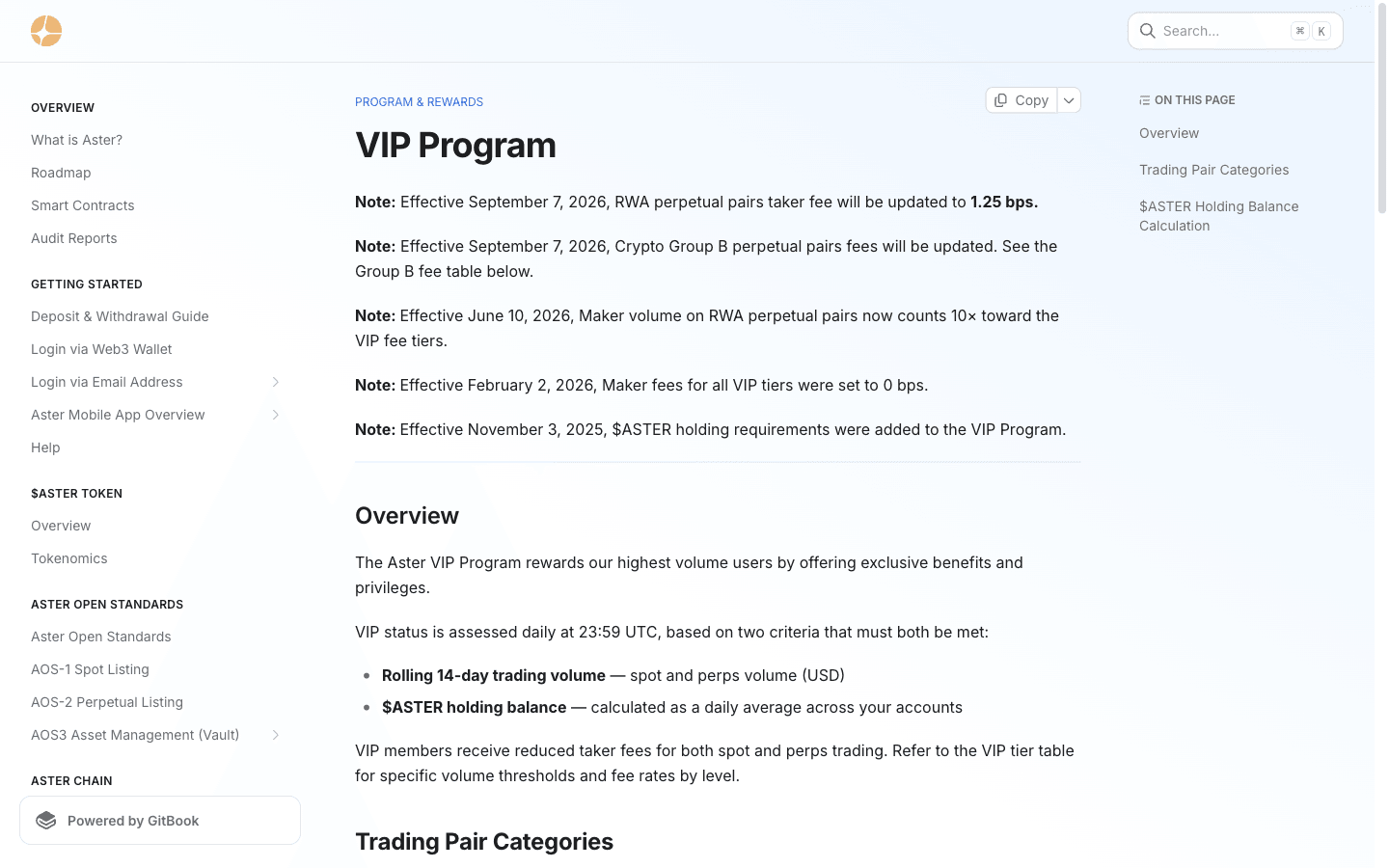
Since November 3, 2025, Aster’s VIP tiers need two things at once: rolling 14-day trading volume (spot and perps, in USD) and a minimum ASTER balance, calculated as the daily average of your spot, perpetual and Aster Staking balances (hourly snapshots at random times, pending orders included). Status is assessed daily at 23:59 UTC. Taker fees only — maker is 0% at every tier.
| Tier | 14-day volume | ASTER held (≈ USD at $0.686) | General taker | Group B taker |
|---|---|---|---|---|
| VIP 1 | < $5M | 0 | 0.040% | 0.100% |
| VIP 2 | ≥ $5M | ≥ 500 (≈ $340) | 0.035% | 0.050% |
| VIP 3 | ≥ $25M | ≥ 2,500 (≈ $1,720) | 0.033% | 0.033% |
| VIP 4 | ≥ $100M | ≥ 25,000 (≈ $17,150) | 0.023% | 0.023% |
| VIP 5 | ≥ $500M | ≥ 250,000 | 0.020% | 0.020% |
| VIP 6 | ≥ $1B | ≥ 2,500,000 | 0.016% | 0.016% |
Tier images on the official VIP Program page, re-checked October 15, 2026 (unchanged since September 25). ASTER value uses the ASTERUSDT spot price of about $0.686 at 06:57 UTC on October 15, 2026. RWA pairs stay at 0.0125% at every tier.
- Reaching VIP 2 is mostly a volume question. $5M in 14 days is about $357,000 a day. The 500 ASTER (roughly $340 at the time of writing) is small next to that.
- RWA maker volume counts 10× toward the volume requirement (since June 10, 2026). A market maker quoting $500,000 of gold on the book is credited with $5M.
- Sub-accounts scale with tier: 10 at VIP 1–2, 15 at VIP 3–4, 20 at VIP 5–6.
- Holding ASTER has price risk. The saving at VIP 2 is 0.005% of taker volume — $50 per $1M. Only chase it if you already trade that much.
6. ASTER payment, AFEE and referral discounts
- Pay spot fees in ASTER: 5% off. The spot fee docs describe the switch: deposit ASTER into the spot wallet and toggle on “Pay fee in ASTER”; spot fees are then deducted from ASTER first at a 5% discount. The perpetuals fee and VIP pages describe no ASTER payment discount, so perp fees stay at the rates above (re-read October 15, 2026). Several fee guides and Google’s AI summary still say ASTER holders get 5% off perpetual fees; that claim comes from 2025 news and is not in the current perps docs. For perps, ASTER matters only as part of the VIP 2–6 requirement.
- AFEE is Aster’s fee-offset token: 1 AFEE = 1 USDT, 100,000 in total. It is applied automatically to Pro-mode trading fees, cannot be used as margin, and does not cover funding or liquidation fees.
- Referral rebate. Aster sets aside 10% of referees’ fees by default, and the referrer chooses how much goes back to invitees (the dashboard default is 0%). With our code DTLpLc you get 5% of your fees back (split set September 29, 2026), credited by the next day — about 0.038% net on a VIP 1 taker fill. How it works: Aster referral code DTLpLc. Aster also runs points campaigns in stages, separate from fees; the current stage and claim dates are in our Aster points program guide.
7. Spot fees
Aster Spot uses the same maker/taker model: 0.005% maker and 0.04% taker, with VIP tiers on rolling 14-day volume and 5% off when paid in ASTER. Buying 0.1 BTC at $100,000 costs 0.5 USDT as a maker and 4 USDT as a taker (Aster’s own examples). Pairs listed through AOS-1, Aster’s permissionless spot listing standard, pay a maker rebate of 0.25 bp since June 25, 2026 — makers are paid on each fill. Projects pay a one-time listing fee for AOS-1 (the tokenomics page puts it at 50,000 USDT), which is used to buy back ASTER; traders do not pay it.
8. 1001x mode fees (formerly “Simple” mode)
1001x is a separate product: one-click perps priced by oracle against an on-chain liquidity pool, not the order book. Its fees work differently.
| Setting | Open | Close | Other |
|---|---|---|---|
| BTC below 500x, ETH/USD (max 250x), other crypto (max 75x) | 0.08% | 0.08% | Margin can be added |
| Forex (max 200x, BNB Chain only) | 0.02% | 0.02% | Margin can be added |
| BTC/USD at 500x, 750x or 1001x (“Degen”) | 0% | max(PnL × 15% ÷ notional, 0.03%) | No margin top-ups; net profit capped at ≈500% (500x/750x) or ≈300% (1001x) |
| Execution fee (all 1001x positions) | $0.50 on BNB Chain or $0.20 on Arbitrum, charged at open | ||
Funding in 1001x is charged every block from the long/short open-interest imbalance plus a borrow rate, and shows up in unrealized PnL. On liquidation, the docs state the 85% loss rate includes the closing fee.
9. Shield Mode fees
Shield Mode is Aster’s AMM-style, private trading interface. When you open a position you choose between a flat fee of 0.03% on open and close, or a profit share of 15–20% (15% on BTCUSDT and ETHUSDT) that is charged only on winning trades. Its fee page also mentions a limited-time zero-fee launch event; check the order panel for the current rate. A 20% share of a $500 gain is $100 — far more than 0.03% of a $10,000 position ($3) — so the profit share suits small or losing trades, and the flat fee suits winners.
Put the 0% maker fee to work
Post-only limit orders on Aster’s order book pay nothing to open or close. Join with code DTLpLc for 5% back on your taker fees.
10. Funding rates and intervals
Funding is a payment between longs and shorts that keeps the perp near the index; Aster neither charges nor receives it. Positive funding means longs pay shorts.
- Intervals vary by market. From Aster’s public
fundingInfoendpoint at 06:57 UTC on October 15, 2026: of 604 trading perps, 201 settle every 8 hours, 352 every 4 hours and 51 every hour. BTCUSDT and ETHUSDT are 8-hourly (00:00, 08:00, 16:00 UTC); ASTERUSDT and HYPEUSDT are 4-hourly. In extreme volatility Aster reserves the right to change a market’s funding cap, floor and interval. - Formula: average premium index plus clamp(interest rate − premium index, −0.05%, +0.05%), divided by 8/N for an N-hour interval. The interest rate is 0.01% per 8 hours (0% on BNBUSDT and several RWA pairs). The premium index is sampled every 5 seconds.
- Caps: ±0.3% per interval on BTCUSDT and ETHUSDT, ±2% on most small caps (API values).
- Timing quirk: there is a 15-second deviation — a position opened at 16:00:05 UTC may still pay the 16:00 funding.
- Source of payment: your perps balance first, then position margin, which moves your liquidation price.
What it cost recently: over the 90 funding intervals from September 15, 08:00 UTC to October 15, 00:00 UTC, BTCUSDT funding on Aster added up to 0.3695% (positive in 79 of 90 intervals), or $36.95 on a $10,000 long held all month. That is more than four times the $8.00 taker round trip. Binance’s BTCUSDT summed to 0.3062% over the same intervals. Live comparisons: funding rate tracker.
11. Deposits, withdrawals and liquidation
- Orders: no gas to place, amend or cancel.
- Deposits: no Aster fee, only the source chain’s gas. Cross-chain deposits are confirmed by 3 of 4 Aster Chain validators and usually arrive in 1–5 minutes (Ethereum is slower). Networks: BNB Chain, Ethereum, Arbitrum, Solana, Robinhood and Arc. Email-login accounts can receive USDT on Arbitrum One only.
- Withdrawals: batched and signed by 2 of 3 validators. The destination chain’s fee comes off the amount: the Withdraw dialog quoted 0.11 USDT to BNB Chain and 0.51 USDT to Ethereum, Arbitrum or Solana on October 15, 2026, although the docs still say “as low as 1 USDT”. Time: about 30 seconds (Ethereum slower). A June 2025 change limits same-day profit withdrawals to a daily cap.
- Negative balances: USDT is the settlement asset, so losses, funding or fees can push one collateral asset negative in multi-asset mode. Click Withdraw → Rebalance or deposit the shortfall; withdrawals are blocked until every balance is non-negative.
- Liquidation: a liquidation fee applies, part of which goes to the insurance fund (“Insurance Clearance Fee” in your history). The docs do not publish the rate, and liquidation fees do not earn referral commission. Closing a position yourself before it reaches maintenance margin avoids the fee.
- Negative balance after liquidation: the insurance fund settles it automatically only if it is in a USDT perps account with no open positions, is no more than 5,000 USDT, and you have not transferred funds in since; otherwise Aster’s support handles it (liquidation docs, re-read October 15, 2026).
- Vaults: creating an Aster Vault locks 100 ASTER, returned if the vault’s lifetime PnL is positive and burned if not (the waiver Aster ran until September 30, 2026 has ended in the current docs). Vault trading fees and VIP status are calculated per vault account.
The withdrawal fee on every chain, the cheapest route and screenshots of each step are in the Aster deposit and withdrawal guide.
12. Worked examples
| Trade | Fees in / out | Total | |
|---|---|---|---|
| A | $10,000 BTC long, market in and market out | $4.00 + $4.00 | $8.00 |
| B | Same trade, limit in, market out | $0 + $4.00 | $4.00 |
| C | Same trade, limit in and limit out | $0 + $0 | $0 (funding still applies) |
| D | $5,000 round trip on a Group B pair at VIP 1 | $5.00 + $5.00 | $10.00 |
| E | $50,000 gold (RWA) round trip, taker both ways | $6.25 + $6.25 | $12.50 |
| F | $1,000,000 of taker volume at VIP 2 vs VIP 1 | 0.035% vs 0.040% | $350 vs $400 |
| G | $10,000 BTC long, market in and out, held 30 days (the 90 funding intervals to October 15, 2026) | $8.00 fees + $36.95 funding | $44.95 |
| H | Grid bot: 100 maker fills of $1,000 each (post-only) | $0 per fill | $0 (funding on any open position still applies) |
1001x, two ways. (1) $100 of margin at 100x on BTC: $10,000 notional pays about $8 to open, $8 to close and a $0.50 execution fee on BNB Chain — about $16.50, or 16.5% of the margin, before any price move. (2) $100 at 1001x: $100,100 notional, no opening fee. Close with a $200 profit and the fee is max($30 ÷ $100,100, 0.03%) = 0.03%, about $30. Close with a $1,000 profit and the fee is $150 — exactly 15% of the gain. Close at a loss and you still pay the 0.03% minimum.
Funding versus fees (row G). A $10,000 BTC long held for the 30 days to October 15, 2026 paid $36.95 in funding on Aster against $8.00 of taker fees. For anything longer than a day, funding — not the 0.04% — is the cost to watch.
13. Aster vs Hyperliquid, Lighter and Binance
| Venue (entry tier) | Maker | Taker | Discounts | Funding interval |
|---|---|---|---|---|
| Aster (VIP 1) | 0% | 0.040% | AFEE fee credits on Pro; code DTLpLc rebates 5% of fees (≈ 0.038% net taker) | BTC/ETH 8h; many alts 4h or 1h |
| Hyperliquid (tier 0) | 0.015% | 0.045% | 4% off first $25M with a referral code; HYPE staking 5–40% | 1h |
| Lighter Standard | 0% | 0% | Premium 0.004% / 0.028% for lower latency | 1h |
| Binance USDⓈ-M (Regular) | 0.020% | 0.050% | 10% off paying in BNB (0.018% / 0.045%) | BTC/ETH 8h |
A $10,000 market round trip costs $8.00 on Aster, $9.00 on Hyperliquid, $0 on Lighter Standard (with a 300 ms taker delay) and $10.00 on Binance. For resting limit orders Aster and Lighter Standard both charge nothing. Hyperliquid catches Aster at its tier 1 ($5M of 14-day volume, 0.040%) and undercuts it from tier 2, and it has the deepest DEX order books: about $4–8B of daily volume, against Aster’s $0.8–2.6B a day in our September 26 and October 15, 2026 snapshots. Details: Hyperliquid fees, Aster vs Hyperliquid, Lighter vs Aster, Aster vs Binance and the lowest-fee DEX list.
14. Where your fees go
Aster’s tokenomics page (upgrade dated June 17) says 99% of daily platform fees automatically buy back ASTER via a TWAP that settles to a public buyback wallet. All bought-back ASTER is distributed to veASTER stakers, and an equal amount is burned from reserves (team allocation first) until total supply reaches 3 billion. In other words, the taker fee you pay funds staking rewards rather than a team treasury — a similar idea to Hyperliquid’s Assistance Fund. Staking details: Aster staking guide.
15. How to pay the least on Aster
- Post limit orders. Maker is 0% on every perp category. Use post-only so an order never crosses the spread by accident. Maker-only grid and market-making bots pay no commission at all (row H above); only funding on the open position remains. Setting one up: Aster API trading guide.
- Check the category. A Group B pair costs 2.5× a General pair at VIP 1; RWA pairs are the cheapest takers on the venue.
- On spot, pay fees in ASTER for 5% off, if you are happy holding some ASTER (the docs offer it on spot only, not perps).
- Mind the funding clock. On 8-hour markets, closing before 00:00, 08:00 or 16:00 UTC (plus the 15-second margin) skips that payment; many alts settle every 4 hours or hourly.
- Stay on the order book for cost. 1001x’s 0.08% per side and Shield’s profit share buy leverage and privacy, not savings.
- Sign up through our referral link with code
DTLpLc: 5% of the 10% commission on your fees comes back to you as a next-day rebate, for 365 days. It never adds to your fees.
New to perps on a DEX? What a DEX is, Aster for beginners and the best DEX comparison are the places to start.
FAQ
How much are Aster DEX fees?
On the order-book perpetuals (Pro mode), crypto General pairs cost 0% maker and 0.04% taker at VIP 1, falling to 0.016% taker at VIP 6. The 21 Group B pairs cost 0.1% taker at VIP 1, RWA perps 0.0125% taker at every tier (since September 7, 2026), and maker is 0% everywhere. Spot is 0.005% maker / 0.04% taker. 1001x charges 0.08% per side below 500x. Checked against docs.asterdex.com on October 15, 2026.
How much does a trade on Aster actually cost?
Fees are charged on notional, not on your margin. $500 of margin at 20x is a $10,000 position, so a market round trip costs $8.00, which is 1.6% of the margin. Hold it and funding usually costs more: a $10,000 BTC long on Aster paid $36.95 of funding over the 30 days to October 15, 2026. Liquidation adds a fee on top. A limit (maker) entry and exit costs $0 in trading fees.
Does paying fees in ASTER lower Aster perp fees?
No. Aster’s spot fee page offers 5% off spot fees paid in ASTER (toggle “Pay fee in ASTER” and keep ASTER in the spot wallet). The perpetuals fee page and the VIP page list no ASTER payment discount, so perp fees stay at the rates above (checked October 15, 2026). The “5% off perps for ASTER holders” line in several guides and AI summaries traces back to 2025 news. Holding ASTER matters for perps only as part of the VIP 2–6 requirement, and AFEE credits can offset Pro fees.
How do Aster VIP tiers work?
VIP status is assessed daily at 23:59 UTC and needs both a rolling 14-day spot-plus-perps volume and a daily average ASTER balance across your spot, perp and staking accounts. VIP 2 needs at least $5M and 500 ASTER for 0.035% taker; VIP 6 needs $1B and 2.5M ASTER for 0.016%. Maker fees are 0% at every tier. RWA maker volume counts ten times toward the volume requirement.
What do 1001x (Simple mode) and Shield Mode cost?
1001x, which older guides call Simple mode, charges 0.08% of notional to open and 0.08% to close below 500x, plus a $0.50 (BNB Chain) or $0.20 (Arbitrum) execution fee. At 500x, 750x and 1001x there is no opening fee; the close fee is the larger of 15% of profit divided by notional and 0.03%. Shield Mode charges 0.03% per side or 15–20% of profit. Both cost more than Pro-mode limit orders.
Is Aster DEX good for low fees?
For resting limit orders, yes: maker is 0%, so maker-only strategies and grid bots pay no commission. At the entry tier its 0.04% taker also beats Hyperliquid’s 0.045%: a $10,000 market round trip costs $8.00 versus $9.00. Hyperliquid undercuts Aster’s VIP 1 rate from its tier 2 (0.035% above $25M) and has deeper books; Lighter’s Standard account charges 0% on both sides. See the Aster DEX review for more than fees.
How much are DEX fees in general?
Perp DEX taker fees at the entry tier currently run from 0% (Lighter Standard) through 0.04% (Aster) to 0.045% (Hyperliquid), with maker fees between 0% and 0.015%; Binance USDⓈ-M charges 0.050% taker at its Regular tier. Swap DEXs charge a pool fee per trade instead. The full comparison is in DEX vs CEX trading fees.
How often is funding charged on Aster?
Every 8 hours on BTCUSDT and ETHUSDT (00:00, 08:00 and 16:00 UTC). Of the 604 trading perps on October 15, 2026, 201 settled every 8 hours, 352 every 4 hours and 51 every hour. Funding moves between longs and shorts; Aster neither charges nor receives it. A position opened up to about 15 seconds after the timestamp can still be charged.
Does Aster charge withdrawal fees?
Aster adds no platform fee, but you pay the destination chain’s network fee, which Aster deducts from the amount. The Withdraw dialog quoted 0.11 USDT to BNB Chain and 0.51 USDT to Ethereum, Arbitrum or Solana on October 15, 2026 (the docs still say “as low as 1 USDT”), and withdrawals arrive in about 30 seconds (Ethereum is slower). Deposits carry no Aster fee. You must clear any negative collateral balance before withdrawing. Fee per chain and the cheapest route: Aster withdrawal fee by chain.
Does the Aster referral code DTLpLc lower my fees?
Yes, by a rebate: with DTLpLc, 5% of the trading fees you pay on Aster Perps comes back to you for 365 days. Aster sets aside 10% of referees’ fees by default and each referrer decides how much to pass back (the dashboard default gives the invitee 0%); we set ours to 5% for you on September 29, 2026. Aster’s docs call your share a discount on your fees and say all rebate rewards are calculated in real time and credited to your Aster account by the following day. A 0.04% VIP 1 taker fill nets out at about 0.038%. Maker fills (0%) and liquidation fees earn nothing. Signing up with a code never raises your fees. Details: Aster referral code DTLpLc.
Start trading on Aster
0% maker on every perp, 0.04% taker at VIP 1, 0.0125% on RWA perps. Referral code DTLpLc: 5% of your fees back.
Want the deepest DEX books instead? Hyperliquid with HOLYGRAIL takes 4% off your first $25M.
Disclosure: DTLpLc is our Aster referral code; we receive a share of referred accounts’ fees and pass 5% of those fees back to you (split set September 29, 2026). Rates, tiers and API figures were checked on October 15, 2026 against docs.asterdex.com, Aster’s announcements and its public API. Aster can change fees at any time — the order form always shows the rate that applies.