
Aster at a glance
| Type | Self-custodial perp and spot DEX on Aster Chain (PoSA layer-1, 50 ms blocks, zero gas) |
| Modes | Pro (order book) · Shield (private, AMM-style) · 1001x (pool-based) · Spot |
| Pro fees | Maker 0 at every VIP level · taker 4.0 bps (VIP 1) → 1.6 bps (VIP 6) · RWA 1.25 bps · Group B 10 bps at VIP 1 |
| Markets | 607 perps trading (578 USDT, 27 USD1, 2 U-quoted) · full list by category |
| 24h volume | $1.43B across trading perps (public API, October 20, 2026, 03:53 UTC) |
| Max leverage | Pro: BTC/ETH 200x up to $400 notional, 150x to $300k · 1001x mode: BTC/USD 1001x |
| Token | ASTER ≈ $0.73, market cap ≈ $1.98B (CoinGecko, September 25, 2026); 99% of daily fees buy it back |
| Trading cost | $10,000 BTC market order: fee plus measured slippage ≈ $4.20 (measured October 14, 2026) |
| Safety | Self-custodial · 7 published audits (vault and yield contracts) · Immunefi bounty up to $200,000 · no licence (checked Sept 27) |
| Login | EVM or Solana wallet, or email (email accounts: USDT on Arbitrum only) |
| App | Android on Google Play (3.8★, 880 ratings) · iPhone via TestFlight · web in English and Japanese |
| Our code | DTLpLc — 5% of your Aster Perps fees rebated for 365 days |
Verdict: the privacy-and-leverage specialist
Aster is the perp DEX to pick if two things matter to you: keeping your positions and liquidation levels out of public view, and access to leverage far above what Hyperliquid (40x BTC) or Lighter (50x BTC) allow — as long as you understand that the headline numbers apply to small positions or to a separate product. On the Pro order book the fee schedule is simple and competitive: 0% maker at every level and 0.04% taker at VIP 1, a flat 1.25 bps on stock and commodity perps, and no gas. Its perps traded $1.43B in the 24 hours to October 20, 2026, 03:53 UTC, and on BTC and ETH its order book is tight enough that a $10,000 market order costs little more than the fee (our measurement).
The downsides are breadth and moving parts. Four modes have four different fee models; "1001x" is a pool-based side product with profit caps; VIP 2 and above require holding ASTER; and the incentive layer (points stages, zero-fee promotions, buybacks) changes often. Aster Chain is also young: Proof-of-Staked-Authority, no external validators in its first phase, and core chain contracts not yet open source. Our rating: a strong second venue for makers, privacy-minded traders and RWA perps; Hyperliquid remains the default for depth, Lighter for zero-fee taking.
Pros
- 0% maker fee on every Pro perp at every VIP tier; 0.04% taker at base.
- RWA perps (stocks, gold, oil) at a flat 1.25 bps taker — among the cheapest anywhere on-chain.
- Hidden orders and Account Privacy: size, direction and PnL of hidden positions stay out of public feeds.
- High leverage on small size: 200x on BTC and ETH up to $400 notional, HYPE 300x up to $1,000, and 1001x mode.
- Deposits from BNB Chain, Ethereum, Arbitrum, Solana, Robinhood and Arc with no deposit fee; Japanese web interface.
- 99% of daily fees buy back ASTER for stakers, with an equal burn from reserve.
Cons
- Leverage falls fast with size: BTC is 150x from $400 to $300k, 75x above $800k, 25x above $12M.
- Three perp modes (Pro, Shield, 1001x) with three fee models (taker %, profit share, PnL-based close fee) — easy to misread.
- VIP discounts need both volume and an ASTER balance; Group B pairs cost 10 bps at VIP 1.
- Young chain: PoSA, no external validators yet, core chain code closed-source.
- Email accounts can only deposit USDT on Arbitrum; the iPhone app is a TestFlight beta (Android is on Google Play).
- No licence, and the T&C reserve limited identity checks. The referral benefit is a rebate (5% of your fees with our code), and each referrer can change its split.
Open an Aster account
Sign up through DTLpLc — 0% maker, 0.04% taker, no gas on trades, and 5% of your fees back.
Who Aster is for, and who should skip it
Good fit
- Limit-order traders: 0% maker on every Pro perp, at every VIP level.
- Traders who do not want their size and liquidation price visible on-chain (hidden orders, Account Privacy).
- Stock, gold and oil perp traders: 1.25 bps taker, around the clock.
- Small, defined-risk high-leverage bets, if you read the 1001x rules first.
- People who already hold ASTER, USDF or asBNB and want to use them as margin.
Look elsewhere
- Large takers who want the deepest books: Hyperliquid trades several times Aster's volume.
- Anyone expecting 200x on a real position: leverage drops with size, and most altcoin perps start at 5x–20x.
- Beginners who want one simple fee model; Aster has three perp modes.
- Residents of the US, Canada, the UK and the other restricted countries (see below).
- Traders who need a licensed, regulated counterparty or phone support.
Is Aster DEX safe and legit?
Aster is legitimate, and your funds are not held by a company account, but it carries real protocol and platform risk. It is a working exchange with a history that goes back to APX Finance, public audits for its vault and yield contracts, and a live bug bounty. The weak points are a young, partly closed chain, audits that do not cover everything, no licence, and a lot of phishing aimed at its users. Here is what we checked on September 27, 2026:
| Check | What we found |
|---|---|
| Custody | Self-custodial: you connect your own EVM or Solana wallet (or an email login generates one). There is no deposit to a company-held account in your name, but funds on the exchange sit in Aster's bridge and chain contracts. |
| Audits | Aster's Audit Reports page lists 7 reports: AsterVault, AsterEarn, asBNB (Salus Security and PeckShield), USDF (PeckShield), USDF & asUSDF (Halborn) and asCAKE (Salus Security). No audit of the Pro order-book engine or the Aster Chain core is listed. |
| Bug bounty | Immunefi programme live since April 16, 2025: critical smart-contract bugs pay 10% of funds at risk, from $50,000 up to $200,000. |
| Incidents | No report we could find of a hack that drained user funds. In September 2025 a misconfigured price index on the newly listed XPL perp spiked its price to nearly $4 (about $1.30 elsewhere) and liquidated traders; it was not a hack, and Aster reimbursed users in USDT, fees included. |
| Chain trust | Aster Chain (live March 16, 2026) runs Proof-of-Staked-Authority with no external validators in Phase 1; core chain contracts and RPC are not open source; bridge deposits need 3 of 4 validator signatures, withdrawals 2 of 3. Details below. |
| Licence | None. The Terms bar the US, Canada, the UK, China, Russia, Ukraine and other listed countries, and reserve "limited identity verification". Trustpilot tags the profile "may be associated with high-risk investments". |
Critics also argue that a chain whose validators and core code the team controls is "decentralized" only in custody, not in operation. That is a fair description of Phase 1: Aster's docs say observer nodes and staking validators will be introduced gradually, with no date. In practice: keep on Aster only what you are actively trading, withdraw profits to your own wallet, and prefer the Pro order book over the pool-based modes for anything you hold. For the general case, see how DEXs work and where the risks are.
Scams to avoid: fake Aster sites, airdrops and "fund recovery"
Most money lost "on Aster" is lost on sites that only look like Aster. Search results and social feeds carry fake airdrop, "allocation checker" and registration pages that ask you to connect a wallet and approve a token spend, which lets a drainer empty the wallet.
- Use one domain:
asterdex.com. Bookmark it; do not trust ads or links in replies and DMs. - Claims never need an approval. Aster's TGE docs say claiming ASTER needs "no gas fees or wallet authorization"; treat any claim page that asks you to approve a token spend as phishing.
- Check token contracts. Copycat "ASTER" tokens with no liquidity circulate on other chains; ASTER is a BEP-20 on BNB Chain.
- Revoke old approvals with your wallet's approval manager (or revoke.cash) if you ever signed on a doubtful page.
- Ignore "recovery" services. Two of the six Trustpilot reviews of asterdex.com promote firms that supposedly got the reviewer's money back, a classic follow-up scam. Real support is the ticket system in Aster's official Discord; no one legitimate asks for your seed phrase.
What users say: Trustpilot, Google Play and Reddit
Public ratings are few and mixed, so read them as signals, not scores (checked September 27, 2026):
- Google Play: 3.8 stars from 880 ratings for the official Android app (100K+ downloads). Positive reviews call it smooth and easier than connecting a browser wallet; the recurring complaints are that the leverage shown for many coins cannot actually be used at size, that Phantom is missing from the app, and occasional order errors. The leverage complaint is the bracket system at work.
- Trustpilot: 2.3 from only 6 reviews, all one-star, on an unclaimed profile. The specific ones describe a liquidation during an abnormal price spike on a small-cap perp (partly compensated, the reviewer says), an email account locked out after a 2FA problem with slow support, and a stop-loss that did not trigger before liquidation. The rest are the "recovery" posts above.
- Reddit and forums: the threads that rank question whether Aster's 2025 volume was inflated by airdrop farming and wash trading, report slow deposits or support, and ask whether fake "Aster" tokens are a scam. Others like the fees and the hidden orders.
Our read: the complaints match the known weak spots (bracket leverage, thin altcoin perps during spikes, email-account recovery), not missing funds on the main venue. Six reviews is too small a sample to call Aster good or bad.
Who is behind Aster
Aster is the merger of two BNB Chain projects: APX Finance (formerly ApolloX, a perp DEX whose pool-based engine lives on as the 1001x mode) and Astherus (a yield and liquid-staking protocol that brought asBNB and USDF). Aster's changelog says "Astherus & APX have evolved into Aster" (March 2025), and APX holders could swap into ASTER when the token launched on September 17, 2025, with 704 million ASTER claimable in the first airdrop. Aster's docs describe it as "backed by YZi Labs", the investment firm formerly called Binance Labs, and Binance co-founder Changpeng Zhao (CZ) was reported to have said in a September 2025 X Space that he advises Aster "on product and tech" and that the team includes "a couple of ex-Binance people" (news coverage of a live audio session, not a published statement). Each link, with its primary source: Is Aster owned by Binance? The sourced answer. That backing, the airdrop and the 1001x headline drove the late-2025 surge; Aster's docs do not name individual team members.
What Aster is: Aster Chain, encrypted orders and privacy
Aster describes itself as a privacy-focused perp DEX. Its argument: on fully transparent venues every order, position size and liquidation level can be read on-chain, and other traders use that to hunt visible liquidations. Aster's answer is Aster Chain, a layer-1 built for derivatives that went live on March 16, 2026. It uses Proof-of-Staked-Authority (PoSA) consensus — staking economics combined with a reputation-based validator set — and the docs quote 50 ms blocks, up to 100,000 TPS and zero gas.
The Account Privacy toggle rests on two mechanisms. Orders placed with privacy on are ZK-verifiable encrypted orders: they do not show up in your main address's history, and you can prove your record to an auditor or tax adviser by sharing a "viewer pass". Each private trade also uses a fresh one-time stealth address, so outsiders cannot link your fills. With privacy off, activity is public like on any DEX. Two footnotes from the docs: hidden orders always require ZK verification, and "to comply with regulatory requirements", internal transfers to other users are disabled while Account Privacy is on.
Transparency trade-offs are stated plainly. Bridge contracts are published on the Smart Contracts page, but core chain contracts and RPC infrastructure are not open source "at the moment" to protect the matching engine, and in Phase 1 external validators cannot join. Cross-chain deposits settle once 3 of 4 bridge validators sign; withdrawals are batched and need 2 of 3. Who runs it and who backs it: see above.
Older write-ups call Aster "an Arbitrum DEX" or "a BNB Chain DEX". Neither is right today: Aster Chain settles trades, BNB Chain, Ethereum, Arbitrum, Solana and two smaller chains are deposit rails, the ASTER token is a BEP-20 on BNB Chain, and only the 1001x pool contracts run on BNB Chain and Arbitrum. New to the concept? See what a DEX is.
Four trading modes: Pro, 1001x ("Simple"), Shield and Spot
Reviews from 2025 describe two modes, Simple and Pro. Aster's own materials used the same split ("MEV-free, one-click execution in Simple Mode"; "Pro Mode adds 24/7 stock perpetuals, Hidden Orders, and grid trading"). Today the one-click pool product is labelled 1001x, Pro is the order book, and two more tabs have been added: Shield and Spot. When an older review says "Simple mode", read "1001x".
- Perpetuals (Pro). The central limit order book: USDT- and USD1-quoted perps, single- or multi-asset margin, cross and isolated, hedge mode, sub-accounts (10 at VIP 1–2 up to 50 for market-maker tiers), TWAP, scaled, chase and hidden orders. This is where the VIP fee schedule applies and where most volume trades.
- Shield Mode. A simplified, AMM-style interface with order and position privacy built in and higher leverage (20x minimum, up to 1001x on BTC/ETH, 500x forex, 50x stocks). Fees are either a flat 0.03% or a 15–20% share of profit (15% on BTC/ETH), and positions auto-close at 50,000 USDT profit on BTC/ETH. The docs still mention a limited-time zero-fee promotion.
- 1001x (formerly "Simple"). One-click, fully on-chain perps against the ALP liquidity pool on BNB Chain and Arbitrum, with oracle prices from Pyth, Chainlink and Binance. No deposit to the exchange account is needed. Rules below.
- Spot. An order-book spot market at 0.005% maker / 0.04% taker, with permissionless AOS-1 listings (50,000 USDT listing fee, which goes to the ASTER buyback) and tokenised stock tokens ("bStocks").
Around these sit Aster Earn yield products — asBNB (BNB liquid staking), USDF (a yield-bearing stablecoin redeemable 1:1 for USDT), asUSDF, asBTC, asCAKE and ALP — several of which count as margin. The "Trade & Earn" programme pays USDF holders who trade at least $50,000 a week on at least two days.
Aster fees in brief
In short: Pro perps cost 0% maker and 0.04% taker at the base tier, RWA (stock and commodity) perps a flat 1.25 bps taker at every VIP level, and 21 "Group B" pairs 0.1%. VIP tiers need both 14-day volume and an ASTER balance. Every group, every VIP tier and the official fee screenshots are in our Aster fees guide; this review keeps only what the verdict rests on.
What a trade costs
| Order | Aster fee | For comparison |
|---|---|---|
| $10,000 BTC market order, VIP 1 | $4.00 | Hyperliquid tier 0 $4.50; Lighter Standard $0 |
| $10,000 BTC limit order that fills | $0 | Hyperliquid $1.50; Lighter Standard $0 |
| $10,000 NVDA or gold market order (RWA) | $1.25 | Lighter Standard $0 |
| $10,000 Group B market order, VIP 1 | $10.00 | — |
| $1M taker volume per month, VIP 1 | $400 | Hyperliquid $450 ($432 with HOLYGRAIL) |
Paying in ASTER is a spot discount (5% off spot fees only), so budget perps at the full rate. Aster charges no gas on orders, cancels or funding and no deposit fee; withdrawals take a network fee from the amount. Funding settles every 8 hours on BTC and ETH and every 4 or 1 hours on many other pairs. Full breakdown, including AFEE fee offsets: Aster DEX fee structure.
Measured trading costs: spread and slippage at $1k and $10k
A fee table says what Aster charges; the order book decides what you pay on top. We read the public order books of Aster Pro, Hyperliquid and Lighter for BTC, ETH and SOL perps 36 times on October 14, 2026 (13:47–14:09 UTC), with no account, and computed for every snapshot the quoted spread and the average fill of a $1,000 and a $10,000 market order against the mid price (buys and sells averaged). Medians below; the worst snapshot is in brackets.
| Market | Venue | $10k market order: fee + slippage | Spread | Slippage, $1k | Slippage, $10k |
|---|---|---|---|---|---|
| BTC | Aster Pro (VIP 1) | $4.20 ($5.14) | 0.01 bp | 0.01 bp | 0.20 bp (1.1 bp) |
| BTC | Hyperliquid (tier 0) | $4.56 ($5.30) | 0.12 bp | 0.06 bp | 0.06 bp (0.80 bp) |
| BTC | Lighter Standard | $0.37 ($0.84) | 0.01 bp | 0.31 bp | 0.37 bp (0.84 bp) |
| ETH | Aster Pro (VIP 1) | $4.60 ($5.78) | 0.27 bp | 0.44 bp | 0.60 bp (1.8 bp) |
| ETH | Hyperliquid (tier 0) | $4.70 ($5.27) | 0.41 bp | 0.20 bp | 0.20 bp (0.77 bp) |
| ETH | Lighter Standard | $0.46 ($1.12) | 0.65 bp | 0.38 bp | 0.46 bp (1.1 bp) |
| SOL | Aster Pro (VIP 1) | $4.95 ($5.90) | 1.9 bp | 0.95 bp | 0.95 bp (1.9 bp) |
| SOL | Hyperliquid (tier 0) | $4.98 ($6.60) | 0.95 bp | 0.48 bp | 0.48 bp (2.1 bp) |
| SOL | Lighter Standard | $0.58 ($1.43) | 0.38 bp | 0.29 bp | 0.58 bp (1.4 bp) |
bp = basis point (0.01%). Slippage is measured from the mid price, so it includes half the spread. Fees: Aster 0.04% (VIP 1), Hyperliquid 0.045% (tier 0), Lighter Standard 0%. Snapshots of displayed liquidity, not test trades; Aster's hidden orders are invisible in the book and can only improve a fill.
What it means for an Aster DEX review: at $1,000–$10,000 the book is not the problem. On BTC and ETH Aster's slippage was a fraction of a basis point, so the taker fee is nearly the whole cost: about $4.20 per $10,000 BTC market order against $4.56 on Hyperliquid ($4.38 with code HOLYGRAIL) and $0.37 on Lighter Standard, which charges no fee but delays taker orders by 300 ms. SOL was Aster's thinnest book in our sample: a median spread of 1.9 bp against 0.95 bp on Hyperliquid and 0.38 bp on Lighter, so a $10,000 SOL market order came to about $4.95 all-in, level with Hyperliquid's $4.98 only because Aster's fee is lower; with code HOLYGRAIL the same Hyperliquid order came to $4.80. A limit order that rests on the book costs 0% on Aster at every tier, the same as on Lighter Standard and below Hyperliquid's 0.015% tier-0 maker fee. The picture changes with size: from about $100k a BTC market order was cheaper on Hyperliquid with code HOLYGRAIL, and at $1M even without a code, because its deeper book absorbs the order (our Aster vs Hyperliquid measurement, September 26, 2026).
Leverage brackets: why "200x" is only for small positions
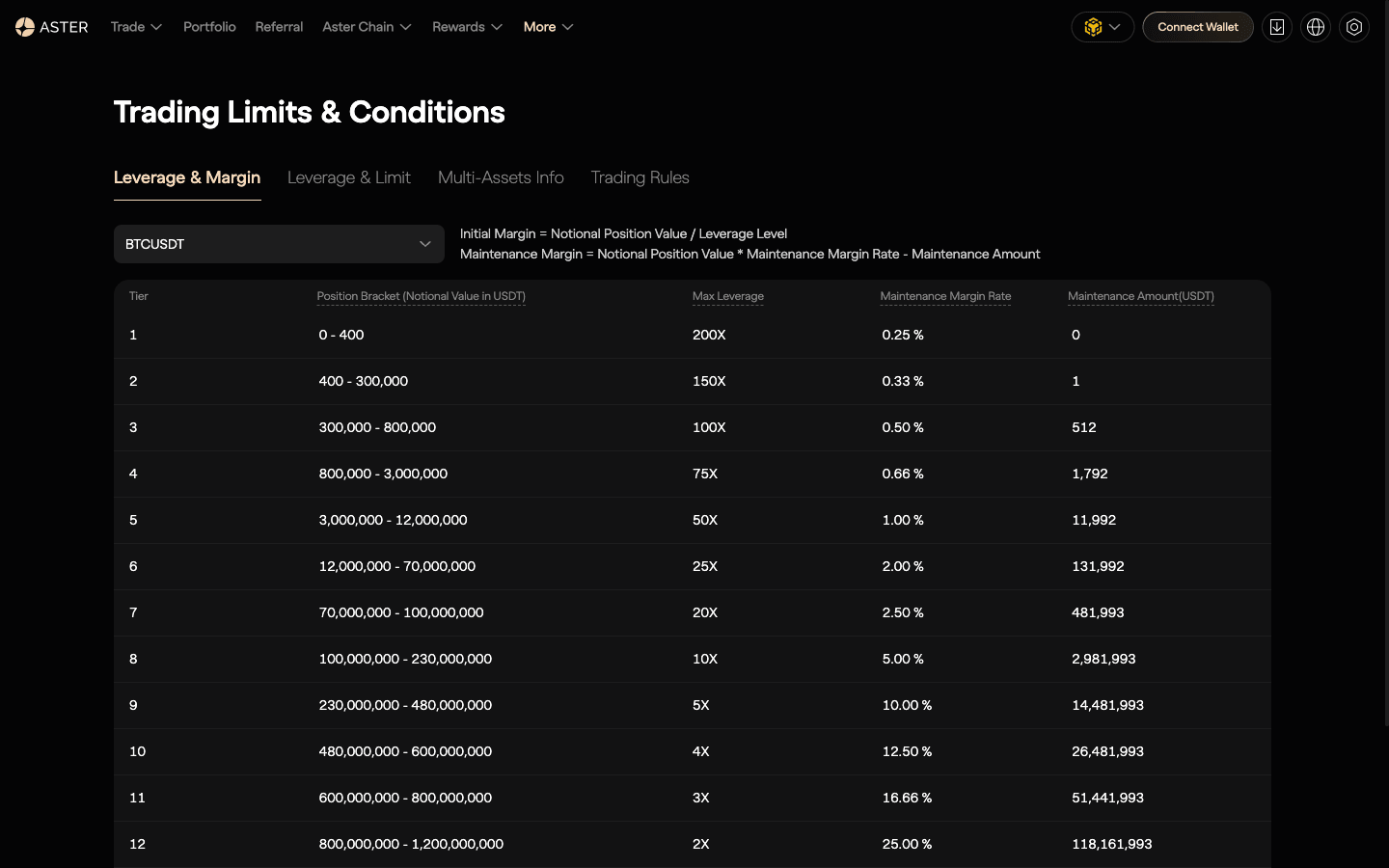
On the Pro order book Aster uses Binance-style leverage brackets: the larger your position's notional value, the lower the maximum leverage and the higher the maintenance margin rate. The trading-rules page says "Aster offers a maximum of 200 leverage", but on BTCUSDT that applies only up to $400 of notional:
| BTCUSDT notional | Max leverage | Maintenance margin rate |
|---|---|---|
| ≤ $400 | 200x | 0.25% |
| ≤ $300,000 | 150x | 0.33% |
| ≤ $800,000 | 100x | 0.5% |
| ≤ $3M | 75x | 0.66% |
| ≤ $12M | 50x | 1% |
| ≤ $70M | 25x | 2% |
| ≤ $100M | 20x | 2.5% |
Further brackets step down to 10x at $230M, 5x at $480M and 1x at $1.8B. ETHUSDT follows the same ladder to $12M.
Other first-bracket limits on September 25, 2026: HYPE 300x up to $1,000, SOL 100x up to $50,000, XRP 100x up to $40,000, BNB and ASTER 200x up to $400, gold (XAUUSDT) 100x up to $50,000 but only 20x on XAUUSD1. Across the 584 symbols trading that day most first brackets were modest: 317 capped at 5x and 133 at 20x (current limits by category: markets and volume, rebuilt on every site build). In practice a $100,000 BTC position gets 150x and a $1M position 75x — still more than Hyperliquid or Lighter, but nothing like the banner number. Margin modes and the 1001x conditions are in the table below.
Margin modes and 1001x conditions
Two settings decide how much of your money backs a Pro position: cross or isolated (which positions share margin) and Single- or Multi-Asset Mode (what counts as margin). Shield and 1001x have fixed rules of their own:
| Mode | What backs the position | Conditions that matter |
|---|---|---|
| Cross (Pro default) | The whole balance and unrealized PnL of other positions | Least likely to liquidate one position, but the whole balance is at risk. With Hedge Mode on, the long and short of a contract share one liquidation price |
| Isolated (Pro) | Only the margin assigned to that position | Add margin to move the liquidation price away, or remove it down to what the position needs. Cross/isolated is chosen before opening and cannot change while a position or open order exists on that contract |
| Single-Asset Mode | USDT or USD1, PnL per position | Works with cross or isolated |
| Multi-Asset Mode | Other assets at a collateral ratio: BTC, ETH and BNB 95%, SOL 90%, ASTER 80%, USDT (also USDC, USDF) 99.99%, USD1 99% | Cross only; PnL netted across positions. Collateral is auto-exchanged when a balance falls below −$10,000, on a liquidation shortfall, or at a loan-to-value of 0.995 with no positions; a negative balance beyond −$1,000 pays hourly interest |
| Shield Mode | Isolated only | Leverage from 20x to 1001x on BTC and ETH; no margin top-ups, no hedge mode |
| 1001x mode | Isolated only, from a wallet on BNB Chain or Arbitrum, against the ALP pool | BTC/USD up to 1001x. From 500x you cannot add margin, the close fee is a share of profit and net ROI is capped (about 300% at 1001x): full 1001x rules |
Sources: Aster docs (cross and isolated margin, Single-Asset & Multi-Asset Mode, Shield Mode, 1001x) and the public assetIndex for collateral ratios (collateral ratio = 1 − bid buffer), read September 27, 2026.
Markets and volume: every Aster pair by category
Aster's public API listed 607 trading perpetual markets (October 20, 2026, 03:53 UTC; quoted in USDT 578, USD1 27, U 2), the longest list of any on-chain venue we track. Grouped by Aster's own tags, which also drive the filters in the market selector (Top, Meme, AI, Stocks, Commodities, ETF, Pre-launch):
| Category | Markets | 24h volume | Share | Max leverage (first bracket) | Busiest |
|---|---|---|---|---|---|
| Top (majors) | 16 | $720.7M | 50.3% | 10x–200x | BTCUSDT, ETHUSDT, SOLUSDT, ASTERUSDT |
| Other crypto | 352 | $59.5M | 4.2% | 3x–300x | HYPEUSDT, QUSDT, BTCUSD1, WLFIUSDT |
| Stocks and ETFs | 130 | $293.3M | 20.5% | 5x–50x | SKHYNIXUSD1, SNDKUSD1, MUUSD1, SPCXUSD1 |
| Commodities | 13 | $336.0M | 23.5% | 20x–100x | XAUUSD1, CLUSD1, CLUSDT, BZUSDT |
| Meme | 56 | $15.6M | 1.1% | 3x–75x | DOGEUSDT, SIRENUSDT, BULLAUSDT, 龙虾USDT |
| AI | 40 | $7.6M | 0.5% | 3x–50x | WLDUSDT, AGTUSDT, PHAUSDT, TAOUSDT |
Aster public futures API (exchangeInfo, ticker/24hr) and leverage-bracket endpoint, rebuilt with every site build (live, October 20, 2026, 03:53 UTC). Untagged crypto markets are grouped as “Other crypto”.
It is top-heavy: 607 markets traded $1.43B in 24 hours, the ten busiest took 84% of it, and 550 traded under $1M. Real-world assets matter on Aster: the USD1-quoted gold, oil and stock perps sit near the top of the volume list. The ten busiest markets:
| # | Market | Category | 24h volume | Max leverage | …up to notional | Funding every |
|---|---|---|---|---|---|---|
| 1 | BTCUSDT | Top (majors) | $357.3M | 200x | $400 | 8h |
| 2 | XAUUSD1 | Commodities | $259.9M | 20x | $1M | 4h |
| 3 | ETHUSDT | Top (majors) | $230.3M | 200x | $400 | 8h |
| 4 | SKHYNIXUSD1 | Stocks and ETFs | $76.8M | 20x | $1M | 4h |
| 5 | SNDKUSD1 | Stocks and ETFs | $73.3M | 20x | $1M | 8h |
| 6 | SOLUSDT | Top (majors) | $59.7M | 100x | $50k | 8h |
| 7 | CLUSD1 | Commodities | $45.7M | 20x | $1M | 4h |
| 8 | MUUSD1 | Stocks and ETFs | $45.1M | 20x | $1M | 8h |
| 9 | ASTERUSDT | Top (majors) | $25.5M | 200x | $400 | 4h |
| 10 | ZECUSDT | Top (majors) | $24.9M | 75x | $100k | 8h |
First-bracket leverage across the whole list. The header number applies only to the smallest positions (see leverage brackets above); most small caps are capped far lower:
| Max leverage (bracket 1) | Markets | Examples (busiest first) |
|---|---|---|
| 300x | 1 | HYPEUSDT |
| 200x | 6 | BTCUSDT, ETHUSDT, ASTERUSDT, BTCUSD1, BNBUSDT, ETHUSD1 |
| 100x | 7 | SOLUSDT, XRPUSDT, CLUSDT, XAGUSDT, XAGUSD1, XAUUSDT, SOLUSD1 |
| 75x | 10 | ZECUSDT, DOGEUSDT, XMRUSDT, SUIUSDT, LTCUSDT, ADAUSDT, BCHUSDT, AVAXUSDT |
| 50x | 37 | SOXLUSD1, SPCXUSDT, BZUSDT, SKHYNIXUSDT, MUUSDT, SOXLUSDT, MSTRUSDT, SNDKUSDT |
| 20x | 142 | XAUUSD1, SKHYNIXUSD1, SNDKUSD1, CLUSD1, MUUSD1, SPCXUSD1, CRCLUSDT, WLFIUSDT |
| 10x | 66 | BNCUSD1, CTUSDT, TIAUSDT, ZROUSDT, BATUSDT, MARSCOINUSDT, CASHCATUSDT, SANDUSDT |
| 5x | 323 | QUSDT, SIRENUSDT, BRUSDT, BTWUSDT, AGTUSDT, PHAUSDT, HUMAUSDT, AVAUSDT |
| 3x | 15 | OUSDT, CARDSUSDT, TROLLUSDT, XCNUSDT, MAXUSDT, 1000NEXUSDT, BREWUSDT, VELOUSDT |
Stock and commodity perps are cash-settled and track a price feed. US stock perps keep trading overnight and at weekends; outside 9:30–16:00 ET, limit orders more than 5% more aggressive than the mark are rejected and market orders fill only within 5% of it, and in thin periods Aster switches to an EWMA-smoothed mark price. Many exist in both USDT and USD1 versions (XAUUSDT and XAUUSD1, CLUSDT and CLUSD1); the USD1 ones cap at 20x but carry most of the volume. Pre-launch markets on private companies (OpenAI, Anthropic) have no external spot price: use low leverage. Taker fees there are 0.0125% against 0.04% on crypto.
Every trading symbol has a $5 minimum notional, but lot sizes matter: the smallest BTCUSDT order is 0.001 BTC. Symbols use Aster's own names: the suffix is the quote asset, and 1000-prefixed tokens (1000PEPE) are 1,000 tokens per contract. How Aster ranks against other venues by volume: the perp DEX ranking; Hyperliquid's list: Hyperliquid markets.
Order types, hidden orders and API
The Pro ticket offers market, limit, stop limit, stop market, trailing stop and post-only orders, with TP/SL on mark or last price, reduce-only, and a BBO button. Strategy orders add TWAP (1 minute to 7 days, up to 30 per account), Scaled (up to 110 sub-orders) and Chase (always post-only, reprices every second). The distinctive one is the hidden order: a limit order that never appears on the book; the resulting position is excluded from public data feeds, so its size, direction and PnL are invisible to outsiders while matching, margin and liquidation work on the full size.
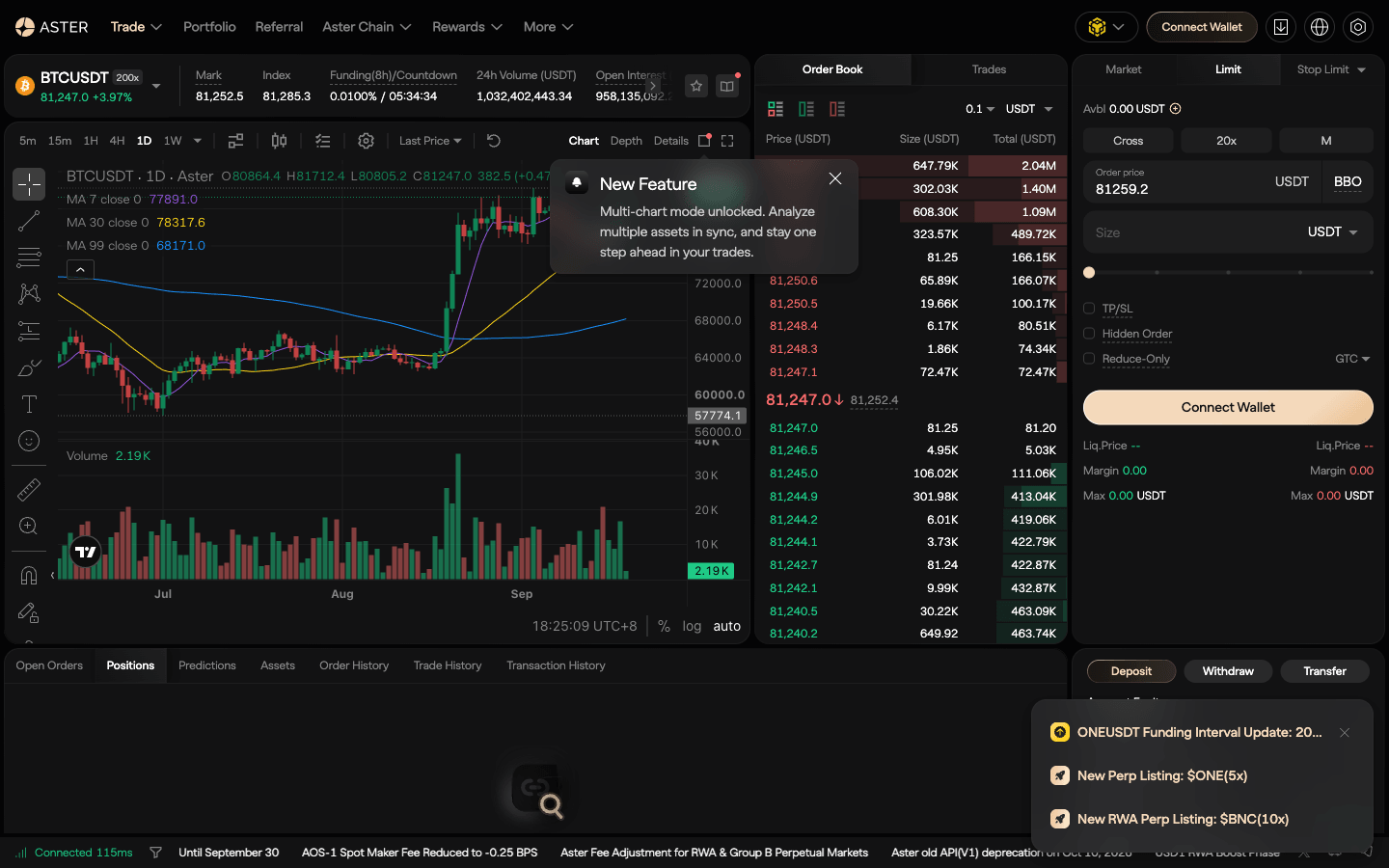
The REST API allows 2,400 request weight and 1,200 orders per minute (300 orders per 10 seconds). A site banner (seen September 25, 2026) announced that the old V1 API (API key + HMAC signature) would be deprecated on October 10, 2026; Aster's official API docs list V1 as "Legacy", and since March 25, 2026 no new V1 API keys can be created (checked October 14, 2026). For a new bot, use V3: an API wallet (agent) approved by your main wallet signs each request with EIP-712, so the bot never holds your main wallet's private key. Since September 1, 2026, authenticated V3 endpoints such as account and orders return error -5050 until the main wallet has made a deposit; public market data needs no deposit. Guides: Aster order types, hidden orders and other hidden features, Aster API.
1001x mode and Shield Mode: the rules that matter
"Up to 1001x" is the headline, but it is a different product: you trade against the ALP pool, not an order book, and the rules change sharply at 500x.
| 1001x market / leverage | Fees | Add margin? | Max net ROI |
|---|---|---|---|
| BTC/USD below 500x | 0.08% open + 0.08% close | Yes | None |
| BTC/USD 500x / 750x | 0% open; close = max(PnL × 15% ÷ notional, 0.03%) | No | ≈ 500% |
| BTC/USD 1001x | 0% open; same PnL-based close fee | No | ≈ 300% |
| ETH/USD up to 250x · other crypto up to 75x | 0.08% open + 0.08% close | Yes | None |
| Forex up to 200x (BNB Chain) | 0.02% open + 0.02% close | Yes | None |
- Execution fee on every open: $0.50 on BNB Chain, $0.20 on Arbitrum — 1% of a $50 margin trade before anything happens.
- Funding is charged every block, so holding a high-leverage 1001x position for hours costs more than the fee table suggests.
- Liquidation distance at 1001x is a small fraction of 1%, and the docs give inconsistent liquidation-loss rates (60%, 85%, 90% on different pages). Treat the whole margin as the stake.
- Limit orders in 1001x can fail to fill even when price touches them (mark not reached, not held long enough, or pool capacity).
Shield Mode is the privacy-first alternative with leverage from 20x to 1001x, a flat 0.03% or 15–20% profit-share fee, hourly funding and automatic close at 50,000 USDT profit on BTC/ETH (3,000 USDT on RWA/stocks). Both modes suit very short, small, defined-risk bets. For anything you plan to hold, use Pro. Pro margin modes and liquidation: margin modes table.
The ASTER token: buybacks, veASTER and staking
ASTER is a BEP-20 token on BNB Chain with a maximum supply of 8 billion. On September 25, 2026 CoinGecko showed about $0.73, a market cap of roughly $1.98B, 2.71B circulating and 7.80B total supply. Allocation per the docs: 53.5% airdrop, 30% ecosystem and community, 7% treasury, 5% team, 4.5% liquidity and listings.
- Buybacks (since June 17, 2026): 99% of daily platform fees flow to a buyback wallet and buy ASTER by TWAP; all of it goes to veASTER stakers as Loyalty Rewards. Every buyback triggers an equal burn from reserve, executed bi-weekly, until total supply reaches 3 billion.
- Staking on Aster Chain: delegate to a validator and choose a lock of up to 208 weeks. Each weekly epoch pays a 150,000 ASTER base pool (by validator transaction share) and a 300,000 ASTER loyalty pool plus the buybacks (by lock weight and trading activity). Exiting early costs a penalty that scales with the remaining lock — the docs' example uses a 60% maximum and 2% minimum.
- Utility on the exchange: 5% off spot fees paid in ASTER (not perps), ASTER balance required for VIP 2+, 80% collateral ratio as margin.
A long lock with a 60%-style early-exit penalty is a serious commitment; do not stake more than you would hold for the full term. Walkthrough: Aster staking guide.
Deposits and withdrawals
Wallet accounts can deposit on six networks: BNB Chain, Ethereum, Arbitrum, Solana, Robinhood and Arc (minimum deposit 0 on every listed asset; you pay the source chain's gas):
| Network | Assets accepted for the perp account |
|---|---|
| BNB Chain | USDT, USD1, BNB, asBNB, lisUSD, WBETH, slisBNB, BTC, ETH, CAKE, LISTA, USDF, ASTER, TWT, USDC, U and 6 stock tokens (BEP-20) |
| Ethereum | USDT, USD1, ETH, USDC, U |
| Arbitrum | ETH, USDC.e, USDT, USDC |
| Solana | USDC, USDT, JLP, SOL, USD1 |
| Robinhood | USDG |
| Arc | USDC |
Source: Aster's public deposit-assets API for the perp account, read September 29, 2026. BTC and ETH on BNB Chain are BEP-20 tokens, not native BTC or ETH; send only a listed asset on its listed network.
Deposits arrive in 1–5 minutes (Ethereum is slower); withdrawals take about 30 seconds after the batch, with gas deducted from the amount. Email-login accounts can only receive USDT on Arbitrum One — anything else must be recovered through a separate retrieval flow at your own gas cost. Connecting a wallet on BNB Chain needs at least 0.001 BNB. A third-party fiat on/off-ramp has been available since February 2026. Screens and fixes: our guide to Aster deposit and withdrawal.
Mobile app and language
The official Android app, "Aster DEX: Access DeFi markets", is on Google Play under the developer name Aster DEX with a link back to asterdex.com: 3.8 stars from 880 ratings, 100K+ downloads, last updated September 24, 2026 (checked September 27). On iPhone, the App Store app "Aster: On-Chain Perps & Spot" (seller Unorex Solutions Corp.) is linked from asterdex.com/en/download, but it is listed in only 13 of the 30 storefronts we checked, not the US, UK or Japan; a TestFlight beta and a direct APK also exist. Install only from the links on asterdex.com/en/download, never an "Aster" app found by store search. The app connects your wallet over WalletConnect (Trust Wallet is the docs' suggestion). The web app works in a phone browser and has a Japanese interface (asterdex.com/ja). Tips: trading Aster on mobile.
Points and airdrop: the Stage 6 claim opens November 4
Aster has run points "stages" since launch, each feeding an ASTER airdrop. Stage 6 "Convergence" ran February 2 – March 29, 2026 in weekly epochs that scored fee and maker contribution, position size and duration, Aster assets used as margin, liquidations and PnL, times a team boost plus referral points. Aster called it the last stage allocated by trading volume. Its airdrop is 64,000,000 ASTER (0.8% of supply) for wallets with at least 10,000 points. Holders chose a vesting option during April 20 – May 2, 2026; the 50%-now option was claimable May 4 – June 4, 2026 (closed), and the 100% vested claim runs November 4 – December 4, 2026 (from 12:00 UTC). Aster's airdrop page still showed these windows when we opened it logged out on October 14, 2026, with 63,379,391.84 ASTER locked until November 4, a supply that can reach the market from that day.
- Claim only on asterdex.com/en/airdrop with the wallet that earned the points. Claiming needs no token approval; any page asking for one is phishing.
- No new trading-volume stage. The "Stardust" programme that followed (March 30 – August 30, 2026) announced no airdrop, so do not size trades for points.
- The invite screen our link opens used to read "Enter your invite code to earn your airdrop" (September 27, 2026); it reads just "Enter your invite code" now. A code places you in a points team; it does not promise tokens.
Every stage, the claim checklist and the unlock schedule: Aster airdrop (Stage 6 claim) guide.
Before you sign up
In short: a code is bound only at your first connection, so open the link before you connect anything. Our Aster referral code DTLpLc gives back 5% of the taker fees you pay on Aster Perps for 365 days; maker fills are already 0%, so nothing changes there. The invite screen, the email route, payout timing and the split we chose are documented with dated screenshots on that page; what the rebate is worth at each fee tier is in our Aster fees guide.
Open an Aster account
Open the link, press Confirm on the invite screen, then connect a wallet or log in with email.
Open Aster →How to start trading on Aster
Open the referral link and connect
Open asterdex.com/en/referral/DTLpLc, click Confirm on the “Enter your invite code” screen, then pick EVM chains or Solana and a wallet or Log in with Email (details in the referral code guide).
Deposit
Choose network and asset and approve in your wallet; the balance appears in a few minutes. Email accounts: USDT on Arbitrum One only.
Trade in Pro first
Set margin mode and leverage (the default is cross 20x), place a limit order to pay 0% maker, and attach TP/SL. Try Shield or 1001x only after reading their fee rules.
Withdraw
Pick network, token and amount; the network fee is deducted. Clear any negative balance in Multi-Asset Mode first.
Screens and pitfalls: Aster perps for beginners.
KYC and restricted countries
Signing up is a wallet connection or email login — no document upload. But Aster's Terms and Conditions (updated February 25, 2026) say in section 2.3: "We may implement limited identity verification procedures". So the accurate statement is "no KYC in the normal sign-up flow", not "never KYC". The Terms prohibit use by persons in the United States, Canada, the United Kingdom, China, North Korea, Russia, Ukraine, Cuba, Iran, Venezuela and Syria, and in sanctioned areas. Japan is not on the perps list, although Aster's separate prediction-markets product lists Japan among its restricted regions. Canada and the UK are where the perp DEXs differ most: Hyperliquid and edgeX exclude only Ontario and do not name the UK (Aster vs other perp DEXs in Canada and the UK). Never use a VPN or other workaround to get around a venue's restrictions. Context: DEX trading without KYC.
Risks and what to watch
- Bracket leverage. The advertised 200x or 1001x applies to tiny positions or a separate pool product; size decides your real maximum.
- Mode confusion. Pro, Shield and 1001x charge differently. The fee in the order ticket is the one that applies.
- Chain maturity. PoSA with no external validators in Phase 1, closed-source core chain code, and bridges secured by 3-of-4 / 2-of-3 validator signatures.
- Collateral. Multi-Asset Mode can leave a negative USDT or USD1 balance after a loss; past −1,000 USD it accrues interest and at −10,000 USD assets are auto-exchanged.
- Incentive dependence. Points stages, promotions and buyback economics change; do not let a campaign drive position size.
- Identity checks. The Terms reserve limited identity verification.
- Phishing. Fake Aster airdrop and allocation sites drain wallets through token approvals; use asterdex.com only and never approve a spend to "claim".
- Operational errors. A mispriced new listing (XPL, September 2025) liquidated traders before Aster reimbursed them; avoid high leverage on freshly listed perps.
Aster vs the alternatives
| Aster | Hyperliquid | Lighter | |
|---|---|---|---|
| Base taker / maker | 0.04% / 0% | 0.045% / 0.015% | 0% / 0% (Standard) |
| Stocks / commodities taker | 1.25 bps | Via HIP-3 builder markets | 0% (Standard) |
| Max leverage BTC | 200x ≤ $400, 150x ≤ $300k; 1001x mode | 40x | 50x, no brackets |
| 24h volume | $1.43B (October 20, 2026, 03:53 UTC) | $4–8B | ≈ $1.7B (September 25, 2026) |
| Privacy | Hidden orders, Account Privacy | Fully public | Public order book |
| Our code | DTLpLc (5% of fees rebated, 365 days) | HOLYGRAIL (4% off first $25M) | 718610TD (Premium week rebated) |
| Review | this page | Hyperliquid review | Lighter review |
If you only open one perp DEX account, make it Hyperliquid through code HOLYGRAIL for the deepest books and a verified 4% discount. Add Aster for zero maker fees, privacy and cheap RWA perps, or Lighter for free taking. Comparisons: Aster vs Hyperliquid, Aster vs Lighter, Aster vs Binance, and the best DEX comparison.
Frequently asked questions
Is Aster DEX safe and legit?
Aster is a real, self-custodial perp DEX with a public team history (it grew out of APX Finance and Astherus), backing from YZi Labs, published audits and a $200,000 Immunefi bug bounty. As of September 27, 2026 we found no report of a hack that drained user funds; the best-known incident was a pricing error on the XPL perp in September 2025, which Aster reimbursed. The risks are elsewhere: Aster Chain is young (Proof-of-Staked-Authority, no external validators in Phase 1, closed-source core contracts), the audits cover vault and yield contracts rather than the order book or the chain, Aster holds no financial licence, and fake Aster sites are common. Use asterdex.com only and trade sizes you could afford to have stuck.
Is Aster DEX good?
For makers, privacy-minded traders and stock or commodity perps, yes: maker fees are 0 at every VIP level, RWA perps cost a flat 1.25 bps taker, and hidden orders keep positions out of public feeds. It is weaker on simplicity (three perp modes with three fee models), on leverage for larger positions (200x on BTC applies only up to $400 of notional) and on track record. Hyperliquid remains the deeper default venue.
Who made Aster DEX and who backs it?
Aster is the merger of two BNB Chain projects: APX Finance (formerly ApolloX, a perp DEX) and Astherus (a yield and liquid-staking protocol). Its changelog says "Astherus & APX have evolved into Aster" (March 2025), and APX holders could swap into ASTER at the September 17, 2025 token launch. Aster's docs describe it as "backed by YZi Labs", the investment firm formerly known as Binance Labs. Binance co-founder Changpeng Zhao (CZ) was reported to have said in an X Space on September 27, 2025 that he advises Aster "on product and tech" only and that the team includes "a couple of ex-Binance people"; those quotes come from news coverage of a live audio session, not a published statement, and reports that YZi Labs holds a minority stake are not confirmed by either party. Aster's docs do not name individual team members.
Why did Aster become so popular?
Three things in late 2025: a large airdrop (53.5% of the ASTER supply is allocated to airdrops, with 704 million tokens claimable at the September 17, 2025 launch), CZ's public support, and eye-catching features such as 1001x leverage and hidden orders. Volume jumped with the airdrop and points campaigns, which is also why some traders questioned how much of it was incentive-driven. In 2026 the story shifted to Aster Chain, privacy and the June 2026 buyback-and-burn upgrade.
What are Aster DEX trading fees?
On the Pro order book, maker fees are 0 at every VIP level. Taker fees are 4.0 bps (0.04%) at VIP 1 for general crypto perps, falling to 1.6 bps at VIP 6, 10 bps at VIP 1 for the 21 "Group B" pairs, and a flat 1.25 bps on RWA perps (stocks, commodities) since September 7, 2026. USD1-quoted crypto perps follow the 0.04% schedule. Spot is 0.005% maker / 0.04% taker, with 5% off spot fees paid in ASTER; Aster's docs describe no ASTER discount on perp fees. There is no gas on trades.
Has Aster DEX been hacked?
We found no report of a protocol hack or smart-contract exploit that drained Aster user funds as of September 27, 2026. In September 2025 a misconfiguration on the newly listed XPL perpetual (an index price left hard-coded from pre-launch testing, according to news reports) pushed its price on Aster to nearly $4 while other markets traded around $1.30, liquidating traders. It was not a hack, and Aster reimbursed affected users in USDT, including trading and liquidation fees. The more common losses come from phishing: fake "Aster airdrop" or "allocation" sites that ask you to approve a token spend. Aster's own TGE docs state that claiming ASTER needs no wallet authorization.
Does Aster require KYC?
The sign-up flow is a wallet connection or an email login, with no identity check. Aster's Terms and Conditions (updated February 25, 2026) nonetheless reserve the right in section 2.3 to implement "limited identity verification procedures", so do not treat "no KYC" as guaranteed. Residents of the US, Canada, the UK, China, North Korea, Russia, Ukraine, Cuba, Iran, Venezuela, Syria and sanctioned areas may not use it at all.
Is 1001x leverage on Aster real? Is it the same as "Simple mode"?
Yes, but only in the 1001x mode on BTC/USD, a separate pool-based product that Aster and older reviews called "Simple Mode" (one-click, MEV-resistant), as opposed to the "Pro" order book. At 500x and above there is no opening fee, you cannot add margin, the close fee is max(PnL × 15% ÷ notional, 0.03%), and net profit is capped at about 500% (500x/750x) or 300% (1001x) of margin. On the Pro order book, BTC tops out at 200x, and only for positions up to $400 of notional.
What chain is Aster on?
Aster Chain, its own Proof-of-Staked-Authority layer-1 (live since March 16, 2026) with 50 ms blocks, up to 100,000 TPS and zero gas. BNB Chain, Ethereum, Arbitrum and Solana are the main deposit and withdrawal rails, and Robinhood Chain and Arc each accept one stablecoin deposit. The ASTER token is a BEP-20 token on BNB Chain, and the 1001x mode's contracts run on BNB Chain and Arbitrum.
What is the ASTER token used for?
ASTER (max supply 8 billion) is used for a spot fee discount (5% off spot fees paid in ASTER; the docs give no such discount on perps), VIP qualification (VIP 2 and above need an ASTER balance), margin collateral at an 80% ratio, and staking on Aster Chain. Since June 17, 2026, 99% of daily platform fees buy back ASTER, which is distributed to veASTER stakers, and an equal amount is burned from reserve until total supply reaches 3 billion.
Does Aster have a mobile app and a Japanese interface?
Yes. The Android app "Aster DEX: Access DeFi markets" is on Google Play under the developer name Aster DEX, linked to asterdex.com (3.8 stars from 880 ratings, 100K+ downloads, updated September 24, 2026). On iPhone, the App Store app "Aster: On-Chain Perps & Spot" (seller Unorex Solutions Corp.) is linked from asterdex.com/en/download but is listed only in some regions (13 of the 30 storefronts we checked, not the US, UK or Japan); a TestFlight beta and a direct APK also exist. The web app has a Japanese interface at asterdex.com/ja. Email-login accounts can only be funded with USDT on Arbitrum One.
Ready to try Aster?
Sign up with DTLpLc: 0% maker on every Pro market, 1.25 bps on RWA perps, no gas.
Want the deepest on-chain books too? Join Hyperliquid with HOLYGRAIL for 4% off.
Disclosure: links on this page use our referral code DTLpLc. Aster pays us a share of referred accounts' trading fees at no extra cost to you; we pass 5% of your fees back to you (split set September 29, 2026; we will update this page if it changes). Figures are as of October 14, 2026 and may change. Perpetual futures — especially at 200x–1001x — are high-risk instruments; this is not investment advice.