
Beyond the base rates. Hyperliquid perp rates fall from 0.045% / 0.015% up to $5M of 14-day volume to 0.024% / 0% above $7B (all fee tiers ↓). Fees are charged on position size, not margin: $1,000 at 10x is a $10,000 position and pays $4.50 per market order (0.45% of your margin). Spot volume counts double toward your tier. HYPE staking: 5–40% off, on top of any referral discount. Growth-mode HIP-3 stock perps: 0.009% taker. Third-party apps add a builder fee of up to 0.1% on perps. Liquidations carry no clearance fee. Work out your own fee →
Hyperliquid fee tiers: taker and maker by 14-day volume
Hyperliquid has seven fee tiers, set by your rolling 14-day weighted volume, assessed at the end of each UTC day (weighted volume = perps + 2 × spot). Tier 1 starts above $5M, so most traders pay the tier 0 rates in the first row. One tier applies to perps, HIP-3 perps and spot.
Which tier am I? Add up your last 14 days of perp volume plus twice your spot volume: at $5M or less you are tier 0 (most traders), and crossing a threshold in the table puts you on the next, cheaper row once the day closes in UTC. Hyperliquid’s Portfolio page shows your 14-day volume.
| Tier | 14-day weighted volume | Perp taker | Perp maker | Spot taker | Spot maker | Perp taker with HYPE staking |
|---|---|---|---|---|---|---|
| 0 | ≤ $5M | 0.045% | 0.015% | 0.070% | 0.040% | 0.0428– |
| 1 | > $5M | 0.040% | 0.012% | 0.060% | 0.030% | 0.0380– |
| 2 | > $25M | 0.035% | 0.008% | 0.050% | 0.020% | 0.0333– |
| 3 | > $100M | 0.030% | 0.004% | 0.040% | 0.010% | 0.0285– |
| 4 | > $500M | 0.028% | 0.000% | 0.035% | 0.000% | 0.0266– |
| 5 | > $2B | 0.026% | 0.000% | 0.030% | 0.000% | 0.0247– |
| 6 | > $7B | 0.024% | 0.000% | 0.025% | 0.000% | 0.0228– |
Source: Hyperliquid docs, trading/fees (checked October 19, 2026). The staking column applies 5% (more than 10 HYPE staked) to 40% (more than 500,000 HYPE); the same discount applies to maker and spot fees. HYPE staking (5–40%, section 6) and a referral code (4%, section 7) multiply on top of these rates; large makers can earn rebates. To turn your tier into a cost per trade, month and year, use the Hyperliquid fee calculator.
Pay 4% less on every Hyperliquid trade
Open Hyperliquid through code HOLYGRAIL: 0.045% becomes 0.0432% taker, 0.015% becomes 0.0144% maker, for your first $25M of volume.
Estimate (all market orders, tier 0, no staking): the code saves about $18 a month at $1M of monthly volume and about $180 a month at $10M, until the discount’s $25M volume cap is used (about 25 months at $1M, 2.5 at $10M): about $450 in total at tier 0.
Open Hyperliquid →We earn a commission when you sign up through our links; it never raises your fees.
1. What are Hyperliquid’s fees? Every fee at a glance
| What you do | What it costs (base tier) | Who receives it |
|---|---|---|
| Perp market order (taker) | 0.045% of notional ($4.50 per $10,000) | Community: HLP, the Assistance Fund (buys and burns HYPE), deployers |
| Perp limit order that rests and fills (maker) | 0.015% ($1.50 per $10,000) | Same |
| Spot taker / maker | 0.070% / 0.040% | Same; HIP-1 deployers can keep a share |
| HIP-3 perp (growth mode) | 0.009% / 0.003% (xyz markets) | Protocol and the market’s deployer |
| HIP-3 perp (normal) | 0.090% / 0.030% (deployer fee scale 1) | Split 50/50 protocol and deployer |
| Placing, changing, cancelling orders | No gas | — |
| Liquidation | No clearance fee; you keep remaining margin | — |
| Funding (hourly) | Varies; baseline 0.00125%/h paid by longs, capped at 4%/h | The other side of the trade, not Hyperliquid |
| USDC deposit | 0.20 USDC CCTP fee from Arbitrum + source-chain gas (min 5 USDC) | Circle’s CCTP forwarder and the source chain |
| USDC withdrawal | 0.2 USDC flat + HyperEVM gas (HYPE, tiny) | The CCTP withdrawal (legacy bridge: $1) |
| Native BTC / ETH / SOL deposit or withdrawal | Network fee only (Unit charges no protocol fee) | Bitcoin / Ethereum / Solana network |
| Trading through a third-party app | Hyperliquid fee + builder fee (max 0.1% perps, 1% spot) | The app (builder) |
Fees are charged on notional, not on margin. Leverage does not change the rate, but it multiplies what the fee means for your account: $1,000 of margin at 10x opens a $10,000 position, pays $4.50 to open with a market order and $4.50 to close, and that 0.90% of margin is gone before the price moves. At the 40x BTC maximum the same round trip is 3.60% of margin. Fees are taken from your USDC balance on each fill. To see what they do to a whole trade (net PnL, ROE and the break-even exit after both fees and funding), use the futures PnL calculator.
Trading through an app costs more. Front-ends such as Based, Liquid, Dexari, Phantom or fomo add a builder fee on top of Hyperliquid's fee (for example +0.025% on Based and +0.05% on Liquid perps; the protocol caps it at 0.1% on perps and 1% on spot). The referral discount also applies to orders placed through apps with a builder code (on Hyperliquid's part of the fee, not the builder fee; mainnet check, October 1, 2026), but apps such as Phantom often set their own Hyperliquid referral code on accounts that have none, so enter a code on Hyperliquid before you start using an app: open app.hyperliquid.xyz/join/HOLYGRAIL with the same self-custody wallet before you connect it to an app (an email or Google sign-up in an app creates a new wallet without the code; Phantom users open the link with their Phantom wallet before first using Phantom’s perps). fomo is different: fomo has no wallet connection (Apple, Google or email only) and creates its own wallet and Hyperliquid account for you, so a Hyperliquid code such as HOLYGRAIL cannot apply there (see our fomo app review). Each app's fee and approval rules are in Hyperliquid builder codes explained.
2. Estimate your Hyperliquid fee: what will your trade cost?
Enter your position size and settings. Rates come from the same registry as the tables on this page (Hyperliquid docs, checked October 19, 2026); the Binance line uses its Regular-user rate on USDT-margined futures (spot for spot).
Your rate0.045% per side
Fee$9.00 (open + close)
As a share of margin0.90% of $1,000.00 at 10x
Same trade on Binance (Regular, USDT-margined)$10.00
With code HOLYGRAIL this trade would cost $8.64 instead of $9.00: −4% on your first $25M of volume.
Join Hyperliquid with HOLYGRAIL →Excludes funding, spread and builder fees. The referral discount stops after $25M of volume. To compare Hyperliquid with Lighter, Aster and other venues on one screen, use the multi-venue DEX fee calculator.
3. What are Hyperliquid’s perpetual fee tiers?
Most traders only ever see tier 0: you need more than $5M of weighted volume in 14 days (about $357,000 a day) to reach tier 1. The full ladder, copied from the official schedule:
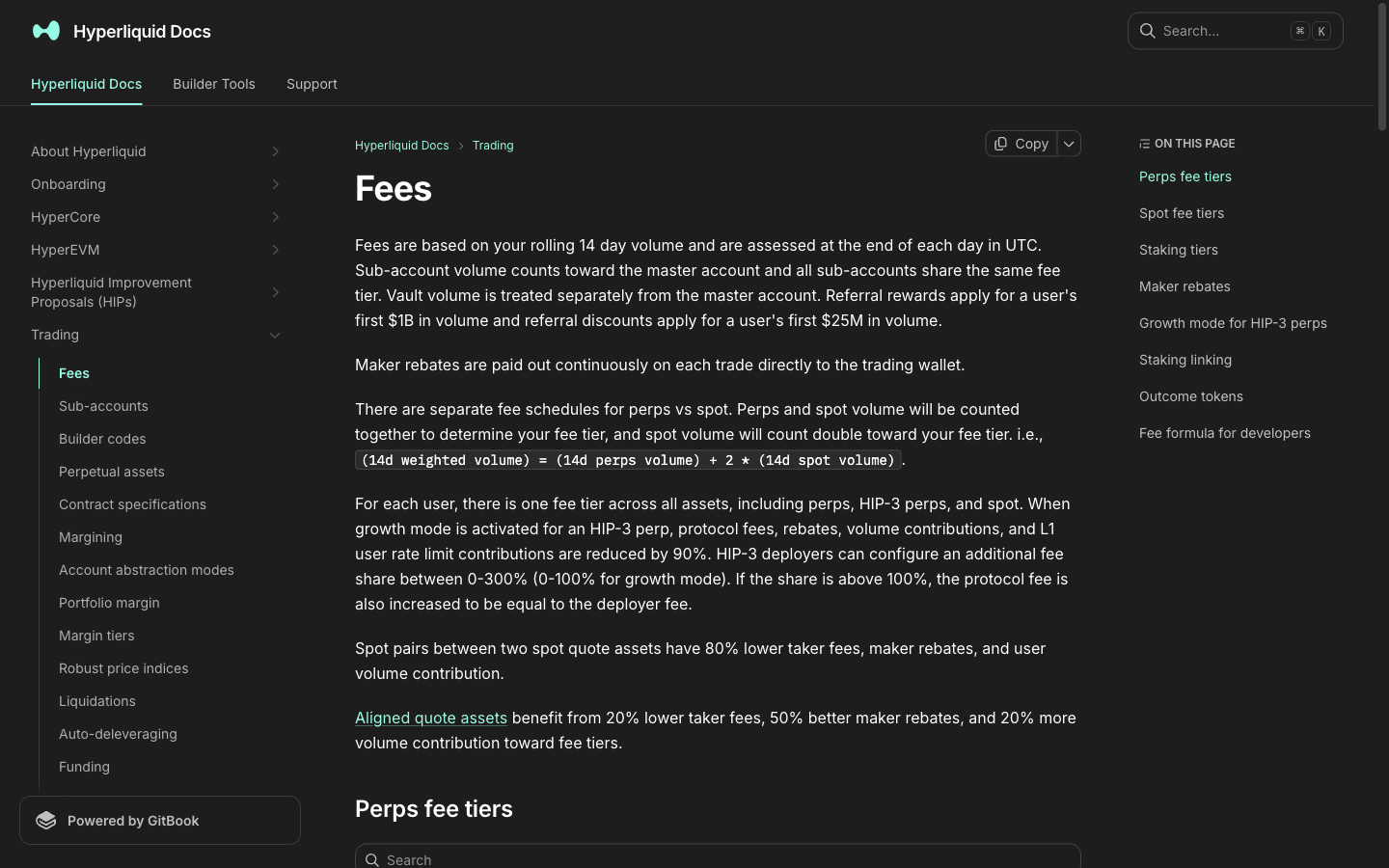
| Tier | 14-day weighted volume | Taker | Maker |
|---|---|---|---|
| 0 | ≤ $5M | 0.045% | 0.015% |
| 1 | > $5M | 0.040% | 0.012% |
| 2 | > $25M | 0.035% | 0.008% |
| 3 | > $100M | 0.030% | 0.004% |
| 4 | > $500M | 0.028% | 0.000% |
| 5 | > $2B | 0.026% | 0.000% |
| 6 | > $7B | 0.024% | 0.000% |
Source: Hyperliquid docs, trading/fees (checked October 19, 2026). These rates apply to all validator-operated perps (178 live markets on October 20, 2026, including BTC, ETH, SOL and HYPE).
For scale: a $10,000 market order costs $4.50 at tier 0 and $2.40 at tier 6. The same $10,000 as a resting limit order costs $1.50 at tier 0 and nothing from tier 4. The maker rate is a third of the taker rate at tier 0, so the order type you choose matters more than the tier for anyone trading less than $5M a fortnight.
How to check your rate and the fees you paid
- Your current rate: the order form shows a Fees line with your taker / maker rate (it reads 0.0450% / 0.0150% at tier 0). Developers can query rates and daily volumes with the
userFeesinfo request. - What you actually paid: the Trade History tab lists every fill with a Fee column; Export as CSV saves it for your records or tax return.
- Before you trade: the estimate above, the full Hyperliquid fee calculator (per month and year, with app builder fees) or our DEX fee calculator.
4. How does the 14-day weighted volume work?
- Formula:
14d weighted volume = 14d perp volume + 2 × 14d spot volume. $1M of spot counts as $2M toward your tier. - Timing: assessed at the end of each UTC day on a rolling 14-day window (not at each fill), so a burst of volume lifts your tier the next day and drops out two weeks later.
- One tier for everything: the same tier applies to perps, HIP-3 perps and spot, each with its own rate table.
- Sub-accounts add their volume to the master account and share its tier (sub-accounts guide). Vaults are counted separately.
- Discounted volume counts less: growth-mode HIP-3 markets and stablecoin-to-stablecoin spot pairs contribute only 10% and 20% of their volume respectively.
5. How much are Hyperliquid spot fees?
| Tier | 14-day weighted volume | Spot taker | Spot maker |
|---|---|---|---|
| 0 | ≤ $5M | 0.070% | 0.040% |
| 1 | > $5M | 0.060% | 0.030% |
| 2 | > $25M | 0.050% | 0.020% |
| 3 | > $100M | 0.040% | 0.010% |
| 4 | > $500M | 0.035% | 0.000% |
| 5 | > $2B | 0.030% | 0.000% |
| 6 | > $7B | 0.025% | 0.000% |
- Pairs between two spot quote assets (stablecoin swaps such as USDT0/USDC) have 80% lower taker fees, maker rebates and volume contribution. A $10,000 stablecoin swap costs about $1.40 instead of $7.00.
- Aligned quote assets (stablecoins that share reserve yield with the protocol) give 20% lower taker fees, 50% better maker rebates and 20% more volume contribution on pairs quoted in them.
- Fees collected in a HIP-1 token (the base side of its USDC pair) go to that token’s deployer by default (100%). The deployer can lower that share but never raise it again, and the part not sent to the deployer is burned.
More on buying spot, Unit assets and minimum order sizes in the Hyperliquid spot trading guide. Per-pair perp minimums and how they compare with Lighter and Aster: Hyperliquid minimum order size.
6. How much does HYPE staking cut your fees?
Staking HYPE (the Staking tab, app.hyperliquid.xyz/staking) gives a percentage discount on top of your volume tier. It applies to both taker and maker fees.
| Staking tier | HYPE staked | Fee discount |
|---|---|---|
| Wood | > 10 | 5% |
| Bronze | > 100 | 10% |
| Silver | > 1,000 | 15% |
| Gold | > 10,000 | 20% |
| Platinum | > 100,000 | 30% |
| Diamond | > 500,000 | 40% |
The official schedule publishes the resulting rates. Perp taker fees (%) by volume tier and staking tier:
| Tier | Base | Wood | Bronze | Silver | Gold | Platinum | Diamond |
|---|---|---|---|---|---|---|---|
| 0 | 0.045 | 0.0428 | 0.0405 | 0.0383 | 0.0360 | 0.0315 | 0.0270 |
| 1 | 0.040 | 0.0380 | 0.0360 | 0.0340 | 0.0320 | 0.0280 | 0.0240 |
| 2 | 0.035 | 0.0333 | 0.0315 | 0.0298 | 0.0280 | 0.0245 | 0.0210 |
| 3 | 0.030 | 0.0285 | 0.0270 | 0.0255 | 0.0240 | 0.0210 | 0.0180 |
| 4 | 0.028 | 0.0266 | 0.0252 | 0.0238 | 0.0224 | 0.0196 | 0.0168 |
| 5 | 0.026 | 0.0247 | 0.0234 | 0.0221 | 0.0208 | 0.0182 | 0.0156 |
| 6 | 0.024 | 0.0228 | 0.0216 | 0.0204 | 0.0192 | 0.0168 | 0.0144 |
Source: Hyperliquid docs, perps fee tiers table (checked October 19, 2026). Maker at tier 0: 0.015% base, 0.0143% Wood, 0.0135% Bronze, 0.0128% Silver, 0.0120% Gold, 0.0105% Platinum, 0.0090% Diamond.
Is staking worth it for fees alone? Bronze (more than 100 HYPE, about $9,300 at the September 25, 2026 price of roughly $93) saves 0.0045 percentage points on every taker trade: $45 per $1M of volume. A trader doing $2M a month saves about $90 a month.
The catches:
- Price risk: the HYPE you stake can fall by more than the fees you save.
- Lock-ups: a delegation is locked for 1 day, and moving HYPE from staking back to your spot balance goes through an unstaking queue of 7 days (at most 5 pending withdrawals per address).
- Rewards are modest: validators showed a predicted staking APR of about 2.0–2.2% a year after commission, with 440.9M HYPE staked (API, September 26, 2026). The docs set the reward rate inversely proportional to the square root of total stake. More in the staking guide.
Staking linking: if you keep HYPE in a cold wallet, you can permanently link it as a “staking user” to your trading address. The docs warn that linking cannot be undone and that the staking user can move all funds out of the trading user, so only link two addresses you control. Nothing is needed if you stake from the address you trade with.
7. How much does a referral code save? 4% off your first $25M
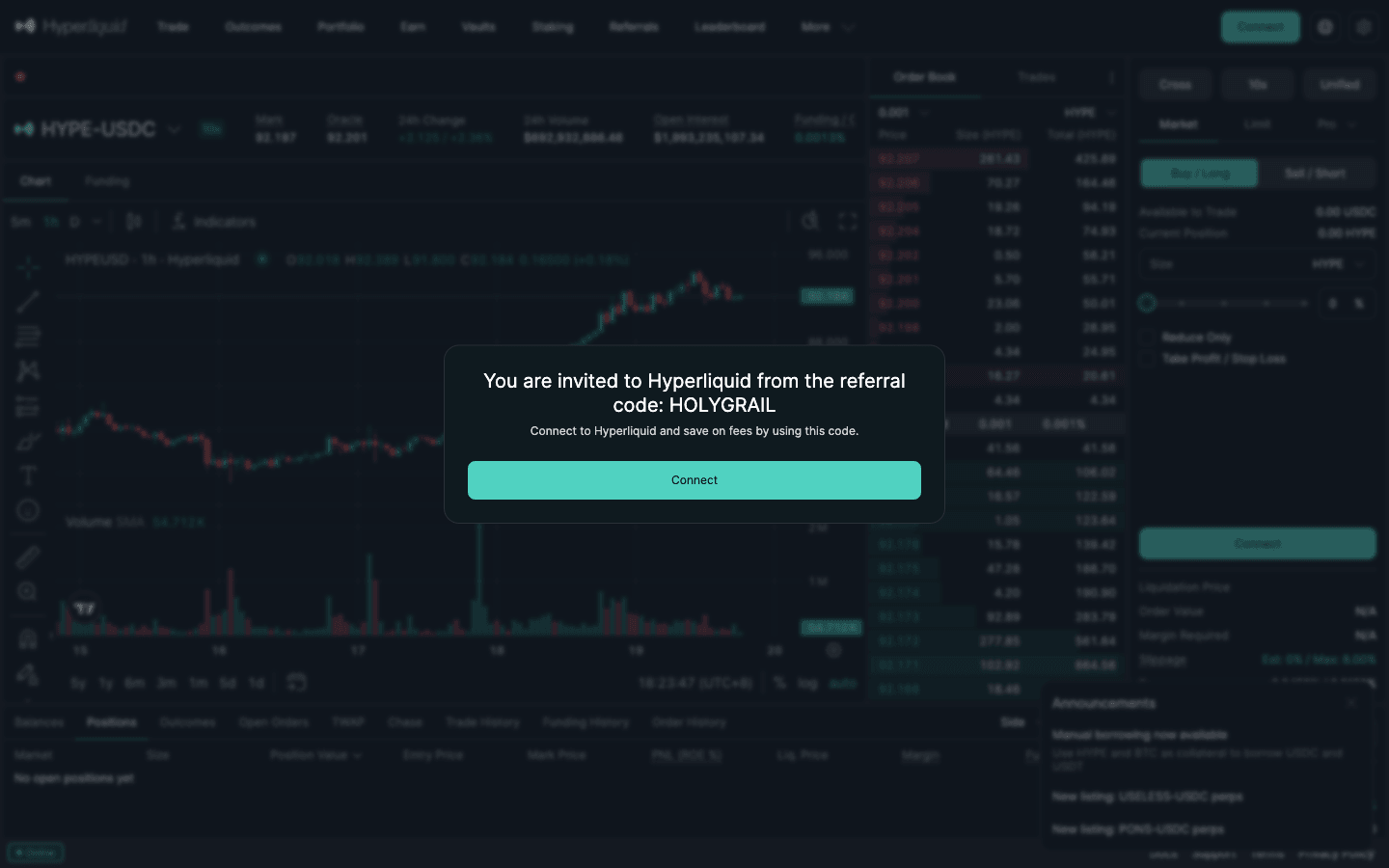
An account that uses a referral code gets 4% off its trading fees for its first $25M of volume. You can open a join link (for ours, app.hyperliquid.xyz/join/HOLYGRAIL) or type a code on the Referrals page (app.hyperliquid.xyz/referrals). Set it up before you start trading so none of your early volume misses the discount. It does not apply to vaults or sub-accounts, which the clearinghouse treats as independent accounts.
The discounts multiply. Rate = tier rate × (1 − staking discount) × (1 − 0.04):
- Tier 0, no staking, referral: 0.045% × 0.96 = 0.0432% taker, 0.0144% maker.
- Tier 0, Bronze, referral: 0.0405% × 0.96 = 0.0389%.
- Tier 0, Gold, referral: 0.036% × 0.96 = 0.0346%, below the undiscounted tier 2 rate.
The referrer (us, for HOLYGRAIL) receives 10% of your fees net of your discount; that never changes the rate you pay. Full details: Hyperliquid referral code HOLYGRAIL.
8. Hyperliquid maker rebates: who gets paid to trade?
Only makers who supply a large share of the exchange’s liquidity: they are paid instead of charged. The threshold is your share of all 14-day weighted maker volume:
| Rebate tier | Share of 14-day maker volume | Maker fee |
|---|---|---|
| 1 | > 0.5% | −0.001% (you receive) |
| 2 | > 1.5% | −0.002% |
| 3 | > 3.0% | −0.003% |
Rebates are paid continuously to the trading wallet on each fill. With perp volume around $4B in the 24 hours to 03:53 UTC on October 20, 2026, 0.5% of the exchange’s maker flow means hundreds of millions of dollars every two weeks: a professional market-maker tier. More in the maker rebate strategy guide.
9. Are HIP-3 stock perps cheaper? Growth mode explained
HIP-3 perps are markets deployed by third parties who stake 500,000 HYPE, such as the stock, index and commodity perps on trade.xyz. They use your normal fee tier, staking discount and referral discount, then apply the deployer’s settings:
- Deployer fee share: 0–300% (0–100% in growth mode). With the common setting of 1.0 (100%), the fee is twice the validator-perp fee, split 50/50 between the protocol and the deployer: 0.090% taker / 0.030% maker at tier 0.
- Growth mode cuts all-in fees, rebates and volume contribution by at least 90%, so the baseline taker rate is 0.0045–0.009%. On xyz markets (deployer fee scale 1.0) that is 0.009% taker / 0.003% maker. Growth mode is only allowed for markets disjoint from crypto (not crypto perps, crypto baskets or gold, which PAXG already tracks), and it has a 30-day cooldown per asset.
- Live check (API, September 25, 2026): 109 live xyz markets, 104 of them in growth mode (for example XYZ100, TSLA, NVDA). xyz:GOLD is not, so it pays the 0.090% rate.
The fee line in the order form always shows the market’s actual rate, so check it before trading a HIP-3 asset. Our trade.xyz guide covers the stock perps themselves.
10. Hyperliquid priority fees: what they cost and who pays them
Short answer: unless you send API orders with a priority rate, you pay no priority fee. Priority fees are optional payments in HYPE that latency-sensitive traders and market makers attach to orders to be processed sooner; the docs call them an advanced feature for latency-sensitive users. They do not change your maker/taker rate. Every priority fee is burned, according to the docs.
| Priority type | What you pay | What it buys |
|---|---|---|
| Order priority on IOC (immediate) orders | A rate you choose, charged on the filled notional from your undelegated staked HYPE | About 45 ms earlier in the mempool ordering per basis point, versus lower-priority orders (the docs' empirical estimate), linear up to 8 bps; from 8 bps to 100% it only breaks ties between orders in the same 70 ms window |
| Order priority on ALO (post-only) orders | A rate on the resting notional, charged when the order is placed, filled or not | A place ahead of zero- or lower-priority orders at the same price placed within the last 400 ms |
| Gossip (read) priority | A HYPE bid from spot balance in two Dutch auctions every 3 minutes (minimum 0.1 HYPE) | About 25 ms faster market data per auction slot for one node IP |
Source: Hyperliquid docs, for-developers/api/priority-fees (checked October 14, 2026). Order priority works only for IOC or non-reduce-only ALO orders, not on outcome markets.
What it costs in dollars: the rate applies to notional like a normal fee. One basis point on a $10,000 IOC fill is $1.00 in HYPE; the 8 bps top of the linear range is $8.00, on top of the $4.50 taker fee, and moves the order up to roughly 360 ms ahead of zero-priority orders in the mempool ordering (not 360 ms off your total latency). Cancels are always processed before any immediately executable order, priority or not, so market makers can still pull stale quotes. Node operators can read the IOC priority fee paid on each fill from the node's fills file (field priorityGas).
For a normal trader the levers that matter are your fee tier, maker orders, staking and a referral code; priority fees are a tool for API traders competing on speed. For order routing and latency in practice, see DEX execution speed and fill quality compared and the Hyperliquid API guide.
Trade at the official rate, minus 4%
The official web app has no builder fee. Join with HOLYGRAIL and your first $25M costs 4% less on perps, spot and HIP-3.
11. How does Hyperliquid funding work? Not a fee, but a cost
Funding keeps the perp price close to the spot oracle. On Hyperliquid it is paid every hour (CEXs usually settle every 8 hours), peer to peer: Hyperliquid collects nothing. The formula is F = average premium + clamp(interest − premium, −0.05%, +0.05%) on an 8-hour basis, paid at one-eighth each hour. The interest component is fixed at 0.00125% per hour (0.01% per 8 hours, 11.6% APR paid to shorts when the premium is zero), and the rate is capped at 4% per hour for every asset.
The payment is position size × oracle price × funding rate, settled on the position you hold at each hourly mark. A trade opened and closed between two marks therefore pays no funding at all; a position held for a week goes through 168 settlements.
What that meant in practice, from the API for the 30 days to September 25, 2026:
| Market | Hyperliquid 30-day funding | Cost to a $10,000 long | Binance (same 30 days) | Bybit |
|---|---|---|---|---|
| BTC | 0.7664% | $76.64 | 0.5421% | 0.4421% |
| ETH | 0.8277% | $82.77 | 0.3804% | 0.3521% |
| SOL | 0.5998% | $59.98 | 0.2320% | 0.0533% |
Sources: Hyperliquid fundingHistory (720 hourly rates each), Binance fapi/v1/fundingRate and Bybit v5/market/funding/history (90 eight-hour rates each), fetched September 25, 2026.
Two lessons. First, for a position held more than a few days, funding costs more than trading fees: the BTC long above paid $76.64 in funding against $9.00 for a taker round trip. Second, Hyperliquid funding sat above the big CEXs in this window, because 72% of BTC hours were exactly at the 0.00125% baseline while CEX rates drifted lower. Shorts received that difference. The rate is shown next to the countdown in every market header, and the official funding comparison page sets it against Binance and Bybit; see Hyperliquid funding rate explained.
12. What does Hyperliquid charge for deposits and withdrawals?
- USDC deposits (Arbitrum, Ethereum, Base or Polygon, arriving as USDC on HyperCore): Hyperliquid itself charges nothing, but the app’s Circle CCTP deposit route deducts a 0.20 USDC forwarding fee from Arbitrum (about 0.24 USDC from Ethereum or Base), and you pay the source chain’s gas. Minimum 5 USDC; smaller deposits can be lost. Deposit guide.
- USDC withdrawals: 0.2 USDC flat, deducted from the amount, plus a tiny HyperEVM gas fee in HYPE, on the Circle CCTP route the app has used since late September or early October 2026 (October 15, 2026). The app says withdrawals arrive within 5 minutes. Guides quoting $1 describe the legacy Arbitrum bridge, which the docs now call deprecated. The fee is fixed, so one $5,000 withdrawal costs the same as one $50 withdrawal. Withdrawal guide.
- Native BTC, ETH, SOL, ZEC, AVAX, MON, XPL go through Unit: no protocol fee, only the network fees of the chains involved. Minimums apply (0.0003 BTC, 0.007 ETH, 0.12 SOL).
- Trading actions are gasless: orders, cancels, funding and liquidations need no gas. Liquidations go to the order book first and carry no clearance fee.
- HyperEVM transactions pay gas in HYPE; moving tokens between HyperCore and HyperEVM also uses HYPE gas.
- Phantom users: Phantom does not support Arbitrum, so the docs suggest selling a little SOL for USDC to cover the withdrawal fee or importing the key into a wallet like Rabby.
- Vaults: HLP takes no leader commission (0 in the vault API) and has a 4-day lock-up after each deposit. Leaders of user vaults take a 10% profit share.
13. Worked examples with real numbers
A. First trade: $5,000 BTC position held one day
- Open and close with market orders at tier 0: 0.045% × $5,000 × 2 = $4.50 (with HOLYGRAIL: $4.32).
- Funding for 24 hours at the baseline: $5,000 × 0.00125% × 24 = $1.50 (paid by a long).
- One withdrawal: $0.20 (plus a fraction of a cent of HyperEVM gas).
- Total: $6.20, or $6.02 with the referral discount. Using limit orders for both legs cuts the trading part to $1.50 ($1.44).
B. Active trader: $3M of perp volume a month
That is about $1.4M per 14 days, so tier 0. Assume 60% taker, 40% maker:
- No discounts: $1.8M × 0.045% + $1.2M × 0.015% = $810 + $180 = $990 a month.
- With a referral code: $990 × 0.96 = $950.40 (saves $39.60).
- With Bronze staking and a referral code: $990 × 0.90 × 0.96 = $855.36 (saves $134.64 a month).
- Shifting the mix to 30% taker / 70% maker at the same discounts: ($900k × 0.045% + $2.1M × 0.015%) × 0.864 = $622.08.
C. Stock perp on trade.xyz: $5,000 of TSLA
xyz:TSLA is in growth mode: 0.009% × $5,000 × 2 = $0.90 round trip, versus $4.50 for the same notional on BTC and $9.00 on a non-growth HIP-3 market such as xyz:GOLD.
D. The same BTC trade through a mobile app
Through an app with a 0.025% builder fee: (0.045% + 0.025%) × $5,000 × 2 = $7.00 instead of $4.50. Through one at 0.10%: $14.50.
14. Hyperliquid fees vs Binance, Bybit, Lighter, Aster
At the entry tier Hyperliquid is cheaper than Binance’s standard USDT-margined futures and Bybit on both sides, Lighter’s Standard account is cheaper still (it charges nothing but delays taker orders and cancels), and Aster’s crypto perps are slightly cheaper than Hyperliquid at 0.04% taker / 0% maker. A $10,000 market-order round trip costs $9.00 on Hyperliquid, or $8.64 with code HOLYGRAIL:
| Venue | Taker / maker | $10k taker round trip | Top tier | KYC |
|---|---|---|---|---|
| Hyperliquid Hyperliquid review → | 0.045% / 0.015% | $9.00 ($8.64 with HOLYGRAIL) | 0.024% / 0% (tier 6); 0.0144% taker with Diamond staking | No |
| Binance USDⓈ-M Hyperliquid vs Binance → | 0.050% / 0.020% | $10.00 ($9.00 paying in BNB) | 0.017% / 0% (VIP 9) | Yes |
| Bybit Hyperliquid vs Bybit → | 0.055% / 0.020% | $11.00 | 0.030% / 0% (Supreme VIP) | Yes |
| Lighter Hyperliquid vs Lighter → Lighter review → | 0% / 0% Standard; 0.028% / 0.004% Premium | $0 Standard, $5.60 Premium | No volume tiers; up to 30% off Premium by staking LIT | No |
| Aster (crypto perps) Aster vs Hyperliquid → Aster review → | 0.04% / 0% | $8.00 | 0.016% / 0% (VIP 6) | No |
Binance futures fee page (USDT-margined) and Bybit fee page (Perpetual & Futures tab), Lighter and Aster docs; dates in the registry notes behind each rate (October 15, 2026 for Binance, October 19, 2026 for Lighter, October 19, 2026 for Aster). Hyperliquid looks at 14-day volume for its tiers, Binance at 30 days; Hyperliquid and Lighter settle funding hourly, Binance and Bybit every 8 hours on BTC.
Hyperliquid fees vs Binance
Verdict: against Binance’s standard USDT-margined futures, Hyperliquid is cheaper on both sides of the book at retail volume; from Binance VIP 2 upward, Binance wins on taker fees and Hyperliquid’s maker fee stays equal or lower. A Regular Binance futures account pays 0.050% taker / 0.020% maker; Hyperliquid charges 0.045% / 0.015%. On a $10,000 taker round trip that is $10.00 on Binance against $9.00 on Hyperliquid, or $8.64 with a referral code. Paying Binance fees in BNB brings its taker rate to 0.045%, level with Hyperliquid’s base rate, but still above the 0.0432% you get with a code. For Bybit, OKX, Coinbase, Uniswap and the other perp DEXs side by side, see our CEX vs DEX fees comparison.
- Mid tiers: Binance VIP 2 ($10M of 30-day volume and at least 25 BNB) pays 0.040% taker / 0.016% maker. The same volume is under $5M per 14 days on Hyperliquid, so still tier 0: Binance is cheaper for takers there, Hyperliquid for makers. Further up the ladder the pattern mostly holds: at comparable volume Binance’s taker rate is equal or lower, while Hyperliquid’s maker rate is equal or lower and reaches 0% from tier 4. HYPE staking narrows the taker gap (Gold, 20% off, puts tier 0 at 0.036%).
- Top tiers: Binance VIP 9 charges 0.017% taker and 0% maker, but needs $25B of 30-day volume plus 5,500 BNB. Hyperliquid tier 6 ($7B of 14-day volume) is 0.024% / 0%, or 0.0144% taker with Diamond staking.
- USDC-margined contracts: Binance’s USDC-margined futures run a promotional 0.040% taker / 0% maker for Regular users (fee page, checked October 14, 2026). While it lasts, that undercuts Hyperliquid’s base 0.045% / 0.015% on both sides, though only on the pairs Binance lists with USDC margin.
- Tier windows: Hyperliquid looks at 14 days, Binance at 30, so a volume burst moves your Hyperliquid tier faster, and it also drops out faster.
- Withdrawals: Hyperliquid charges 0.2 USDC plus a tiny HyperEVM gas fee; Binance charged 0.6 USDC to withdraw USDC on Arbitrum (its public network API, October 15, 2026). Either way that is noise next to trading fees, so compare the trading fee and funding, not the withdrawal fee.
- Funding: Hyperliquid settles hourly, Binance every 8 hours on BTC, and in the 30 days to September 25, 2026 Hyperliquid funding cost longs more (table in section 11).
- Custody and KYC: Binance holds your funds and requires identity verification; Hyperliquid is self-custodial with no KYC.
Hyperliquid is also cheaper than Bybit at the entry tier. Lighter’s Standard account is free but adds 300 ms to taker orders and cancels (maker orders are not delayed); if zero fees matter more to you than speed, open it through our Lighter link (code 718610TD) and read our Lighter fees guide. Aster’s 0% maker beats Hyperliquid for passive flow. What Hyperliquid adds for the fee is depth: BTC perps traded about $3.8B in the 24 hours to 08:00 UTC on September 25, 2026, with a $1 spread (about 0.12 bp) in our order-book snapshot that morning. Detailed match-ups: Hyperliquid vs Binance, vs Bybit, vs Lighter, vs Aster, DEX vs CEX fees and the eight-venue table in lowest-fee DEXs.
15. Funded accounts and prop firms on Hyperliquid
Hyperliquid itself does not offer funded accounts. Hyperliquid's docs describe no funded-account or prop-trading program (full docs searched October 19, 2026), and every Hyperliquid account trades its own deposit. A “Hyperliquid funded account” is sold by a third-party prop firm that prices simulated trades on Hyperliquid’s markets (and may copy some of them on-chain for its own account). Here is what one costs, from the published rulebook of one such firm, Propr (propr.xyz, read October 19, 2026; not a partner of ours):
| What you pay or must do | Propr (Hyperliquid perps) |
|---|---|
| Evaluation fee | One-time, $25 to $1,998 depending on account size and rules; $275 for a $25,000 Classic 1-Step account; not refundable once activated |
| Rules to pass (Classic 1-Step) | 10% profit target, 3% maximum daily loss, 6% maximum drawdown, no time limit |
| Trading fees | Standard Hyperliquid maker/taker fees, passed through at cost and deducted from the account balance |
| Your share | 80% of the gains on the funded account, up to $300,000 of funded capital across accounts |
| Identity check | A one-time KYC check before the funded account |
The catch: every Propr account, funded accounts included, is simulated; Propr decides whether to copy a trade to Hyperliquid, and that position belongs to Propr. Payouts are rewards for simulated results, not profits from a Hyperliquid account you own. Propr’s own disclosures add that most participants do not pass and that it is not authorised or regulated by any financial authority.
Fees use up the loss limit quickly. On a $25,000 account the 3% daily loss limit is $750. One $25,000 market-order round trip at Hyperliquid’s base taker rate of 0.045% costs $22.50, which is 3% of that day’s allowance. At 10x ($250,000 of notional) the round trip costs $225, or 30% of the allowance. Limit orders at the 0.015% maker rate cost a third as much.
No referral or staking discount: the fees are charged on the firm’s account, so there is no Hyperliquid account of yours for a referral code or staked HYPE to apply to.
The on-chain alternative: run a Hyperliquid vault
Hyperliquid’s own way to trade other people’s money is a vault. Anyone can create one with at least 100 USDC. Creation costs a 10,000 USDC gas fee, which is distributed like trading fees. The leader must keep at least 5% of the vault at all times and receives 10% of the profits. These rules come from the docs for legacy HyperCore vaults, which trade validator-operated perps only. Depositors can withdraw after a 1 day lock-up, so a vault gives you no fixed allocation the way a prop firm’s funded account does. More in the Hyperliquid vaults guide. If you would rather trade your own capital at a size you can afford, open an account with code HOLYGRAIL: you pay 0.0432% taker / 0.0144% maker on your first $25M of volume.
16. Where do Hyperliquid’s fees go? How Hyperliquid makes money
On most exchanges the fee is the company’s revenue. Hyperliquid’s docs say its fees are “entirely directed to the community”:
- HLP, the protocol’s market-making vault, whose depositors share its profit and loss (vaults guide).
- The Assistance Fund at the system address
0xfefe…fefe, which converts trading fees to HYPE automatically as part of L1 execution. HYPE in the fund is burned, removed permanently from circulating and total supply. - Deployers: spot and HIP-3 deployers may keep up to 50% of the trading fees their markets generate.
No team treasury takes a cut of trading fees. For the size of that flow, DefiLlama counted $75M of Hyperliquid fees in the 30 days to September 25, 2026 and $914M over the previous 12 months (DefiLlama fees and revenue dashboard). The fee rates on this page are what each trade pays; those dashboards show what all trades together paid.
17. How to pay the least on Hyperliquid
- Use a referral code from day one: 4% off both sides until $25M, at no cost.
- Post limit orders (Post Only / ALO if you want to guarantee maker): 0.015% instead of 0.045%.
- Trade on the official web app when you can, to avoid builder fees.
- Stake HYPE if you already hold it: Wood (more than 10 HYPE) is 5% off, Bronze 10%.
- Keep volume in one master account. Sub-accounts share the tier; a second wallet starts from zero.
- Mind funding on multi-day holds; it usually outweighs the trading fee.
- Size leverage with fees in mind: the fee is on notional, so at 10x a taker round trip is 0.90% of margin.
- Batch withdrawals: the 0.2 USDC fee is flat.
18. FAQ
What are Hyperliquid’s trading fees?
Perpetuals cost 0.045% taker and 0.015% maker at the base tier; spot costs 0.070% taker and 0.040% maker. A $10,000 market order on a perp therefore costs $4.50 and a $10,000 limit order that fills as maker $1.50. Rates fall in seven tiers based on 14-day weighted volume (down to 0.024% / 0% on perps above $7B). HYPE staking takes 5–40% off and a referral code takes 4% off your first $25M of volume. Orders pay no gas. (Hyperliquid docs, checked October 19, 2026.)
What are the fees for Hyperliquid Priority?
Hyperliquid priority fees are optional: an order pays one only if it is sent with a priority rate, which the docs describe as an advanced feature for latency-sensitive users, and it does not change your maker/taker rate. On IOC orders it is a rate they choose, charged on the filled notional from undelegated staked HYPE; up to 8 bps, each basis point moves the order about 45 ms ahead in the mempool ordering (the docs' empirical estimate), so 8 bps on a $10,000 fill costs $8.00 and puts the order up to roughly 360 ms ahead of zero-priority orders. On post-only (ALO) orders it is charged on the resting notional when the order is placed and buys queue position among orders placed in the last 400 ms. Faster market data is sold separately in gossip auctions (two Dutch auctions every 3 minutes, minimum 0.1 HYPE). All priority fees are burned. (Hyperliquid docs, checked October 14, 2026.)
Are Hyperliquid fees charged on margin or on position size?
On position size (notional). Opening $10,000 of BTC with $1,000 of margin at 10x pays 0.045% of $10,000, which is $4.50, or 0.45% of the margin you posted. A market-order round trip at 10x therefore costs 0.90% of margin, and at the 40x BTC maximum 3.60%.
How are Hyperliquid fee tiers calculated?
By rolling 14-day weighted volume, assessed at the end of each UTC day (not at each fill): perp volume plus two times spot volume. Sub-account volume counts toward the master account and all sub-accounts share its tier. Vault volume is counted separately. One tier applies across perps, HIP-3 perps and spot.
Is Hyperliquid cheaper than Binance?
On Binance’s standard USDT-margined futures, yes for most traders. Hyperliquid charges 0.045% taker / 0.015% maker; Binance USDⓈ-M charges 0.050% / 0.020% to Regular users (0.045% / 0.018% paying in BNB), per the Binance fee page (checked October 15, 2026). On a $10,000 taker round trip that is $9.00 against $10.00, or $8.64 with a Hyperliquid referral code. Binance's taker rate becomes the lower one from VIP 2 (0.040%, which needs $10M of 30-day volume and 25 BNB), while Hyperliquid's maker rate stays equal or lower at every comparable volume level. One exception: Binance's USDC-margined futures run a promotional 0.040% taker / 0% maker for Regular users, below Hyperliquid's base rates on both sides.
How much does the HOLYGRAIL referral code save?
Hyperliquid gives referred accounts 4% off trading fees for their first $25M of volume. At the base perp rate that is 0.045% → 0.0432% taker and 0.015% → 0.0144% maker, or $18 saved per $1M of taker volume. It does not apply to vaults or sub-accounts.
Does Hyperliquid charge gas fees?
Not for trading. Placing, changing and cancelling orders, funding payments and liquidations need no gas, because they run on HyperCore, Hyperliquid’s own order-book layer. Gas appears only around it: transactions on HyperEVM, and moving tokens between HyperCore and HyperEVM, pay gas in HYPE, and a USDC withdrawal carries a tiny HyperEVM gas fee in HYPE on top of its 0.2 USDC fee. Liquidations also carry no clearance fee.
Does Hyperliquid charge deposit fees?
Hyperliquid charges none. Depositing USDC through the app’s Circle CCTP route deducts a 0.20 USDC forwarding fee from Arbitrum (about 0.24 USDC from Ethereum or Base), and you pay the source chain’s gas. The minimum deposit is 5 USDC; smaller deposits can be lost. Native BTC, ETH and SOL go through Unit, which charges no protocol fee, only the network fee.
What is the Hyperliquid withdrawal fee?
A flat 0.2 USDC per USDC withdrawal, deducted from the amount, plus a tiny HyperEVM gas fee in HYPE, on the Circle CCTP route the app has used since late September or early October 2026 (checked October 15, 2026). The $1 fee in the API docs belongs to the deprecated legacy bridge. Because the fee is flat, batching withdrawals saves money.
How does Hyperliquid make money?
Hyperliquid’s docs say trading fees are “entirely directed to the community”: the HLP vault, the Assistance Fund, which converts fees to HYPE and burns them, and the deployers of spot and HIP-3 markets. No team treasury takes a cut. DefiLlama counted $75M of Hyperliquid fees in the 30 days to September 25, 2026 and $914M over 12 months.
Where can I see the fees I paid on Hyperliquid?
In the Trade History tab under the chart: every fill has a Fee column, and “Export as CSV” downloads the list for your records or taxes. Your current taker / maker rate is shown on the Fees line of the order form, and developers can read rates and daily volumes with the userFees info request.
Which perp DEX has zero trading fees?
Lighter. Its Standard account charges 0% taker and 0% maker, in exchange for 300 ms of added delay on taker orders and cancels (maker orders are not delayed), per the Lighter docs checked October 6, 2026. Its Premium account costs 0.028% / 0.004% with lower latency. Aster also charges 0% maker on its order-book perps.
Is Hyperliquid safe?
Hyperliquid is self-custodial: trades, margin and liquidations settle on its own layer-1 and nobody can move your funds without your key. The real risks are leverage and liquidation, validator concentration, market-manipulation events in thin markets that hit the HLP vault (March and November 2025), and phishing sites. None of those drained user balances through a code exploit. Keep only trading capital on the exchange; our Hyperliquid review covers each incident with sources.
Does Hyperliquid pay maker rebates?
Only to large market makers. An account whose maker volume is more than 0.5% of all 14-day weighted maker volume is paid −0.001% per maker fill instead of being charged, rising to −0.003% above 3.0%. Rebates are paid continuously to the trading wallet. Everyone else pays the maker rate of their tier, 0.015% at tier 0 and 0% from tier 4.
Can I get a funded account on Hyperliquid?
Not from Hyperliquid: Hyperliquid's docs describe no funded-account or prop-trading program (checked October 19, 2026). Third-party prop firms sell evaluations priced on Hyperliquid’s markets. Propr, for example, charges a one-time fee of $25 to $1,998, pays 80% of funded gains, and passes standard Hyperliquid maker/taker fees through at cost. Its accounts are simulated, so no referral code or staking discount applies (rulebook read October 19, 2026). Hyperliquid’s own route to managing other people’s capital is a vault: the leader keeps at least 5% and receives 10% of profits.
Are HIP-3 stock and commodity markets cheaper?
Growth-mode HIP-3 markets are. On trade.xyz (the largest HIP-3 venue) 104 of 109 live markets were in growth mode on September 25, 2026, at 0.009% taker / 0.003% maker. HIP-3 markets outside growth mode cost twice the normal perp rate, 0.090% / 0.030% at tier 0 for a deployer fee scale of 1, for example xyz:GOLD.
What is a builder fee on Hyperliquid, and why do apps cost more?
A builder fee is what a third-party front-end (an app or bot that sends orders to Hyperliquid with its builder code) adds on top of Hyperliquid’s own fee. If you pay more than 0.045% taker in a mobile app, this is why: for example Based +0.025%, Liquid +0.05%, Dexari +0.10% on perps (September 2026). The protocol caps builder fees at 0.1% on perps and 1% on spot, and you approve each builder’s maximum once. You can review and remove approvals at app.hyperliquid.xyz/builderCodes.
Is funding a Hyperliquid fee?
No. Funding is paid every hour between longs and shorts and Hyperliquid collects nothing from it; it is capped at 4% per hour. It is settled on the position you hold at each hourly mark, so a trade opened and closed between two marks pays none. Held for weeks it can cost more than trading fees: over the 30 days to September 25, 2026, a BTC long paid 0.7664% in funding, or $76.64 on a $10,000 position, versus $9.00 for a taker round trip.
Start with 4% lower fees
Open Hyperliquid with code HOLYGRAIL. No KYC: a wallet or an email login is enough. The discount applies automatically to your first $25M.
Disclosure: HOLYGRAIL is our Hyperliquid referral code and 718610TD our Lighter code; we earn a share of referred accounts' fees at no cost to you. Fee figures are copied from Hyperliquid's published schedule and API (tier tables checked October 19, 2026) and from the other venues' fee pages, dated in each table note. Not investment advice.