
Perpetual futures (perps, or perpetual swaps) are crypto derivatives that track an asset’s price but never expire. You post collateral, pick long or short and a leverage, and your profit or loss follows the price, without ever owning the coin. Instead of an expiry date, a funding payment between longs and shorts keeps the contract near the spot price. It is paid every hour on Hyperliquid and every 8 hours on Binance’s BTC contract. Perps trade on centralized exchanges and on perp DEXs; the perp DEXs alone handled about $17.66B of volume in 24 hours (September 27, 2026, DefiLlama).
Want to try a perp with real money, small?
Hyperliquid is the largest perp DEX: 178 markets, no gas on orders and email login. Code HOLYGRAIL takes 4% off your fees on the first $25M of volume.
Comparing venues first? See the best DEX for perps and the perp DEX ranking.
We earn a commission when you sign up through our links; it never raises your fees.
1. Perpetual futures in plain English
A normal future is an agreement to buy or sell an asset at a set price on a set date. A perpetual future keeps the “agreement on the price” part and removes the date. You can hold it for a minute or a year; it only closes when you close it or when you are liquidated.
Three things follow, and they explain almost everything about perps:
- You never own the coin. A BTC perp is a contract on BTC’s price, settled in cash (USDC on Hyperliquid). Hyperliquid’s contract specifications describe it as a “linear perpetual” with USDC collateral and an oracle price quoted in USDT.
- You can bet either way. Going long profits when the price rises; going short profits when it falls. Shorting is as easy as buying.
- You trade with leverage. The exchange only asks you to post a fraction of the position’s value as margin, so small moves become large gains or losses.
People search for the same thing under many names: perps, perpetual swaps, perpetual contracts, “perp crypto”. They all mean this product. The name “perpetual swap” was popularised by BitMEX, which listed the first widely traded crypto perp, its XBTUSD “perpetual swap”, in 2016.
2. The three features that define a perp
| Feature | What it means | On Hyperliquid (verified October 19, 2026) |
|---|---|---|
| No expiry | No settlement date and no monthly or quarterly rollover | “Delivery / expiration: N/A (funding payments every hour)” |
| Funding rate | A periodic payment between longs and shorts that pulls the perp toward spot | Every hour, capped at 4% per hour, peer-to-peer with no fee taken |
| Leverage on margin | You post a fraction of the position’s value as collateral | Up to 40x on BTC and 25x on ETH; 178 perp markets as of October 20, 2026 |
3. Margin, leverage, long and short
Margin is the collateral you lock; leverage is the position size divided by that margin. $1,000 of margin at 10x opens a $10,000 position. Two margin levels matter:
- Initial margin: what you must post to open the position. On Hyperliquid it is simply 1 ÷ the leverage you set (10% at 10x).
- Maintenance margin: the minimum equity the position must keep. On Hyperliquid it is half of the initial margin at the market’s maximum leverage: 1.25% of the position value for BTC (40x max), 2% for ETH (25x max). Fall below it and you are liquidated.
The margin itself is usually a stablecoin: USDC on Hyperliquid, USDT on most exchange contracts. Some contracts, such as Binance’s COIN-M perps, take the coin itself (BTC for BTCUSD), so the value of your margin moves with the price as well. The trade-offs are in coin-margined vs USDT-margined.
You also choose a margin mode. Isolated ring-fences the margin for one position; cross lets every position share the whole account balance, which pushes the liquidation price further away but puts the whole balance at risk. Details: cross margin vs isolated margin.
Profit and loss follow one rule: a 1% price move changes your margin by 1% × leverage. At 10x, a 1% move is a 10% gain or loss on your margin, which traders call ROE (return on equity). Liquidations and unrealised P&L use a mark price that blends exchange prices, not the last trade, so one bad print cannot wipe you out (mark vs index price).
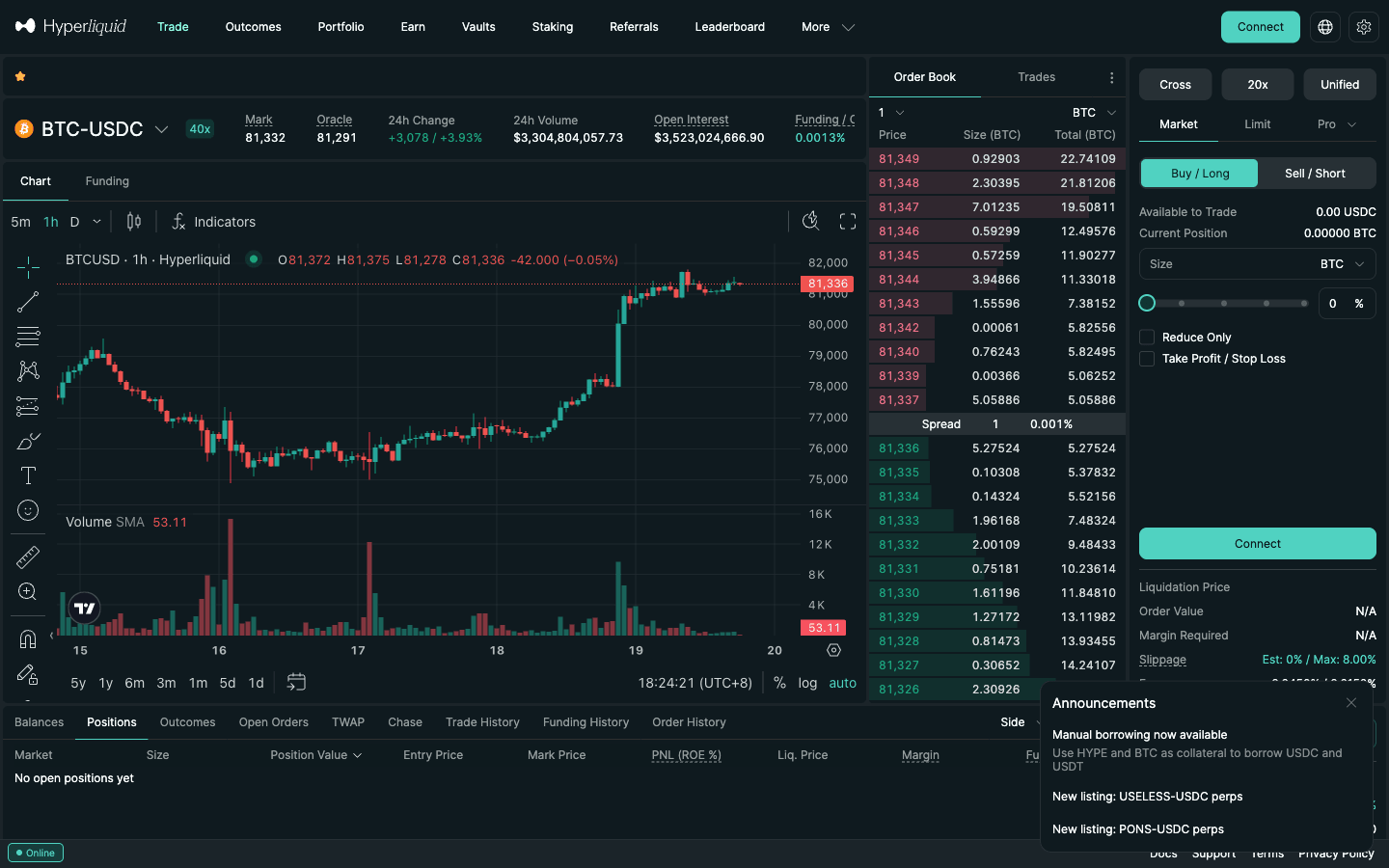
4. How funding works
A dated future converges to spot because it settles against spot on expiry day. A perp never settles, so it needs another anchor: funding. Each interval, one side pays the other a percentage of its position value:
- Perp above spot → funding positive → longs pay shorts. Too many buyers; the payment rewards anyone who sells the perp and buys spot, which pulls the prices together.
- Perp below spot → funding negative → shorts pay longs.
The money moves between traders. Hyperliquid’s docs put it plainly: funding is “purely peer-to-peer and no fees are collected on the payments”. The rate has two parts: a fixed interest component of 0.01% per 8 hours (the same baseline most exchanges use; Hyperliquid quotes it as 11.6% a year paid to shorts) and a premium that measures how far the perp trades from the oracle price. Hyperliquid computes an 8-hour rate and pays one eighth of it every hour, so a calm market shows about 0.00125% per hour.
Intervals and caps differ by venue, which matters when you compare rates:
| Venue | Type | Funding paid | Cap |
|---|---|---|---|
| Hyperliquid | Perp DEX | Every hour | 4% per hour |
| Lighter | Perp DEX | Every hour | 4% per 8 hours |
| edgeX | Perp DEX | Every 4 hours | 0.2% per interval (BTC, ETH) |
| Aster (BTCUSDT) | Perp DEX | Every 8 hours | 0.3% per interval |
| Binance (BTCUSDT) | CEX | Every 8 hours | 0.3% per interval |
| Bybit (BTCUSDT) | CEX | Every 8 hours | 0.333% per interval |
Read from each venue’s docs or public API, September 26–27, 2026. On Aster and Binance, some other symbols settle funding more often than every 8 hours.
An hourly 0.00125% and an 8-hourly 0.01% are the same cost; always convert to the same period before comparing. The formula, live rates across exchanges and a funding cost calculator are in our funding rate guide.
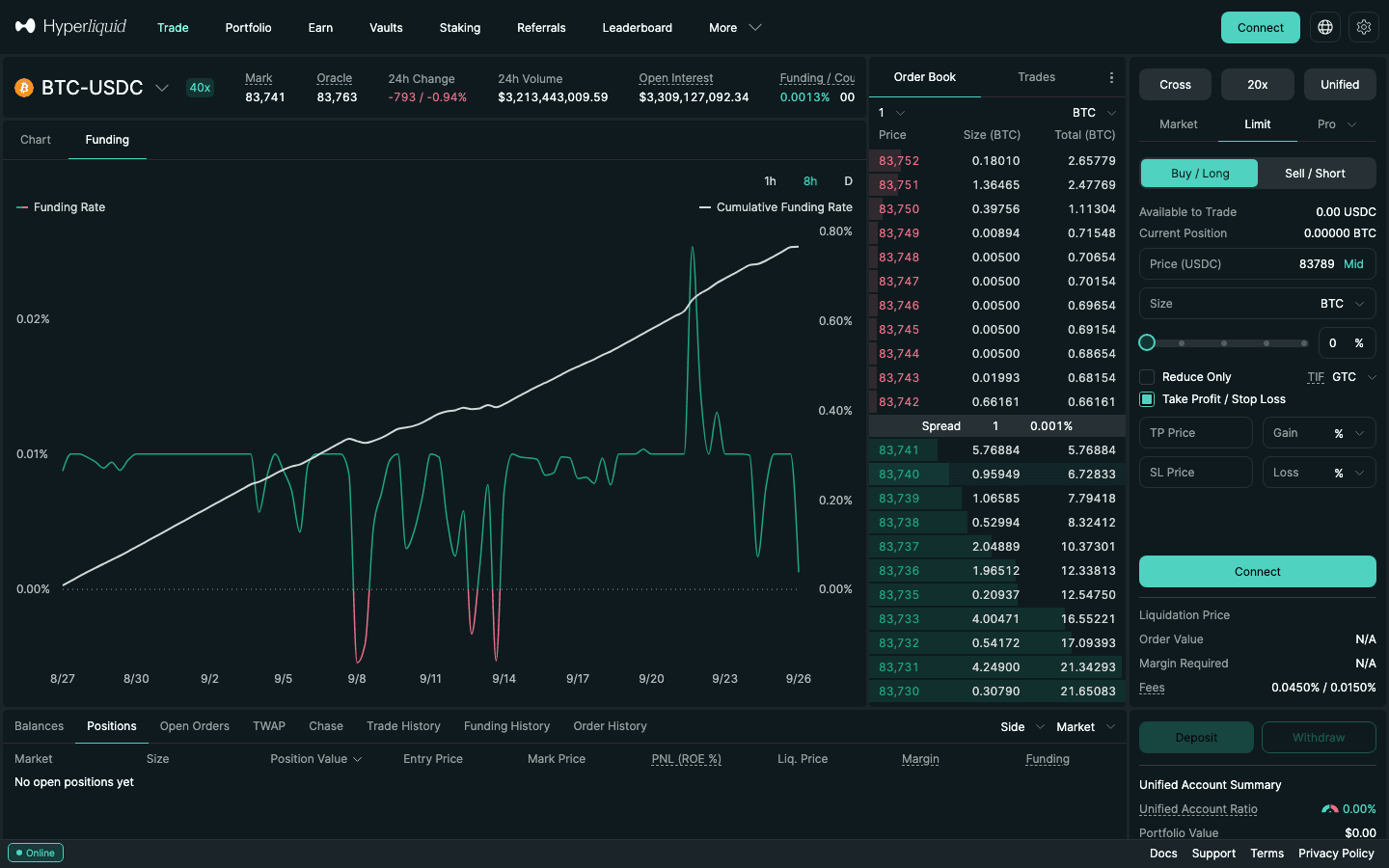
5. Perps vs spot vs dated futures
| Spot | Dated futures (e.g. CME) | Perpetual futures | |
|---|---|---|---|
| Do you own the coin? | Yes | No (cash-settled contract) | No (cash-settled contract) |
| Expiry | None | Monthly or quarterly; roll to stay exposed | None |
| How price tracks spot | It is spot | Converges at expiry; premium or discount (basis) before | Funding payments every interval |
| Cost of holding | None | Basis, built into the price | Funding, paid or received |
| Leverage | None (1x) | Set by exchange margin | Up to 40x on Hyperliquid BTC, 150x on Bybit BTCUSDT |
| Shorting | Only by borrowing | Yes | Yes, one click |
| Liquidation | Never | Yes (margin call / liquidation) | Yes, automatic |
| Contract size | Any amount | Fixed contracts (CME Micro Bitcoin: 0.1 BTC) | Any size above a small venue minimum |
| Where | Any exchange, AMMs | Regulated futures exchanges via a broker | CEXs and perp DEXs |
If you want to hold a coin for years, spot is simpler and cannot be liquidated. Perps make sense for leverage, shorting and hedging, over periods where funding stays small. The two comparisons people ask about most, with numbers:
Perpetual futures vs spot: what holding costs
On Hyperliquid a perp is cheaper per trade (0.045% taker against 0.07% on spot at the base tier), but a long perp pays funding every hour while spot costs nothing in between. For $10,000 of BTC exposure, opened and closed with market orders, 1x perp long with the BTC funding Hyperliquid actually charged (summed hourly rates to September 30, 2026):
| Holding period | Spot: fees | Perp 1x long: fees + funding |
|---|---|---|
| 1 day | $14.00 | $9.00 + $2.41 = $11.41 |
| 7 days | $14.00 | $9.00 + $16.84 = $25.84 |
| 30 days | $14.00 | $9.00 + $72.19 = $81.19 |
| 90 days | $14.00 | $9.00 + $218.49 = $227.49 |
| 12 months | $14.00 | $9.00 + $595.30 = $604.30 |
Hyperliquid fee schedule (tier 0) and fundingHistory for BTC: 30 days 0.72%, 90 days 2.18%, 12 months 5.95% of notional paid by longs; 1 and 7 days use the 30-day average. Price assumed unchanged; a referral code lowers both fee columns by 4%.
The perp is cheaper for about 2.1 days; after that spot wins by a growing margin. Leverage does not change the funding bill, because funding is charged on position size, not on margin: a 5x long on $10,000 pays the same as a 1x long. Spot also lets you withdraw, stake or use the coin; a perp is only a price contract, but it is the only way to short on Hyperliquid (its lending market lends only stablecoins) and the simplest way to hedge coins you keep (hedging guide). Rule of thumb: weeks or longer, spot; hours to a couple of days, shorts and hedges, perps. A middle option, spot bought with borrowed USDC, is compared in perps vs spot margin.
Perpetuals vs CME Bitcoin futures
CME's Bitcoin futures are the regulated dated futures most traders compare perps with. Since May 29, 2026 they trade 24/7 on CME Globex (except Saturday 2:00–4:00 a.m. CT and 4:00–4:02 p.m. CT on weekdays), so the old weekend “CME gap” no longer forms; what still separates them:
| CME Bitcoin futures | Perpetual on a DEX (Hyperliquid) | |
|---|---|---|
| Contract size | 5 BTC (Bitcoin futures) or 0.1 BTC (Micro) | Any size from a small minimum ($10 on Hyperliquid) |
| Expiry | Monthly (6 consecutive) + quarterlies; last trade 4:00 p.m. London, last Friday | None |
| How it tracks spot | Converges to the CME CF Bitcoin Reference Rate at settlement | Funding between longs and shorts (hourly on Hyperliquid) |
| Trading hours | 24/7 on CME Globex since May 29, 2026, except two maintenance windows | 24/7/365 |
| Margin and leverage | Set by CME Clearing (Oct 2026 BTC maintenance ≈21.9% of notional, about 4.6x); brokers may add more | Notional ÷ leverage; BTC up to 40x |
| Fees | Per contract: exchange + clearing fee + broker commission | % of notional: 0.045% taker at the base tier |
| Access | Futures broker account with identity checks; CFTC-regulated | Wallet or email login, no KYC; restricted persons (e.g. US) excluded |
cmegroup.com contract specs, margins and quotes, read September 25, 2026; Hyperliquid docs and the facts registry.
Basis vs funding, a worked example. At 05:59 CT on September 25, 2026 the October CME Bitcoin future traded at $85,250 while Hyperliquid's BTC oracle (a weighted median of exchange spot prices) read $84,780: a premium of $470, or 0.55% with 35 days to the October 30 expiry, about 5.8% a year. A long buying the future locks that cost in; it is paid through convergence as expiry approaches, and rolling to the next month means paying the next spread plus a second set of fees. On the perp, BTC longs paid about 9.3% a year in funding over the previous 30 days, but the cost is paid hourly and is not fixed in advance. For a 1.2 BTC position held 35 days that was roughly $564 of basis on 12 Micro contracts against about $910 of funding on the perp, before CME's per-contract fees and broker commission and the perp's 0.045% taker fees. Multi-week BTC exposure was cheaper on CME that week; short-term, small or altcoin trades suit perps, which also need no broker, start at $10 and allow up to 40x on BTC against about 4.6x at CME's exchange margin.
In the US, regulated futures on a qualified exchange are section 1256 contracts (marked to market, 60% long-term / 40% short-term), while the CFTC's May 2026 approval of a regulated bitcoin perpetual (Kalshi's BTCPERP) is being challenged by CME in court. Offshore perp DEXs are a separate matter: Hyperliquid's terms exclude US persons.
6. Worked example with real fees
You deposit $1,000 of USDC on Hyperliquid and open a 10x BTC long: position value $10,000, isolated margin.
| Scenario | Perp: $1,000 at 10x | Spot: $1,000 of BTC |
|---|---|---|
| BTC +5% | +$500 (+50% on margin) | +$50 (+5%) |
| BTC −5% | −$500 (−50% on margin) | −$50 (−5%) |
| BTC −8.86% | Liquidated: margin gone | −$88.61, you still hold the BTC |
- Trading fees. A market order is a taker fill at 0.045% (base tier), so opening costs $4.50 and a round trip $9.00. With a referral code’s 4% discount the taker rate is 0.0432%, a round trip $8.64. Binance USDⓈ-M charges 0.05% taker / 0.02% maker at its regular tier.
- Funding. At the 0.01%-per-8h baseline the long pays $1.00 every 8 hours ($0.125 an hour on Hyperliquid), about $3.00 a day and $90.00 over 30 days, charged on the full $10,000, not on your margin. When funding turns negative, the long receives it instead.
- Liquidation. With BTC’s 1.25% maintenance margin, a 10x isolated long is liquidated after a fall of about 8.86%: entry × (1 − 1/10) ÷ (1 − 1.25%).
The lesson most beginners learn the hard way: at 10x, the same 5% move that costs a spot holder $50 costs you half your margin, and an ordinary daily swing can end the trade. To run this example with your own prices, size, fees and funding, use the futures PnL calculator: it returns net PnL, ROE and the break-even exit, and flags an exit beyond the liquidation price.
7. Liquidation and a leverage table
When your equity falls to the maintenance margin, the exchange closes the position for you. Hyperliquid first sends market orders to the order book, and any collateral left after the close stays with you. If equity drops below two-thirds of the maintenance margin before the book can absorb it, a backstop liquidation hands the position to the liquidator vault (part of HLP), and the maintenance margin is not returned. Hyperliquid charges no separate clearance fee on liquidations.
How far BTC can move before an isolated position on Hyperliquid is liquidated, from the documented formula with BTC’s 1.25% maintenance margin (before fees and funding):
| Leverage | Initial margin | Long liquidated after a fall of | Short liquidated after a rise of | ROE per 1% move |
|---|---|---|---|---|
| 2x | 50.0% | 49.37% | 48.15% | 2% |
| 3x | 33.3% | 32.49% | 31.69% | 3% |
| 5x | 20.0% | 18.99% | 18.52% | 5% |
| 10x | 10.0% | 8.86% | 8.64% | 10% |
| 20x | 5.0% | 3.80% | 3.70% | 20% |
| 40x | 2.5% | 1.27% | 1.23% | 40% |
Long: (1/L − m) ÷ (1 − m); short: (1/L − m) ÷ (1 + m); m = 1.25%. ETH (2%) and smaller coins with higher maintenance rates liquidate sooner at the same leverage. In cross margin the leverage setting does not decide the liquidation price; your whole account balance does.
Worked formulas for cross margin, margin tiers and every venue: liquidation price guide.
8. Estimate: a perp position
Try your own numbers in this quick estimate. It uses Hyperliquid’s base-tier taker fee, BTC’s maintenance margin and the 0.01%/8h funding baseline from our registry (isolated margin, no fees in the liquidation distance).
- Position value
- –
- Profit / loss on that move
- –
- Liquidated after a move against you of
- –
- Round-trip taker fees (with code)
- –
- Funding per day at the baseline
- –
9. What traders use perps for
- Directional trading with leverage. The main use: expressing a view on price with less capital tied up.
- Shorting. Betting on a fall without borrowing coins. How to do it safely: how to short crypto on a DEX.
- Hedging. Holding spot BTC and shorting the same amount of BTC perp locks in the dollar value without selling the coins. See how to hedge crypto with perpetuals.
- Basis and funding arbitrage. Long spot, short perp, collect positive funding: a “delta-neutral” trade whose return is the funding rate minus fees. Returns shrink when funding falls: funding rate arbitrage.
- Markets you cannot buy easily. Hyperliquid lists perps on stocks, indices and commodities through HIP-3 markets, for example (trade.xyz stock perps).
10. Risks
- Liquidation. The most common way to lose money on perps is leverage, not hacks. Use 2–5x while learning and set a stop-loss before you open.
- Funding drag. In a crowded market, funding can cost a long far more than the baseline. Hyperliquid caps it at 4% per hour, a ceiling that exists for a reason. Check the rate before holding for days.
- Volatility and gaps. Stops are market orders; in a fast move they fill worse than the trigger price.
- Venue risk. On a CEX, the exchange holds your collateral. On a perp DEX, you rely on smart contracts, oracles and validators instead. Keep only trading capital on any venue.
- Regulation. Perps are restricted in some countries and venues exclude them. Hyperliquid’s terms exclude the US, Ontario and sanctioned regions; never use a VPN to get around such terms.
- Taxes. Funding, fees and realised P&L are usually taxable events you must record yourself on a DEX (DEX tax reporting).
A fuller checklist: perp risk management.
11. A short history: 1993 to 2026
- 1993. Yale economist Robert Shiller proposed “perpetual futures” in the Journal of Finance (vol. 48, no. 3), as a way to create cash-settled derivatives on assets that are hard to trade directly, such as real-estate price indices.
- 2016. BitMEX listed XBTUSD, a bitcoin perpetual swap with 8-hour funding, on May 13, 2016 (listing date in BitMEX’s public API). Eight hours is still the funding interval Binance and Bybit use on their BTC contracts.
- On-chain perps. Perp DEXs brought perp trading on-chain, with self-custody and public positions. By September 2026 DefiLlama counted $626.46B of perp DEX volume over 30 days, $216.95B of it (35%) on Hyperliquid (September 27, 2026).
- 2026 in the US. On May 29, 2026 the CFTC approved Kalshi’s cash-settled bitcoin perpetual on a regulated US exchange; CME sued the CFTC in June, and the CFTC moved to dismiss in September. Background: regulated perps in the US.
12. Where perps trade: CEX vs perp DEX
Most explainers stop at centralized exchanges, but a large share of perp trading now happens on-chain: all perp DEXs together had about $17.66B of 24-hour volume and $14.51B of open interest on September 27, 2026 (DefiLlama).
| Perp DEX (Hyperliquid) | CEX (Binance, Bybit) | |
|---|---|---|
| Custody | Your wallet; the exchange never holds an account in your name | The exchange holds your collateral |
| Sign-up | Connect a wallet or log in with email; no KYC | Account, ID verification |
| Base fees (taker / maker) | 0.045% / 0.015% | Binance 0.05% / 0.02% |
| BTC max leverage | 40x | Bybit 150x |
| Funding interval | Hourly | 8 hours on BTC |
| Transparency | Positions, liquidations and funding public on-chain | Internal ledger |
| Fiat | No; deposit USDC | Yes |
| Main risks | Smart contracts, oracles, phishing, your own keys | Exchange failure, frozen withdrawals |
Which perp DEX? Our best DEX for perps page compares Hyperliquid, Lighter, Aster and edgeX by use case, and the perp DEX ranking updates volume and open interest every six hours. Coming from Binance or Bybit: moving from CEX to DEX perps. New to DEXs altogether: what is a DEX.
13. Open your first perp on Hyperliquid
- Open Hyperliquid through the referral link. Use app.hyperliquid.xyz/join/
HOLYGRAIL, connect a wallet (Rabby, MetaMask) or log in with email, then click Enable Trading (a free signature). The code must be attached before your account passes Hyperliquid’s $10,000 volume limit for entering one. - Deposit USDC. From Arbitrum or another supported network; the minimum is 5 USDC (smaller deposits can be lost). Step by step: deposit guide.
- Pick a market and set margin. Choose BTC-USDC, click the leverage button and set 2–5x, and choose Isolated for your first trade.
- Choose direction and size. Buy / Long or Sell / Short; enter a size you can afford to lose. Read the Liquidation Price and Margin Required lines before submitting.
- Attach a stop-loss. Tick Take Profit / Stop Loss and set the stop well inside the liquidation price.
- Watch funding and close. The Positions tab shows unrealised P&L and funding paid. Close with Market or Limit, then withdraw (0.2 USDC plus a tiny gas fee for USDC to Arbitrum).
Every screen, with screenshots: how to use Hyperliquid. All fee tiers: Hyperliquid fees.
Ready for step 1?
Join Hyperliquid with code HOLYGRAIL: 4% off fees on your first $25M of volume (0.0432% taker instead of 0.045%). Hourly funding, BTC up to 40x, no gas on orders.
Prefer zero-fee perps? Lighter (code 718610TD) charges 0% on Standard accounts.
14. FAQ
What are perpetual futures?
Perpetual futures (perps, or perpetual swaps) are derivative contracts that track the price of an asset such as bitcoin but never expire. You post collateral, usually USDC, choose long or short and a leverage, and your profit or loss follows the price. Instead of an expiry date, a funding payment between longs and shorts keeps the contract close to the spot price; on Hyperliquid it is paid every hour.
What is the difference between futures and perpetual futures?
A standard (dated) future has an expiry date: on that day it settles against the spot price, so to stay exposed you roll into the next contract. A perpetual future has no expiry and no rollover. It stays anchored to spot through periodic funding payments instead: when the perp trades above spot, longs pay shorts; when it trades below, shorts pay longs. Both are usually cash-settled, so you never receive the coin.
How do perpetual futures work?
You deposit collateral (margin) and open a position several times larger: $1,000 at 10x controls $10,000 of BTC. If BTC rises 5% the long gains $500; if it falls 5% it loses $500. Every funding interval you pay or receive a small percentage of the position value, depending on whether the perp trades above or below spot. If losses eat your margin down to the maintenance margin (1.25% of the position for BTC on Hyperliquid), the position is liquidated.
How are funding fees calculated?
Funding payment = position value × funding rate. At the common baseline of 0.01% per 8 hours, a $10,000 position pays or receives $1.00 every 8 hours, about $3.00 a day. On Hyperliquid the rate is computed as an 8-hour figure and paid hourly at one eighth of it (0.00125% an hour at the baseline). The payment goes to traders on the other side, not to the exchange.
What does “perp” mean in crypto?
“Perp” is short for perpetual futures contract, a futures-style derivative with no expiry date. “Perp DEX” means a decentralized exchange that lists perps, such as Hyperliquid, Lighter, Aster or edgeX. “Perpetual swap” is the same thing: BitMEX used that name when it listed its XBTUSD contract in 2016.
Are perpetual futures legal?
It depends on where you live. In the US, the CFTC approved Kalshi’s cash-settled bitcoin perpetual (BTCPERP) on a regulated exchange on May 29, 2026; CME sued the CFTC in June 2026 arguing that perpetuals are swaps, and the CFTC asked the court to dismiss the case in September. Offshore venues are separate: Hyperliquid’s terms exclude the US, Ontario and sanctioned regions. In Japan, registered domestic exchanges may offer individuals at most 2x leverage. Check your own country’s rules and each venue’s terms; this is not legal advice.
What is a perpetual futures exchange?
Any venue that lists perps. Centralized exchanges (Binance, Bybit, OKX) hold your funds and require KYC. Perp DEXs such as Hyperliquid, Lighter, Aster and edgeX let you trade from your own wallet, with positions and settlement on-chain; together they traded about $17.66B in the 24 hours DefiLlama measured on September 27, 2026. Our perp DEX ranking updates every six hours.
Can you lose more than you deposit with perpetual futures?
On Hyperliquid, no: the documented worst case is losing the margin behind the position. If an isolated position is backstop-liquidated you lose that isolated margin; in cross margin you can lose the whole cross balance, and Hyperliquid’s docs say an account with no isolated positions “ends up with zero account equity”. It does not describe billing you for more. You can, however, lose 100% of the margin quickly at high leverage.
What is the difference between crypto perpetuals and CME Bitcoin futures?
A CME Bitcoin future (5 BTC, or 0.1 BTC for the Micro) expires monthly and settles in cash against the CME CF Bitcoin Reference Rate, so you roll it to stay exposed and pay the basis (its premium over spot) instead of funding. A perpetual never expires and is held near spot by funding. On September 25, 2026 the October CME contract's premium worked out to about 5.8% a year, against about 9.3% a year of Hyperliquid BTC funding over the previous 30 days, so multi-week BTC exposure was cheaper on CME before broker commissions; perps win on size (from $10), leverage (up to 40x on BTC), altcoins and access without a broker.
Why don’t perpetual futures expire?
Because they are designed without a settlement date: the funding payment does the job that expiry does in a dated future, pulling the price back toward spot. Robert Shiller proposed perpetual futures in a 1993 Journal of Finance paper as a way to cash-settle derivatives on assets that are hard to trade directly; crypto exchanges adopted the idea from 2016 because traders wanted leverage without rolling contracts every month or quarter.
How much leverage should a beginner use on perps?
Two to five times at most while learning. At 2x a BTC long on Hyperliquid is liquidated after roughly a 49% fall; at 20x after about 3.8%, a move bitcoin can make in an hour. The maximum (40x on BTC) is a ceiling, not a recommendation. Always attach a stop-loss.
Where can I trade perpetual futures without KYC?
On a perp DEX you trade from your own wallet, so there is no account in your name and usually no ID check. Hyperliquid is the largest by volume (35% of perp DEX volume over the 30 days to September 27, 2026, DefiLlama) with 178 perp markets as of October 20, 2026; it charges 0.045% taker / 0.015% maker at the base tier and takes 4% off fees on your first $25M of volume with a referral code. Respect each venue’s restricted-country list.
Trade perps on-chain
Hyperliquid has the largest share of on-chain perp volume (35% of perp DEX volume over 30 days, DefiLlama, September 27, 2026). Sign up with HOLYGRAIL and your first $25M of volume is 4% cheaper.
Still comparing? See our DEX picks or the HOLYGRAIL code explained.
Disclosure: HOLYGRAIL (Hyperliquid) and 718610TD (Lighter) are our referral codes; we earn a share of referred accounts’ fees, and it never raises yours. Fees, leverage caps, margin rates and funding rules were read from official documentation and public APIs on September 26–27, 2026; market-size figures from DefiLlama on September 27, 2026; the BitMEX listing date from BitMEX’s API and the Shiller paper from its Crossref record on September 27, 2026. Examples ignore slippage and price changes in funding. Nothing here is financial, legal or tax advice.