
Lighter DEX fact sheet
| Item | Details |
|---|---|
| Type | Order-book perp and spot DEX, application-specific zk-rollup settling on Ethereum |
| Chain | Its own rollup (Lighter Core) with proofs, state and exits on Ethereum; deposits from 12 networks |
| Fee tiers | Standard 0% / 0% · Plus 0.005% · Premium up to 30% off with staked LIT |
| Activity (API) | $1.78B 24h volume, 2,211,626 trades, ≈ $548.4M open interest summed over active perps (October 19, 2026) |
| Token | LIT: ≈ $5.01, 250M circulating of 1B max (CoinGecko, September 25, 2026); staking pays a fixed 6% APR |
| Login / KYC | Email or any of 586 wallets, keyed to an Ethereum address; no identity verification in the sign-up flow |
| Team / backers | Founded 2022 by CEO Vladimir Novakovski, launched January 2025; $68M raised at ≈ $1.5B (Fortune, Nov 2025); backers include Founders Fund, Ribbit, Haun, Robinhood, Coinbase |
| Official links | lighter.xyz · app.lighter.xyz · lighter.exchange · docs.lighter.xyz · X @Lighter_xyz |
| App | Web (Japanese UI available) · Lighter Mobile on iOS/Android (trading only in selected regions) |
| Our code | 718610TD: 10% of your trading fees rebated every Monday from sign-up (invite dialog and docs, October 19, 2026) |
Verdict: the cheapest serious perp DEX, if you can live with 300 ms
Lighter is the only major on-chain perpetuals venue where a retail account pays nothing — 0% maker, 0% taker, no gas — on every market it lists. That makes it the obvious home for discretionary traders who trade often, for grid and range strategies run by hand, and for anyone whose edge is a few basis points wide. The catch is deliberate: Standard accounts run at 300 ms taker latency, and Lighter earns its money from the traders who need faster fills or bigger API limits through its Premium and Plus tiers (plus liquidations and market makers). On top of that you get 50x on BTC and ETH, dozens of tradable stocks, indices, commodities and currency pairs, pre-IPO markets, and a proof system that makes order matching publicly verifiable on Ethereum.
The weak points are real but specific. Books outside BTC, ETH and a handful of majors are thinner than Hyperliquid's, most altcoins are capped at 3–10x, the points program that drove early growth is no longer visible in the app, and the whole venue still depends on one sequencer for live trading. Our rating: first choice for low-cost manual trading and stock/FX perps; second choice behind Hyperliquid for deep altcoin liquidity and for latency-sensitive bots unless you pay for Premium.
Pros
- 0% maker / 0% taker on perps and spot for the default account (official fee page, re-read October 19, 2026).
- Verifiable matching and liquidations: zk-proofs checked on Ethereum, full state data posted as Ethereum blobs, and an Escape Hatch to exit on L1.
- 50x on BTC and ETH — above Hyperliquid's 40x / 25x caps — with one fixed limit per market and no size brackets.
- Stocks, indices, gold, oil and FX perps 24/7, plus pre-IPO markets (OPENAI, ANTHROPIC) and a perpRFQ desk for size.
- Deposits from 12 networks including Solana, Bitcoin and Tron with a $5 minimum; card deposits advertised in the app.
- Funding is fully peer-to-peer; the protocol LLP vault has 0% operator fee.
Cons
- Standard taker orders wait 300 ms by design; in fast markets you fill later than you clicked.
- Premium is cheap (0.028% taker) but not free, and LIT discounts top out at 30% only with 500,000 LIT staked.
- Long-tail books are thin; 78 of the 213 perps are capped at 5x or 3x (October 19, 2026).
- Mobile app trading is limited to selected regions and the app is English only.
- Points, referral rebates and the 6% staking APR are all discretionary and can change without notice (on October 19, 2026 the invite dialog offered a 10% fee rebate, while Lighter's docs and app still also describe a free first Premium week).
Open a free Lighter account
Sign up through 718610TD: Standard stays 0% / 0%, and 10% of any fees you pay on Premium, Plus or advanced orders comes back in USDC every Monday.
What is Lighter DEX? A zk-rollup built only for trading
In one line: Lighter is a decentralized exchange (DEX) for perpetual futures, with a small spot market, that runs as its own zero-knowledge rollup on Ethereum, so it can match orders at exchange speed while Ethereum checks that every match and liquidation followed the rules. It is not a sidechain and not an AMM; it is a central limit order book whose results are proven. Lighter calls its engine Lighter Core. Users keep custody in Ethereum smart contracts that hold every deposit and the canonical state root — the single hash that commits to all balances, positions, public pools and order books. Off-chain, a sequencer orders user-signed transactions first-in-first-out and gives soft finality within milliseconds; API servers stream that state to traders. In parallel, witness generators and a custom prover produce a succinct proof for every state transition, and hundreds of thousands of those proofs are aggregated into a single batch proof that Ethereum verifies before the contract accepts the new state.
Each state update is posted to Ethereum together with compressed data blobs listing the per-account changes, and the proof also attests that those blobs are sufficient to rebuild every account. In practice this means the operator cannot fill your order at a price the rules forbid, skip your liquidation, or invent a balance: the proof would fail and Ethereum would reject the update. That is the meaning of Lighter's slogan "verifiable order matching and liquidations", and it is the key difference from venues whose correctness rests on their own validator set.
The Escape Hatch
Verifiability protects against cheating; it does not by itself protect against a sequencer that simply stops. For that, Lighter runs a priority request queue on Ethereum. You can submit critical exit operations — withdrawals, public-pool exits and reduce-only IOC orders — directly on L1, and the sequencer must process them within a predefined time. If it does not, the contract enters Escape Hatch mode: it freezes, and every user can reconstruct their account from the blobs, generate a proof of their balances, positions and pool shares, and withdraw the full value on Ethereum without anyone's cooperation. This exit path is what distinguishes a rollup from a sidechain.
Lighter on Robinhood Chain: a separate instance
Lighter also runs a second, separate exchange instance connected to Robinhood Chain. It has its own order books, API (api.rh.lighter.xyz) and API docs (apidocs.rh.lighter.xyz), and it is not the same account or balance as the main exchange. What the official sources showed on September 26, 2026:
- USDG is the base collateral (USDC plays that role on the main exchange), valued at 100%. Tokenised SPY and USO can be posted as extra collateral at a 50% loan-to-value.
- Markets: the instance's exchangeStats endpoint listed 84 order books, a mix of perps (BTC, ETH, SOL, HYPE, LIT, large US stocks, gold, silver, pre-IPO OPENAI and ANTHROPIC) and stock-token spot pairs quoted in USDG (TSLA/USDG, NVDA/USDG, SPY/USDG and others), with about $341M of 24-hour volume on September 26, 2026 (17:00 UTC) — a fraction of the main exchange.
- Fees: Standard accounts are free there too (0% maker and taker). Premium is priced differently: 0.0120% maker / 0.0350% taker below $1M of 14-day volume, with discounts that depend on 14-day volume rather than staked LIT.
- Points: the Robinhood Chain instance runs its own points program (terms effective August 10, 2026, weekly drops on Fridays since August 21) that bans wash trading, self-trading, multi-account farming and referral abuse. The docs do not publish a total reward pool, so we do not quote one.
- Restricted regions are wider: besides the main exchange's list, the program terms also exclude Singapore, Switzerland, the United Arab Emirates and South Sudan for points and perps.
On the main exchange you will still see rhSPY/USDC and rhQQQ/USDC spot pairs and a USDG deposit route from Robinhood Chain. Everything else in this review, and our referral link, refers to the main exchange at app.lighter.xyz (also reachable at lighter.exchange). The docs do not say that main-exchange referral codes carry over to the Robinhood Chain instance.
How to use Lighter (sign up in 5 steps)
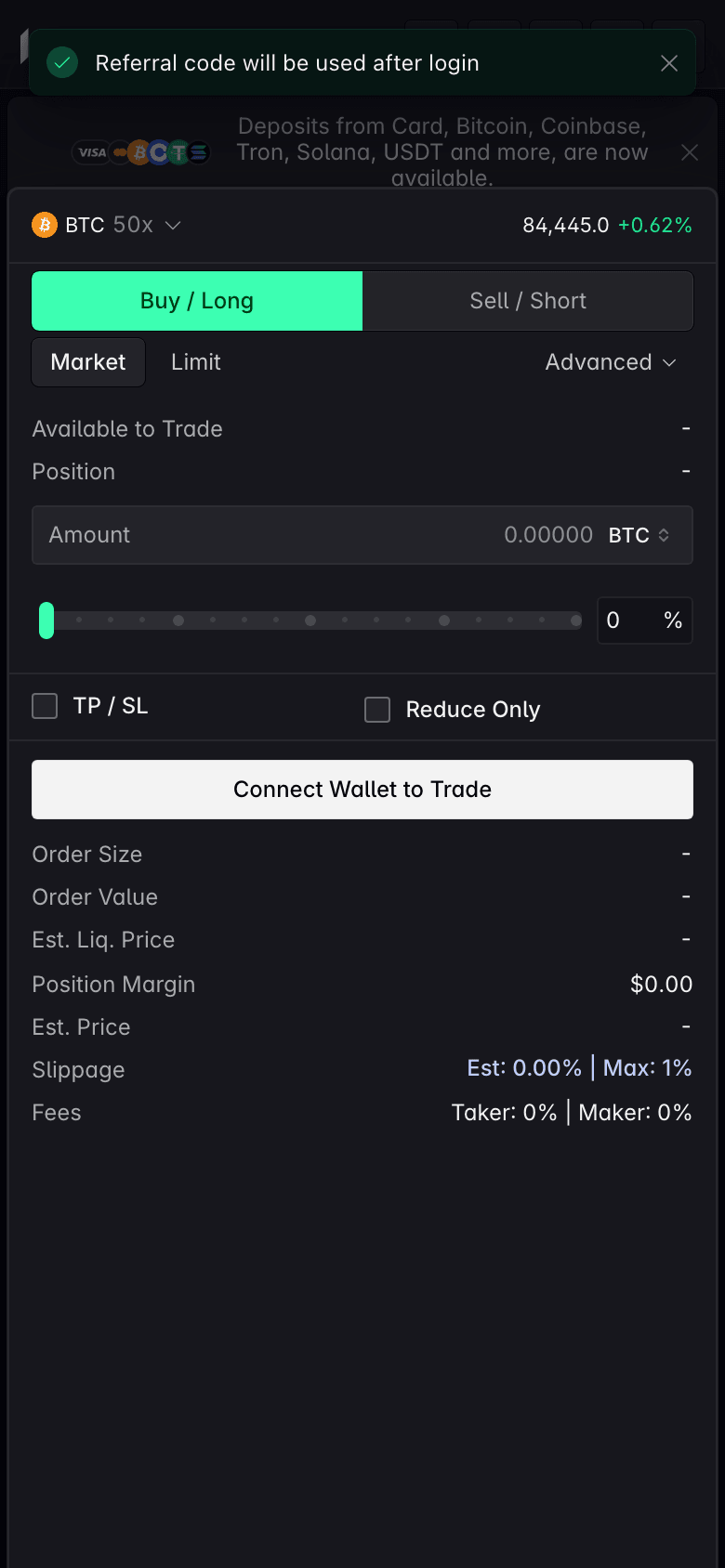
Using Lighter takes about ten minutes, most of it waiting for the deposit, and there is no KYC: you open the invite link, log in with an email address or a wallet, deposit at least $5, pick an account type and place an order. Steps 1–2 and the order ticket were re-checked logged out on October 19, 2026; the deposit and account-type screens are from our September 2026 sign-up (dated in the text and captions).
| # | Step | What happens | Time |
|---|---|---|---|
| 1 | Open the invite link | "You're invited!" dialog; toast "Referral code will be used after login" | 10 s |
| 2 | Log in | Email, or one of 586 wallets (six marked Recommended) | 1 min |
| 3 | Deposit | $5 minimum for a new account ($10 from Bitcoin); the first deposit creates the account | 2–20 min |
| 4 | Pick an account type | Standard (0% / 0%), Plus or Premium; click one, do not just close the dialog | 1 min |
| 5 | Trade | Pick a market, Market or Limit, size from $10, TP / SL, place; close with Reduce Only | 2 min |
Step 1: Open the invite link before you log in
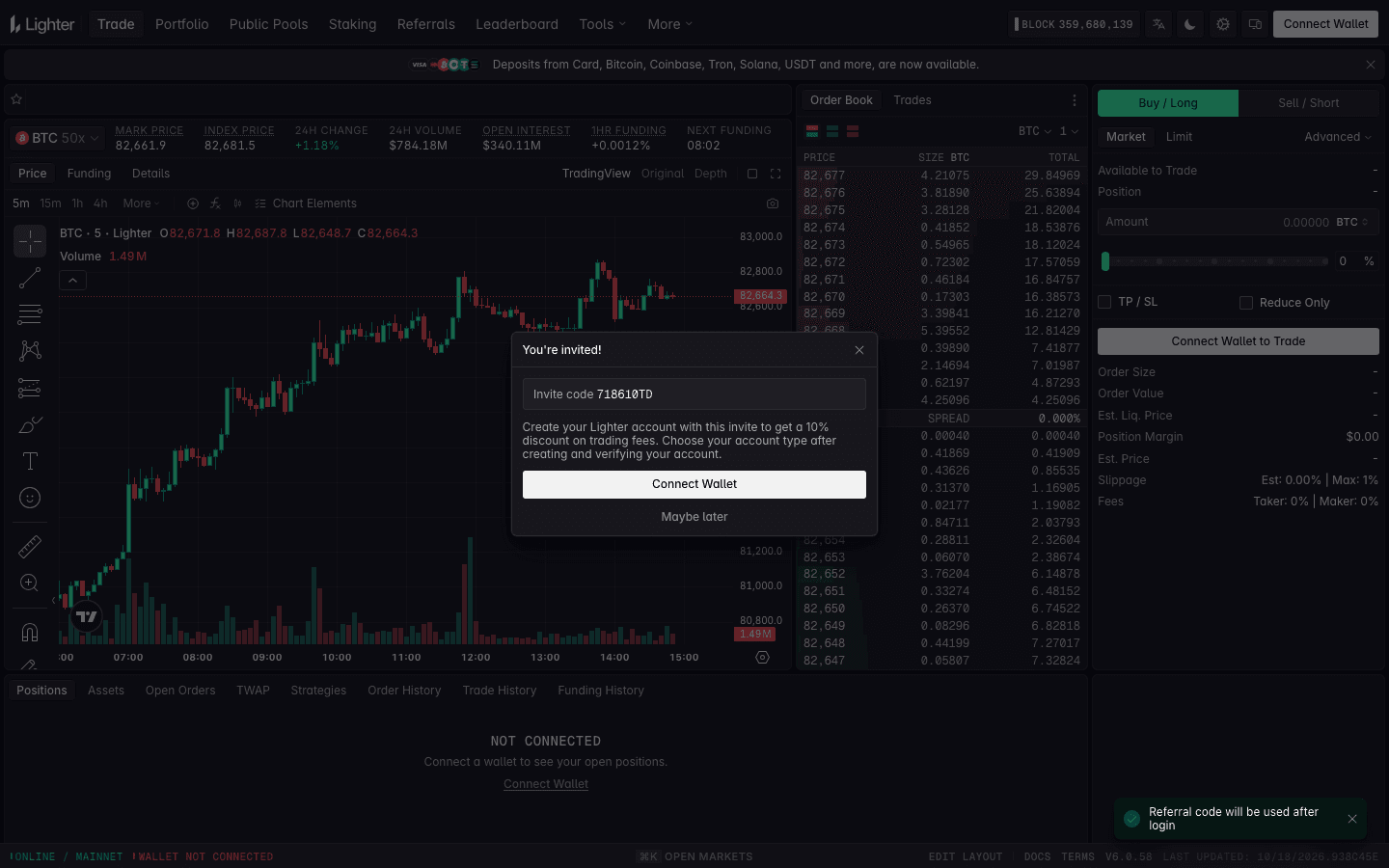
Go to app.lighter.xyz/?referral=718610TD in the browser you will trade in. On October 19, 2026 the app showed a dialog titled "You're invited!" with the invite code and the text "Create your Lighter account with this invite to get a 10% discount on trading fees", and a toast confirmed "Referral code will be used after login". You never type the code. Lighter's referral docs say attribution is permanent: if you log in first and look for a referral field afterwards, there is none.
Step 2: Log in with email or a wallet
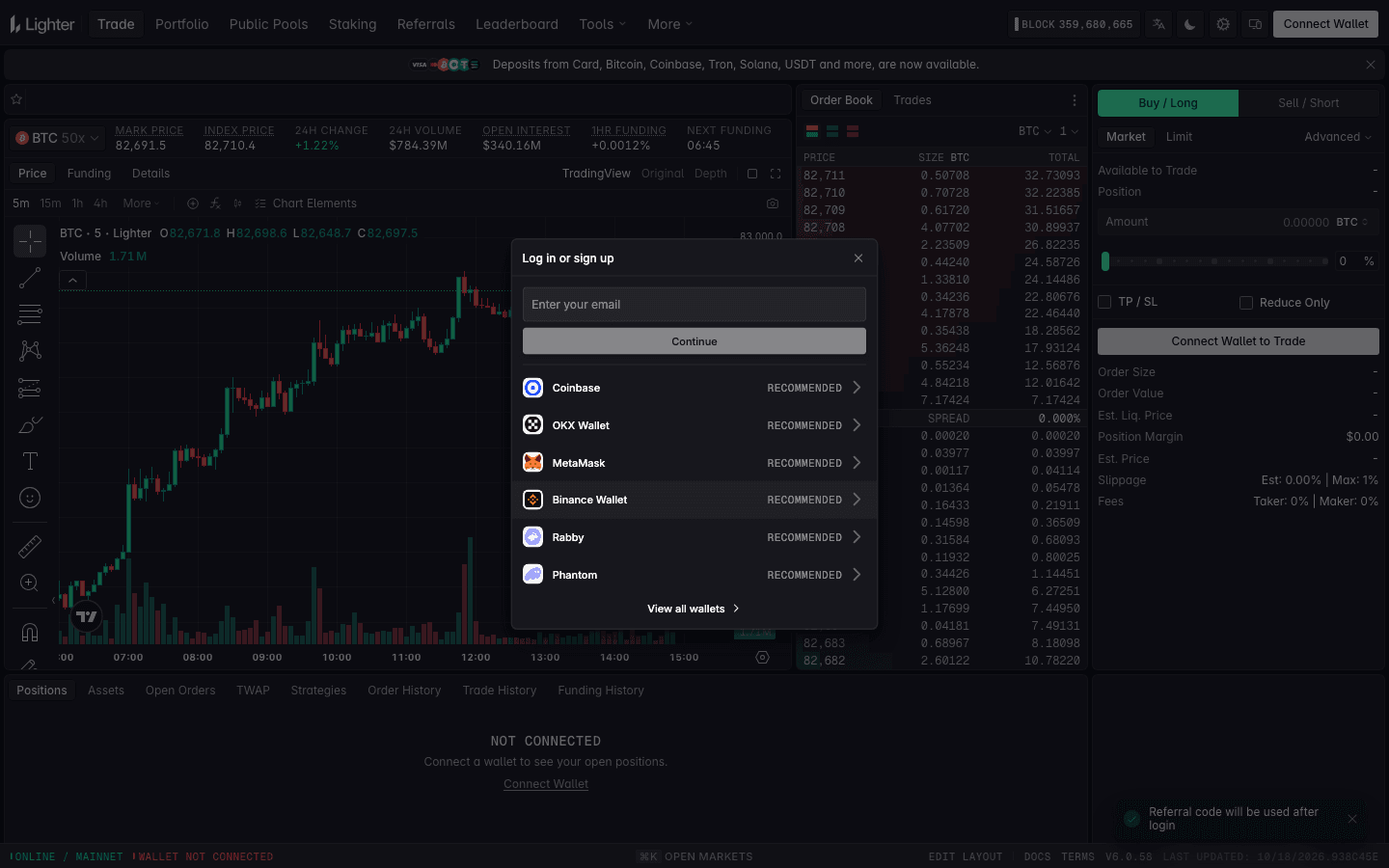
The login window is titled "Log in or sign up": an email field with a Continue button on top, and a wallet list below. Pick your wallet and sign a message; the signature registers a trading key for your account and costs no gas, so from then on you do not approve every order in your wallet. Wallet choices and the email option are explained in Lighter wallet and app below.
Step 3: Deposit (this creates your account)
Logging in alone does not create a Lighter account. According to Lighter's API docs, the first deposit generates your account index, which is why a new login sees a window titled "Deposit to create account". Choose the chain and asset, check the minimum ($5 for a new account on most routes, $10 from Bitcoin), add a small buffer for bridge and swap slippage, and confirm in your wallet. Only USDC can go into the perps balance; other assets are converted on the way in. Most routes show "Processing" and then "Completed" within minutes. Every route and minimum is in deposits and withdrawals below and in our Lighter deposit and withdrawal guide.
Step 4: Pick Standard, Plus or Premium
Once the deposit lands, an invited account sees an account-type dialog offering Premium, Plus and Standard. On September 25, 2026 its footer warned "Closing this without choosing will discard your invite", so always click one option, even if you only want the free Standard account. Standard (0% / 0%, 300 ms taker delay) suits almost everyone; Premium suits scalpers and bots; Plus suits API users who need higher limits but not speed (account types compared). You can upgrade at any time and move down once every 24 hours.
Step 5: Place your first trade, and close it
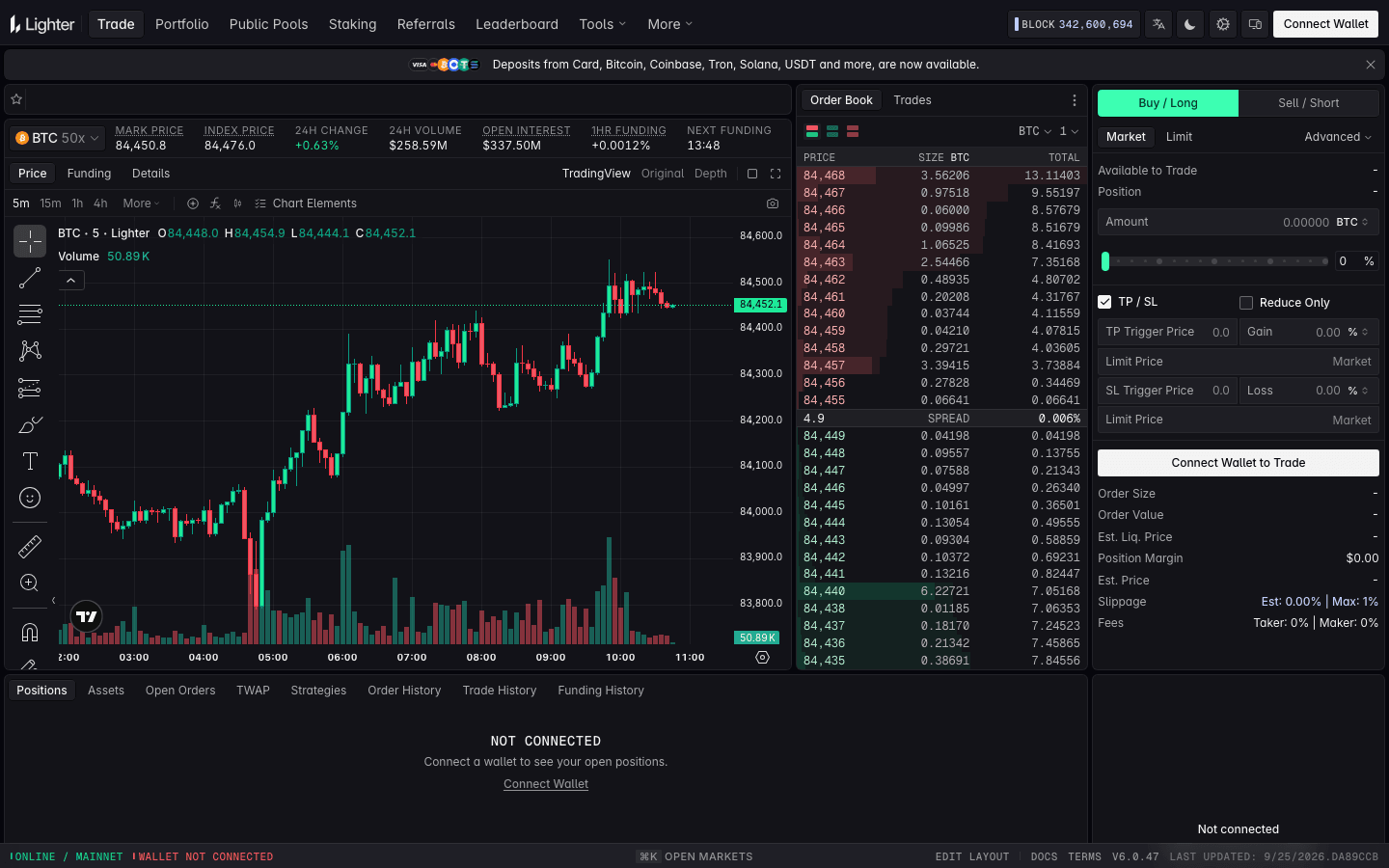
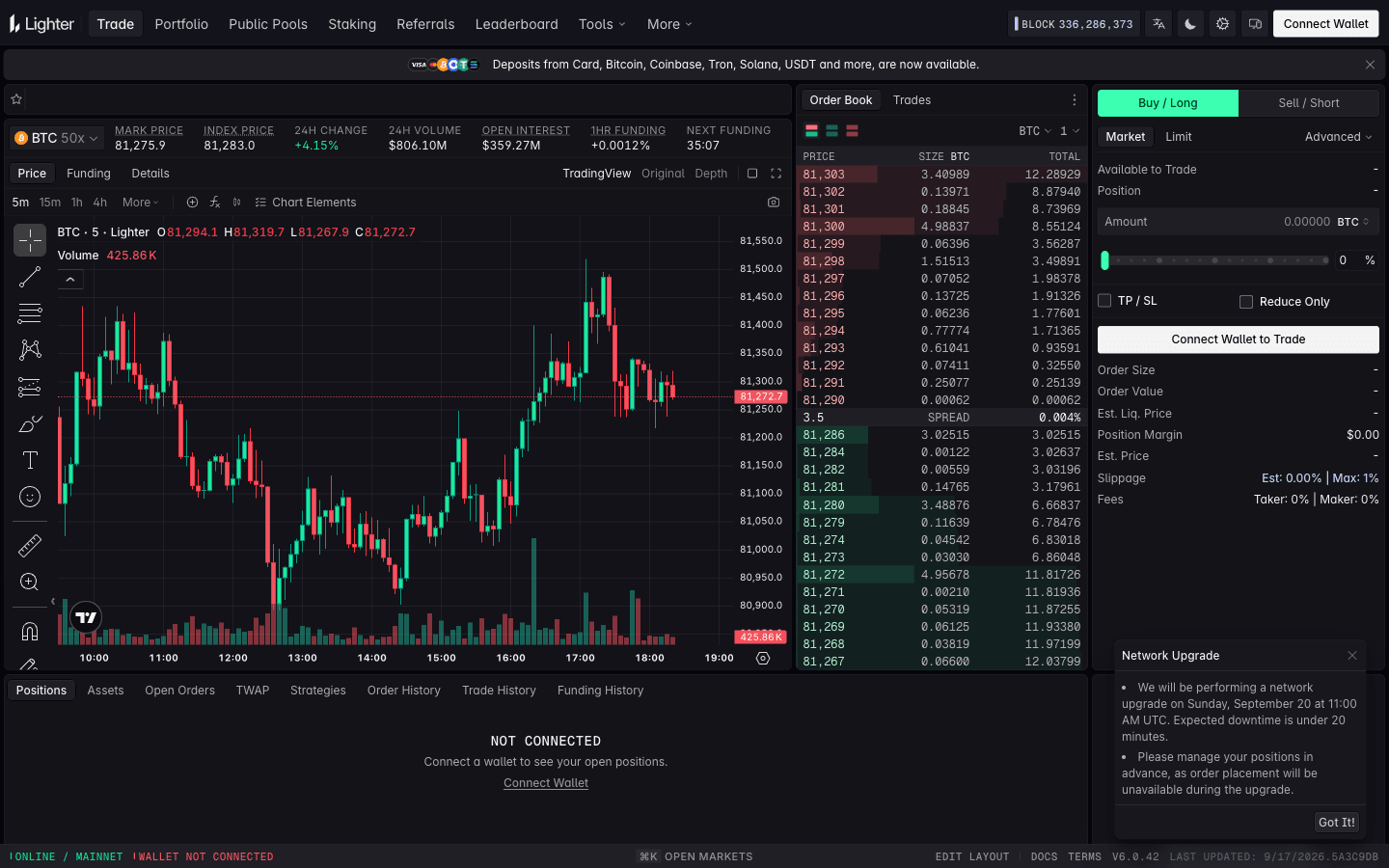
Click the market name at the top left (it shows the maximum leverage, e.g. "BTC 50x") or press ⌘K to search; the picker has Featured, All, Favorites, Perps, Spot and RWA tabs. In the order ticket choose Buy / Long or Sell / Short, then Market, Limit or Advanced, enter a size (minimum $10 of notional), tick TP / SL for a take-profit and stop-loss, check Est. Liq. Price and place the order. On a Standard account the fee line reads "Taker: 0% | Maker: 0%" (it did again on October 19, 2026).
- Set leverage on purpose. A new BTC position starts at 20x unless you change it. Use 2–5x and Isolated margin for a first trade so only that position's margin is at risk (cross vs isolated margin).
- Prefer limit orders on Standard. A taker order waits 300 ms before it reaches the book; a resting limit order is not delayed.
- To close, place an opposite order of the same size with Reduce Only ticked. It can only shrink the position, never flip it. Every order type is explained in the Lighter order types guide.
| Problem | Likely cause and fix |
|---|---|
| No invite dialog appeared | The link lacked the referral parameter, or the wallet already has an account (existing accounts cannot add a code). Open the full invite link before your first login. |
| Logged in but no account shows | No deposit yet: the first deposit creates the account. Deposit at least $5 and wait for "Completed". |
| USDC is in spot, perps shows no balance | The deposit went to spot. Transfer USDC to perps, or enable a Unified Trading Account on the web. |
| Order rejected | Below $10 or the market's minimum size, or a limit price too far from the mark price. |
| A fee on a "free" account | TWAP, Chase, Iceberg or RFQ orders carry 0.01% on Standard. Plain market and limit orders are free. |
Create your Lighter account
Open the invite link first so code 718610TD is attached: Standard trading stays free, and 10% of any fees you pay later comes back weekly.
Lighter wallet and app
There is no separate "Lighter wallet" to download. You log in with a wallet you already use, or with an email address, and your Lighter account is tied to the Ethereum (L1) address behind that login. On October 19, 2026 the login window marked Coinbase, OKX Wallet, MetaMask, Binance Wallet, Rabby and Phantom as Recommended, and "View all wallets" searched 586 wallets, with WalletConnect for phone wallets.
- Browser-extension wallets (MetaMask, Rabby, OKX Wallet, Coinbase Wallet) are the smoothest on desktop: one connection, one signature, no gas.
- Email login creates an embedded wallet. Per the app's own text you can open it and export its private key; do that and store the key offline before you deposit a meaningful amount.
- Multisig and smart-contract wallets (Safe and similar) work through a box in the login modal that registers your key with an Ethereum priority transaction; withdrawals from them use the secure route only.
- Lost wallet = lost account. Secure withdrawals only go to the address that created the account, and nobody can reset it. Consider a fresh wallet used only for trading.
The Lighter app. Lighter Mobile by Elliot Technologies, Inc. is on the App Store (version 1.1.4, updated September 25, 2026, first released January 13, 2026) and on Google Play (updated September 24, 2026, 10K+ downloads); both listings were re-checked on October 19, 2026. Read the store text before relying on it: it describes connecting your wallet and following prices, funding and liquidity, and says that "in selected supported regions, the app includes additional wallet-based features. In other regions, the app remains available for viewing market information". The App Store listing is English only and the app is listed in the US, Japan, the UK, Canada, South Korea, Singapore, Germany, France, Australia, Hong Kong and Taiwan (not China). Check that the publisher reads Elliot Technologies before installing; look-alike apps exist.
Wherever the app is view-only, the web app works in a phone browser: the chart fills the screen, and Buy / Long and Sell / Short buttons open the same ticket as on desktop (Market / Limit / Advanced, TP / SL, Reduce Only). The web app also offers a Japanese interface, which the mobile app does not. More on phones in our Lighter app guide.
Team, funding and backers
Lighter was founded in 2022 by Vladimir Novakovski, its CEO, and launched in January 2025 (Fortune). The company behind the apps is Elliot Technologies, Inc. (the publisher of Lighter Mobile). On November 11, 2025 Fortune reported a $68M round at a valuation of around $1.5B, led by Founders Fund and Ribbit Capital with Haun Ventures and Robinhood participating, following a $21M round in 2024 led by Haun Ventures and Craft Ventures (Fortune). Lighter's own site names Founders Fund, Ribbit, Haun, Robinhood and Coinbase as backers.
Why it matters for a trader: a well-funded team is more likely to keep shipping (the mobile app arrived in January 2026, and stock, pre-IPO and Robinhood Chain markets are live), and the Robinhood link explains the tokenised-stock focus. It does not change the risk model — your funds are protected by the rollup's proofs and Escape Hatch, not by who invested.
Account types: Standard, Plus and Premium
Lighter does not use volume tiers. Instead you pick an account type, and the type decides both your fee and your latency. The type is tied to your Ethereum (L1) address, so it applies to your main account and all sub-accounts. According to the API docs (re-checked October 6, 2026) you can switch down once every 24 hours; upgrades have no cooldown.
| Account type | Maker / taker | Taker latency | Maker / cancel latency | Sub-accounts | API limits |
|---|---|---|---|---|---|
| Standard (default) | 0% / 0% | 300 ms | none / 300 ms | 4 | 60 REST req/min |
| Plus (opt-in) | 0.005% / 0.005% | 300 ms | 200 ms / 200 ms | 16 | 4,000 tx/min · 24,000 reads/min |
| Premium (opt-in) | 0.0040% / 0.0280% | 140 ms | none on post-only / none | 64 | 4,000–72,000 tx/min (by staked LIT) |
Sources: docs.lighter.xyz trading-fees and apidocs.lighter.xyz account-types, both checked October 6, 2026; the two doc sites gave the same latencies and Plus limits; API limits from apidocs.lighter.xyz rate-limits (updated October 13, 2026), checked October 15, 2026. Cancel latency covers modifies too. Premium transaction limits rise with staked LIT. Order caps and the volume quota are in our Lighter account types and rate limits table.
- Standard is what you get by default: free perps and spot, taker orders and cancels wait 300 ms; maker orders are not delayed, up to 4 sub-accounts (which cannot be deleted). The one exception to "free" is advanced order types — Lighter's referral doc confirms that "fees paid to access advanced order types via a Standard account" exist, and the order ticket showed 0.01% maker and taker for TWAP on September 25, 2026 while market and limit orders showed 0%.
- Plus is for API users who do not care about speed but need throughput: 0.5 bps per side, its own latency (300 ms taker, 200 ms maker and 200 ms cancel), 4,000 transactions per minute, 24,000 weighted read requests and 16 sub-accounts. Enable it with the
changeAccountTierendpoint or in the app. - Premium is the HFT tier: faster taker fills at 140 ms and instant cancels (cancels and post-only placements carry no added latency), 64 sub-accounts, and 4,000–72,000 transactions per minute depending on staked LIT, plus a volume quota: one extra transaction for every $2 traded, stackable to 15,000,000.
Fees in brief. Premium fees fall as you stake LIT (up to 30% off with 500,000 LIT staked; taker latency stays 140 ms at every tier), and LIT Fee Credits let you rent a tier instead of locking tokens. A $10,000 market order costs $0 on Standard and $2.80 on Premium with no LIT staked, against $4.50 at Hyperliquid's base tier. Every account still pays funding (hourly, peer-to-peer), a liquidation fee of up to 1% that goes to the LLP vault, and gas plus bridge slippage on deposits. The LIT staking tiers, Plus and perpRFQ fees and worked cost examples are in our Lighter fees guide.
Which account should you use? Manual traders placing a few dozen orders a day: Standard, and use limit orders so latency matters less. API traders who need more than 60 requests a minute but are not racing anyone: Plus. Market makers, scalpers and anyone whose strategy depends on cancelling quickly: Premium — and sign up with a referral link first, because referred accounts get 10% of their fees rebated.
Markets, volume and leverage
On October 19, 2026 Lighter's exchangeStats endpoint reported 246 order books, of which 213 were active perpetual markets and 10 active spot pairs (the rest inactive). 24-hour volume was $1.78B across 2,211,626 trades, and open interest summed over the active perps came to roughly $548.4M (CoinGecko, which counts open interest its own way, showed $1.1B on October 20, 2026). Volume is concentrated: BTC and ETH made up about three-quarters of it.
| Market | 24h volume (October 19, 2026, 05:49 UTC) |
|---|---|
| BTC | $783M |
| ETH | $572M |
| SOL | $67M |
| HYPE | $39M |
| ZEC | $31M |
| TSLA | $18M |
| US100 (Nasdaq-100) | $15M |
| LIT | $13M |
| XAU (gold) | $13M |
Spot is small by comparison: LINK, LIT, UNI, ETH, AAVE, SKY, LDO, XAUT (tokenised gold) and Robinhood's rhSPY and rhQQQ, all against USDC. Every perp has a $10 minimum order. For the full list see our Lighter trading pairs list, and for how Lighter's volume compares with other venues, the perp DEX ranking.
Maximum leverage by market
Lighter sets one initial-margin fraction per market, with no position-size brackets — a $5M BTC position gets the same 50x as a $500 one. Maintenance margin is 60% of the initial margin and the close-out level 40%. The distribution across the 213 active perps on October 19, 2026 (from the API's min_initial_margin_fraction field; unchanged when we re-read it on October 19, 2026):
| Max leverage | Markets | Examples | Initial / maintenance margin |
|---|---|---|---|
| 50x | 7 | BTC, ETH, SPY, US500, EUR/USD, GBP/USD, USD/JPY | 2% / 1.2% |
| 30x | 2 | US100, QQQ | 3.33% / 2% |
| 25x | 9 | SOL, XAU (gold), XAG (silver), PAXG, AUD/USD, USD/CHF and other FX | 4% / 2.4% |
| 20x | 25 | XRP, HYPE, BNB, ZEC, WTI, NVDA, TSLA, AAPL, AMZN | 5% / 3% |
| 15x | 5 | DOGE, ARB, OP, UNI, NEAR | 6.67% / 4% |
| 10x | 84 | LINK, AVAX, ADA, SUI, MSTR, COIN, NATGAS and most large caps | 10% / 6% |
| 8x | 3 | PENGU, POL, ZK | 12.5% / 7.5% |
| 5x | 45 | LIT, ASTER, TAO, PENDLE; pre-IPO OPENAI, ANTHROPIC | 20% / 12% |
| 3x | 33 | New and thin listings | 33.3% / 20% |
Older pages (including an earlier version of this review) list gold at 15x and DOGE at 10x; the live API now shows 25x and 15x. The docs' contract-specification table lags the API — trust the order ticket.
Order types cover market and limit, stop-loss and take-profit triggers on the mark price, post-only and reduce-only, good-till-time, and an Advanced menu with Conditional, TWAP (one slice every 30 seconds, from 5 minutes to 30 days), Scale, Atomic multi-leg, Chase Limit and Iceberg orders. There is no named trailing stop or OCO. Details: Lighter order types and Lighter leverage limits.
RWA, pre-IPO and pre-launch markets
Lighter's real-world-asset perps trade 24/7: US stocks (NVDA, TSLA, AAPL, AMZN, MSTR, COIN and more), Asian names such as Samsung, SK hynix, Tencent, Xiaomi and BYD, the S&P 500 and Nasdaq-100 (US500, SPY, US100, QQQ), gold, silver, platinum, palladium, copper, WTI and Brent crude, natural gas, and currency pairs including EUR/USD, GBP/USD and USD/JPY. They support both cross and isolated margin. Leverage does not change outside the underlying market's hours — a 10x gold long stays 10x over the weekend — but the docs warn that volatility can jump at the open, because off-hours prices come from Lighter's internal pricing mechanism rather than a live exchange feed. The protocol's LLP vault now provides liquidity and handles liquidations on these markets.
Pre-IPO markets — OPENAI and ANTHROPIC were live on September 25, 2026, and the app was announcing a new OURA pre-IPO listing at up to 5x — let you take a view on companies before they list. They follow the RWA design with three differences: pricing is purely internal with no price caps, margin is isolated only, and the funding premium multiplier is cut to 1/100 so funding stays small. After an IPO the market converts into a normal perp once a stable price feed exists, or may be settled early if a stock split distorts the price.
Pre-launch markets (tokens that are not trading yet) are isolated-only as well, charge no liquidation fee, and skip the LLP takeover: below the close-out margin a position is auto-deleveraged directly. Treat pre-IPO and pre-launch contracts as the highest-risk products on the platform.
Margin, liquidations and funding
Three margin levels drive everything. Above the initial margin you can do anything; between initial and maintenance you are in pre-liquidation and may only reduce positions; below maintenance the engine cancels your orders and sends IOC orders to close positions one by one; below the close-out level the account is taken over by the LLP insurance vault, with auto-deleveraging as the last resort.
Worked example. $1,000 of USDC backing a $50,000 BTC long at 50x: initial margin is $1,000 (2%), maintenance $600 (1.2%). A loss of $400 — a 0.8% drop in BTC — puts you into liquidation. If the engine closes you at a better price than the "zero price", it keeps up to 1% of the position as a liquidation fee for the LLP. The same $1,000 at 10x backs a $10,000 position with $600 maintenance margin (10% / 6%), so it survives roughly a 4% drop instead of 0.8%. Use isolated margin for anything above 10x.
Cross, isolated and unified margin. All markets support cross and isolated margin except pre-IPO and pre-launch (isolated only). A Unified Trading Account (web only for now) merges spot and perp balances; with it you can use Multi-Asset Margin, posting ETH or XAUT at a 70% loan-to-value as collateral for perps — for example holding ETH and shorting the ETH perp as a delta-neutral funding trade.
Funding is paid every hour, entirely between traders. Each minute Lighter samples the premium of the impact bid/ask over the index at a random second, averages the 60 samples, adds an interest component of 0.01% per 8 hours, clamps the result and divides by 8 so the premium is spread over eight hours, as on centralised exchanges. More in Lighter insurance fund and ADL.
The LIT token and staking
LIT (Lighter Infrastructure Token) is Lighter's native token. On September 25, 2026 CoinGecko showed it at about $5.01, a market cap of roughly $1.25B, 250 million tokens circulating and a maximum supply of 1 billion. It trades on Lighter itself (LIT/USDC spot and a 5x LIT perp) and elsewhere. Its uses, per the official LIT Utility page:
- Staking APR: stakers currently earn a fixed 6% APR. Unstaking has a 3-day lockup. About 114.7 million LIT sat in the staking pool on September 25, 2026.
- LLP access: the protocol vault is open only to LIT stakers, up to 10 USDC of LLP deposits per LIT staked.
- Premium fee discounts of 2.5% to 30% from 1,000 to 500,000 staked LIT (table above), plus higher API limits; LIT Fee Credits for renting a tier.
- Buybacks: the protocol buys LIT back with trading-fee revenue through daily 24-hour TWAPs.
Institutional access is arriving too: on September 23, 2026 Bitwise listed the Bitwise Lighter Staking ETP (ticker BLIT) on Deutsche Börse Xetra, tracking LIT and designed to capture staking yield. Bitwise's press release describes Lighter as charging "retail traders no trading fees, generating revenue instead from professional market makers, liquidations and treasury income". A token is not a reason to use an exchange, and staking APRs are discretionary; stake only what you would hold anyway. See the Lighter LLP and staking guide.
LLP and public pools
The Lighter Liquidity Pool (LLP) is the protocol's own vault. It makes markets, takes over liquidated accounts and acts as the insurance fund. On September 25, 2026 the API reported an APR figure of 13.71%, total value of about $73.9M, a Sharpe ratio of 3.86 and a 0% operator fee. Its share price history (tracked in docs/FACTS.md) shows +8.6% over the 365 days to September 24, 2026, with a maximum drawdown of −8.9% since launch and −5.4% within the past year — a yield product with real downside, not a savings account. The deposit modal states a 5-minute cooldown and that "Lighter offers no compensation for losses".
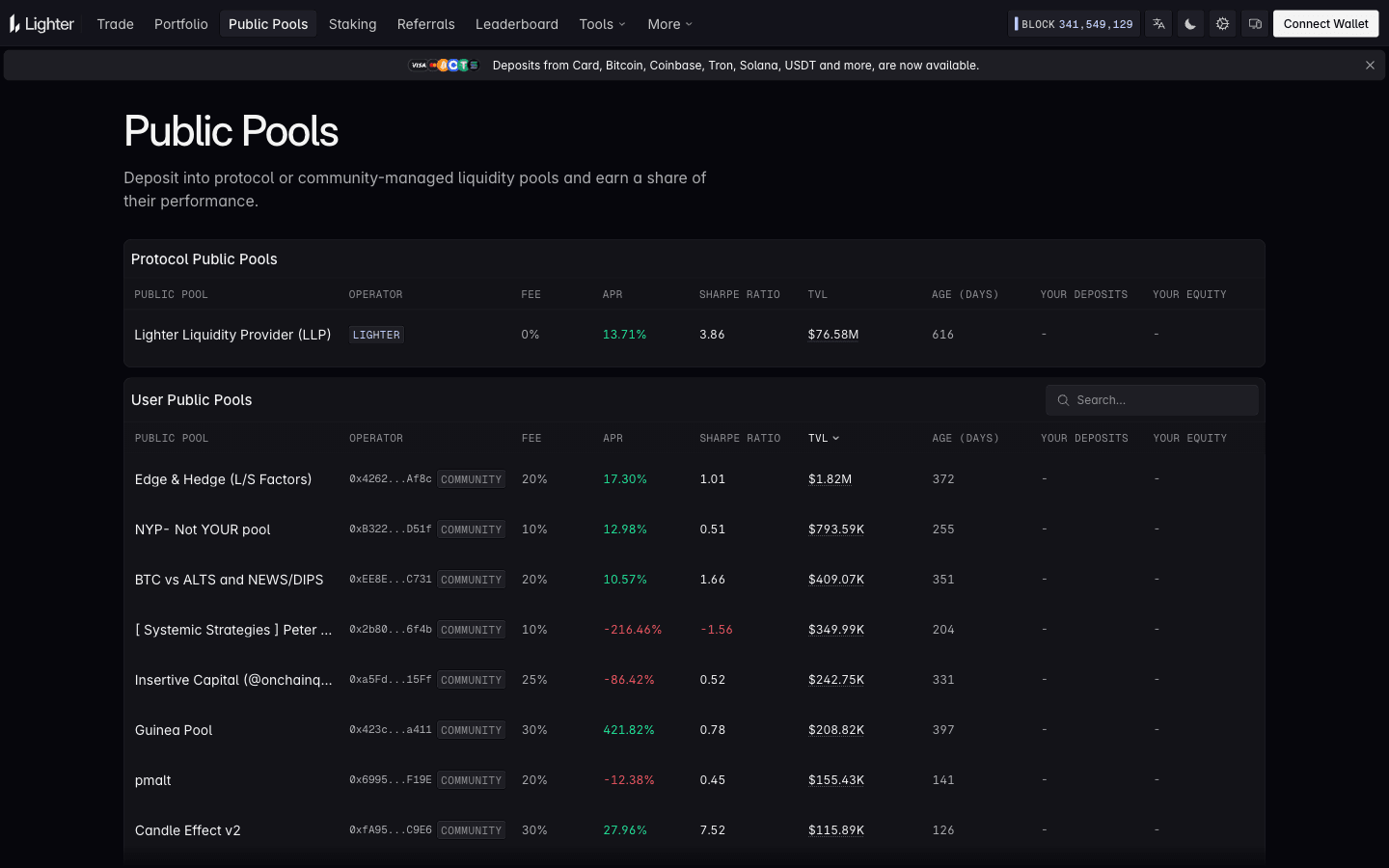
Public pools are vaults run by whitelisted operators through a sub-account. Operators set a profit fee and a minimum own share (the docs' example: a 10% minimum share lets $10,000 of operator capital accept $90,000 from others). There is no lockup — you can withdraw at any time — and pools cannot hold isolated positions. Displayed APRs vary from strongly positive to deeply negative, so read the track record and drawdown, not the headline number.
Deposits and withdrawals
Lighter's universal deposit addresses accept assets from twelve networks and convert them to USDC (or to USDC/ETH for spot): Ethereum, Arbitrum, Base, Optimism, Polygon, BNB Chain, HyperEVM, Monad, Solana, Tron, Bitcoin and Robinhood Chain. Accepted assets include USDC and USDT on most chains, ETH, SOL, BNB, native BTC and cbBTC, USDe and more. The app banner on September 25, 2026 read: "Deposits from Card, Bitcoin, Coinbase, Tron, Solana, USDT and more, are now available."
| Route | Minimum | Notes |
|---|---|---|
| Deposit from Ethereum | $5 | Also 1 USDC direct to the Ethereum contract (USDC only for perps) |
| Deposit from other EVM chains / Solana | $5 new account · $3 existing | Send a little extra: bridge and swap slippage apply |
| Deposit from Tron / Bitcoin | $5 / $10 | Status goes Processing → Completed, typically within minutes |
| Secure withdrawal | 1 USDC | Settles through Ethereum; the API's withdrawal delay read 1,456 s (~24 min) on Sept 25, 2026 |
| Fast withdrawal | 4 USDC | USDC only, completes via Arbitrum; check the fee shown in the modal |
| Transfer to another Lighter account | 1 USDC | Needs the Ethereum key's signature when sending to another L1 address |
Step-by-step screenshots and fixes for stuck deposits are in our guide to Lighter deposit and withdrawal.
Points and airdrop: what is actually running
Much of the "Lighter review" content online is about points farming, and most of it is out of date. What the official sources said on September 25, 2026:
- Season 1 ended with the final private-beta distribution on September 30, 2025.
- The docs' market-maker page opens with "Points Season 2 ended on December 26th 2025", while the retail page still describes 200,000 points a week distributed on Fridays. The two pages contradict each other.
- The app navigation (Trade, Portfolio, Public Pools, Staking, Referrals, Leaderboard, Tools) had no Points entry, and app.lighter.xyz/points returned a 404.
- Lighter on Robinhood Chain has its own points program (terms effective August 10, 2026, first weekly drop August 21) that bans wash trading, self-trading and multi-account farming.
So: do not trade on the main exchange expecting points. Trade there because it is free. Background and the history of both seasons: Lighter airdrop and LIT token.
Lighter referral code: what 718610TD gives you
Because Standard accounts pay nothing, Lighter's referral program is built around paid accounts. On October 19, 2026 Lighter's referral docs ("Referee discount") and the app's invite dialog both promised referred users 10% of their trading fees, rebated every Monday from sign-up. The same docs page still opens with the older line about the first week of Premium fees rebated, and the app still contains its "first week of Premium free" wording, so the offer you see after sign-up may differ. On Standard it changes nothing, because there is no fee to discount; it pays off if you switch to Premium/Advanced or Plus, or use paid advanced orders. The code can only be attached at sign-up through the invite link, never added or changed later, payouts have a $1 minimum, and all rebates are discretionary under the program rules. Payout timing and what we earn are in our Lighter referral code guide.
Trade with 0% fees, and keep 10% of any fees you do pay
Join with code 718610TD. Standard accounts pay nothing; on Premium or Plus, 10% of your fees comes back in USDC every Monday.
Who can use Lighter
Lighter's Terms of Service (last updated December 29, 2025) state in their opening notice that the service is not available to persons in the United States, Canada, the United Kingdom, China, North Korea, Russia, Ukraine, Cuba, Iran, Venezuela, Sudan, Belarus, Myanmar and Syria, and the "Prohibited Person" clause adds anyone in jurisdictions under comprehensive UN, EU, UK or US sanctions. Japan is not on either list. Hyperliquid and edgeX draw the line differently, excluding only Ontario in Canada and not naming the UK (Lighter vs other perp DEXs by country). The sign-up flow is a wallet connection with no identity verification, which is how self-custodial venues work — it does not make trading anonymous (deposits and withdrawals are public on-chain) and it does not change your tax obligations. Do not use a VPN or other workaround to access Lighter from a restricted country. Background: trading on DEXs without KYC.
Is Lighter DEX safe?
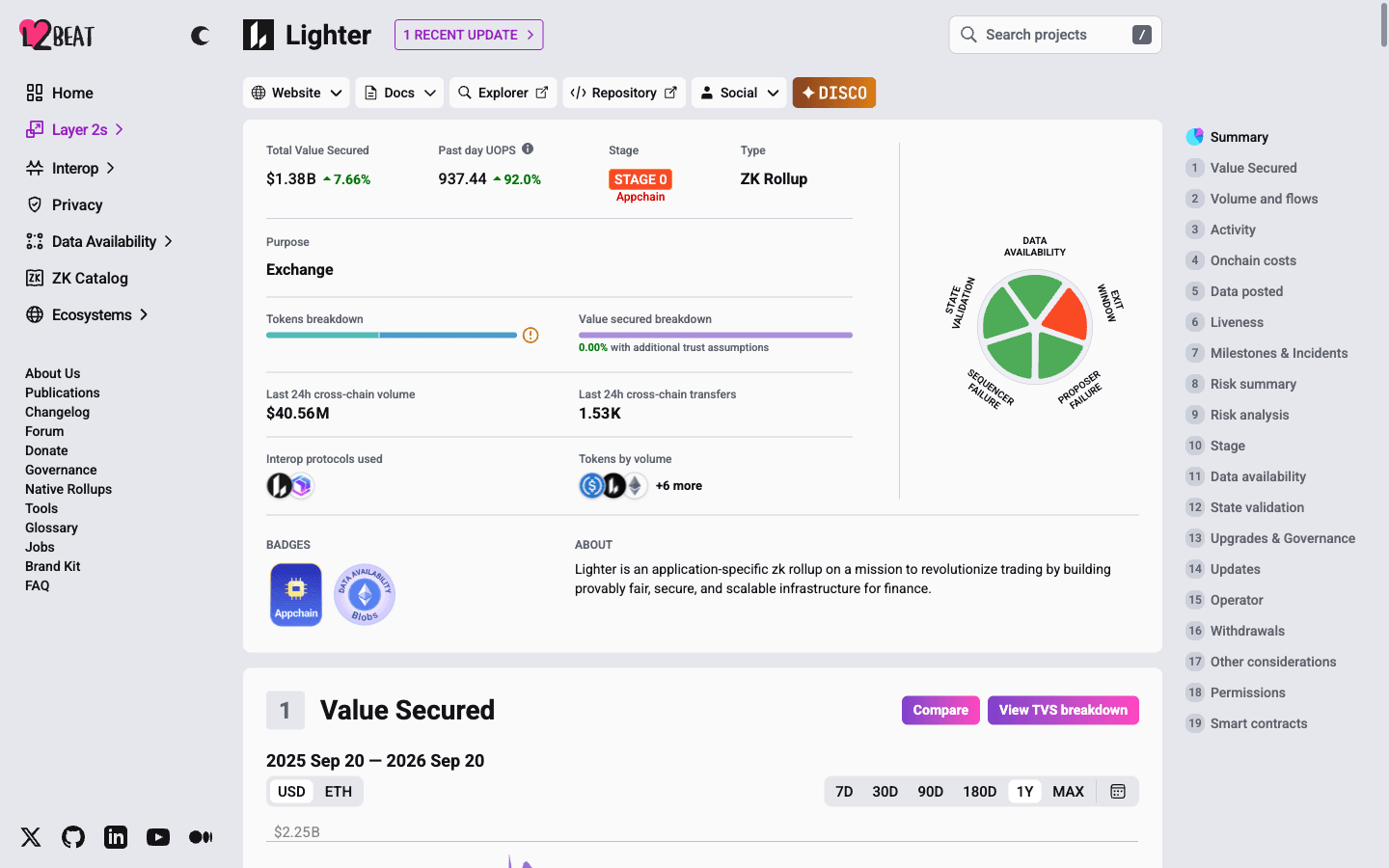
Short answer: the custody design is among the strongest of any perp DEX, and the remaining risks are market and operational ones. Your deposits sit in Ethereum smart contracts, not with a company; every batch of matching and liquidations is proven with ZK proofs that Ethereum verifies; and if the sequencer ignores exit requests, the Escape Hatch lets everyone withdraw on Ethereum without Lighter's help. Nine audit files covering the contracts and circuits are listed on docs.lighter.xyz. The honest caveats: L2BEAT rates Lighter at Stage 0 (the earliest rollup maturity stage, so upgrades are still controlled by the team), live trading depends on one sequencer, and leverage can wipe out an account far faster than any smart-contract bug. You can follow each batch from your trade to its proof on Ethereum in the Lighter explorer. The full list is in the next section.
Official Lighter links, and how to avoid fake sites
Most losses around new exchanges come from look-alike sites, not from the protocol. Use only these:
- lighter.xyz — the home page (docs, whitepaper, audits, status and "official app links").
- app.lighter.xyz and lighter.exchange — the trading app (both listed in the official docs' introduction).
- docs.lighter.xyz and apidocs.lighter.xyz — documentation; x.com/Lighter_xyz — announcements.
- Lighter Mobile by Elliot Technologies, Inc. on the App Store and Google Play.
In September 2026 Google's results for "lighter dex" included a page on github.io titled "Lighter Dex | Official Site" that is not run by Lighter. Bookmark app.lighter.xyz, check the address bar before you connect a wallet, and remember that Lighter never asks for a seed phrase — it only asks you to connect and sign. If a site asks for your recovery phrase or a token approval you did not expect, close it.
Risks and what to watch
- Leverage. 50x means a 1.2% maintenance margin; on BTC that is a sub-1% move to liquidation.
- Latency mismatch. Standard taker orders land 300 ms after you click. In fast markets the fill can be worse than the price you saw.
- Sequencer and upgrade risk. One sequencer provides live trading; if it stalls, trading stops even though the Escape Hatch protects funds. L2BEAT lists Lighter at Stage 0, the earliest rollup maturity stage.
- RWA and pre-IPO pricing. Off-hours and pre-IPO prices come from Lighter's internal mechanism; pre-IPO markets have no price caps.
- Vault risk. LLP and public pools can and do lose money; LLP's worst drawdown since launch was about −9%.
- Program risk. Referral rebates, points and the 6% staking APR are discretionary and can be changed or ended at any time.
Lighter vs the alternatives
Hyperliquid is the venue most traders compare Lighter with: it is the largest on-chain perp exchange ($4–8B a day), with deeper altcoin books and its own L1, but it charges 0.045% taker at the base tier where Lighter Standard charges 0%. Our head-to-head test is in Hyperliquid vs Lighter; if you open Hyperliquid, code HOLYGRAIL takes 4% off your fees on the first $25M. Aster is the third big order-book perp DEX, with a separate 1001x mode.
| Item | Hyperliquid | Lighter | Aster |
|---|---|---|---|
| Base taker / maker | 0.045% / 0.015% | 0% / 0% (Standard) 0.028% / 0.004% (Premium) | 0.04% / 0% |
| Max leverage (BTC) | 40x | 50x, no brackets | 200x up to $400 notional (Pro); 1001x in 1001x mode |
| 24h volume | $4–8B | ≈ $1.96B (CoinGecko, October 20, 2026) | ≈ $1.43B (CoinGecko, October 20, 2026) |
| Settlement | Own L1 (HyperCore) | zk-rollup on Ethereum | Aster Chain L1 |
| Non-crypto perps | Via HIP-3 builder markets | Stocks, indices, commodities, FX, pre-IPO | Stocks, commodities (RWA) |
| Our code | HOLYGRAIL (4% off first $25M) | 718610TD (10% of fees rebated) | DTLpLc |
| Review | Hyperliquid review | this page | Aster review |
Choose Lighter when fees decide it or you want stock and FX perps; choose Hyperliquid when you need the deepest altcoin books or the largest on-chain perp venue. Many active traders keep both: Hyperliquid for liquidity, Lighter for free fills. More comparisons: Lighter vs Aster, Lighter vs Jupiter perps (for Solana traders), Hyperliquid fees, and the full best DEX comparison.
Frequently asked questions
What is Lighter DEX (lighter.xyz)?
Lighter is a decentralized perpetual futures and spot exchange built as its own zero-knowledge rollup on Ethereum. An off-chain order book matches trades, and every batch of matches and liquidations is proven with ZK proofs that Ethereum verifies. lighter.xyz is the project's home page; you trade at app.lighter.xyz (also lighter.exchange) from a self-custodial wallet, with no KYC at sign-up. The default Standard account pays 0% maker and 0% taker, and the protocol's token is LIT.
Is Lighter DEX safe?
Lighter is a non-custodial zk-rollup: deposits sit in Ethereum smart contracts, every batch of trades is proven with zero-knowledge proofs that Ethereum verifies before the state updates, and an Escape Hatch lets users withdraw directly on Ethereum if the sequencer stops processing priority requests. 9 audit reports for its contracts and circuits are listed in the docs. That removes operator fraud on matching, not market risk: leverage, liquidations, a single sequencer for live trading, Stage 0 upgrade control and young RWA pricing remain. Use only app.lighter.xyz or lighter.exchange, and never enter a seed phrase.
Which Lighter sites are official?
lighter.xyz is the home page. The trading app is at app.lighter.xyz (the official docs also list lighter.exchange), the documentation at docs.lighter.xyz and apidocs.lighter.xyz, and the X account is @Lighter_xyz. The mobile app is Lighter Mobile by Elliot Technologies on the App Store and Google Play. Look-alike pages exist: in September 2026 a page on github.io titled "Lighter Dex | Official Site" ranked in Google for "lighter dex". Lighter only asks you to connect and sign with your wallet, never for a seed phrase.
How do I use Lighter?
Open app.lighter.xyz through an invite link, click Connect Wallet and log in with an email address or a wallet, then deposit at least $5 (USDC is simplest); that first deposit creates your account. Choose Standard (0% fees) in the account-type dialog, pick a market, choose Market or Limit, enter a size of at least $10, add a stop-loss and place the order. Close it with an opposite order ticked Reduce Only. The five steps with screenshots are in the "How to use Lighter" section above.
Which wallet do I need for Lighter?
Any EVM wallet in the login list works: Coinbase, OKX Wallet, MetaMask, Binance Wallet, Rabby and Phantom are marked Recommended, and "View all wallets" searches 586 wallets including WalletConnect for phone wallets (checked October 19, 2026). You can also sign up with just an email address; the app then creates an embedded wallet whose private key you can export. Your Lighter account is tied to the Ethereum address that created it, and secure withdrawals go back to that address.
Does Lighter have a mobile app?
Yes. Lighter Mobile (Elliot Technologies) is on the App Store (version 1.1.4, updated September 25, 2026) and Google Play (updated September 24, 2026, 10K+ downloads). Its store listing says wallet-based features are available only in selected supported regions and that elsewhere the app only shows market information; it is English only. The web app at app.lighter.xyz works in a phone browser with the full order ticket.
Is Lighter a crypto or an exchange? Is LIT a good buy?
Both names refer to one project, but they are different things. Lighter is the exchange; LIT (Lighter Infrastructure Token) is its token, which trades on Lighter and elsewhere and is used for staking (a fixed 6% APR at the time of writing), LLP access and Premium fee discounts. You do not need LIT to trade on Lighter. Whether LIT is a good buy is a price question we do not answer: its value depends on the exchange's volume, fee revenue and buybacks, and on token supply still to be released (250M of 1B circulating in September 2026). This is not investment advice.
Who founded Lighter, and who backs it?
Lighter was founded in 2022 by Vladimir Novakovski, its CEO. Fortune reported on November 11, 2025 that Lighter raised $68M at a valuation of around $1.5B in a round led by Founders Fund and Ribbit Capital, with Haun Ventures and Robinhood participating, after a $21M round in 2024. Lighter's own site lists Founders Fund, Ribbit, Haun, Robinhood and Coinbase among its backers. Backers do not make a venue safe; the zk-rollup design and your own risk management do.
Is Lighter really zero-fee?
On the default Standard account, yes: 0% maker and 0% taker on every perp and spot market, with no gas on orders. You pay with latency (300 ms taker) instead. Premium/Advanced accounts pay 0.0040% maker / 0.0280% taker for 140 ms fills, Plus accounts pay 0.005% for higher API limits, and even Standard accounts pay a small fee on advanced order types such as TWAP (the order ticket showed 0.01% on September 25, 2026). Funding and a liquidation fee of up to 1% apply to everyone.
What is a Lighter Premium account, and how is it different from Standard and Plus?
Standard is free: taker orders and cancels wait 300 ms; maker orders are not delayed, with up to 4 sub-accounts and 60 API requests a minute. Premium (now labelled "Premium/Advanced" in the docs) costs 0.0040% / 0.0280% (cut by up to 30% with staked LIT) and buys faster taker fills (140 ms) with no added delay on cancels or post-only orders, 64 sub-accounts and 4,000–72,000 transactions per minute depending on staked LIT (rate-limits page, checked October 15, 2026). Plus costs 0.005% per side, keeps a delay (300 ms taker, 200 ms maker and 200 ms cancel) and raises API limits to 4,000 transactions and 24,000 weighted reads per minute. The account type is tied to your Ethereum address; you can downgrade once every 24 hours and upgrade at any time.
What does the Lighter referral code 718610TD give me?
Lighter's referral docs and the app's invite dialog (both checked October 19, 2026) promise referred users 10% of their trading fees, rebated every Monday from sign-up. The same docs page still opens with the older line about the first week of Premium fees rebated, and the app still carries that free-Premium-week wording, so the offer your invite shows may differ. On the free Standard account there is nothing to discount, so it matters if you use Premium/Advanced, Plus or paid advanced orders. The code can only be attached at sign-up through the invite link; it cannot be added or changed later, and all rebates are discretionary.
Is there a Lighter points season running now?
Do not assume so. Season 1 ended on September 30, 2025. The docs contradict each other on Season 2: the market-maker page says it ended on December 26, 2025, while the retail page still describes 200,000 points a week. On September 25, 2026 the app had no Points page (app.lighter.xyz/points returned a 404). The separate Lighter instance on Robinhood Chain runs its own points program with weekly drops since August 21, 2026.
What leverage does Lighter offer?
Each market has one fixed maximum with no size brackets. On October 19, 2026 the API showed 50x on BTC, ETH, SPY, US500 and the major FX pairs, 30x on US100 and QQQ, 25x on SOL, gold and silver, 20x on XRP, HYPE, BNB, ZEC and large US stocks, and 10x or less on most altcoins. Pre-IPO markets such as OPENAI are 5x and isolated-only.
How do I deposit on Lighter, and is there a minimum?
Connect a wallet and use Deposit. Lighter accepts deposits from Ethereum, Arbitrum, Base, Optimism, Polygon, BNB Chain, HyperEVM, Monad, Solana, Tron, Bitcoin and Robinhood Chain; they are converted to USDC for perps. Minimums are $5 for a new account ($3 for an existing one on most EVM chains and Solana, $10 from Bitcoin). The app also advertises card and Coinbase deposits. Withdrawals are either secure (via Ethereum, 1 USDC minimum) or fast (USDC via Arbitrum, 4 USDC minimum).
Ready to try Lighter?
Open your account through 718610TD — trade free on Standard, and get 10% of any Premium or Plus fees back every Monday.
Also trading on Hyperliquid? Join with HOLYGRAIL for 4% off fees.
Disclosure: links on this page use our referral code 718610TD. Lighter pays us a share of the fees paid by accounts referred through it (Premium and Plus fees, and advanced-order fees on Standard); free Standard trading generates no commission, and our commission never raises your fees. The 10% referee rebate is paid by Lighter's referral program, not by us. Figures are as of October 19, 2026 and may change. Perpetual futures are high-risk instruments; this is not investment advice.