1. Liquidation price formula (long, short, cross, tiers)
A position is liquidated when its margin plus unrealized PnL falls to the maintenance margin, measured at the mark price. For a fresh isolated position holding exactly its initial margin (notional ÷ leverage) and a flat maintenance rate m, that gives two lines you can use on any venue:
Long: liquidation price = entry × (1 − 1/L) ÷ (1 − m)
Short: liquidation price = entry × (1 + 1/L) ÷ (1 + m)
Exact (Hyperliquid docs): liq_price = price − side × margin_available ÷ size ÷ (1 − m × side)
margin_available = margin − maintenance margin; maintenance margin = notional × m − deduction
- L
- leverage (isolated margin = notional ÷ L)
- m
- maintenance margin rate of the tier at the liquidation price
- side
- +1 for a long, −1 for a short
- margin
- isolated margin, or the account value in cross margin
Exact vs shortcut. Most cheat sheets use entry × (1 − 1/L + m) for longs. It puts a long’s liquidation price slightly too close to entry, because the exchange measures the maintenance margin on the position’s value at the liquidation price, which is smaller than at entry:
| BTC long, Hyperliquid | Shortcut entry × (1 − 1/L + m) | Exact formula | Shortcut is off by |
|---|---|---|---|
| 5x | $66,684 | $66,490 | $194.79 |
| 10x | $74,892 | $74,801 | $90.90 |
| 25x | $79,816 | $79,787 | $28.57 |
| 40x | $81,047 | $81,034 | $12.99 |
Entry $82,073 (Hyperliquid BTC mark, October 20, 2026 03:53 UTC), maintenance 1.25%. Our arithmetic.
Cross margin. Put the account value into margin_available instead. That is why Hyperliquid’s docs say the liquidation price of a cross position is independent of the leverage you set: a lower setting only locks more collateral as initial margin. With several cross positions, their unrealized PnL moves every liquidation price at once.
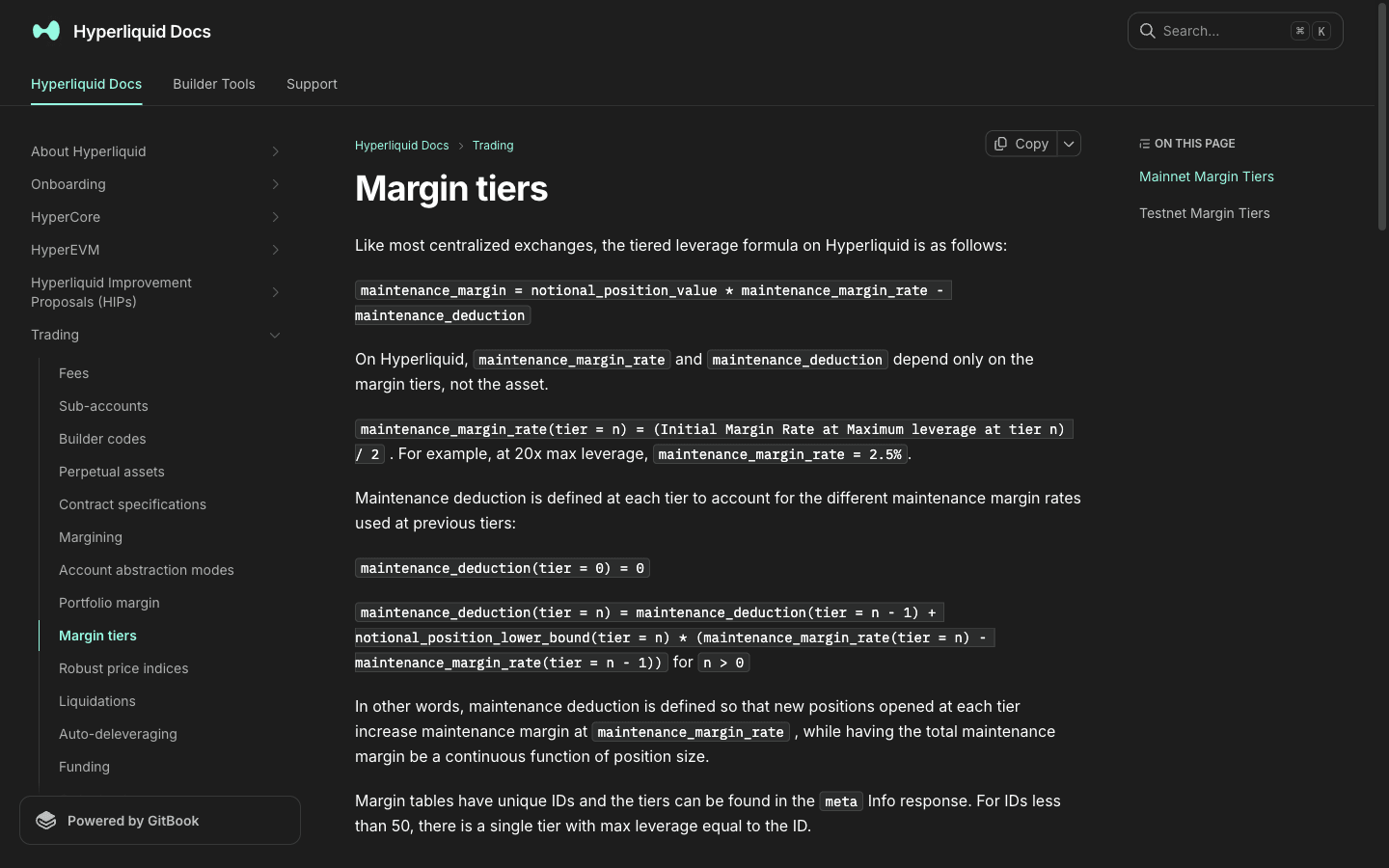
Margin tiers. Venues raise the maintenance rate as the position grows: maintenance margin = notional × rate − deduction, where the deduction keeps the requirement continuous from one tier to the next. With a deduction D, an isolated long liquidates at (entry × size − margin − D) ÷ (size × (1 − rate)) and a short at (entry × size + margin + D) ÷ (size × (1 + rate)). Hyperliquid’s docs add that the tier that counts is the one matching the position value at the liquidation price, and the calculator re-evaluates it there. edgeX applies its tier rate to the whole position with no deduction. Full tables: DEX leverage tiers comparison.
2. Worked example: a 10x BTC long, step by step
The calculator’s default trade: $10,000 of BTC on Hyperliquid at $82,073 (the mark at October 20, 2026 03:53 UTC), isolated, 10x.
- Quantity = $10,000 ÷ $82,073 = 0.12184 BTC.
- Initial margin = $10,000 ÷ 10 = $1,000.00.
- Maintenance margin at entry = 1.25% × $10,000 = $125.00, so margin_available = $875.00.
- Liquidation price = $82,073 − $875.00 ÷ 0.12184 ÷ (1 − 0.0125) = $74,801, 8.86% below entry.
Check: at $74,801 the position has lost $886.08, leaving $113.92 of equity, exactly 1.25% of the position’s value at that price. The same trade as a short liquidates at $89,166 (+8.64%). At the 40x maximum the long would liquidate at $81,034, only 1.27% away.
3. How to calculate a liquidation price in 4 steps
- Find the maintenance margin rate for your market and size: on Hyperliquid half the initial margin at the asset’s max leverage (1.25% for BTC); on Lighter 60% of the minimum initial margin; on Aster and edgeX the bracket or tier your notional falls in.
- Work out the margin behind the position: notional ÷ leverage for isolated, the account value for cross.
- Subtract the maintenance margin at entry (notional × rate − deduction) to get margin_available.
- Divide by the quantity and by (1 − rate) for a long or (1 + rate) for a short, then subtract that from the entry price (long) or add it (short).
Then compare the result with your stop-loss. If the stop is beyond the liquidation price, the exchange will close you before your stop ever triggers; the calculator flags it.
4. Venue rules: Hyperliquid, Lighter, Aster, edgeX
| Hyperliquid | Lighter | Aster (Pro order book) | edgeX | |
|---|---|---|---|---|
| Maintenance margin | Half the initial margin at the asset’s max leverage: BTC 1.25%, ETH 2%, SOL/XRP 2.5%, 10x markets 5%, 3x markets 16.7% | 60% of the minimum initial margin: BTC/ETH 1.2%, SOL 2.4%, HYPE/XRP 3% | By position size (BTC): 0.25% to $400, 0.33% to $300,000, 0.5% to $800,000, minus a cumulative deduction | By tier, on the whole position (BTC): 0.5% to $1M, 0.67% to $3M, 1% to $5M… |
| Formula | notional × rate − deduction; the tier at the liquidation price counts | Σ size × mark × maintenance fraction | notional × bracket rate − cumulative maintenance amount | position value × tier rate (no deduction) |
| Price that triggers it | Mark price | Mark price | Mark price | Oracle price (Stork) |
| What happens first | Full-size market order to the book; leftover collateral stays with you | Pre-liquidation below initial margin (only risk-reducing trades); below maintenance all orders cancelled, then zero-price IoC orders | All orders cancelled, one large IOC order | Liquidation when the available balance reaches zero and margin drops to maintenance |
| Fee | No clearance fee on book liquidations | Up to 1% to the LLP insurance fund on partial liquidation | Liquidation fee, part of it booked as “Insurance Clearance Fee” | Liquidation fee 1% |
| Backstop | Below two-thirds of maintenance margin: HLP liquidator vault takes over, maintenance margin not returned | Below the close-out margin (0.8% on BTC/ETH): the LLP takes positions over; then ADL | Rest closed at the bankruptcy price and handed to the insurance fund; then ADL | Auto-deleveraging (edgeX ADL rules) |
| Large positions | Above 100,000 USDC: the first liquidation order is 20% of the position; for the next 30 s further orders are for the whole position | Positions closed one by one until the account is back above maintenance | Higher brackets carry a higher maintenance rate | Lower max leverage per tier, down to 6x above $50M |
From each venue’s liquidation docs and public APIs (re-checked October 1, 2026; sources and dates below). dYdX BTC-USD and ETH-USD use one maintenance fraction of 1.2% at up to 50x; both are in the calculator.
Hyperliquid
When account equity drops below maintenance margin, the protocol sends market orders for the full position to the book. If that restores maintenance margin, whatever collateral is left stays with you, and there is no clearance fee. Above 100,000 USDC only 20% goes out in the first liquidation order; during the 30-second cooldown that follows, any further liquidation order is for the whole position. Only below two-thirds of maintenance margin does the liquidator vault inside HLP take over, and then the maintenance margin is not returned. BTC allows 40x up to $150M and 20x above; ETH 25x to $100M, then 15x. Background: HLP, insurance and ADL; where other traders’ liquidations cluster: Hyperliquid liquidation map; one-market depth: the cross vs isolated margin guide.
Lighter
Lighter sets three margin levels per market. BTC and ETH have a 2% minimum initial margin (50x), 1.2% maintenance and a 0.8% close-out margin. Between initial and maintenance the account is in pre-liquidation: you can only reduce risk. Below maintenance the engine cancels your open orders and sends immediate-or-cancel orders at the “zero price”, taking up to a 1% fee for the LLP insurance fund if they fill better. Below the close-out margin the LLP takes the positions over, so the calculator shows both prices. An isolated position is treated as a separate account whose collateral is its allocated margin.
Aster
On Aster’s order-book perps, liquidation triggers when margin (initial collateral plus realized and unrealized PnL) falls below maintenance margin, checked on the mark price; Aster recommends keeping the margin ratio below 80%. The engine cancels open orders, sends one large IOC order, and if that is not enough closes the rest at the bankruptcy price for the insurance fund. Aster’s docs still list their own liquidation calculator as “coming soon”, so this page applies Aster’s published brackets and deductions. The separate 1001x mode has its own rules and is not covered. More: Aster margin, leverage and liquidation.
edgeX
edgeX uses the oracle price (Stork) for margin requirements and liquidation prices, not the last trade. BTC’s risk tiers run 0.5% to $1M, 0.67% to $3M, 1% to $5M, 2% to $20M, 2.5% to $30M, 5% to $40M, 6.25% to $50M, 8.33% above $50M, with the whole position at its tier’s rate. Cross margin is the default; isolated margin works through separate sub-accounts. Liquidations carry a 1% fee.
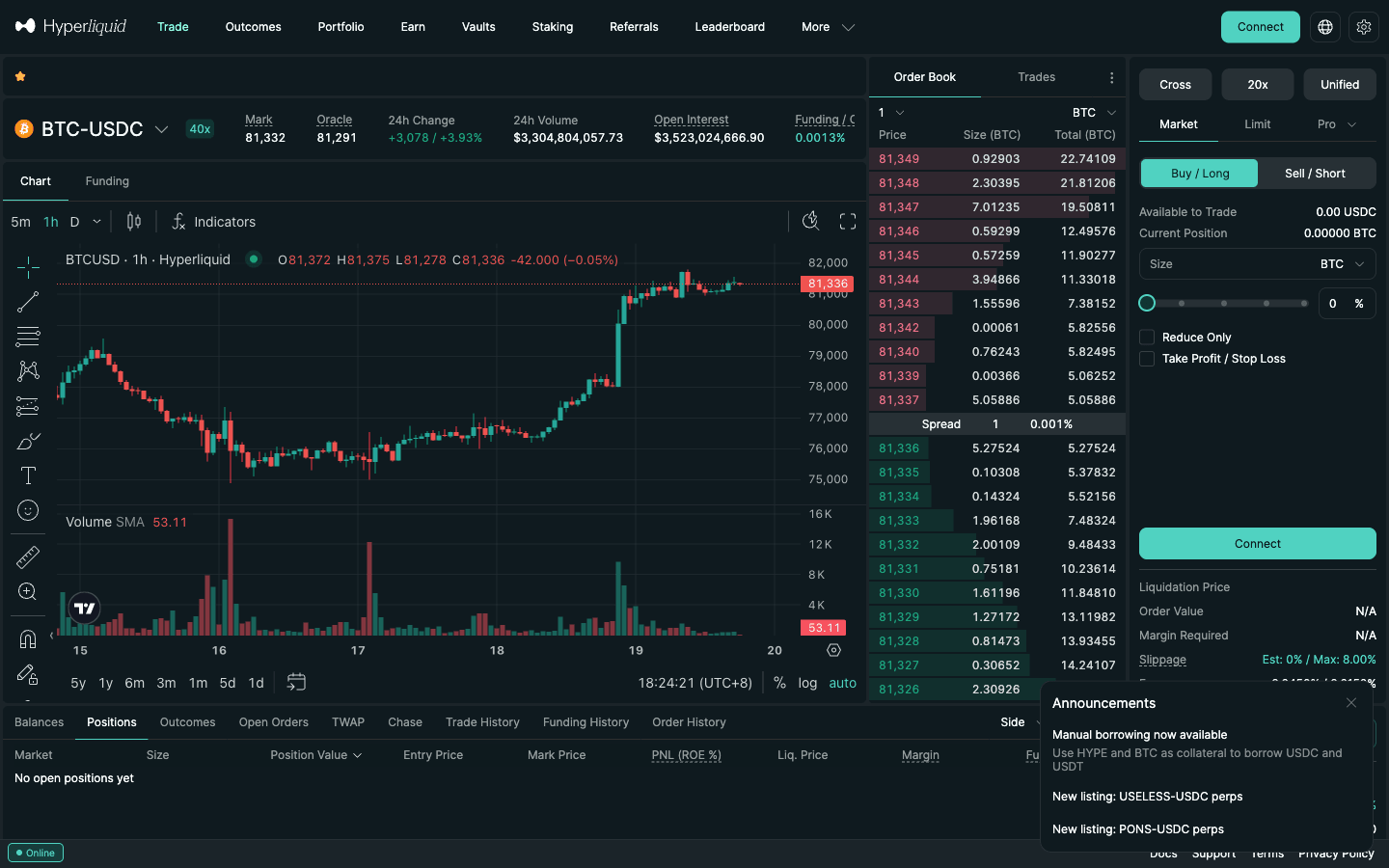
Pick a venue that returns what is left
On Hyperliquid, book liquidations carry no clearance fee and leftover margin stays in your account. Join with HOLYGRAIL for 4% off fees on your first $25M. Prefer zero trading fees? Lighter’s Standard account charges 0% maker and taker; code 718610TD.
5. BTC liquidation prices at 3x–40x on Hyperliquid, Lighter, Aster and edgeX
Same trade on four venues: $10,000 of BTC, isolated, entry at Hyperliquid’s BTC mark of $82,073 (October 20, 2026 03:53 UTC) so the numbers are comparable. Maintenance rates: Hyperliquid 1.25%, Lighter 1.2% (partial liquidation starts there), Aster 0.33% with a 1 USDT deduction, edgeX 0.5%.
| Leverage | Isolated margin | Hyperliquid long | Lighter long | Aster long | edgeX long |
|---|---|---|---|---|---|
| 3x | $3,333.33 | $55,408 (−32.49%) | $55,380 (−32.52%) | $54,888 (−33.12%) | $54,990 (−33.00%) |
| 10x | $1,000.00 | $74,801 (−8.86%) | $74,763 (−8.91%) | $74,102 (−9.71%) | $74,237 (−9.55%) |
| 25x | $400.00 | $79,787 (−2.78%) | $79,747 (−2.83%) | $79,043 (−3.69%) | $79,186 (−3.52%) |
| 40x | $250.00 | $81,034 (−1.27%) | $80,993 (−1.32%) | $80,278 (−2.19%) | $80,423 (−2.01%) |
| Leverage | Hyperliquid short | Lighter short | Aster short | edgeX short |
|---|---|---|---|---|
| 3x | $108,080 (+31.69%) | $108,133 (+31.75%) | $109,079 (+32.90%) | $108,886 (+32.67%) |
| 10x | $89,166 (+8.64%) | $89,210 (+8.70%) | $89,992 (+9.65%) | $89,831 (+9.45%) |
| 25x | $84,302 (+2.72%) | $84,344 (+2.77%) | $85,083 (+3.67%) | $84,931 (+3.48%) |
| 40x | $83,086 (+1.23%) | $83,127 (+1.28%) | $83,856 (+2.17%) | $83,706 (+1.99%) |
Our arithmetic from each venue’s published formula and margin parameters (October 1, 2026). Real liquidation prices also move with fees, funding and each venue’s own mark or oracle price.
Below 10x the venue barely matters: the maintenance rate is small next to 1/L. At high leverage it matters. At 40x, Aster’s lower 0.33% rate leaves more room than Hyperliquid’s 1.25%, but only about $756 of BTC price, or $92 on this position, and Aster charges a liquidation fee while Hyperliquid charges no clearance fee on book liquidations. At Lighter’s 50x BTC maximum, partial liquidation starts 0.81% below entry and full liquidation at 1.21%.
ETH on Hyperliquid (mark $2,411.80, maintenance 2%): long liquidation prices are $1,640.68 (−31.97%) at 3x, $2,214.92 (−8.16%) at 10x, $2,362.58 (−2.04%) at 25x (the maximum). Shorts: $3,152.68 (+30.72%), $2,600.96 (+7.84%), $2,459.09 (+1.96%).
6. Leverage → distance to liquidation
The adverse move, in percent of entry, that liquidates a fresh isolated position (long / short). Only leverage and the maintenance rate matter, so it works at any price.
| Leverage | HL BTC (1.25%) | HL ETH (2%) | HL SOL/XRP (2.5%) | HL 10x alts (5%) | Lighter BTC/ETH (1.2%) | Aster BTC ≤$300,000 (0.33%) | edgeX BTC ≤$1M (0.5%) |
|---|---|---|---|---|---|---|---|
| 2x | 49.37% / 48.15% | 48.98% / 47.06% | 48.72% / 46.34% | 47.37% / 42.86% | 49.39% / 48.22% | 49.83% / 49.51% | 49.75% / 49.25% |
| 3x | 32.49% / 31.69% | 31.97% / 30.72% | 31.62% / 30.08% | 29.82% / 26.98% | 32.52% / 31.75% | 33.11% / 32.89% | 33.00% / 32.67% |
| 5x | 18.99% / 18.52% | 18.37% / 17.65% | 17.95% / 17.07% | 15.79% / 14.29% | 19.03% / 18.58% | 19.74% / 19.61% | 19.60% / 19.40% |
| 10x | 8.86% / 8.64% | 8.16% / 7.84% | 7.69% / 7.32% | 5.26% / 4.76% (max) | 8.91% / 8.70% | 9.70% / 9.64% | 9.55% / 9.45% |
| 20x | 3.80% / 3.70% | 3.06% / 2.94% | 2.56% / 2.44% (max) | n/a (max 10x) | 3.85% / 3.75% | 4.69% / 4.65% | 4.52% / 4.48% |
| 25x | 2.78% / 2.72% | 2.04% / 1.96% (max) | n/a (max 20x) | n/a (max 10x) | 2.83% / 2.77% | 3.68% / 3.66% | 3.52% / 3.48% |
| 40x | 1.27% / 1.23% (max) | n/a (max 25x) | n/a (max 20x) | n/a (max 10x) | 1.32% / 1.28% | 2.18% / 2.16% | 2.01% / 1.99% |
| 50x | n/a (max 40x) | n/a (max 25x) | n/a (max 20x) | n/a (max 10x) | 0.81% / 0.79% (max) | 1.68% / 1.66% | 1.51% / 1.49% |
Long / short move to liquidation. “max” marks the market’s maximum leverage (October 1, 2026). The Aster column ignores its 1 USDT deduction, which is negligible above a few thousand dollars.
Next to real volatility the table becomes a warning. Over the 90 days to September 30, 2026, BTC’s average daily high-to-low range on Hyperliquid was 2.77%, ETH’s 3.78%, SOL’s 4.33% and HYPE’s 5.65%, and BTC’s biggest single hour moved 4.01%. In hourly data to October 1, 2026, a 40x BTC long opened at the start of any hour would have hit its liquidation price within 24 hours 37.6% of the time; at 20x, 1.4%; at 10x, never. A 25x ETH long: 29.2% (our back-test on Hyperliquid candles). More in sizing for volatile markets.
7. Cross margin examples
The same $10,000 BTC long at $82,073 on Hyperliquid, in cross margin with nothing else open. Maintenance margin at entry is $125.00.
- $1,000 account: liquidation ≈ $74,801 (−8.86%).
- $2,000 account: liquidation ≈ $66,490 (−18.99%).
- $5,000 account: liquidation ≈ $41,556 (−49.37%).
The leverage slider (10x or 40x) changes none of these numbers; it only decides how much of the account is locked as initial margin and what you can still open. What does change them is everything else in the account: a losing second cross position pulls this liquidation price closer, a winning one pushes it away, and withdrawing unrealized profit can move it a long way (Hyperliquid only lets you remove margin if what remains covers the initial margin and at least 10% of total position value). Hyperliquid’s Unified Account also counts spot USDC as cross collateral, and the app warns that a Unified Account Ratio above 95% may lead to liquidation.
8. Why your exchange shows a different number
- Estimate vs position. The order form shows an estimate. Hyperliquid says it can be off because book liquidity changes your fill, and when your margin is short it assumes the account is topped up to the initial margin.
- Fees and funding change the margin behind the position (numbers below).
- Other positions. In cross margin the PnL of every other cross position moves this one’s liquidation price.
- Shortcut formula. A calculator using entry × (1 − 1/L + m) shows a slightly higher long liquidation price than the exchange (table in section 1).
- Tiers and deductions. Above a tier boundary the rate and the deduction change; one flat rate is wrong for large positions.
- Trigger price. Liquidation uses the mark price (Hyperliquid, Lighter, Aster) or the oracle price (edgeX), not the last trade on the chart (mark vs index price).
9. How fees and funding move your liquidation price
The formulas assume the margin behind the position never changes. In practice every dollar that leaves it moves the liquidation price toward the market by that dollar ÷ (size × (1 − m)).
- Funding. Hyperliquid and Lighter settle funding every hour; Aster’s BTC perp every 8 hours. BTC longs on Hyperliquid paid 0.7219% of notional in funding over the 30 days to September 30, 2026. On the $10,000 10x isolated long above that is $72.19, which lifts the liquidation price from $74,801 to about $75,401. A short collecting the same funding sees its liquidation price move away.
- Trading fees. In cross margin the opening fee comes out of the account value. Hyperliquid’s base taker fee (0.045%) on $10,000 is $4.50, which moves the cross liquidation price about $37 closer. See the DEX fee calculator.
- Liquidation costs. Hyperliquid charges no clearance fee on book liquidations but keeps the maintenance margin in a backstop; Lighter takes up to 1% on partial liquidations; Aster and edgeX charge a liquidation fee. Getting stopped out one tick before liquidation is cheaper.
- Adding margin (isolated) or depositing (cross) moves the price away. Hyperliquid’s margining docs list partial closes, adding isolated margin and depositing USDC as the three ways to rescue a losing position.
At the 0.01%-per-8-hours baseline, funding on this position is about $3.00 a day, but a crowded market can pay many times that: Hyperliquid funding rate explained.
10. Choosing leverage from your stop distance
Leverage and position size are different decisions. Position size decides how much you lose if the stop hits; leverage only decides how much margin you park in the position and therefore where liquidation sits.
- Set the stop where the trade idea is wrong, from the chart.
- Size the position from risk: notional = (account × risk per trade) ÷ stop distance. With $10,000 and 1% risk, a 2% stop allows $5,000 of notional.
- Choose leverage so liquidation is at least twice the stop distance away. Stops can slip in fast markets (a market TP/SL on Hyperliquid tolerates up to 10% slippage). The calculator’s stop field does this for you.
| Stop distance | BTC (1.25%) | ETH (2%) | SOL (2.5%) | 10x alts (5%) |
|---|---|---|---|---|
| 1% | 31x | 25x (cap) | 20x (cap) | 10x (cap) |
| 2% | 19x | 16x | 15x | 10x (cap) |
| 3% | 13x | 12x | 11x | 9x |
| 5% | 8x | 8x | 8x | 6x |
| 8% | 5x | 5x | 5x | 4x |
| 10% | 4x | 4x | 4x | 4x |
Maximum isolated long leverage on Hyperliquid (rounded down) that keeps liquidation at least 2× the stop distance away: 1 ÷ (1 − (1 − 2 × stop) × (1 − m)). “cap” = the market’s maximum. Lighter’s 1.2% BTC rate gives the same numbers as the BTC column except at a 3% stop (14x) and a 5% stop (9x).
With $5,000 of notional and a 2% stop on BTC, 10x means $500 of margin and a liquidation 8.86% away, far beyond the stop; the dollar risk is still $100. Practical rules that survive this maths: beginners 1–3x (liquidation roughly 32%–49% away on BTC); swing trades held overnight usually 5x or less (20x leaves 3.80%); a tight-stop scalp can use more only because the stop is tight (at 40x the cushion is 1.27%). Sizing in depth: position sizing strategy and risk management for perp DEXs.
11. How to avoid liquidation: a checklist for any perp DEX
Every venue’s docs say the same in different words. Hyperliquid: place stop-loss orders or exit before the mark price reaches the liquidation price. Aster: lower leverage, add collateral, set a stop-loss, monitor funding, avoid oversized positions, close before high-volatility events.
- Size from the stop, then pick leverage so that liquidation sits at least twice as far away as the stop (table above).
- Treat the headline cap as a limit, not a setting. At 20x a 3.80% move liquidates a BTC long; at 5x it takes 18.99%.
- Use isolated margin for anything speculative, so one position cannot pull the rest of the account toward liquidation. Aster does not let you change the margin mode while a position or open order exists.
- Trade liquid markets with size in proportion to the book. On October 1, 2026 a simulated $1M market buy on Hyperliquid’s order book filled about 0.015% above mid on BTC but around 1.24% on JUP; in a thin market the fill, not the trigger, sets your loss.
- Check the calendar and the funding rate. On September 11, 2026, in the hour after the US CPI release, ETH moved 6.21% from high to low.
- Attach the stop to the position, on the exchange. Hyperliquid triggers TP/SL on the mark price, the same price that triggers liquidation; Aster lets you choose mark or last price. TP/SL attached to an entry are placed only if the parent fills completely (Hyperliquid order types).
- Budget for funding. In the 7 days to October 1, 2026 AERO longs on Hyperliquid paid 0.98% of notional in funding. AERO is a 3x market with a 16.7% maintenance margin, so a fresh 3x isolated long starts 20% from liquidation; that week’s funding brings liquidation to about −18.8%. On a 10x position the same drain would eat 10% of the margin.
- In cross margin, watch the account, not one position. Hyperliquid liquidates cross positions when the Cross Margin Ratio reaches 100%; Aster recommends keeping its margin ratio below 80%.
- Exit yourself, one step early. Aster’s docs advise closing manually before the maintenance threshold to avoid liquidation fees; Lighter restricts an account to risk-reducing trades once it falls below initial margin. Cascades are real, as the October 10, 2025 market-wide crash showed (how liquidation cascades form).
12. What the calculator does not include
- It is an estimate from published rules, not advice and not the exchange’s own engine. Check the order form before you trade.
- Trading fees, funding and slippage are not deducted (section 9 shows how much they move the price).
- Cross margin assumes no other open positions; real cross accounts add every position’s PnL and maintenance margin.
- Venues other than Hyperliquid share Hyperliquid’s mark as the default entry; type your own entry for those books.
- Aster’s high-leverage mode, Hyperliquid HIP-3 markets, portfolio margin and Lighter’s per-market buckets beyond BTC, ETH, SOL, HYPE and XRP are not modelled; use the custom rate for them.
Sources (official pages behind every rule, with the date we last checked them)
- api.hyperliquid.xyz/info (verified October 1, 2026)
- docs.asterdex.com/trading/perpetuals/fees-and-specs/liquidations.md (verified September 27, 2026)
- docs.lighter.xyz/trading/liquidations-and-llp-insurance-fund (verified September 26, 2026)
- edgex-1.gitbook.io/edgeX-documentation/trading/last-price-index-price-and-oracle-price (verified October 1, 2026)
- edgex-prod-v2.edgex.exchange/api/v2/public/meta/getMetaData (verified October 1, 2026)
- hyperliquid.gitbook.io/hyperliquid-docs/trading/liquidations (verified October 1, 2026)
- hyperliquid.gitbook.io/hyperliquid-docs/trading/margin-tiers (verified October 14, 2026)
- hyperliquid.gitbook.io/hyperliquid-docs/trading/margining (verified September 27, 2026)
- hyperliquid.gitbook.io/hyperliquid-docs/trading/robust-price-indices (verified September 27, 2026)
- indexer.dydx.trade/v4/perpetualMarkets (verified October 14, 2026)
- indexer.dydx.trade/v4/perpetualMarkets (verified October 1, 2026)
- mainnet.zklighter.elliot.ai/api/v1/orderBookDetails (verified October 14, 2026)
- asterdex.com/bapi/futures/v1/friendly/future/common/brackets (verified October 14, 2026)
Formulas: Hyperliquid Liquidations, Margin tiers, Lighter Liquidations & LLP, Aster Liquidations, edgeX Liquidation Logic.