
Verdict: for perpetuals, an order-book DEX is cheaper than a CEX; for spot, it depends on the pool: a swap in a standard 0.30% Uniswap pool costs more than a CEX spot order. What one $10,000 market order costs at the base tier (rates as published on October 15, 2026):
| Where | Taker fee | Cost |
|---|---|---|
| Perp DEX Hyperliquid, code HOLYGRAIL | 0.0432% | $4.32 |
| CEX futures Binance USDT-M futures | 0.05% | $5.00 |
| Swap DEX (spot) Uniswap 0.30% pool (Ethereum) | 0.30% + $0.031 gas | $30.03 |
Binance at its Regular-user rate ($4.50 with fees paid in BNB). Without a code Hyperliquid costs $4.50; Bybit perps $5.50. Spot: a Binance spot order costs $10.00, a swap in a Uniswap 0.05% pool $5.03 including gas. Gas measured on Ethereum on October 15, 2026. Every tier and discount on the DEX side: Hyperliquid fees; how the 4% discount is applied: Hyperliquid referral code.
Open Hyperliquid with code HOLYGRAIL →4% off your first $25M, no gas per order, no KYC.
Are on-chain derivatives platforms cheaper than CEXs for frequent trading?
Yes, at the base tier, and trading more often does not change that: order-book perp DEXs charge no gas per order, so 500 orders cost the same in network fees as five. At $1M a month on a 50/50 maker-taker mix, Hyperliquid with a code costs $288, 18% less than Binance's $350. Lighter's Standard tier costs $0 but delays taker orders by 300 ms, so for latency-sensitive scalping the choice is Lighter Premium (0.028% taker) or Hyperliquid, which adds no delay.
| Venue | $100k / month | $1M / month |
|---|---|---|
| DEX Lighter (Standard; 300 ms taker delay) | $0 | $0 |
| DEX Hyperliquid, code HOLYGRAIL | $28.80 | $288 |
| CEX Binance USDT-M futures | $35 | $350 |
| CEX Bybit perpetuals | $37.50 | $375 |
Rates as published on October 15, 2026; funding and spread excluded (section 7 has every venue and $10k). A CEX gets cheaper only from VIP 2: $10M of 30-day futures volume plus 25 BNB on Binance.
Trade perps on Hyperliquid with HOLYGRAIL →0.045% becomes 0.0432% taker.
The all-in formula. What a trade really costs is more than the headline rate:
- CEX = maker/taker fee + spread (hidden in "simple buy" and "convert") + withdrawal fee + fiat deposit/withdrawal fee.
- Order-book DEX (Hyperliquid, Lighter, Aster) = maker/taker fee + bid-ask spread + gas on deposit and withdrawal only.
- AMM swap DEX (Uniswap, Jupiter) = pool fee + aggregator/interface fee + gas on every swap + price impact + MEV risk.
Funding on perps is paid between traders on both sides and is not an exchange fee. On October 15, 2026 a $100,000 BTC-perp market order filled 0.00006% from mid on Binance, 0.0006% on Hyperliquid and 0.0054% on Lighter: under 0.01% everywhere, so on majors the fee is the cost that decides.
Estimate your own trade. Enter your size, maker/taker mix and venue in the DEX fee calculator: it uses the same registry rates as this page, including the Hyperliquid referral discount and HYPE staking tiers.
Pay less than CEX fees on every perp trade
Open Hyperliquid with code HOLYGRAIL: 0.045% becomes 0.0432% taker for your first $25M of volume, with no gas and no KYC.
We earn a commission when you sign up through our links; it never raises your fees.
1. Cheapest base-tier fees in 2026: CEX vs DEX ranked
These are the rates a new account pays with no VIP status, no token holdings and no volume, which is what most traders pay. Every number was read from the venue's own fee page or docs; CEX pages were re-read on October 15, 2026. Lower is cheaper; ties are broken by the maker rate.
| # | Perp venue | Type | Taker | Maker | Note |
|---|---|---|---|---|---|
| 1 | Lighter (Standard) | DEX | 0% | 0% | 300 ms taker delay; Premium 0.028% with no delay Source: docs.lighter.xyz |
| 2 | Paradex (Retail) | DEX | 0% | 0% | Web-UI orders only, 300 ms speed bump Source: docs.paradex.trade |
| 3 | Aster (order book) | DEX | 0.04% | 0% | 0% maker at every VIP tier Source: docs.asterdex.com |
| 4 | Binance USDC-M (promo) | CEX | 0.04% | 0% | Promotional; USDC-margined contracts only Source: binance.com/en/fee/futureFee |
| 5 | Pacifica | DEX | 0.04% | 0.015% | Base tier Source: pacifica.fi |
| 6 | Hyperliquid + code | DEX | 0.0432% | 0.0144% | 4% off your first $25M Source: hyperliquid.gitbook.io |
| 7 | Hyperliquid | DEX | 0.045% | 0.015% | Tier 0, no discounts Source: hyperliquid.gitbook.io |
| 8 | edgeX | DEX | 0.045% | 0.04% | Regular tier Source: edgex.exchange |
| 9 | dYdX | DEX | 0.05% | 0.01% | Tier 1 Source: docs.dydx.xyz |
| 10 | Binance USDT-M | CEX | 0.05% | 0.02% | 10% off paying in BNB Source: binance.com/en/fee/futureFee |
| 11 | OKX | CEX | 0.05% | 0.02% | Regular user Source: okx.com/fees |
| 12 | Bybit | CEX | 0.055% | 0.02% | Non-VIP Source: bybit.com fee-rate page |
The pattern is clear: eight of the nine cheapest lines are DEXs, and the only CEX line among them (Binance USDC-M (promo)) is a promotional rate on USDC-margined contracts. The standard CEX schedules cluster at 0.02% maker and 0.05%–0.055% taker. Two caveats keep the ranking honest. Lighter's Standard and Paradex's Retail 0% tiers delay orders (Lighter by 300 ms on taker orders), which matters to scalpers and not to swing traders. And a fee rank says nothing about the depth of the book, which is why Hyperliquid, the deepest perp DEX, is our default pick even though it is not the cheapest line. For one zero-fee venue priced against that depth, order by order, see Hyperliquid vs Paradex fees and liquidity.
| # | Spot venue | Type | Taker | Maker | Note |
|---|---|---|---|---|---|
| 1 | Lighter spot (Standard) | DEX | 0% | 0% | Order book Source: docs.lighter.xyz |
| 2 | Aster spot | DEX | 0.04% | 0.005% | Order book Source: docs.asterdex.com |
| 3 | Uniswap 0.05% pool | DEX | 0.05% | 0.05% | AMM swap, plus gas; one fee, no maker/taker Source: developers.uniswap.org |
| 4 | Hyperliquid spot | DEX | 0.07% | 0.04% | Tier 0, order book Source: hyperliquid.gitbook.io |
| 5 | OKX spot | CEX | 0.10% | 0.08% | Regular user Source: okx.com/fees |
| 6 | Binance spot | CEX | 0.10% | 0.10% | 0.075% paying in BNB Source: binance.com/en/fee/schedule |
| 7 | Bybit spot | CEX | 0.10% | 0.10% | Non-VIP Source: bybit.com fee-rate page |
| 8 | Uniswap 0.30% pool | DEX | 0.30% | 0.30% | Every v2 pool (0.30%), common v3 tier; plus gas Source: developers.uniswap.org |
| 9 | Coinbase Exchange | CEX | 0.60% | 0.40% | $0–10K 30-day volume; published order-book schedule Source: help.coinbase.com |
Spot is where "DEX vs CEX" splits in two. Order-book DEXs are cheaper than any CEX retail spot tier. Swap DEXs are cheaper or dearer depending on the pool: a 0.05% Uniswap pool undercuts Binance's 0.10%, a 0.30% pool costs three times as much, and both add gas. Coinbase's public order-book schedule starts at 0.60% taker / 0.40% maker below $10K of monthly volume, the most expensive line on either chart.
2. How CEX and DEX fees work
Maker vs taker, in one paragraph
A maker order rests on the order book, for example a limit buy below the current ask, and adds liquidity for others. A taker order fills immediately against a resting order: every market order, and any limit order that crosses the spread. Because takers consume liquidity, every order-book venue charges them more: Binance USDT-M 0.02% maker vs 0.05% taker, Hyperliquid 0.015% vs 0.045%, Coinbase Exchange 0.40% vs 0.60%. If you can wait for a fill, a limit order is the cheapest fee cut available anywhere, before any code or VIP tier.
What a CEX charges
A centralized exchange (Binance, OKX, Bybit, Coinbase, Kraken) charges a maker/taker fee on its order book, re-rated monthly on your 30-day volume. Its app's "simple buy", "convert" and card products usually show no separate trading fee and instead build a spread into the quoted price; Coinbase's disclosure says its simple buys include a spread plus a Coinbase fee that varies by payment method and order size, both shown in the order preview. On top come a flat per-network withdrawal fee and fiat charges, for example Coinbase's $25 for a USD wire out.
What an order-book DEX charges
Hyperliquid, Lighter and Aster run a central limit order book on their own chain or rollup, so the fee model is the CEX one: maker/taker, tiered on volume (Hyperliquid on 14-day volume). Orders, cancels and liquidations cost no gas. You pay network fees only to move money in or out, for example 0.2 USDC plus a tiny gas fee for a USDC withdrawal from Hyperliquid.
What a swap (AMM) DEX charges
On Uniswap you trade against a liquidity pool, not another trader. Each pool has one fee, paid by every swap: 0.01%, 0.05%, 0.30% and 1% on v3 pools and 0.30% on every v2 pool, and v4 pools can set any fee or a dynamic one (Uniswap developer docs, read October 15, 2026). Since the UNIfication vote in December 2025 part of that fee goes to the protocol, but the swapper pays the same total. Jupiter on Solana routes across many pools and adds a platform fee of 0.02% on SOL–stablecoin swaps and 0.10% on most other pairs. Then come gas, price impact on thin pools and MEV (below). This is the "DEX fee" most generic guides describe; it is a different product from a perp DEX.
3. What one trade costs: $100 to $100,000
One market (taker) order, base tier, fee plus gas. Ethereum gas uses the typical Uniswap swap measured on October 15, 2026: about 140,000 gas (median of 93 swaps) at 0.094 gwei with ETH at $2,357.24, or $0.031 per swap. Spread and price impact are left out because on BTC they were negligible at every size (section 6); on a thin token they are not.
| Venue (market order) | Type | $100 | $1,000 | $10,000 | $100,000 |
|---|---|---|---|---|---|
| Lighter perp (Standard) | DEX | $0 | $0 | $0 | $0 |
| Aster perp | DEX | $0.04 | $0.40 | $4.00 | $40.00 |
| Hyperliquid perp, code HOLYGRAIL | DEX | $0.043 | $0.432 | $4.32 | $43.20 |
| Hyperliquid perp, no code | DEX | $0.045 | $0.45 | $4.50 | $45.00 |
| Binance USDT-M perp | CEX | $0.05 | $0.50 | $5.00 | $50.00 |
| OKX perp | CEX | $0.05 | $0.50 | $5.00 | $50.00 |
| Bybit perp | CEX | $0.055 | $0.55 | $5.50 | $55.00 |
| Uniswap 0.05% pool, Ethereum | DEX swap | $0.081 | $0.531 | $5.03 | $50.03 |
| Hyperliquid spot | DEX | $0.07 | $0.70 | $7.00 | $70.00 |
| Binance spot | CEX | $0.10 | $1.00 | $10.00 | $100 |
| Uniswap 0.30% pool, Ethereum | DEX swap | $0.331 | $3.03 | $30.03 | $300 |
| Coinbase Exchange (entry tier) | CEX | $0.60 | $6.00 | $60.00 | $600 |
Three readings. At $100 the gas on a Uniswap swap is small today, but it is a flat cost: at the highest base fee of the past 30 days (8.72 gwei on September 24 in our six-hourly samples) the same swap would have cost about $2.87 in gas, which is 2.9% of a $100 trade. At $1,000 and above the percentage fee is all that matters, and the order-book DEXs lead: $0.432 per $1,000 on Hyperliquid with a code against $0.50 on Binance USDT-M, $3.03 through a 0.30% Uniswap pool and $6.00 at Coinbase's entry tier. At $100,000 a Coinbase entry-tier order costs $600, the same trade on Hyperliquid $45.00. Put your own size and mix into the fee calculator to see the monthly total.
4. DEX vs CEX for perpetuals: fees in detail
The full base-tier schedule with the discounts each venue offers. CEX VIP 1 needs $5M of 30-day volume on Binance (plus 5 BNB) and $5M on OKX ($100,000 of assets also qualifies), so almost every retail account pays these rates.
| Venue | Type | Maker | Taker | Notes |
|---|---|---|---|---|
| Hyperliquid | DEX | 0.015% | 0.045% | Tier 0 (< $5M 14-day volume). 4% referral discount, 5–40% HYPE staking discount Source: hyperliquid.gitbook.io/hyperliquid-docs/trading/fees |
| Lighter (Standard) | DEX | 0% | 0% | Default account; 300 ms taker delay. Premium (opt-in, faster): 0.004% / 0.028% Source: docs.lighter.xyz |
| Aster (order book, USDT perps) | DEX | 0% | 0.04% | VIP tiers need volume and an ASTER balance; the 5% ASTER-payment discount is spot only. USD1 perps 0 / 0.04% Source: docs.asterdex.com |
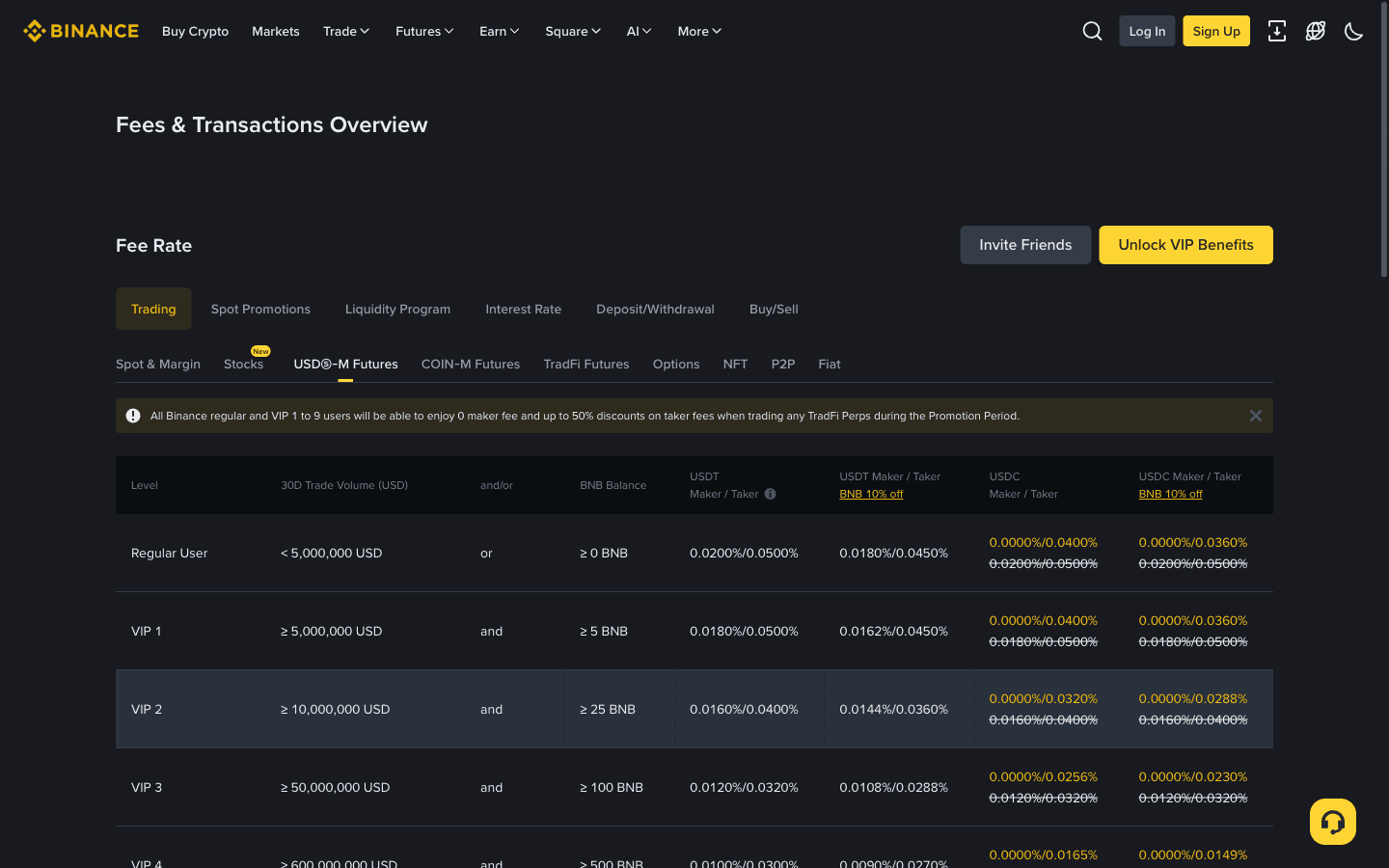
| Binance USDT-margined Futures | CEX | 0.02% | 0.05% | Regular User (< $5M 30-day volume). 10% off with BNB: 0.018% / 0.045% Source: binance.com/en/fee/futureFee |
| Binance USDC-margined Futures | CEX | 0% | 0.04% | Regular User, promotional rate on the fee page on October 14, 2026; level with Aster, below Hyperliquid on maker Source: binance.com/en/fee/futureFee |
| Bybit Perpetuals | CEX | 0.02% | 0.055% | Non-VIP Source: bybit.com/en/announcement-info/fee-rate |
| OKX Futures | CEX | 0.02% | 0.05% | Regular user (< $100K assets or < $5M 30-day volume) Source: okx.com/fees |
On USDT-margined perps the CEXs are almost identical: 0.02% maker everywhere and 0.05% taker except on Bybit (0.055%). Discounts stack differently. Binance takes 10% off futures fees paid in BNB (0.018% / 0.045%). Hyperliquid takes 4% off with a referral code and a further 5–40% for staking HYPE, so a Bronze staker (100+ HYPE) with a code pays 0.045% × 0.90 × 0.96 = 0.0389% taker. Aster's 5% discount for paying in ASTER is documented for spot fees only, so its perp taker stays 0.04% until VIP 2. Lighter Standard has nothing to discount.
Tiers move differently too. Binance and OKX re-rate you on 30-day volume, Bybit on 30-day volume or asset balance. Hyperliquid uses rolling 14-day volume (spot counts double) and drops to 0.040% / 0.012% above $5M, 0.035% / 0.008% above $25M and 0.030% / 0.004% above $100M. OKX reaches 0.028% taker at VIP 3 ($50M of 30-day futures volume or $2M of assets). A CEX taker fee first drops below Hyperliquid's base rate at VIP 2: 0.040% on Binance from $10M of 30-day futures volume plus 25 BNB, and 0.036% on OKX from $10M or $200,000 of assets. Hyperliquid's own next tier, 0.040%, starts at $5M of 14-day volume. Every tier and discount: Hyperliquid fees explained. Newer venues price close to the big perp DEXs: Polymarket Perps charges 0.040% taker / 0.0125% maker at its entry tier (Polymarket docs, October 15, 2026); see our Polymarket Perps review.
5. Spot fees: CEX vs order-book DEX vs swap DEX
| Venue | Type | Maker / pool fee | Taker | Gas per trade |
|---|---|---|---|---|
| Hyperliquid spot | Order-book DEX | 0.040% | 0.070% | None per order |
| Lighter spot (Standard) | Order-book DEX | 0% | 0% | None per order |
| Aster spot | Order-book DEX | 0.005% | 0.04% | None per order |
| Uniswap (Ethereum, L2s) | AMM swap DEX | 0.01%, 0.05%, 0.30% and 1% pool fee (v3); 0.30% on every v2 pool | same (one fee per swap) | Yes: about $0.031 on Ethereum on October 15, 2026 |
| Jupiter (Solana) | Swap aggregator | 0.02% SOL–stablecoin, 0.10% most other pairs, plus the pools' own fees | same | Base fee 5,000 lamports per signature (≈ $0.0005) plus optional priority fee |
| Binance spot (Regular) | CEX | 0.10% | 0.10% | None |
| Bybit spot (Non-VIP) | CEX | 0.10% | 0.10% | None |
| OKX spot (Regular) | CEX | 0.08% | 0.10% | None |
| Coinbase Exchange ($0–10K tier) | CEX | 0.40% | 0.60% | None |
Retail spot on a CEX costs 0.10% per side on Binance (0.075% paying in BNB) and Bybit, and 0.08% / 0.10% on OKX. Coinbase's order book starts at 0.60% / 0.40% and only reaches 0.20% / 0.10% between $100K and $1M of monthly volume. Hyperliquid spot is 0.070% / 0.040% at tier 0, Aster spot 0.04% / 0.005%, Lighter Standard spot 0%. A $5,000 spot buy costs $30.00 on Coinbase's lowest tier, $5.00 on Binance, $3.50 on Hyperliquid, $15.03 through a 0.30% Uniswap pool including gas, and nothing on Lighter.
6. Hidden costs on both sides
Spread and slippage
The spread you cross is a cost even at a 0% fee, and a large order walks the book. We measured it on October 15, 2026 between 06:59 and 07:02 UTC by walking each live BTC-perp order book 12 times: a $100,000 market buy filled a median 0.0006% from the mid price on Hyperliquid, 0.0054% on Lighter and 0.00006% on Binance Futures, which is $0.60, $5.40 and $0.06. Lighter's first price levels are thin and its deep size sits a few ticks out, yet with no fee it was still the cheapest all-in on this order: $5.40 against $43.80 on Hyperliquid with a code and $50.06 on Binance (taker fee plus impact). On BTC and ETH the spread is noise next to a 0.045% fee. On long-tail altcoins and thin AMM pools it is the opposite: price impact can exceed the fee many times over, and the deepest books for small caps are still on Binance and Bybit. Check depth two ticks away before assuming zero fee means zero cost; see price impact and slippage.
MEV and sandwich attacks (swap DEXs)
A swap sent to a public mempool can be sandwiched: a bot sees it, buys just before you, lets your swap push the price up, and sells just after, so you fill at the worst price your slippage tolerance allows. It is a cost that never shows up as a fee. Keep slippage tolerance tight and use a router or wallet that sends swaps privately. Order-book DEXs and CEXs work differently: a limit order cannot fill worse than its limit price. More in sandwich attack protection.
Gas
"DEX means gas" is only true of swaps. Hyperliquid, Lighter and Aster execute orders without per-order gas; you pay once on deposit (cents on Arbitrum or Base) and once on withdrawal, so a trader placing 200 orders a month pays no more gas than one placing two. On Ethereum mainnet, gas is lower than its reputation in 2026: the base fee had a median of 0.117 gwei across 120 six-hourly samples from September 15 to October 15, 2026, and a typical Uniswap swap cost about $0.031. It spikes in busy markets, and it is a flat cost, so it hurts small trades most. Solana's base fee is 5,000 lamports per signature, about $0.0005 with SOL at $102.15, plus an optional priority fee.
Withdrawal fees
CEXs charge a flat fee per network. Binance's network list on October 15, 2026 priced USDT withdrawals at 0.01 USDT on BNB Smart Chain, 0.4 on Arbitrum One, 0.4 on Ethereum, 0.3 on Solana and 1.5 on Tron; deposits are free. Coinbase charges 0.01% (max 20 USDT) plus network fee on USDT withdrawals and $25 for a USD wire. On the DEX side Hyperliquid deducts 0.2 USDC (plus a tiny HyperEVM gas fee) for a USDC withdrawal to Arbitrum; Lighter and Aster pass through the destination chain's gas. A self-custody trader moves funds far less often than someone shuttling between a CEX and a wallet. Per-venue detail: withdrawal limits and fees.
Funding
Funding is the biggest cost most perp traders ignore, and it is not exchange revenue on either side: it flows from the crowded side of the market to the other. Hyperliquid settles hourly around a baseline of 0.01% per 8 hours, the same baseline Binance uses. A $10,000 position held a month at baseline pays about $90, ten times a Hyperliquid taker round trip on the same size. Compare the live rate for the specific market; neither side is structurally cheaper. See how funding works.
Fiat conversion
This is the CEX advantage. Funding a DEX means a card or bank on-ramp somewhere upstream, and CEX "convert" or simple-buy products bake a spread into the price rather than showing a fee. If you are deciding on cost, fund your DEX account via a CEX spot order plus one withdrawal, not via the convert widget.
7. Monthly examples: $10k, $100k and $1M
Assumptions: monthly perp volume split 50/50 between maker and taker fills, base tier everywhere, no VIP status. Hyperliquid "with referral" applies the 4% discount. Coinbase is shown on its spot order book at the tier you trade in on the way to that volume ($0–10K, $50K–100K and $100K–1M). Funding, spread and withdrawals are excluded because they depend on your positions, not the venue's schedule.
| Venue | $10,000 / month | $100,000 / month | $1,000,000 / month |
|---|---|---|---|
| Lighter (Standard) | $0 | $0 | $0 |
| Aster (order book) | $2.00 | $20 | $200 |
| Hyperliquid (with referral) | $2.88 | $28.80 | $288 |
| Hyperliquid (no referral) | $3.00 | $30 | $300 |
| Binance USDT-M (BNB discount) | $3.15 | $31.50 | $315 |
| Binance USDT-M / OKX | $3.50 | $35 | $350 |
| Bybit | $3.75 | $37.50 | $375 |
| Coinbase spot (order book) | $50 | $200 | $1,500 |
If you take liquidity on every fill the gap widens: at $1M of pure taker volume Bybit costs $550, Binance and OKX $500 (Binance $450 with BNB), Hyperliquid $450 ($432 with a referral code), Aster $400, Lighter Premium $280 and Lighter Standard $0. $1M a month is still below Binance's, OKX's and Hyperliquid's first volume tier. Switching a $1M-a-month account from Bybit to Hyperliquid saves about $87 a month on a 50/50 mix; from Bybit to Lighter it is the full $375. Over a year that is $1,000–$4,500 per million dollars of monthly volume, before any spread difference. Run your own numbers in the fee calculator, or open Hyperliquid with code HOLYGRAIL to trade at the "with referral" rate.
8. Hyperliquid vs CEX: the head-to-head most people mean
When traders compare CEX and DEX fees they are usually asking whether the largest perp DEX can replace Binance or Bybit for their own account. Line by line:
| Hyperliquid | Binance / Bybit / OKX | |
|---|---|---|
| Custody | Your wallet; withdrawals are on-chain transactions | Exchange wallet; withdrawals need approval and can be paused |
| KYC | None (email or wallet login) | Required |
| Perp taker / maker (base) | 0.045% / 0.015%; 0.0432% taker with a referral code; 0.0389% with code + 100 HYPE staked | Binance 0.05% / 0.02% (USDT-M; USDC-M 0.04% / 0% promotional); Bybit 0.055% / 0.02%; OKX 0.05% / 0.02% |
| Markets | 178 core perps + HIP-3 stocks, commodities, indices; 336 spot pairs (as of October 20, 2026) | Binance USDⓈ-M 568 crypto perpetuals + 221 TradFi (stocks, commodities): 789 in all (Binance API, October 15, 2026) |
| 24h perp volume | $8.63B on core perps (API), $13.4B with HIP-3 markets (CoinGecko), October 15, 2026 | Binance ~$88.6B, OKX ~$31.9B, Bybit ~$19.8B (CoinGecko, same time) |
| Open interest | $11.0B (API, core perps) to $14.9B (CoinGecko) | Binance ~$32.7B (CoinGecko) |
| Max leverage BTC / ETH | 40x / 25x (lower above $150M / $100M notional) | 150x Binance and Bybit, 100x OKX on BTC |
| Order gas | None | None |
| Withdrawal | USDC to Arbitrum 0.2 USDC flat + tiny HyperEVM gas; native BTC, ETH, SOL supported | Flat per-network fee, e.g. Binance USDT 0.4 USDT on Arbitrum, 1.5 USDT on Tron (October 15, 2026) |
| Where fees go | HLP vault, HYPE assistance fund (buys and burns HYPE), deployers | Exchange revenue |
| Fiat | No | Yes |
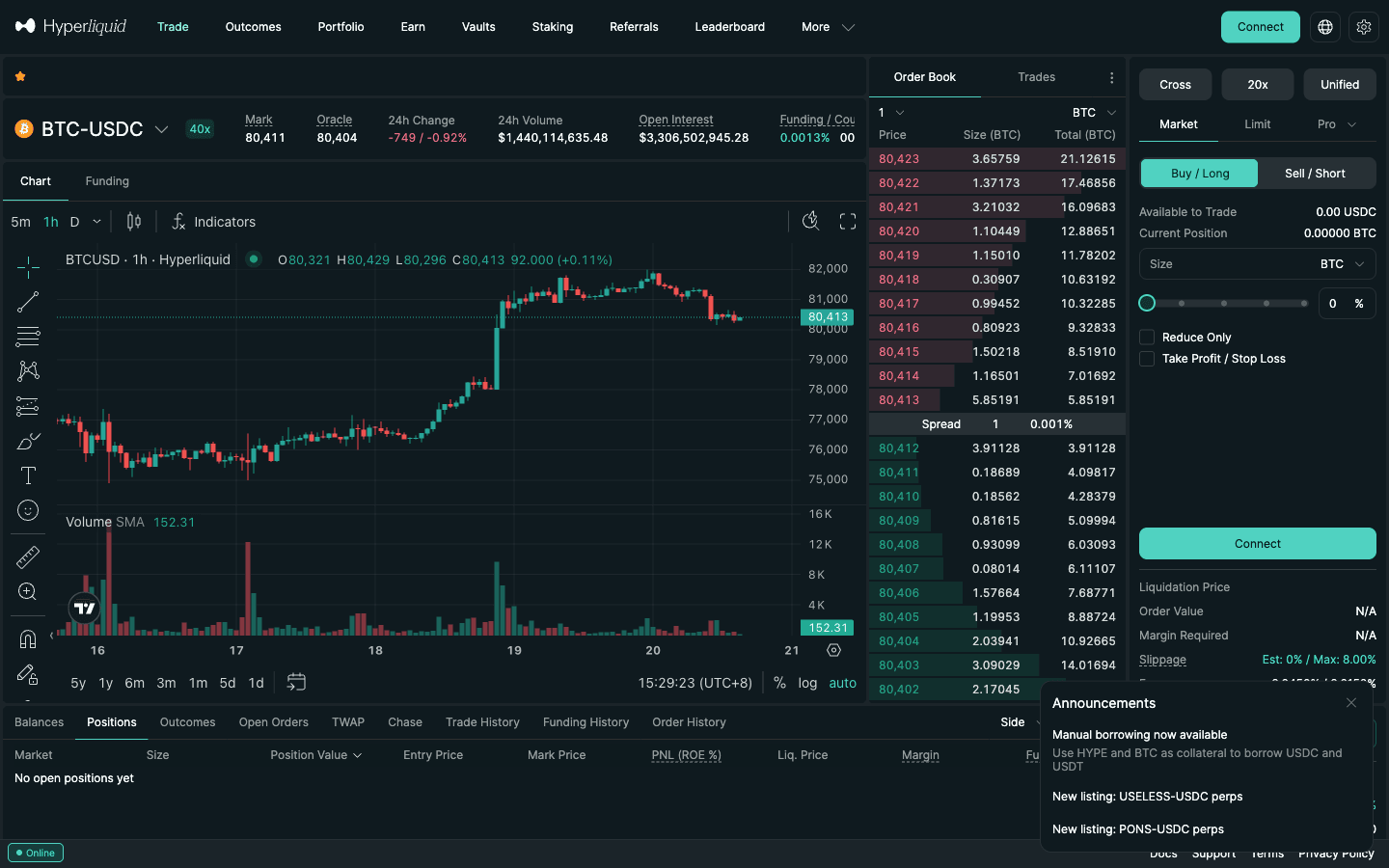
The honest summary: for BTC, ETH, SOL and the top 50 alts, Hyperliquid is cheaper at the base tier, keeps custody with you, needs no ID and fills like a CEX. A CEX still wins if you want 100x+ leverage (Hyperliquid caps BTC at 40x and lowers it further above $150M notional), bank rails in the same account, or the deepest book in a thin altcoin. Full comparisons: Hyperliquid vs Binance, Hyperliquid vs Bybit, Lighter vs Binance Futures.
Run the numbers, then trade at DEX rates
Hyperliquid with code HOLYGRAIL: 4% off fees on your first $25M of volume. Not sure it beats your current exchange? Compare your own size in the fee calculator first.
9. Beyond fees: custody, KYC and volume
| CEX (Binance, Bybit, OKX, Coinbase) | DEX (Hyperliquid, Lighter, Aster; Uniswap for swaps) | |
|---|---|---|
| Who holds your funds | The exchange (custodial). You hold an IOU. | You do (self-custody). Funds sit in your wallet or a contract you control. |
| Identity check (KYC) | Mandatory before trading; limits without it. | None to trade. Geo-blocks apply; fiat on-ramp partners may ask for KYC. |
| Fee model | Maker/taker on the order book; a spread on simple buy and convert | Maker/taker on order-book DEXs; one pool fee plus gas on swap DEXs |
| Gas per order | None. | None on Hyperliquid, Lighter, Aster; yes on every AMM swap. |
| Liquidity | Binance Futures ~$88.6B/day, 568 crypto USDⓈ-M perpetuals plus 221 TradFi (October 15, 2026). | Hyperliquid ~$13.4B/day with HIP-3 (October 15, 2026), 178 core perps (as of October 20, 2026); Hyperliquid, Aster, Lighter and edgeX together ~$19.8B/day. |
| Max leverage (BTC) | 150x Binance and Bybit, 100x OKX. | 40x Hyperliquid, 50x Lighter; Aster 1001x mode is a separate capped-ROI product. |
| Fiat on/off-ramp | Built in (bank, card). | Not built in; fund with stablecoins from a CEX or an on-ramp. |
| Support and recovery | Ticket desk; password reset. | None. Lose the key, lose the account. |
| Failure mode | Insolvency, withdrawal halts, hacks of the hot wallet. | Smart-contract or validator-set risk; front-end phishing; user error. |
Custody. On a CEX, "your" 10,000 USDT is a row in a database; the exchange owns the coins and owes you. If it is hacked (Bybit lost roughly $1.5B from a cold-wallet transfer in February 2025 and made customers whole from its own reserves), goes insolvent (FTX, 2022) or pauses withdrawals, you wait. On a DEX your USDC sits in a contract or chain account that only your key can move; a withdrawal is a transaction you sign, not a request you file. The DEX risk is different, not absent: validator-set or proof-system risk, bridge contracts and phishing, with no support desk. Read DEX security best practices.
KYC. Every major CEX requires identity documents before you trade. The perp DEXs compared here have no account to verify: Hyperliquid logs you in with a wallet signature or an email code, Lighter with an Ethereum wallet, Aster with a wallet or email. They do geo-block restricted jurisdictions (the United States is the usual exclusion), and you remain responsible for tax reporting where you live. Details in the no-KYC trading guide.
Volume. CoinGecko's derivatives list on October 15, 2026 (07:05 UTC, converted at $80,812 per BTC) put Binance Futures at about $88.6B of 24-hour volume, OKX at $31.9B and Bybit at $19.8B. The four perp DEXs compared here, Hyperliquid (the largest DEX on the list: $13.4B including HIP-3 markets; $8.63B on its 178 core perps per its own API), Aster ($2.63B), Lighter ($2.32B) and edgeX ($1.41B), together traded about $19.8B: roughly Bybit's size and a little over a fifth of Binance. Other on-chain venues on the list, such as Variational and GMX on Solana, are not counted. Hyperliquid's open interest ($14.9B) is about 46% of Binance Futures' $32.7B. The rest of the market is in the live perp DEX ranking.
10. Which is better: DEX or CEX?
| Your situation | Better choice | Why |
|---|---|---|
| First crypto purchase with a bank card | CEX (or an on-ramp), then move to a DEX if you trade | DEXs have no fiat rails |
| Retail perp trader, BTC / ETH / SOL, market orders | Hyperliquid for the deepest DEX book, or Lighter Standard | Hyperliquid's 0.045% (0.0432% with a code) is below Binance's 0.05%; Lighter's 0% beats every CEX, with a 300 ms delay |
| Limit-order / grid trader | Aster or Lighter | 0% maker on both; Hyperliquid 0.015% at tier 0 |
| Swapping a token once in a while | A CEX spot order, or a swap DEX with a low-fee pool | 0.10% on Binance vs a 0.05%–0.30% pool fee plus gas |
| Cannot or will not complete KYC | Perp DEX | No account to verify; check geo-restrictions |
| Need 100x+ leverage | Binance or Bybit (150x on BTC) | Hyperliquid 40x, Lighter 50x; Aster 1001x mode is a separate capped product |
| Long-tail altcoins with thin DEX books | Binance or Bybit | Spread cost on a thin book exceeds the 0.5–1 bp fee saving |
| Spot accumulation | Hyperliquid spot or Lighter spot | 0.07% / 0% versus 0.10% on Binance and 0.60% on Coinbase's entry tier |
| Already VIP 3+ on a CEX ($50M+ monthly) | Compare your actual rate | OKX VIP 3 taker is 0.028%, Hyperliquid tier 3 (> $100M 14-day) is 0.030%; at this scale rebates and OTC terms decide |
| Holding a large balance you do not trade daily | Cold storage, not either exchange | Neither a CEX ledger nor a hot trading wallet is a vault |
If the answer is a DEX, our Best DEX ranking compares the venues on liquidity, verified fees and safety.
11. Moving from a CEX to a DEX in four steps
- Buy USDC (or USDT) on the CEX spot market rather than through the convert widget, so you pay the 0.10% order-book fee instead of a hidden spread.
- Withdraw to a wallet you control on a cheap network. Hyperliquid accepts USDC on Arbitrum, Ethereum, Base and Polygon and native BTC, ETH and SOL; several CEXs list Hyperliquid as a direct withdrawal network, which skips the bridge step.
- Deposit and enable trading. On Hyperliquid, connect the wallet (or log in with email), click Enable Trading (a gas-free signature) and deposit. Attach a referral code before your first trade so every fill is discounted; Hyperliquid stops accepting a code once your account passes $10,000 of volume, and a code cannot be changed once set.
- Start with isolated margin and small size until you have seen a liquidation and a funding payment on the venue. The step-by-step version is in how to migrate from a CEX to a DEX.
Trade perps below CEX fees, without giving up custody
Hyperliquid with code HOLYGRAIL: 4% off fees on your first $25M of volume. Lighter with code 718610TD: first week of Premium fees rebated. Aster with referral code DTLpLc: 5% of your fees back as a rebate.
FAQ
Which is cheaper, a CEX or a DEX?
It depends on the kind of DEX. Order-book perp DEXs are cheaper at the base tier: Hyperliquid charges 0.045% taker / 0.015% maker (0.0432% with a referral code), Aster 0.04% / 0% and Lighter Standard 0%, against 0.05–0.055% taker on Binance, OKX and Bybit USDT-margined perps, and none of them charge gas per order. AMM swap DEXs such as Uniswap charge a pool fee (0.01%, 0.05%, 0.30% and 1%) plus gas on every swap, so a 0.30% pool costs more than a 0.10% CEX spot order. A CEX taker fee only drops below Hyperliquid's base rate at VIP 2, which needs $10M of 30-day futures volume on Binance (plus 25 BNB) or $10M on OKX ($200,000 of assets also qualifies).
Where can I compare maker and taker fees across DEX and CEX derivatives platforms?
Section 1 of this page ranks the base-tier maker and taker fees of 12 perpetual venues, DEXs and CEXs in one table, each read from the venue's own fee page or docs (CEX schedules re-read on October 15, 2026): Lighter Standard 0% / 0%, Aster 0% / 0.04%, Hyperliquid 0.015% / 0.045%, Binance USDT-M 0.02% / 0.05%, OKX 0.02% / 0.05% and Bybit 0.02% / 0.055% (maker / taker). To price your own size and maker/taker mix, the DEX fee calculator uses the same registry rates, including the Hyperliquid referral discount and HYPE staking tiers.
Can I reduce derivatives trading costs by switching from a CEX to an on-chain platform?
Yes, at the base tier that most accounts pay. With a 50/50 maker-taker mix, $1M a month of perp volume costs $350 on Binance USDT-M, $375 on Bybit, $288 on Hyperliquid with a referral code and $0 on Lighter's Standard tier. None of these order-book DEXs charges gas per order, so trading more often adds no network cost. The saving shrinks as you climb CEX VIP tiers: from VIP 2 ($10M of 30-day futures volume plus 25 BNB) Binance's 0.040% taker is below Hyperliquid's base 0.045%. Switching takes one stablecoin withdrawal; the steps are in how to migrate from a CEX to a DEX. Add the Hyperliquid referral code before your account passes $10,000 of volume, after which a code can no longer be entered.
Which on-chain derivatives platforms have the best fees compared with leading CEXs?
At the base tier: Lighter Standard (0% maker and taker, 300 ms taker delay), Paradex Retail (0%, web-UI orders only), Aster (0% maker / 0.04% taker) and Hyperliquid (0.015% / 0.045%; 0.0432% taker with a referral code), against 0.02% / 0.05% on Binance and OKX and 0.02% / 0.055% on Bybit. For the best balance of fees and liquidity, depth counts as much as the rate: on October 15, 2026 Hyperliquid traded $13.4B in 24 hours (CoinGecko, including HIP-3 markets) and held $14.9B of open interest, about 46% of Binance Futures' $32.7B, and a $100,000 BTC market buy filled 0.0006% from mid on its book against 0.0054% on Lighter. Our best perp DEX ranking weighs fees, liquidity and safety; the two leaders are compared in Hyperliquid vs Lighter.
How much are DEX fees?
The largest order-book perp DEXs charge 0% to 0.045% taker and 0% to 0.015% maker at the base tier (Lighter Standard 0%, Aster 0.04% / 0%, Hyperliquid 0.045% / 0.015%), with no gas per order; smaller ones such as dYdX charge up to 0.05% taker. Swap DEXs charge a pool fee: 0.01%, 0.05%, 0.30% and 1% on Uniswap v3 pools and 0.30% on every v2 pool, plus gas, which was about $0.031 for a typical Uniswap swap on Ethereum on October 15, 2026. On Solana, Jupiter adds a 0.02%–0.10% platform fee on top of the pools' fees, and the network base fee is 5,000 lamports per signature.
Which Bitcoin exchange has the lowest fees?
For BTC perpetuals at the base tier, Lighter Standard and Paradex Retail charge 0% (both add a small order delay), Binance's USDC-margined BTC perp is 0% maker / 0.04% taker under a promotion (fee page, October 14, 2026), Aster is 0.04% taker and Hyperliquid 0.045% (0.0432% with a referral code). For BTC spot, Hyperliquid charges 0.07% taker, Binance, Bybit and OKX 0.10%, and Coinbase 0.60% at the entry tier of its published order-book schedule. Rates as published on October 15, 2026.
How much does Coinbase charge for $1,000?
On Coinbase's published order-book schedule (Coinbase Exchange), a $1,000 market order at the entry tier ($0–10K of 30-day volume) costs $6.00: 0.60% taker. A resting limit order that fills as maker costs 0.40%, or $4.00. Coinbase Advanced shows its own fee tier only after sign-in and in the order preview. In the simple Coinbase app, a buy includes a spread plus a Coinbase fee that depends on payment method and order size; Coinbase publishes no fixed rate and shows both in the order preview, and simple limit orders carry a separate 1% execution fee. The same $1,000 BTC perp trade costs $0.45 on Hyperliquid, $0.432 with a referral code.
What are maker and taker fees?
A maker order rests on the order book (a limit order below the ask or above the bid) and adds liquidity; a taker order fills immediately against a resting order (a market order, or a limit that crosses the spread) and removes liquidity. Exchanges charge takers more: Binance USDT-M perps 0.02% maker vs 0.05% taker, Hyperliquid 0.015% vs 0.045%. AMM swap DEXs have no makers and takers; every swap pays the pool fee.
Do DEXs charge gas fees on every trade?
Order-book perp DEXs do not. Hyperliquid runs its own L1 (HyperCore) where placing, cancelling and filling orders is gas-free; Lighter is a zk-rollup and Aster runs on Aster Chain, and neither charges gas per order. You pay network gas only when depositing or withdrawing, for example 0.2 USDC plus a tiny gas fee for a USDC withdrawal from Hyperliquid to Arbitrum. AMM swaps (Uniswap, Jupiter) pay gas on every swap.
Which is better, CEX or DEX?
Use a CEX for the fiat leg (bank in, bank out), 100x+ leverage and long-tail altcoins whose only deep book is on Binance or Bybit. Use an order-book DEX for the trading itself if you want to keep custody, skip KYC and pay less: Hyperliquid's 0.045% base taker fee is below every major CEX's standard USDT-margined rate. Many active traders in 2026 run both: a CEX as the on-ramp and a perp DEX as the venue.
Is a DEX safer than a CEX?
They fail differently. A CEX can go insolvent or halt withdrawals (FTX, November 2022) or be hacked (Bybit lost roughly $1.5B from an Ethereum cold wallet in February 2025 and covered it from its own reserves). A DEX cannot lend out your balance, but you carry smart-contract, validator-set and front-end phishing risk, and there is no support desk to recover a lost key. Spread large balances across venues and keep long-term holdings in cold storage regardless of where you trade.
Disclosure: HOLYGRAIL, 718610TD and DTLpLc are our referral codes; we earn a share of referred accounts' fees at no cost to you. DEX rates are from each protocol's official documentation; CEX rates from each exchange's public fee page, re-read on October 15, 2026; Uniswap, Jupiter and Solana fees from their developer docs on the same day. Gas and order-book depth were measured on-chain and via public APIs on October 15, 2026; volume and open interest are from CoinGecko and Hyperliquid's API on the same day. Exchanges change schedules without notice; confirm your own fee tier before trading. Not investment advice.