
Aster staking means locking ASTER on Aster Chain with a validator for 26 to 208 weeks. You earn a base reward from a 150,000 ASTER weekly pool and a loyalty reward from a 300,000 ASTER weekly pool plus all ASTER bought back with 99% of Aster’s fees. On October 19, 2026 that added up to an estimated 2.89%–23.16% loyalty APY plus 1.34%–1.64% base, lower than the 4–32% shown in September. Leaving early costs a penalty; asBNB and asUSDF are the no-lock alternatives.
1. ASTER staking vs veASTER, asBNB, USDF and asUSDF
“Aster staking” covers several products that are easy to mix up. Only the first one stakes the ASTER token; veASTER is not a token you can hold, just the weight of your lock.
| Product | What it is | You deposit | Yield (October 19, 2026) | Lock / exit | Margin use |
|---|---|---|---|---|---|
| ASTER staking | Delegation to an Aster Chain validator | ASTER | Loyalty 2.89%–23.16% + base 1.34%–1.64%, in ASTER | 26–208 weeks; early-exit penalty | No |
| veASTER | Your loyalty weight: amount × remaining lock ÷ 208 weeks | (created by locking ASTER) | Decides your share of the loyalty pool | Shrinks as the unlock date nears | Not transferable |
| asBNB | Liquid staking token on BNB | BNB or slisBNB | 1.24% APY (TVL $71.4M) | None; queued while a Binance Launchpool runs | 95% collateral value |
| USDF | Aster’s stablecoin, 1:1 with USDT | USDT (mint free) | Trade & Earn rewards when held as margin | Redeem 1–2 days, up to 7 for large amounts, 0.1% fee | 99.99% collateral value |
| asUSDF | Staked USDF (delta-neutral strategy yield) | USDF | 1.2% APY (TVL $5.9M) | 2-hour wait to withdraw, no fee | Earn token |
| ALP | Liquidity pool behind Aster’s 1001x mode | Pool assets | No APY shown (TVL $5.4M) | Pool rules | – |
Sources: asterdex.com/en/staking and /en/earn (logged out), docs.asterdex.com Earn, USDF FAQ and Trade & Earn pages, read October 19, 2026. APYs are Aster’s own estimates and change weekly.
Older guides also mention asCAKE (minting ended in April 2025) and asBTC (documented but not listed on the Earn page). Aster’s user-managed Vaults, where you copy a manager’s perp strategy, are a separate product; see the DEX passive income guide for vaults across venues.
2. ASTER staking rewards: base and loyalty
When you stake you make two choices, a validator and a lock period, and each drives one reward layer:
- Base rewards (150,000 ASTER a week). Each validator gets a share of the pool equal to its share of network transactions, then splits it among its delegators pro rata after its commission: User reward = Validator reward × (your stake ÷ validator’s total stake) × (1 − commission). Every validator showed 0% commission on October 19, 2026.
- Loyalty rewards (300,000 ASTER a week plus fee buybacks). Since June 17, 2026, 99% of Aster’s daily platform fees buy ASTER via TWAP into a public buyback wallet (0xa0edBaBcb48034e368de286b49F9603C7AfA1b60), and each epoch the whole buyback is added to the loyalty pool. Each permissionless spot listing pays a 50,000 USDT fee that funds a further buyback. The pool is split by Power share (section 4).
The docs add a supply effect: for every ASTER bought back, an equal amount is burned from reserve, bi-weekly, until total supply reaches 3 billion. Because the buyback part grows with Aster’s trading fees, your loyalty APY rises and falls with exchange volume, not only with how much ASTER others stake.
3. Current APY by lock and by validator
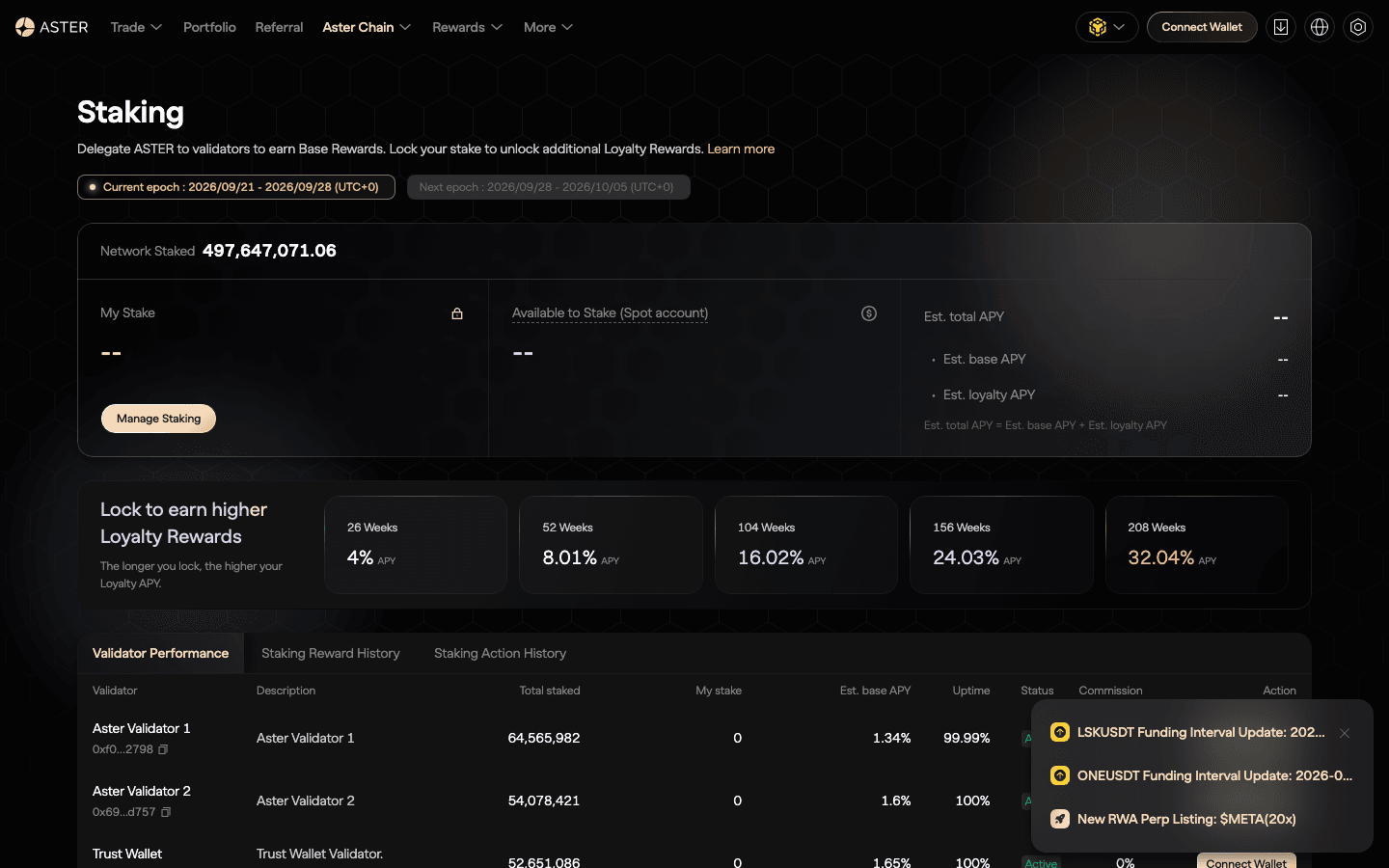
The staking page (logged out, October 19, 2026; epoch 32, October 19–26) showed 508,554,935 ASTER staked and these estimated loyalty APYs:
| Lock period | Est. loyalty APY (October 19, 2026) | veASTER per staked ASTER at start | September 25, 2026 |
|---|---|---|---|
| 26 weeks | 2.89% | 0.125 | 4% |
| 52 weeks | 5.79% | 0.25 | 8.01% |
| 104 weeks | 11.58% | 0.5 | 16.02% |
| 156 weeks | 17.37% | 0.75 | 24.03% |
| 208 weeks (max) | 23.16% | 1 | 32.04% |
The table is linear because loyalty weight is proportional to remaining lock time: 208 weeks earns exactly eight times 26 weeks. Every estimate is 28% lower than on September 25, when 208 weeks showed 32.04%. The estimate divides the weekly loyalty pool (300,000 ASTER plus that epoch’s fee buyback) by total veASTER, so it falls when buybacks shrink or when more stake is locked for longer; network stake itself only grew from 497.6M to 508.6M. Base APY depends on the validator:
| Validator | Total staked (ASTER) | Est. base APY |
|---|---|---|
| Aster Validator 1 | 64,635,297 | 1.34% |
| Binance Wallet | 59,506,974 | 1.46% |
| Lista | 55,863,754 | 1.55% |
| Trust Wallet | 55,407,871 | 1.57% |
| BNB Chain | 55,193,121 | 1.58% |
| WLFI | 55,125,382 | 1.58% |
| Pancake | 54,922,528 | 1.58% |
| Aster Validator 2 | 54,435,837 | 1.59% |
| United Stables ($U) | 53,464,403 | 1.64% |
Source: Aster’s public validators endpoint behind asterdex.com/en/staking, October 19, 2026 06:07 UTC. All nine validators were Active with 0% commission and 99.99–100% uptime. Estimates change every epoch.
The validator Aster runs with the most stake shows the lowest base APY, because base rewards follow transactions processed, not stake: a smaller validator with the same transaction share pays more per staked token. Validator choice moves base APY by only a few tenths of a percent, and you can switch validators any time (effective next epoch).
4. veASTER, Power and the trading boost
Loyalty rewards are shared by Power:
- veASTER = Locked amount × (Remaining lock duration ÷ 208 weeks).
- Power = veASTER × Boost, where the boost comes from your own trading volume in the epoch: 1.05x above $500k, 1.15x above $50M, 1.25x above $200M.
- Your weekly loyalty reward = Weekly loyalty pool × (your Power ÷ total network Power).
The consequence most guides miss: veASTER decays. 10,000 ASTER locked for 208 weeks starts at 10,000 veASTER, but after one year only 156 weeks remain, so it counts as 7,500. The APY you see at the start is not the APY you earn at the end unless you extend the lock (which resets the unlock date for your whole position). Snapshots are taken on Monday at 00:00 UTC. Total network weight was 392,071,524 veASTER on October 19, 2026, so 10,000 veASTER would get at most about 0.0026% of the weekly loyalty pool. Rewards are split by Power (veASTER × boost), and other stakers’ boosts raise total Power, so the real share is a little lower.
5. Unlock penalty and what you can change
You can leave before your unlock date, but you pay a penalty that depends on the time left:
Penalty = unlockAmount × max(N%, min(M%, remaining lock ÷ 4 years))
The docs’ example uses a maximum M of 60% and a minimum N of 2% on a 10,000 ASTER stake:
| Scenario | Remaining lock | Penalty rate | Penalty |
|---|---|---|---|
| Exit immediately (4-year lock) | 4 years | 60% | 6,000 ASTER |
| Exit after 1 year | 3 years | 60% | 6,000 ASTER |
| Exit after 2 years | 2 years | 50% | 5,000 ASTER |
| Exit after 3 years | 1 year | 25% | 2,500 ASTER |
| Exit near maturity | 0.05 years | 2% | 200 ASTER |
| Exit at maturity | 0 | 0% | 0 ASTER |
Net withdrawal = principal − penalty + accumulated rewards. Penalised tokens go partly into the next epoch’s reward pool and partly to the ecosystem fund. Other rules from the staking FAQ: you can add ASTER any time, but all positions share one unified lock period; you can extend the lock (the new unlock date applies to everything); you can switch validators (from the next epoch); rewards are settled once per epoch, not in real time; and exiting at or after the unlock date is penalty-free. The docs call M and N “examples”, so check the figure the unlock dialog shows before you confirm.
6. How to stake ASTER, step by step
- Get ASTER into your Aster Spot account. Buy it on Aster Spot (ASTER/USDT) or deposit ASTER from BNB Chain (Aster deposit and withdrawal guide). Staking draws from the “Available to Stake (Spot account)” balance.
- Open Aster Chain → Staking (asterdex.com/en/staking) and connect your wallet.
- Pick a validator in the Validator Performance table and click Stake.
- Enter the amount and choose the lock period. The page previews the loyalty APY for 26, 52, 104, 156 and 208 weeks.
- Confirm the transaction. The position earns from the next epoch.
- Optionally enable Auto-reinvest, which compounds rewards into your stake; it applies to all your staking positions.
The Staking Reward History and Staking Action History tabs on the same page show what you earned and every stake, extension or unlock. New to Aster? The Aster tutorial for beginners covers connecting and the first trade.
7. Worked example: 10,000 ASTER for 52 weeks
At the CoinGecko price on October 19, 2026 ($0.7035), 10,000 ASTER is about $7,035. Using that day’s estimates and assuming they held (they will not exactly):
- Loyalty at 5.79% + base at about 1.5% ≈ 7.3% a year, roughly 728 ASTER. Because veASTER decays, the loyalty part falls as the unlock date approaches, so the realised figure over a full 52 weeks would be lower unless you extend.
- Trade more than $500k in an epoch and that week’s loyalty weight is 1.05x.
- Early exit halfway through: with 26 weeks left, remaining ÷ 4 years = 12.5%, between the docs’ example floor (2%) and cap (60%). The penalty would be 1,250 ASTER, about three times the roughly 364 ASTER earned in the first half. A lock is only worth it if you are sure you will not need the tokens.
- Price risk: rewards are in ASTER. If ASTER falls 20% during the lock, a 7.3% token yield still leaves you down in dollar terms.
Trade on Aster, boost your staking weight
Epoch trading volume above $500k lifts your loyalty weight to 1.05x. Maker orders on crypto perps pay 0%. Code DTLpLc returns 5% of your perps fees.
8. Aster Earn: asBNB, USDF and asUSDF
asBNB
asBNB is a liquid staking token minted from BNB or slisBNB (BNB is converted to slisBNB automatically). The staked slisBNB is used in Binance Launchpools through Lista DAO, and the rewards raise asBNB’s value; HODLer airdrops and Megadrops need claiming in the app. Launchpool rewards take 3–5 business days to show in the net asset value. Withdrawals always return slisBNB and are queued while a launchpool is active. The docs advertise “up to 30% APY”; the Earn page showed 1.24% on October 19, 2026 (1.76% on September 25), which is what you should plan around. asBNB counts at 95% as trading collateral.
USDF and asUSDF
USDF is Aster’s stablecoin, minted 1:1 from USDT with no fee on Aster. The USDT goes to Aster’s custodian Ceffu and is deployed into delta-neutral positions (for example spot BTC hedged with an equal short, earning funding). Redeeming on Aster costs 0.1% and takes 1–2 days, up to 7 for large amounts; PancakeSwap offers an instant swap with swap fees. asUSDF is staked USDF: its value rises with the strategy yield (1.2% APY, $5.9M TVL on October 19, 2026, down from 2.4% on September 30 as funding cooled). Minting and withdrawing asUSDF is free, with a 2-hour wait to withdraw.
USDF counts at 99.99% as trading collateral and earns Trade & Earn rewards when held as margin in Multi-Asset Mode: deposit rewards on any balance above 1 USDF, plus trading rewards if you trade on at least 2 days a week with $50,000+ of weekly volume, counted on up to 100,000 USDF. Audits listed by Aster cover AsterVault, AsterEarn and asBNB (Salus, PeckShield) and USDF and asUSDF (PeckShield, Halborn). An audit reduces smart-contract risk; it does nothing about custodian or strategy risk.
9. Which option fits you
| If you… | Consider | Why |
|---|---|---|
| Believe in ASTER for years and will not sell | ASTER staking, long lock | Highest loyalty weight (23.16% est. at 208 weeks); fee buybacks flow to stakers |
| Hold ASTER but may need it within a year | 26-week lock or no staking | Early-exit penalties can exceed a year of rewards |
| Hold BNB anyway | asBNB | No lock, launchpool rewards, usable as margin |
| Keep stablecoins on Aster to trade | USDF as margin (Trade & Earn) or asUSDF | Yield on idle margin; accept custodian risk |
| Want the least risk | None of the above | All carry token, contract or custodian risk |
10. Risks
- Token price. ASTER rewards on a multi-year lock are a leveraged bet on ASTER.
- Penalty. Up to 60% in the docs’ example if you leave early; the parameters are described as examples, so check the live figure before committing.
- Changing rates. Pools, buybacks and total stake change every epoch: the 208-week estimate went from 32.04% to 23.16% in under a month. Aster can also change the program.
- Young chain. Aster Chain launched on March 16, 2026; at launch its docs said core chain contracts and RPC were not open-sourced and external validators were not supported in Phase 1.
- Custody and strategy (USDF/asUSDF). Funds sit with Ceffu and hedged positions on Binance; a custodian or exchange failure, or deeply negative funding, would hit the backing.
- Launchpool dependence (asBNB). The yield depends on Binance continuing launchpools and airdrops.
11. Aster vs Hyperliquid vs Lighter staking
| ASTER (Aster) | HYPE (Hyperliquid staking) | LIT (Lighter LLP and staking) | |
|---|---|---|---|
| Reward source | Emissions + 99% of fees bought back | Emissions reserve | Fixed APR in LIT (bought on market) |
| Rate | 2.89%–23.16% est. loyalty + 1.34%–1.64% base (October 19, 2026) | ~2.12%–2.24% est. (October 15, 2026) | 6% fixed |
| Lock / unstake | Choose 26–208 weeks; early-exit penalty | Delegation lock 1 day, unstaking queue 7 days | Unstake lockup 3 days |
| Trading perk | Volume boosts loyalty weight; ASTER counts for VIP | Fee discounts up to 40% | Premium fee discounts up to 30%, LLP access |
For the trading itself, Hyperliquid has the deepest on-chain books; code HOLYGRAIL takes 4% off fees on your first $25M. Compare venues in the best DEX guide, read the Aster review, and check Aster’s points status in the Aster points and airdrop guide.
12. FAQ
How does Aster staking work?
You stake ASTER on Aster Chain by choosing a validator and a lock period of up to 208 weeks (about 4 years). Rewards come from two weekly pools: a base pool of 150,000 ASTER shared by validators according to the transactions they process, and a loyalty pool of 300,000 ASTER plus all ASTER bought back with 99% of Aster’s daily platform fees, shared by lock weight (veASTER). Rewards settle once per weekly epoch, Monday to Sunday UTC, and new stakes start earning from the next epoch.
What APY does Aster staking pay right now?
On October 19, 2026 the staking page estimated loyalty APY at 2.89% for a 26-week lock, 5.79% for 52 weeks, 11.58% for 104 weeks, 17.37% for 156 weeks and 23.16% for 208 weeks, on top of an estimated base APY of 1.34%–1.64% depending on the validator. On September 25, 2026 the same table read 4% to 32.04%, so the estimate moves every epoch with fee buybacks and total stake. Rewards are paid in ASTER.
How do I stake ASTER?
Hold ASTER in your Aster Spot account, open Aster Chain → Staking (asterdex.com/en/staking), connect your wallet, pick a validator, click Stake, enter the amount, choose a lock of 26, 52, 104, 156 or 208 weeks and confirm. You can turn on Auto-reinvest to compound rewards into the stake.
What is veASTER?
veASTER is the weight used for loyalty rewards: locked amount × remaining lock time ÷ 208 weeks. 10,000 ASTER locked for 208 weeks starts at 10,000 veASTER; locked for 52 weeks it starts at 2,500. The weight falls as the unlock date approaches unless you extend the lock. Your Power (share of the loyalty pool) is veASTER × a trading-volume boost of 1.05x to 1.25x. You cannot buy or transfer veASTER; it only exists inside your staking position.
Can I unstake ASTER early, and what is the penalty?
Yes, with a penalty: unlockAmount × max(N%, min(M%, remaining lock ÷ 4 years)). The docs’ example uses a 60% maximum and a 2% minimum, so exiting with 1 year left costs 25% and with 2 years left 50%. Exiting at or after the unlock date is free. Penalised tokens go partly to future reward pools and partly to the ecosystem fund.
When are Aster staking rewards paid?
Once per epoch. An epoch runs from Monday 00:00 UTC to Sunday 23:59 UTC and the snapshot is taken on Monday at 00:00 UTC. New stakes, top-ups, lock extensions and redeem requests take effect in the next epoch, and rewards are not streamed in real time.
What are asBNB and asUSDF?
They are Aster Earn tokens, not ASTER staking. asBNB is minted from BNB or slisBNB and collects Binance Launchpool, HODLer airdrop and Megadrop rewards (TVL $71.4M, APY 1.24% on October 19, 2026; withdrawals return slisBNB). asUSDF is staked USDF, Aster’s stablecoin backed by USDT in delta-neutral positions at the custodian Ceffu (TVL $5.9M, APY 1.2%). asBNB counts at 95% and USDF at 99.99% as trading collateral.
Is Aster staking safe?
It carries several risks: ASTER price risk on a long lock, an early-exit penalty up to 60% in the docs’ example, reward estimates that change weekly (the 208-week figure fell from 32.04% to 23.16% between September 25 and October 19, 2026), a young chain whose core contracts and RPC were not open-sourced at launch, and, for USDF and asUSDF, custodian and strategy risk at Ceffu and Binance. Audits exist for the Earn contracts, but audits do not remove custody or market risk.
Does trading on Aster increase staking rewards?
Yes. Your epoch trading volume multiplies your loyalty weight: 1.05x above $500k, 1.15x above $50M and 1.25x above $200M. Separately, VIP fee tiers count the ASTER you hold, including staked ASTER, toward the ASTER-balance requirement.
Open Aster
Stake ASTER, mint asBNB or USDF, and trade 605 perps (October 19, 2026) from one account. Referral code DTLpLc.
Disclosure: DTLpLc and HOLYGRAIL are our referral codes; we earn a share of fees paid by referred accounts. Staking and Earn figures were read on asterdex.com and in Aster’s docs on October 19, 2026; APYs are Aster’s own estimates and change weekly. Not financial advice.