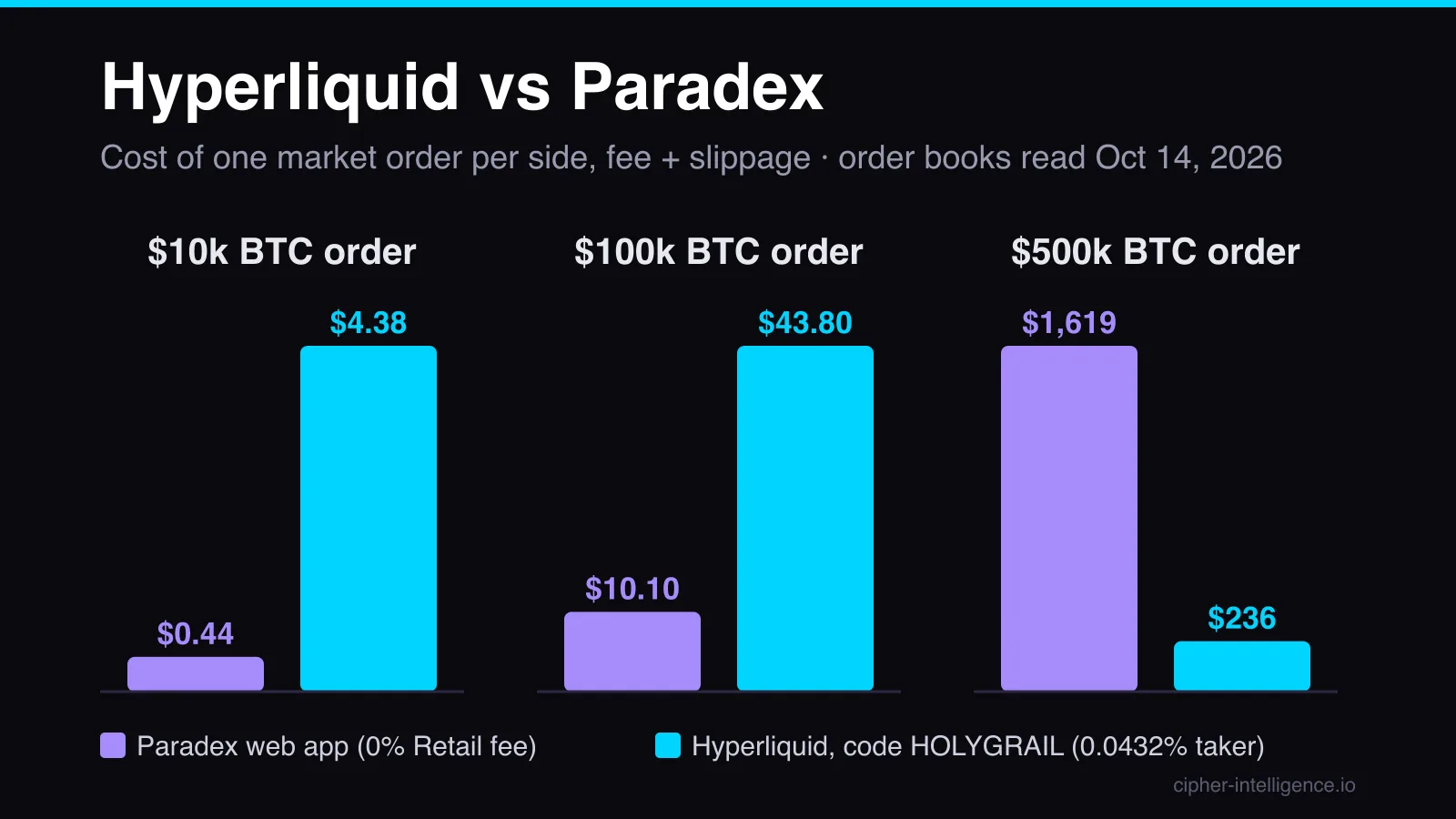
Hyperliquid vs Paradex: Paradex is cheaper for small web-app trades, Hyperliquid is cheaper and faster for size. Paradex charges 0% on Retail orders but delays them by 300 ms; Hyperliquid charges 0.045% taker (0.0432% with code HOLYGRAIL) and traded about 420× Paradex's perp volume on October 14, 2026 ($5.09B vs $12.1M). In our order-book test the zero fee won up to about $100,000 on BTC and lost badly at $500,000. Paradex adds encrypted positions and a live XP season; Hyperliquid has no points program.
Verdict: who should pick which
| If you… | Pick |
|---|---|
| click a few small BTC or ETH orders a day in the web app | Paradex: 0% fee; $10,000 BTC cost $0.44 vs $4.38 |
| trade six figures or more per order | Hyperliquid: $500,000 BTC cost $236 vs $1,619 |
| trade altcoins beyond the majors | Hyperliquid: 178 perps vs 66, and far deeper books |
| scalp, react to news or run a high-frequency taker bot | Hyperliquid: no 300 ms delay, no 1,000-orders-a-day cap |
| do not want your positions visible to anyone | Paradex: positions and PnL are encrypted |
| want options, or 50x on BTC/ETH/SOL | Paradex: options on 14 underlyings; 50x vs 40x |
| want spot, vaults, staking and third-party apps on one account | Hyperliquid: 336 spot pairs, HLP, HyperEVM |
Can you use both? Yes. The cheapest setup for most people is Hyperliquid for size and altcoins and Paradex for small private orders. We have no Paradex referral code, so the only code on this page is Hyperliquid's.
HOLYGRAIL takes 4% off your Hyperliquid fees on the first $25M of volume and has to be entered before $10,000 of volume. The discount also applies to orders you place through apps such as Based or Liquid, but apps often attach their own code to accounts that have none, so join with HOLYGRAIL first (fomo creates its own account, so the code cannot apply there). Details: Hyperliquid referral code HOLYGRAIL.
We earn a commission when you sign up through our links; it never raises your fees.
Hyperliquid vs Paradex at a glance
| Hyperliquid | Paradex | |
|---|---|---|
| What it is | Its own Layer 1 (HyperCore order book + HyperEVM), HyperBFT consensus | Paradex Chain: an appchain on the Starknet stack, a ZK rollup that posts encrypted state diffs to Ethereum |
| Fee, web app / UI | 0.045% taker / 0.015% maker (tier 0); 0.0432% / 0.0144% with code HOLYGRAIL | 0% taker / 0% maker on Retail orders (perps, spot and options) |
| Fee, API / bots | Same schedule as the UI (volume tiers) | Interactive-token API orders count as Retail (0%, 3/s, 1,000/day). Standard API (Pro): 0.045% taker (0.035% at $25M+ / 14 days), 0.003% maker |
| Order delay | None added | 300 ms on Retail orders and cancels; 3 orders/s, 1,000 a day |
| Max leverage BTC / ETH / SOL | 40x / 25x / 20x | 50x / 50x / 50x |
| Perp markets (October 14, 2026) | 178 plus HIP-3 builder markets | 66, of which 23 stocks, indices, commodities and FX |
| 24h perp volume (October 14, 2026) | $5.09B | $12.1M |
| Open interest (October 14, 2026) | $11.36B | $11.1M |
| BTC spread (October 14, 2026) | 0.12 bps | 1.09 bps (book a web-app order sees) |
| Other products | 336 spot pairs (as of October 20, 2026), vaults, HyperEVM | Dated options on 14 underlyings, 2 spot pairs, vaults (VTFs) |
| Funding | Paid hourly | Accrues continuously (rate quoted per 8 hours) |
| Privacy | Fully public: every order, fill and position is visible | Positions, balances and PnL hidden from the public; orders visible only to Paradex |
| Points | No points program running; HYPE airdrop paid November 29, 2024 | XP Season 3 has been live since February 1, 2026 (end date "TBD"), sharing 4,000,000 XP every Wednesday |
| Token | HYPE (staking: 5–40% off fees) | DIME (1,000,000,000 supply; discounts on Pro taker fees only) |
| Referral code | HOLYGRAIL: 4% off the first $25M | None from us (Paradex referees get 5% more XP, no fee discount) |
| Not available to | the US, Ontario (Canada) and sanctioned jurisdictions (plus citizens of sanctioned jurisdictions) | the United States and US persons, Canada and Canadian persons, US territories, and sanctioned regions (Cuba, Iran, North Korea, Syria, and the Crimea, Donetsk, Luhansk and Sevastopol regions of Ukraine) |
Fees, leverage, limits, XP and Terms read from docs.paradex.trade, paradex.trade and hyperliquid.gitbook.io; markets, volume, open interest and spreads from the two public APIs on October 14, 2026, 14:24–14:29 UTC. Hyperliquid volume swings with the day of the week; the figures here are one reading, not an average.
Who should pick which
Paradex suits a patient, small, manual trader. If you place a handful of BTC or ETH orders a day from the web app, its 0% Retail fee saves you real money: on Hyperliquid every $10,000 of taker volume costs $4.32 even with our code. The price is speed. Every Retail order and every cancel waits 300 ms before it reaches the book, and you can send at most 3 orders a second and 1,000 a day. Positions are private, and the XP season pays something for activity you would do anyway.
Hyperliquid suits everyone who needs depth or speed. Order size is the dividing line. Once a market order is large enough to eat through Paradex's book, the slippage costs more than Hyperliquid's fee; in our test that happened between $100,000 and $500,000 on BTC, and less predictably on ETH. Hyperliquid also lists 178 perps against 66, adds no delay to orders, and lets bots trade on the same fee schedule as the web app. If privacy is not your main reason to leave Hyperliquid, our Hyperliquid alternatives guide matches the other common reasons (fees, leverage, stocks, Solana) with the venue that suits each.
| Trader type | Pick | Why |
|---|---|---|
| Small manual trades on BTC / ETH | Paradex | 0% fee, 1.01 bps of slippage at $100,000 on BTC |
| Six-figure orders | Hyperliquid | $500,000 BTC: $236 vs $1,619 per side |
| Altcoin trader | Hyperliquid | 178 perps; Paradex caps 35 of its 66 at 5x |
| Scalper or news trader | Hyperliquid | No 300 ms speed bump, no daily order cap |
| High-frequency taker bot | Hyperliquid | No speed bump and far deeper books; on Paradex, interactive-token API orders are Retail (0%) but capped at 3 a second and 1,000 a day, and faster flow is Pro at 0.045% taker |
| Market-making bot | Paradex on fees | Pro maker orders pay a flat 0.003%, against 0.0144% on Hyperliquid with code; Hyperliquid has the deeper book to quote into |
| Wants positions hidden | Paradex | Encrypted state, no public position data |
| Options trader | Paradex | Dated options on 14 underlyings; Hyperliquid has none |
| Farming points | Paradex | XP Season 3 is live; Hyperliquid has no program |
| Wants spot, vaults and apps | Hyperliquid | 336 spot pairs, HLP, Based / Liquid apps |
Liquidity and depth: what an order really costs (October 14, 2026)
Volume and open interest first. At 14:24 UTC on October 14, 2026, Hyperliquid's API reported $5.09B of 24-hour perp volume and $11.36B of open interest; Paradex's reported $12.1M and $11.1M. That is roughly 420× the volume and 1,000× the open interest. On BTC alone, Hyperliquid traded $2.37B with $3.22B open; Paradex $3.8M with $6.4M open.
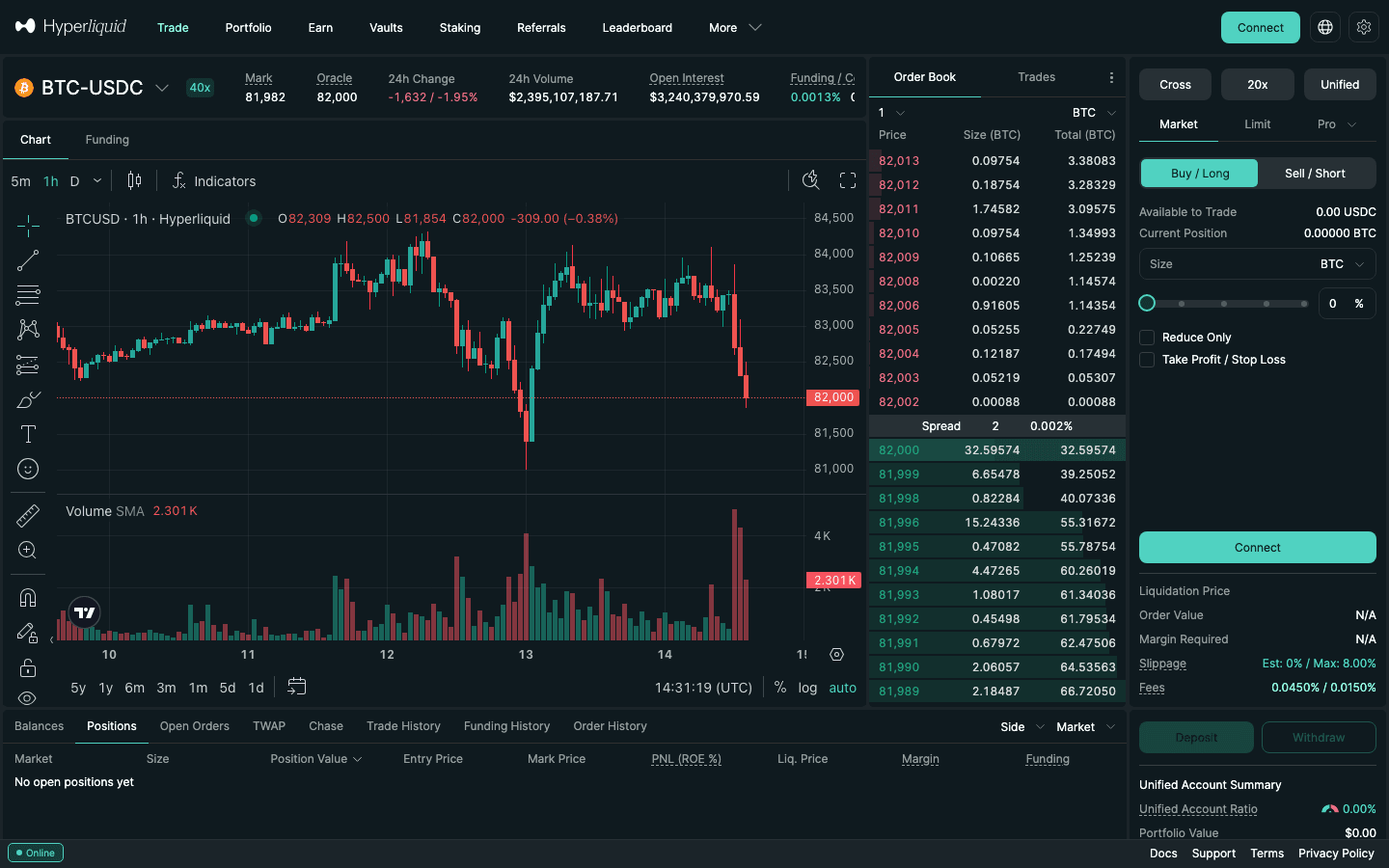
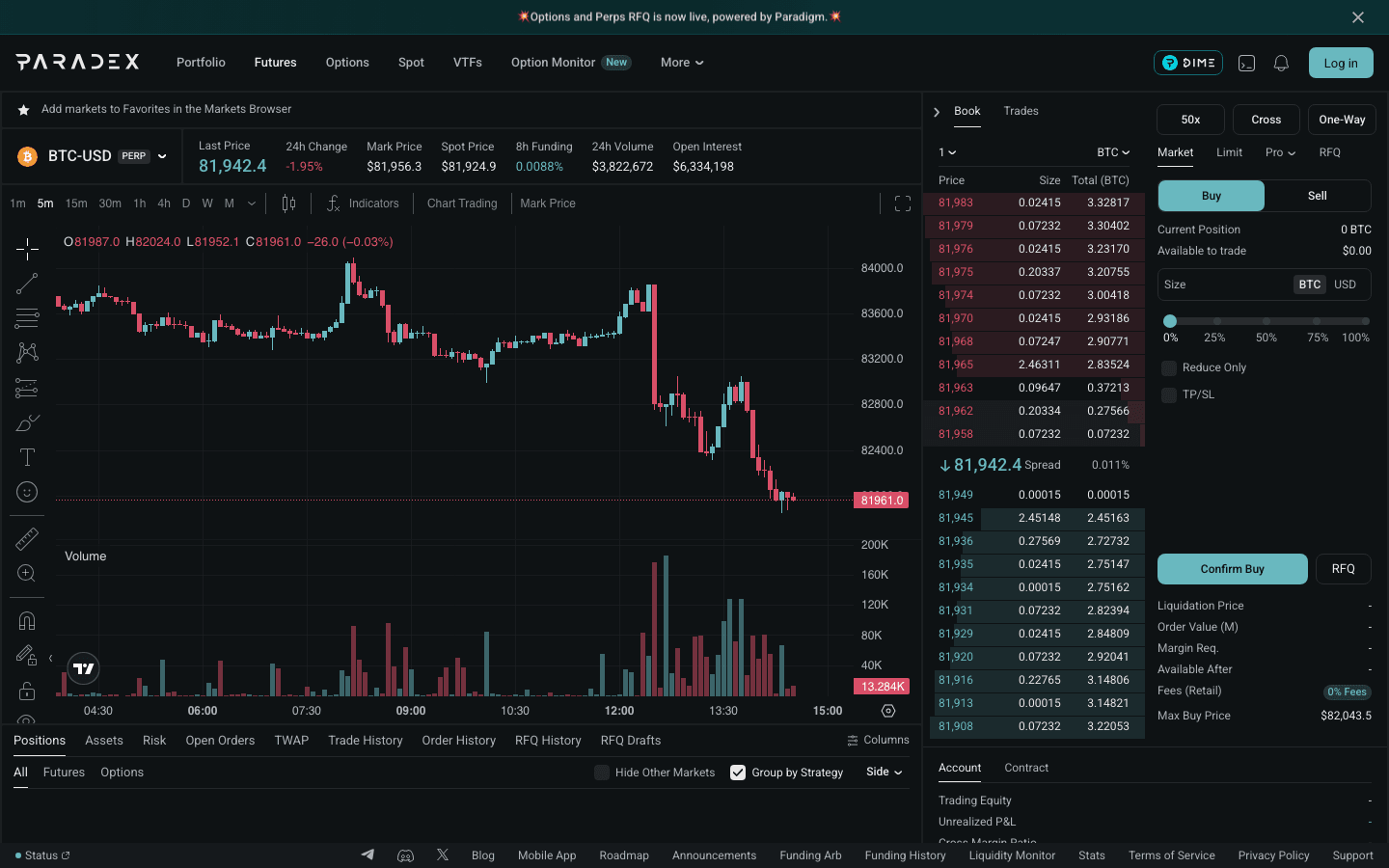
Spread and depth
Volume says how much trades; depth says what your order costs. We sampled both books three times between 14:25 and 14:27 UTC. For Paradex we used the book a web-app order actually sees, which includes the Retail Price Improvement quotes market makers post only for Retail orders (the public API book without them was far thinner). Hyperliquid's API returns 20 price levels per side, which on BTC covered only the first 2.5 bps from the mid price, so its depth figures are a floor.
| Median of 3 samples | Hyperliquid | Paradex (web-app book) |
|---|---|---|
| BTC spread | 0.12 bps | 1.09 bps |
| BTC depth per side | $4.6M within 2.5 bps | $300,000 within 10 bps |
| ETH spread | 0.41 bps | 1.97 bps |
| ETH depth per side | $10.7M on the top 20 levels | $226,000 within 10 bps |
| SOL spread | 0.96 bps | 3.55 bps |
| SOL depth per side | $2.6M within 10 bps | $76,000 within 10 bps |
Even in a band a quarter as wide on BTC, Hyperliquid held about 15× Paradex's BTC depth and 47× its ETH depth. Paradex's book is also lumpy: most of its BTC depth sat in a handful of large quotes, so the cost jumps once an order runs past them.
Fee plus slippage: one market order, both venues
We then walked a market buy and a market sell of $10,000, $100,000 and $500,000 through each book five times between 14:28 and 14:29 UTC and took the median distance from the mid price. Adding each venue's fee gives the cost per side: 0% for a Paradex web-app order, 0.0432% for Hyperliquid with HOLYGRAIL (0.045% without).
| Market order | Cheaper | Hyperliquid total (with code) | Paradex total (Retail) | Hyperliquid slippage | Paradex slippage |
|---|---|---|---|---|---|
| BTC $10,000 | Paradex | $4.38 | $0.44 | 0.06 bps | 0.44 bps |
| BTC $100,000 | Paradex | $43.80 | $10.10 | 0.06 bps | 1.01 bps |
| BTC $500,000 | Hyperliquid | $236 | $1,619 | 0.4 bps | 32.38 bps |
| ETH $10,000 | Paradex | $4.53 | $1.21 | 0.21 bps | 1.21 bps |
| ETH $100,000 | Paradex | $46.70 | $12.20 | 0.35 bps | 1.22 bps |
| ETH $500,000 | Hyperliquid | $257 | $4,106 | 0.82 bps | 82.12 bps |
Per side, so a round trip costs about twice this. Slippage comes from five walks at 14:28–14:29 UTC, the spreads in the depth table from three earlier samples (14:25–14:26 UTC), so the two tables are separate minutes and not directly comparable. Paradex Retail orders also wait 300 ms, so in a fast market the book can move before the fill; the table does not model that. Read October 14, 2026 from api.prod.paradex.trade (/orderbook/…/interactive) and api.hyperliquid.xyz (l2Book).
The pattern is clear. Up to $100,000 on BTC, Paradex's slippage (about 1.01 bps) stays below Hyperliquid's fee (4.32 bps with code), so the zero fee wins. At $500,000 the order runs out of Paradex's book and costs $1,619 against $236. ETH was less stable: the $100,000 order cost 1.22 bps at the median on Paradex but 42.69 bps in the worst of five samples, when the large quotes had moved. If your orders are small and you can wait 300 ms, Paradex is cheaper; if not, Hyperliquid is.
Fees: 0% Retail vs Hyperliquid with HOLYGRAIL
Paradex classifies every order, not every account. Orders from the web app, or from the API with an "interactive" token, are Retail: 0% maker and taker on perps, spot and options, a 300 ms speed bump on submissions and cancels, queue priority at each price, and access to RPI quotes. Standard API orders are Pro: no delay and much higher rate limits, but they pay. If an account exceeds a Retail rate limit (3 a second, 1,000 a day), it switches to Pro behaviour.
| Fee schedule (perps) | Taker | Maker | Conditions |
|---|---|---|---|
| Paradex Retail | 0% | 0% | Web app or interactive API; 300 ms speed bump |
| Paradex Pro 0 | 0.045% | 0.003% | Standard API orders, base tier |
| Paradex Pro 4 | 0.035% | 0.003% | $25M+ of 14-day volume; DIME staking (up to 30% off) and paying in DIME (40% off) stack, floor 0.0175% |
| Hyperliquid tier 0 | 0.045% | 0.015% | Same base fee in the web app, the API and apps (apps may add their own builder fee) |
| Hyperliquid tier 0 + HOLYGRAIL | 0.0432% | 0.0144% | 4% off the first $25M of volume |
| Hyperliquid + HOLYGRAIL + Bronze staking | 0.03888% | — | Stake 100+ HYPE for 10% more off |
Paradex: docs.paradex.trade Trading Fees and Retail and Pro Orders, re-read October 14, 2026. Hyperliquid: hyperliquid.gitbook.io Fees and Referrals, re-read October 14, 2026. Paradex's public markets API listed a different API fee for every perp that day than the documented Pro schedule; we quote the documentation, so check the fee shown in your account before running a bot.
Two things follow. First, Paradex's zero fee is for low-rate flow: the web app, or an API bot on an interactive token that stays within 3 orders a second and 1,000 a day. A taker bot on the standard API pays 0.045%, the same as Hyperliquid's tier 0 before any code, on a much thinner book; a maker bot pays only 0.003% there, less than Hyperliquid's 0.0144% with code. Second, Hyperliquid's base fee is the same in the web app, the API and apps (apps may add their own builder fee on top), and you can lower it. Join with HOLYGRAIL for 4% off the first $25M of volume (enter it before $10,000 of volume), stake HYPE for 5–40% off, and climb volume tiers. The discount follows your account into apps that use builder codes, as long as HOLYGRAIL was set before an app could attach its own. Full schedule and worked examples: Hyperliquid fees explained; per-trade math: Hyperliquid fee calculator.
Need the depth? Trade Hyperliquid for 4% less
Join with code HOLYGRAIL: 0.0432% taker / 0.0144% maker on your first $25M of volume.
Privacy: encrypted positions vs a public order book
This is Paradex's real point of difference. Per its Privacy Perps docs, orders are stored only on Paradex's servers and are visible to its operators, not to the public. Paradex Chain's RPC nodes hide position and account fields unless the owner signs the request, and the state updates posted to Ethereum are encrypted, with a zero-knowledge proof that they are correct. Nobody outside can see your entries, size, PnL or liquidation price.
The privacy has limits worth knowing. A Privacy Council (Paradex Foundation, Paradex and Karnot) holds keys that can decrypt the state in an emergency, so that users can recover funds if Paradex stops. Paradex itself sees your orders. Deposits and withdrawals through bridges are visible on the chain they come from.
Hyperliquid is the opposite: every order, fill, liquidation and position sits on its public Layer 1. That is why whale trackers exist, and why large traders sometimes avoid it. It also makes Hyperliquid fully auditable: you can check any wallet's history in a block explorer. If you trade size and do not want to be followed, Paradex's model is a genuine advantage; for most retail traders, public positions change nothing. See what others can see on Hyperliquid in our Hyperliquid whale tracker guide.
Points and tokens: Paradex XP vs Hyperliquid
Paradex: XP Season 3 has been live since February 1, 2026 (end date "TBD"), sharing 4,000,000 XP every Wednesday, according to its XP docs on October 14, 2026. Two earlier seasons ran from February 2024 to January 2026. Paradex says Season 3 "will introduce a brand new earnings mechanic" that "will roll out in the coming weeks", so check the docs before farming. Joining with someone's referral code gives you 5% more XP; we have no Paradex code.
Paradex's token is DIME (1,000,000,000 total supply, issued on Ethereum and bridged to Paradex Chain, Solana and Hyperliquid). Staking DIME or paying fees in it discounts Pro taker fees only; Retail orders are already free. Net protocol revenue funds DIME buybacks.
Hyperliquid: no points program is running. Its HYPE airdrop was paid on November 29, 2024, and nothing about a new season had been announced on October 14, 2026; details in the Hyperliquid airdrop guide. HYPE staking cuts fees for every order type (5–40% off), and the referral discount stacks on top. Which perp DEX points programs are open right now, ranked by cost: perp DEX airdrops 2026.
Farm points only with trades you would make anyway. Paradex's XP is free to earn on Retail orders, but slippage still costs money at size, and points convert into an unknown amount of token later.
Markets, leverage and products
Perps. Hyperliquid listed 178 perps on October 14, 2026, plus stocks, indices and commodities on HIP-3 builder markets. Paradex listed 66, including 23 on stocks, indices, commodities and FX (NVDA, TSLA, US500, gold, oil and others). The full Hyperliquid list: Hyperliquid trading pairs.
Leverage. Paradex allows 50x on BTC, ETH and SOL (and on XRP, BNB and PAXG), more than Hyperliquid's 40x on BTC and 25x on ETH. Further down the list Paradex is stricter: 35 of its 66 perps allowed only 5x on October 14, 2026.
Options and spot. Paradex lists dated, European-style options on 14 underlyings, settled in USDC, at 0% for Retail orders; Hyperliquid has no options (our perps vs options guide covers where on-chain options actually trade). Hyperliquid has the far larger spot market (336 pairs as of October 20, 2026) against Paradex's 2.
Funding. Hyperliquid settles funding hourly. Paradex accrues funding continuously and quotes the rate per 8 hours; its premium is a weighted median of several venues' books, Hyperliquid's among them. Compare the two before holding a position for days: how Hyperliquid funding works.
Deposits. Hyperliquid takes native USDC on Arbitrum (not USDC.e) with a 5 USDC minimum, plus bridged BTC, ETH, SOL and others: Hyperliquid deposit guide. Paradex takes USDC from more than 30 chains through integrated bridges, with its native bridge on Ethereum.
Chain, custody and what happens in a crisis
Paradex runs on Paradex Chain, an appchain built on the Starknet stack. It is a ZK rollup: state changes are proven and posted, encrypted, to Ethereum, which keeps an escape hatch open: if Paradex stops, the Privacy Council can decrypt and publish the state needed for users to recover funds. If its insurance fund runs dry, Paradex applies a socialized loss charge to withdrawals made during the shortfall instead of closing traders' profitable positions; it advertises "No ADL".
Hyperliquid runs its own Layer 1 with HyperBFT consensus; its validators, not proofs, secure the chain and the USDC bridge. If an account goes negative, auto-deleveraging closes the most profitable, most leveraged positions on the other side at the previous mark price, so the platform never carries bad debt. Neither model is risk-free: Paradex users carry the operator and council trust, Hyperliquid users the validator set. Our full assessment: Hyperliquid review.
Who can use them
Paradex does not serve the United States and US persons, Canada and Canadian persons, US territories, and sanctioned regions (Cuba, Iran, North Korea, Syria, and the Crimea, Donetsk, Luhansk and Sevastopol regions of Ukraine) (Restricted Persons page, read October 14, 2026). Hyperliquid's Terms exclude the US, Ontario (Canada) and sanctioned jurisdictions (plus citizens of sanctioned jurisdictions); details in Hyperliquid restricted countries. Neither exchange asks for ID, but that does not make access permitted. Paradex's Terms explicitly forbid using a VPN to get around its restrictions, and you should not use one on either exchange. "No KYC" is also not anonymity: deposits are on-chain, and profits are taxable where you live. More: trading on DEXs without KYC.
Start on the deeper book
Open Hyperliquid with code HOLYGRAIL: 4% off your fees on the first $25M of volume. Enter it before $10,000 of volume and before you connect any app.
New to it? How to use Hyperliquid walks through the first deposit and order.
Hyperliquid vs Paradex FAQ
Is Paradex better than Hyperliquid?
For small manual trades, Paradex is cheaper: web-app orders pay 0%, and on October 14, 2026 a $10,000 BTC market order cost about $0.44 per side there (no fee, slippage only) against $4.38 (fee plus slippage) on Hyperliquid with code HOLYGRAIL. Hyperliquid is better for size, altcoins and speed: it traded about 420× Paradex's perp volume that day, a $500,000 BTC order cost $236 there against $1,619 on Paradex, and it adds no 300 ms delay. Pick Paradex for private, small, slow trades; Hyperliquid for everything that needs depth.
What are the trading fees on Paradex?
Retail orders (the web app, or the API with an interactive token) pay 0% maker and taker on perps, spot and options. Pro orders (the standard API) pay 0.045% taker at the base tier, down to 0.035% at $25M of 14-day volume, and a flat 0.003% maker; staking or paying in DIME cuts the Pro taker fee to no less than 0.0175%. Retail orders carry a 300 ms speed bump and a limit of 1,000 orders a day; an account that exceeds a Retail limit is treated as Pro. Fees read from docs.paradex.trade on October 15, 2026 and re-checked October 14, 2026.
How does Paradex make money with zero fees?
From Pro (API) traders, who pay 0.045% taker and 0.003% maker. Market makers also post Retail Price Improvement (RPI) quotes that only Retail orders can hit, which is why the book a web-app user sees is much deeper than the public API book. Net protocol revenue funds DIME buybacks, per the DIME docs.
Is there a Paradex airdrop or points program?
Yes. XP Season 3 has been live since February 1, 2026 (end date "TBD"), sharing 4,000,000 XP every Wednesday (docs, read October 14, 2026). Paradex says a new XP mechanic "will roll out in the coming weeks". DIME, the token, already exists (1,000,000,000 total supply). Hyperliquid has no points program running; its HYPE airdrop was paid on November 29, 2024.
Can I use a referral code on Paradex?
Paradex's referral program gives the person who joins with a code 5% more XP, not a fee discount (Retail orders are already 0%). We do not hold a Paradex code. On Hyperliquid, code HOLYGRAIL takes 4% off taker and maker fees on your first $25M of volume; it has to be entered before $10,000 of volume.
Which has higher leverage, Hyperliquid or Paradex?
Paradex on the majors: 50x on BTC, ETH and SOL (also XRP, BNB and PAXG), against 40x on BTC and 25x on ETH at Hyperliquid. Most smaller Paradex markets are capped lower: 35 of its 66 perps allowed only 5x on October 14, 2026.
Is Paradex on Starknet?
Paradex runs its own chain, Paradex Chain, built on the Starknet stack (Cairo VM). It is a ZK rollup: state updates are proven and posted to Ethereum, encrypted, which keeps an escape hatch open: if Paradex stops, the Privacy Council can decrypt and publish the state needed for recovery. It is not StarkEx, and it is not the public Starknet network.
Is Paradex private?
Positions, balances, entries, PnL and liquidation levels are hidden from other users and from chain observers; the data posted to Ethereum is encrypted. Orders are stored on Paradex's servers and visible to its operators, and a Privacy Council (Paradex Foundation, Paradex and Karnot) holds keys that can decrypt the state in an emergency. Deposits and withdrawals through public bridges stay visible on the source chain. On Hyperliquid every order, fill and position is public.
Can I use Hyperliquid or Paradex from the US or Canada?
Not from the US on either. In Canada it depends on the exchange: Paradex excludes all of Canada (its list: the United States and US persons, Canada and Canadian persons, US territories, and sanctioned regions (Cuba, Iran, North Korea, Syria, and the Crimea, Donetsk, Luhansk and Sevastopol regions of Ukraine)), while Hyperliquid's Terms exclude the US, Ontario (Canada) and sanctioned jurisdictions (plus citizens of sanctioned jurisdictions): Ontario, not the rest of Canada. Neither asks for KYC, but that does not make access permitted. Paradex's Terms explicitly forbid using a VPN to get around its restrictions; do not use one on either exchange.
Can I use both exchanges?
Yes; they are separate accounts. A common split is Paradex for small, private, non-urgent orders at 0% and Hyperliquid for size, altcoins and anything time-sensitive. Join Hyperliquid with HOLYGRAIL before you connect any app, because apps often attach their own code to accounts that have none.
Disclosure: HOLYGRAIL is our Hyperliquid referral code; we earn a share of referred accounts' fees. We have no referral code or other relationship with Paradex. Volume, open interest, market counts, spreads, depth and slippage were read from the public Paradex and Hyperliquid APIs on October 14, 2026 (14:24–14:29 UTC) and change continuously; they are one dated reading, not an average. Fees, limits, XP status and Terms were read from the official documentation and websites the same day. Screenshots were taken logged out. Nothing here is investment advice.