Short answer. The best free Hyperliquid whale tracker is the CoinGlass Hyperliquid Whale Tracker for scanning every open position over $1M, HypurrScan for reading one wallet, and HyperTracker or HyperStats for free alerts (HyperStats also pushes to Telegram). They all work because Hyperliquid publishes every account’s positions and the wallet behind every fill. Right now the 200 largest active accounts hold $4.17B of the $11.05B open interest (October 20, 2026, 03:53 UTC; filter them in the live table above).
Every whale on these trackers trades on Hyperliquid. Join with code HOLYGRAIL for 4% off your fees on the first $25M of volume, before you use any app. Open Hyperliquid with HOLYGRAIL →
1. CoinGlass Hyperliquid whale tracker: what it shows and its limits
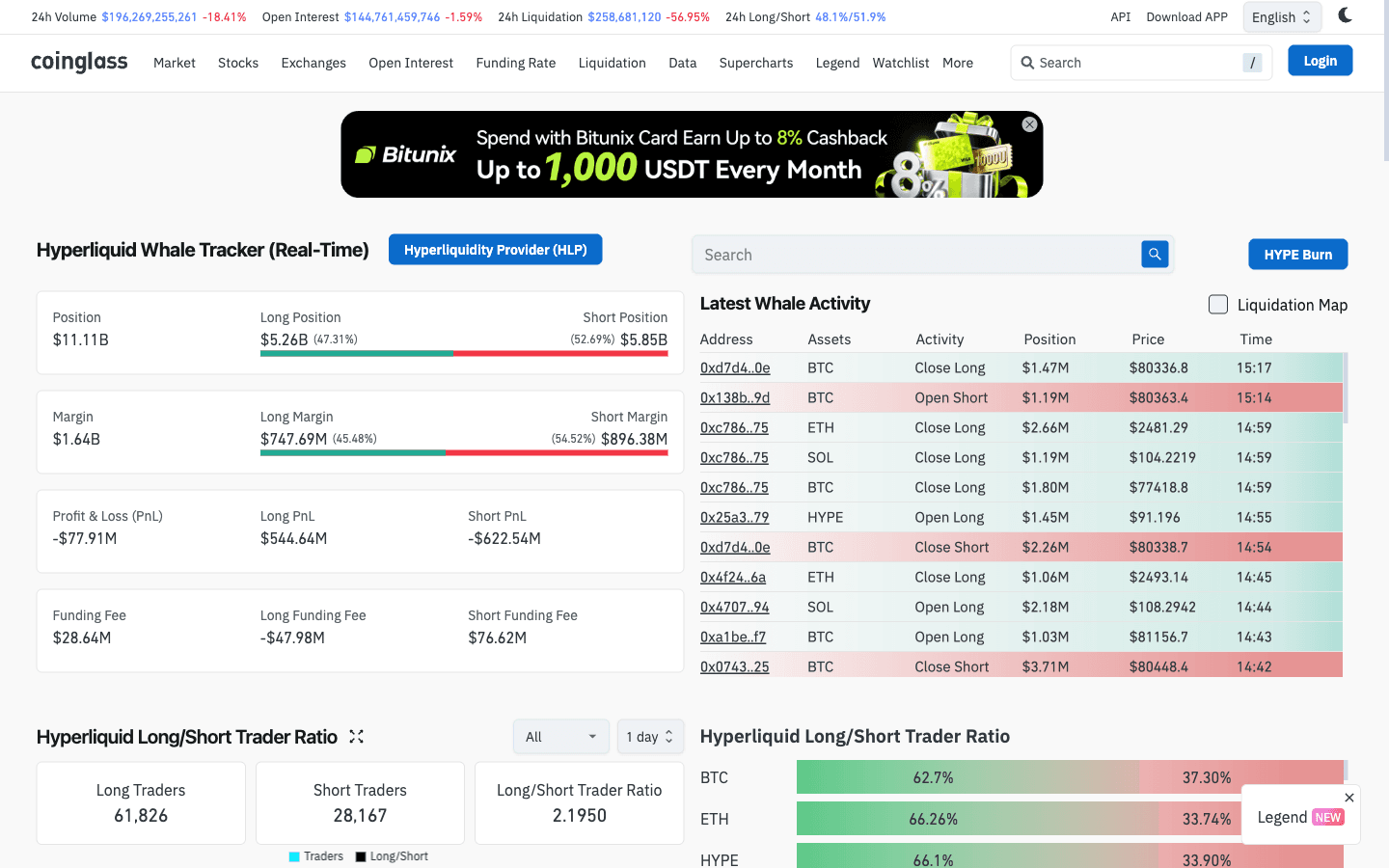
The CoinGlass Hyperliquid Whale Tracker (coinglass.com/hyperliquid) is the page most people mean by “Hyperliquid whale tracker”. It is free, it needs no account to read, and it covers every open Hyperliquid position with a notional value over $1M, the cut-off CoinGlass gives in its own API reference. We read it again on October 4, 2026 (around 15:20 UTC). What you get:
- Whale totals. $12.02B of whale positions, 46.59% long and 53.41% short, on $1.77B of margin. Longs were up $582.69M and shorts down $626.86M; longs had paid $62.63M of funding and shorts had received $100.26M. A week earlier (September 26) the same tiles read $11.84B and 53.28% short, so the skew is persistent, not a one-day event.
- Latest Whale Activity. A feed of large opens and closes with address, coin, size, price and time. The smallest entries were about $1.01M, in line with the cut-off.
- Long/Short Trader Ratio. Counts accounts, not dollars: 79,390 long against 25,065 short over one day (3.17), with a per-coin breakdown.
- Hyperliquid Wallet Analysis table. Every whale position with entry, liquidation price, margin, funding and entry time, sortable and paginated (45 pages that day). Each address opens a CoinGlass wallet page, covered in the wallet tracker section.
- Cohort pages. coinglass.com/hl groups wallets by size from Shrimp ($0–$250) to Whale ($500K–$1M), Tidal Whale ($1M–$50M) and Leviathan ($50M and up). The names match HyperTracker’s cohorts, but the top band does not: CoinGlass’s Leviathan starts at $50M, HyperTracker’s at $5M (section 6). On October 4 the 86 Leviathan wallets held $4.43B of positions, $3.27B of it short.
What the CoinGlass whale tracker does not tell you
- Anything under $1M. The retail crowd that sits close to the price, and most of the liquidations that start a cascade, never appear. For those levels use the exact maps in our Hyperliquid liquidation map guide.
- Who is good, as opposed to big. The table ranks by size, so the top rows are the same low-leverage cross shorts every day. The largest, the address beginning 0x5b5d, also held $233M of spot in the same account on October 4: a hedge, not a crash call. Size tells you who can move the market, not who is worth copying.
- History on the main page. The table shows open positions; a closed trade simply drops off. For fills, TWAP slices and deposits, open the wallet page or the explorer.
- The time zone. Activity times are shown in your device’s local time with no label, so convert before you compare them with on-chain timestamps (UTC).
- Free alerts. Alerts need a CoinGlass account, and the whale-alert API (about 200 most recent records, positions over $1M) is not included in CoinGlass’s entry Hobbyist API plan. For free alerts with no account, HyperTracker and HyperStats are the alternatives compared below.
- A head start. Like every tracker, it shows a fill after it is on-chain. Whale data confirms and warns; it does not let you front-run.
The panel-by-panel walkthrough is in How to read each CoinGlass panel. If you only need the largest positions, the live table at the top shows the same data rebuilt from Hyperliquid’s own API.
2. Whale longs and shorts by market, right now
The live table lists single positions; this section adds them up. It is rebuilt from the public API every time the site deploys (every six hours): we take the 200 largest accounts on the official leaderboard that traded in the last 30 days and query each one’s clearinghouseState. Data as of October 20, 2026, 03:53 UTC.
Whale longs and shorts by market
| Market | Mark price | Total OI | Whale longs | Whale shorts | Net | Positions |
|---|---|---|---|---|---|---|
| ETH | $2,412 | $2.6B | $481.2M | $793.1M | net short $311.9M | 63 |
| BTC | $82,073 | $3.25B | $324.1M | $796.1M | net short $472M | 60 |
| HYPE | $79.39 | $1.61B | $138.6M | $336.5M | net short $197.9M | 68 |
| SOL | $105.23 | $578.4M | $85.5M | $192.6M | net short $107.1M | 47 |
| ZEC | $1,149 | $526.4M | $32.8M | $180.7M | net short $147.9M | 47 |
| NEAR | $4.868 | $287.7M | $58.9M | $64.8M | net short $5.9M | 38 |
Trading the markets these whales hold? Join Hyperliquid with code HOLYGRAIL and pay 0.0432% instead of 0.045% taker on your first $25M of volume. Open Hyperliquid with HOLYGRAIL →
Big positions closest to liquidation
Positions of $5M or more in the sample, sorted by the distance between the mark price and the exchange’s liquidation price. These are the levels where forced orders could hit the book.
| Wallet | Position | Mark | Liq. price | Distance |
|---|---|---|---|---|
| 0x77dd…e0e9 | $108.9M ETH long, 10x | $2,412 | $2,233 | 7.4% |
| 0x0392…d7d9 | $100.3M ETH long, 9x | $2,412 | $2,203 | 8.7% |
| 0x218a…7da2 | $59.2M BTC short, 8x | $82,075 | $90,730 | 10.5% |
| 0x469e…58a5 | $41M BTC long, 25x | $82,075 | $72,568 | 11.6% |
| 0x6046…b21d | $101.4M BTC long, 12x | $82,075 | $69,544 | 15.3% |
Source: official leaderboard JSON + clearinghouseState per wallet and metaAndAssetCtxs for mark price and open interest, api.hyperliquid.xyz, October 20, 2026, 03:53 UTC. Main Hyperliquid perps only (HIP-3 markets excluded). Wallet links open HypurrScan.
Right now the sample is net short $472M on BTC and net short $311.9M on ETH. Read those totals with care. When we ran this snapshot on September 26, 2026 (16:33 UTC), the skew was driven by two low-leverage cross books (mostly 5x), the addresses beginning 0x5b5d and 0xb83d: together about $1.36B of short notional across ETH, BTC, SOL, HYPE, ZEC and other majors, opened well below the mark and carrying roughly $189M of unrealized losses without being reduced. Accounts that short every major at low leverage and never get liquidated are usually hedging spot or vault inventory, not betting on a crash. That is lesson one of whale tracking: the biggest positions are frequently the least informative.
3. Best Hyperliquid whale trackers compared (2026)
Every tool below reads the same public Hyperliquid state, so the differences are workflow, delay, alerts and price. Features and prices were read on each tool’s own page on September 26, 2026 (CoinGlass re-checked October 4, 2026). We have no affiliate relationship with any tracker.
- CoinGlass Hyperliquid Whale Tracker: best for a one-screen scan of the largest positions and their liquidation prices. Free.
- HypurrScan: best free deep-dive on a single address, including TWAP slices and resting orders.
- Official leaderboard: where every tracker starts; find whales by PnL, ROI or volume.
- HyperTracker: best free alerts and the clearest whale definitions (size cohorts and PnL cohorts).
- HyperStats: graded wallets (S+ to F) and Telegram alerts for the wallets you save.
- CoinLobster: live large-fill feed with the account named; Pro $29/mo for 25 followed wallets.
- Buildix: $500K+ whale positions, flips and "insider scores"; free tier delayed 15 minutes.
- Proliquid: public whale-flow page with buy vs sell notional and whale liquidations, 5-minute delay.
- CoinAnk: Smart Money Radar with alpha scores; the full real-time feed is VIP.
- Dexly: leaderboard plus one-click copy trading.
- Hyperdash: wallet explorer by trading style, with copytrade and countertrade.
- Hyperbot: tracker plus copy trading for Hyperliquid and Aster, with Telegram alerts.
- Public info API: free, no key; build exactly the filter you want.
| Tracker | Best for | Free tier | Paid | Delay | Alerts |
|---|---|---|---|---|---|
| CoinGlass Hyperliquid Whale Tracker coinglass.com/hyperliquid | Scanning every open position over $1M with entry, liquidation price, margin and funding; wallet pages; long/short trader ratio; liquidation map | Free web view | Account for alerts | Real-time (per CoinGlass) | Yes, with a CoinGlass account |
| HypurrScan hypurrscan.io | Reading one wallet: perps, open orders, fills incl. TWAP slices, spot, vaults, staking | Free | None | Live | No |
| Hyperliquid leaderboard (official) app.hyperliquid.xyz/leaderboard | Finding whales by PnL, ROI and volume over 24h, 7D, 30D and All-time (47,429 accounts); how to read it in section 5 | Free | None | Rolling windows | No |
| HyperTracker hypertracker.io | Wallet cohorts (Whale, Leviathan, Smart Money), wallet search, move alerts | Dashboard and alerts free, no account | API: 100 tokens/day free, then $179–$1,999/mo | Real-time (per vendor) | Yes (in-app) |
| HyperStats hyperstats.org | Wallets graded S+ to F (107,053 tracked), a live feed of large opens, closes and liquidations | Free | None listed | Auto-refresh every 30 s | Telegram (favourites), public Telegram/X channels |
| CoinLobster coinlobster.com/hyperliquid-whale-tracker | Live large-fill feed naming the account, proven-traders board by realized profit | Follow a wallet + alerts free | Pro $29/mo: 25 wallets, 50 alerts | Live feed | Yes |
| Buildix buildix.trade/whale-tracker | $500K+ positions, opens/closes/flips, aggregate bias, "insider scores" | Free with 15-min delay | $9–$79/mo | 15 min on free tier | Telegram |
| Proliquid proliquid.xyz/whales | Crawlable whale flow: buy vs sell notional, last 40 large trades, whale liquidations | Free public page | Trading terminal | 5 min on public page; live in terminal | In terminal |
| CoinAnk coinank.com/hyperliquid | Smart Money Radar (alpha score, risk labels), whale position totals, liquidation map | Free preview | VIP (7-day free trial) | Full real-time feed is VIP | VIP |
| Dexly dexly.trade/hyperliquid/leaderboard | Leaderboard with 1D/7D/1M/all-time windows, wallet explorer, one-click copy trading | Free to browse | Copy trading | Not stated | No |
| Hyperdash hyperdash.com | Wallet explorer by PnL, style and copy score; trader profiles; copytrade/countertrade | Free analytics | 0.015% builder fee when you trade through it | Live | Watch lists |
| Hyperbot hyperbot.network | Whale tracker for Hyperliquid and Aster plus copy trading | Free dashboard | Copy-trading fees | Real-time (per vendor) | Telegram |
| Public info API api.hyperliquid.xyz/info | Any address: positions with liquidation price, orders, fills; WebSocket trades name buyer and seller | Free, no key | None | Real-time | Build your own |
Also useful: TraderMap (tradermap.io/hyperliquid) lists whale positions with live PnL, and cross-chain labelling tools such as Arkham help you find out which exchange or fund funded a Hyperliquid address, since deposits arrive through the Arbitrum bridge. For a deeper Hyperdash review see the Hyperdash guide.
Trade the markets the whales trade, for less
Open Hyperliquid with referral code HOLYGRAIL and your fees drop 4% on your first $25M of volume: 0.045% taker becomes 0.0432%. The official app adds no builder fee, and your whale-tracking tools work on the same account.
We earn a commission when you sign up through our links; it never raises your fees. Details: Hyperliquid referral code HOLYGRAIL · Hyperliquid fees.
4. Hyperliquid wallet tracker: follow any address
A whale tracker shows you the largest wallets; a wallet tracker follows the ones you choose. On Hyperliquid every address is public, so you only need the address, never a connected wallet or a signature. Treat any “tracker” that asks you to connect a wallet or sign a message to view an address as a red flag. The wallet lookup at the top of this page opens one address in four of the tools below at once.
CoinGlass vs HypurrScan vs Hyperdash vs Nansen, in one line each (all four opened with the same address on October 15, 2026): HypurrScan is the most complete raw record (fills with TWAP labels, orders, vaults, staking) and is fully free; CoinGlass gives the cleanest PnL summary (24-hour, 48-hour, 7-day, 30-day and total, with an all-time chart) next to its whale table; Hyperdash adds who the wallet is (its tags name known funds and traders), trade-duration stats and a copy score; Nansen adds its own wallet labels, realized vs unrealized PnL, drawdown and a daily PnL calendar, and is the one to pick if you already use Nansen on other chains. Nansen’s Profiler opens a Hyperliquid address without signing in; its alerts need an account.
| Tool | What you see for one address | Alerts when it trades |
|---|---|---|
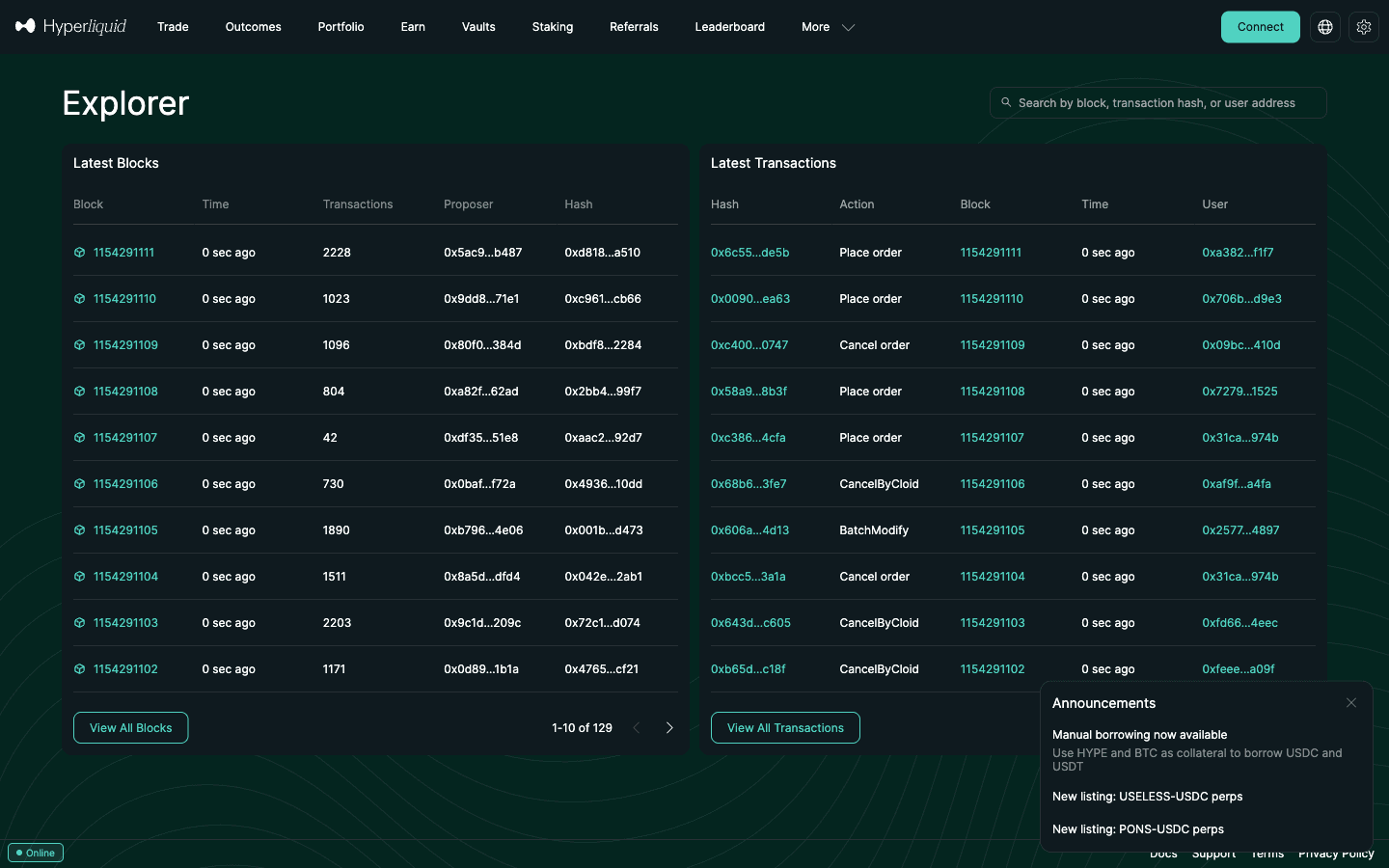
| Official Hyperliquid explorer app.hyperliquid.xyz/explorer | Every action the address signed (orders, cancels, transfers), newest first, with block and time: proof that a trade happened, but no balances or positions | No |
| HypurrScan hypurrscan.io/address/… | Perps with liquidation price, open orders, fills with TWAP labels, spot, vaults, staking | No |
| CoinGlass wallet page coinglass.com/hyperliquid/… | All-time, 24-hour, 7-day and 30-day PnL with a PnL chart; account value split into perp and spot; positions including HIP-3 markets; tabs for transactions, open orders, deposits and withdrawals, spot holdings | With a CoinGlass account |
| Hyperdash hyperdash.com | Trader profile, style and copy score, positions and history; copytrade or countertrade | Watch lists |
| HyperTracker hypertracker.io | Wallet search with cohort labels (size and PnL) | Yes, free, no account |
| HyperStats hyperstats.org | Wallet grade (S+ to F) and recent activity | Telegram, for favourited wallets |
| Nansen Profiler app.nansen.ai/profiler?address=…&chain=hyperliquid | Account value and staked HYPE, Nansen wallet labels, all-time PnL split into realized and unrealized, max drawdown, leverage and direction bias, a daily PnL calendar, positions with liquidation price and funding, balances, orders, history and transfers. Opens without signing in | Smart Alerts and watchlists, with a Nansen account |
A worked example. The CoinGlass wallet page for the address beginning 0x5b5d, the biggest row on the whale table, showed on October 4, 2026: $405.27M of account value ($172.24M perp, $233.03M spot), $856.07M of perp positions across 20 markets at 4.97x account leverage, including shorts in the HIP-3 markets xyz:GOLD and xyz:SILVER, +$91.80M of all-time PnL and −$56.76M over 30 days. Read on the whale table alone, it looks like a $282M ETH short losing $41M. Read as a whole account, it is a large, long-running book that hedges spot holdings. That is why a wallet tracker beats a position list: you judge the trader, not one trade.
Wider on-chain analytics: Nansen, Arkham, Dune, DefiLlama, Artemis
These five are not whale trackers, but traders reach for them when a Hyperliquid wallet or venue needs more context. Each line was checked on the vendor's own page or docs on October 18, 2026 (Artemis on October 15).
| Tool | What it shows for Hyperliquid | Price tier |
|---|---|---|
| Nansen nansen.ai/hyperliquid | Smart Money positioning on Hyperliquid, perps leaderboards (7D, 30D, all time) filterable by Smart Money and whales, and the Profiler for one address (row above). | Free account with a small daily API allowance; Pro plan for alerts and more credits (price shown only inside the app) |
| Arkham info.arkm.com | Entity labels and transfer maps across chains: the tool for finding which exchange or fund funded a Hyperliquid address through the Arbitrum bridge. | No price shown on its product page |
| Dune dune.com | SQL dashboards. Dune's HyperCore tables (Hyperliquid trades, order book, funding) are gated to enterprise and trial accounts; HyperEVM data is public. | Free view-only; Analyst $75/mo, Plus $399/mo (monthly billing) |
| DefiLlama defillama.com/perps | Hyperliquid perp volume next to every other venue (reported and normalized), open interest, fees, revenue and bridge TVL: the honest cross-venue check. | Free; Pro $49/mo (no API), API plan $300/mo |
| Artemis artemis.ai | Hyperliquid fees, revenue and volume on the same basis as 600+ other protocols (dashboard free to view), plus an AI analyst over its data library; see our Hyperliquid stats page for the same figures live. | Intern free; Investor $100/mo |
For a step-by-step on reading a single wallet, see section 7; for trader profiles and copy trading, the Hyperdash guide. If you plan to copy a wallet through Hyperdash or another app, join Hyperliquid with code HOLYGRAIL first: apps such as Phantom often set their own Hyperliquid referral code on accounts that have none, so enter a code on Hyperliquid before you start using an app.
5. Hyperliquid leaderboard: how to read it and find top traders
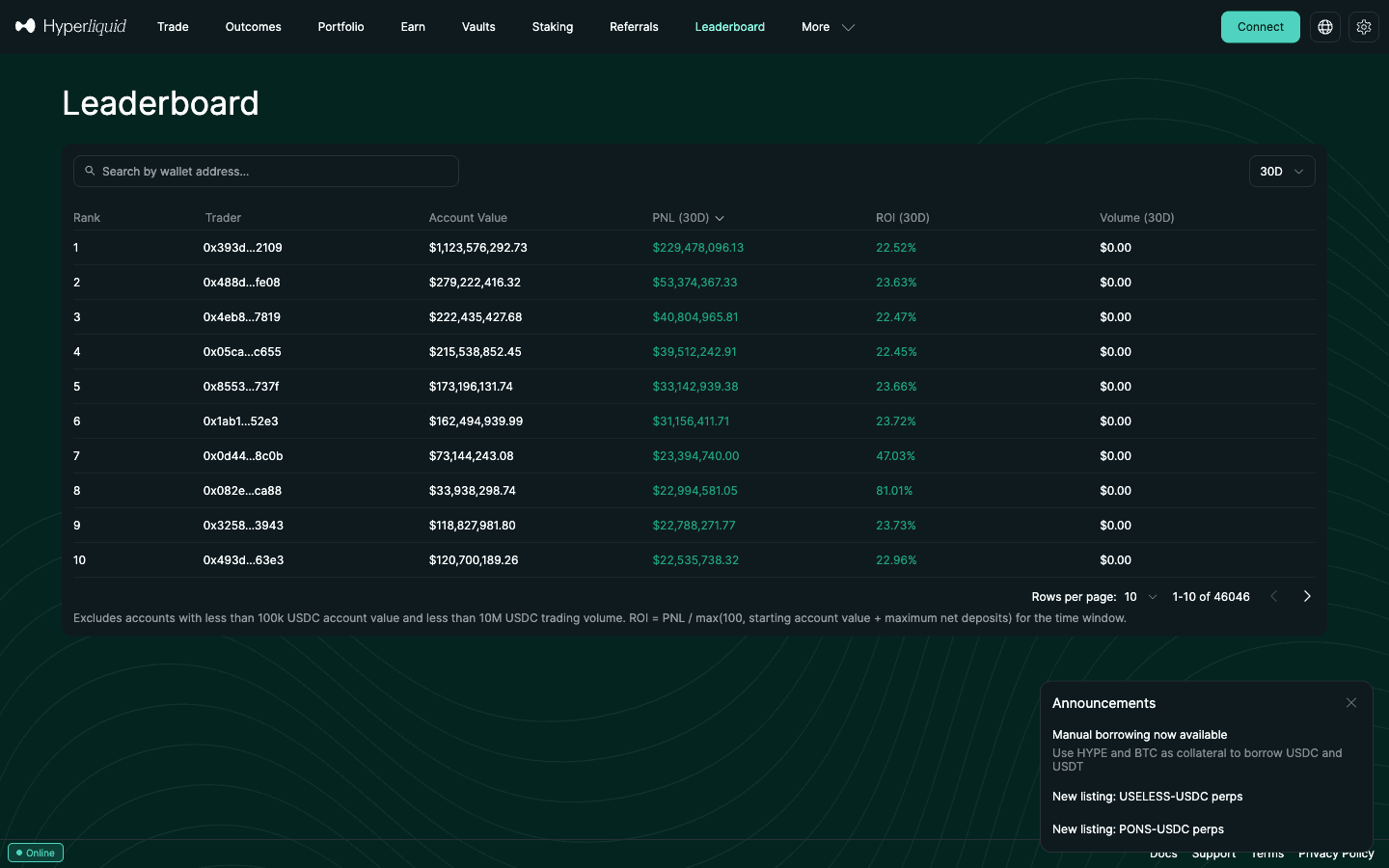
Where it is: the official Hyperliquid leaderboard is at app.hyperliquid.xyz/leaderboard. It is free, needs no wallet, and ranks 47,429 accounts (read October 20, 2026, 01:00 UTC): every account with at least 100,000 USDC of account value or 10M USDC of trading volume, and the volume that counts is all-time volume. Most whale lists, including our live table at the top of this page, start from this list or the same public data, so learning to read it is the fastest way to find traders worth following and to skip the ones that only look good.
What each column means
- Time window. A dropdown switches every column between 24h, 7D, 30D and All-time; 30D is the default. Rank changes completely between windows, so check more than one.
- Trader. The address, or a display name the owner set. The search box finds an address or a display name. Click a row and the app opens that address in the official Hyperliquid explorer.
- Account Value. Everything in the account now: perps, spot and staked HYPE together. Sortable.
- PNL. The change in account value over the window, net of deposits and withdrawals. It includes unrealized PnL on open positions and price moves of spot tokens held in the account, which is why a wallet that never trades can top the board. Sorted high to low by default.
- ROI. PNL divided by the larger of $100 and the starting account value plus the maximum net deposits in the window (the formula is printed under the table). A small starting balance makes ROI explode, so treat a huge ROI on a small account with suspicion and look at volume and account value next to it.
- Volume. Traded notional in the window. Zero volume means the account did not trade at all.
Account Value, PNL, ROI and Volume are sortable; Rank and Trader are not. The table shows up to 50 rows a page. Behind the page sits one public JSON file, and the app quietly drops 14 rows from it (Hyperliquid’s own HLP and liquidator vaults and the treasury addresses of Unit, the asset bridge whose spot tokens include USOL), so a ranking built from the raw file only matches the app after the same filter.
Top 10 on the Hyperliquid leaderboard by 30-day PnL
The board as the official app ranks it on the 30D window, rebuilt with this page every six hours. Data read October 20, 2026, 01:00 UTC.
| # | Trader | Account value | PnL (30D) | ROI (30D) | Volume (30D) | All-time PnL |
|---|---|---|---|---|---|---|
| 1 | 0x5b5d…c060 | $262.7M | +$76.5M | 38% | $321.2M | +$174.4M |
| 2 | 0xb83d…6e36 | $242.1M | +$72.3M | 44% | $489.2M | +$134.9M |
| 3 | 0xfc66…ca06 | $125M | +$17M | 15% | $5.69B | +$36.2M |
| 4 | 0x87f9…e2cf | $118.4M | +$15.7M | 15% | $19.15B | +$63.8M |
| 5 | 0x45d2…4029 | $55.3M | +$12.5M | 29% | $4.9M | +$62.2M |
| 6 | BobbyBigSize | $31.3M | +$12.4M | 17% | $2.49B | +$141.7M |
| 7 | 0x0242…ffa1 | $22.5M | +$10.3M | 89% | $847.8M | +$5.5M |
| 8 | 0xecb6…2b00 | $93M | +$10.2M | 8% | $12.66B | +$210.2M |
| 9 | 0x3a98…f4b8 | $9M | +$9M | 10,231% | $72K | +$9M |
| 10 | 0x936c…bb0f | $12.1M | +$8.7M | 20% | $1.04B | +$12.8M |
Source: stats-data.hyperliquid.xyz/Mainnet/leaderboard (read October 20, 2026, 01:00 UTC), with the rows the official app hides removed, so ranks match app.hyperliquid.xyz/leaderboard at that time. Holdings of zero-volume accounts from the public info API (spotClearinghouseState, delegatorSummary and spotMetaAndAssetCtxs for supply and 24-hour volume) in the same build. Addresses link to HypurrScan. The board changes every day.
Every account in today’s top 10 traded in the past 30 days. That is not always so: on October 15, 2026, the top 10 included wallets that had traded nothing, led by one holding about 100% of a near-untraded HIP-1 token marked at +$645M. The table below keeps only accounts with real volume:
Top 10 Hyperliquid traders by 30-day PnL (at least $10M of volume)
| # | Trader | Account value | PnL (30D) | ROI (30D) | PnL (7D) | All-time PnL |
|---|---|---|---|---|---|---|
| 1 | 0x5b5d…c060 | $262.7M | +$76.5M | 38% | +$17.4M | +$174.4M |
| 2 | 0xb83d…6e36 | $242.1M | +$72.3M | 44% | +$23.2M | +$134.9M |
| 3 | 0xfc66…ca06 | $125M | +$17M | 15% | +$10.9M | +$36.2M |
| 4 | 0x87f9…e2cf | $118.4M | +$15.7M | 15% | +$7.5M | +$63.8M |
| 5 | BobbyBigSize | $31.3M | +$12.4M | 17% | +$3.5M | +$141.7M |
| 6 | 0x0242…ffa1 | $22.5M | +$10.3M | 89% | +$6.8M | +$5.5M |
| 7 | 0xecb6…2b00 | $93M | +$10.2M | 8% | +$3.1M | +$210.2M |
| 8 | 0x936c…bb0f | $12.1M | +$8.7M | 20% | −$137K | +$12.8M |
| 9 | 0xb695…a92d | $49.2M | +$8.6M | 20% | +$2.9M | +$3.1M |
| 10 | 0xd475…1a91 | $24.3M | +$8.1M | 28% | +$2.9M | +$68.6M |
Same data (read October 20, 2026, 01:00 UTC), filtered to accounts with at least $10M of 30-day volume: 2,957 accounts, of which 1,028 were profitable over 30 days and only 553 were profitable over 7 days, 30 days and all time. Names are display names the owners set on the leaderboard.
Read the second table the way section 2 reads the whale table. #1 (0x5b5d…c060) and #2 (0xb83d…6e36) are among the low-leverage cross books that hold the largest shorts on the exchange; Hyperdash tags 0x5b5d as “Abraxas Capital (Hedged) #2”. Their 30-day PnL mostly tracks how the market moved against or with those shorts: the same 0x5b5d account showed −$56.76M of 30-day PnL on CoinGlass on October 4. #8 made +$8.7M in 30 days while losing $137K in the last seven. A 30-day rank is one window, not a record.
Found a trader worth following? Trade the same markets from your own account, opened with code HOLYGRAIL: 4% off fees on your first $25M of volume (0.045% taker becomes 0.0432%). Open Hyperliquid with HOLYGRAIL →
The raw leaderboard data: stats-data.hyperliquid.xyz/Mainnet/leaderboard
The app loads its table from one public file: GET https://stats-data.hyperliquid.xyz/Mainnet/leaderboard. No key and no wallet; it is a static file on Hyperliquid’s CDN, separate from the info API. It is a single JSON object, and it is big: 38.5 MB on October 15, 2026, with 47,443 rows (read October 20, 2026, 01:00 UTC). Download it once, cache it, and never poll it from a phone or inside a page load: we fetch it once per site build, every six hours, and build the tables above from that copy. The shape, trimmed to one row:
{
  "leaderboardRows": [
    {
      "ethAddress": "0x5b5d…c060",
      "accountValue": "292563867.2…",
      "windowPerformances": [
        ["day",     { "pnl": "…", "roi": "…", "vlm": "…" }],
        ["week",    { "pnl": "…", "roi": "…", "vlm": "…" }],
        ["month",   { "pnl": "53602958.7…", "roi": "0.2316…", "vlm": "320293580.9…" }],
        ["allTime", { "pnl": "…", "roi": "…", "vlm": "…" }]
      ],
      "prize": 0,
      "displayName": null
    }
  ]
}- Numbers are strings (parse them), and
roiis a fraction: 0.2316 means 23.16%. - Window names differ from the app:
day,week,monthandallTimeare the app’s 24h, 7D, 30D and All-time. displayNameis null unless the owner set one (1,475 listed accounts had);prizewas 0 on every row.- The file has no positions. For what an address holds now, call the info endpoint with
clearinghouseState(weight 2), as the API section shows. That is exactly how our live whale table is built. - Filter like the app if you want the app’s ranks: drop the HLP and liquidator vaults (from the vault list at stats-data.hyperliquid.xyz/Mainnet/vaults) and the Unit treasury addresses.
From the leaderboard to a wallet: HypurrScan, Hyperdash, Nansen
- Copy the address. Click the row on the official board; the explorer page that opens has the full address in its URL.
- Open it in a wallet tracker. Paste it into the wallet lookup at the top of this page, which opens HypurrScan, Hyperdash, CoinGlass and the official explorer in one go, or go straight to hypurrscan.io/address/ followed by the address.
- Check who it is. Hyperdash tags known funds and traders and shows a copy score and trade-duration stats; Nansen’s Profiler adds its own labels, realized vs unrealized PnL and max drawdown. A fund label or a permanent two-sided book means a hedge, not a call.
- Check the record across windows. Positive PnL over 7D, 30D and all time, at moderate leverage and real volume, is the filter that matters (see signal vs noise).
Other boards rank differently, which is useful as a cross-check. Hyperdash’s leaderboard is ranked by realized PnL, so holders who never trade do not top it: on October 15 its 30-day top trader showed about +$14.1M, not the $645M TBC mark that topped the official board that morning. HyperTracker’s leaderboards (24h, 7d, 30d, all) rank perp PnL among other boards; Dexly adds one-click copy trading (see the tracker table above) and Nansen’s leaderboards filter by Smart Money and Whales. Even the same wallet differs between tools: within about 70 minutes on the morning of October 15 (UTC), the 30-day PnL of 0x5b5d read +$53.6M in the official file, +$51.0M on Nansen and +$37.7M on CoinGlass, because each tool samples the window at a different moment and computes PnL its own way. Compare traders inside one tool, not across tools.
Before you copy a top trader
- The losers are listed, just at the bottom. Accounts are not removed when they blow up: the list keeps every account with at least 10M USDC of all-time volume, empty or not. James Wynn’s account (whales lose too) is still on it with $1 of account value and −$22.1M all time. About 69% of listed accounts (32,810) now hold under $100k. A PnL sort pushes the losers to the bottom, so the 30D PnL view you open shows only the month’s winners. Of the 18,624 listed accounts that traded in the past 30 days, 391 showed a 30D ROI of 100% or more, and 118 of those are still down all time.
- Mean reversion. The 30-day window rewards the trader whose bet happened to match the month.
- You cannot copy their size or their leverage cap. A large account is capped at lower leverage on BTC and ETH than you are, and sits through moves that liquidate a 20x follower (see copying the leverage).
- You are late. Their fill is on-chain before any copy tool reacts, and copy apps add their own fees; apps such as Phantom often set their own Hyperliquid referral code on accounts that have none, so enter a code on Hyperliquid before you start using an app.
How copy trading on Hyperliquid works, which apps offer it and what they charge: Hyperliquid copy trading.
6. What counts as a Hyperliquid whale?
Hyperliquid has no official "whale" label, so every tracker draws its own line. The definitions worth knowing:
- By account size (HyperTracker). Perp equity from Shrimp (under $250) up to Whale ($500K–$1M), Tidal Whale above that, and Leviathan ($5M+).
- By results (HyperTracker). Smart Money = $100K–$1M of cumulative all-time perp profit; Money Printer = over $1M; at the other end, Giga-Rekt = over $1M of cumulative losses.
- By position size (Buildix). Positions of $500K and up.
- By trade size (Proliquid). Individual fills above a size cut-off that Proliquid adjusts as market conditions change.
- By the official leaderboard. Accounts appear only if they hold at least 100,000 USDC of account value or have traded 10M USDC all time; that cut leaves 47,429 accounts today, and a whale that blew up stays listed.
The distinction that matters is big versus good. A whale moves the market because of its size; a smart-money wallet is worth following because of its record. The top of the official leaderboard can be holders, not traders: on October 15, 2026, the top ten by 30-day PnL included accounts that had traded nothing (section 5). Filter for both size and a multi-window profit record before you treat a wallet as a signal.
Why you can see every whale on Hyperliquid
On a centralized exchange you can see that a $5M market buy printed, but never who sent it. Hyperliquid runs its own chain (HyperCore), and account state is public by design. Three facts from the official API docs make a whale tracker possible:
- Every trade names both sides. The
tradesWebSocket feed carries ausersfield with the buyer and seller address of each fill. - Any address's positions are one request away.
clearinghouseStatereturns an address’s open perp positions with size, entry price, leverage, margin mode, unrealized PnL and the exchange’s ownliquidationPx.openOrdersreturns its resting orders;userFillsits latest 2,000 fills. - The leaderboard is public JSON. Third-party trackers all start from the same list, which is why they agree on who the whales are.
7. How to track a Hyperliquid whale wallet, step by step
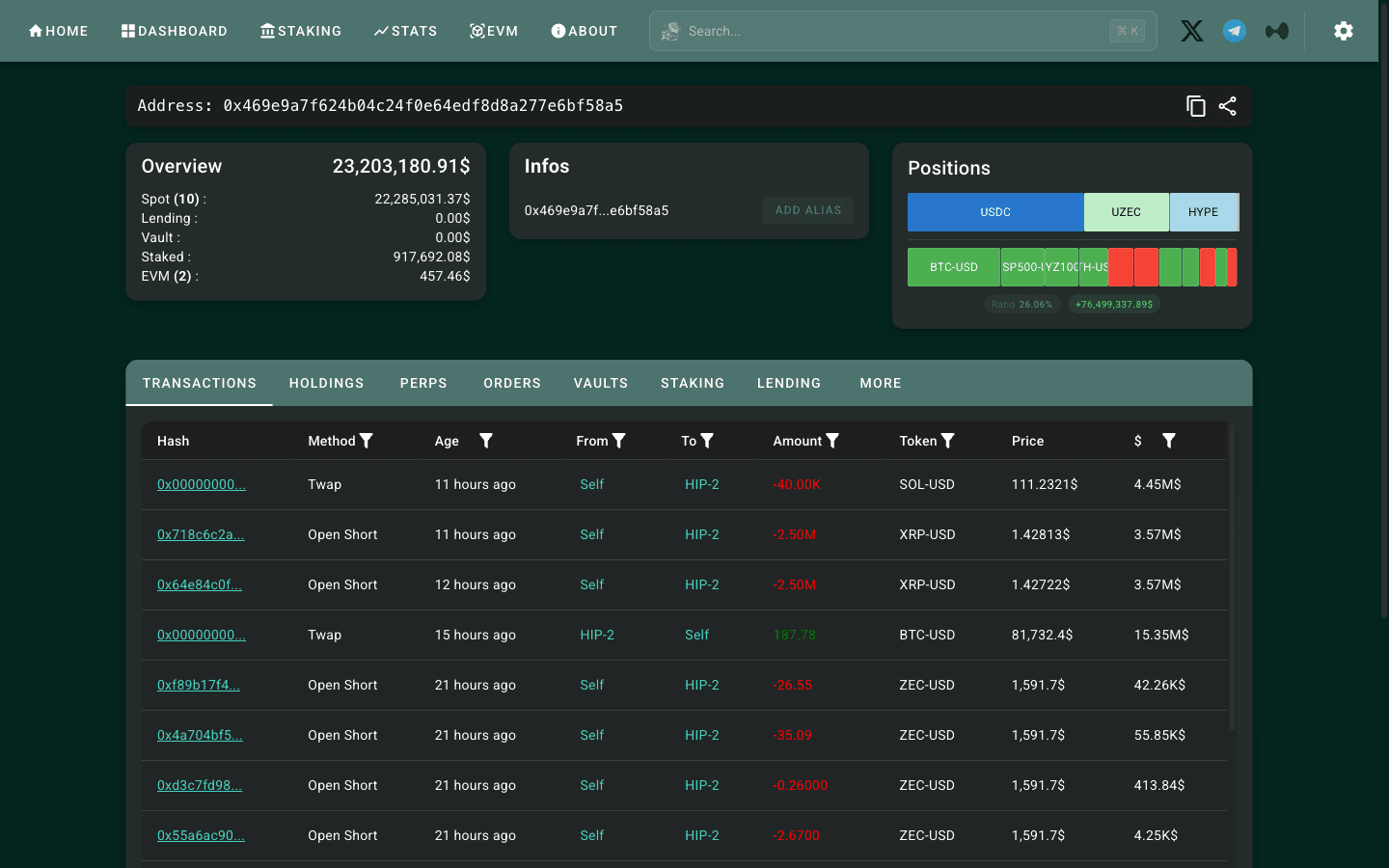
We use the address beginning 0x469e as the example. On September 26, 2026 it showed $24.9M of account value on the leaderboard and $408.5M of volume in the past seven days, held 10,000 ETH long from $2,720.51 at 25x cross with a liquidation price of $1,667.17, and ran shorts in SOL, XRP, HYPE and ZEC.
- Pick a whale on the leaderboard. Open app.hyperliquid.xyz/leaderboard, switch the window to 7D or 30D, and sort by Volume. You want accounts with eight or nine figures of volume and positive PnL across more than one window. Copy the address from the Trader column.
- Open the wallet in HypurrScan. Paste the address into hypurrscan.io. The overview splits total value into spot, vault, staked and EVM balances; the Positions bar shows margin per market; the tabs give Transactions, Holdings, Perps, Orders, Vaults and Staking.
- Read the Perps tab. For each position note side, size, entry price, leverage and margin mode. The liquidation price matters most: 0x469e’s ETH long liquidates at $1,667.17 against a $2,693.80 mark, a 38% buffer, so the whale is nowhere near a forced exit and any drawdown it takes is voluntary.
- Check the Orders tab and recent fills. Resting limit orders show where the whale wants to add or exit. In the transactions list, a Method of "Twap" repeating at a fixed interval (as often as every 30 seconds, with optional ±20% size randomisation) is a native TWAP order slicing a large trade; "Open Short" or "Close Long" are the frontend labels for market and limit fills.
- Set an alert. Add the address to HyperTracker, follow it on CoinLobster or favourite it on HyperStats with Telegram linked, so the next open, add or close reaches you without refreshing a page.
- Re-check the whale tables daily. Sort the CoinGlass table by Unrealised PNL to see which whales are under water and how far each Liq.Price sits from the mark. A cluster of whale liquidation prices near the current price is the setup for a cascade, covered in the liquidation map guide.
8. How to read the CoinGlass Hyperliquid Whale Tracker
The CoinGlass page at coinglass.com/hyperliquid is the best-known Hyperliquid whale dashboard, but it does not explain its panels. Here is what each one means and how to use it.
Overview tiles
Across the top: total whale Position split into long and short, Margin long and short, Profit & Loss (unrealized) for each side and cumulative Funding Fee for each side, next to links for the HLP vault and HYPE burn. When we read it on September 26, 2026 (around 17:00 UTC) it showed $11.84B of whale positions, 46.72% long and 53.28% short; longs were up $691.40M and shorts down $759.98M; longs had paid $57.38M of funding and shorts had received $87.26M. That tells you the short side is large, losing, and being paid to wait, which is the profile of hedged books rather than panicked bears.
Latest Whale Activity
A running list of large fills: address, asset, activity (Open Long, Close Short and so on), position size, price and time. Use it to see whether whales are opening or closing into a move. The smallest entries on the list at that time were around $0.6M, so treat it as a large-trade feed rather than a complete one; each address is clickable.
Long/Short Trader Ratio
This counts accounts, not dollars: 73,249 long traders against 26,942 short traders over one day (a ratio of 2.72), with a per-symbol breakdown. Compare it with the position tiles. On September 26 most accounts were long while most whale dollars were short. When the head count and the money disagree like that, the money usually decides, and crowded longs pay funding while they wait.
Hyperliquid Wallet Analysis table
The table at the bottom lists individual whale positions. The columns: User (address), Assets, Side, Position (notional), Unrealised PNL (%), Entry Price, Liq.Price, Margin, Funding Fee paid or received, current Price and Entry Time. Sort by Unrealised PNL to find whales under pressure, and compare Liq.Price with Price to see who could be forced out. The Liquidation Map link turns the same data into price levels; see our Hyperliquid liquidation map guide.
9. Hyperliquid whale alerts: Telegram and in-app
Most people who find a whale worth watching next want to know when it trades. Your options, from least to most setup:
- HyperStats: favourite a wallet, link Telegram, and HyperStats messages you when it opens or closes. It also posts filtered public alerts to Telegram and X. Free.
- HyperTracker: add an address to alerts and it notifies you when the wallet opens, adds, reduces or closes. Free, no account needed for the dashboard.
- CoinLobster: following a wallet, and the alert when it trades, costs nothing; Pro ($29/mo) raises the limit to 25 wallets and 50 alerts.
- Buildix and Hyperbot: whale alerts delivered to Telegram (Buildix’s free tier runs 15 minutes behind).
- Your own bot: subscribe to
userFillsfor up to 10 addresses per IP, or totradesfor every fill in a market, and forward anything above your size threshold to a Telegram chat through the Bot API.
10. Hyperliquid whale order tracking: fills, TWAPs and resting orders
Position snapshots tell you what a whale holds; order tracking tells you what it is doing. Three data sources cover it:
- Fills.
userFillsreturns up to 2,000 fills per response, and only the 10,000 most recent fills of an address are available (page through them withuserFillsByTime). Each fill carries price, size, direction label, closed PnL, fee and whether the order crossed the spread. A whale paying taker fees on every fill is in a hurry; one filling as maker is patient. - TWAP slices. Hyperliquid’s native TWAP splits a parent order into sub-orders at intervals of at least 30 seconds. The
userTwapSliceFillsrequest and the TWAP labels on HypurrScan expose them. Regularly spaced fills of similar size (sub-orders can be randomised by up to ±20%) mean the whale’s true size is many times what any single print shows. See the TWAP order guide. - Resting orders.
openOrdersandfrontendOpenOrdersreturn an address’s live limit, stop and take-profit orders. Whale stops are the cleanest signal of where a whale expects to be wrong. Because placing and cancelling orders costs no gas, large visible bids can be pulled instantly; treat a wall that vanishes as price approaches as spoofing, not support.
The exchange-wide version is the trades WebSocket stream, whose users field names the buyer and seller of every fill on a market. A filter for fills above, say, $500k on BTC and ETH is a real-time whale order tracker in about thirty lines of code, and is the same public data CoinLobster’s large-fill feed is built on.
11. Build your own Hyperliquid wallet tracker with the public API
Everything the paid dashboards do starts from free endpoints. The building blocks, with the rate-limit weights from the official docs:
| Need | Request | Weight / limit |
|---|---|---|
| List of whales | GET stats-data.hyperliquid.xyz/Mainnet/leaderboard | Public JSON (about 38.5 MB on October 15, 2026) with 24h/7D/30D/all-time PnL, ROI and volume for every listed account; format in section 5 |
| Positions of one address | POST info, type clearinghouseState | Weight 2 of 1,200 per minute per IP, so about 600 wallets a minute |
| Resting orders | POST info, type openOrders or frontendOpenOrders | Weight 20 |
| Trade history | POST info, type userFills or userFillsByTime | Weight 20 plus 1 per 20 fills returned; max 2,000 per response |
| Live fills for followed wallets | WebSocket subscribe userFills or userEvents | Max 10 unique users across user-specific subscriptions; max 10 connections and 1,000 subscriptions per IP |
| Live whale prints, all wallets | WebSocket subscribe trades per coin | Filter on size; users field gives buyer and seller |
| Historical fills | S3 bucket hl-mainnet-node-data (node_fills_by_block) | Requester pays transfer |
A minimal tracker is a loop that loads the leaderboard once a day, keeps the top few hundred addresses, polls clearinghouseState for each and diffs the position list against the previous poll to emit "opened", "added", "reduced" and "closed" events. That is how the live section above is built (we poll 200 wallets per deploy). To run it unattended, follow the WebSocket setup guide, the Hyperliquid API guide and the rate limits; the info endpoints need no API key and no wallet.
Trade the same book the whales trade
Join Hyperliquid with code HOLYGRAIL for 4% off fees on your first $25M of volume. Your positions will be as public as theirs, so plan your stops accordingly.
12. Reading whale data: what is signal and what is noise
Worth acting on
- A profitable, high-volume wallet opening a new direction. Filter for accounts with positive PnL over 7D, 30D and all-time and at least tens of millions in volume. A fresh position from one of these, at moderate leverage (10x or below) and in size relative to its account, is the highest-quality whale signal available.
- Several unrelated whales building the same side on the same market. One wallet is a bet; five wallets with different histories is a consensus.
- Whale liquidation prices bunching near the mark. The "closest to liquidation" table above lists them (or sort the live table by “Closest to liquidation”). If the mark approaches such a cluster, forced orders follow; the Hyperliquid liquidation map shows this per market.
- Whales taking the other side of extreme funding. When funding is stretched and whales are positioned against the crowd (compare CoinGlass’s trader ratio with its position split), the crowd usually pays.
Usually noise
- Giant low-leverage shorts that never move. The largest books on the exchange are low-leverage (mostly 5x) cross shorts across every major, opened far below today’s price and kept open through large unrealized losses. That pattern usually means inventory hedging by market makers or funds, not a market call.
- Top-of-leaderboard PnL with zero volume. Those are HYPE holders marking up; there is nothing to follow.
- A single large order in the book. Gas-free cancels make spoofing free. Wait for fills, not quotes.
- Copying the leverage. A whale at 5x cross with a large account can sit through a 15% move. The same trade at 20x on a small account is liquidated after roughly a 3.8% move on BTC. Leverage caps also shrink with size: BTC allows 40x below $150M of notional and 20x above it, ETH 25x then 15x above $100M, so the largest whales are structurally less levered than you can be.
13. Whales lose too: four verified wallets
Whale tracking content tends to show winners. The public record says size is no guarantee. Each figure below comes from the Hyperliquid API (portfolio and userFillsByTime) on September 26, 2026; follow the links to check them yourself.
- James Wynn (0x5078…edb6). The most publicised Hyperliquid whale of 2025. His perp PnL peaked at +$75.7M with $80.6M of account value on May 21, 2025, fell to −$20.8M by June 4, 2025, and stands at −$23.4M all-time. The account is empty.
- 0xa523 (0xa523…75aa). First active in August 2025, account value up to $27.1M on August 27, 2025, then −$25.4M of PnL by September 3 and −$44.0M by October 1, 2025, a bigger loss than Wynn’s. Inactive since.
- The biggest loser on the leaderboard (0xb317…83ae). Perp PnL of +$156.0M and $284.8M of account value on January 14, 2026; −$128.9M by February 4, 2026. A swing of about $285M in three weeks.
- The ZEC short (0x92ea…50e9). Japanese outlet JinaCoin reported on September 7, 2026 (citing HypurrScan) that this wallet was short 32,760 ZEC from $444 with $25.1M of unrealized loss. The API shows it bought back about 38,000 ZEC of shorts on September 20, 2026 (19:28–20:15 UTC) at an average of $1,512.91, booking about −$32.0M on those closing fills.
None of these wallets were small or unsophisticated. The lesson is the one in the signal section: follow records, not size, and never inherit someone else’s leverage.
14. Pitfalls of Hyperliquid whale tracking
- You are late by construction. The fill is on-chain before any tracker shows it, and free tiers add delay (15 minutes on Buildix, 5 on Proliquid’s public page). Whale data works for confirmation and for anticipating liquidation flow, not for front-running.
- Sub-accounts and multiple wallets. One trader can be several addresses; a "whale closing" may be a transfer between accounts. HypurrScan’s Transactions tab shows internal transfers.
- Vault positions are shared. A vault address’s positions belong to its depositors and follow the vault leader’s strategy. Check the Vaults tab before reading a vault as a single whale (see Hyperliquid vaults).
- Hedges look like bets. A short on Hyperliquid may hedge spot held elsewhere. The only defence is the wallet’s history: does it hold directional positions and close them for profit, or run permanent two-sided books?
- Copy trading is not following. Trackers alert you; copy-trading products (Hyperdash, Dexly, Hyperbot, Hyperliquid vaults) place trades for you and add their own fees.
- Your positions are public too. Keep stops away from obvious liquidation clusters and keep fees low with the fee guide and a referral code.
Start whale watching on Hyperliquid
Sign up with code HOLYGRAIL for 4% off fees on your first $25M of volume, then use the leaderboard, explorer and public API from the same account. New to the exchange? Read how to use Hyperliquid first.
FAQ
What is the best Hyperliquid whale tracker?
For scanning the largest open positions, the CoinGlass Hyperliquid Whale Tracker. For reading one wallet in depth, HypurrScan. For free alerts, HyperTracker (in-app) or HyperStats (Telegram). For finding whales in the first place, the official leaderboard at app.hyperliquid.xyz/leaderboard. All of them read the same public Hyperliquid data, so pick by workflow rather than by data coverage.
Is there a free Hyperliquid whale tracker?
Yes. The official leaderboard, HypurrScan, the CoinGlass whale tracker, HyperStats and the public info API are free. HyperTracker's dashboard and alerts are free without an account (its API is paid above 100 tokens a day), CoinLobster lets you follow wallets for free (Pro is $29 a month), and Buildix is free with a 15-minute delay. Prices checked September 26, 2026.
What counts as a whale on Hyperliquid?
There is no official threshold. HyperTracker calls a wallet with $500K to $1M of perp equity a Whale and $5M or more a Leviathan; Buildix tracks positions of $500K and up; Proliquid counts individual fills above a size cut-off it adjusts to market conditions. The official leaderboard only lists accounts with at least 100,000 USDC of account value or 10M USDC of volume.
How do I track a specific Hyperliquid wallet address?
Paste the address into the wallet lookup at the top of this page, or straight into HypurrScan (hypurrscan.io), to see its positions, liquidation prices, open orders and fills; the official explorer at app.hyperliquid.xyz/explorer lists every action it signed. To be notified when it trades, add it to HyperTracker, follow it on CoinLobster or favourite it on HyperStats and link Telegram. Developers can subscribe to the userFills WebSocket feed for up to 10 addresses per IP.
Where is the Hyperliquid leaderboard?
At app.hyperliquid.xyz/leaderboard. It is free and needs no wallet. It ranks every account with at least 100,000 USDC of account value or 10M USDC of all-time volume by PnL, ROI, volume or account value over 24h, 7D, 30D and All-time, and clicking a row opens the address in the explorer. The same data is a public JSON file at stats-data.hyperliquid.xyz/Mainnet/leaderboard (about 38.5 MB). PnL includes price moves of tokens held, so check the volume column before you treat a top row as a trader.
What is the best Hyperliquid wallet tracker?
To follow one address, paste it into HypurrScan for positions, orders and fills (the official Hyperliquid explorer shows its signed actions), Hyperdash for a trader profile, or CoinGlass (coinglass.com/hyperliquid/ followed by the address) for all-time and 30-day PnL, a PnL chart, positions including HIP-3 markets, transactions, open orders and deposits. For alerts when the wallet trades, add it to HyperTracker (free, no account) or favourite it on HyperStats with Telegram linked. None of them need your wallet or a signature.
How do I get Hyperliquid whale alerts on Telegram?
HyperStats sends Telegram alerts for the wallets in your favourites list and runs public Telegram and X alert channels; Buildix and Hyperbot also deliver whale alerts to Telegram. HyperTracker and CoinLobster alert you inside their own apps. If you want full control, a small bot on the trades WebSocket feed can post fills above your size threshold to a Telegram chat.
Is the CoinGlass Hyperliquid whale tracker real-time?
CoinGlass labels the page real-time, and its Latest Whale Activity list shows each large fill with address, size, price and time. Keep in mind that every tracker shows a fill after it is already on-chain, so whale data is for confirmation and for spotting liquidation clusters, not for front-running. Proliquid’s public page runs on a 5-minute delay and Buildix’s free tier on 15 minutes.
Can you see who is trading on Hyperliquid?
You see the wallet address, not a name. The trades WebSocket feed includes a users field with the buyer and seller address of every fill, and a clearinghouseState request returns any address’s positions. Names appear only when a trader sets a display name on the leaderboard or a tracker labels the wallet.
What is the difference between a whale and a smart money wallet?
A whale is defined by size, a smart money wallet by results. In HyperTracker's cohorts a Whale holds $500K–$1M of perp equity, while Smart Money has made $100K–$1M of all-time perp profit (Money Printer: over $1M). A wallet can be both, either or neither; the biggest accounts on Hyperliquid are often hedgers or market makers, not profitable directional traders.
Are Hyperliquid whales always profitable? Should I copy them?
No. The biggest all-time loser on the official leaderboard is down about $128.9M, and well-known whales such as James Wynn and the 0xa523 wallet lost tens of millions (figures from the Hyperliquid API, September 26, 2026). Copy the idea and the risk management, never the leverage: a whale at 5x with a large account survives moves that liquidate a 20x follower.
How much do Hyperliquid whales hold right now?
As of October 20, 2026, 03:53 UTC, the 200 largest active accounts on the leaderboard held $4.17B of perp positions, about 38% of Hyperliquid’s $11.05B open interest. 78 positions were above $10M; the largest was a $256.5M ETH short at 5x cross. This figure is rebuilt from the API on every site build.
Disclosure: HOLYGRAIL is our referral code; we earn a share of referred accounts’ fees, and it never raises yours. Whale positions and open interest are rebuilt from the public Hyperliquid API on every site build (last: October 20, 2026, 03:53 UTC); the historical wallet figures and CoinGlass readings are dated in the text. Tracker features and prices were read on each tool’s website on September 26, 2026 (CoinGlass on October 4, 2026) and can change. Nothing here is investment advice.