
Short version. With BTC at $83,748 (Hyperliquid, September 25, 2026): a one-month 84,000 call cost $3,566 on Derive and breaks even at $87,566; a 1 BTC perp long costs about $75 in taker fees for the round trip plus about $25 a day in funding at the baseline rate, and breaks even near $84,700, but can be liquidated. Options lose about $51 a day to time decay at the money. Perps suit short-term directional trades and hedges; options suit defined-risk bets on big moves and insurance. On-chain options exist (Derive, Paradex, Aevo); Hyperliquid, Lighter and Aster are perps-only.
Trade perps on the deepest on-chain book
Hyperliquid: 178 perps (as of October 20, 2026), $4–8B of daily volume, 0.045% taker. Code HOLYGRAIL takes 4% off your fees for the first $25M.
We earn a commission when you sign up through our links; it never raises your fees.
1. Perps vs options side by side
| Perpetual future | Option (buyer) | |
|---|---|---|
| What you own | A linear position: +$1 per $1 move per unit (long) | The right to buy (call) or sell (put) at a strike by expiry |
| Expiry | None | Fixed date (e.g. October 30, 2026, 08:00 UTC) |
| Upfront cost | Margin (collateral you get back) + trading fee | Premium (spent) |
| Holding cost | Funding, paid or received every hour on Hyperliquid | Time decay (theta), built into the premium |
| Maximum loss | Your margin (liquidation); more across a cross account | The premium |
| Liquidation | Yes | No for a bought option |
| Break-even | Entry + fees + funding | Strike + premium (call) or strike − premium (put) |
| Volatility exposure | None directly | Yes: premium rises with implied volatility |
| DEX liquidity (Sep 2026) | Deep: Hyperliquid $7.63B / 24h | Thin: Derive $264.9M notional / 24h, others lower |
2. How a perpetual future works
A perpetual ("perp") tracks the spot price without ever expiring. You post margin, choose leverage (up to 40x on BTC on Hyperliquid, 50x on Lighter), and your profit or loss moves one-for-one with the price. What keeps the perp near spot is funding: when the perp trades above the index, longs pay shorts; below, shorts pay longs. On Hyperliquid funding is paid every hour, and in calm markets it sits at a baseline of 0.00125% per hour (0.01% per 8 hours) paid by longs. Over the 30 days to September 25, 2026, a BTC long paid a total of 0.7664%.
The other cost is the trading fee: 0.045% taker / 0.015% maker at Hyperliquid's base tier, 0.0432% / 0.0144% with a referral code. The risk is liquidation: if losses eat your margin down to the maintenance level, the position is closed. For a 1 BTC long at about $84,000, the isolated liquidation price is around $68,000 at 5x and $76,600 at 10x. More: funding rates explained, liquidations on Hyperliquid.
3. How an option works
A call pays max(price − strike, 0) at expiry; a put pays max(strike − price, 0). You pay the premium upfront, and that is all a buyer can lose. The premium has two parts: intrinsic value (how far in the money the option is) and time value, which depends on time to expiry and implied volatility (IV). On September 25, 2026, one-month BTC options near the money were priced at an IV of about 34% on both Deribit and Derive.
Time value shrinks every day, which is called theta. Deribit's greeks put the theta of the at-the-money October 30 call at about −$51 per day per BTC. Writing (selling) options flips the picture: you collect the premium and theta, but a seller's loss is open-ended on calls and large on puts, and sellers post margin and can be liquidated like a perp trader.
Options settle at a fixed time on expiry day: Deribit's October 30 BTC options, for example, expire at 08:00 UTC.
4. Worked example: BTC call vs perp long
You expect BTC to rise over the next five weeks. Two ways to express it, priced on September 25, 2026 at about 17:00 UTC:
- Option: buy one BTC-30OCT26-84000 call at the Derive mark price of $3,566 (Deribit's mark was 0.0436 BTC, about $3,656). Expiry October 30, 2026, 08:00 UTC, 831 hours away.
- Perp: buy 1 BTC on Hyperliquid at $83,748 with market orders both ways (0.045% each side) and hold to the same date, paying funding at the baseline 0.00125% per hour: about $870 over 831 hours, or $25 a day.
| BTC on Oct 30 | Long 84k call (paid $3,566) | Long 1 BTC perp (fees + funding) | 1 BTC spot + 84k put (paid $3,340) |
|---|---|---|---|
| $70,000 | −$3,566 | −$14,687 | −$3,088 |
| $75,000 | −$3,566 | −$9,689 | −$3,088 |
| $80,000 | −$3,566 | −$4,692 | −$3,088 |
| $84,000 | −$3,566 | −$693 | −$3,088 |
| $87,566 | $0 (break-even) | +$2,871 | +$478 |
| $90,000 | +$2,434 | +$5,304 | +$2,912 |
| $100,000 | +$12,434 | +$15,299 | +$12,912 |
Our arithmetic from the quotes above, per 1 BTC. Perp column: price change − taker fees on entry and exit − baseline funding; real funding varies every hour. Excludes option trading fees and any slippage.
What the table shows:
- If BTC rises quickly, the perp wins: at $90,000 it makes $5,304 against $2,434 for the call, because the call first has to earn back its $3,566 premium.
- If BTC goes nowhere, the perp is cheaper: at $84,000 the call loses its entire premium, while the perp loses about $693 in fees and funding.
- If BTC falls hard, the call wins: the call can never lose more than $3,566; the perp loses $9,689 at $75,000. And with leverage, the perp may never reach expiry: at 10x (about $8,375 of margin) the liquidation price is about $76,300, so a dip to $75,000 closes the trade at a loss of most of the margin even if BTC recovers later.
A fair comparison therefore depends on sizing. A perp sized so that a stop-loss caps the loss at $3,566 (for example 1 BTC with a stop at about $80,200) has a similar worst case to the call, but a stop can slip and a sharp wick can stop you out before a rally; the option cannot be stopped out.
5. Worked example: hedging with a put vs a perp short
You hold 1 BTC and want protection for five weeks.
- Buy the 84,000 put for $3,340 (Derive mark). Your worst-case value on October 30 is $84,000 − $3,340 = $80,660 of effective sale price, and you keep all upside above $84,000 minus the premium (last column of the table).
- Short 1 BTC perp on Hyperliquid at $83,748. Your spot and perp now offset: the combined value is locked near $83,748 in both directions. At baseline funding the short receives about $870 over the period, and the fees are about $75. You give up all upside while the hedge is on.
The put is insurance with a premium; the perp short is a lock that can pay you. A common middle ground is to short a perp for only part of the position. Our guide to hedging crypto with perpetuals walks through the sizing and the liquidation risk on the short leg.
Hedge or trade direction on Hyperliquid
Hourly funding, 0.015% maker, no gas on orders. Join with HOLYGRAIL before your first trade; Hyperliquid stops accepting codes after $10,000 of volume.
6. Costs: funding vs premium and theta
| Cost on 1 BTC (Sep 25, 2026) | Perp long on Hyperliquid | ATM call, Oct 30 expiry |
|---|---|---|
| Entry and exit fees | ~$75 taker both ways ($72 with a referral code; ~$25 maker both ways) | Derive: taker rate 0.03% of the underlying plus a $0.50 base fee, capped at 12.5% of the option price; Deribit 0.03% |
| Holding cost per day | ~$25 at the baseline funding rate (can be higher, lower or negative) | ~$51 theta today, rising as expiry approaches |
| Bid-ask spread | About $1 on BTC | Derive: $3,359 bid / $3,918 ask (about 16% wide); Deribit 0.043 / 0.044 BTC |
| What you pay for | Leverage and linear exposure | A capped loss and no liquidation |
The spread row is the one most guides skip. On-chain option books are wide: buying the call at Derive's ask ($3,918) rather than its mark ($3,566) moves the break-even from $87,566 to $87,918. Use limit orders near the mark or request a quote. Perp spreads on liquid pairs are a fraction of a basis point. Fee detail for the perp side: Hyperliquid fees; the same fee comparison across venues: DEX vs CEX fees.
7. Where to trade options on-chain in 2026
We checked each venue's public API on September 25, 2026:
| Venue | Options listed | Activity | Fees |
|---|---|---|---|
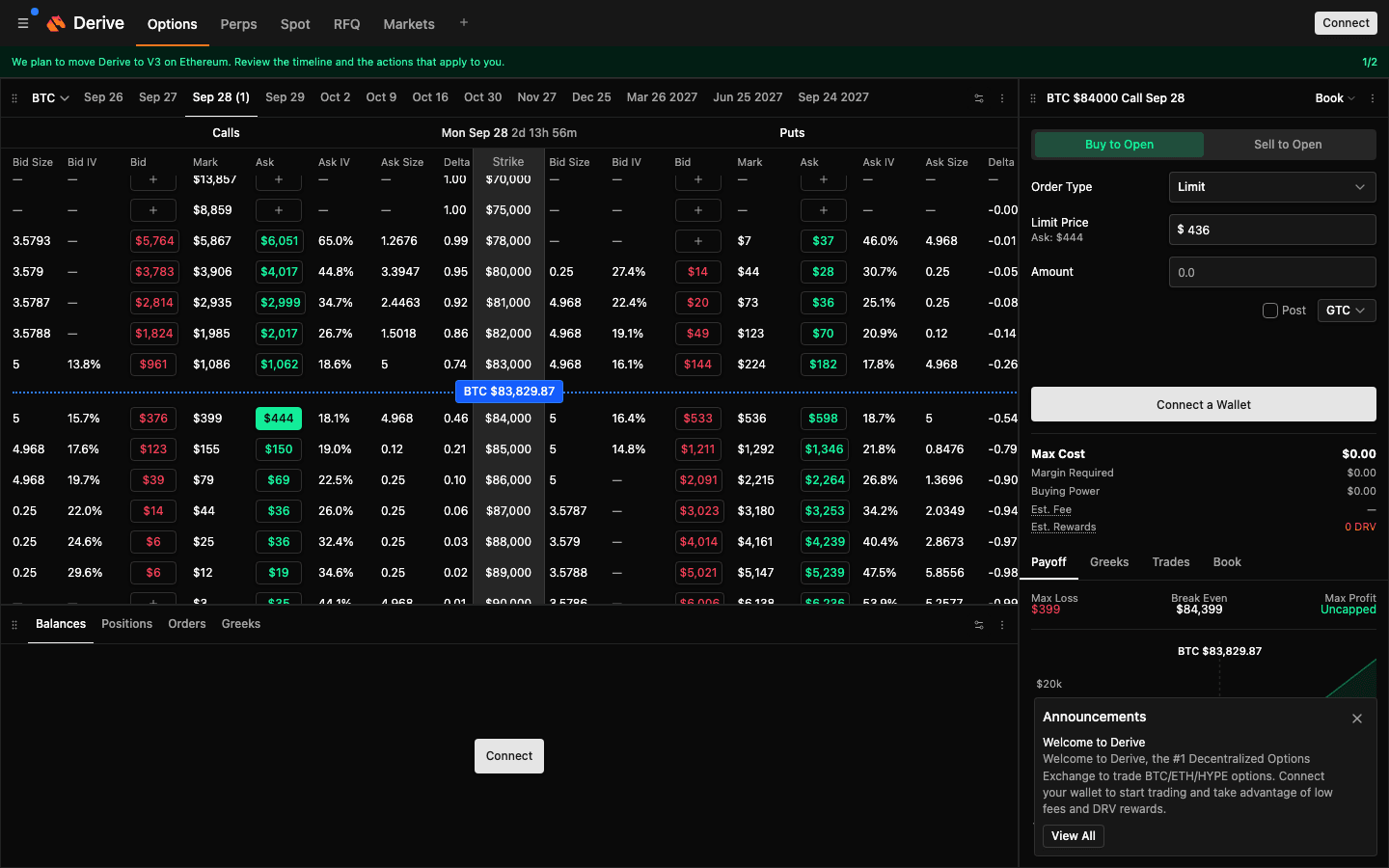
| Derive (on-chain) | 716 BTC options live | $264.9M notional / $3.94M premium traded in 24h (all assets) | Taker 0.03% / maker 0.01% rate + $0.50 base fee, capped at 12.5% of option price (API parameters) |
| Paradex (on-chain) | 4,848 option markets listed | The Oct 30 BTC 84k call showed no 24h volume and no open interest | Retail 0%; Pro 0.01% capped at 12.5% of premium |
| Aevo (on-chain) | BTC and ETH options | BTC options OI 40 contracts; $12k of premium traded in 24h | Not re-verified |
| Deribit (centralized, KYC) | 998 BTC options | ~$106M 24h volume; the reference market for crypto options | 0.03% taker / maker (instrument data) |
| Hyperliquid | No options; HIP-4 outcome markets (daily BTC binary) | Perps: $7.63B 24h volume | Perps 0.045% / 0.015%; outcomes currently 0% |
- Derive (formerly Lyra) is the most active on-chain options venue we found: 716 live BTC option instruments and $264.9M of option notional ($3.94M of premium) traded in 24 hours across all assets, 2,168 trades.
- Paradex lists thousands of option markets and charges retail users no fee, but the contracts we checked had no trades and no open interest; quotes existed with a spread of about $210 on the 84k call.
- Aevo is live, but its BTC options had only 40 contracts of open interest; treat it as illiquid.
- Hyperliquid, Lighter and Aster list no options. Hyperliquid's HIP-4 outcome markets (a daily BTC binary that settles at 06:00 UTC, zero fees at launch) are the closest thing: a yes/no bet with a capped payoff, not a strike-and-expiry option.
Most crypto option volume still trades on centralized Deribit (about $106M of BTC options in 24 hours on the same day), which requires identity verification. We hold no referral codes for any options venue; links to perps venues on this page are ours.
8. When each one fits
Use a perp when you expect a move soon, want to add or cut size freely, want to hedge spot cheaply, or trade altcoins that have no options market. Keep leverage low enough that normal volatility cannot liquidate you, and always set a stop. Venues: Hyperliquid vs Lighter vs Aster.
Use an option when you want a fixed maximum loss, expect a large move but not its timing within a window, want insurance on a spot holding through a known event, or want to trade volatility itself. Accept that most bought options expire worthless and that on-chain spreads are wide.
Many traders use both: a perp for the core directional view and a cheap out-of-the-money put as disaster insurance. For how perps compare with other instruments, see perps vs spot, perps vs CME futures and perps vs spot margin. New to DEXs: what is a DEX and the best DEXs in 2026.
9. Tax and Japan notes
For readers in Japan: the National Tax Agency's crypto FAQ (December 2025 edition) treats income from crypto transactions as miscellaneous income under progressive taxation, and states that crypto margin-style trading is not eligible for separate taxation; losses cannot offset salary income. The FAQ does not address crypto options specifically, so ask a tax accountant how to treat premiums and settlements. Keep records of premiums paid and received, funding, fees and settlement values in yen. See our DEX tax reporting guide. Not tax advice.
10. FAQ
What is the difference between perpetual futures and options?
A perpetual future is a linear bet with no expiry: you gain or lose one dollar per dollar of price move per unit, pay trading fees, and pay or receive funding every hour while the position is open. An option is the right, not the obligation, to buy (call) or sell (put) at a fixed strike by an expiry date: you pay a premium upfront, the most a buyer can lose is that premium, and the option loses time value (theta) every day.
Are perps or options better for beginners?
Buying an option has a hard maximum loss (the premium) and no liquidation, which is simpler to size. But options add strikes, expiries and implied volatility, and most options expire worthless when the move does not come in time. Perps are simpler to trade but can be liquidated. A beginner who uses 2–3x leverage and a stop-loss on a perp takes a similar risk to buying an option, with lower cost if the move comes quickly.
Which is cheaper to hold: a perp or an option?
At September 25, 2026 prices, holding 1 BTC long on Hyperliquid at the baseline funding rate cost about $25 a day, while a one-month at-the-money BTC call lost about $51 a day to theta (Deribit greeks). The option buys downside protection with that extra cost. Funding changes every hour and can turn negative, while theta speeds up as expiry approaches.
Can I trade crypto options on a DEX?
Yes. On September 25, 2026 Derive had 716 live BTC options and traded $264.9M of option notional in 24 hours; Paradex listed 4,848 option markets, though many showed no volume; Aevo was live but thin (40 BTC option contracts of open interest). Hyperliquid, Lighter and Aster do not offer options. Most crypto option volume still trades on Deribit, a centralized exchange that requires KYC.
What is the break-even on a call option?
Strike plus premium at expiry. The BTC 84,000 call expiring October 30, 2026 had a Derive mark of $3,566 on September 25, 2026, so it breaks even at $87,566, about 4.6% above the $83,748 perp price at the time. A perp long entered at $83,748 breaks even after about $950 of fees and baseline funding, near $84,700.
Can I hedge with perps instead of options?
Yes, and it is cheaper, but different. Shorting a perp against spot BTC locks in the price in both directions: you give up the upside and you receive funding when it is positive. Buying a put keeps the upside and sets a floor, for the premium. On September 25, 2026 an 84,000 put cost $3,340, which set an effective floor of $80,660 for about 35 days.
How are perps and options taxed in Japan?
Under the National Tax Agency FAQ (December 2025 edition), gains from crypto transactions, including margin-style crypto trading, are generally miscellaneous income taxed at progressive rates, and losses cannot offset salary income. The FAQ does not address crypto options specifically; ask a tax accountant. This is not tax advice.
Disclosure: HOLYGRAIL, 718610TD and DTLpLc are our referral codes for perps venues; we earn a share of referred accounts' fees at no cost to you. We have no affiliation with Derive, Paradex, Aevo or Deribit. Prices and venue data were read from public APIs on September 25, 2026; payoffs are illustrative arithmetic. Not investment or tax advice.