
A Solana perpetual DEX lets you trade leveraged, non-expiring futures on SOL, BTC, ETH and more from your own Solana wallet. By 30-day volume on DefiLlama (September 26, 2026), the biggest are GMTrade (GMX on Solana, $22.78B), Pacifica ($10.98B) and Jupiter Perps ($6.76B), with Pacifica leading the last 24 hours. Drift, once Solana’s largest perp DEX, was exploited on April 1, 2026 and now relaunches as Velocity, which is still tiny. For SOL itself, the deepest perp market of any DEX is on Hyperliquid, which takes native SOL deposits: $266M of SOL volume and $711M of SOL open interest on September 25, 2026.
Quick picks: the best Solana perp DEXs (September 2026)
- GMTrade: largest by 30-day volume ($22.78B). Best for FX, commodity and stock perps; SOL is a small share.
- Pacifica: best Solana order book. 0.040% / 0.015% fees; led 24h volume ($228.4M).
- Jupiter Perps: best for simple SOL/BTC/ETH trades at the oracle price. Up to 250x; 0.06% to open and to close.
- Phoenix: lowest published taker fee on an on-chain book (0.035%); $933.2M in 30 days.
- Flash Trade: highest leverage (up to 500x on SOL, BTC and ETH in Degen Mode); 0.02% to open and close on SOL.
- BULK: new high-speed order book; 0% maker fee in Phase 1.
- Bullet: ZK-rollup order book settling on Solana; small ($7.6M 24h on September 25).
- Adrena: 0% to open, 0.14% to close, up to 100x; very little volume.
Not on Solana, but takes SOL: Hyperliquid, the deepest SOL book of any DEX (0.045% / 0.015%, 4% lower with code HOLYGRAIL). Avoid assuming Drift still works: it is paused, and its relaunch, Velocity, did about $16,000 of SOL volume in the 24 hours to September 26, 2026.
Trade SOL where the liquidity is
Hyperliquid: 20x SOL perps, hourly funding, native SOL deposits. Join with HOLYGRAIL for 4% off trading fees on your first $25M of volume.
We earn a commission when you sign up through our links; it never raises your fees.
1. Solana perp DEXs ranked by volume
DefiLlama is the reference most people check, so we rank by its 30-day volume, which smooths out daily swings. On Saturday, September 26, 2026, its Solana perps page showed $623.2M of 24-hour volume, $229.2M of open interest and $41.48B over 30 days. Weekly volume was down 40.96%, and weekends are quieter: on Thursday, September 25 the 24-hour figure was $1.292B.
| # | Venue | Model | 30d volume | 24h volume | Open interest |
|---|---|---|---|---|---|
| 1 | GMTrade (GMX on Solana) | Pools (GMX V2 design) | $22.78B | $202.7M | $103.4M |
| 2 | Pacifica | Order book, off-chain matching | $10.98B | $228.4M | $57.5M |
| 3 | Jupiter Perps | Pool (JLP) vs oracle | $6.76B | $140.2M | $43.7M |
| 4 | Phoenix | On-chain order book | $933.2M | $52M | $24.5M |
| 5 | Flash Trade | Pool-to-peer (FLP) | $15.8M | not shown | not shown |
| – | Adrena | Peer-to-pool (ALP) | no data | no data | no data |
| – | Drift (now Velocity) | DLOB + vAMM | $0 | no data | no data |
Source: defillama.com/perps/chain/solana, read September 26, 2026 at about 19:37 UTC (reported volume). DefiLlama shows Flash Trade with a 30-day figure only, lists Adrena with no data, and shows Drift at $0 over 30 days. BULK and Bullet are not on DefiLlama’s Solana page; their own APIs are in the table below.
The ranking hides two things. GMTrade’s volume is mostly FX: its five biggest markets on CoinGecko on September 25 were USD/MXN ($120M), USD/JPY ($53.6M), WTI ($46M), USD/CHF ($44.4M) and USD/CAD ($40.3M), while SOL-USD did about $20M. And no Solana-native venue comes close to Hyperliquid’s SOL book. The per-venue API reads below (September 25, 2026) show SOL volume where each venue publishes it:
| Venue | Model | 24h volume | Open interest | Source (Sept 25, 2026) |
|---|---|---|---|---|
| Hyperliquid (not Solana-native) | Order book, own L1 | $266.4M SOL · $7.18B all perps | $711.1M SOL | Hyperliquid API, 10:46 UTC |
| Jupiter Perps | Pool (JLP) vs oracle | $220.3M SOL · ~$281M total | Not published per market | jup.ag/perps UI, 08:40 UTC |
| Pacifica | Order book, off-chain matching | $61.9M SOL · $594.1M total | $117.8M total | Pacifica API, 10:44 UTC |
| GMTrade (GMX on Solana) | Pools (GMX V2 design) | $20.0M SOL · $615.1M total (mostly FX) | ≈$214M total | CoinGecko + DefiLlama |
| Backpack (CEX, KYC) | Central order book | $26.2M SOL | $24.9M SOL | CoinGecko |
| Phoenix | On-chain order book | $64.75M total | ≈62,600 SOL (≈$7.4M) | DefiLlama + Phoenix API |
| BULK | Order book, execution layer beside Solana | $3.4M SOL · $42.8M total | $6.5M total | BULK API |
| Bullet | Order book, ZK rollup settling on Solana | $1.3M SOL · $7.6M total | n/a | Bullet API |
| Velocity (ex-Drift) | DLOB + vAMM, Solana program | $0.05M SOL · $0.24M total | ≈637 SOL | Velocity data API |
CoinGecko OI converted at BTC $84,734. Trackers count volume differently: Pacifica’s own API reported $594.1M for September 25, about 1.8× DefiLlama’s $333.0M. CoinGecko’s BULK figures are more than ten times what BULK’s own API reports, so we used the API.
Hyperliquid’s SOL open interest alone ($711M) is larger than the open interest of every Solana perp DEX on DefiLlama added together. The Solana perp market has also changed a lot in 2026: Drift is gone, and newer order books (Pacifica, Phoenix, BULK, Bullet) compete with the pool model that Jupiter, GMTrade and Flash Trade use.
2. How we picked
A Solana perp DEX made the list only if it was live and we could read its fees from official docs or an API. We then compared five things:
- Liquidity: 30-day and 24-hour volume on DefiLlama, open interest, and measured order-book depth for SOL. Thin markets cost more than any fee table shows.
- Total cost: taker/maker or open/close fees, plus funding or borrow fees and slippage or price impact, worked through for a $10,000 SOL trade.
- Markets and leverage: SOL, BTC and ETH leverage caps, and whether the venue lists memecoins, stocks or FX.
- Security record: incidents, audits, and who can upgrade the program or change parameters (the Drift exploit came through admin control).
- Access: restricted countries, supported wallets and collateral (USDC, USDT or SOL), and whether you need an invite.
We left out venues we could not verify on September 26, 2026. JTX (Jito) and Imperial appear in some top-10 lists, but we could not reach an official trading app for either. Ranger, often listed as a Solana perp aggregator, returned a 404 on its homepage, and its docs now describe Ranger Earn, a yield-vault product. Percolator is a perpetual-futures risk-engine library published on GitHub by Solana co-founder Anatoly Yakovenko; its README calls it an “educational research project” that is not audited, so it is not a place to trade.
3. Fees and SOL leverage compared
| Venue | Base taker / maker | SOL max leverage | Holding cost | Referral |
|---|---|---|---|---|
| Hyperliquid | 0.045% / 0.015% | 20x | Hourly funding | HOLYGRAIL: −4% fees on first $25M |
| Jupiter Perps | 0.06% to open, 0.06% to close | Up to 250x | Hourly borrow fee + price impact fee | No perps referral program |
| Pacifica | 0.040% / 0.015% | 20x | Hourly funding | Points referral only, no fee discount |
| GMTrade | 0.010% or 0.012% open/close (docs) | Per pool, falls as pool OI grows | Borrow + adaptive funding + price impact | Referee −10% fees |
| Phoenix | 0.035% / 0.005% | 25x | Hourly funding | Referral codes can cut fees |
| Flash Trade | 0.02% open, 0.02% close (docs) | Up to 500x (Degen Mode) | Margin (borrow) fee + size-based spread | Referral links (rebates) |
| Adrena | 0% open, 0.14% close | Up to 100x | Borrow fee by pool utilization | Referral system |
| BULK | 0.035% / 0% (Phase 1) | 20x | Hourly funding | n/a |
| Bullet | 0.040% / 0.010% | 20x | Funding (see docs) | n/a |
| Velocity (ex-Drift) | Live: 0.020% / −0.0025% | 20x | Hourly funding | Referee discount in docs |
| Lighter (not Solana-native) | 0% / 0% Standard | 25x | Hourly funding | 718610TD: first Premium week rebated |
Sources: each venue’s fee docs and live APIs (September 25–27, 2026). Velocity’s docs list a 0.06% Regular taker fee, but its live market API charges 0.020% taker and pays a 0.0025% maker rebate, and its app advertises “2 bps fees” for beta testers. BULK’s Phase 2 schedule adds a 0.020% maker fee at the base tier. GMTrade’s VIP page labels the regular tier “5 bps”, so check the fee line in the order preview before trusting either number. Flash Trade’s fee table is dated July 3, 2026 in its docs and adds a size-based spread on entry and exit.
Pool-based vs order-book pricing. Jupiter, GMTrade, Flash Trade and Adrena let you trade against a liquidity pool at the oracle price. You pay a position fee on open and/or close, a price-impact fee or spread that grows with size, and an hourly borrow fee on the size you hold. Order-book venues (Pacifica, Phoenix, BULK, Bullet, Hyperliquid) charge maker/taker fees and settle funding between longs and shorts, usually hourly. For a quick trade the order books are usually cheaper. The pool model’s advantage is predictable fills at the oracle price for mid-size orders.
4. What a $10,000 SOL trade costs on each
Example: a $10,000 SOL long, opened and closed with market orders, held 24 hours. Rates are as published in late September 2026. Slippage comes from our live order-book reads at about 10:48 UTC on September 25.
| Venue | Trading fees (in + out) | 24h holding cost | Slippage, $10k buy | Total |
|---|---|---|---|---|
| Hyperliquid | $9.00 ($8.64 with HOLYGRAIL) | $3.00 funding at the 0.00125%/h baseline | $0.42 | ≈ $12.06–$12.42 |
| Pacifica | $8.00 | $3.00 funding at the same baseline | $0.42 | ≈ $11.42 |
| Phoenix | $7.00 | Funding varies (hourly) | not measured | ≈ $7.00 + funding |
| BULK | $7.00 | $3.00 at its current SOL rate | not measured | ≈ $10.00 |
| Bullet | $8.00 | Funding varies | $2.71 | ≈ $10.71 + funding |
| Flash Trade | $4.00 | Margin fee by utilization | Spread on entry and exit | ≈ $4.00 + spread + margin fee |
| Jupiter Perps | $12.00 | $3.60 borrow (SOL long 0.0015%/h) | Price impact fee (tiny at $10k) | ≈ $15.60+ |
Funding at 0.00125% per hour is the baseline rate that Hyperliquid, Pacifica and BULK all showed on SOL at the time. Funding changes every hour and can be many times higher when longs are crowded. Jupiter’s borrow rate was 0.0015%/h for SOL longs at 08:40 UTC on September 25. Flash Trade’s margin fee and spread depend on pool utilization and size and are shown in its order panel. Slippage is counted on the entry only. Totals are rounded.
At $10,000 the differences are a few dollars. They grow with turnover. A trader who opens and closes $10,000 of SOL 20 times a month pays about $180 in taker fees on Hyperliquid ($172.80 with HOLYGRAIL), $160 on Pacifica, $140 on Phoenix or BULK, and $240 on Jupiter. Resting limit orders cut the order-book numbers much further: 0.015% maker on Hyperliquid and 0.015% on Pacifica, 0.005% on Phoenix, 0% on BULK in Phase 1. Jupiter’s pool markets have no maker side. Off Solana, Lighter charges 0% on Standard accounts, so its fee line is $0.
5. Order-book depth for SOL
Fees are only part of execution cost. We read the live SOL books at about 10:48 UTC on September 25, 2026 and simulated a market buy against each:
- Hyperliquid SOL: spread 0.84 bp. Average fill vs mid: +0.004% for $10k, +0.009% for $100k, +0.040% for $1M. The 20 levels shown held about $3.5M of asks.
- Pacifica SOL: spread 0.84 bp. +0.004% for $10k, +0.020% for $100k. The levels returned by the API held about $379k of asks, so a $1M order would go beyond them.
- Bullet SOL: the top-of-book spread was tight, but +0.027% for $10k and +0.057% for $100k, with about $588k of asks returned.
Jupiter, GMTrade and Flash Trade have no order book. Their price-impact fee or spread plays the role of slippage. Jupiter’s docs give a linear part that is tiny at $10k (about $0.0008 on a $10k SOL trade) plus an extra fee when a trade worsens the long/short imbalance past a threshold. For SOL, the documented example is a $750k threshold and a 50 bp maximum. For orders up to a few hundred thousand dollars, Pacifica and Hyperliquid fill SOL almost identically. Above that, Hyperliquid’s book is several times deeper.
6. Each venue in detail
GMTrade: GMX’s design on Solana, mostly FX volume
GMTrade is the Solana deployment inspired by GMX V2. GMX’s own stats count it as its Solana network, and DefiLlama lists it as GMX on Solana. It uses isolated liquidity pools, with the same position, swap, borrow and adaptive-funding building blocks as GMX. Its docs list a 0.010% or 0.012% open/close fee on crypto, commodity and stock markets: the lower rate when your trade balances long and short open interest, the higher when it doesn’t. Swaps cost 0.05% or 0.07%, and liquidations 0.05%. Max leverage is set per pool and falls as that pool’s open interest grows. Holding GT gives up to 10% off fees, and referred traders get another 10%. Its Terms exclude US persons from perps and exclude sanctioned territories. It is the largest Solana perp venue by 30-day volume ($22.78B), but most of that is FX. TVL was $28.0M on September 25.
Pacifica: the Solana order book with real volume
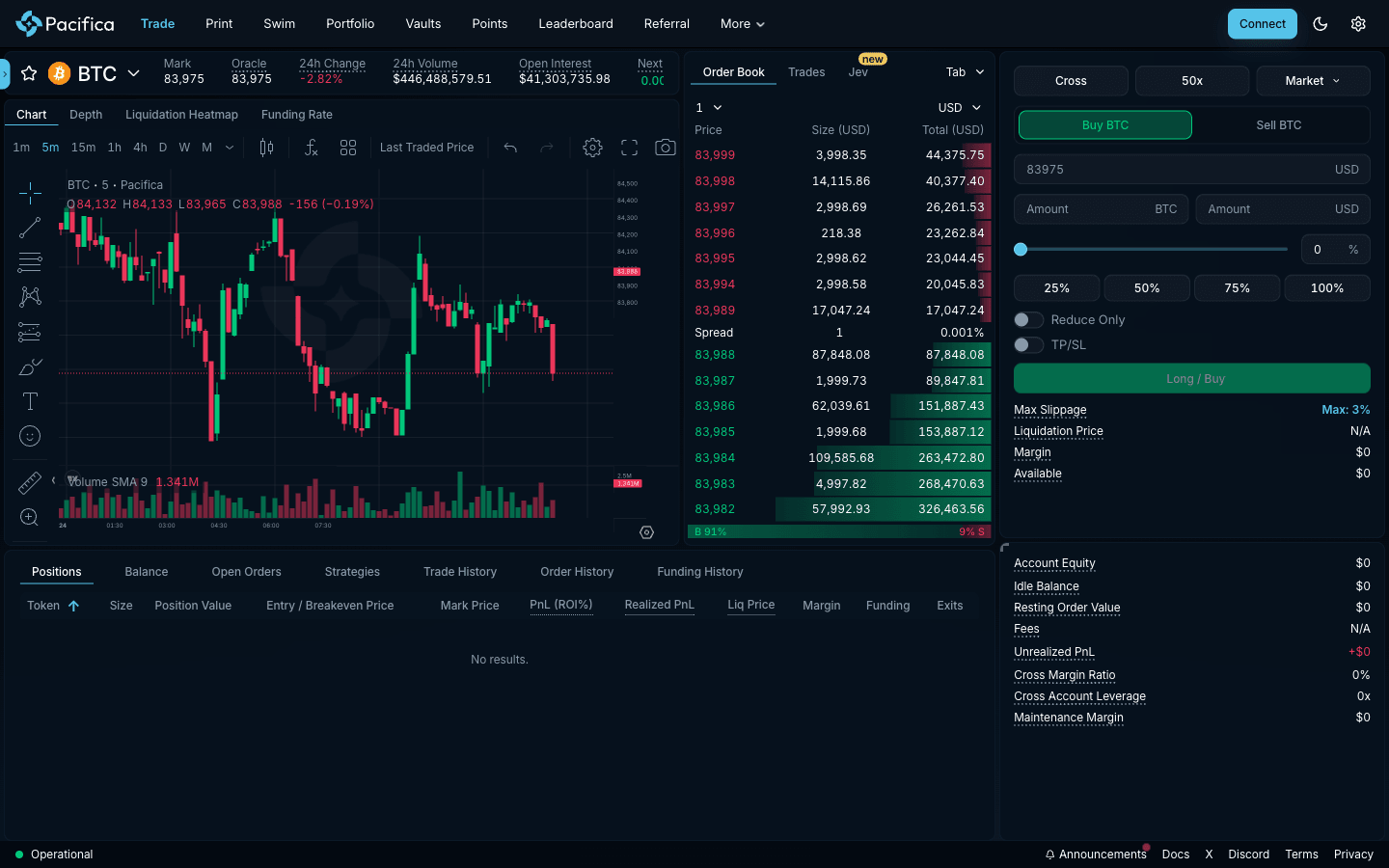
Pacifica is a “hybrid” Solana perp DEX. Matching runs off-chain, while USDC and SOL deposits and withdrawals settle on Solana. The API listed 78 markets: 77 perps plus SOL-USDC spot, including about 24 RWA perps (stocks, FX, metals, oil). Max leverage is 50x on BTC and ETH and 20x on SOL. Fees by 30-day volume start at 0.040% / 0.015% and fall to 0.028% / 0% at the top tier. Funding is hourly, with a 0.00125%/h baseline. On September 25 the API showed $594.1M of 24h volume ($290M BTC, $226M ETH, $62M SOL) and $117.8M of open interest; on DefiLlama it led Solana’s 24-hour volume on September 26 ($228.4M). The minimum deposit is $10 in USDC and a USDC withdrawal costs $1. The docs still list closed-beta caps of $500k account equity and $500k of withdrawals per 24h. Points run weekly; the referral link shares points, not fees. Japan is not on its restricted list. Full review: Pacifica review. Open Pacifica.
Jupiter Perps: the largest SOL pool
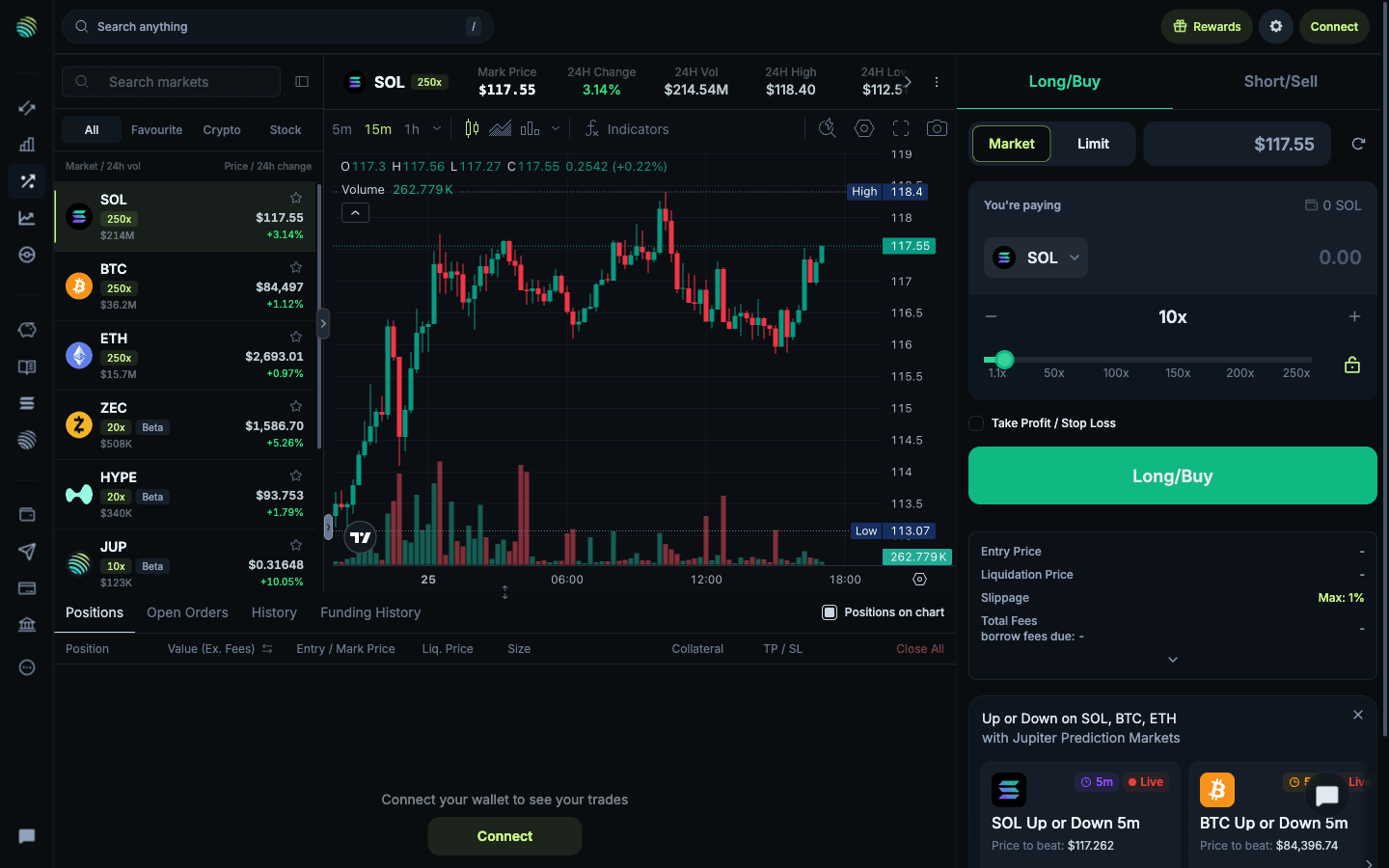
Jupiter Perps trades SOL, ETH and wBTC against the JLP pool, whose assets are SOL, ETH, wBTC, USDC, USDT and JupUSD. Longs post the underlying token as collateral (SOL for a SOL long) and shorts post USDC. DefiLlama put Jupiter Perps’ TVL at $814M on September 25. Leverage runs from 1.1x to 250x. Orders use a two-transaction keeper model, and oracle prices come from Chaos Labs’ Edge (primary), Chainlink and Pyth. Costs: 0.06% base fee to open and 0.06% to close, a price-impact fee, an hourly borrow fee paid by both sides, and Solana transaction fees. JLP holders get 75% of fees. A liquidation forfeits all remaining collateral, which is harsher than order-book venues where leftover margin stays with you. You can hold at most 6 positions and 20 limit orders per pair and side. Newer “Beta” order-book markets (JUP 10x; HYPE, ZEC and some stocks 20x) use USDC collateral and are capped at $50k per account per market. Perps are also in the Trade tab of the Jupiter Mobile app. Japan is not on Jupiter’s prohibited list; the US is. There is no perps referral program. More: Hyperliquid vs Jupiter Perps and Lighter vs Jupiter.
Phoenix: on-chain order book, low taker fee
Phoenix is a non-custodial perp exchange on Solana with an on-chain order book, run from the same phoenix.trade site as the Phoenix spot order book. Its API listed 90 active markets, including equities with extended-hours calendars. Fees are 0.035% taker / 0.005% maker, and SOL goes up to 25x. Funding is hourly. You can sign in with email or Google (a Privy wallet) or a Solana wallet, and USDC is the only collateral. Phoenix says it is “not available in the U.S. or sanctioned jurisdictions”. Its API documents invite codes that whitelist a wallet, so new users may need one. DefiLlama showed $933.2M of 30-day volume.
Flash Trade: pool-to-peer with the highest leverage
Flash Trade calls itself an asset-backed perpetuals and spot exchange on Solana with up to 500x leverage. Traders trade against the FLP liquidity pools (a “pool-to-peer” model), priced from Pyth with a backup oracle. Its docs list a 0.02% open and 0.02% close fee on SOL, BTC, ETH and other crypto-pool markets, 0.1% on JUP, JTO and memecoins such as BONK and WIF, plus a size-based spread charged on entry and exit and an hourly margin fee that rises with pool utilization. Every position has a hard profit cap set at open. V2 runs on Flash’s own execution layer with orders confirming in about 50 milliseconds, and you can sign in with email, a social account, a passkey or a wallet. DefiLlama showed only $15.8M of 30-day volume, so it is a niche venue today.
Adrena: zero opening fee, little volume
Adrena is a peer-to-pool perp DEX (the ALP pool is the counterparty, as on GMX) with up to 100x leverage and all protocol revenue shared with token holders. Opening a position is free and closing costs 0.14%, so a full round trip is 0.14%, plus a borrow fee that rises with utilization and a 0.05% liquidation fee. The app was live on September 26, 2026 (SOL longs and shorts from 3x to 100x), but DefiLlama had no volume data for it and the BTC market showed about $6,400 of open interest. Treat it as experimental.
BULK and Bullet: new high-speed order books
BULK describes itself as an execution layer running natively alongside Solana. It uses leaderless BFT consensus, a 25 ms taker speed bump that protects makers, portfolio margin and hourly funding. Of 22 listed markets, 8 were trading (BTC 40x, ETH 25x, SOL and PAXG 20x, the rest 10x). The API reported $42.8M of 24h volume and $6.5M of open interest on September 25. Phase 1 fees are 0.035% taker and 0% maker.
Bullet is a ZK-rollup exchange that settles on Solana. Its API listed 23 markets with $7.6M of 24h volume, and SOL is 20x. Fees are 0.040% taker / 0.010% maker at the base tier, falling to a maker rebate at VIP 6. The exchange API showed a per-user deposit limit of 100,000 USDC. Parts of its architecture (the ZK VM and data availability) are still marked “in development” in the docs. Both venues are live but small. They make sense for traders who want to farm early incentives, not for large SOL positions.
Backpack: a CEX, and not for Japan
Backpack Exchange appears in Solana perp lists and had $26.2M of SOL perp volume on CoinGecko, but it is a centralized, KYC exchange, not a DEX. Its support site says it does not currently serve residents of Japan, Canada or New Zealand.
7. What happened to Drift
Drift was Solana’s largest perp DEX until April 1, 2026, when attackers gained admin/signer control, whitelisted a fake collateral token and drained vaults. Drift’s own recovery plan (May 5, 2026) puts user losses at $295M; some trackers and press cite about $285M. The forensic firm Mandiant, cited in Drift’s plan, attributed the attack to a North Korean group, as did Elliptic, Chainalysis and TRM Labs, and DefiLlama’s hacks database classifies it as an access-control “proxy upgrade hijack”. Drift’s perp volume on DefiLlama is now zero.
The recovery plan. Every affected wallet gets a recovery token worth $1 of verified loss each, redeemable against a recovery pool. The pool is funded by a share of the relaunched exchange’s revenue in USDT, by Tether, which has committed up to $127.5M tied to the exchange’s revenue, and by other partners with up to $20M. Drift said in June 2026 it would relaunch “as the largest USDT-based perpetual exchange on Solana”; key parts of the plan go through DAO votes.
The relaunch is Velocity. Drift’s relaunch runs at app.velocity.exchange, and press reported the rebrand in early July 2026. Velocity’s docs call it a fork of Drift Protocol v2, “not an upgrade in place”: a new program, no on-chain state carried over (old Drift accounts do not appear), and USDT instead of USDC as collateral. It splits admin power into timelocked “warm” keys and a pause-only key, and OtterSec’s post-fork audit (final report September 3, 2026) found no Critical issues and 41 High ones, all marked fixed in the deployed code. It is still small: an open beta with five perps (SOL, BTC and ETH at 20x; HYPE and ZEC at 10x), about $235k of combined 24h volume on September 25 and about $16,000 on SOL-PERP on September 26, 2026. Meanwhile drift.trade still advertises Drift as “Solana’s most reliable trading platform”, and several AI summaries and older “Drift vs X” articles, including a few on this site, describe a venue that no longer operates as they say. For Velocity’s fees, insurance fund and October volume side by side with Hyperliquid, see Hyperliquid vs Drift (now Velocity).
Zeta Markets, another older Solana perps venue, shows $0 TVL on DefiLlama. We found no live Zeta perps volume.
8. How to start trading perps on Solana
- Get a Solana wallet. Phantom, Solflare and Backpack are the common choices; Pacifica, Jupiter and Phoenix connect to standard Solana wallets. Phoenix and Flash Trade also let you sign in with email or a social account, which creates an embedded wallet.
- Fund it with the right collateral. Keep a little SOL for transaction fees (the base fee is 5,000 lamports per signature, plus an optional priority fee). Then hold what the venue takes: USDC on Pacifica and Phoenix (Pacifica also takes SOL deposits), SOL or USDC on Jupiter (longs post the underlying, shorts USDC), USDT on Velocity.
- Connect and deposit. Connect on the official site only: type the URL yourself, because look-alike pages (including a fake Drift site) have appeared in search results. Order-book venues need a deposit into your trading account; Jupiter and Flash Trade take collateral with each position.
- Start small, with low leverage. Place a small trade, set a stop-loss and take-profit, and check the fee and liquidation price in the order preview before confirming.
- On a phone: Jupiter Mobile has perps in its Trade tab. Phantom’s in-app perps run on Hyperliquid through Phantom’s builder code, which adds Phantom’s fee (see the caveat below).
9. The Hyperliquid route: SOL deposits via Unit
For Solana users, the practical alternative is Hyperliquid: keep your SOL, deposit it natively, and trade the deepest SOL perp book on any DEX.
- Open the app with an EVM wallet (Rabby, MetaMask, OKX, Coinbase) or log in with email. Phantom is listed among the interfaces in Hyperliquid’s docs, but Phantom does not support Arbitrum. If you ever want to withdraw USDC to Arbitrum, use Rabby or the email login.
- Deposit SOL via Unit. Your Unit deposit address is permanent and tied to your Hyperliquid address. The minimum is 0.12 SOL and arrival typically takes about a minute. Unit charges no protocol fee, only network fees. SOL arrives as USOL in your spot balance. Solana memecoins such as PUMP, FARTCOIN, SPX and BONK can also be deposited.
- Sell USOL for USDC on the USOL/USDC spot market (0.070% taker / 0.040% maker at tier 0; USOL did $6.5M of spot volume on the morning of September 25). Or keep the SOL and deposit USDC separately as margin.
- Trade the SOL perp: 20x max (10x above $70M notional), 0.045% taker / 0.015% maker, hourly funding. Solana-ecosystem perps listed too: PUMP ($53.4M 24h), JUP ($10.6M), TRUMP ($10.4M), FARTCOIN ($10.0M), PENGU ($8.1M), kBONK, WIF, JTO, PYTH and more, mostly at 5–10x (September 25).
Worked example: 10 SOL (≈ $1,189 at $118.92 on September 25) sold for USDC at the 0.070% spot taker fee costs about $0.83. A $5,000 SOL long at 5x then costs $2.25 to open and about $2.25 to close ($2.16 each with HOLYGRAIL). Guides: Hyperliquid bridge routes (Solana, Arbitrum), deposit guide, full fee schedule.
One caveat for Phantom users: Phantom’s built-in perps trading runs on Hyperliquid through Phantom’s builder code, which adds Phantom’s own fee (0.05%) on top of Hyperliquid’s. A Hyperliquid referral code still works there: the referral discount also applies to orders placed through apps with a builder code, so HOLYGRAIL keeps 4% off Hyperliquid’s part of each order (Phantom’s fee is not discounted). The catch is timing: apps such as Phantom often set their own Hyperliquid referral code on accounts that have none, so enter a code on Hyperliquid before you start using an app. A code cannot be added after $10,000 of volume, so with your Phantom wallet, open app.hyperliquid.xyz/join/HOLYGRAIL before you first use Phantom’s perps. Trading directly at app.hyperliquid.xyz also removes Phantom’s fee.
Bring your SOL to the deepest SOL perp book
$266M of SOL volume and $711M of SOL open interest on September 25, 2026. Join with HOLYGRAIL: 4% off fees on your first $25M. How the code works: HOLYGRAIL referral guide.
10. Which one should you use?
- You want to stay fully on Solana and trade SOL, BTC or ETH simply: Jupiter Perps. Fills at the oracle price, deep JLP liquidity, up to 250x. Accept the 0.06% per side and the borrow fee.
- You want a Solana order book with maker pricing: Pacifica (0.040% / 0.015%, 20x SOL), or Phoenix if you have access (0.035% / 0.005%, 25x SOL).
- You trade FX, oil or stocks on-chain: GMTrade, where most of the volume is exactly that.
- You are farming early incentives on new venues: BULK, Bullet or Adrena are live with small books. Size accordingly.
- You trade size, scalp SOL, or want Solana memecoin perps: Hyperliquid. Deepest SOL book, native SOL deposits, many Solana-ecosystem perps. Code HOLYGRAIL.
- You want the lowest fees and don’t mind leaving Solana: Lighter (code
718610TD): 0% / 0% on Standard accounts, SOL at 25x. It accepts deposits from Solana among other routes.
Jupiter Perps alternatives
Jupiter Perps is the default for many Solana traders, but its 0.06% fee to open and again to close, the hourly borrow fee and the “liquidation takes all remaining collateral” rule push active traders elsewhere. The main Jupiter Perps alternatives: Pacifica for a Solana order book at 0.040% taker and 0.015% maker; Flash Trade if you like the pool model at 0.02% per side; GMTrade for FX and commodity perps; and, off Solana, Hyperliquid (0.045% taker, native SOL deposits, far deeper SOL liquidity) or Lighter (0% fees on Standard). Head-to-heads: Hyperliquid vs Jupiter Perps and Lighter vs Jupiter Perps.
Still choosing between ecosystems? Our best DEX guide compares every major perp DEX, and the perp DEX ranking tracks live volume across all chains.
11. Risks specific to Solana perps
- Admin-key and upgrade risk. The Drift exploit came through admin control, not a trading bug. Check who can upgrade a program and whether there is a timelock. Velocity’s docs have an “Admin keys and upgrade authority” page. Pacifica keeps a cold vault on a Squads multisig with a timelock.
- Hybrid custody. Pacifica, BULK and Bullet match orders off the Solana base layer. Deposits and withdrawals settle on-chain, but during trading you rely on the operator’s engine. Read each venue’s withdrawal caps; Pacifica’s docs list $500k per 24h, and Bullet showed a 100,000 USDC deposit limit.
- Pool counterparty. On Jupiter, GMTrade, Flash Trade and Adrena the pool is your counterparty. Heavy one-sided open interest raises price impact and borrow costs exactly when everyone wants the same side. Flash Trade also caps profit per position.
- Liquidation rules differ. Jupiter liquidation takes all remaining collateral. Order-book venues usually return what’s left after maintenance. See the liquidation price calculator.
- Leverage. SOL’s daily range is often several percent. A 20x position is liquidated after a move of roughly 2.5% (half the initial margin), and the 100x–500x on offer at pool venues leaves almost no room. The leverage limits guide shows the tiers.
- Phishing. Look-alike pages, including a fake Drift site, have appeared in search results. Bookmark official URLs and never sign a transaction you did not start. More in our DEX security checklist.
12. FAQ
What is a Solana perp DEX?
A Solana perp DEX is a decentralized exchange on Solana where you trade perpetual futures, leveraged contracts on SOL, BTC, ETH and other assets that never expire, from your own wallet instead of a custodial account. Some match orders in an order book (Pacifica, Phoenix); others let you trade against a liquidity pool at the oracle price (Jupiter Perps, GMTrade, Flash Trade).
What is the best perp DEX on Solana?
By 30-day volume on DefiLlama (September 26, 2026) the largest are GMTrade ($22.78B, mostly FX perps), Pacifica ($10.98B) and Jupiter Perps ($6.76B). For trading SOL simply on Solana, Jupiter Perps (0.06% to open and 0.06% to close, up to 250x). For an order book with maker pricing, Pacifica (0.040% / 0.015%). For the deepest SOL book of any DEX, Hyperliquid, which is not on Solana but accepts native SOL deposits: $266M of SOL volume and $711M of SOL open interest on September 25, 2026.
Which DEX is best for Solana?
It depends on what you trade. For spot swaps, Jupiter is Solana’s main swap aggregator; it routes across spot DEXs such as Raydium, Orca and Meteora. For perpetual futures, the Solana venues with real volume are GMTrade, Pacifica, Jupiter Perps and Phoenix. Spot DEX rankings and perp DEX rankings are different lists, so check which one an article is ranking.
Is Drift still working?
No, not as before. Drift was exploited on April 1, 2026; Drift’s own recovery plan puts user losses at $295M and Mandiant attributed the attack to a North Korean group. The Drift program is paused, and Drift’s relaunch runs at app.velocity.exchange, a new fork of Drift v2 with a new program and USDT collateral, running as an open beta. Affected users get recovery tokens backed by a pool that Tether (up to $127.5M) and partners (up to $20M) have committed to support. Velocity’s SOL-PERP showed about $16,000 of 24h volume on September 26, 2026.
What are the best Jupiter Perps alternatives?
Pacifica if you want an order book with lower taker fees (0.040% vs 0.06%) and maker pricing; Flash Trade if you like the pool model (it lists 0.02% to open and close on SOL); GMTrade for FX, commodity and stock perps; and Hyperliquid, off Solana, for the deepest SOL book and native SOL deposits.
Which Solana perp DEX has the lowest fees?
On published base rates for a taker: Flash Trade lists 0.02% per side on SOL (plus a spread and a margin fee), Velocity charges 0.020% live, then BULK and Phoenix at 0.035%, Pacifica and Bullet at 0.040%, and Jupiter at 0.06% per side. GMTrade’s docs list 0.010% or 0.012% on crypto markets. Pool-based venues add borrow fees and price impact, so compare the full order preview. Off Solana, Lighter’s Standard account is 0% / 0%.
What is the max leverage on SOL perpetuals?
Flash Trade goes up to 500x on SOL, BTC and ETH in its Degen Mode, and Jupiter Perps up to 250x on the same three; Adrena goes to 100x. Order-book venues are lower: Phoenix and Lighter 25x, Hyperliquid, Pacifica, Bullet, BULK and Velocity 20x. At 20x, a 5% initial margin leaves little room on a coin that often moves several percent in a day.
Is it safe to trade perps on a Solana DEX?
No venue is risk-free. Drift, the most established Solana perp DEX, lost user funds through a compromise of its admin and upgrade rights, not a trading bug. Check who controls upgrades and whether there is a timelock, read the audit record, keep only trading capital on the venue, and prefer venues with a long incident-free record and real volume.
Can I trade Solana perps from Japan?
Japan is not on the restricted lists of Jupiter, Pacifica, Phoenix (which excludes the US and sanctioned jurisdictions) or Hyperliquid. Backpack says it does not currently serve residents of Japan, Canada or New Zealand. Always read the venue’s terms yourself; this is not legal advice.
How do I use SOL on Hyperliquid?
Send native SOL to your Hyperliquid Unit deposit address (minimum 0.12 SOL; typically about 1 minute). It arrives as USOL in your spot balance. Sell it on the USOL/USDC spot market (0.070% taker at tier 0) to get USDC margin, then trade the SOL perp at 0.045% / 0.015%.
Does Jupiter Perps have a referral code?
We found no referral program for Jupiter Perps in its docs (checked September 25, 2026). Any site offering a “Jupiter Perps referral code” is pointing to something else.
Start trading SOL perpetuals
Hyperliquid HOLYGRAIL (4% off fees on your first $25M) · Lighter 718610TD (0% on Standard accounts) · Pacifica for a Solana-native order book.
New to perps? Start with what a DEX is and how to use Hyperliquid. Funding explained: Hyperliquid funding rate.
Disclosure: HOLYGRAIL and 718610TD are our referral codes; we earn a share of fees paid by referred accounts. We hold no code for Jupiter, Pacifica, GMTrade, Phoenix, Flash Trade, Adrena, BULK, Bullet, Velocity or Backpack. Volumes, open interest, order books and fees were read from official APIs, docs, DefiLlama and CoinGecko between September 25 and September 27, 2026; they change daily. Not financial advice.