
Short answer. Hyperliquid is the cheaper and far deeper venue: an order book on its own chain with 0.045% taker / 0.015% maker fees, no gas on orders, 178 perp markets and $4.03B of 24-hour volume (October 20, 2026). Jupiter Perps is Solana’s pool-based perp exchange: you trade SOL, ETH and wBTC against the JLP pool at oracle prices for 0.06% on open and on close, plus a price impact fee and an hourly borrow fee, with leverage up to 250x (not 100x, as older pages say); its API showed $274M of 24-hour volume on October 15, 2026. Pick Hyperliquid for cost, depth and market choice; pick Jupiter only for a short, Solana-native trade on the three majors or leverage above 20x on SOL. Drift, the other Solana name in this search, now trades as Velocity after its April 2026 exploit and did about $140,000 a day on October 15, 2026 (Hyperliquid vs Drift).
Trade on Hyperliquid with 4% off
Join with code HOLYGRAIL: 4% off every trading fee on your first $25M of volume, applied automatically.
We earn a commission when you sign up through our links; it never raises your fees.
1. Two designs: order book vs JLP pool
This page compares Jupiter Perps, Jupiter’s perpetual futures exchange, not the Jupiter swap aggregator. They share a brand and a website, but the perp exchange is a separate protocol with its own pool and fees.
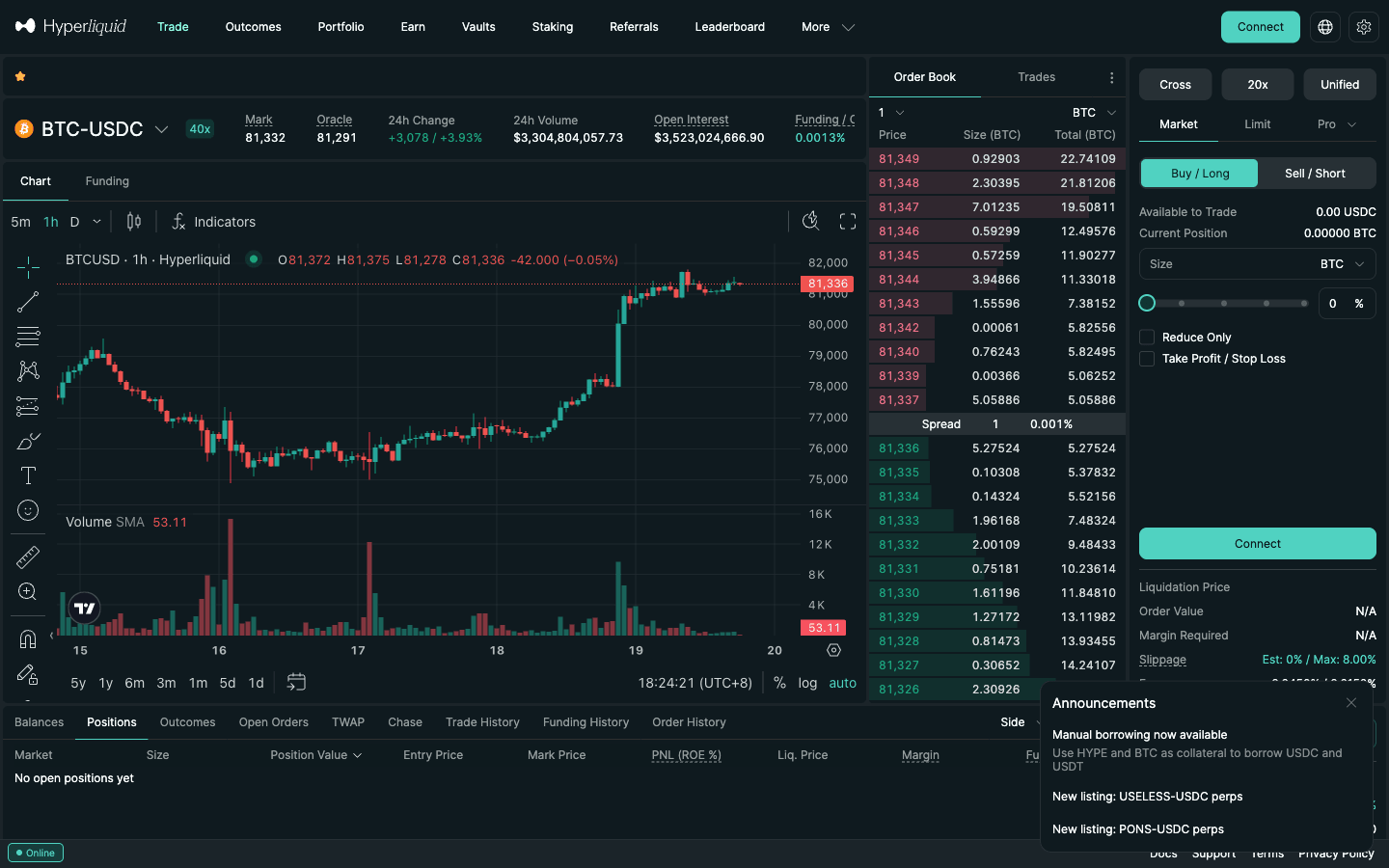
Hyperliquid runs its own layer 1. HyperCore keeps an order book for every market in chain state and matches orders in price-time priority, like a centralized exchange. Your counterparty is another trader or market maker. Orders, cancels and liquidations cost no gas. Why that matters for price is explained in our AMM vs order book guide.
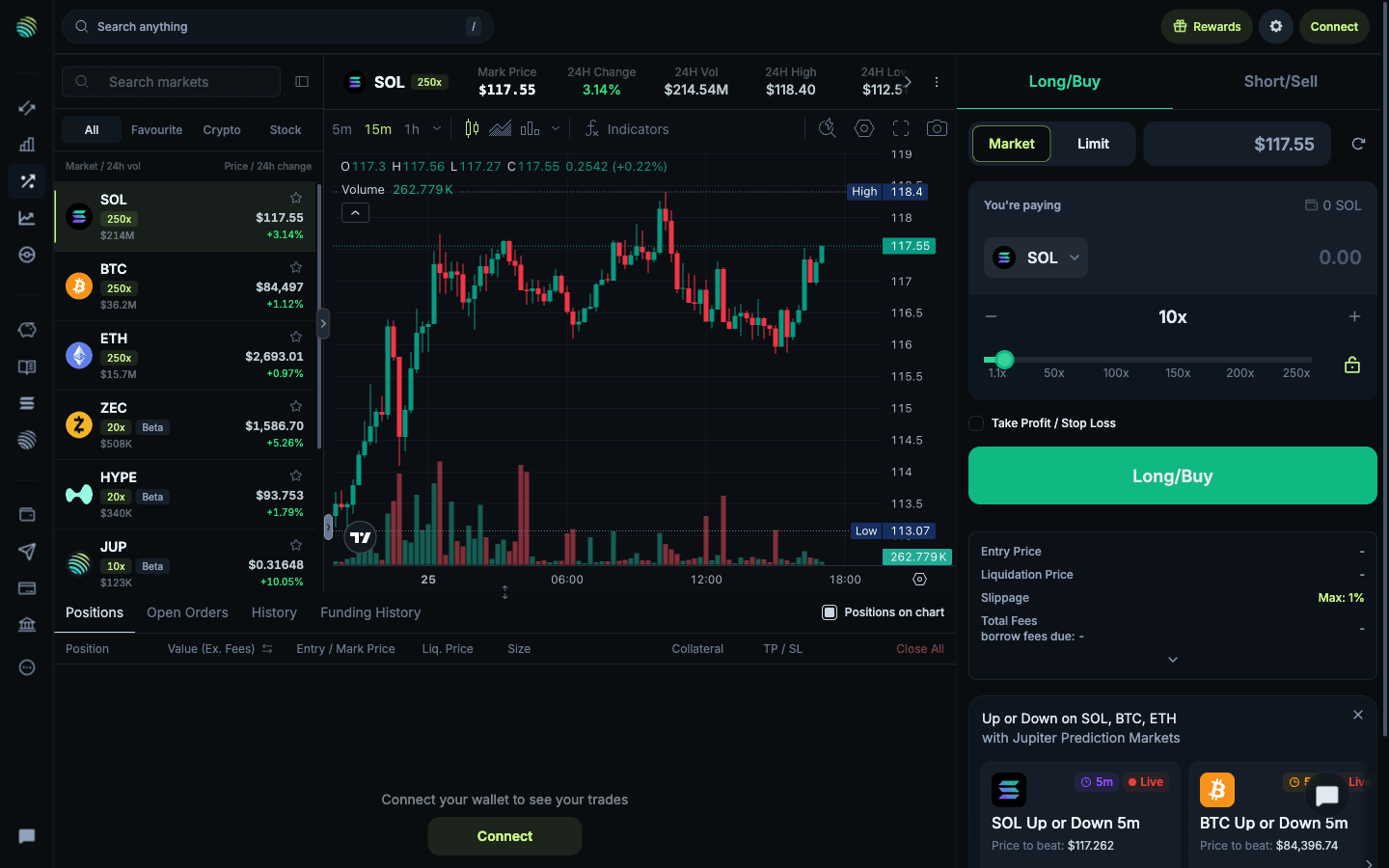
Jupiter Perps is a standalone Solana protocol, not an aggregator of other perp DEXs. On its SOL, ETH and wBTC markets you borrow from the Jupiter Liquidity Provider (JLP) pool, which is the counterparty to every position: when traders win the pool pays, when they lose the pool keeps it. There is no book. Positions open at an oracle price (Edge by Chaos Labs as primary, Chainlink and Pyth for verification and fallback), and the docs describe a price impact fee that “simulate[s] the price impact that would occur on a traditional orderbook exchange”. Every trade takes two Solana transactions: you submit a request, then a keeper run by Jupiter executes it. JLP holders receive 75% of the fees and Jupiter keeps the rest.
2. Side-by-side comparison
| Hyperliquid | Jupiter Perps | |
|---|---|---|
| Model | Central limit order book on its own L1 (HyperCore) | Trader-vs-pool (JLP) at oracle prices on Solana; Beta markets on the GUM order-book engine |
| Markets | 178 crypto perps (as of October 20, 2026), plus HIP-3 stocks/commodities and spot pairs | SOL, ETH, wBTC (JLP); 6 Beta markets: JUP, HYPE, ZEC, SPCX, SNDK, SKHYNIX |
| Trading fee | 0.045% taker / 0.015% maker (tier 0), falling with 14-day volume | 0.06% on open and on close + price impact fee (JLP); Beta 0.035% / 0.005% |
| Holding cost | Hourly funding between longs and shorts (baseline 0.00125%/h; can be received) | Hourly borrow fee paid to the pool by both sides (JLP); hourly funding on Beta |
| Max leverage | BTC 40x, ETH 25x, SOL 20x, HYPE 10x | 250x on SOL, ETH, wBTC; Beta 20x |
| 24h perp volume | $4.03B (API, October 20, 2026) | $274M on the three pool markets (Jupiter API, October 15, 2026) |
| Open interest | $11.05B (API, October 20, 2026) | $38.7M (DefiLlama, October 15, 2026) |
| Liquidity pool for LPs | HLP vault: $179.1M, 3.5% APR (October 20, 2026), lock-up 4 days | JLP token: $869.2M in the pool, 8.33% fee APY (October 15, 2026), no lock-up |
| Collateral | USDC margin (unified account also uses spot balances) | Long: the asset itself (SOL, wETH, wBTC). Short: USDC. Beta: USDC |
| Order types | Market, limit, stop market/limit, TP/SL, trailing stop, TWAP, scale, chase | Market, limit, TP/SL (JLP); market and limit only on Beta |
| Liquidation | At maintenance margin (1.25–5% on majors); market orders to the book first, leftover margin stays yours | Oracle hits liquidation price; all remaining collateral goes to the JLP pool |
| Gas | None on orders; 0.2 USDC + a tiny HyperEVM gas fee to withdraw USDC to Arbitrum | Solana fee on each request, optional priority fee / Jito tip; escrow rent refunded on close |
| Fee discounts | 4% referral (first $25M), HYPE staking 5–40% | None published |
Jupiter rules from docs.jup.ag; JLP size and APY and the 24-hour volume of the three pool markets from Jupiter’s perps API (jlp-info, market-stats), October 15, 2026; Jupiter open interest from DefiLlama’s Solana perps page (October 15, 2026). Hyperliquid figures from its docs and API; live values are fetched when the site is built. Updated October 15, 2026.
3. Pros and cons of each
Hyperliquid
Pros
- Lower trading fees (0.045% taker, 0.015% maker) and a 4% referral discount
- 178 perp markets plus stocks and commodities via HIP-3
- Deep books: the most volume and open interest of any perp DEX
- Shorts can earn funding; full order types, sub-accounts and an API
Cons
- Lower leverage caps (20x on SOL, 40x on BTC)
- Needs a bridge or deposit from Arbitrum, or a native SOL deposit
- Validator set is small; March 2025 incidents needed intervention
Jupiter Perps
Pros
- Trade straight from any Solana wallet, no bridge
- Oracle-priced fills with no book slippage on SOL, ETH, wBTC
- Up to 250x leverage and more room to liquidation at the same leverage
- Longs can hold cheaply when pool utilization is low
Cons
- 0.06% on both open and close, plus price impact and hourly borrow fees
- Only 3 pool markets; Beta markets are small and capped at $50,000 per account
- Liquidation forfeits all remaining collateral to the pool
- No referral or volume discount published
4. Fees, including borrow and price impact
Hyperliquid: one fee per fill, plus funding
At the base tier (under $5M of 14-day volume) a market order pays 0.045% and a resting limit order 0.015%. Both fall with volume, down to 0.024% / 0% above $7B, and spot volume counts double toward your tier. A referral code takes 4% off until you have traded $25M, and HYPE staking stacks a further 5–40%. Holding costs come from funding, paid peer-to-peer every hour; the interest component alone is 0.00125% per hour, and the rate moves with the premium of the perp over the oracle. When funding is positive longs pay and shorts receive. Full schedule: Hyperliquid fees; funding mechanics: Hyperliquid funding rate.
Jupiter Perps: five separate charges
- Base fee: 0.06% of size on open and again on close, including TP/SL closes and liquidations.
- Price impact fee, charged on open and close. A linear part scales with trade size and is tiny for retail sizes (the docs’ SOL example: $0.0008 on $10,000). An additive part kicks in when the gap between long and short open interest exceeds a per-asset threshold; the docs’ SOL example uses a $750,000 threshold and caps the total price impact fee at 50 bps (0.50%).
- Borrow fee, charged hourly from your collateral for as long as the position is open:
utilization × hourly borrow rate × position size. Both longs and shorts pay it; nobody receives it except the pool. On October 15, 2026 Jupiter’s pool API showed 0.0015%/hour for SOL longs, 0.0013%/hour for BTC and ETH longs and 0.0007%/hour for USDC-collateral shorts, with utilization at 10.25% (SOL longs), 14.0% (wBTC), 6.4% (ETH) and 65.52% (USDC for shorts). - Swap fee if your deposit token differs from the position’s collateral token: 10 bps base for SOL/ETH/wBTC, 2 bps for stablecoins, adjusted by pool weights.
- Solana transaction fees on every request, optional priority fees or Jito tips, and rent for the position’s escrow account (refunded when you close).
DefiLlama put the scale in context on October 15, 2026: $8.24M of fees over 30 days for Jupiter’s perp exchange, against $88.5M for Hyperliquid.
5. Worked example: a $10,000 SOL position
A $10,000 SOL long at 10x, opened and closed with market orders, on both venues at the rates of October 15, 2026 (first run September 25, 2026; the rates barely moved). Holding costs assume that day’s rates stay constant, which they will not; funding in particular swings with positioning.
| Cost item | Hyperliquid (SOL perp) | Jupiter Perps (SOL long) |
|---|---|---|
| Open + close fees | $9.00 ($8.64 with a referral code) | $12.00 |
| Price impact at this size | ≈ $0.98 round trip (median of seven SOL book reads, October 15, 2026 05:22 UTC) | Linear part ≈ $0; additive part only if the long/short OI gap exceeds the threshold (cap 0.44% on SOL in Jupiter’s pool API) |
| Holding cost, 24 hours | $3.00 funding at the 0.00125%/h baseline (paid by longs) | $0.37–$3.60 borrow fee (see the note below) |
| Holding cost, 7 days | $21.00 at the baseline | $2.58–$25.20 |
| Network fees | None on orders | Solana fees on the open and close requests |
| Total, 24 hours | ≈ $12.98 | ≈ $12.37–$15.60 + Solana fees |
| Total, 7 days | ≈ $30.98 | ≈ $14.58–$37.20 + Solana fees |
Why a range for Jupiter’s borrow fee: Jupiter’s pool API showed 0.0015%/hour for SOL longs on October 15, 2026, the same rate as on September 25 and 27. Jupiter’s fee docs apply that rate as utilization × hourly rate × position size, and the same API put SOL-long utilization at 10.25%, which gives about $0.37 a day. If the displayed rate is already the effective rate, the day costs $3.60. The docs do not settle which, so both ends are shown; on a live position the “Borrow Fees Due” line is the number to trust. Hyperliquid funding is paid by longs only while the rate is positive, and it moves with positioning; its price impact here is the round trip on the SOL book (the bid side was thinner than the ask side at that moment).
So on a long, fees favour Hyperliquid and holding may favour Jupiter. The round trip is $3.00 cheaper on Hyperliquid ($3.36 with a referral code). Held for a day the two end up close; held for a week at the baseline funding rate, a Jupiter long can cost less if the utilization-scaled borrow figure applies. Check both numbers before a multi-day hold.
The short side is clear-cut. A $10,000 SOL short held a day costs $9.00 in fees on Hyperliquid and, at a positive baseline rate, earns about $3.00 of funding, so about $6.00 net before price impact. On Jupiter the short pays $12.00 in base fees plus $1.10–$1.68 of borrow (0.0007%/hour on October 15, 2026; USDC utilization was 65.52%), about $13.10–$13.68.
At $1M the gap is about execution. A simulated $1M market buy on Hyperliquid’s SOL book averaged 0.029% above mid on October 15, 2026 (0.038% on September 25), plus the 0.045% taker fee. On Jupiter you get the oracle price with no book slippage, but the price impact fee can climb to the per-asset cap if you push the pool’s long/short imbalance past the threshold: 0.44% on SOL in Jupiter’s pool API (the docs’ example uses 0.50%). The SOL market also showed only $10M of available liquidity for the whole pool on October 15, 2026.
Use the fee calculator to rerun this with your own size and tier.
6. Liquidity and volume by market
| Market | Hyperliquid 24h volume | Jupiter Perps 24h volume | Hyperliquid max leverage | Jupiter max leverage |
|---|---|---|---|---|
| SOL | $465M | $163M | 20x | 250x |
| BTC | $3.85B | $29M | 40x | 250x |
| ETH | $1.73B | $82.4M | 25x | 250x |
| HYPE | $476M | Beta market (not in the API) | 10x | 20x |
| ZEC | $355M | Beta market (not in the API) | 10x | 20x |
| JUP | $5.3M | Beta market (not in the API) | 10x | 20x |
24-hour volumes: Hyperliquid API metaAndAssetCtxs, 04:48 UTC, October 15, 2026; Jupiter perps API market-stats for SOL, ETH and wBTC, 04:52 UTC the same day. Jupiter’s API does not report the Beta (GUM) markets; in the app on September 25 the six of them traded about $1.2M combined. Leverage caps: current docs and the Hyperliquid API.
SOL is the only market where Jupiter is in the same league, which fits its user base: people whose money already lives on Solana. On BTC Hyperliquid traded more than 100 times as much as Jupiter, and on ETH about 20 times. Across all markets, Hyperliquid carried $11.05B of open interest (October 20, 2026) against $38.7M for Jupiter Perps (DefiLlama, October 15, 2026). Beyond the table, Hyperliquid lists 178 perps in total plus HIP-3 markets for stocks and commodities, while Jupiter’s pool markets stop at three. Pool size matters too: the JLP pool held $869.2M (October 15, 2026), and the pool API capped available liquidity at $10M for SOL and $20M each for BTC and ETH on October 15, 2026.
7. Leverage (250x, not 100x) and liquidation
Jupiter’s maximum is 250x, not 100x. Its current docs give a leverage range of 1.1x to 250x on SOL, ETH and wBTC. The 100x figure that many comparison pages and AI answers still repeat was the cap in Jupiter’s own documentation in 2024. The 500x in the liquidation formula is a different parameter: it defines the minimum maintenance margin and is not a leverage you can pick. Likewise, pages that give Hyperliquid 50x are out of date; Hyperliquid cut its caps after the March 2025 incidents (section 10).
Hyperliquid sets leverage per asset: BTC 40x (20x above $150M of notional), ETH 25x, SOL 20x, HYPE and ZEC 10x. Maintenance margin is half the initial margin at max leverage, so 1.25% on BTC, 2% on ETH and 2.5% on SOL. Jupiter lets you pick anything from 1.1x to 250x on SOL, ETH and wBTC, and because its liquidation formula uses the 500x protocol limit, the maintenance requirement is about 0.2% of size plus the estimated closing fee.
That gives Jupiter more room at the same leverage, measured as the price move from entry to liquidation on a SOL long:
| Leverage | Hyperliquid, isolated SOL long | Jupiter, SOL long (at open, before borrow fees) |
|---|---|---|
| 10x | ≈ 7.7% | ≈ 9.7% |
| 20x | ≈ 2.6% | ≈ 4.7% |
| 50x | Not available (SOL max 20x) | ≈ 1.7% |
| 100x | Not available | ≈ 0.7% |
Hyperliquid: docs formula with 2.5% maintenance margin, (1/leverage − 2.5%) ÷ (1 − 2.5%). Jupiter: docs formula, 1/leverage − 0.2% − 0.06% close fee. Price impact fees and funding/borrow accrual ignored.
Two things cut the other way. First, Jupiter’s liquidation price moves toward you every hour, because borrow fees come out of collateral; the docs warn that a position “can approach its liquidation price over time… even without any price movement”. Second, what you lose differs. On Jupiter’s pool markets liquidation forfeits all remaining collateral to the JLP pool. On Hyperliquid the position is first closed with market orders on the book when equity drops below maintenance margin, and whatever collateral survives the fill stays yours; the HLP liquidator vault takes over (keeping the rest) only if equity falls below two-thirds of maintenance margin. Positions over 100,000 USDC are liquidated 20% at a time. Liquidation triggers also differ: Jupiter uses the oracle price, Hyperliquid a mark price that blends the oracle, its own book and CEX prices. How to stay clear of both: how to avoid liquidation cascades and Hyperliquid leverage limits.
Lower fees, more markets, no borrow fee
Hyperliquid charges 0.045% taker at the base tier and nothing to hold a position beyond funding. Code HOLYGRAIL takes 4% off every fee on your first $25M.
8. Jupiter’s Beta markets
Jupiter now also lists six Beta markets: JUP, HYPE, ZEC and the stock perps SPCX (SpaceX), SNDK (SanDisk) and SKHYNIX (SK hynix), each up to 20x as of October 15, 2026 (JUP launched at 10x). They work differently from the pool markets: the docs say they are “powered by GUM, an orderbook trading engine”, use USDC collateral, charge 0.035% taker / 0.005% maker with hourly funding instead of base, impact and borrow fees, and hold one net, isolated position per market. Maintenance margin is 2.5% of position value, the liquidation fee is 0.75% on the crypto markets and 1% on the stock markets (lowered from 1.25% and 1.5% at launch) and, unlike the pool markets, remaining collateral is returned after liquidation. Limits are still tight: $50,000 per account per market ($10,000 on JUP), $5M of total open interest per market ($1M on JUP), and no take-profit or stop-loss orders. The early-access gate is gone: the docs now say “No JUP stake is required.” On September 25, 2026 the Beta markets traded about $1.2M combined in the app; on October 15, 2026 Hyperliquid traded $476M of HYPE and $355M of ZEC alone.
9. HLP vs JLP for liquidity providers
If you are asking “which liquidity pool is better”, the two pools are not the same product. HLP (Hyperliquidity Provider) is a protocol vault: it runs market-making strategies across Hyperliquid, performs liquidations, supplies USDC in Earn and accrues a portion of trading fees, and depositors share its PnL. JLP is a token backed by the pool that is the counterparty on Jupiter Perps: it earns 75% of the pool markets’ fees and keeps traders’ losses, but pays out their wins, and most of it is held in SOL, ETH and wBTC.
| HLP (Hyperliquid) | JLP (Jupiter) | |
|---|---|---|
| What it is | A protocol vault you deposit USDC into | A token (SPL) you mint with SOL, ETH, wBTC, USDC or USDT, or buy on Jupiter Swap |
| How it earns | Runs market-making strategies, performs liquidations, supplies USDC in Earn and accrues a portion of trading fees | 75% of all Jupiter Perps pool-market fees (open/close, price impact, borrow, swap, mint/burn) plus traders’ losses |
| What you are exposed to | The vault’s trading PnL (market-making and liquidation outcomes) | Price of SOL, ETH and wBTC in the pool plus trader PnL: when traders win, the pool pays |
| Size and yield | $179.1M, 3.5% APR (as of October 20, 2026) | $869.2M in the pool (limit $3B), 8.33% fee APY (read October 15, 2026) |
| Getting out | Withdraw 4 days after your most recent deposit | Sell on Jupiter Swap any time, or burn on the Earn page (weight-based fee) |
HLP: Hyperliquid docs (protocol vaults) and live vaultDetails API. JLP: docs.jup.ag (earn/jlp) and Jupiter’s perps API jlp-info. Jupiter says the Earn-page APY is in USD, counts only the fee share, leaves out asset prices and trader PnL, and is updated every 7 days from the previous week’s fees.
In practice: JLP is a yield token that carries crypto price risk (about 69% of the pool sat in SOL, ETH and wBTC on October 15, 2026, so a sharp SOL sell-off pulls JLP down whatever the fee APY), with an exit through Jupiter Swap at any time. HLP is closer to a stablecoin strategy fund whose risk is a bad trading episode, with a lock-up of 4 days. Jupiter’s docs put it plainly: JLP “tends to perform relatively better during sideways or bearish market conditions” and can lag simply holding the assets in a strong bull market. More on the Hyperliquid side: Hyperliquid vaults and HLP. If you came to trade rather than to provide liquidity, the trader’s choice is simpler:
Trade against deep books, not a pool
Open a Hyperliquid account with HOLYGRAIL and pay 0.0432% instead of 0.045% on your first $25M of taker volume.
10. Track record and incidents
The comparison people search for most after fees is “what went wrong before”. From the venues’ own statements:
- March 12, 2025, Hyperliquid (ETH whale). A trader withdrew unrealized profit from a very large ETH long, lowering its margin, and was then liquidated into HLP. Hyperliquid said there was “no protocol exploit or hack”; HLP lost about $4M in 24 hours. Maximum leverage was then cut to 40x on BTC and 25x on ETH.
- March 26, 2025, Hyperliquid (JELLY). After what Hyperliquid called “evidence of suspicious market activity” in the thin JELLY market, which had left the liquidator holding a large short, the validator set voted to delist JELLY perps. The Hyper Foundation made users whole apart from flagged addresses, refunding longs as if they had settled at $0.037555. The intervention protected HLP, but it showed that a small validator set can change a market’s outcome. Hyperliquid also publishes which markets sit at their open-interest caps (open-interest caps and order rejections).
- Jupiter Perps and the same class of attack. Jupiter’s pool only lists SOL, ETH and wBTC, the kind of asset that is hard to push around, and prices them from three oracles. Its docs are explicit about the remaining risk: oracle-priced trades “could be exploited by moving prices on external exchanges and opening positions on Jupiter”, and the price impact fee exists to counter that. The thinner Beta markets (JUP, ZEC, stock perps) run on a separate engine with $50,000 per-account and $5M open-interest caps. We found no loss event on Jupiter Perps comparable to the two above in Jupiter’s docs. Its structural risk is different: JLP pays when traders win, so a strong trend with crowded winning positions shows up as a JLP drawdown, not as a protocol loss.
Neither record makes a venue “safe”. Keep only trading capital on either, and prefer stop-losses to relying on how a venue handles a crisis.
11. Hyperliquid vs Drift (now Velocity)
Solana traders used to compare Jupiter, Hyperliquid and Drift, which was once Solana’s largest perp DEX. The comparison has changed because Drift has changed. On April 1, 2026 attackers took over Drift v2’s upgrade and admin controls and drained its vaults (DefiLlama classes it as a proxy upgrade hijack); Drift’s recovery plan (May 5, 2026) puts the loss of user funds at $295M, and its June 3 update says Mandiant attributed the attack to UNC6862, a North Korean group. The v2 program is paused (DefiLlama still shows $642,475 in “Drift Trade”). Drift relaunched as Velocity, whose docs describe it as “a fork of Drift v2 … not an upgrade in place: a new program deployment, no onchain state carried over”. It quotes and settles every market in USDT instead of USDC, and DefiLlama lists it under Drift.
| Hyperliquid | Drift / Velocity | |
|---|---|---|
| What you trade on today | Hyperliquid (HyperCore order book) | Velocity: Drift’s relaunch, a fork of Drift v2 on Solana (new program, no state carried over) |
| Taker / maker fee | 0.045% / 0.015% (tier 0); 0.0432% taker with HOLYGRAIL | 0.020% taker / 0.0025% maker rebate live on October 15, 2026; published Regular tier 0.060% taker |
| Max leverage | BTC 40x, ETH 25x, SOL 20x, HYPE 10x | SOL, BTC, ETH 20x; HYPE, ZEC 10x |
| Markets | 178 perps (as of October 20, 2026) plus HIP-3 and spot | 5 perps (SOL, BTC, ETH, HYPE, ZEC) |
| 24h volume (October 15, 2026) | $8.06B | $140,000 |
| Collateral and custody | USDC on HyperCore; self-custodial, secured by its validator set and the deposit bridges | USDT in Velocity’s Solana program vaults (4.23M USDT deposited on October 15, 2026); self-custodial; parameters admin-settable behind a timelock, plus a pause key |
| Insurance | HLP liquidator vault, then auto-deleveraging | Staker-owned Insurance Fund per collateral market, fed 15% of net trading fees; lifetime cap per market by tier ($100M for tier A, $0 for speculative listings) |
| 2026 incident history | Best-known incidents date from March 2025 (ETH whale, JELLY; section 10) | April 1, 2026: $295M of user funds lost in the Drift v2 exploit; v2 paused, users repaid through the DFX recovery token |
| Audits | Docs list Zellic’s audit of the legacy Arbitrum bridge; Circle’s HyperEVM contracts audited separately | OtterSec on Velocity (final report September 3, 2026: 41 High findings, all fixed); Trail of Bits and Neodyme on the pre-fork Drift v2 code |
| Referral | HOLYGRAIL: 4% off fees (we earn a share) | Referees get 5% off taker fees; we hold no Drift or Velocity code |
Velocity: data.velocity.exchange/stats/markets (live fees, leverage limits, 24-hour volume and deposits, October 15, 2026, 04:50 UTC) and docs.velocity.exchange (trading fees, insurance fund, audits, referrals, admin keys). Drift: drift.trade/updates (recovery plan, May 5; recovery update, June 3; DFX claims, October 1, 2026). Hyperliquid: docs, registry and API (October 15, 2026). Drift’s own homepage still advertises 101x leverage and Drift v2’s cumulative volume; neither describes the venue you can trade on today.
Fees and leverage
Velocity’s published schedule starts at 0.060% taker for accounts under $5M of 30-day volume, but the rate read from the program on October 15, 2026 was 0.020% on every market, with a 0.0025% rebate for post-only makers; the docs warn the rates are admin-settable, so check the live number before trading. That is cheaper than Hyperliquid’s 0.045% taker fee on paper. Leverage is no higher: 20x on SOL, BTC and ETH and 10x on HYPE and ZEC, against Hyperliquid’s 40x on BTC, 25x on ETH and 20x on SOL.
Markets and liquidity
This is where the two are not comparable. Velocity lists 5 perps and traded about $140,000 across all of them in the 24 hours to October 15, 2026; Hyperliquid traded $8.06B in the same window. USDT deposits on Velocity were about 4.23M USDT against a 5M USDT deposit cap. A taker order on Velocity first runs a short auction for market makers, then meets resting orders and finally the protocol’s vAMM, so small orders fill; with about $140,000 of daily volume across five markets, larger orders are likely to move the price noticeably (we did not sample Velocity’s book).
Custody, insurance and admin keys
Both are self-custodial. Velocity is a Solana program: you connect a Solana wallet, collateral sits in the program’s vaults, and trading is cross-margined in USDT. Its docs are unusually frank about control: margin ratios, fee splits, oracle sources and pause states are admin-settable, routine changes go through a timelocked “warm” key, and a separate pause key can freeze deposits, withdrawals or trading immediately but cannot unpause. Bad debt is absorbed first by the account’s own estate, then by a staker-owned Insurance Fund per collateral market, which receives 15% of net trading fees (another 15% goes to vAMM capital and 70% is protocol revenue); each market can draw only up to its tier’s lifetime cap, and speculative listings draw nothing. Hyperliquid’s backstop is the HLP liquidator vault and auto-deleveraging (section 10 and our insurance fund and ADL guide).
The 2026 incident and the DFX recovery token
- April 1, 2026: the Drift v2 exploit; $295M of user funds lost per Drift’s recovery plan, the third-largest loss of 2026 in DefiLlama’s hacks list on October 15, 2026.
- May 5: recovery plan. Tether committed up to $127.5M and strategic partners up to $20M to support the relaunch and user recovery.
- June 3: Drift named a new head of protocol, engaged former Gauntlet staff for risk, and published Mandiant’s attribution.
- September 3: OtterSec’s final audit report on Velocity: 41 High findings, all fixed in the deployed code, no Critical.
- October 1: DFX claims opened. Each verified USDT of loss became one DFX (299,500,811 in total, no further minting). DFX can be redeemed for USDT from a recovery pool that held about $3.1M at launch, roughly $0.0104 per DFX; the pool grows daily from a share of Velocity’s net revenue (60% of the first 30K USDT a day, rising to 90% above 100K) and from any recovered funds. The claim window closes on January 1, 2028.
Our read. Velocity is a careful rebuild with an honest set of docs, but on October 15, 2026 it traded about 1/57,000 of Hyperliquid’s volume, with five markets and 20x leverage at most. Use it if you were a Drift user and want to follow the recovery, or if you specifically need a USDT-settled perp on Solana; for everything else, Hyperliquid’s order book is the deeper and, after a referral code, still competitively priced venue. Neither DFX nor any token here is a recommendation.
The deep order book, 4% cheaper
Hyperliquid traded $8.06B in the 24 hours to October 15, 2026. Join with HOLYGRAIL to pay 0.0432% taker on your first $25M.
12. Chains, wallets, custody and bots
- Getting funds in. Jupiter needs nothing but a Solana wallet and SOL or USDC. Hyperliquid accepts USDC from Arbitrum, Ethereum, Base and Polygon, and native SOL (minimum 0.12 SOL), which arrives as a spot balance you can sell for USDC margin. Log in with an EVM wallet or email. Withdrawing USDC to Arbitrum costs 0.2 USDC plus a tiny HyperEVM gas fee in HYPE. Setup: how to use Hyperliquid, best wallet for Hyperliquid.
- Custody. Both are self-custodial: no account holds your coins in a company’s name. On Jupiter your collateral sits in the program’s custody accounts on Solana; on Hyperliquid it sits in HyperCore, secured by its validator set, with bridges on the deposit chains.
- Counterparty. On Hyperliquid you face other traders, with HLP and auto-deleveraging as the backstop. On Jupiter you face the JLP pool, so its solvency depends on trader PnL and on oracle quality; the docs note oracle prices “may differ from prices on other venues”.
- Execution path. Jupiter’s pool trades depend on a keeper picking up your request and on Solana confirming it, and a slippage setting (default 1%) cancels the trade if the oracle moves too far in between. Hyperliquid orders go straight to the chain’s book.
- Bots and API. Hyperliquid has a documented REST and WebSocket trading API with an official Python SDK (API guide). Jupiter’s perps API (perps-api.jup.ag) builds transactions for opening, closing, limit orders and TP/SL that your bot then signs and submits on Solana.
- Access. Jupiter’s terms exclude wallets in the United States and a list of sanctioned or restricted countries. Hyperliquid’s terms exclude the United States, Ontario and sanctioned regions. Check the rules where you live.
13. How to start on each
Hyperliquid
- Open Hyperliquid through our link so code
HOLYGRAILis applied (4% off fees on your first $25M). - Connect an EVM wallet (MetaMask, Rabby, Phantom’s EVM account) or log in with email.
- Deposit at least 5 USDC of USDC from Arbitrum, or send SOL natively (minimum 0.12 SOL) and sell it for USDC.
- Pick a market, set leverage (cross or isolated), and place a market or limit order with a stop-loss.
Step by step with screenshots: how to use Hyperliquid.
Jupiter Perps
- Open jup.ag/perps and connect a Solana wallet (Phantom, Solflare, Backpack).
- Keep a little SOL for transaction fees (the interface recommends 0.03 SOL) and post at least $10 of collateral: SOL, ETH or wBTC for longs, USDC for shorts.
- Choose SOL, ETH or wBTC, set leverage (1.1x to 250x) and your slippage, then sign the request; a keeper executes it a moment later.
- Watch “Borrow Fees Due” and the liquidation price, which moves closer every hour. Beta markets are open to any wallet, within their per-account caps.
14. When each one wins (and where Drift fits)
- Hyperliquid wins for almost every repeat trader: lower fees, a funding model where shorts can earn rather than pay, 178 markets (as of October 20, 2026), stops, trailing stops, TWAP, sub-accounts, an API, and books deep enough that a $1M SOL order moved the price by about three basis points on October 15, 2026. It is also the only one of the two where a referral code cuts your fees.
- Jupiter Perps wins if your funds already live on Solana, you want SOL, ETH or wBTC exposure for a few hours, and you value oracle-priced fills with no book to walk, or you truly need more than 20x on SOL. On longs, low pool utilization can make holding cheaper than Hyperliquid’s funding; watch the “Borrow Fees Due” line, because the fee never stops and it pulls your liquidation price closer.
What about Drift? After its April 2026 exploit Drift trades as Velocity, with 5 USDT-settled markets and about $140,000 of daily volume on October 15, 2026 (section 11). Among Solana venues, GMTrade and Pacifica now compete with Jupiter; see best DEX for Solana perpetuals for the full field, and our Hyperliquid alternatives guide for every venue that competes with Hyperliquid.
Many Solana users end up using both: Jupiter for a quick hedge without leaving Solana, Hyperliquid for everything else. For other matchups see Lighter vs Jupiter, Hyperliquid vs Lighter and Hyperliquid vs GMX, or the full field on best DEXs in 2026.
15. FAQ
Is Hyperliquid cheaper than Jupiter Perps?
On trading fees, yes: a $10,000 round trip costs $9.00 in taker fees on Hyperliquid ($8.64 with a referral code) versus $12.00 in base fees on Jupiter’s SOL, ETH and wBTC markets. Holding costs are closer. Jupiter charges an hourly borrow fee on both longs and shorts (between about $0.37 and $3.60 a day on a $10,000 SOL long at the rates of October 15, 2026, depending on how utilization is applied); Hyperliquid has hourly funding that longs pay and shorts receive when it is positive (about $3 a day at the baseline). Shorts are clearly cheaper on Hyperliquid; a long held for several days can cost less on Jupiter when pool utilization is low.
Is Jupiter Perps good for trading?
For a short-term SOL, ETH or BTC trade from a Solana wallet, yes: fills come at the oracle price with no order book to walk, leverage goes up to 250x, and there is nothing to bridge. For anything else it is limited: three pool markets plus six small Beta markets, a 0.06% fee on both open and close, and a borrow fee that runs every hour. Active traders usually get lower costs and far more markets on Hyperliquid.
What markets does Jupiter Perps have?
Three pool markets, SOL, ETH and wBTC, traded against the JLP pool with up to 250x leverage, plus six Beta markets (JUP, HYPE, ZEC and the stock perps SPCX, SNDK and SKHYNIX) that run on the GUM order-book engine with USDC collateral and up to 20x leverage. As of October 15, 2026 any wallet can trade them (the docs now say “No JUP stake is required”), within per-account caps. Hyperliquid lists 178 crypto perps (as of October 20, 2026) plus HIP-3 stock and commodity markets.
Which has more liquidity, Hyperliquid or Jupiter?
Hyperliquid by a wide margin: $4.03B of 24-hour perp volume and $11.05B of open interest (Hyperliquid API, October 20, 2026) versus $274M of 24-hour volume on Jupiter’s three pool markets (Jupiter API, October 15, 2026) and $38.7M of open interest (DefiLlama, October 15, 2026). SOL is the closest contest: in the 24 hours to October 15, 2026 it traded about $465M on Hyperliquid and $163M on Jupiter. Jupiter’s pool API showed $10M of available liquidity on SOL and $20M on BTC and ETH that day, which caps how much open interest the pool can carry.
Is Jupiter Perps leverage 100x or 250x?
250x today. Jupiter’s docs list a leverage range of 1.1x to 250x on SOL, ETH and wBTC. Older articles and AI answers still say 100x because that was the cap in Jupiter’s own documentation in 2024. A separate 500x figure appears in the liquidation formula: it sets the minimum maintenance margin (0.2% of size) and is not a leverage you can choose. At 250x your collateral is 0.4% of the position, so a move of about 0.14% (after the 0.2% maintenance requirement and the 0.06% closing fee) liquidates it.
Does Jupiter Perps have slippage?
Not in the order-book sense: pool-market trades fill at the oracle price whatever the size. Instead Jupiter charges a price impact fee that grows with trade size and with the long/short imbalance, up to a per-asset cap (0.44% on SOL in its pool API, unchanged on October 15, 2026). Your slippage setting (default 1%) still matters, because the keeper executes your request a moment later and cancels it if the oracle has moved further than you allow. Beta markets do have a real order book, and a market order there can fill only partly.
What happens when you get liquidated on each platform?
On Jupiter’s pool markets the protocol closes the position when the oracle price reaches the liquidation price and keeps all remaining collateral. On Hyperliquid the position is first closed with market orders on the book when equity falls below maintenance margin, and any collateral left after the fill stays with you; only if equity falls below two-thirds of maintenance margin does the HLP liquidator vault take it over and keep the rest.
Which is safer, Hyperliquid or Jupiter Perps?
Both are self-custodial and neither is risk-free. Hyperliquid has the longer public incident record: in March 2025 its HLP vault lost about $4M on one ETH liquidation, and its validators voted to delist the manipulated JELLY market. It cut maximum leverage afterwards. Jupiter Perps limits its pool to three large assets priced by three oracles, and its docs say the price impact fee exists because oracle-priced trades “could be exploited by moving prices on external exchanges”. Its risks are the pool itself (JLP pays winning traders), oracle quality, the keeper and Solana smart-contract risk.
HLP or JLP: which liquidity pool is better?
They are different bets. HLP ($179.1M, 3.5% APR as of October 20, 2026) is a USDC vault whose return is the PnL of Hyperliquid’s market-making and liquidation strategies, with a lock-up of 4 days. JLP ($869.2M, 8.33% fee APY as of October 15, 2026) holds SOL, ETH, wBTC and stablecoins and earns 75% of Jupiter Perps fees plus traders’ losses, so it also moves with crypto prices; you can sell it at any time. JLP’s quoted APY excludes price moves and trader PnL. Neither is a savings product.
HYPE vs JUP: what do the tokens do?
HYPE is Hyperliquid’s native token: staking it cuts your trading fees by 5–40%, it is gas on HyperEVM and it secures the chain through validator staking. JUP is Jupiter’s governance token: staked JUP votes in the Jupiter DAO and earns Active Staking Rewards; unstaking takes 7 days. Beta perp markets no longer need staked JUP. You do not need either token to trade the main markets on either exchange. This is not a price forecast.
Why trade perps instead of spot?
Perps let you go short as easily as long, use leverage, and hold a position without owning or moving the coin, which is why they are used for hedging. The costs are funding or borrow fees while you hold and the risk of liquidation. If you only want to own SOL or BTC for the long term, spot has neither.
Can I use Hyperliquid with a Solana wallet?
Hyperliquid uses EVM-style addresses. You can log in with email or an EVM wallet, and Phantom supports Hyperliquid through its own integration. SOL can be deposited natively (minimum 0.12 SOL) and arrives as a spot balance you can sell for USDC margin. Jupiter Perps works with any Solana wallet directly.
Hyperliquid vs Drift: is Drift still running?
Drift’s original exchange (Drift v2) was exploited on April 1, 2026, with $295M of user funds lost according to Drift’s recovery plan, and that program is paused. Drift has relaunched as Velocity, a fork of Drift v2 on Solana that settles in USDT. On October 15, 2026 Velocity listed 5 perp markets at up to 20x leverage and traded about $140,000 in 24 hours, against $8.06B on Hyperliquid. Affected users receive DFX, a recovery token redeemable from a pool funded by Velocity’s revenue.
Does Jupiter Perps have a referral code?
We found no referral program for Jupiter Perps in the official docs and hold no code for it. Hyperliquid’s referral code HOLYGRAIL gives 4% off trading fees on your first $25M of volume.
Open your Hyperliquid account
178 perp markets (as of October 20, 2026), gas-free orders and 4% off fees with HOLYGRAIL. You can deposit SOL directly.
Prefer to stay on Solana? Jupiter Perps (no referral link; we have no code).
Disclosure: HOLYGRAIL is our Hyperliquid referral code; we earn a share of referred accounts’ fees at no cost to you. We have no referral relationship with Jupiter. Figures come from docs.jup.ag, the jup.ag/perps screen and Jupiter’s perps API, Drift’s updates, Velocity’s docs and data API, DefiLlama, the Hyperliquid docs and the Hyperliquid API, each with the date shown; we have no referral relationship with Drift or Velocity; volumes and rates change constantly. Not investment advice.