
Short answer. Lighter is the cheaper and bigger venue: 0% maker / 0% taker on its default Standard account, a real order book with 213 perp markets, and $53.91B of 30-day volume against $6.76B for Jupiter (September 27, 2026). Jupiter Perps trades SOL, ETH and wBTC against the JLP pool at oracle prices for 0.06% to open and 0.06% to close, plus a price impact fee and an hourly borrow fee, with up to 250x leverage (Lighter: 50x). Trade often, use limit orders, short, or want markets beyond the big three: Lighter. Want a quick, high-leverage SOL bet without leaving Solana: Jupiter.
Scorecard: Lighter wins 6 of 9
| Category | Winner | Why |
|---|---|---|
| Trading fees | Lighter | 0% maker and taker on Standard vs 0.06% to open and 0.06% to close |
| Holding cost (shorts) | Lighter | Shorts earn positive funding on Lighter; on Jupiter longs and shorts both pay hourly borrow |
| Max leverage | Jupiter | 250x on SOL, ETH and wBTC vs 50x on BTC/ETH and 25x on SOL |
| Market choice | Lighter | 213 perps + 10 spot pairs vs 3 pool markets + 6 Beta markets |
| Volume and open interest | Lighter | $53.91B vs $6.76B over 30 days; OI $616.8M vs $43.7M |
| SOL liquidity | Jupiter | $250.5M vs $58.0M of SOL volume on September 25, 2026 |
| Order types | Lighter | TWAP, chase limit, post-only, stop and take-profit limits on a real book |
| Liquidation outcome | Lighter | Partial liquidation, you keep what is left vs all remaining collateral to JLP |
| Staying on Solana | Jupiter | Any Solana wallet, no bridge; Lighter withdraws via Ethereum or Arbitrum |
Fees, leverage and market counts from the official docs and APIs (checked September 27, 2026; Lighter’s market count October 19, 2026); volume and open interest from DefiLlama (September 27, 2026); SOL volume from the Lighter and Jupiter APIs (September 25, 2026).
Trade with zero fees on Lighter
Sign up with code 718610TD: 0% maker and taker on Standard, and your first week of Premium fees rebated if you try the faster tier.
We earn a commission when you sign up through our links; it never raises your fees.
1. Two designs: order book vs JLP pool
Lighter is a perpetuals exchange built as a zk-rollup. A sequencer matches orders first-in, first-out in a central limit order book, and zero-knowledge proofs of that matching are verified on Ethereum before the state updates. Your counterparty is another trader or a market maker, exactly as on a centralized exchange, and you can rest a limit order and be the maker. If the operator ever stops processing requests, an Ethereum priority queue and an “escape hatch” let users withdraw with proofs. More on the architecture in our Lighter review.
Jupiter Perps is a Solana program from the team behind the Jupiter swap aggregator. On its 3 main markets there is no book: traders borrow from the Jupiter Liquidity Provider (JLP) pool, which takes the other side of every position at an oracle price (Edge by Chaos Labs as primary, Chainlink and Pyth as checks). Instead of walking a book, you pay a price impact fee that simulates one. Each trade is a request that a Jupiter-run keeper executes in a second transaction; Jupiter’s pool API gives 45 seconds as the maximum request execution time. JLP holders get 75% of the fees and carry trader PnL. Jupiter now also lists 6 Beta markets that run on an order-book engine called GUM (details below). Background on both designs: AMM vs order book DEXs.
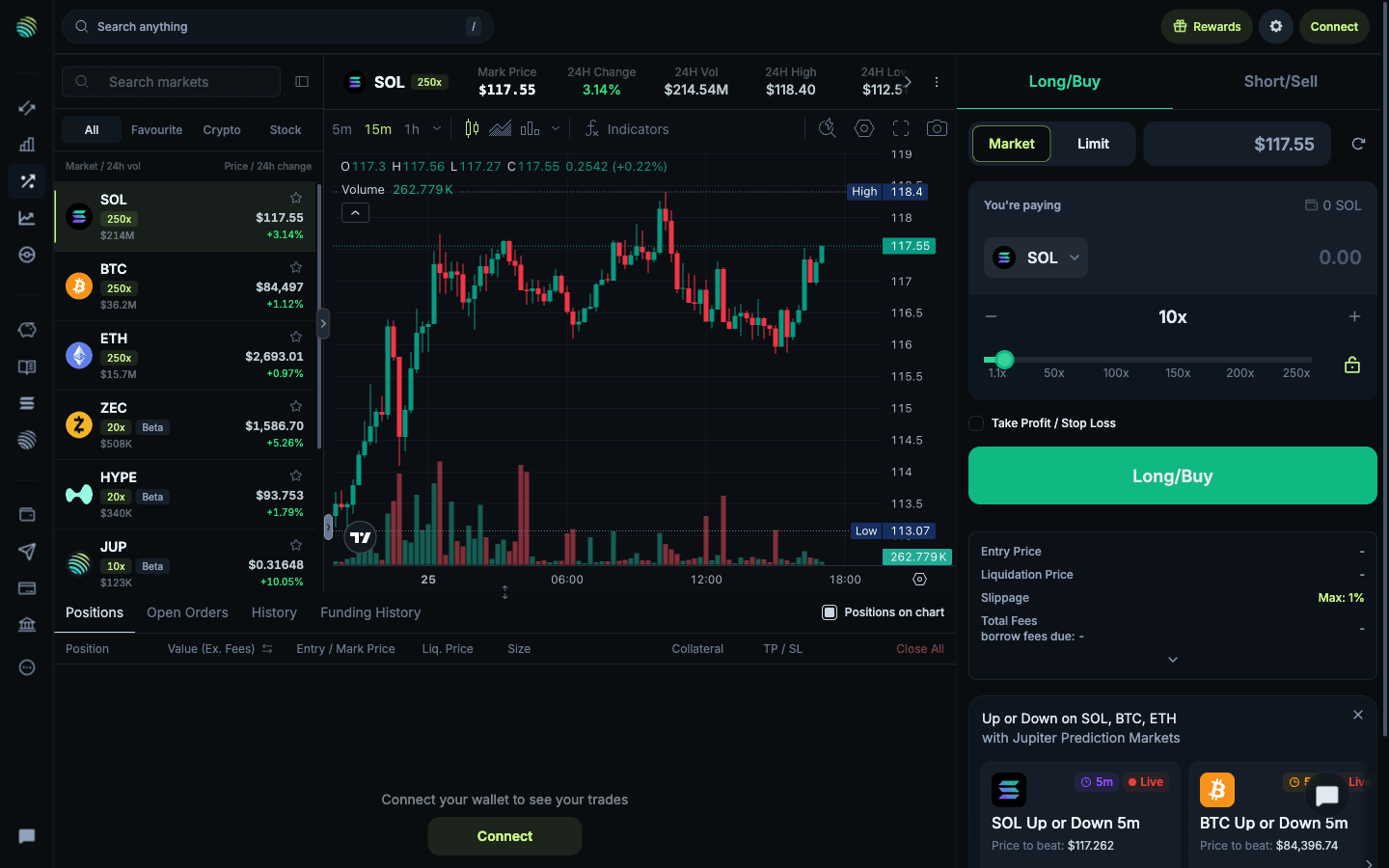
2. Side-by-side comparison
| Lighter | Jupiter Perps | |
|---|---|---|
| Model | Central limit order book in a zk-rollup; proofs verified on Ethereum | Trader-vs-pool (JLP) at oracle prices on Solana; 6 Beta markets on the GUM order-book engine |
| Trading fee | Standard 0% maker / 0% taker; Premium 0.004% / 0.028% (140 ms) | 0.06% on open + 0.06% on close + price impact fee, no maker/taker split; Beta 0.005% / 0.035% |
| Holding cost | Hourly funding between longs and shorts (baseline 0.00125% per hour; shorts receive it when positive) | Hourly borrow fee paid to the pool by longs and shorts alike |
| Max leverage | BTC/ETH 50x, SOL 25x, HYPE/ZEC 20x, JUP 10x | 250x on SOL, ETH, wBTC; Beta 20x |
| Markets | 213 perps (crypto, FX, indices, stocks, metals, pre-IPO) + 10 spot pairs | SOL, ETH, wBTC + 6 Beta markets (JUP, HYPE, ZEC, SPCX, SNDK, SKHYNIX) |
| 30-day volume (September 27, 2026) | $53.91B (both Lighter deployments) | $6.76B |
| Open interest (September 27, 2026) | $616.8M | $43.7M |
| Order types | Market, limit (post-only, reduce-only, IOC, good-til-time), stop-loss and take-profit (market or limit), TWAP, advanced TWAP, chase limit | Market; limit orders that trigger at the oracle price (up to 20 per asset and side); TP/SL. Beta: market and resting limit, no TP/SL |
| Collateral | USDC (ETH and XAUT also accepted at 70% LTV in a unified account) | Long: SOL, wETH, wBTC. Short: USDC. Beta: USDC |
| Execution | Your order hits the book; Standard adds 300 ms to takers | Request + keeper: two Solana transactions; a request can wait up to 45 seconds |
| Liquidation | Partial first, up to 1% fee to the LLP; the rest of your margin stays yours | Oracle hits the liquidation price; all remaining collateral goes to the JLP pool |
| Wallet / chain | EVM wallet or email; deposits from Ethereum, Arbitrum, Base, Solana and more | Any Solana wallet |
| KYC | None to trade (wallet or email login) | None (connect a Solana wallet) |
| Operator (Terms) | Elliot Technologies, Inc.; Florida (US) law | “Jupiter”, registered address in George Town, Grand Cayman (Cayman Islands); Panama law |
| Token | LIT: Premium fee discount up to 30%, LLP access, 6% staking APR, buybacks | JUP: governance and quarterly staking rewards, Litterbox buybacks |
| Referral benefit | Code 718610TD: first week of Premium fees rebated | No referral program found |
Lighter: docs.lighter.xyz, lighter.xyz/terms and the public API. Jupiter: docs.jup.ag (including its Terms of Use) and perps-api.jup.ag. Volume and open interest: DefiLlama. Checked September 27, 2026.
3. Why other sites say 20x, 100x or 0% maker
Several comparison tables, and the AI answers built on them, list Lighter at 20x with 153 markets and Jupiter at 100x with 10 markets and a 0% maker fee. As of September 27, 2026, the official sources say otherwise:
- Lighter 20x. 20x is the default leverage a new BTC or ETH position opens at; the maximum is 50x, set per market by the initial margin fraction in Lighter’s API. 25 markets (HYPE, ZEC, XRP and BNB among them) do top out at 20x, and SOL at 25x.
- Jupiter 100x. Jupiter’s 2024 documentation said “up to 100x”. The current docs give 1.1x to 250x on SOL, ETH and wBTC; Beta markets go up to 20x.
- Market counts. Lighter’s API listed 213 active perps and 10 spot pairs; counts like 153 are older snapshots. Jupiter has 3 pool markets plus 6 Beta markets.
- Jupiter 0% maker. The pool markets have no maker/taker split. Every open and every close pays 0.06%, whether it came from a market or a limit order. Only the Beta markets have a maker fee, 0.005%.
4. Pros and cons of each
Lighter
Pros
- 0% maker and 0% taker on Standard; Premium (0.028% taker) only if you want speed
- A real order book: resting limit orders, post-only, TWAP, stop and take-profit limits
- 213 perps including FX, indices, stocks and metals, plus 10 spot pairs
- Shorts receive funding when it is positive
- Partial liquidation; margin left afterwards stays yours
- Deposits straight from Solana, Ethereum, Arbitrum, Base and more
Cons
- Standard adds 300 ms to taker orders
- Leverage tops out at 50x (BTC/ETH) and 25x on SOL
- Withdrawals go out via Ethereum or Arbitrum, so returning to Solana needs a bridge
- Younger: public mainnet since October 1, 2025
Jupiter Perps
Pros
- Up to 250x on SOL, ETH and wBTC
- Native to Solana: any Solana wallet, no bridge
- Oracle fills with no book to walk; the largest SOL perp volume of the two
- Long collateral in the asset itself (SOL, wETH, wBTC)
- Backed by the $950.8M JLP pool (September 27, 2026)
Cons
- 0.06% on open and 0.06% on close, plus price impact and hourly borrow for every position
- Only 3 pool markets; the 6 Beta markets have tight per-account caps and no TP/SL
- Liquidation takes all remaining collateral on the pool markets
- Keeper execution: a request can take up to 45 seconds
5. Fees, funding and borrow
Lighter: free on Standard, pay for speed on Premium
Every Lighter account starts as Standard: 0% maker and 0% taker on all perp and spot markets. The catch is latency: 300 ms added to taker orders and cancels; maker orders are not delayed. Premium is opt-in and cuts taker latency to 140 ms (cancels and post-only orders get no added delay) for 0.004% maker / 0.028% taker, discounted by up to 30% if you stake LIT. Advanced order types such as TWAP showed a 0.01% fee line on Standard in the app, so check the ticket before using them. Details: Lighter fees.
Holding a position costs funding, paid peer-to-peer at every hour mark with no cut for the exchange. The baseline interest component is 0.01% per 8 hours (0.00125% per hour), the premium moves it up or down, and the cap is 0.5% per hour. When the rate is positive, longs pay and shorts receive. Over the 200 hours to 13:00 UTC on September 25, SOL longs paid in every hour, 0.2303% in total, which works out to about 0.00115% per hour. Over 30 days (719 hourly rates to September 25), BTC funding summed to 0.763%, ETH 0.656% and SOL 0.471%.
Jupiter Perps: five separate charges
- Base fee: 0.06% of size on open and again on close, TP/SL closes and liquidations included.
- Price impact fee on open and close. The linear part is tiny at retail size (the docs’ SOL example: $0.0008 on $10,000). An additive part applies when the long/short open-interest gap passes a per-asset threshold; the pool API caps the total at 0.44% on SOL.
- Borrow fee, hourly, from your collateral: utilization × hourly rate × size, paid by longs and shorts. On September 25 the pool API showed 0.0015%/h for SOL longs (utilization 11.1%), 0.0013%/h for BTC and ETH longs and 0.0006%/h for USDC-backed shorts (utilization 58.6%).
- Swap fee if your deposit token differs from the collateral token: 10 bps for SOL/ETH/wBTC, 2 bps for stablecoins, adjusted by pool weights.
- Solana fees on every request, optional priority fees or Jito tips, and escrow rent that is refunded on close.
The big structural difference: on Lighter a short can earn the holding cost when funding is positive; on Jupiter everybody pays the pool.
6. Worked example: $10,000 of SOL
A $10,000 SOL long at 10x, opened and closed with market orders, using the rates and books of September 25, 2026 (about 13:15 UTC). Holding costs assume those rates hold, which they will not.
| Cost item | Lighter (SOL perp) | Jupiter Perps (SOL long) |
|---|---|---|
| Trading fees, open + close | $0 (Standard) · $5.60 (Premium taker) | $12.00 base fee |
| Execution cost at $10,000 | ≈ $1.20 crossing the spread twice (0.006% each way) | No book; linear price impact ≈ $0 at this size |
| Holding cost, 24 hours | ≈ $2.76 funding paid by longs (8-day average rate) | $0.40–$3.60 borrow fee |
| Holding cost, 7 days | ≈ $19.30 | $2.80–$25.20 |
| Network fees | None on orders | Solana fees on the open and close requests |
| Total, 24 hours (Standard) | ≈ $3.96 | ≈ $12.40–$15.60 + Solana fees |
| Total, 7 days (Standard) | ≈ $20.50 | ≈ $14.80–$37.20 + Solana fees |
Lighter funding uses the 200-hour average of 0.00115%/h. Jupiter’s borrow is shown as a range because its docs apply the displayed rate as utilization × rate × size (11.1% × 0.0015%/h ≈ $0.40 a day) while the trade form presents 0.0015%/h as the rate itself ($3.60 a day); the live “Borrow Fees Due” line settles it on a real position. Lighter Premium adds $5.60 of taker fees to every Lighter total.
The short side is clear-cut. The same $10,000 short held for a day costs nothing in Lighter fees and, at the recent positive funding, receives about $2.76. On Jupiter the short pays $12.00 in base fees plus $0.84–$1.44 of borrow.
For active traders the gap compounds. Twenty $10,000 round trips a day cost $240.00 in Jupiter base fees and $0 in Lighter Standard fees (about $112.00 on Premium). That is the whole case for Lighter if you scalp; see DEX vs CEX fees for how both compare with Binance.
At $1M, Jupiter’s oracle fill can win on execution. A simulated $1M market buy on Lighter’s SOL book averaged 0.063% above mid. On Jupiter you fill at the oracle price, but the price impact fee can climb toward its 0.44% cap if your order pushes the pool’s long/short imbalance past the threshold, and only $10M of SOL liquidity was available per side.
7. Liquidity, volume and open interest
Across the whole venue Lighter is far larger. DefiLlama showed $53.91B of 30-day volume for Lighter against $6.76B for Jupiter Perps, and $616.8M of open interest against $43.7M, about 14 times as much (September 27, 2026). Market by market, the picture on September 25, 2026 was:
| Market | Lighter 24h volume | Jupiter 24h volume | Lighter max leverage | Jupiter max leverage |
|---|---|---|---|---|
| SOL | $58.0M | $250.5M | 25x | 250x |
| BTC | $825.2M | $31.7M | 50x | 250x |
| ETH | $269.2M | $13.5M | 50x | 250x |
| HYPE | $50.4M | Beta market | 20x | 20x (Beta) |
| ZEC | $81.0M | Beta market | 20x | 20x (Beta) |
| JUP | $0.41M | Beta market | 10x | 20x (Beta) |
Volumes: Lighter exchangeStats and Jupiter market-stats, about 13:15 UTC, September 25, 2026 (Lighter total that day: $1.65B; Jupiter pool markets: about $296M). Jupiter’s Beta markets traded about $1.2M combined earlier that day (jup.ag/perps). Leverage: current registry values.
SOL is where Jupiter leads: its SOL market did more than four times Lighter’s SOL volume, which fits a user base whose money already sits on Solana. Everywhere else Lighter is far larger: 26 times Jupiter’s BTC volume and 20 times its ETH volume, plus about 200 more perp markets, including FX, US indices, stocks, gold and pre-IPO contracts. Jupiter’s JLP pool held $950.8M (September 27, 2026), but what a trader can use is capped by “available liquidity” per market and side.
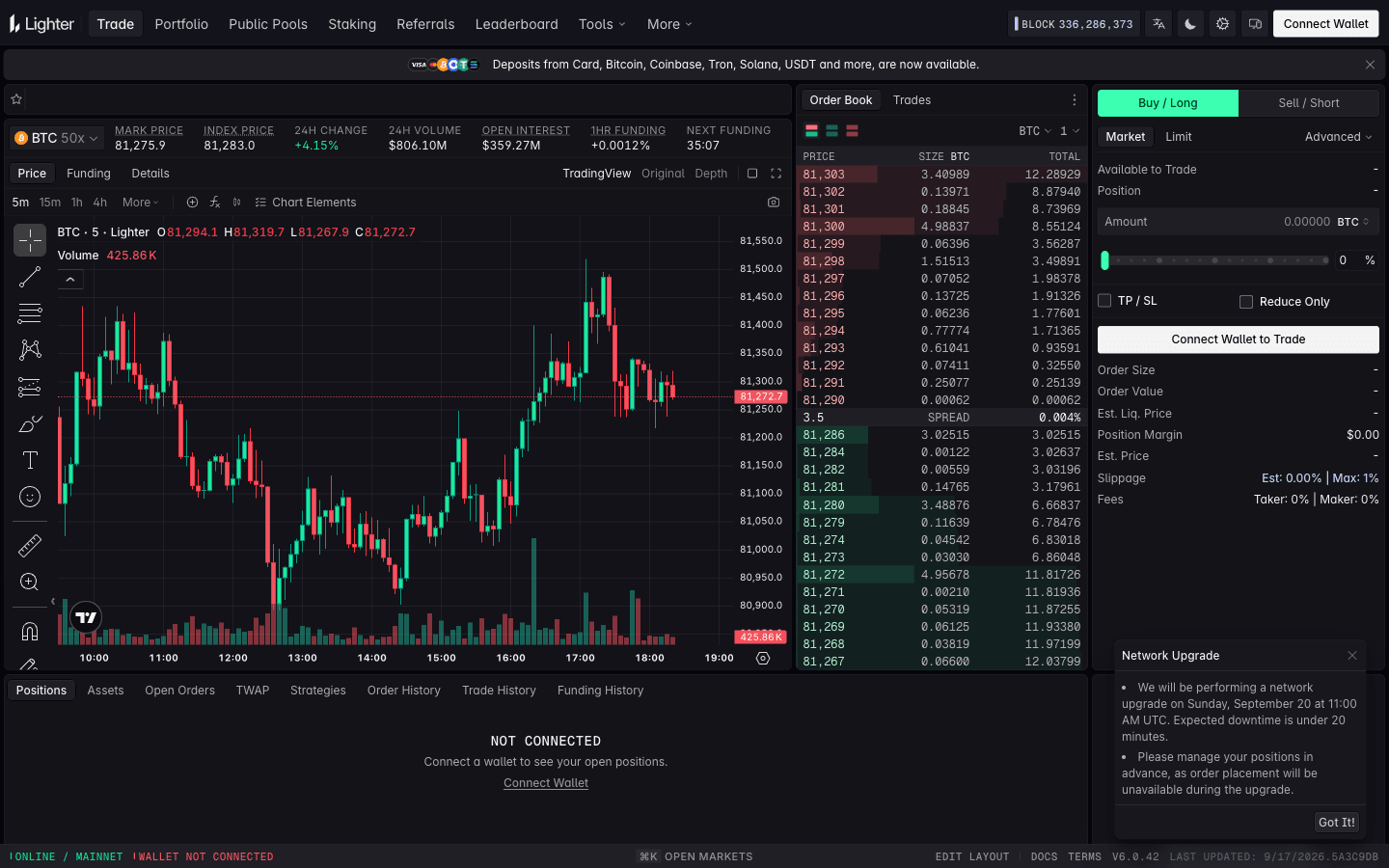
8. Leverage and liquidation
Lighter sets leverage per market from its initial margin fraction: 50x on BTC and ETH, 25x on SOL, 20x on HYPE, ZEC, XRP and BNB, 10x on JUP and lower on most small caps. Maintenance margin is 60% of the initial margin at max leverage: 1.2% on BTC and ETH, 2.4% on SOL. Jupiter allows 1.1x to 250x on SOL, ETH and wBTC; its liquidation formula uses a protocol maximum of 500x, so maintenance is about 0.2% of size plus the estimated close fee.
| Leverage | Lighter, isolated SOL long | Jupiter, SOL long (at open) |
|---|---|---|
| 10x | ≈ 7.8% | ≈ 9.7% |
| 25x | ≈ 1.6% (SOL max) | ≈ 3.7% |
| 50x | Not available on SOL (BTC/ETH: ≈ 0.8%) | ≈ 1.7% |
| 100x | Not available | ≈ 0.7% |
Approximate price drop from entry to liquidation. Lighter: 1 − (1 − 1/leverage) ÷ (1 − maintenance), with 2.4% maintenance on SOL (1.2% on BTC/ETH). Jupiter: 1/leverage − 0.2% − 0.06% close fee. Funding, borrow and price impact ignored.
What happens at the line matters more than where it sits. On Lighter, falling below maintenance first cancels your open orders and liquidates partially with immediate-or-cancel orders on the book, with a fee of up to 1% to the LLP insurance pool; margin left afterwards is yours. Only below the close-out margin does the LLP take the position over, and auto-deleveraging is the last resort. On Jupiter’s pool markets, liquidation hands all remaining collateral to the JLP pool, and because borrow fees are deducted every hour the liquidation price creeps toward you even if the price never moves. (Jupiter’s Beta markets return the remainder minus a 0.75% fee, 1% on the stock perps.) More in our Lighter leverage limits and liquidation price calculator.
Zero fees, 213 markets, a real order book
Open a Lighter account with 718610TD. Standard is free; if you upgrade to Premium in your first week, those fees are rebated.
9. Order types
Lighter offers what you would expect from a centralized exchange: market orders, limit orders with post-only, reduce-only, immediate-or-cancel and good-til-time options, stop-loss and take-profit orders in market or limit form, plus TWAP, advanced TWAP (passive, neutral or aggressive) and chase limit orders that follow the best price. Because there is a real book, a resting limit order is a maker order. Walkthrough: Lighter order types guide.
Jupiter Perps has market orders, limit orders and TP/SL on its pool markets. A limit order there is a trigger: it opens a position when the oracle price reaches your target, and it pays the same 0.06% base fee as a market order. You can keep up to 20 active limit orders per asset and side, and none can be created while a market’s utilization is above 80%. The Beta markets run on a book, so they have resting limit orders with a maker fee, but no TP/SL yet.
10. Chains, wallets and moving money between them
- Jupiter: connect any Solana wallet, hold SOL or USDC, trade. Longs are collateralised in the asset itself (SOL, wETH, wBTC) and shorts in USDC, so your PnL on a long lands in SOL. Jupiter’s 6 Beta markets (JUP, HYPE, ZEC and the stock perps SPCX, SNDK, SKHYNIX) use USDC and, as of October 15, 2026, are open to any wallet within per-account caps (the docs say “No JUP stake is required”).
- Lighter: log in with an EVM wallet or email; the login screen lists Phantom, MetaMask, Rabby, OKX Wallet, Coinbase and Binance Wallet among its recommended options. Solana users do not need to bridge themselves: Lighter’s universal deposit addresses take USDC, USDT and SOL on Solana (and assets on Ethereum, Arbitrum, Base, BNB Chain, Polygon, Tron, Bitcoin and others) and convert them to USDC, with a $5 minimum for a new account. Withdrawals go out through Ethereum (“secure”, 1 USDC minimum) or Arbitrum (“fast”, USDC only, 4 USDC minimum), so getting back to Solana needs a bridge or an exchange. Step by step: Lighter deposits and withdrawals, Lighter sign-up.
- Custody: both are self-custodial. Lighter’s balances sit in the rollup with Ethereum as the settlement layer; Jupiter’s sit in the program’s custody accounts on Solana. Neither holds an account in your name.
11. KYC, operators and who can use them
Neither venue asks for identity documents. You trade from a self-custody wallet (or, on Lighter, an email login), so there is no account in your name to verify. That is how DEXs work, not a loophole: your on-chain activity is public and traceable, fiat on-ramps still require KYC, and taxes apply as usual. More in our no-KYC DEX guide.
- Lighter: the Terms of Service (last updated December 29, 2025) are issued by Elliot Technologies, Inc., which provides the interface and API, and are governed by Florida (US) law. They exclude persons in the US, Canada, the UK, China, North Korea, Russia, Ukraine, Cuba, Iran, Venezuela, Syria and other sanctioned places (the opening notice adds Sudan, Belarus and Myanmar). Public mainnet opened on October 1, 2025; the Security Audits page lists 9 audit reports for its contracts and circuits, and the Ethereum escape hatch lets users withdraw if the sequencer stops.
- Jupiter: the Terms of Use name “Jupiter” with a registered address in George Town, Grand Cayman (Cayman Islands), governed by Panama law with binding arbitration. They describe the interface as a front end to open-source, permissionless contracts. Prohibited localities include the US, the Republic of China, Singapore, Cuba, Iran, North Korea, Syria and other regions under US, UK or EU sanctions.
Jupiter’s terms explicitly forbid using a VPN to get around its list. Lighter’s say it may log your IP address to enforce access restrictions and collects no other personal data through the interface. Do not try to get around either; check the rules where you live before depositing.
12. LIT vs JUP: what the tokens do for traders
Some searches for “Lighter vs Jupiter” are about the tokens. Here is what each one does for a trader. It is not a view on the price.
| LIT (Lighter) | JUP (Jupiter) | |
|---|---|---|
| Fee discount | Up to 30% off Premium fees at 500,000 LIT staked | None on Perps fees |
| Staking | Fixed 6% APR; unstaking takes 3 days | Governance votes and quarterly Active Staking Rewards; unstaking cooldown of 7 days |
| Access | LLP deposits: up to 10 USDC per LIT staked | Nothing extra: Beta markets need no JUP stake (October 15, 2026) |
| Buybacks | Protocol buys LIT with trading-fee revenue in daily TWAPs | 50% of on-chain revenue goes to the Litterbox Trust, which buys JUP (about 134 million JUP burned so far) |
| Perp fees, 30 days | $3.47M | $8.44M |
| Protocol revenue, 30 days | $2.86M | $2.11M |
| Spent on the token, 30 days | $2.88M (LIT buybacks) | $1.06M (from Perps) |
Token utility: docs.lighter.xyz (LIT Utility, Trading Fees) and docs.jup.ag (Staking, JUP Token FAQ, Tokenomics, Beta Markets, re-read October 15, 2026), checked September 27, 2026. Fees, revenue and token spending: DefiLlama “Lighter Perps” and “Jupiter Perpetual Exchange” (September 27, 2026).
Two things stand out. Jupiter Perps collects more fees ($8.44M vs $3.47M over 30 days) even with a fraction of the volume, because every trade pays 0.06% each way plus borrow, while most Lighter volume is free; 75% of Jupiter’s fees go to JLP holders, not the protocol. And Lighter spent more on its own token than Jupiter Perps did on JUP. Neither token is needed to trade the main markets. Compare other venue tokens in DEX native tokens compared.
13. LLP vs JLP: the pools behind each venue
Both venues have a pool, but they do different jobs. JLP is Jupiter’s counterparty: it earns 75% of Perps fees and absorbs trader PnL, and it holds SOL, ETH, wBTC, USDC, USDT and JupUSD, so JLP holders carry market exposure too. It held $950.8M on September 27, 2026. LLP is Lighter’s insurance and liquidity pool; it takes over positions in liquidations and is open only to LIT stakers (up to 10 USDC per staked LIT). It held $74.3M on September 27, 2026. If passive yield is your real interest, compare the risks in our Lighter LP and staking guide.
14. Who should pick which
- Pick Lighter if you trade more than a few times a week, use limit orders, want to short and earn positive funding, or need anything beyond SOL, ETH and BTC: altcoins, gold, FX, US indices and stock perps. It is also the better pick for bots, with a public API and per-account rate limits (Lighter API guide).
- Pick Jupiter Perps if your money lives on Solana, you want a short-term SOL, ETH or BTC position without bridging, and you value oracle fills with no book to walk, or you specifically want more than 25x on SOL and accept that a liquidation keeps all your collateral.
- Want the deepest on-chain book instead? Hyperliquid charges 0.045% taker but trades several billion dollars a day; code
HOLYGRAILtakes 4% off fees on your first $25M. Compare in Hyperliquid vs Jupiter and Hyperliquid vs Lighter.
Other Solana options are covered in best DEX for Solana perpetuals, and the full field in best DEXs in 2026. New to all of this? Start with what a DEX is.
15. FAQ
Is Lighter cheaper than Jupiter Perps?
For trading fees, yes, by a wide margin. A Lighter Standard account pays 0% maker and 0% taker, so a $10,000 round trip costs nothing in fees (about $1.20 of spread on SOL on September 25, 2026). Jupiter charges 0.06% to open and 0.06% to close on SOL, ETH and wBTC, so $12.00, plus a price impact fee and an hourly borrow fee. For holding, Lighter longs pay hourly funding (about $2.76 a day on $10,000 SOL at the recent average) while Jupiter longs pay borrow ($0.40–$3.60 a day at that day’s rate).
Is Lighter better than Jupiter?
For most perp traders, yes: Lighter wins 6 of the 9 categories we scored (fees, holding cost for shorts, market choice, volume and open interest, order types and liquidation outcome). Jupiter wins on maximum leverage (250x vs 50x), on SOL volume and on convenience if your money already sits in a Solana wallet. Pick Jupiter for a quick, high-leverage SOL, ETH or BTC trade without bridging; pick Lighter for anything you trade often or hold short.
Which has more leverage, Lighter or Jupiter?
Jupiter: 1.1x to 250x on SOL, ETH and wBTC (the app warns above 150x). Lighter: 50x on BTC and ETH, 25x on SOL, 20x on HYPE, ZEC, XRP and BNB, and less on most alts. At the same leverage Jupiter leaves slightly more room before liquidation because its maintenance requirement is about 0.2% of size, but a Jupiter liquidation takes all remaining collateral, and borrow fees pull the liquidation price closer every hour.
Why do some sites say Lighter has 20x and Jupiter 100x?
Both figures are out of date or describe something else. On Lighter, 20x is the default leverage a new BTC or ETH position starts at; you can raise it to 50x, and 25 markets have a 20x maximum. Jupiter’s own documentation said “up to 100x” in 2024; the current range is 1.1x–250x. Market counts such as 153 are older snapshots: Lighter’s API listed 213 active perps on October 19, 2026, and Jupiter has 3 pool markets plus 6 Beta markets. And Jupiter’s pool markets have no 0% maker fee: every open and close pays 0.06%, limit orders included.
Which is bigger, Lighter or Jupiter Perps?
Lighter, by volume and open interest. DefiLlama showed $53.91B of 30-day volume for Lighter against $6.76B for Jupiter Perps, and $616.8M of open interest against $43.7M (September 27, 2026). SOL is the exception: on September 25, 2026 Jupiter traded $250.5M of SOL versus $58.0M on Lighter. Jupiter has the larger pool behind it: JLP held $950.8M on September 27, 2026, while Lighter’s LLP insurance pool held $74.3M.
Is Lighter on Solana?
No. Lighter is a zk-rollup whose proofs are verified on Ethereum, and it uses EVM-style accounts (EVM wallet or email login; Phantom is among the listed wallets because it supports EVM accounts). It does accept deposits from Solana: USDC, USDT and SOL sent to its universal deposit address are converted to USDC (minimum $5 for a new account). Withdrawals go out through Ethereum or, for fast USDC withdrawals, Arbitrum. Jupiter Perps is a native Solana program.
Do Lighter and Jupiter require KYC?
No. Neither asks for identity documents to trade: you connect a self-custody wallet (or log in with email on Lighter). That does not make them anonymous or open to everyone. Your on-chain activity is public, Lighter’s Terms exclude persons in the US, Canada, the UK, China, Russia and several sanctioned countries, and Jupiter’s exclude the US, Singapore, the Republic of China and sanctioned regions. Taxes apply as usual.
LIT vs JUP: what do the tokens do for traders?
LIT cuts Lighter Premium fees by up to 30% (at 500,000 LIT staked), is required to deposit into the LLP (up to 10 USDC per LIT staked) and earns a fixed 6% staking APR; Lighter buys LIT back with trading-fee revenue. JUP is staked for governance votes and quarterly Active Staking Rewards (Jupiter’s Beta markets no longer require staked JUP); 50% of Jupiter’s on-chain revenue goes to the Litterbox Trust, which buys JUP. Neither token is needed to trade the main markets. This is not a price forecast.
Which is better for scalping?
Lighter. With zero fees, twenty $10,000 round trips a day cost $0 in fees on a Standard account against $240.00 in base fees on Jupiter. The trade-off is Standard’s 300 ms taker latency; Premium cuts it to 140 ms for 0.028% taker. Jupiter also needs a keeper to execute each request, which is slower for in-and-out trades.
Do Lighter or Jupiter have a referral code?
Lighter does: code 718610TD gives a new account its first week of Premium fees rebated (up to $10M of volume). On the free Standard account there is nothing to rebate. We found no referral program for Jupiter Perps and hold no code for it.
Open your Lighter account
0% maker and taker on Standard, 50x on BTC and ETH, and a Premium week rebated with 718610TD. You can fund it straight from Solana.
Staying on Solana? Jupiter Perps (no referral link; we have no code). Referral details: Lighter referral code.
Disclosure: 718610TD is our Lighter referral code and HOLYGRAIL our Hyperliquid code; we earn a share of fees paid by referred accounts at no cost to you (on Lighter, Premium fees and advanced-order fees on Standard; free Standard market and limit orders earn us nothing). We have no referral relationship with Jupiter. Figures come from docs.lighter.xyz, the Lighter API, docs.jup.ag, Jupiter’s perps API and DefiLlama; the per-market snapshot is from September 25, 2026 and the rest was checked on September 27, 2026. Volumes and rates change constantly. Not investment advice.