
Short answer. On a DEX, crypto passive income comes from three things: lending stablecoins (Hyperliquid USDC 3.15% on September 30, 2026), staking the exchange's token (HYPE about 2.12%–2.23% after commission, LIT a fixed 6% APR) and depositing into a liquidity vault (Hyperliquid HLP 3.5% trailing on October 20, 2026, Lighter LLP 14.64% but only for LIT stakers). On stablecoins the dependable range today is roughly 2–4% a year; anything higher is a share of somebody's trading profit and loss and can go negative. None of it is guaranteed, rewards in tokens move with the token's price, and in most countries they are taxed as income.
Start where the deepest yield products are
Hyperliquid hosts HLP, USDC lending, user vaults and HYPE staking on one account with no gas. Join with code HOLYGRAIL for 4% off your trading fees on your first $25M of volume.
We earn a commission when you sign up through our links; it never raises your fees.
1. Ways to earn crypto passive income on a DEX, at a glance
Every method pays you for a job somebody else needs done: lending margin to traders, securing a chain, quoting prices, or absorbing liquidations. What that job is tells you where the risk sits. The rate column shows the best-established DEX product for each method, with its date.
| Method | Where the yield comes from | Current DEX rate | Lock-up | Main risk | Risk level |
|---|---|---|---|---|---|
| Stablecoin lending | Interest paid by traders who borrow USDC | Hyperliquid USDC 3.15% (September 30, 2026) | None documented | Borrower shortfall, smart contract | Low |
| Delta-neutral stablecoin | Funding paid to a hedged short, run by a custodian | Aster asUSDF 2.4% (September 30, 2026) | Redeem 1–2 days, up to 7 for large amounts | Custodian, strategy | Low–medium |
| Native token staking | New tokens from the protocol's reward reserve | HYPE 2.12%–2.23% (October 19, 2026); LIT 6% | 7 days (HYPE), 3 days (LIT) | Token price | Medium (price) |
| Protocol liquidity vault | Market making and liquidations with your USDC | HLP 3.5% (October 20, 2026); LLP 14.64% (September 30, 2026) | 4 days (HLP) | Trading and liquidation losses | Medium |
| AMM liquidity provision | A share of swap fees (Uniswap v2: 0.25% of each 0.30% trade) | Varies by pool and day | None | Impermanent loss, both tokens' prices | Medium–high |
| Copy vaults and public pools | A trader's profits, minus their profit share | Largest Hyperliquid vaults −13.8% to +1,099.8% (September 30, 2026) | 1 day (Hyperliquid) | The manager's trading | High |
Risk level is our judgement of how much of your principal is exposed, not a rating. Sources: Hyperliquid API (allBorrowLendReserveStates, validatorSummaries, vaultDetails, vault list), Lighter API and docs, Aster Earn page and docs, Uniswap developer docs (fees), read on the dates shown.
2. Every DEX product with its current rate
The table lists every passive product on the three largest order-book perp DEXs that we could verify from an official source. "Rate" is what the venue itself reports: a trailing annualised return for vaults and pools, the current rate for lending and staking.
| Product | You deposit | Rate | Size | Getting out | Main risk |
|---|---|---|---|---|---|
| Hyperliquid USDC lending | USDC | 3.15% supply APY (September 30, 2026) | $519.6M supplied | No lock-up documented | Borrower shortfalls (10% interest buffer) |
| Hyperliquid HLP | USDC | 3.5% APR, trailing (October 20, 2026) | $179.1M | 4 days after your latest deposit | Trading and liquidation losses |
| Hyperliquid user vaults | USDC | −13.8% to +1,099.8% among the ten largest (September 30, 2026) | 3,093 open, $102.2M | 1 day; leader takes 10% of profit | The leader's trading |
| HYPE staking | HYPE | 2.12%–2.23% after commission (October 19, 2026) | 442.1M HYPE staked | 1 day delegation lock + 7 days queue | HYPE price |
| LIT staking (Lighter) | LIT | 6% fixed APR | 112.8M LIT (September 27, 2026) | 3 days unstake lockup | LIT price |
| Lighter LLP | USDC (10 per staked LIT) | 14.64% shown; 8.07% actual over 12 months (September 30, 2026) | $78.5M | Short cooldown in the app | Liquidation and ADL losses |
| Lighter Public Pools | USDC | −271% to +384% (pools over $100k, September 30, 2026) | 334 pools, $4.4M | No lock-up; 10–30% operator fee | The operator's trading |
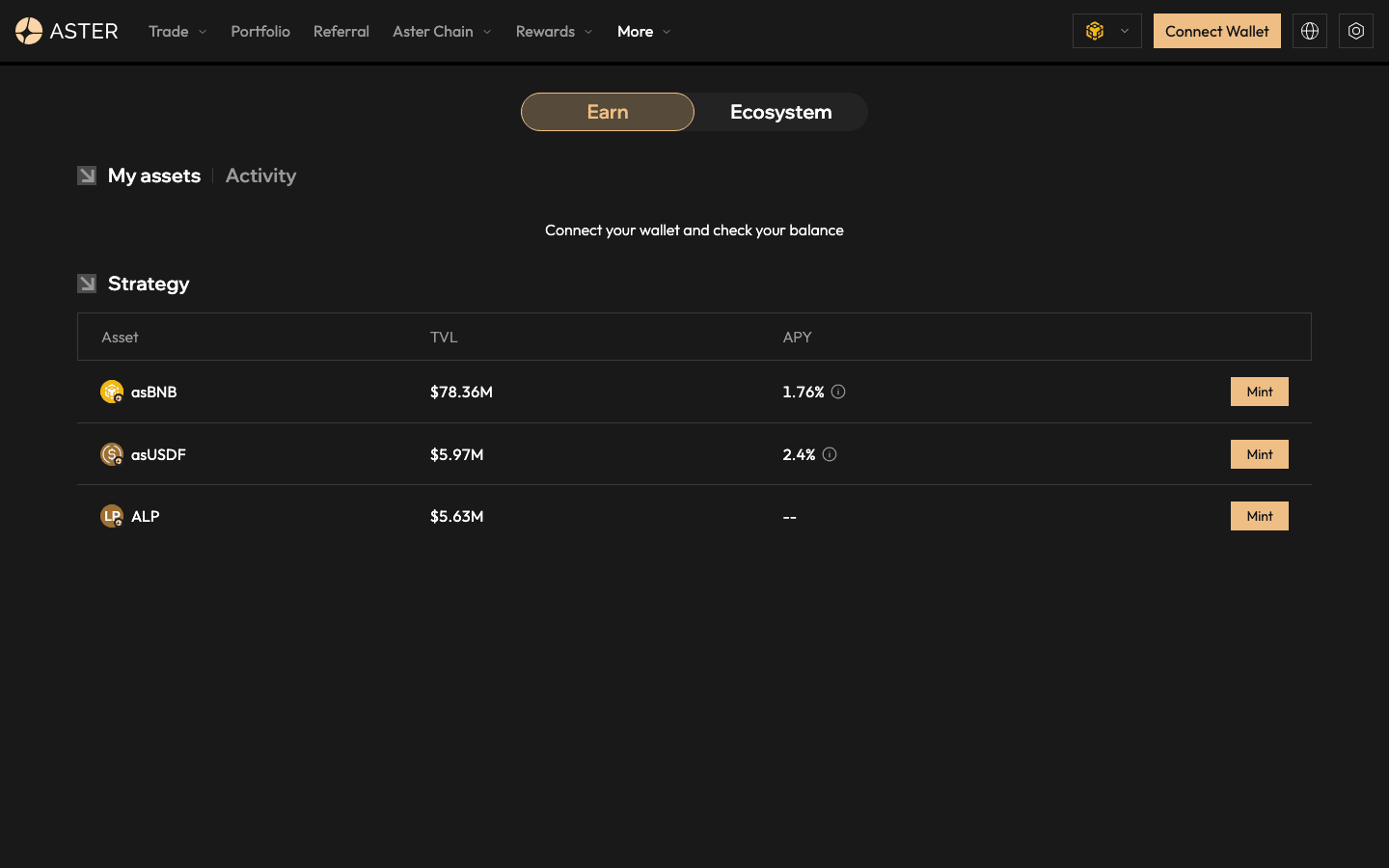
| Aster asUSDF | USDT → USDF | 2.4% APY (September 30, 2026) | $6M | Redeem 1–2 days, up to 7 for large amounts, 0.1% fee | Custodian and strategy risk |
| Aster asBNB | BNB | 1.55% APY (September 30, 2026) | $78M | Withdrawals paid in slisBNB | BNB price, liquid-staking risk |
| ASTER staking | ASTER | Weekly pools, no single APR published | — | Lock up to 208 weeks; early-exit penalty | ASTER price, penalty |
Sources: Hyperliquid API and stats-data vault list; Lighter API account and publicPoolsMetadata and docs (LIT Utility); Aster Earn page and docs. HLP rate and size are fetched when the site is built.
3. Hyperliquid: USDC lending, HLP, user vaults and HYPE staking
Hyperliquid has the widest menu for anyone who wants to earn yield on Hyperliquid, and all of it runs on HyperCore, so depositing into a vault, lending USDC or staking HYPE costs no gas once your funds are on the chain.
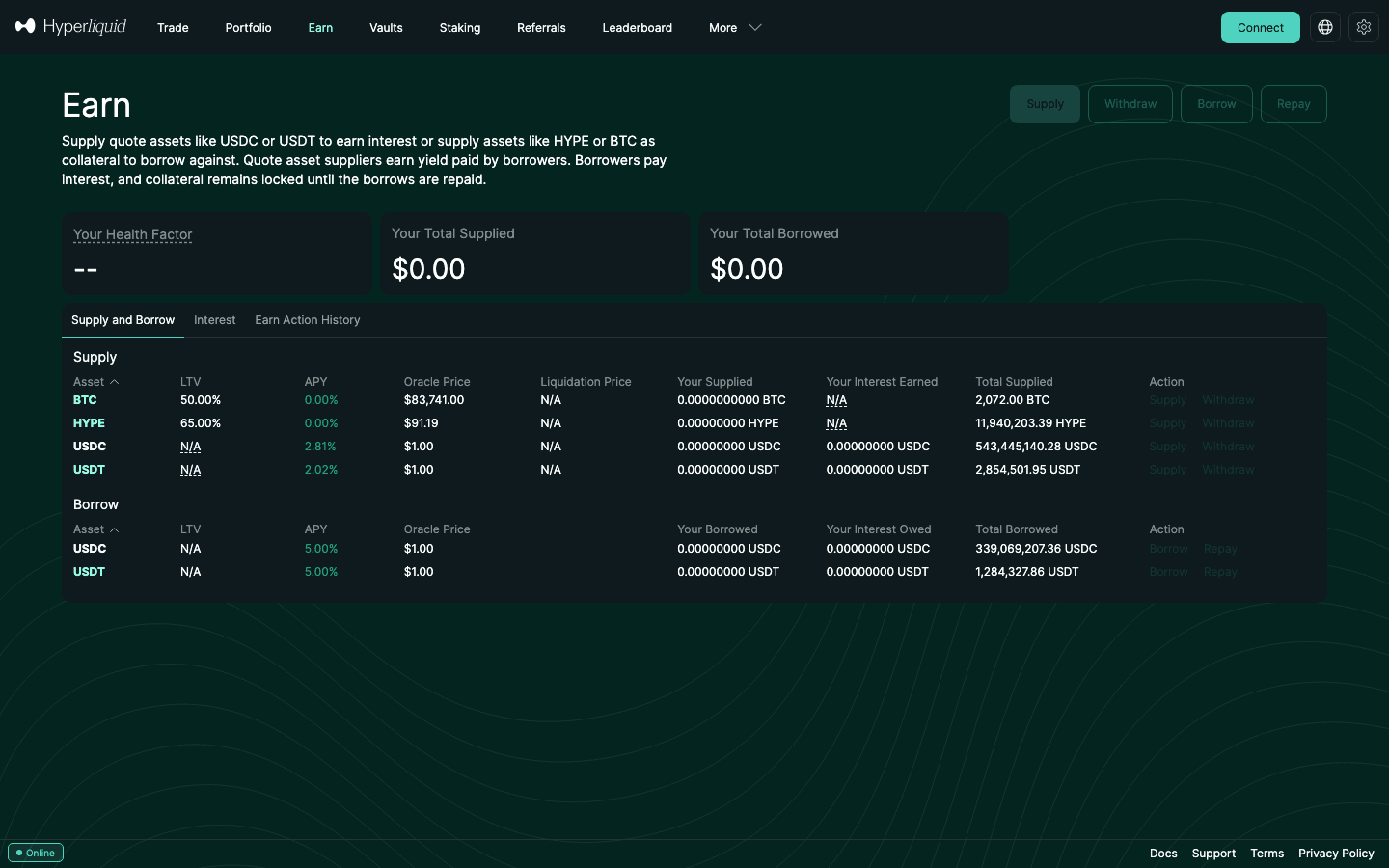
USDC lending (borrow/lend)
Hyperliquid's docs say users "can supply eligible quote assets to earn yield", which traders borrow against HYPE (65% loan-to-value) or BTC (50%). On September 30, 2026 the USDC pool had $519.6M supplied, 69.9% utilisation and a 3.15% supply rate. The borrow rate is 5% a year up to 80% utilisation and then climbs steeply, and the protocol keeps 10% of the interest as a buffer against liquidations. So the supply rate is roughly the borrow rate × utilisation × 0.9, which is why it moves every hour. The docs describe no lock-up for supplied USDC (one address can supply up to 250M USDC). Supplied HYPE and BTC earn nothing; they only serve as collateral.
HLP (Hyperliquidity Provider)
HLP is the protocol vault: it makes markets, takes over liquidations below two-thirds of maintenance margin and supplies USDC to the lending pool. It charges no fee and no profit share. On October 20, 2026 it held $179.1M and reported a 3.5% APR; on September 30, 2026 it had made +$602,237 over the past month and +$138.4M since it started in May 2023. The lock-up is 4 days after your most recent deposit, and every top-up restarts the clock. Its return is a share of real trading P&L, and the risk section lists its worst episodes. Full guide: Hyperliquid vaults and HLP.
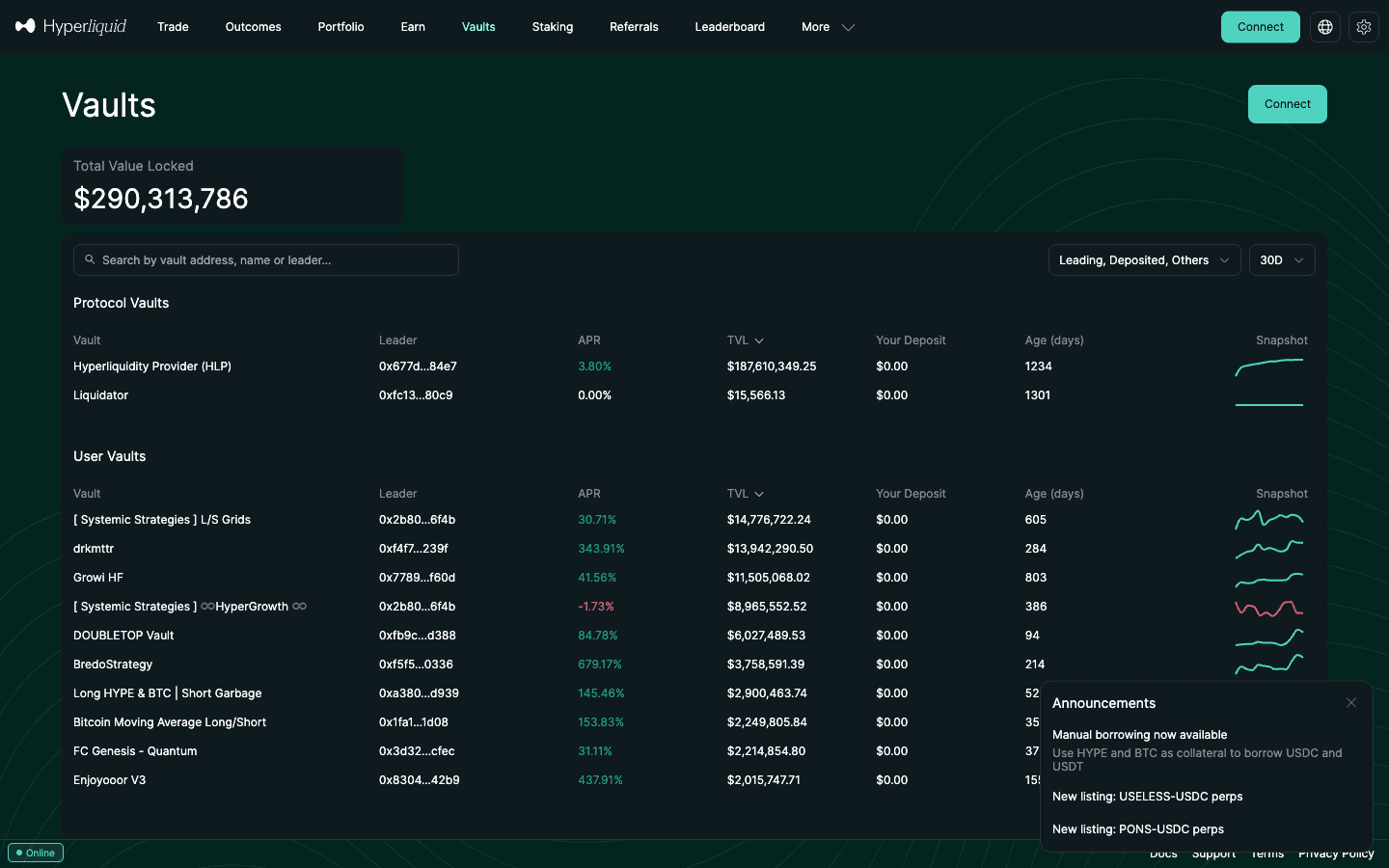
User vaults
Any trader can open a vault (the docs now call these HyperCore vaults "legacy" and point new builders to tokenised vaults on HyperEVM). Depositors share the leader's P&L pro rata; the leader must keep at least 5% of the vault and takes 10% of your profit, and deposits lock for 1 day. On September 30, 2026 there were 3,093 open user vaults holding $102.2M. Among the ten largest, reported APRs ranged from −13.8% to +1,099.8%. Read the drawdown and trade history on the vault page, not the APR, and see our DEX copy trading guide for how to judge a vault leader.
HYPE staking
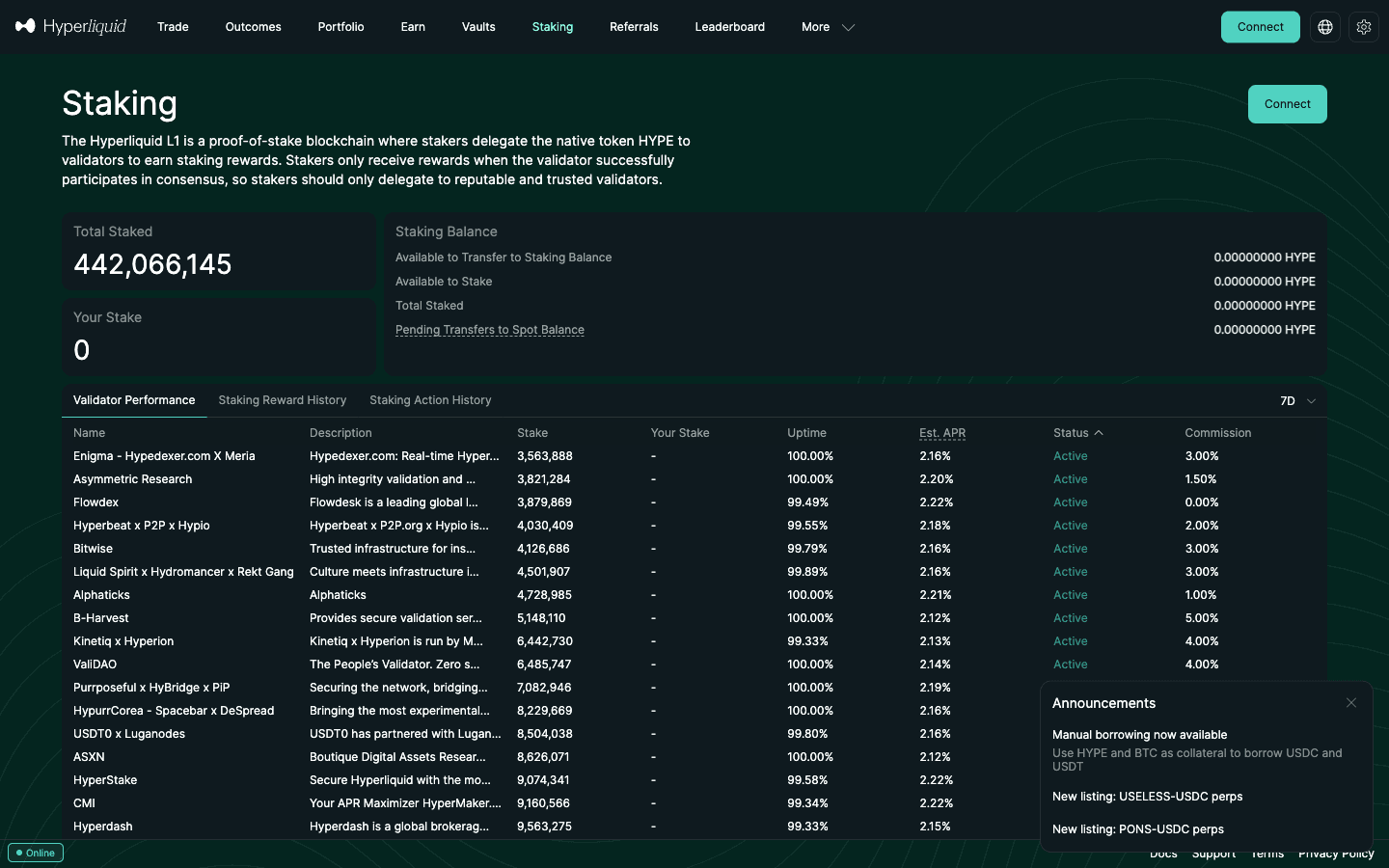
Staking HYPE with a validator pays rewards from the future-emissions reserve. The rate falls as more is staked (inversely with the square root of total stake): the docs give about 2.37% at 400M HYPE, and with 442.1M HYPE staked across 27 active validators the validators' predicted APRs after commission were 2.12%–2.23% (October 19, 2026). Rewards accrue every minute, are paid daily and compound automatically. Delegations lock for 1 day; moving HYPE back to your spot balance goes through an unstaking queue of 7 days. There is no automatic slashing, but a jailed validator earns nothing, so pick one with good uptime. Staking also cuts your trading fees by 5% (over 10 HYPE) up to 40% (over 500,000 HYPE). Liquid-staking tokens such as Kinetiq's kHYPE keep the HYPE usable elsewhere but take a cut of the rewards. Walkthrough: Hyperliquid staking: how to stake HYPE.
4. Lighter: LIT staking, LLP and Public Pools
Lighter's passive products are built around its LIT token.
- LIT staking. The docs (LIT Utility) state that stakers "currently earn a fixed 6% APR", paid in LIT that the protocol buys on the market; separately, trading-fee revenue buys back LIT. Unstaking has a lockup of 3 days. On September 27, 2026 the staking page showed 112.8M LIT staked. Staking 1,000 LIT or more also discounts Premium trading fees.
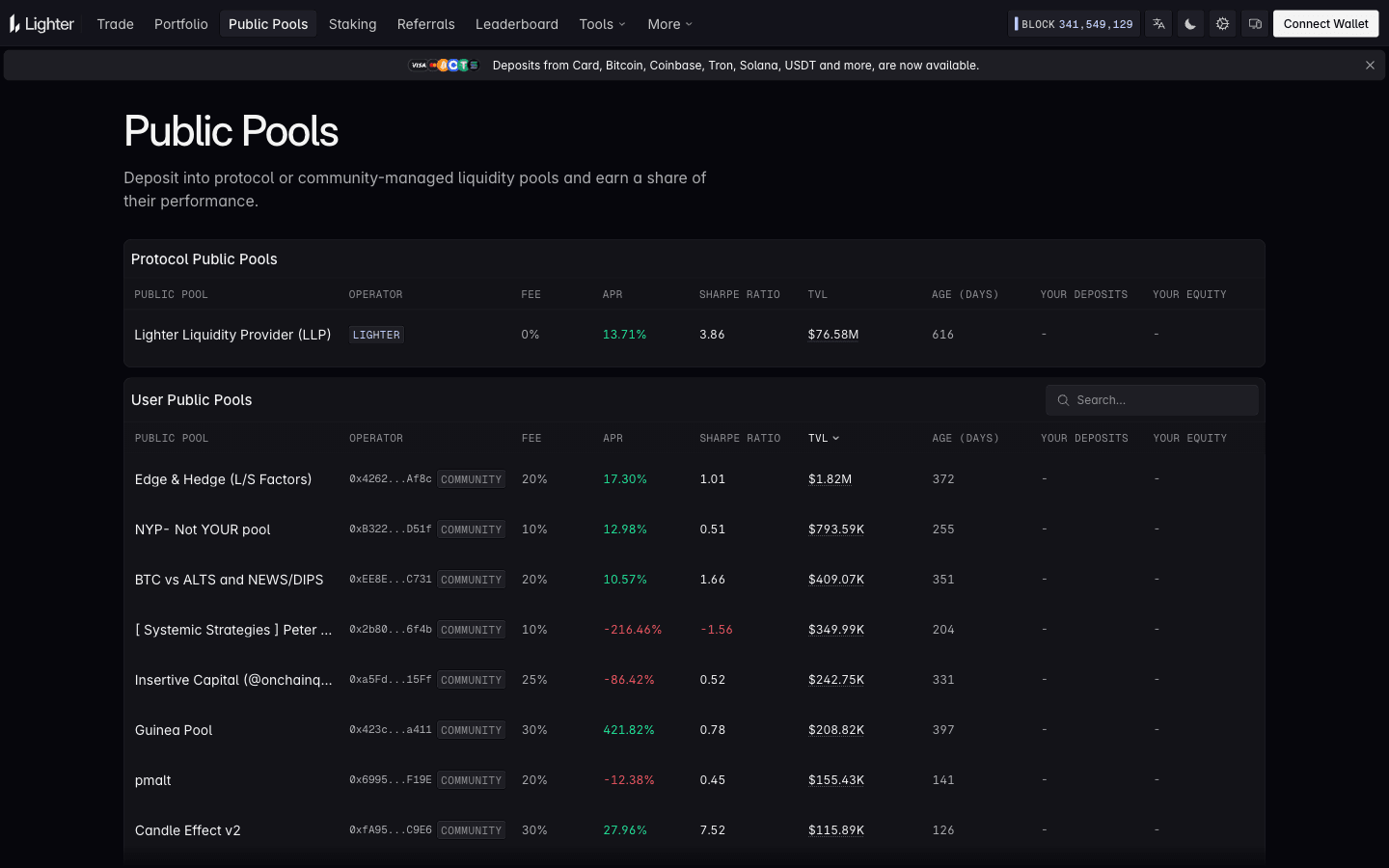
- LLP (Lighter Liquidity Provider). The protocol pool that takes over liquidated positions and backstops auto-deleveraging. It is open only to LIT stakers: 10 USDC of deposits per LIT staked. On September 30, 2026 the API showed $78.5M in the pool, an annualised figure of 14.64% (labelled APR in the app) and a 0% operator fee. Its share price rose 0.92% over 30 days, 3.85% over 90 days and 8.07% over 12 months. The deposit screen warns: "Lighter offers no compensation for losses."
- Public Pools. User-run trading pools: you receive shares, the operator takes a fee on profits and must keep a minimum share of the pool, and there is no lock-up. On September 30, 2026 there were 334 user pools holding $4.4M in total. Operator fees on the ten largest were 10–30%, and reported APRs on pools above $100,000 from −271% to +384%.
The catch with LLP is the entry ticket: to deposit $10,000 you must first stake 1,000 LIT, about $4,760 at the $4.76 (verified September 27, 2026) LIT price, and that stake carries LIT's price risk. More in our Lighter LLP and staking guide.
Want LLP access and zero trading fees?
Lighter's Standard account trades perps at 0% maker and 0% taker. Sign up with 718610TD and you can activate a free Premium trial week that starts at sign-up: the fees you pay that week are rebated (on up to $10M of volume).
5. Aster: ASTER staking, asUSDF, asBNB and vaults
- ASTER staking (on Aster Chain). Each weekly epoch pays a 150,000 ASTER base pool and a 300,000 ASTER loyalty pool plus fee-buyback rewards. You choose a lock of up to 208 weeks; leaving early costs a penalty of the remaining lock ÷ 4 years, within a floor and cap (the docs' example uses 2% and 60%, so exiting a 4-year lock at once costs 60%). Aster publishes no single staking APR, so we do not quote one. Details: Aster staking guide.
- USDF and asUSDF. USDF is minted 1:1 from USDT with no minting fee on Aster; staking it gives asUSDF, whose value accrues the yield from delta-neutral positions (spot bought, the same amount shorted in perps to collect funding) that the custodian Ceffu runs on Binance. The Earn page showed 2.4% APY on September 30, 2026. Redeeming USDF back to USDT takes 1–2 days, up to 7 for large amounts, with a 0.1% fee.
- asBNB. A liquid-staked BNB token: 1.55% APY on the Earn page on September 30, 2026; withdrawals come back as slisBNB.
- Vaults (AOS-3). Manager-run trading vaults: minimum deposit 100 USDT, USDF, USD1 or U (each vault takes one deposit asset, chosen by the manager), a profit share of up to 100% set by the manager, and a default lock-up of 1 day.
Aster lists audits for its Earn contracts and for USDF/asUSDF. An audit reduces smart-contract risk; it does nothing about custodian or strategy risk.
6. How perp DEX liquidity vaults work (HLP, LLP, ALP)
HLP, LLP and ALP are often called "liquidity pools", but they are not Uniswap-style pools. Nothing is paired against a volatile token, so there is no impermanent loss. Instead your USDC becomes the capital of a trading desk that the exchange runs: it quotes prices, takes over positions that liquidations could not close, and in some designs is the direct counterparty to traders. You share that desk's profit and loss pro rata.
- Order-book vaults (Hyperliquid HLP, Lighter LLP). Traders trade against each other on an order book. The vault is one participant among many: it posts quotes like a market maker and steps in when a liquidation cannot be filled on the book.
- Pool counterparty (Aster ALP). The pool itself takes the other side of trades, so traders' net winnings are the pool's losses and vice versa. Aster's docs describe ALP holders as "the market-maker counterparty for perp trades on the platform".
| Hyperliquid HLP | Lighter LLP | Aster ALP | |
|---|---|---|---|
| Where profit comes from | Spread capture, liquidation takeovers, lending interest, fee share | Market making, partial-liquidation fee (up to 1%), positions taken over below close-out margin | Trading P&L, trading and funding fees, platform fees, all into NAV |
| Where losses come from | Informed or manipulative flow; liquidations it takes over at a loss | Takeovers that keep falling; ADL shortfalls it backstops | Traders winning on net |
| Deposit and exit | USDC, 4 days lock-up after the last deposit | USDC, 10 per LIT staked (3 days LIT unstake) | Mint on BNB Chain or Arbitrum; no burn for 48 hours |
| Fees | No fee, no profit share | 0% operator fee | Mint/burn fee: 0.25% base, adjusted by pool weights |
| Size | $179.1M (October 20, 2026) | $78.5M (September 30, 2026) | $5.6M, no APY shown (September 30, 2026) |
HLP is several desks in one
HLP is a parent vault with 7 child vaults: Strategy A, B and X and four liquidators. The API's all-time P&L by child vault on September 30, 2026 shows where the money is made: the original HLP Liquidator +$43.5M and Liquidator 2 +$30.8M, Strategy A +$4.3M, while Strategy B was −$4.2M and Liquidator 3 −$505,272. Liquidations happen on the book first; HLP's liquidator only takes over an account once its equity falls below two-thirds of its maintenance margin, and then keeps that margin, which is a large part of the vault's long-run profit.
LLP isolates risk by strategy
Lighter keeps all LLP funds in one account but splits the collateral into LLP Strategies, and each market maps to one strategy. Losses are capped at the collateral allocated to that strategy: if one strategy is wiped out, its markets go to auto-deleveraging while the other strategies' collateral is untouched (Lighter docs). When an account drops below close-out margin, LLP takes its positions over only while LLP itself stays above its initial margin requirement; anything beyond that is auto-deleveraged.
ALP is the counterparty
ALP's value is the pool's net asset value, so every source of profit or loss shows up in the token price rather than as a payout. The mint and burn fee is dynamic: lower when your deposit moves the pool toward its target weights and higher when it moves it away. ALP cannot be burned within 48 hours of minting.
7. AMM liquidity pools and impermanent loss
The other kind of DEX yield is providing liquidity to a swap pool such as Uniswap, Curve or Aerodrome. You deposit two tokens (say ETH and USDC) and earn a share of every swap's fee: on Uniswap v2 each trade pays 0.30%, of which 0.25% goes to liquidity providers; Uniswap v3 pools use standard fee tiers of 0.05%, 0.30% and 1% (Uniswap docs). Your return is the fees earned minus impermanent loss: when one token's price moves, the pool rebalances you into more of the loser and less of the winner, so you end up with less value than if you had simply held both tokens.
| ETH price vs when you deposited | Impermanent loss vs holding | On $10,000 deposited |
|---|---|---|
| Rises 25% | 0.6% | ≈ $62 less than holding |
| Rises 50% | 2.0% | ≈ $202 less than holding |
| Rises 100% | 5.7% | ≈ $572 less than holding |
| Rises 200% | 13.4% | ≈ $1,340 less than holding |
| Falls 50% | 5.7% | ≈ $572 less than holding |
A 50/50 constant-product pool (Uniswap v2 style), before fees: loss = 2·√r ÷ (1 + r) − 1, where r is the price ratio. Concentrated-liquidity positions (v3) earn more fees in range but magnify this loss.
That is the key difference from HLP or LLP: a perp vault holds USDC and takes trading risk, while an AMM position holds two tokens and takes price-divergence risk. Stable pairs (USDC/USDT) have almost no impermanent loss and correspondingly thin fees; volatile pairs pay more because the loss is real. We cover the perp venues in depth because that is where our referral links are, but AMM pools are a legitimate option if you understand the maths above.
8. DEX yield vs a centralized exchange's Earn
Most "crypto passive income" guides send you to an exchange's Earn page. The difference is who holds the coins and what can go wrong.
| Centralized Earn (lending/staking on an exchange) | DEX (Hyperliquid, Lighter, Aster) | |
|---|---|---|
| Custody | The company holds your coins and decides where they go | You hold them until you deposit into a public contract or vault |
| What can fail | The company's solvency: Celsius and BlockFi froze withdrawals and went bankrupt in 2022 | Smart contracts, bridges, oracles, and the trading book of a vault |
| Transparency | Rates published, positions private | Rules in the docs, balances and P&L visible through public APIs |
| Account | Verified account (KYC) | A wallet; no account in your name |
| Protection | Depends on the country; lent coins are usually outside client-asset protection | None; "Lighter offers no compensation for losses" |
Neither side is risk-free, and the stablecoin rates are in the same low single digits. The DEX side's advantage is that you can see the risk: HLP's and LLP's full P&L histories are public, which is how the drawdowns in this article were measured.
9. Stablecoin yield: where to put your USDC
Perp DEXs pay stablecoin holders for jobs traders need done: lending margin, making markets, taking over bankrupt positions and holding an insurance buffer. That is why the yield is real, why it rises with volume and volatility, and why most of it can turn negative in a bad week. Ranked from least to most exposed:
- Hyperliquid USDC lending (3.15%, September 30, 2026). You earn interest, not trading P&L; losses only arise if a borrower's collateral cannot cover the loan beyond the 10% buffer.
- Aster asUSDF (2.4%). A delta-neutral funding strategy: low market risk, but you rely on a custodian and on Binance, and exits take days.
- Hyperliquid HLP (3.5% trailing). The largest and longest-running vault, +$138.4M of lifetime profit, but it has lost millions in single episodes.
- Lighter LLP (8.07% over the last 12 months). Higher recent returns, a smaller pool, and you must hold LIT to get in.
- User vaults and Public Pools. Pure bets on a trader. Size them like a trade.
10. Worked examples: $10,000 for a year, and $100 a month
What each option would pay on $10,000 if today's rates held for a full year. They will not; treat this as a way to compare scale, not a forecast.
| Option | Rate used | One year at that rate | What changes the answer |
|---|---|---|---|
| Hyperliquid USDC lending | 3.15% | ≈ $315 | Utilisation of the USDC pool, hour by hour |
| Aster asUSDF | 2.4% | ≈ $240, minus about $10 to redeem | Funding rates on Binance |
| Hyperliquid HLP | 3.5% | ≈ $350 | One bad liquidation week can erase months |
| Lighter LLP | 8.07% (actual last 12 months) | ≈ $807, plus 6% on the 1,000 LIT you must stake (≈ $286) | LIT price on the ≈ $4,760 stake; LLP drawdowns |
| HYPE staking ($10,000 ≈ 109 HYPE at $91.65) | 2.23% | ≈ 2.4 HYPE | A 10% move in HYPE equals about 4.5 years of rewards |
Prices: HYPE $91.65 (verified September 27, 2026), LIT $4.76 (verified September 27, 2026). HLP rate as of October 20, 2026; other rates September 30, 2026 or as dated above.
How much capital does $100 a month take?
People search for how to make $1,000 a month or $100 a day from crypto. Divide the income you want by the rate: at today's DEX rates, that is a lot of capital.
| Product | Rate | For $100 a month | For $1,000 a month |
|---|---|---|---|
| Hyperliquid USDC lending | 3.15% | ≈ $38,100 | ≈ $381,000 |
| Aster asUSDF | 2.4% | ≈ $50,000 | ≈ $500,000 |
| HYPE staking (best validator) | 2.23% | ≈ $53,800 | ≈ $538,100 |
| Hyperliquid HLP (trailing) | 3.5% | ≈ $34,300 | ≈ $342,900 |
| LIT staking | 6% | ≈ $20,000 | ≈ $200,000 |
| Lighter LLP (actual last 12 months) | 8.07% | ≈ $14,900 | ≈ $148,700 |
Capital = yearly income ÷ rate, rounded to $100, before tax and fees, assuming the rate holds for a year. $100 a day ($36,500 a year) would take roughly thirty times the "$100 a month" column.
The lesson: on stablecoins the reliable range today is 2–4%. Anything above that, including the LLP's strong year, is paid for with exposure to liquidations, to a token, or to a manager. Promises of $100 or $500 a day from a small balance are leverage or risk dressed up as income.
11. Is crypto passive income worth it? What "passive" leaves out
It can be worth it if you already hold stablecoins or HYPE/LIT and would otherwise leave them idle, and if you size it so that a vault's bad month or a token's 30% fall does not hurt you. It is not a substitute for a savings account: there is no deposit insurance and no guaranteed principal. Before you deposit, check the things the headline rate leaves out:
- Price is not income. If HYPE rises 20% in a year while you stake it at 2.23%, only about 2.23% of your gain is yield; the rest is price exposure you would have had anyway. The reverse is also true.
- Rewards are paid in the token. HYPE, LIT and ASTER rewards are worth whatever the token is worth when you sell.
- Trailing APRs are history. A vault's APR is the past, annualised; check its drawdowns and losing days.
- Exit time. 4 days for HLP, 7 days for HYPE, 1–2 days, up to 7 for large amounts to redeem USDF, and locks of up to 208 weeks for ASTER.
- Monitoring. Rates change hourly; vault leaders change strategy; protocols change reward policy. Check monthly.
- Getting there costs something. Exchange spreads, withdrawal fees and bridge fees eat into a 3% yield on a small balance.
- Tax. Each reward is usually income when received, so you may owe tax on tokens that later fall.
12. Risks, drawdowns and lock-ups
- HLP has lost money before. On March 12, 2025 Hyperliquid said HLP had lost about $4M over the previous 24 hours, after a trader's large ETH long was liquidated. Two weeks later JELLY was manipulated and validators voted to delist and settle the market; HLP's P&L for that fortnight ended +$1.2M, but only because of that governance decision. HLP's largest sampled drop, −$4.7M between October 29 and November 12, 2025, covers a POPCAT manipulation that the security firm Halborn describes; we found no official loss figure. Spread over today's $179.1M vault, a loss that size would be about 2.6%, or $260 on $10,000: 74% of a year's return at the current APR.
- LLP drawdowns. Its share price fell 8.94% from March 2 to 5, 2025, and 5.35% on October 10–11, 2025. It lost value on 90 of the last 365 days.
- Custody and smart-contract risk. Funds sit on HyperCore behind the Arbitrum bridge, in Lighter's Ethereum contracts, or, for USDF, with Ceffu on Binance. Each can fail in a different way, and none of them is insured.
- Token price risk. Staking rewards are small next to price moves in HYPE, LIT or ASTER.
- Policy risk. Lighter's 6%, Aster's weekly pools and Hyperliquid's reward curve are parameters the protocol can change.
- Lock-ups: HLP 4 days, Hyperliquid user vaults 1 day, HYPE 1 day delegation + 7 days unstaking queue, LIT 3 days, USDF redemption (1–2 days, up to 7 for large amounts), ALP 48 hours after minting, ASTER up to 208 weeks. Lighter Public Pools and Hyperliquid USDC lending have none documented.
How these pools make and lose money is explained in section 6; HLP's liquidation role in detail: Hyperliquid insurance fund, HLP and ADL.
13. Referral income
If you have an audience, referral commissions are the one income stream that does not put your capital at risk. Hyperliquid pays 10% of referred users' fees on their first $1B of volume (you need $10,000 of your own volume to create a code). Lighter pays 10% or 20% (its app advertises up to 30%, with no published requirement) weekly, from the Premium and Plus fees referred users pay and, on Standard accounts, from their advanced-order fees (plain Standard trades are free, so they earn nothing). Aster pays a default 10% for 365 days. It is only passive once people have signed up and keep trading. How it works: Hyperliquid referral code HOLYGRAIL explained.
14. How to start in five steps (and taxes)
- Pick the product first, from the tables above, based on the asset you hold and how quickly you might need it back.
- Open the account through a referral link if you will also trade: on Hyperliquid, app.hyperliquid.xyz/join/HOLYGRAIL takes 4% off trading fees (it does not change vault or lending returns).
- Deposit. On Hyperliquid a connected wallet deposits USDC on Arbitrum (minimum 5 USDC; less is lost), while an email login can also receive USDC on other chains at its deposit address (deposit guide). Lighter and Aster show their supported chains in the deposit panel. Send a small test first.
- Supply, deposit or stake from the Earn, Vaults or Staking pages, and note the unlock date.
- Review monthly. Check the vault's P&L and drawdown, not just its APR, and keep a record of every deposit, withdrawal and reward.
Taxes: in the US, staking rewards are ordinary income when received (IRS digital-asset guidance); vault profits and losses are generally gains or losses when you withdraw, but check local rules. See our DEX tax reporting guide. Comparing venues overall? Start with the best DEX guide or what a DEX is.
Earn and trade on one account
HLP, USDC lending, vaults and HYPE staking all live on Hyperliquid. Join with code HOLYGRAIL for 4% off your trading fees on your first $25M.
Also: Lighter (718610TD) · Aster (DTLpLc)
FAQ
What is the best way to earn crypto passive income on a DEX?
It depends on the risk you accept. For stablecoins, the lowest-risk option we found is supplying USDC to Hyperliquid's lending pool (3.15% a year on September 30, 2026, no lock-up), then the HLP vault (3.5% trailing APR on October 20, 2026, 4 days lock-up, can lose money). For tokens you already hold, native staking pays HYPE about 2.12%–2.23% a year after validator commission and LIT a fixed 6% APR. Higher numbers exist (Lighter's LLP shows 14.64%) but they come from trading and liquidation profits that can turn negative.
Can I lose money earning passive income with crypto?
Yes. Vaults such as HLP and LLP share trading losses: HLP's profit and loss fell by about $4.7M between October 29 and November 12, 2025, and LLP's share price once fell 8.94% in three days (March 2025). Staking rewards are paid in a volatile token, so a price fall can wipe out years of rewards. Smart contracts, bridges and custodians can fail. Only put in money you could afford to lose.
How much money do I need to make $1,000 a month in crypto passive income?
At the rates on this page, a lot. $1,000 a month is $12,000 a year, which needs about $381,000 in USDC lending at 3.15% or about $148,700 in Lighter's LLP at its actual 12-month return of 8.07%. Anyone promising $100 or $500 a day from a small balance is selling leverage or risk, not passive income.
Do I need a crypto wallet to earn yield on a DEX?
Yes, a DEX has no account in your name: you connect a self-custody wallet (Rabby, MetaMask and similar) and sign each deposit. Hyperliquid also lets you log in with an email address, which creates a wallet for you. You buy the USDC or tokens on a regular exchange first and send them to that wallet. On a centralized exchange's Earn product you need no wallet, but you need a verified account and you hand custody to the exchange.
Is DEX yield better than a centralized exchange's Earn product?
It trades one risk for another. On a centralized exchange your coins are lent or staked by the company, so its solvency is your risk; lenders to Celsius and BlockFi found that out when both froze withdrawals and went bankrupt in 2022. On a DEX you keep custody until you deposit, every rule is public and balances are visible on-chain, but smart-contract, bridge and trading-loss risk are yours, and nobody compensates you. Rates on both sides are in the same low single digits for stablecoins.
Is DEX staking safe for beginners?
Native staking is the simplest option and carries no trading-loss risk: HYPE and LIT staking pay rewards in the token and Hyperliquid has no automatic slashing. The real risks are the token's price (a 10% fall in HYPE equals about 4.5 years of 2.23% rewards), the unstaking delay (7 days for HYPE, 3 days for LIT, locks of up to 208 weeks with early-exit penalties for ASTER) and reward policies that the protocol can change.
Can stablecoins reduce the risk of crypto passive income?
They remove token price risk but not the rest. Supplying USDC earns interest (3.15% on Hyperliquid on September 30, 2026) without exposure to a volatile token, but you still carry smart-contract, bridge and stablecoin risk, and stablecoin vaults such as HLP can lose money in a bad week.
Does the Hyperliquid HLP vault guarantee a yield?
No. HLP is a market-making and liquidation vault: depositors share its profit and loss. It showed a 3.5% APR and $179.1M of deposits on October 20, 2026 and +$138.4M of all-time profit on September 30, 2026, but it has had losing stretches, including about $4M lost in 24 hours in March 2025. Deposits unlock 4 days after your latest deposit.
Can anyone deposit into Lighter's LLP?
Only LIT stakers. Each 1 LIT staked lets you deposit up to 10 USDC into the Lighter Liquidity Provider pool, so $10,000 of LLP capacity needs 1,000 LIT staked. Lighter's user-run Public Pools are open to everyone, have no lock-up and charge an operator fee on profits (10–30% on the ten largest pools on September 30, 2026).
What is asUSDF on Aster?
USDF is Aster's stablecoin, minted 1:1 from USDT; staking it gives asUSDF, whose value rises with the yield from delta-neutral positions (spot bought and the same amount shorted in perps) run through the custodian Ceffu on Binance. The Earn page showed 2.4% APY on September 30, 2026. Redeeming USDF for USDT takes 1–2 days, up to 7 for large amounts, with a 0.1% fee.
Is referral income passive?
Only after people sign up and keep trading. Hyperliquid pays referrers 10% of referred users' fees on their first $1B of volume; Lighter pays 10–20% weekly (its app says up to 30%), from the Premium and Plus fees referred users pay and, on Standard accounts, from their advanced-order fees; Aster pays a default 10% for 365 days. Income stops when your referrals stop trading.
Do I pay tax on staking rewards and vault profits?
In most countries, yes. In the US the IRS treats staking rewards as ordinary income when you receive them. In Japan the National Tax Agency treats crypto received from staking or lending as income at its market value when acquired, generally taxed as miscellaneous income. Keep every deposit, withdrawal and reward with its date and value. This is not tax advice.
Disclosure: HOLYGRAIL (Hyperliquid), 718610TD (Lighter) and DTLpLc (Aster) are our referral codes; we earn a share of referred accounts' trading fees, never of your yield. Lighter's referral kickbacks come from Premium and Plus fees and, on Standard accounts, from advanced-order fees. Rates, pool sizes and lock-ups were read from each protocol's API, app and official docs on the dates shown and change constantly. Past returns do not predict future returns. Nothing here is financial or tax advice.