Hyperliquid Vaults & HLP (2026): Top Vaults, APR and Risks
Hyperliquid vaults are shared trading accounts: you deposit USDC, a leader trades it, and you share the profit or loss. HLP, the protocol’s own vault (market making and liquidations, no fee, 4-day lock-up), held $179.1M at an app APR of 3.5% on October 20, 2026. User vaults are run by traders who keep 10% of your profit (1-day lock-up).
Depositing needs a funded account: open Hyperliquid with code HOLYGRAIL → (4% off your own trading fees on the first $25M; it does not apply inside vaults).
The ten largest Hyperliquid user vaults by TVL (October 20, 2026)
Vault (age)
TVL
APR (app)
30-day return
Leader’s stake
Growi HF833 days · closed to deposits
$13.6M
9.9%
+1.1%
5.0%
[ Systemic Strategies ] L/S Grids634 days
$9.9M
−14.4%
−15.6%
7.6%
drkmttr314 days
$8.7M
−22.3%
−31.2%
37.2%
DOUBLETOP Vault124 days
$6.8M
−2.0%
−1.5%
6.6%
BredoStrategy244 days
$6.2M
−0.5%
+6.1%
9.1%
[ Systemic Strategies ] ♾️ HyperGrowth ♾️416 days
$5.8M
−8.9%
−9.7%
11.0%
Long HYPE & BTC | Short Garbage558 days · closed to deposits
$2.4M
−12.5%
−12.5%
52.0%
FC Genesis - Quantum402 days
$2.4M
−4.9%
−5.3%
38.7%
Bitcoin Moving Average Long/Short383 days
$2.3M
−0.8%
+0.3%
8.7%
Enjoyooor V3185 days · closed to deposits
$1.9M
−17.2%
−16.0%
20.0%
TVL and APR as the app shows them (stats-data.hyperliquid.xyz); 30-day return is our time-weighted calculation from each vault’s own 30-day PnL and account-value history (api.hyperliquid.xyz vaultDetails), not annualised; leader’s stake is the share of the vault the leader owns. Read October 20, 2026, rebuilt every six hours. Ranked by size, not quality: dollar PnL and deposit status · HLP’s 90-day APR history · risks.
We earn a commission when you sign up through our links; it never raises your fees.
By BLTZ · Published · Updated · Rules re-read on hyperliquid.gitbook.io/hyperliquid-docs/hypercore/vaults on October 19, 2026 · Vault table and HLP figures from the public API, rebuilt every six hours · How we verify
1. What a Hyperliquid vault is
On Hyperliquid, a vault is simply an account whose balance is owned by many addresses. One address — the leader — places the trades; every depositor owns a percentage of the account equal to their share of total deposits. When the account's equity rises, each share is worth more; when it falls, each share is worth less. Because vaults live on HyperCore, the same order book everyone else trades on, every position, fill, deposit and withdrawal is public in real time. That is the core difference from copy-trading products on centralised exchanges, where you see whatever the platform chooses to show.
There are two kinds, and they behave differently enough that the rest of this guide treats them separately:
Protocol vaults — chiefly HLP (Hyperliquidity Provider), which runs Hyperliquid's own market-making strategies, performs backstop liquidations, supplies USDC to Earn and receives a portion of trading fees. It is community-owned and charges nothing.
User vaults — created by any trader who deposits 100 USDC and pays a 10,000 USDC creation fee. The leader runs whatever strategy they like on validator-operated perps and keeps 10% of depositors' profits. This is Hyperliquid's native form of copy trading.
One caveat for 2026: the docs now call these HyperCore vaults the "legacy" product. Builders can deploy tokenised vaults on HyperEVM (for example following ERC-4626) with full access to spot and HIP-3 markets. Everything below describes the native vaults in the app's Vaults tab, which is what "Hyperliquid vaults" means to almost everyone searching for it.
Live snapshot — October 20, 2026
Metric
Value
Total value in all open vaults (HLP + user vaults)
$272.9M
HLP (protocol vault) TVL
$179.1M
HLP APR shown in the app
3.5%
HLP all-time PnL (since May 2023)
+$138.8M
Open user vaults
3,074
User vaults with TVL ≥ $1M / ≥ $100k
18 / 73
User vaults with TVL under $1,000
2,578
Two things stand out. HLP is about 66% of all vault capital. And the long tail of user vaults is very long: 2,578 of the 3,074 open user vaults hold under $1,000, which usually means the leader's own minimum deposit and nobody else. The vault list looks crowded; the vaults that matter fit on two pages. Source: api.hyperliquid.xyz vaultDetails and stats-data.hyperliquid.xyz vault list, read at build time.
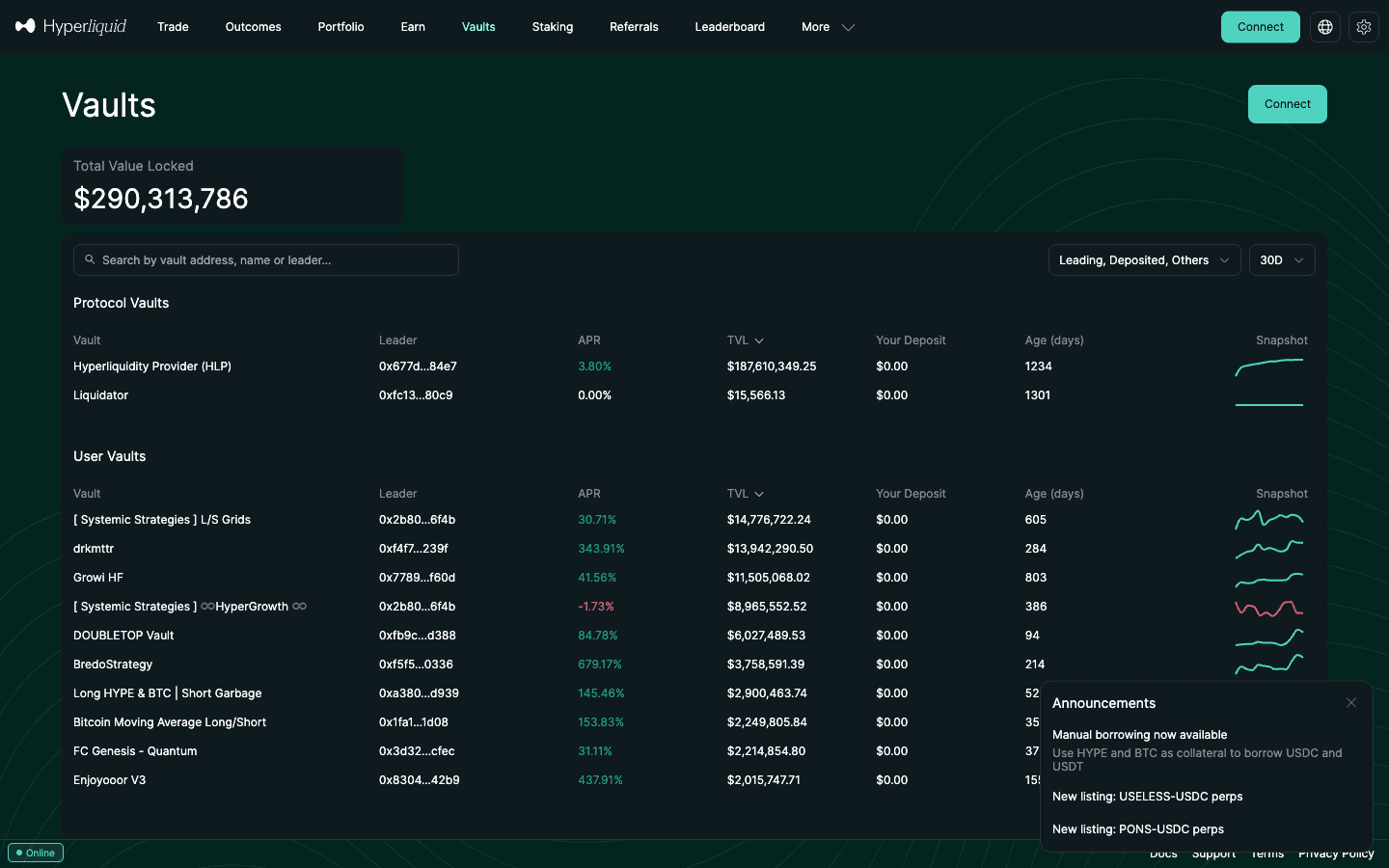
app.hyperliquid.xyz/vaults (September 2026) — protocol vaults on top, user vaults sorted by TVL below. The APR column is the number most people look at first and should be the number they trust least.
2. Top 10 Hyperliquid vaults right now: dollar PnL and deposits
The table at the top of this page ranks the ten largest open user vaults on October 20, 2026 by TVL, with the app’s APR, our 30-day return and the leader’s stake. HLP, the protocol vault, is left out because it is a different product (next section). Here are the raw dollar results the vault list does not show, and whether the leader currently accepts new money (a leader can switch deposits off at any time):
Largest Hyperliquid user vaults by TVL: PnL in USDC (October 20, 2026)
Vault
TVL
30-day PnL
All-time PnL
Deposits
Growi HF
$13.6M
+$113,872
+$3M
Closed
[ Systemic Strategies ] L/S Grids
$9.9M
−$2.1M
+$1.1M
Open
drkmttr
$8.7M
−$4.6M
+$5.3M
Open
DOUBLETOP Vault
$6.8M
−$142,250
+$505,463
Open
BredoStrategy
$6.2M
−$31,550
+$3.1M
Open
[ Systemic Strategies ] ♾️ HyperGrowth ♾️
$5.8M
−$788,325
+$5.6M
Open
Long HYPE & BTC | Short Garbage
$2.4M
−$357,334
+$2.2M
Closed
FC Genesis - Quantum
$2.4M
−$120,822
−$440,492
Open
Bitcoin Moving Average Long/Short
$2.3M
−$18,943
−$378,425
Open
Enjoyooor V3
$1.9M
−$396,239
+$834,346
Closed
Source: stats-data.hyperliquid.xyz vault list (TVL, APR, PnL, creation time) and api.hyperliquid.xyz vaultDetails (leader's share, whether deposits are allowed, the 30-day series behind the 30-day return), read October 20, 2026. Ranked by TVL, not by quality.
What the tables say on October 20, 2026: 8 of the ten had positive all-time PnL and 1 were up over the past 30 days in dollars. Leaders held between 5.0% and 52.0% of their own vaults; 5 of the ten sat below 10%, close to the 5% minimum, which means depositors' money carries most of the risk. 3 of the ten were not accepting new deposits, so you can only watch them. The app's APR does not document its window and does not match a simple 30-day annualisation, which is why we show a 30-day return next to it: when the two disagree, read the vault's PnL chart. A high APR next to a short age is a hot month extrapolated to twelve; section 5 explains what to check before you trust any row. This is a list of the largest vaults, not a list of recommendations.
Depositing needs a Hyperliquid account: open it with HOLYGRAIL first
Vaults open to deposits take them from a funded Hyperliquid account. Enter code HOLYGRAIL when you open it, because a code cannot be added after $10,000 of volume. It does not change vault returns (referral discounts do not apply inside vaults); it takes 4% off your own trading fees on the first $25M.
3. Hyperliquid HLP: what it is, APR history, drawdowns
What it is: HLP (Hyperliquidity Provider) is Hyperliquid's own protocol vault. It runs the exchange's market-making strategies, takes over liquidations, supplies USDC to Earn and receives part of trading fees. It is community-owned, charges depositors nothing and locks each deposit for 4 days. APR: there is no fixed rate; on October 20, 2026 the app showed 3.5% on $179.1M of TVL, and over the last 103 days HLP returned 3.40% a year on average (window by window below). Drawdowns: it can and does lose money when a large position is liquidated into it at a bad price (about $4M in one day in March 2025), its liquidator can be targeted in thin markets, and you cannot leave during the lock-up.
HLP is not an AMM curve; it is a set of active strategies with their own accounts that post and cancel limit orders on the book like any professional market maker. The parent HLP vault holds the aggregate; its components are child vaults you can see in the app and the API:
HLP component (October 20, 2026)
Account value
Role
HLP parent account
$39.3M
Direct perp account of the parent vault
HLP Strategy X
$100.6M
Market-making strategy
HLP Liquidator 2
$30M
Backstop liquidations
HLP Strategy A
$3.2M
Market-making strategy
HLP Strategy B
$3M
Market-making strategy
HLP Liquidator 4
$1M
Backstop liquidations
HLP Liquidator 3
$1M
Backstop liquidations
HLP Liquidator
$999,999
Backstop liquidations
The child vaults add up to $139.7M; together with the parent's own account that is the $179.1M shown as HLP's TVL. Four income streams feed depositors:
Market-making PnL. Spread captured across Hyperliquid's perp markets, net of adverse selection and inventory losses. This is the largest and most variable component.
Backstop liquidations. Positions that fall below two-thirds of maintenance margin are taken over by the liquidator vault, a component strategy of HLP. The docs note these are profitable on average (the trader's maintenance margin is not returned); on most venues that flow goes to the operator. See the liquidation and insurance guide.
A portion of trading fees. The fee docs say fees go entirely to the community — "HLP, the assistance fund, and deployers" — without publishing a split. On-chain, the assistance fund clearly takes the bulk: in the week to September 26, 2026 it spent $16.3M of USDC buying HYPE, while HLP's entire PnL for that week, fees included, was $172,498.
Earn. The vault supplies USDC to Hyperliquid Earn.
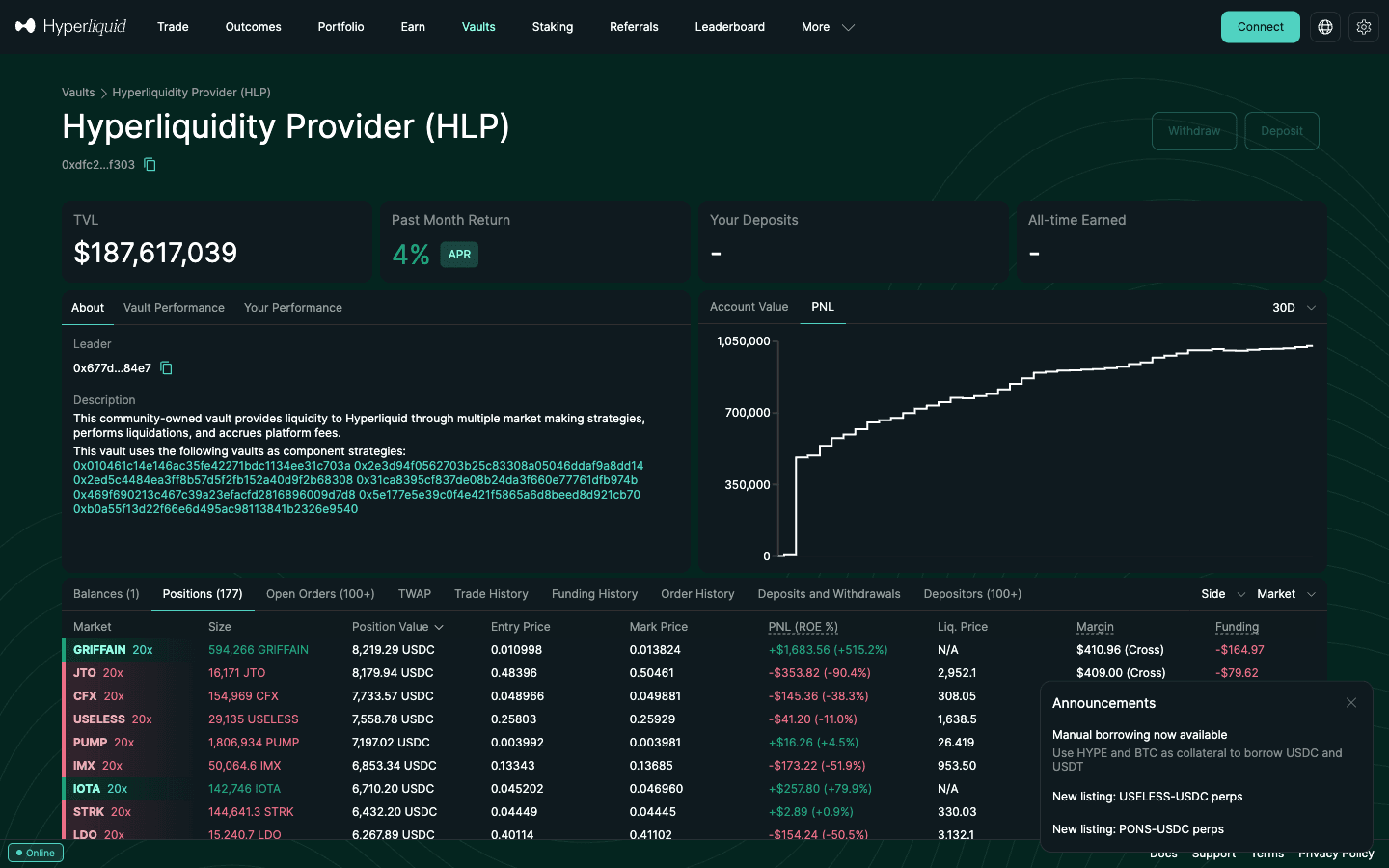
The HLP vault page (September 2026). TVL, past-month return and APR are at the top; the Vault Performance tab shows the account value and PnL history you should actually read.
HLP APR history: the last 90 days
The app shows only today's APR. To see how HLP's return actually moves, we annualise each window of its own account-value and PnL history (the API keeps one sample about every two weeks; the table starts at the last sample before the 90-day mark, so it covers 103 days, and the last window ends at the build):
HLP APR and TVL, last 103 days (to October 20, 2026)
Window (UTC)
TVL at end
HLP PnL
Annualised
Jul 8 – Jul 22
$247.4M
+$8,181
0.08%
Jul 22 – Aug 5
$216.1M
+$74,834
0.84%
Aug 5 – Aug 19
$186.3M
+$223,354
2.89%
Aug 19 – Sep 2
$189.2M
+$749,100
10.40%
Sep 2 – Sep 16
$187.5M
+$268,774
3.72%
Sep 16 – Sep 29
$183M
+$262,645
3.98%
Sep 29 – Oct 12
$181.5M
+$201,915
3.20%
Oct 12 – Oct 20
$179.1M
+$162,342
4.36%
Jul 8 – Oct 20 (103 days)
$179.1M (−31%)
+$2M
3.40%
Annualised = PnL in the window ÷ the average of opening and closing TVL × 365 ÷ days (the whole-period row uses the time-weighted average TVL). Our calculation from api.hyperliquid.xyz vaultDetails (HLP allTime series), read October 20, 2026. For comparison, the app's own APR on October 20, 2026: 3.5%.
Over these 103 days the windows ranged from 0.08% to 10.40% annualised while TVL moved down 31%, from $258.4M to $179.1M. For scale, the two crash fortnights of October 2025 and early February 2026 added $41.4M and $18.8M on their own: those two fortnights alone are 43% of HLP's all-time profit (below).
HLP rules that matter to a depositor
No fee and no profit share — you receive 100% of your pro-rata PnL.
4-day lock-up from your most recent deposit. Deposit on September 14 at 08:00 and you can withdraw from September 18 at 08:00. Topping up restarts the clock for the whole balance.
Returns are USDC-denominated. HLP is not a bet on HYPE or on crypto going up; it is a bet on Hyperliquid's trading activity and on its strategies' edge.
Withdrawals can carry slippage if open positions have to be reduced to free your margin.
HLP does not backstop HIP-3 markets. Each builder-deployed perp DEX has its own onchain backstop liquidator that falls back to auto-deleveraging (HIP-3 docs).
HLP APY today, and how its returns actually arrive
The number people search for as "HLP APY" is the APR on the vault page. It is not a promised rate: it is recent performance annualised, and it is the only return: HLP deposits earn no points, and the 2023–24 points program behind the Hyperliquid airdrop has ended. Hyperliquid does not document the window; as a cross-check, the past 30 days' PnL annualised on the starting balance gives 4.18%, in the same range as the displayed 3.5%. Here is what HLP actually earned, from the same API the app uses:
HLP PnL (October 20, 2026)
USDC
Past 24 hours
+$27,256
Past 7 days
+$147,815
Past 30 days
+$612,769
All time (since May 10, 2023)
+$138.8M
Three facts from HLP's full history (our aggregation of the vaultDetails all-time series, sampled about every two weeks since May 2023) explain why the APR alone misleads:
Returns come in bursts. HLP's PnL rose $41.4M in the two weeks around the October 10, 2025 crash and $18.8M in the two weeks to February 4, 2026. Those two fortnights are 43% of everything it has made since launch. Between crashes, returns are thin: from February 4, 2026 to October 20, 2026, HLP's cumulative PnL changed by just +$766,381, with losing and winning months cancelling out. That is why the APR can sit in low single digits for months and then spike.
TVL is well off its peak. HLP peaked at about $603.9M in early September 2025; at $179.1M it is roughly 70% lower. Deposits chase the APR after a good month and leave in quiet ones, so your share of the next burst depends on how much capital is sitting in the vault when it happens.
Crash profits are the flip side of the risk. The same liquidation flow that made HLP money in October 2025 is what cost it money when a single account was liquidated into it at a bad price (below).
If you want an HLP APY estimate, the honest one is a range: low single digits in quiet months, much more in months with a liquidation cascade, and an occasional loss. Size the position for the quiet months.
Drawdowns: can HLP lose money? Every HLP incident, dated
Yes. "Market-neutral" does not mean "cannot lose", and Hyperliquid's own docs warn that trading is inherently risky and that vaults' past performance is no guarantee of future returns. The table below lists every known HLP incident and every large move in its PnL history. The last column is the change in HLP's cumulative PnL over the API sample window that contains the date (usually two weeks; one week in early March 2025) — so it nets the incident against everything else HLP did in that window.
Date
What happened
Official statement
HLP PnL over the surrounding API sample window
Mar 12, 2025
ETH whale: a trader withdrew unrealised profit from a huge ETH long, lowering its margin, and was then liquidated into HLP
Hyperliquid: “no protocol exploit or hack”; HLP lost ~$4M in 24 hours. Max leverage then cut to 40x BTC / 25x ETH
−$4M (Mar 5–12, 2025)
Mar 26, 2025
JELLY: a thin market was pumped after a large short was pushed onto the liquidator strategy
Validators voted to delist JELLY perps; users apart from flagged addresses made whole by the Hyper Foundation, longs settled at $0.037555
+$1.2M (Mar 12–26, 2025)
Oct 10, 2025
Market-wide crash and liquidation cascade
None (market-wide move)
+$41.4M (Oct 1–15, 2025)
Nov 12, 2025
POPCAT: the largest drop in HLP’s sampled history; security firm Halborn attributes it to a coordinated POPCAT manipulation
No official loss figure we could verify
−$4.7M (Oct 29–Nov 12, 2025)
Late Jan 2026
Sharp crypto sell-off into early February
None (market-wide move)
+$18.8M (Jan 21–Feb 4, 2026)
Apr 2026
Unexplained losing fortnight
No official statement found
−$2.3M (Apr 1–15, 2026)
Two lessons. First, the losing windows have been small next to HLP's $138.8M all-time profit — since 2024 no sampled fortnight has cost more than 1% of the TVL at the time (the worst, November 2025, about 0.8%). Second, the worst-case outcome was avoided by intervention, not by design: in the JELLY episode the unrealised loss on the inherited short grew sharply before validators delisted the market and settled it. HLP's PnL for that fortnight ended positive, but the fix was a governance decision. If you deposit, you are also trusting that process.
4. User vaults: the rules from the official docs
User vaults are where the "hyperliquid vaults explained" question gets interesting, because the leader is a stranger. Hyperliquid's rules are short and strictly enforced by the chain:
Rule
Detail
Leader's cut
10% of profits, taken on your gain when you withdraw. No management fee, nothing on losses.
Skin in the game
Leader must hold ≥ 5% of the vault at all times; a withdrawal that would break this is rejected.
Lock-up
1 day after your most recent deposit. The docs describe no leader-set or longer lock-ups.
Creation cost
10,000 USDC fee (distributed like trading fees) plus a 100 USDC minimum deposit. Name and description are permanent.
Tradeable markets
Validator-operated perps only — no spot, no HIP-3 markets.
Custody
The leader can trade the balance but cannot withdraw depositors' funds.
Closing
Leader must flatten every position, then Leader Actions → Close Vault; depositors receive their share automatically.
The 10% profit share, worked through
The docs' own example is the clearest. You deposit 100 USDC into a vault already holding 900 USDC, so you own 10% of a 1,000 USDC vault. Nobody else moves money and the vault grows to 2,000 USDC. Your share is now 200 USDC; the leader takes 10% of your 100 USDC gain, so you withdraw 190 USDC. Three consequences: the leader earns nothing on a losing period; the fee is on your gain since your deposit, so a vault up 300% lifetime but flat since you joined costs you nothing; and because the leader holds at least 5%, a 20% drawdown costs them a fifth of their own stake as well. Some third-party guides describe a high-water mark or end-of-day pricing; the official docs describe neither — the rule is simply 10% of your gain at withdrawal.
5. Hyperliquid vault APR (APY): what the number means and what it hides
The APR column on the vault list is annualised from recent performance. That makes it useful for HLP, whose returns are relatively smooth outside crash weeks, and close to meaningless for a young, leveraged user vault. The top-10 table puts it next to a 30-day return, and section 2 next to the dollar PnL the list does not show.
Read the table as a warning, not a menu of the "best Hyperliquid vaults". The highest displayed APR among the ten is 9.9%, against 3.5% for HLP — that is a hot month extrapolated to twelve, and it says nothing about the drawdown risk that produced it. Across the 73 user vaults holding at least $100,000, 44 showed a negative APR and 23 had negative all-time PnL on October 20, 2026. What to look at instead:
Account value and PnL charts on the vault page, over the longest window available, and the max drawdown the vault page reports. A vertical line up followed by a cliff is not a strategy.
Past Month Return next to APR — the app shows both, and the gap between them tells you how much of the APR is extrapolation.
Positions tab: how many markets, what leverage, how much unrealised loss is sitting in the book right now.
Age and depositor tenure: the page shows how long depositors have stayed. A vault that kept its depositors for 600 days through a drawdown has been stress-tested; one that is three months old has not.
Leader history: paste the leader address into an explorer to see their own trading and past vaults.
Is the vault's % my return?
Only if you were in for the whole window and the vault charges nothing. The APR and all-time PnL describe the account, not you. Your figure is the change in the vault's value between your deposit and your withdrawal, minus the leader's 10% of any gain. A vault that rose 20% while you were in pays you about 18%; one that rose before you arrived pays you nothing for it. The Your Performance tab on each vault page shows your own number.
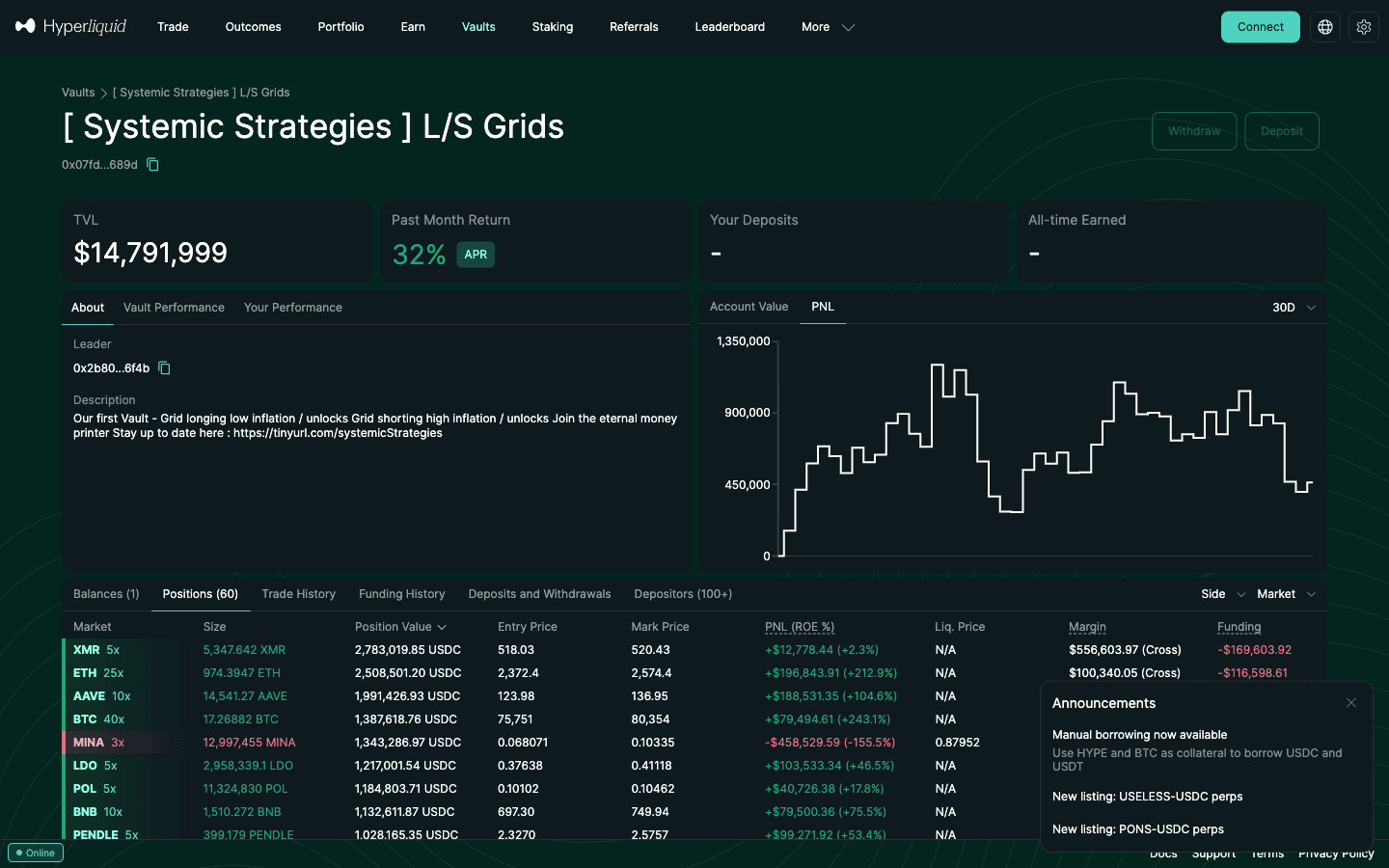
A user vault page (September 2026). Everything you need is here — description, leader address, account value chart, positions, trade history, depositors — and none of it is curated by the leader.
6. How to deposit into a Hyperliquid vault (4 steps)
Open and fund a Hyperliquid account.Sign up with code HOLYGRAIL (enter it now: it cannot be added after $10,000 of volume), then deposit USDC from Arbitrum, Ethereum, Base or Polygon, or send BTC, ETH, SOL or another supported asset and sell it for USDC on spot. Trading and vault actions on HyperCore are gas-free; you pay only source-chain gas on the way in. Details in the Hyperliquid deposit guide.
Pick a vault at app.hyperliquid.xyz/vaults (Vaults in the top navigation; protocol vaults first, user vaults below, sortable by APR, TVL and age) and read its page in the order given in section 5: for HLP the account-value chart over the longest window, for a user vault positions, drawdown and age first.
Click Deposit, enter the USDC amount and confirm. It is a gas-less signature. Your share appears immediately under Your Performance on the vault page and in the Portfolio page's vault balance.
Note the unlock time, then withdraw when you want out. One day for user vaults, four for HLP, counted from this deposit and reset by any later deposit. After that, Withdraw on the vault page returns USDC to your perps account.
Withdrawing, and what happens to open positions
After the lock-up, click Withdraw on the vault page, enter the amount and confirm; USDC returns to your perps account (moving it off Hyperliquid to Arbitrum then costs 0.2 USDC plus a tiny gas fee). The docs spell out what happens inside the vault. If there is enough free margin to keep the open positions at their set leverage, nothing changes. If not, open orders that use margin are cancelled first, smallest margin first. If that is still not enough, 20% of positions are closed at market, repeatedly, until your withdrawal can be paid. Leaders can alternatively set the vault to always close positions proportionally so liquidation prices stay put. Either way, one large withdrawal during a drawdown forces the vault to realise losses — which is why big depositors leaving hurts the people who stay.
Vaults need a funded Hyperliquid account
Open it with code HOLYGRAIL: 4% off your own trading fees on the first $25M of volume. The discount does not touch vault PnL — it lowers what you pay when you trade yourself.
A vault page shows performance, not risk. These are the ways depositors lose money, which vaults each applies to, and what has actually happened (dates and amounts from Hyperliquid's statements and the API):
Risk
Applies to
What happens
On record / the rule
Leader trading loss
User vaults
Every loss passes to depositors pro rata; the leader shares it only through their own stake (at least 5%)
October 20, 2026: 7 of the ten largest vaults were down over 30 days; 23 of the 73 vaults above $100k had negative all-time PnL
Leader with little skin in the game
User vaults
The leader earns 10% of your profit but risks only their own share
October 20, 2026: 5 of the ten largest had a leader holding under 10%
Liquidation of the vault
All vaults
A vault is one cross-margined account: if it is liquidated, every depositor takes the loss
The docs describe no depositor protection beyond the leader’s minimum stake
A liquidated whale lands in HLP
HLP
The liquidator inherits a large position at a bad price
Mar 12, 2025: about $4M lost in 24 hours (ETH whale; Hyperliquid: “no protocol exploit or hack”)
Thin-market manipulation
HLP
Someone pushes an illiquid market after parking a position on the liquidator
Mar 26, 2025: JELLY, settled by a validator vote to delist. Oct 29–Nov 12, 2025: HLP PnL −$4.7M, which Halborn attributes to POPCAT manipulation
Lock-up
HLP and user vaults
You cannot withdraw until the lock-up ends, and every new deposit restarts it for the whole balance
HLP 4 days, user vaults 1 day after your last deposit (docs)
Forced closes on withdrawal
All vaults
If the vault lacks free margin, margin-using orders are cancelled, then 20% of positions are closed, repeatedly
Rule (docs); one large exit in a drawdown realises losses for everyone who stays
Platform risk
All vaults
Your USDC sits on HyperCore, secured by Hyperliquid’s own validator set
Not an Ethereum-verified rollup
No fee discounts
All vaults
Referral and staking discounts do not apply inside a vault; it pays fees at its own tier
The 4% HOLYGRAIL discount applies to your own account only
Two risks no table captures. Strategy drift: a vault's description cannot be edited, but its behaviour can change, so a "BTC swing" vault now holding dozens of altcoin positions is a different product from the one you joined. Survivorship: closed vaults drop off the list, so the vaults you see look better than the odds you face. Size any vault deposit as a leveraged trade you do not control.
8. HLP vs user vaults vs trading yourself
HLP
User vault
Your own account
Who trades
Hyperliquid’s own market-making and liquidation strategies
The vault leader (a trader or a bot)
You
Fee / profit share
None
10% of your profits, paid to the leader
Trading fees only (0.045% / 0.015% base)
Lock-up after each deposit
4 days
1 day
None
Markets
All validator-operated perps, liquidations, USDC in Earn
Validator-operated perps only (no spot, no HIP-3)
Perps, spot, HIP-3
Leader’s own stake
Community-owned
At least 5% of the vault, enforced
100%
Referral / staking discounts
Do not apply
Do not apply
Apply — 4% off with HOLYGRAIL
Return driver
Spread capture, liquidations, fee share
Leader’s trading
Your trading
Which one should you use?
You hold idle USDC on Hyperliquid and want exposure to the exchange's activity rather than to price direction → HLP. Accept the 4-day lock and a return that varies from month to month; size it so a losing month does not matter.
You want a specific trader's strategy and can read their positions → a user vault, treated as one leveraged position with a fixed cap (many traders use 10–25% of trading equity across two or three vaults with different styles). Prefer vaults older than a year whose depositors have stayed.
You want a fixed yield → neither. There is no fixed rate anywhere in the vault system. Compare HYPE staking (HYPE-denominated, 7-day unstake, fee discounts) or the wider DEX passive-income options.
You trade actively yourself → the cheapest improvement is usually reducing your own fees before chasing vault yield: join with a referral code and stake HYPE. See the fee guide and the HOLYGRAIL referral code page.
9. HLP vs other protocol vaults: Lighter LLP, Jupiter JLP, GMX GLV
Other perp DEXs have their own "house" pools, and they are not the same product. HLP and Lighter's LLP are actively managed USDC vaults that make markets and absorb liquidations; Jupiter's JLP and GMX's GLV are liquidity pools that act as the counterparty to every trader and hold volatile tokens, so their value also moves with SOL, ETH or BTC.
HLP
Lighter LLP
Jupiter JLP
GMX GLV
Exchange / chain
Hyperliquid (HyperCore)
Lighter
Jupiter Perps (Solana)
GMX (Arbitrum, Avalanche)
Deposit
USDC
USDC — needs staked LIT (up to 10 USDC per LIT)
SOL, ETH, wBTC, USDC or USDT → JLP token
Pool tokens (e.g. WETH + USDC) → GLV token
How it earns
Active market making, backstop liquidations, a share of fees, Earn
75% of trading, swap and mint/burn fees; counterparty to traders
63% of trading, liquidation, borrow and swap fees; counterparty to traders
Price exposure
USDC-denominated
USDC deposit; mostly perp strategies
Yes — pool holds SOL, ETH, BTC
Yes — pool holds the long token
Lock-up
4 days
None per docs (the app shows a short cooldown)
None (token)
None (token)
Fee to depositors
None
None (operator fee 0%)
Mint/burn fees
Buy/sell price impact
If you want an HLP-style vault on a second venue, Lighter's LLP is the closest match — USDC in, market making and liquidations out, no lock-up in the docs — with the catch that you must stake LIT to get deposit capacity. Our Lighter LLP and staking guide has its dated returns and walks through it; you can open Lighter with our referral link. For JLP and GLV, the fee share is higher on paper but you also carry the pool's token exposure and trader PnL — see Hyperliquid vs Jupiter and Hyperliquid vs GMX.
10. Running your own vault
Anyone can lead a vault: choose a permanent name and description, deposit at least 100 USDC and pay the 10,000 USDC creation fee. On the trade page you switch the address dropdown from "Master" to the vault and trade on its behalf. You must keep at least 5% of the vault at all times, you can only trade validator-operated perps, and you close the vault by flattening every position and choosing Leader Actions → Close Vault. With a 10,000 USDC entry cost this is for traders who already have a track record or an audience; the 2,578 sub-$1,000 vaults on the list are what happens when it is treated as a side project. Firms that manage money for clients should read our desk and institutional setup guide first: it covers multi-sig custody, sub-accounts and the legal terms.
Trade your own account with 4% lower fees
Vault deposits do not get the referral discount — your own trading does. Open Hyperliquid with code HOLYGRAIL for 4% off your first $25M of volume, then browse the Vaults tab from inside the app.
It removes single-trader risk, but it is not risk-free. No individual leader controls it, it charges no fee, and its losses so far have been small next to its $138.8M all-time profit: about $4M in a day in March 2025, and $4.7M in the two weeks to November 12, 2025. But its liquidator can inherit bad positions in thin markets (the JELLY episode in March 2025 ended with a validator vote, not by design), you cannot withdraw for 4 days after each deposit, and your USDC carries Hyperliquid’s own platform risk. Over the 103 days to October 20, 2026 it returned 3.40% a year on average. Size it as money you can leave locked through a crash.
Can HLP lose money?
Yes. It lost about $4M in 24 hours in March 2025 when an ETH whale was liquidated into it, and its PnL fell $4.7M in the two weeks to November 12, 2025. Hyperliquid’s docs themselves warn that trading is inherently risky and past performance is no guarantee of future returns. So far every drawdown has been small next to its $138.8M all-time profit, but past results are not a floor.
What is the HLP APY right now?
HLP has no fixed rate. The app shows an APR annualised from recent performance; on October 20, 2026 it read 3.5% on $179.1M of TVL, and HLP made +$612,769 over the past 30 days. Over the last 103 days its two-week windows ranged from 0.08% to 10.40% annualised (3.40% on average). Its return arrives in bursts: 43% of its all-time PnL came in two fortnights around the October 2025 and early-2026 crashes, so a quiet month says little about the next one.
What is the minimum deposit for a Hyperliquid vault or HLP?
The depositor docs set no minimum for HLP or user vaults; you need USDC in your Hyperliquid perps account (the exchange’s minimum deposit is 5 USDC). Only vault leaders have minimums: at least 100 USDC of their own money and a 10,000 USDC creation fee.
What fees do Hyperliquid vaults charge? How does the 10% profit share work?
HLP charges nothing. A user vault charges no management or deposit fee; the leader takes 10% of your gain, measured from your own deposit, when you withdraw. Deposit 100 USDC into a 900 USDC vault, watch it double to 2,000 USDC, and you receive 190 USDC: your 200 USDC share minus 10 USDC to the leader. Nothing is charged on losses or on a flat period, and protocol vaults such as HLP charge nothing at all.
What is a vault on Hyperliquid?
A vault is a Hyperliquid trading account owned by many depositors. One address (the leader, or the protocol for HLP) trades it; each depositor owns a share proportional to what they put in and gains or loses with the account. HLP is the protocol’s own vault with no fee and a 4-day lock-up; user vaults are run by traders who take 10% of depositors’ profits and lock deposits for 1 day.
What are the best Hyperliquid vaults?
There is no official ranking and no vault that is best for everyone. By size, the largest user vaults on October 20, 2026 were Growi HF, [ Systemic Strategies ] L/S Grids and drkmttr. Of the ten largest, 8 had positive all-time PnL, 1 were up over the past 30 days, and leaders held 5.0% to 52.0% of their own vaults. 3 of the ten were not taking new deposits. Three filters screen out the most obvious red flags: older than a year, positive all-time PnL, and a leader holding well above the 5% minimum (we use 10%). On October 20, 2026, [ Systemic Strategies ] ♾️ HyperGrowth ♾️ passed all three among the ten largest and was open to deposits; that is a starting point for reading positions and drawdowns, not a recommendation. If you want exposure to the exchange itself rather than to one trader, HLP charges no fee and locks for 4 days.
Are Hyperliquid vaults safe?
They are as safe as the strategy inside them. Hyperliquid enforces the rules — the leader cannot withdraw your USDC, must keep at least 5% of the vault, and every position is public — but nothing stops a leader from losing the money by trading. HLP carries market-making and liquidation risk instead of a single trader’s risk. Treat any vault deposit as a leveraged trade you are not controlling, and size it that way.
How much of Hyperliquid’s trading fees go to HLP?
The docs say fees go entirely to the community — HLP, the assistance fund and deployers — but publish no split. On-chain data shows most goes to the assistance fund: in the week to September 26, 2026 it spent $16.3M buying HYPE, while HLP’s entire PnL that week was $172,498. Treat HLP as a market-making and liquidation vault, not a fee-sharing product.
Does HLP backstop HIP-3 markets?
No. Per the HIP-3 docs, each builder-deployed perp DEX has its own onchain backstop liquidator that takes over its liquidatable positions and falls back to auto-deleveraging. HLP’s liquidator covers the validator-operated perps.
If a vault shows +20%, is that my return?
Not necessarily. The vault’s figures are for the whole account over a window (APR is annualised). Your result depends on when you deposited, and in a user vault the leader takes 10% of your gain. If the vault grew 20% between your deposit and your withdrawal, you keep about 18%; if it gained before you joined, none of that is yours. Check Your Performance on the vault page for your own number.
How long is my money locked in a Hyperliquid vault?
User vaults lock for one day after your most recent deposit; HLP locks for four days. Every new deposit restarts the clock for the whole balance. The docs mention no longer lock-ups set by leaders. After the lock-up you can withdraw at any time, subject to positions being reduced if the vault lacks free margin.
What happens if the leader closes the vault?
The leader must close every position first, then choose Leader Actions → Close Vault. All depositors automatically receive their share of the vault in USDC. A leader cannot take depositors’ funds, and cannot withdraw their own stake below the required minimum while the vault is open.
Does depositing in HLP earn points or an airdrop?
Not today. Hyperliquid’s docs describe points programmes that ran from November 1, 2023 until November 2024 and no current one; nothing rewards HLP deposits with points, and no future airdrop is promised. Deposit for HLP’s PnL, not for speculation on rewards.
Does the HOLYGRAIL referral discount apply inside vaults?
No. The 4% referral discount and HYPE staking discounts apply to your own trading account only. A vault pays fees at its own tier and that cost is already inside the PnL you see on the vault page.
Is depositing into HLP the same as staking HYPE?
No. HLP is a USDC deposit that earns from market making, liquidations and fee share, locked for 4 days. Staking HYPE earns HYPE emissions, has a 7-day unstaking queue, exposes you to the HYPE price, and cuts your own trading fees by 5–40%. Many traders hold both; they are different bets.
How are Hyperliquid vault profits taxed?
It depends on where you live, and few tax authorities say anything about vaults specifically. Hyperliquid issues no tax forms, so keep a record of every deposit, withdrawal and the PnL shown under Your Performance (the Portfolio page or an explorer has the history) and ask a local tax adviser.
Disclosure: HOLYGRAIL is our Hyperliquid referral code and we also link to Lighter with our referral; we earn a share of referred accounts' trading fees. Vault rules (profit share, lock-ups, withdrawal handling, creation cost) are from Hyperliquid's official documentation (re-read October 19, 2026); TVL, APR, PnL and vault counts come from the public API at build time and change constantly; HLP history figures are our own aggregation of the API's all-time series. Vaults can lose money; nothing here is investment advice.