
Short answer
- Insurance fund: Hyperliquid has no separate one. The liquidator vault, a strategy inside the community-owned HLP vault ($179.1M on October 20, 2026), takes over positions that drop below 2/3 of maintenance margin without closing on the order book.
- ADL: if an account or isolated position still goes negative, opposite-side traders are ranked by (mark price ÷ entry price) × (position notional ÷ account value), so the biggest winners on the most leverage go first, and are closed at the previous mark price.
- Were you ADL’d? In Trade History the fill reads “Auto-Deleveraging”, not “Market Order Liquidation” or “Backstop Liquidation”; the API’s fill
dirfield says the same (how to check).
Trading on Hyperliquid? Open an account with code HOLYGRAIL for 4% off your fees on the first $25M of volume. We earn a commission when you sign up through our links; it never raises your fees.
The waterfall in short. 1) Equity below maintenance margin (1.25% for BTC, 2% for ETH, up to 16.7% for 3x assets): market orders go to the book, and you keep what is left. 2) Below 2/3 of maintenance margin: backstop. The position goes to HLP’s liquidator and you lose the maintenance margin as well. 3) Negative equity: ADL against the most profitable, most leveraged opposite positions. The profit from backstops goes to HLP depositors, not to the exchange. HLP carries real risk: it has had losing strategies, the JELLY episode in March 2025, and ADL ran on October 10, 2025. On Lighter the LLP plays the same role; Aster uses a classic exchange insurance fund plus an on-screen ADL gauge (section 9).
1. Hyperliquid ADL: when it happens and who gets closed
Auto-deleveraging (ADL) is the last stage of Hyperliquid’s liquidation waterfall. In the docs’ words it “strictly ensures that the platform stays solvent”. It runs only when an account’s value, or an isolated position’s value, becomes negative: by then a market liquidation on the book and the HLP backstop have both failed to close the position before its equity went below zero. Someone still has to take the other side of that loss, so the engine picks traders on the opposite side, ranked by:
(mark price ÷ entry price) × (position notional ÷ account value)
If a short account goes bankrupt, the counterparties are longs. The more a long is in profit (a high mark/entry ratio) and the more leverage it runs (high notional per dollar of account value), the earlier it is closed. Closed positions are settled at the previous mark price. You keep the profit up to that price, but lose the position and any further move. Backstop-liquidated positions get no special treatment in the queue, and a user with no open positions never socializes losses.
| Hyperliquid ADL at a glance | |
|---|---|
| Trigger | Only when an account’s value, or an isolated position’s value, becomes negative, i.e. the book liquidation and the HLP backstop both failed to close it in time |
| Who is in the queue | Traders with open positions on the opposite side. An account with no open positions never shares losses |
| Ranking | (mark price ÷ entry price) × (position notional ÷ account value): biggest profit × highest leverage goes first |
| Close price | At the previous mark price, not the bankrupt account’s price; you keep the profit up to it |
| Fee or penalty | None documented. It is a forced close, not a liquidation of your account |
| Where it shows | Trade History direction “Auto-Deleveraging”; the same value in the fill’s dir field on the API |
| How to move down the queue | Lower effective leverage, realize part of a big winner, keep speculative legs isolated |
From Hyperliquid’s Auto-deleveraging and Liquidations docs and the app’s trade-history labels, re-checked October 15, 2026.
ADL is not a fee or a penalty. It is a forced close at a fair price. The real cost is being taken out of a winning trade at the worst moment, for example during a cascade when you would have liked to hold. It is rare in normal markets, but it ran at scale on October 10, 2025 (section 6). A worked ranking example, and how Lighter and Aster order their queues: section 9.
How to check if you were auto-deleveraged on Hyperliquid
- Trade History tab: an ADL fill shows “Auto-Deleveraging” as its direction. The app attaches this explanation: “Your position was auto-deleveraged because the opposite side could not be liquidated.” Your own liquidations look different: “Market Order Liquidation” (sent to the book) or “Backstop Liquidation” (taken over by HLP at a clearance price).
- API: the same fill returned by the
userFillsinfo request has itsdirfield set to “Auto-Deleveraging”, the value the app reads to apply that label. A liquidation of your own position instead carries aliquidationobject withmethod“market” for a book liquidation, “backstop” for an HLP takeover (details below). - Your PnL: the fill closes at the previous mark price, so its closed PnL is the profit up to that price. Nothing stops you from reopening the trade straight away.
Trade where liquidations go to an open book
No liquidation clearance fee, 178 perp markets (as of October 20, 2026), fees that flow back to HLP and the HYPE assistance fund. Sign up with referral code HOLYGRAIL for 4% off fees on your first $25M.
We earn a commission when you sign up through our links; it never raises your fees.
2. What an insurance fund does on a perpetuals exchange
A leveraged position is liquidated when its equity falls below the maintenance margin. If the engine can close it before equity reaches zero (the bankruptcy price), the trader keeps the rest. If prices gap or the book is thin, the close happens beyond bankruptcy and a deficit appears. The winners on the other side still have to be paid in full. On centralized exchanges such as Binance and Bybit, that deficit is covered by an exchange-run insurance fund, which is filled partly by the liquidation (clearance) fees taken from liquidated traders. When it is not enough, the exchange falls back on auto-deleveraging. Hyperliquid solves the same problem, but the backstop is a vault anyone can deposit into, and the ordinary liquidation charges no fee.
3. Hyperliquid’s liquidation waterfall
| Stage | Trigger | What happens | Other side |
|---|---|---|---|
| 1. Book liquidation | Account equity < maintenance margin | Full-size market orders go to the order book. Positions over 100,000 USDC are first sent 20% at a time; for the 30 seconds after a partial liquidation, any further liquidation order is for the whole position. Whatever collateral is left stays with you. No clearance fee. | Any trader with resting orders |
| 2. Backstop liquidation | Equity < 2/3 of maintenance margin and the book has not closed it | Cross: all cross positions and cross margin move to the liquidator. Isolated: only that position and its margin. The maintenance margin is not returned. | The liquidator strategy inside HLP |
| 3. Auto-deleveraging (ADL) | An account or isolated position has negative value | Opposite-side positions are ranked and closed at the previous mark price against the underwater account, so the platform has no bad debt. | Profitable, leveraged traders on the other side |
From the official Liquidations and Auto-deleveraging pages, re-checked October 15, 2026 (unchanged since our September 25, 2026 read).
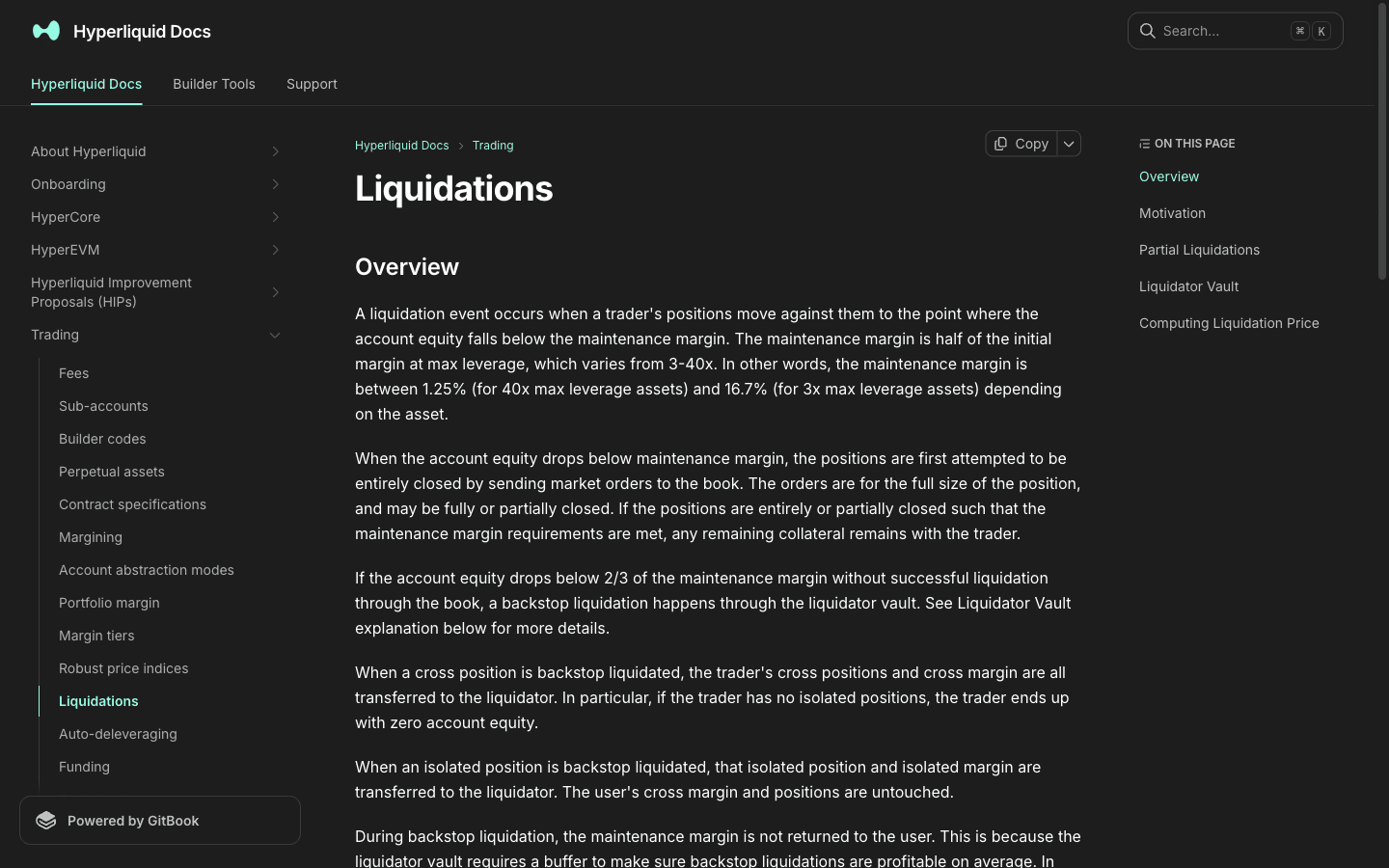
Key details from the docs:
- Maintenance margin is half of the initial margin at the asset’s maximum leverage: 1.25% for BTC (40x), 2% for ETH (25x), 2.5% for SOL (20x), 5% for 10x alts and 16.7% for 3x assets. Assets with margin tiers step up above set notional sizes. Isolated or cross changes which collateral is at risk: Hyperliquid cross vs isolated margin.
- Mark price, not last trade. Liquidations use the mark price, a median of Hyperliquid’s book, the oracle plus a 150-second EMA and external perp prices, updated about every 3 seconds. The docs warn that in volatile markets the mark can differ “significantly” from the book price. How the three prices relate: mark price vs last price vs index price.
- Liquidation profit goes to users. “On most venues, this profit goes to the exchange operator or privileged market makers who internalize the flow. On Hyperliquid, the pnl stream from liquidations go entirely to the community through HLP.”
- Liquidating flow is open to everyone. If your resting order fills against a liquidation, the app notes the fill “was more favorable to you than the price chart at that time, because your order provided liquidity to another user’s liquidation”.
In your Trade History a liquidation shows up as a “Market Order Liquidation” (sent to the book at the mark price that triggered it) or a “Backstop Liquidation” (“taken over by the protocol at a clearance price”). The app defines the clearance price as including “the maintenance margin buffer for the liquidator”. That buffer is the money you lose in a backstop.
Liquidation and ADL data from the Hyperliquid API
The same distinction is in the API, which is free and needs no key for reading. Every fill returned by the userFills info request, or streamed on the userFills and userEvents WebSocket subscriptions, can carry a liquidation object with liquidatedUser, markPx and method (“market” for a book liquidation, “backstop” for an HLP takeover). userEvents also pushes a liquidation event with the liquidated notional and account value, userNonFundingLedgerUpdates lists liquidations in an account's ledger next to deposits and withdrawals, and an ADL fill is marked by its dir (“Auto-Deleveraging”). All of these are per account (Hyperliquid API docs, re-checked October 15, 2026). Requests, Python examples and rate limits: Hyperliquid API guide.
Looking for every liquidation on the exchange rather than your own? Hyperliquid has no market-wide liquidation stream or endpoint in its API: a liquidation is flagged in the liquidated account’s own fills, and the only complete record is the node fill archive on S3. Where the clusters sit right now and which tools reconstruct them: Hyperliquid liquidation map and liquidation data.
4. HLP: the vault that plays the insurance role
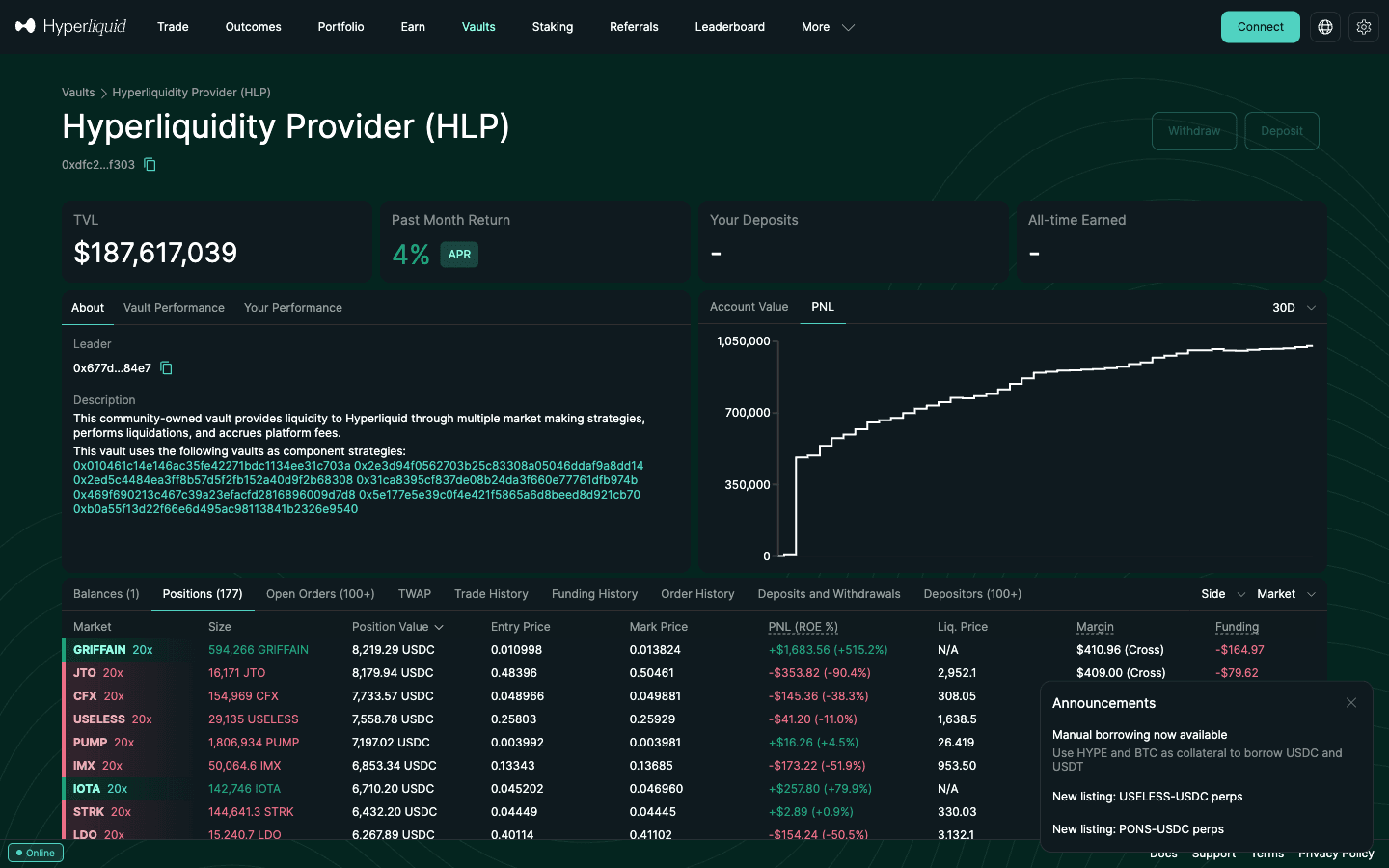
Hyperliquidity Provider (HLP) is a protocol vault that, per the docs, “provides liquidity to Hyperliquid through multiple market making strategies, performs liquidations, supplies USDC in Earn, and accrues a portion of trading fees.” It is community-owned: anyone can deposit USDC and share its PnL, with a 4-day lock-up after each deposit. Trading fees go entirely to the community: to HLP, to the assistance fund (which converts fees to HYPE and burns it) and to HIP-3 and spot deployers. None goes to a team treasury.
Live: HLP held $179.1M at a displayed APR of 3.5% on October 20, 2026 (public API, refreshed on every site build). Snapshot (API vaultDetails, October 15, 2026, 06:55 UTC): PnL +$42,344 over the last day, +$116,403 over the week, +$617,940 over the month and +$138.70M all-time. The leader takes no commission. Of the $179.8M account value at that moment, only about $40.1M sat in HLP’s own perps account; the rest is spread across seven child vaults. The largest, HLP Strategy X, reported about $100.51M of account value but only $1,000 in its perps account, so that capital sits outside perp trading (the docs say HLP also supplies USDC in Earn). The seven child vaults:
| Child vault | Account value | All-time PnL |
|---|---|---|
| HLP Liquidator | $1.00M | +$43.52M |
| HLP Liquidator 2 | $30.00M | +$30.82M |
| HLP Liquidator 3 | $1.00M | −$0.50M |
| HLP Liquidator 4 | $1.00M | +$0.84M |
| HLP Strategy A | $3.17M | +$4.36M |
| HLP Strategy B | $3.02M | −$4.37M |
| HLP Strategy X | $100.51M | +$0.50M |
Public API (vaultDetails and clearinghouseState), October 15, 2026, 06:55 UTC. The parent’s $40.1M plus the seven child vaults add up to HLP’s $179.8M. The four Liquidator vaults held no open positions at the time. Child-vault PnL figures are reported per vault and move over time.
Two things stand out. The liquidation strategies are the biggest earners in HLP’s history (about +$74.7M across the four), which matches the docs’ claim that backstops are profitable on average. And not every strategy wins: Strategy B and Liquidator 3 are negative all-time. The app shows HLP depositors a blunt warning: returns are not guaranteed, “you may lose some or all of your deposit”, and “there is no compensation in case of loss”.
Ready to trade with the waterfall in mind?
Keep leverage moderate, set a stop, and pay less on every fill: referral code HOLYGRAIL takes 4% off fees on your first $25M of volume.
5. Worked example: book liquidation vs backstop
You hold a $50,000 BTC long at 40x with $1,250 of isolated margin. Maintenance margin is 1.25% = $625, and two-thirds of it is about $417.
- BTC falls 1.25%: your equity reaches $625 and a market sell is sent to the book. Suppose it fills with $300 of equity left. You keep the $300 and pay no liquidation fee, only the taker fee on the fill and the slippage.
- The book gaps instead: equity drops below about $417 before the order fills. The position and its margin go to the liquidator. You end with zero on that position, and HLP owns it at the clearance price.
- A stop-loss at a 0.9% drop would have closed the trade with roughly $800 of the $1,250 left (a $450 loss plus fees). Setting one up: Hyperliquid stop-loss and take-profit orders.
- The same trade at 5x ($10,000 margin): maintenance margin is still $625, so liquidation is only reached after a drop of roughly 19%.
The vault’s size does not protect you; your leverage and your stop do. HLP protects the counterparties and the platform. Further reading: leverage limits by asset, how to avoid liquidation cascades.
6. Stress tests: JELLY (March 2025) and October 10, 2025
JELLY, March 2025
According to Halborn’s post-mortem, a trader opened a large short in the small-cap JELLY perp, JELLY’s price was then pumped by more than 400% within an hour, and the short was liquidated into HLP. The short was worth about $4.1M when it was opened; HLP inherited it, and when its loss reached about $12M the validators acted. Hyperliquid’s official account posted on March 26, 2025 (15:47 UTC): “After evidence of suspicious market activity, the validator set convened and voted to delist JELLY perps. All users apart from flagged addresses will be made whole from the Hyper Foundation. This will be done automatically in the coming days based on onchain data.” A follow-up said users with JELLY long positions at the time of settlement would be refunded by the Foundation as if their position had settled at a closing price of 0.037555. Halborn reports that positions were settled at $0.0095.
Two lessons. HLP’s risk includes being handed toxic positions in thin markets. And the validator set can, and did, intervene in a market. Whether you see that as protection or as a centralisation risk, it is part of how Hyperliquid works.
October 10, 2025
More than $19B of positions were liquidated across the crypto market in about 24 hours (CoinGlass annual report; CoinDesk, October 17, 2025). A February 2026 academic study (arXiv 2602.15182) measured $2.10B of Hyperliquid liquidations in the 21:16–21:27 UTC window and about 16 rounds of ADL. In other words, the final stage of the waterfall did run at scale, and profitable traders were closed out. If you trade high leverage through a crash, expect that you can be deleveraged even while winning.
7. HIP-3 markets and validator powers
Builder-deployed perps (HIP-3, such as trade.xyz’s stock and commodity markets) inherit HyperCore’s margining and order books, but each deployer runs its market: it defines the oracle, sets leverage limits and can settle the market at the mark price with the haltTrading action. Deployers must keep 500,000 HYPE staked, and validators can vote to slash it for malicious or irregular operation. The docs stress that slashed stake is burned, not paid to affected users. So on HIP-3 markets, read the deployer’s own rules too. More: trade.xyz stocks on Hyperliquid.
8. What it means for your trading
- Never let the engine close you. A stop-loss or manual exit before the liquidation price keeps the maintenance margin that a backstop would take. Know that price before you size the trade (calculator below).
- Leverage below the maximum means a much wider gap between price and liquidation, and a lower rank in the ADL queue.
- Big winners on high leverage are ADL candidates. In a crash, take partial profit or reduce leverage instead of assuming you will be paid in full at any price.
- Thin markets carry extra risk: small-cap perps and HIP-3 markets can gap, and settlement rules can change by validator or deployer action.
- HLP is an investment, not insurance for you. Depositing earns a share of market-making, fee and liquidation PnL, with a 4-day lock-up and real drawdown risk.
Came here for a liquidation price calculator or a liquidation API? Your own liquidation price: our liquidation price calculator, which applies the docs’ formula with each asset’s maintenance margin. Where everyone else’s liquidations sit: Hyperliquid liquidation map and liquidation data. Which order types protect you before either matters: every Hyperliquid order type explained.
9. Insurance funds and ADL across DEXs: Hyperliquid vs Lighter vs Aster
Every perp venue needs the same three layers: close the position on the book, hand what cannot be closed to a backstop pool, and deleverage winners if the pool cannot absorb the loss. What differs is who owns the pool, when it steps in, what the liquidated trader pays and how the ADL queue is ordered. Here are the three venues we cover side by side, from their official docs (re-checked October 15, 2026).
| Hyperliquid | Lighter | Aster (Pro order book) | |
|---|---|---|---|
| Backstop pool | HLP (liquidator strategies inside the community vault) | LLP (Lighter Liquidity Pool), split into strategy buckets | Insurance fund run by the exchange |
| Who can deposit | Anyone; 4-day lock-up | LIT stakers (10 USDC per LIT staked); 5-minute cooldown | No user deposit option documented |
| Pool size | $179.1M (October 20, 2026) | $86.1M (October 15, 2026) | Not published |
| When the pool takes over | Equity below 2/3 of maintenance margin | Account value below close-out margin (0.8% on BTC/ETH) | IOC order could not restore margin: remainder closed at the bankruptcy price |
| Liquidation fee | None on book liquidations; maintenance margin lost in a backstop | Up to 1% to the LLP on partial liquidations | Yes; part booked as “Insurance clear” |
| ADL trigger | Account or isolated position value negative | Below close-out, positions the LLP cannot take without breaching its own initial margin; a negative account the LLP cannot cover; or a depleted LLP strategy | Insurance fund cannot cover the loss |
| ADL ranking | (mark ÷ entry) × (notional ÷ account value) | Leverage and unrealized PnL | PnL% × effective leverage (winners), shown as a quantile |
| ADL price | Previous mark price | No worse than your zero price | Not specified in the docs |
| ADL warning in the UI | None documented | None documented | LeveragePnLQuantile bar (4 bars = high risk) |
From Hyperliquid docs (liquidations, auto-deleveraging, protocol vaults), Lighter docs (liquidations and LLP, LLP strategies) and Aster docs (liquidations, auto-deleveraging); Aster’s fee field from its public exchangeInfo API; pool sizes from each venue’s API (HLP live at build time, LLP on October 15, 2026).
Lighter: the LLP is the insurance fund
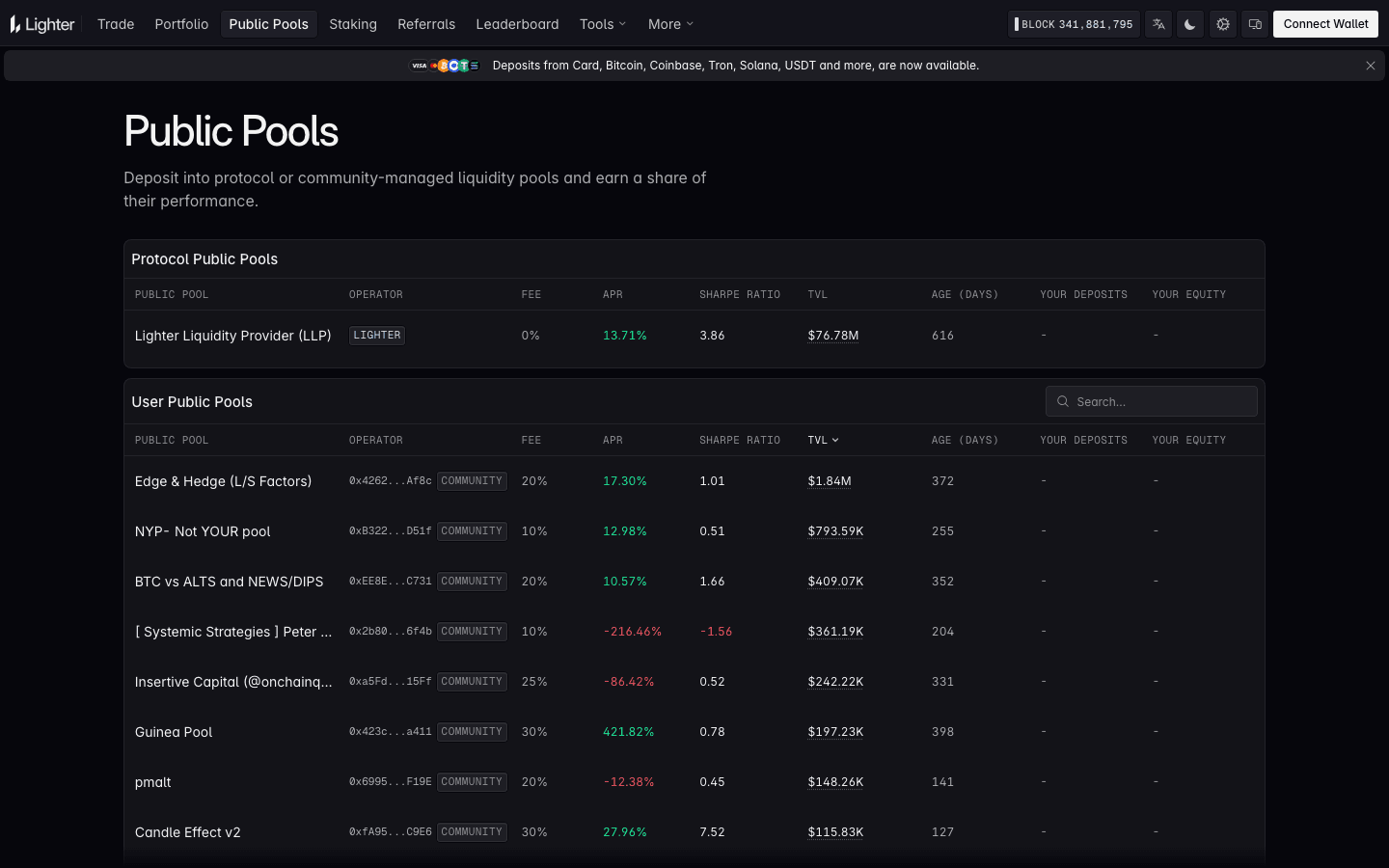
Lighter has no separate insurance wallet either. Its Lighter Liquidity Pool (LLP) market-makes across the exchange and doubles as the insurance fund. Each market has three margin fractions, initial, maintenance and close-out, and the account moves through five stages:
- Healthy: account value at or above the initial margin requirement. Anything goes, as long as the account stays healthy afterwards.
- Pre-liquidation: below initial but above maintenance. Only operations that do not increase any position and do not worsen the account’s value-to-margin ratio are allowed.
- Partial liquidation: below maintenance, above close-out. The engine cancels all open orders, then sends immediate-or-cancel orders for each full position at its “zero price”, the price at which the trade leaves the account’s health unchanged, so any fill can only improve it. It stops once a fully executed trade lifts the account above maintenance. If a fill beats the zero price, up to a 1% liquidation fee goes to the LLP.
- Full liquidation: below close-out. The LLP takes over the positions one by one, in ascending order of unrealized PnL, but only while doing so keeps the LLP itself above its own initial margin requirement. Positions it cannot take are auto-deleveraged instead.
- ADL: when an account is negative and the LLP cannot cover it, the bankrupt positions are matched against opposite-side positions ranked by leverage and unrealized PnL, and only where their zero prices align. The ADL trade is never worse than the counterparty’s zero price, so it cannot reduce that account’s health; it only ends the trade.
The margin fractions come from Lighter’s API (October 15, 2026): BTC and ETH 2% initial (50x), 1.2% maintenance, 0.8% close-out; SOL 4% / 2.4% / 1.6%; HYPE and XRP 5% / 3% / 2%. Worked example, using BTC’s price on September 25, 2026 ($83,744) as the entry: 0.1 BTC is $8,374 of notional. At the 50x maximum the initial margin is $167.49, maintenance $100.49 and close-out $67.00, so partial liquidation starts about 0.81% below entry and the LLP takes the position about 1.21% below. At 10x those points are 8.9% and 9.3% away (the percentages do not depend on the price).
Two details matter for depositors and traders. First, LLP Strategies: the pool’s collateral is split into strategy buckets (for example crypto perps, FX, equities/RWAs), each market is assigned to one, and losses are isolated per strategy. If a strategy’s allocated collateral is fully depleted, that strategy is subject to ADL while the others are unaffected. So the backstop behind a given market is its bucket, not the whole pool. Second, the LLP is a real investment with real drawdowns: on October 15, 2026 it held about $86.1M with a displayed APR of 15.04%; its worst share-price fall since launch was 8.94% (March 2025), and it lost 5.35% in the October 10–11, 2025 sell-off. Depositing requires staked LIT (10 USDC of LLP per LIT), and the deposit screen states that “Lighter offers no compensation for losses.”
Aster: a classic insurance fund, with an ADL gauge
Aster’s order-book perps use the CEX-style design. When margin (initial collateral plus realized and unrealized PnL) drops below maintenance on the mark price, the engine (1) cancels all open orders, (2) sends one large IOC order, (3) rechecks margin after realized losses and the liquidation fee and stops if it is enough, (4) otherwise closes the rest at the bankruptcy price and transfers it to the insurance fund, and (5) if the balance is still negative and the fund cannot cover it, triggers ADL. Profits or leftover assets from bankrupt positions stay with the insurance fund, and part of every liquidation fee is paid into it, shown in your transaction history as “Insurance clear”. Aster’s public exchangeInfo API lists a liquidationFee of 0.025 on BTCUSDT, ETHUSDT and SOLUSDT (the API docs call it the liquidation fee rate). We found no public endpoint or page that reports the fund’s balance.
A negative balance after liquidation is settled from the fund automatically only if all four conditions hold: it is in a USDT perpetuals account, no positions are open, the deficit is at most 5,000 USDT, and nothing was transferred in afterwards. Otherwise you go through Aster support.
Aster’s ADL ranking uses PnL percentage (unrealized profit ÷ position notional) and effective leverage (notional ÷ (account balance + unrealized profit)): winners are ranked by PnL% × effective leverage, losers by PnL% ÷ effective leverage, and the result is converted into a quantile across all users. The Pro interface shows it as a four-bar LeveragePnLQuantile indicator (four bars = high ADL risk). Aster’s docs name two ways to lower it: reduce leverage, or close and reopen the position to reset your priority. If you are deleveraged, the position is reduced without warning, and you can re-enter at any time. More on Aster’s margin tiers and liquidation: Aster margin and leverage guide.
How the ADL queue ranks you: worked example
Two traders are long the same market from $100, and the mark is now $120. Trader A holds $120,000 of notional on a $10,000 account (12x); Trader B the same notional on $60,000 (2x). On Hyperliquid, index = (mark ÷ entry) × (notional ÷ account value): A scores 1.2 × 12 = 14.4, B scores 1.2 × 2 = 2.4. If a short in that market goes bankrupt and HLP’s backstop cannot absorb it, A is closed first, at the previous mark price, even though both made the same trade. Aster’s and Lighter’s formulas differ in detail but point the same way: profit multiplied by leverage puts you at the front of the queue.
Ways to move down the queue on any venue:
- Cut effective leverage. Every ranking multiplies by it. Adding margin to a winning isolated position, or trimming size, does it directly.
- Realize part of a large winner. A reduce-only partial close turns unrealized PnL into realized PnL, which no longer counts in the ranking.
- Isolate speculative positions. On Hyperliquid and Lighter, ADL is triggered by the account or isolated position that goes negative; keeping a risky leg isolated keeps its failure contained.
- Watch crowded markets. ADL happens in cascades like October 10, 2025, when one side of a market is liquidated faster than the book and the backstop can absorb.
Other venues at a glance
| Venue | Backstop | Liquidation fee |
|---|---|---|
| Hyperliquid | HLP liquidator strategy, below 2/3 of maintenance margin; then ADL | None (you pay book slippage; on a backstop you lose the maintenance margin) |
| Lighter | LLP takes over below the close-out margin; then ADL | Up to 1% on partial liquidations, paid to LLP |
| Aster | Insurance fund; then ADL | API liquidationFee 0.025 on BTC/ETH/SOL; part goes to the fund, labelled “Insurance clear” |
| dYdX | Insurance fund | Liquidation penalty up to 1.5%, paid to the insurance fund |
| Ondo Perps | Insurance fund | 1.5%, paid to the insurance fund |
| edgeX | Not covered in our checks | 1% liquidation fee |
From each venue’s documentation as recorded in our fact registry (September–October 2026).
The structural difference: on Hyperliquid and Lighter the backstop is a pool ordinary users can join and earn from, and on Hyperliquid the ordinary liquidation charges nothing. On the fee-charging venues, a liquidated trader pays a fee on top of the loss. Whether a vault backstop is “safer” than a CEX-style insurance fund depends on its size relative to open interest: HLP’s $179.1M sits against about $11.05B of open interest on Hyperliquid’s validator-run perps (API, October 20, 2026), and Lighter’s $86.1M LLP against about $498.7M of open interest on its perps (API, October 15, 2026). That is why ADL exists on all three as the final guarantee.
10. FAQ
Does Hyperliquid have an insurance fund?
Not a separately named one. The job an insurance fund does on a CEX is done by the liquidator strategy inside HLP (Hyperliquidity Provider), a community-owned protocol vault. It takes over accounts that fall below two-thirds of maintenance margin without being closed on the book. Auto-deleveraging is the last line if an account still goes negative. On October 20, 2026 HLP held about $179.1M (API vaultDetails).
When does ADL happen on Hyperliquid?
Only when an account’s value, or an isolated position’s value, becomes negative: the market liquidation on the book and the HLP backstop both failed to close the position before its equity went below zero. That is rare in normal markets, but it ran at scale during the October 10, 2025 crash.
Who gets auto-deleveraged on Hyperliquid?
Traders on the other side of the bankrupt position, ranked by (mark price ÷ entry price) × (position notional ÷ account value). High profit and high leverage put you first in line. Your position is closed at the previous mark price, so you keep the profit up to that point but lose the position. Accounts with no open positions never share losses.
How do I know if I was auto-deleveraged on Hyperliquid?
Open Trade History. An ADL fill is labelled “Auto-Deleveraging” in the direction column, and the app explains: “Your position was auto-deleveraged because the opposite side could not be liquidated.” A liquidation of your own position shows as “Market Order Liquidation” or “Backstop Liquidation” instead. On the API, the fill’s dir field is “Auto-Deleveraging”.
Does Hyperliquid charge a liquidation fee?
No. The docs say: “Unlike CEXs there is no clearance fee on liquidations.” A normal liquidation sends market orders to the book, and any collateral left after it fills stays with you. The costs are the slippage of that market order and, if it goes to a backstop, the maintenance margin you lose.
Is there a Hyperliquid liquidation API?
Only per account. Fills from userFills (and the userFills/userEvents WebSocket streams) carry a liquidation object with method “market” or “backstop”, and userNonFundingLedgerUpdates lists liquidations in the ledger. Hyperliquid has no market-wide liquidation stream or endpoint in its API: a liquidation is flagged in the liquidated account’s own fills, and the only complete record is the node fill archive on S3. For market-wide levels, use a liquidation map built from on-chain positions.
How do I calculate my liquidation price on Hyperliquid?
The docs give liq_price = price − side × margin_available ÷ position_size ÷ (1 − l × side), where l = 1 ÷ maintenance leverage, side = 1 for long and −1 for short, and margin_available is account value (cross) or isolated margin minus the maintenance margin required. Our liquidation price calculator applies it for you.
What is the difference between HLP and the liquidator vault?
The liquidator is one of HLP’s component strategies. HLP (the parent vault) has seven child vaults on the API: four named HLP Liquidator and three trading strategies (A, B, X). Depositors hold shares of HLP and so share the PnL of all of them.
Can HLP lose money on liquidations?
Yes. The docs say backstop liquidations are profitable on average, not every time. On the API the child vault “HLP Liquidator 3” shows an all-time PnL of about −$0.50M while “HLP Liquidator” shows about +$43.52M (October 15, 2026). The app warns HLP depositors that returns are not guaranteed and there is no compensation for losses.
What happened with JELLY in March 2025?
A large JELLY short was liquidated into HLP while the token’s price was being pumped. Hyperliquid posted on March 26, 2025 that “the validator set convened and voted to delist JELLY perps” and that all users apart from flagged addresses would be made whole by the Hyper Foundation. A follow-up said JELLY longs would be refunded as if settled at 0.037555. Halborn’s write-up says validators delisted the market when HLP’s loss reached about $12M and settled positions at $0.0095.
How do Lighter and Aster handle insurance and ADL?
Lighter uses its LLP as the insurance fund: below the close-out margin the LLP takes positions over (any it cannot take without breaching its own initial margin are auto-deleveraged), and ADL also runs if an account is negative and the LLP cannot cover it, at a price no worse than the counterparty’s zero price. LLP losses are isolated per strategy bucket. Aster closes the unfillable part of a liquidation at the bankruptcy price into an exchange insurance fund, funded partly by the liquidation fee (shown as “Insurance clear”), and triggers ADL if the fund cannot cover the loss; a four-bar indicator shows your ADL risk.
How do I avoid a backstop liquidation?
Use a stop-loss that triggers before the liquidation price, keep leverage well below the maximum, and add margin (isolated) or deposit USDC (cross) when equity falls. A book liquidation leaves you the remaining collateral; a backstop takes the maintenance margin too.
Trade on the DEX with the deepest book
About $4.03B of perp volume in the 24 hours to October 20, 2026, liquidations sent to an open book, fees returned to the community. Join with HOLYGRAIL for 4% off fees on your first $25M.
Comparing venues? See the best DEX guide, or Lighter (code 718610TD) for an LLP-backed alternative. New to DEXs: what is a DEX and how to use Hyperliquid.
Disclosure: HOLYGRAIL and 718610TD are our referral codes; we earn a share of fees paid by referred accounts. Mechanics are from Hyperliquid’s official documentation and app; dated HLP figures are from the public API on October 15, 2026, live ones from the build on October 20, 2026. Incident details are attributed to their sources. Not financial advice.