
Short version. 1) Size from the stop: position = (equity × 1%) ÷ stop distance. 2) Liquidation ≥ 2× the stop distance; a 10x BTC long on Hyperliquid liquidates 8.9% away, 40x only 1.3%. 3) Crypto moves together: BTC’s 90-day correlation with ETH is 0.88, with SOL 0.84, so cap portfolio heat at about 3% and count same-direction majors as one position. 4) Isolated margin by default. 5) Keep only trading capital on any exchange. 6) Know your collateral stablecoin. 7) Daily loss limit −3%.
Lower costs are part of risk management
Every fee comes out of your risk budget. Hyperliquid with code HOLYGRAIL: 4% off fees on your first $25M of volume, native TP/SL and isolated margin on every perp.
We earn a commission when you sign up through our links; it never raises your fees.
1. Risk per trade: size from the stop, not the slider
Leverage does not decide how much you can lose; your stop does. The position that fits a fixed dollar risk is:
Position size (notional) = (equity × risk per trade) ÷ stop distance
Worked example. Equity $10,000, risk 1% = $100, stop 4% below entry. Position = $100 ÷ 0.04 = $2,500. At 5x that needs $500 of margin, at 10x $250; both lose the same $100 at the stop. Leverage only changed how much collateral sits in the position and how close the liquidation price is. Costs come out of the $100: two taker fills on Hyperliquid at 0.045% cost $2.25 on this trade, on Aster (0.04%) $2.00, on a Lighter Standard account nothing.
- Per trade: 0.5–1% of equity; 0.25% on thin altcoin books where a stop can fill far from its trigger.
- Per day: a hard stop at −2 to −3% of equity. Losing streaks are normal: with a 40% win rate, eight or more losses in a row somewhere in 100 trades has about a 49% chance. Eight losses cost 7.7% at 1% risk and 33.7% at 5%.
- Recalculate from current equity before every trade, so losing streaks shrink your size automatically. Tools: position size calculator.
Sizing for volatile markets: a checklist
Volatility clusters, so the rules above need tightening on the days that matter. We measured 90 days of Hyperliquid hourly candles (June 27 to September 25, 2026): BTC’s biggest hour was about eight times its average hourly range (0.51%), HYPE’s more than ten times (1.11%), and most of the extremes fell in the same four days (August 19–22). Taking every hour as an entry, an isolated 40x BTC long reached its liquidation distance within 24 hours 39.5% of the time; at 20x 1.6%, at 10x never.
- Cut leverage before the event, not during it. Halve it ahead of CPI, jobs and FOMC releases (08:30 ET and 2:00 p.m. ET): in September 2026 those hours moved four to nine times an average hour, and the second hour after a release was sometimes bigger than the first.
- Widen stops beyond the measured noise, then shrink size to match. A stop inside one average hourly range is noise-bait. Keep the dollar risk fixed: a wider stop means a smaller position, never a bigger loss.
- Use isolated margin for the volatile position. In cross margin a spike on one market drains the collateral behind all the others; isolated margin caps the damage at that position (cross vs isolated margin).
- Watch funding spikes. Hyperliquid pays funding every hour, capped at 4% an hour. In the 90 days to September 25, 2026, HYPE funding peaked near 14 times its baseline on August 22, just before that day’s flush. A rate several times baseline on your side means you are in the crowded trade that gets forced out first.
- Keep spare USDC outside the position so you can add margin instead of being liquidated, or decide in advance that you will not.
2. Leverage vs liquidation distance
Hyperliquid publishes the formula, and it is the clearest way to see what leverage does on any order-book perp DEX. Maintenance margin is half of the initial margin at the asset’s maximum leverage: 1.25% for BTC (40x), 2% for ETH (25x), 2.5% for SOL (20x), 5% for a 10x-max alt such as HYPE, up to 16.7% for 3x assets. On September 25, 2026, 144 of Hyperliquid’s 178 perps were capped at 5x or less.
liq_price = price − side × margin_available ÷ position_size ÷ (1 − l × side)
| Asset (isolated, long move / short move) | 2x | 3x | 5x | 10x | 20x | Max |
|---|---|---|---|---|---|---|
| BTC (max 40x, maint. 1.25%) | −49.4% / +48.1% | −32.5% / +31.7% | −19.0% / +18.5% | −8.9% / +8.6% | −3.8% / +3.7% | −1.3% / +1.2% (40x) |
| ETH (max 25x, maint. 2%) | −49.0% / +47.1% | −32.0% / +30.7% | −18.4% / +17.6% | −8.2% / +7.8% | −3.1% / +2.9% | −2.0% / +2.0% (25x) |
| SOL (max 20x, maint. 2.5%) | −48.7% / +46.3% | −31.6% / +30.1% | −17.9% / +17.1% | −7.7% / +7.3% | −2.6% / +2.4% | −2.6% / +2.4% (20x) |
| 10x-max alt, e.g. HYPE (maint. 5%) | −47.4% / +42.9% | −29.8% / +27.0% | −15.8% / +14.3% | −5.3% / +4.8% | n/a | −5.3% / +4.8% (10x) |
Our calculation from the docs formula, position opened with initial margin only, before funding and fees. Distance = (1/leverage − l) ÷ (1 − l) for longs and ÷ (1 + l) for shorts.
Two lessons. At maximum leverage there is almost no room: 40x BTC liquidates on a 1.3% move, less than BTC’s 2.05% average daily volatility over the last 90 days. And altcoins are punished twice: higher maintenance margin and higher volatility. Liquidation also costs more than a stop: if Hyperliquid has to backstop a position below two-thirds of maintenance margin, the maintenance margin is not returned. Details: liquidation price calculator. How often each leverage level was actually hit over 90 days is in the volatility checklist above.
3. Liquidation cascades: how they happen and how to stay out
A cascade starts when forced liquidation orders push price into the next cluster of liquidation prices, whose forced orders push it further. Longs cascade on the way down, shorts on the way up. The largest on record was October 10, 2025: CoinGlass’s 2025 annual report and CoinDesk put market-wide liquidations above $19 billion in about 24 hours, and an arXiv paper (“Autodeleveraging as Online Learning”, February 2026) counts $2.10 billion of liquidations on Hyperliquid in the eleven minutes from 21:16 to 21:27 UTC, with about 16 rounds of auto-deleveraging.
How Hyperliquid liquidates, in order: when equity falls below maintenance margin (triggered on the mark price, not the last trade), it sends market orders to the book, with no clearance fee on liquidations; positions above 100,000 USDC go 20% at a time with a 30-second cooldown. Below two-thirds of maintenance margin the liquidator vault (part of HLP) takes over, and in a backstop liquidation the position and its margin go to the liquidator vault and the maintenance margin is not returned. If an account still goes negative, auto-deleveraging closes profitable positions on the other side (ADL explained), so even winners can be closed in an extreme event.
- Keep your liquidation price outside the zone a cascade sweeps. Check where clusters sit on the Hyperliquid liquidation map and compute your own price with the liquidation price calculator before you open.
- Place the stop at no more than about half the distance to liquidation. TP/SL triggers on the mark price and fills as a market order with up to 10% slippage tolerance; in a cascade the fill lands well past the trigger, so a stop next to the liquidation price protects almost nothing.
- Stay off the obvious levels. Round numbers and recent swing lows are where stops and liquidations pile up and where cascades accelerate; a stop a little beyond a visible cluster fares better than one inside it.
- Isolate anything leveraged. In cross margin one position’s loss drains the margin of all the others, which is the account-level cascade you can prevent completely.
- During the cascade, reduce rather than defend. Closing part of the position moves the liquidation price away fastest; adding leverage to “defend” moves it closer. Cancel resting orders that would add exposure, use limit orders to exit where you can, and check your trade history for ADL before you re-enter.
4. Correlation: BTC, ETH and altcoins in real data
Diversifying across coins does much less than it looks. We computed the correlation of daily returns from Hyperliquid’s daily candles for the 90 days to the September 24, 2026 close:
| 90 days | BTC | ETH | SOL | HYPE | XRP | DOGE |
|---|---|---|---|---|---|---|
| BTC | 1.00 | 0.88 | 0.84 | 0.63 | 0.87 | 0.82 |
| ETH | 0.88 | 1.00 | 0.83 | 0.72 | 0.78 | 0.74 |
| SOL | 0.84 | 0.83 | 1.00 | 0.70 | 0.76 | 0.75 |
| HYPE | 0.63 | 0.72 | 0.70 | 1.00 | 0.62 | 0.56 |
| XRP | 0.87 | 0.78 | 0.76 | 0.62 | 1.00 | 0.87 |
| DOGE | 0.82 | 0.74 | 0.75 | 0.56 | 0.87 | 1.00 |
Pearson correlation of daily log returns, June 26 to September 24, 2026 closes (90 returns), Hyperliquid candleSnapshot. Our calculation.
| Coin | Daily volatility (90d) | Annualised | Beta to BTC (90d) | Correlation with BTC, 30d | Correlation with BTC, 365d |
|---|---|---|---|---|---|
| BTC | 2.05% | 39% | 1.00 | — | — |
| ETH | 2.82% | 54% | 1.22 | 0.92 | 0.91 |
| SOL | 2.96% | 57% | 1.22 | 0.85 | 0.87 |
| HYPE | 3.98% | 76% | 1.23 | 0.70 | 0.52 |
| XRP | 3.53% | 67% | 1.51 | 0.91 | 0.87 |
| DOGE | 3.35% | 64% | 1.34 | 0.88 | 0.80 |
What it means in practice:
- Majors are one trade. ETH, SOL, XRP and DOGE all correlated 0.82–0.88 with BTC over 90 days, and more over the last 30 (BTC/ETH 0.92). A long in each is a leveraged bet on “crypto up”.
- Alts carry more of the same risk. With a beta of 1.2–1.5, a 1% BTC move has typically come with a 1.2–1.5% move in ETH, SOL or XRP. Size alt positions smaller for the same dollar risk.
- The bear market did not break the link. Over the full year the correlation was 0.87–0.91 for BTC with ETH, SOL and XRP, a year that included BTC’s 53% decline from $124,711 (October 6, 2025) to $58,603 (June 30, 2026).
- HYPE is the partial exception (0.63 over 90 days, 0.52 over a year), but it is also the most volatile (76% annualised).
5. Portfolio heat: total open risk
Portfolio heat is the sum of what you would lose if every open stop were hit, as a percentage of equity. Cap it (about 3% is common), and adjust for correlation, because correlated positions tend to hit their stops together. Measured in volatility terms with the 90-day correlations above:
| Book | Sum of risk | Behaves like | If independent | Read |
|---|---|---|---|---|
| Long BTC, ETH, SOL (1% risk each) | 3% | ≈ 2.85% | 1.73% | One crypto-beta bet |
| Long BTC, ETH, SOL, HYPE (1% each) | 4% | ≈ 3.63% | 2.00% | HYPE diversifies only a little |
| Long BTC + long HYPE (1% each) | 2% | ≈ 1.81% | 1.41% | Lower correlation (0.63) |
| Long BTC + short ETH (1% each) | 2% gross | ≈ 0.49% | 1.41% | A relative-value trade, not two bets |
√(Σ wᵢwⱼρᵢⱼ) with equal 1% risk units and the 90-day correlations. Our calculation; correlations change over time.
Rules: count same-direction majors as one position; cap total heat; if you add a new correlated position, tighten or trim the others; and remember that on cross margin the positions also share one pool of collateral, so one loser drains the rest. More on hedged books: hedging with perps and how to short crypto.
6. Margin mode, stops and funding
- Isolated by default. A cross backstop liquidation on Hyperliquid takes all cross positions and cross margin; an isolated one takes only that position’s margin. On cross the liquidation price does not depend on the leverage you set. See cross vs isolated.
- Stops that fill. Hyperliquid triggers TP/SL on the mark price; market stops fill with a 10% slippage tolerance, while a stop-limit with a tight limit can rest unfilled through a gap. On Lighter, a fat-finger check rejects a stop-limit sell priced below 95% of the higher of trigger and best bid (buys above 105%). Aster lets API users trigger on mark or contract (last) price. Attach the stop with the entry: Hyperliquid order types.
- Stops pay fees too. A triggered stop-market order takes liquidity and pays the taker rate, so every loss carries an entry and an exit fee; on a tight stop they are a real share of the risk. The risk reward calculator shows the R:R and the break-even win rate after those fees.
- Funding is a position cost. Hourly on Hyperliquid and Lighter, 8-hourly by default on Aster. Over the 30 days to September 25, 2026 BTC funding totalled 0.7664% (about $77 on a $10,000 long); hot alts reached 0.0145% an hour, about 0.35% a day. Funding also moves an isolated position’s liquidation price. See funding explained, and put fees and funding into a trade’s net result with the futures PnL calculator. Held hedged, funding becomes the income instead: that is funding rate arbitrage, with its own liquidation and venue risks.
- Events. BTC’s one-hour range on Hyperliquid was 2.75% in the CPI hour and 2.04% in the FOMC hour in September 2026. Reduce size before scheduled releases.
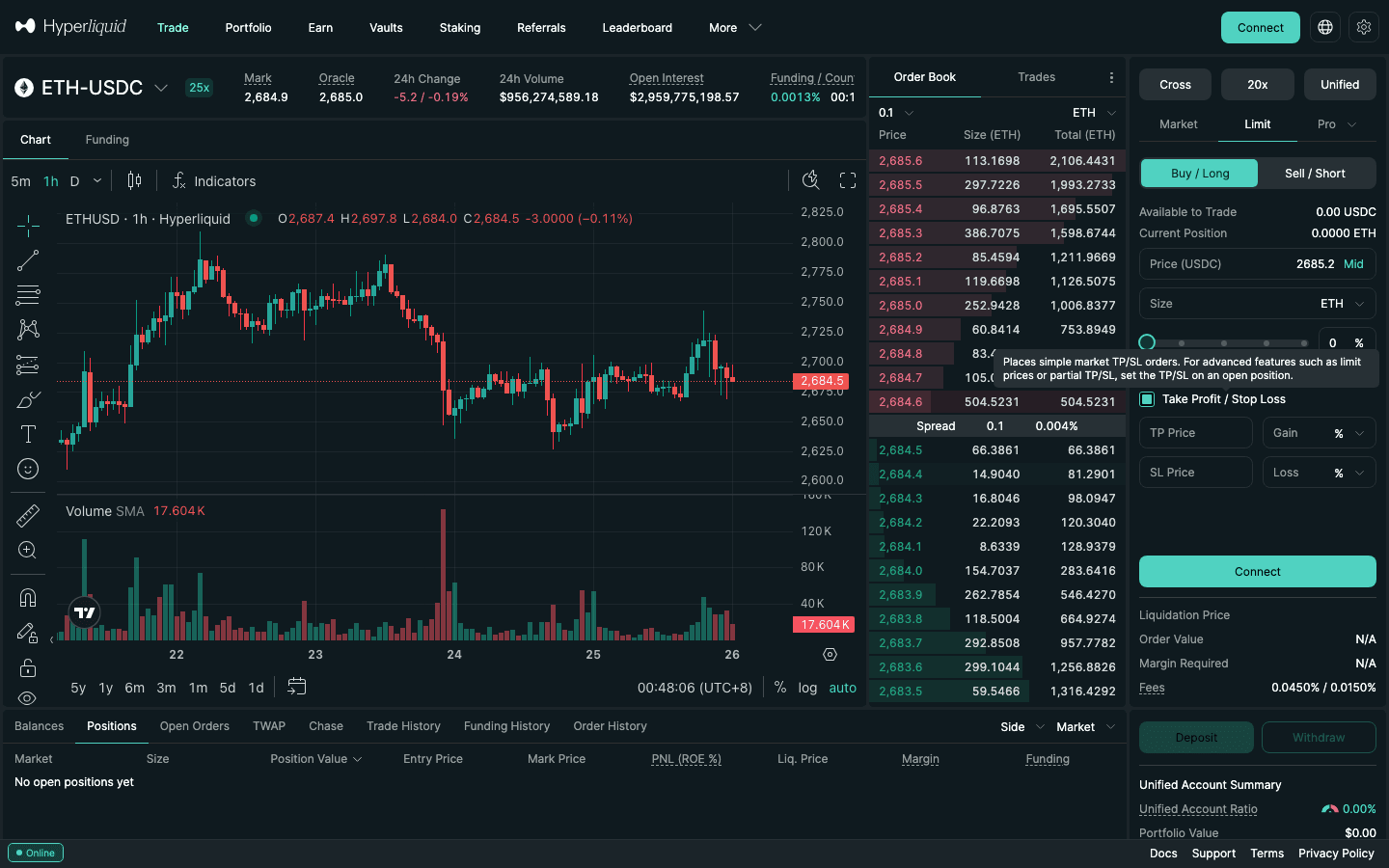
Put the rules on a venue that supports them
Hyperliquid: isolated margin, mark-price TP/SL and trailing stops, hourly funding in the header. Join with HOLYGRAIL for 4% off fees on your first $25M. Second venue for zero fees: Lighter Standard (0%/0%) with 718610TD; for 0% maker: Aster with DTLpLc.
7. Venue risk: how much to keep where
A DEX removes the custodian, not the risk. Protocols halt, bridges get attacked, and markets get manipulated. DefiLlama’s hack database counted 281 incidents worth $2.20B in 2026 up to September 24, with bridge and cross-chain exploits the largest category ($696M); Drift, a Solana perp DEX, lost about $285M on April 1, 2026 after attackers took admin control. The three venues are built differently, which is the only reason spreading funds helps:
| Hyperliquid | Lighter | Aster | |
|---|---|---|---|
| Settlement | Own L1 (HyperCore + HyperEVM); USDC bridged from Arbitrum and other chains | zk-rollup; proofs verified on Ethereum; Escape Hatch to withdraw with proofs if the operator stops | Aster Chain L1; deposits bridged from BNB Chain, Ethereum, Arbitrum, Solana, Sui |
| Collateral | USDC (main perps) | USDC; ETH and XAUT at 70% LTV | USDT by default; Multi-Asset Mode adds USDC, USD1, USDF, BTC, ETH, BNB, SOL, ASTER with haircuts |
| Liquidation | Book first; liquidator vault (HLP) below ⅔ of maintenance margin; no clearance fee | Pre-liquidation, then IOC at the zero price (up to 1% fee to LLP); LLP takeover; ADL only if LLP cannot | Cancel orders → one IOC → insurance fund at bankruptcy price (“Insurance Clearance Fee”) → ADL |
| Base fees (taker / maker) | 0.045% / 0.015% | 0% / 0% Standard; 0.028% / 0.004% Premium | 0.04% / 0% (USDT perps) |
| Max leverage BTC / ETH / SOL | 40x / 25x / 20x | 50x / 50x / 25x | Per bracket (BTC up to 200x under $400); 1001x mode is separate |
| Past incidents (public record) | Mar 2025: ETH whale left HLP ~$4M loss, leverage cut to 40x/25x; JELLY delisted by validators, users made whole. Nov 2025: POPCAT manipulation, ~$4.9M bad debt absorbed by HLP, withdrawals and bridge briefly halted (Halborn) | — | — |
From each venue’s docs and APIs (September 25, 2026) and public post-mortems; see our insurance fund and ADL guide.
Practical rules for venue risk:
- Keep only active trading capital on any exchange. The reserve lives in a wallet you control. A Hyperliquid USDC withdrawal to Arbitrum costs 0.2 USDC plus a tiny HyperEVM gas fee in HYPE and arrives within 5 minutes.
- Split across venues only with a reason: a strategy that fits another fee schedule (Lighter Standard for many small taker fills, Aster for 0% maker), a market only one venue lists, or a balance large enough that one venue’s halt would hurt. Costs of splitting: a lower 14-day volume tier on each venue and more accounts to secure.
- Different designs fail differently. Hyperliquid runs its own L1 and bridge; Lighter proves its state on Ethereum and has an Escape Hatch that lets users withdraw with proofs if the operator stops; Aster runs its own chain with bridges from several networks.
- Scope your keys. Hyperliquid API wallets can be given an expiry of at most 180 days; revoke bots you no longer use. Checklist: DEX security.
- Watch leverage and OI caps before sizing up. Large positions get lower maximum leverage and higher maintenance margin on all three venues.
8. Stablecoin risk
Your PnL is paid in a stablecoin, so its peg is part of your risk. Hyperliquid’s main perps settle in USDC, Lighter in USDC, Aster in USDT by default (Multi-Asset Mode accepts others with haircuts). DefiLlama’s daily price record:
- USDC traded at $0.961 on March 12, 2023, when Circle disclosed reserves at the failed Silicon Valley Bank, and recovered within days. Over the 12 months to September 25, 2026: $0.9988–$1.0011.
- USDT, same 12 months: $0.9979–$1.0035.
- USDe (Ethena, a synthetic dollar): as low as $0.9838 on February 1, 2026.
Rules: know which stablecoin backs each account and each HIP-3 market; do not hold idle balances on an exchange “for later”; and if you use a non-USD asset as collateral (Aster Multi-Asset Mode, Lighter ETH), remember a price drop in the collateral lowers your margin exactly when your positions may be losing too.
9. One-page risk checklist
| Rule | Number | Why / how |
|---|---|---|
| Risk per trade | 0.5–1% of equity, fees included | Size = risk $ ÷ stop % |
| Daily / weekly loss limit | −3% / −6% | Stop trading until the next day / week |
| Portfolio heat | ≤ 3% open risk, correlated positions counted together | BTC/ETH/SOL longs ≈ one bet |
| Effective leverage | ≤ 3–5x on swing trades | Notional ÷ equity, not the slider |
| Liquidation distance | ≥ 2× the stop distance | Read “Liquidation Price” before sending |
| Margin mode | Isolated unless hedged | Cross backstop takes all cross margin |
| Stops | Reduce-only, market-triggered, placed with the entry | Mark-price trigger; 10% slippage cap on HL |
| Funding | Hourly rate × 24 × days checked before holding | Prefer the side that is paid |
| Events | Flat or smaller 30 min before CPI / FOMC / jobs | BTC moved 2–3% in those hours in Sept 2026 |
| Venue exposure | Only active trading capital on any venue; reserve in your own wallet | Split across venues only with a reason |
| Stablecoin exposure | Know which stablecoin backs each account | USDC / USDT / USDe behave differently |
| Drawdown rule | At −10% from peak, halve risk until a new high | −50% needs +100% to recover |
Print it, keep it next to the order form, and review it weekly with your journal. The most common ways traders break these rules are below. New to perps? Start with what is a DEX and how to use Hyperliquid.
10. The 18 costliest perp mistakes (and the fix for each)
The expensive mistakes are mechanical, not analytical: too much leverage for the stop, no stop at all, market orders that pay the taker fee on every fill, funding nobody checked, and a margin mode that lets one trade take the account. Each has a measurable cost and a simple fix.
| # | Mistake | What it costs | The fix |
|---|---|---|---|
| 1 | Using the maximum leverage | Isolated BTC long at 40x liquidated after a 1.3% move | Size from risk; effective leverage ≤ 3–5x |
| 2 | No stop-loss | A backstop liquidation keeps your maintenance margin | Attach TP/SL at entry |
| 3 | Stop too close to liquidation, or a stop-limit that cannot fill | Gaps skip the stop | Market-triggered stop; liquidation ≥ 2× the stop distance |
| 4 | Sizing by “how many x” | Random dollar risk per trade | Size = risk $ ÷ stop % |
| 5 | Paying taker on every fill | $9.00 vs $3.00 per $10k round trip on Hyperliquid | Post-only limit orders |
| 6 | Ignoring funding carry | Up to 0.35% a day on crowded alts | Check the hourly rate before holding |
| 7 | Wrong margin mode | A cross backstop takes all cross margin | Isolated for speculative trades |
| 8 | Averaging down a loser | Liquidation distance roughly halves | Add only to winners, only by plan |
| 9 | Stacking correlated longs | 3 × 1% risk ≈ 2.85% real risk | Count BTC/ETH/SOL as one bet |
| 10 | Market orders in thin hours | 04:00 UTC BTC volume ≈ 1/5 of 14:00 UTC | Limit orders; trade liquid hours |
| 11 | Holding full size through CPI/FOMC | 2.75% BTC range in the September CPI hour | Flat or smaller before releases |
| 12 | Revenge trading after a streak | 8+ straight losses in 100 trades: ≈49% likely at a 40% win rate | Daily loss limit and pause rule |
| 13 | Not knowing your front-end’s builder fee | An extra fee on every trade | Know the builder fee you approved |
| 14 | Skipping the referral discount | Code refused after $10,000 of volume | Join through a referral link first |
| 15 | Wrong chain or below the deposit minimum | Under the minimum is lost | Check chain, asset and minimum |
| 16 | Phishing and fake support | Drained wallet, no recourse | Bookmark the app; support never DMs |
| 17 | Treating 1001x as leverage | Capped ROI plus a PnL-based fee | Treat it as a lottery ticket |
| 18 | No journal, no export | The same mistake repeated; tax gaps | Monthly CSV export + journal |
Hyperliquid docs and API, measured September 25, 2026: liquidation distance from the docs formula (BTC maintenance margin 1.25%); 90-day daily-return correlation BTC/ETH 0.88, BTC/SOL 0.84; BTC perp volume by hour over 30 days; release-hour ranges for the September jobs, CPI and FOMC releases; streak odds by exact calculation. Fees from the registry.
- Leverage, measured. Opening a hypothetical isolated BTC long at the start of every hour over the 90 days to September 25, 2026, the position hit its liquidation price within 24 hours 39.5% of the time at 40x, 1.6% at 20x and never at 10x. BTC's daily volatility over the period was 2.05%.
- Averaging down, in numbers. A $10,000 cross account long 0.25 BTC at $84,000 had its liquidation about 47% below entry; after a 6% drop and doubling the position, liquidation sat only about 21% below the market, and each further 1% cost twice as much.
- Fees against the stop. A taker round trip costs 0.045% × 2 of notional on Hyperliquid: 18% of the risk on a 0.5% stop and 36% on a 0.25% stop. Post-only (ALO) entries, a referral code and staking cut it by up to about two-thirds.
- Liquidity and news. BTC volume at 04:00 UTC was about a fifth of 14:00 UTC, and weekend days averaged about a third of weekdays; BTC moved 2–3% within the September 2026 jobs, CPI and FOMC hours (best times to trade).
Printable pre-trade checklist
Most of the 18 are process errors, so a checklist catches them better than a strategy does. It runs in the order you meet the steps.
| ☐ | Check | The number that matters |
|---|---|---|
| A. Before you deposit | ||
| ☐ | Real URL typed or bookmarked; nobody has my seed phrase | Support never DMs first |
| ☐ | Referral code on the account before I trade | No code accepted after $10,000 of volume; HOLYGRAIL = 4% off the first $25M |
| ☐ | Right asset, right chain, above the minimum; a test amount first | Withdrawal fee 0.2 USDC |
| B. Before you size | ||
| ☐ | Isolated or cross chosen on purpose | A cross backstop takes all cross margin |
| ☐ | Loss at the stop (fees included) ≤ 1% of equity | Size = risk $ ÷ stop % |
| ☐ | Liquidation price at least twice as far as the stop | Isolated BTC long: 3x ≈ 32% away, 10x ≈ 8.9%, 20x ≈ 3.8%, 40x ≈ 1.3% |
| ☐ | Funding over the planned hold priced in; total open risk within the cap | Correlated longs count as one bet |
| C. Before you click | ||
| ☐ | Could this be a post-only limit order? | Maker 0.015% vs taker 0.045% at tier 0 |
| ☐ | Reduce-only stop attached to the order; exit plan written | Market TP/SL fill with a 10% slippage tolerance; a tight stop-limit can rest unfilled in a gap |
| ☐ | Liquid hour; no macro release in the next 30 minutes; trading my plan, not winning back a loss | Daily loss limit not hit |
| D. After the trade | ||
| ☐ | Flat confirmed; leftover TP/SL and limit orders cancelled | A stop without reduce-only can open a new position later |
| ☐ | Journal row written | Trade History and Funding History exported monthly |
On a first trade: $500 deposited, BTC isolated 3x long, $300 notional. Entry costs $300 × 0.045% as a market order; stop 2% below, reduce-only, risks $6 (1.2% of the account); liquidation is about 32% away, sixteen times further than the stop; target 4% above (2:1) or flat after one session.
Fix the cheapest mistake first
Join Hyperliquid through code HOLYGRAIL before you pass $10,000 of volume: 4% off trading fees on your first $25M.
11. Trading plan, journal and circuit breakers
Rules only work if they are written down before the trade and checked after it. A one-page plan, filled in once:
| Plan section | What to write (example) |
|---|---|
| Capital and goal | $10,000 trading capital; no top-ups after losses; positive expectancy over 100 trades |
| Markets | Three to five at most (e.g. BTC, ETH, SOL perps) |
| Venue and fees | Where you trade and what you pay (e.g. Hyperliquid 0.045% taker / 0.015% maker at tier 0) |
| Sessions | When you may trade (UTC); no trading 30 minutes either side of FOMC, CPI and jobs releases |
| Setups and entry trigger | Named setups only, each with an exact trigger (e.g. 1h close back above a broken level, limit order at the retest) |
| Filters | Conditions that cancel a valid setup (e.g. no new long while hourly funding is 8× the baseline) |
| Stop and risk per trade | Invalidation price attached to the order; 1% of equity lost at the stop, fees included |
| Position size and leverage | Size = risk $ ÷ stop %; effective leverage ≤ 3x; isolated for alts |
| Targets and exits | e.g. half at 2R, stop to break-even, rest trailed; time stop after 24 h |
| Max open risk | 3% in total; BTC/ETH/SOL longs count as one bet |
| Loss limits | −3% a day, −6% a week, four losses in a row = 24-hour pause |
| Review | Journal after each trade, metrics weekly, CSV export monthly |
The journal. Exchanges record the facts; only you can record the intent. Use one row per position (open to flat), not per fill:
| Journal field | Source (Hyperliquid) | What it tells you |
|---|---|---|
| Open/close time (UTC), market, direction | Trade History: Time, Market, Direction | Session and holding-time analysis |
| Entry/exit price, size, notional | Price, Size, Trade Value | Slippage against plan |
| Fees and Closed PnL (fees included) | Fee, Closed PNL | Cost as a share of the average win |
| Funding paid or received | Funding History: Payment | Holding cost; net PnL |
| Planned stop, target, risk $ and R-multiple | Manual (net PnL ÷ planned risk) | Compares trades of any size |
| Setup, market condition, exit reason | Manual | Expectancy by setup; where setups fail |
| Leverage and margin mode | Manual (not in the CSV) | Links leverage to results |
| Plan followed (Y/N), rule broken, emotion 1–5 | Manual | Process score; tilt patterns |
Exporting fills. On Hyperliquid open Trade History under the chart and click Export as CSV (Time, Market, Direction, Price, Size, Trade Value, Fee, Closed PNL), then do the same in Funding History (funding is not in the trade file). The app lists your 2,000 most recent fills; the API's userFillsByTime reaches your 10,000 most recent (CSV export guide). Lighter's API has an authenticated export of trades and funding for up to 12 months; Aster's transaction history is exportable in the app. Keep the raw files: they double as tax records.
Four numbers decide whether you have an edge. Win rate means little alone; read it with the average win ÷ average loss. Break-even win rate = average loss ÷ (average win + average loss). Expectancy = win rate × average win − loss rate × average loss (example: 40% winners at +$220 and 60% losers at −$105 is +$25 a trade, +0.25R). Profit factor = gross profit ÷ gross loss (below 1.0 loses money). Max drawdown = (peak − lowest later equity) ÷ peak, and it sets your loss limits, because a 20% drawdown needs +25% to recover, 50% needs +100% and 75% needs +300% (risk reward calculator).
Circuit breakers for yourself, not just your positions:
- Daily loss limit (e.g. −3% of equity): stop, close the app, review tomorrow. Weekly (−6%): no new trades until the weekly review.
- Streak rule (four losses in a row): 24-hour pause. With a 40% win rate, a run of eight or more losses in 100 trades is about 49% likely, so streaks are normal; the danger is oversized risk while you are on one.
- After any liquidation: no trading for the rest of the day, and a written post-mortem (cause: oversized leverage, no or moved stop, event risk, correlation stack) with one rule change before the next trade.
- State rules: tired, angry, euphoric after a big win, or refreshing the chart every 30 seconds = no new positions.
- Drawdown rule: at −10% from peak, halve risk per trade until a new equity high.
Reviews: two minutes after each trade (setup, plan followed, emotion), five minutes a day grading the process rather than the PnL, thirty minutes a week on expectancy and drawdown by setup, and a monthly export where the plan changes only in writing. If fees exceed about a tenth of your average win, use more maker orders or a cheaper venue.
FAQ
What is risk management in crypto trading?
Deciding in advance how much you can lose and enforcing it with position size, stops and limits. For leveraged crypto that means a fixed risk per trade (0.5–1% of equity), leverage low enough that liquidation sits far beyond the stop, a cap on total open risk that counts correlated positions together, daily loss limits, and managing the risks outside the chart: funding, the exchange itself and the stablecoin you hold as collateral.
What is the 1% rule in crypto?
Lose no more than 1% of your account on any single trade, fees included. With $10,000 that is $100. The position size follows from the stop: with a 2% stop, $100 of risk allows a $5,000 position. The rule caps the loss, not the size, which is why leverage is a result of the calculation rather than an input.
How correlated are Bitcoin and altcoins?
Very. On Hyperliquid daily candles for the 90 days to September 24, 2026, the correlation of daily returns with BTC was 0.88 for ETH, 0.84 for SOL, 0.87 for XRP, 0.82 for DOGE and 0.63 for HYPE. Over the past 30 days BTC/ETH reached 0.92. Holding several altcoin longs is mostly one bet on the crypto market, usually with more volatility than BTC.
What is portfolio heat?
The total you would lose if every open stop were hit at once, as a percentage of equity. Many traders cap it around 3%. Because crypto majors move together, count correlated positions as one: three 1% longs on BTC, ETH and SOL behave like about 2.85% of risk in volatility terms, not 1.73% as independent bets would.
Should I spread my funds across several DEXs?
Keep only active trading capital on any exchange and hold the rest in a wallet you control. Splitting across venues with different settlement designs (Hyperliquid’s own L1, Lighter’s Ethereum zk-rollup, Aster Chain) limits the damage from one venue’s halt or incident, at the cost of a lower volume tier on each and more accounts to secure. Split for a reason, not by default.
Is USDC collateral risk-free?
No stablecoin is. DefiLlama’s daily prices show USDC at $0.961 on March 12, 2023 before it recovered; over the 12 months to September 25, 2026 it stayed between $0.9988 and $1.0011, USDT between $0.9979 and $1.0035, and Ethena’s USDe dipped to $0.9838. Know which stablecoin backs each account and do not park more than you trade.
How far away is my liquidation price at 10x?
On Hyperliquid, an isolated 10x long opened with the initial margin liquidates about 8.9% below entry on BTC, 8.2% on ETH, 7.7% on SOL and 5.3% on a 10x-max altcoin such as HYPE, because maintenance margin is higher on assets with lower maximum leverage. Shorts liquidate slightly closer (8.6% on BTC).
Trade with 4% lower fees on Hyperliquid
Code HOLYGRAIL takes 4% off your fees on the first $25M of volume; every basis point saved stays in your risk budget. Compare all venues in our best DEX guide.
Disclosure: HOLYGRAIL (Hyperliquid), 718610TD (Lighter) and DTLpLc (Aster) are our referral codes; we earn a share of referred accounts’ fees at no cost to you. Liquidation rules and fees checked on September 25, 2026; correlations, volatilities and heat figures are our calculations from Hyperliquid’s public candle data; stablecoin prices from DefiLlama. Educational content, not investment advice; leveraged trading can lose more than your margin.