
How to calculate PnL on a USDT-margined vs a coin-margined perpetual
- USDT-margined (linear): PnL = position size in coins × (exit − entry), paid in USDT (or USDC). A short uses (entry − exit).
- Coin-margined (inverse): PnL = contracts × contract value in USD × (1 / entry − 1 / exit), paid in the coin (BTC for BTCUSD). A short flips the sign. Multiply by the exit price to see it in dollars.
Example: a $10,000 BTC long from $80,000. Linear: 0.125 BTC × (88,000 − 80,000) = +1,000 USDT. Inverse: 100 contracts × $100 × (1/80,000 − 1/88,000) = +0.011364 BTC, worth +$1,000 at $88,000.
| BTC exits at | USDT-margined (0.125 BTC) | Coin-margined (100 × $100) |
|---|---|---|
| $88,000 (+10%) | +1,000 USDT | +0.011364 BTC (= +$1,000) |
| $72,000 (−10%) | −1,000 USDT | −0.013889 BTC (= −$1,000) |
Same dollars at the exit, different coin amounts: the inverse long wins less BTC on the way up than it loses on the way down, and its BTC collateral moves with the market too (section 5). Figures are before trading fees and funding. Estimate a USDT- or USDC-margined trade’s net PnL after fees and funding, then check where it would be liquidated.
The difference is the collateral and settlement currency. A USDT-margined (linear) perpetual uses a stablecoin as collateral and pays profit and loss in that stablecoin, so PnL moves one-for-one with price. A coin-margined (inverse) perpetual is sized in dollars but uses the coin itself (BTC, ETH) as collateral and pays PnL in the coin, which makes the coin-denominated result non-linear and ties your margin to the market. Every major perp DEX is linear: Hyperliquid and Lighter settle in USDC, Aster in USDT. Inverse contracts are a CEX product (Binance COIN-M, Bybit, OKX, Deribit) and carry a small share of BTC volume.
Trade linear USDC perps on the largest perp DEX
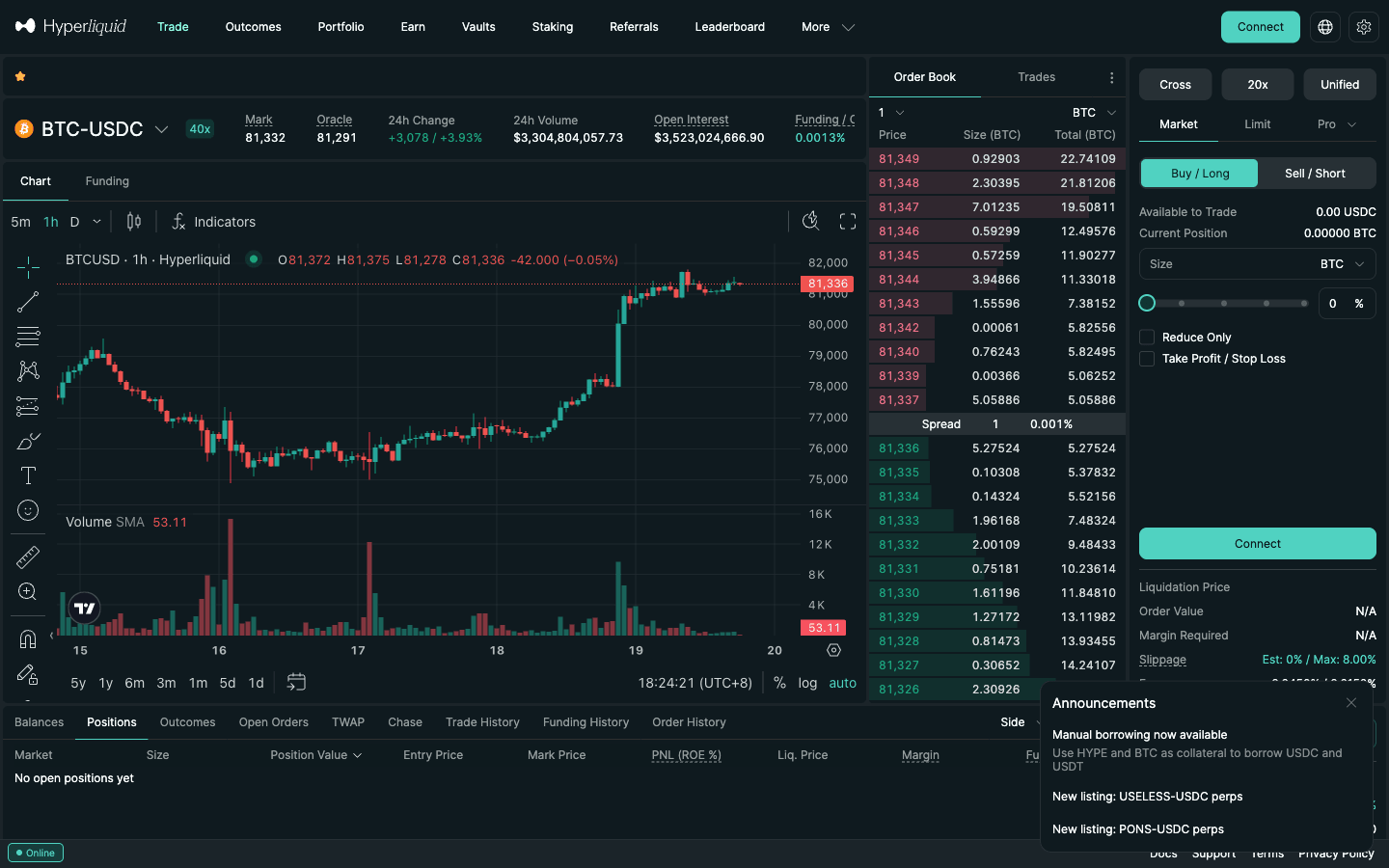
Hyperliquid: 178 perp markets on one USDC balance (as of October 20, 2026), PnL paid in USDC with the linear formula above, and typically $4–8B of perp volume a day. Code HOLYGRAIL gives 4% off fees on your first $25M of volume.
We earn a commission when you sign up through our links; it never raises your fees.
Key takeaways
- Collateral: USDT-M (linear) = a stablecoin; coin-M (inverse) = the coin you trade. One stablecoin balance can margin every pair; coin-M needs a separate coin balance per contract.
- Market: a coin-M long is double exposure, so it amplifies a bull market and hurts twice in a bear market. USDT-M collateral holds its dollar value: the default for bear markets, day trading and beginners.
- Liquidation: at 10x an inverse long is wiped out by a ~9.1% drop (10% for linear), and even at 1x by a 50% drop.
- Hedging: a 1x coin-M short keeps the dollar value of coins you hold flat. On a DEX, build it with spot plus a linear short.
- DEXs: all linear. Hyperliquid perps are technically quanto: USDT-priced, paid in USDC with no FX conversion.
1. Coin-M vs USDT-M at a glance
| USDT-margined (linear, USDT-M) | Coin-margined (inverse, COIN-M) | |
|---|---|---|
| Margin (collateral) asset | A stablecoin: USDT or USDC | The coin itself: BTC for BTCUSD, ETH for ETHUSD |
| PnL and fees settled in | The stablecoin | The coin |
| Collateral value in dollars | Stable (unless the stablecoin de-pegs) | Rises and falls with the coin |
| Contract size | In coins (e.g. 0.1 BTC) | In USD (e.g. $100 per Binance BTCUSD contract) |
| PnL curve | Linear: every $1 move is worth the same | Non-linear in coins: PnL = USD value × (1/entry − 1/exit) |
| Balances | One stablecoin balance margins every pair | A separate coin balance per contract (asset silos) |
| Risk exposure | The position only | Position + collateral: a long is double exposure |
| Market it suits | Bear or sideways markets, day trading | Bull markets (a long grows your coin stack), hedging holdings |
| Best for | Beginners, multi-pair and leveraged traders, DEX users | Miners and long-term holders hedging coins, coin-denominated accounts |
| Available on DEXs | Yes: Hyperliquid, Lighter, Aster, dYdX, edgeX | No: a CEX product (Binance COIN-M, Bybit, OKX, Deribit) |
Venue availability checked on the exchanges’ public APIs and docs, October 15, 2026. USDC-margined contracts (Hyperliquid, Lighter, Deribit, Binance USDC-M) follow the linear column.
2. What is a USDT-margined (linear) contract?
A USDT-margined contract is sized in coins and settled in a stablecoin. You buy, say, 0.1 BTC of exposure and post USDT or USDC as margin. A $1 move in BTC is $0.10 of profit or loss whatever the price level, which is why it is called linear. Your collateral is worth the same in dollars whether BTC rises or falls, so the only thing that moves your balance is the position.
Advantages
- One balance for everything. A single USDT or USDC balance margins BTC, ETH, SOL and every other pair, and profits from one market can support another under cross margin.
- Simple math. PnL, fees and liquidation prices are in dollars and match any calculator; results are easy to report in dollars or yen.
- Deeper markets. Most volume sits on linear books (see section 8), and it is the only design on perp DEXs.
- Stable collateral in a falling market. A crash hurts only your longs, not the margin behind them.
Disadvantages
- You must hold stablecoins, so a trader who owns BTC has to sell or swap it first (a taxable event in many countries).
- You carry stablecoin risk: if the margin stablecoin loses its peg, your collateral shrinks in dollars (section 9).
- Hedging a coin stack needs two legs, the coins and a short, rather than one self-contained position.
3. What is a coin-margined (inverse) contract?
A coin-margined contract is sized in dollars and settled in the coin. A Binance BTCUSD perpetual is $100 of BTC per contract: you post BTC, and profit, loss, fees and funding are paid in BTC. Because each contract has a fixed dollar value, the number of BTC it represents changes with price: $100 is 0.00125 BTC at $80,000 and 0.0025 BTC at $40,000. PnL in BTC therefore follows 1/price, which is why these are called inverse contracts.
Advantages
- Use the coins you already own. Holders, miners and funds that report in BTC can trade or hedge without selling into stablecoins.
- A clean hedge. A 1x short funded with your BTC keeps the dollar value of the stack flat and cannot be liquidated by a rally (section 5).
- Grow the coin stack in a bull market. Profits arrive in BTC, and a long gains from both the position and the rising collateral.
Disadvantages
- Double exposure on longs. The collateral falls with the position, so liquidation comes sooner (section 6).
- Asset silos. BTCUSD needs BTC, ETHUSD needs ETH: each coin is a separate margin balance, and you cannot use USDT without converting it first.
- Harder math. PnL is non-linear in coins, and every fee and funding payment has to be converted to your currency for records and taxes.
- Thinner markets and fewer venues. 30 COIN-M contracts on Binance against hundreds of USDⓈ-M pairs, and no inverse perps on DEXs.
4. Linear, inverse and quanto: the three designs
Every perpetual contract answers three questions: what you post as collateral, what currency your profit and loss is paid in, and what one contract is worth. The combinations give three designs.
| Design | Collateral | PnL paid in | Size unit | PnL formula | Examples |
|---|---|---|---|---|---|
| Linear (USDT- or USDC-margined) | Stablecoin | Stablecoin | Coins (e.g. 0.1 BTC) | size × (exit − entry) | Binance USDⓈ-M, Bybit linear, Lighter, Aster, dYdX, edgeX |
| Inverse (coin-margined) | The coin (BTC, ETH…) | The coin | USD (e.g. $100 per contract) | USD value × (1/entry − 1/exit), paid in the coin | Binance COIN-M, Bybit inverse, OKX inverse swaps, Deribit BTC/ETH-PERPETUAL |
| Quanto | A third currency | That currency, no FX conversion | Coins or a fixed multiplier | Linear PnL in the quote currency, paid 1:1 in the collateral currency | Hyperliquid (USDT-priced, paid in USDC); BitMEX ETHUSD (paid in BTC) until it settled |
Examples checked on the exchanges’ public APIs and docs, October 15, 2026.
Quanto is the third design: the price is quoted in one currency and PnL is paid in another at a fixed 1:1 rate, with no conversion. The textbook example was BitMEX’s ETHUSD, an ETH contract settled in bitcoin; BitMEX’s API shows it, and its inverse XBTUSD, as settled on September 16, 2026. Hyperliquid’s perps are a mild version: prices are in USDT, but PnL is paid in USDC one-for-one (section 11).
The perpetual part is the same for all three: no expiry, and a funding payment between longs and shorts keeps the contract near spot. See funding rates explained if that is new to you, and what are perpetual futures for the basics.
5. PnL math with worked examples
Linear: PnL (USD) = size in coins × (exit − entry). Equivalently, notional × % price change.
Inverse: PnL (coin) = contracts × contract value × (1 / entry − 1 / exit) for a long; the sign flips for a short. The dollar value of that PnL at the exit price equals the linear PnL; what differs is the number of coins and what your collateral is worth.
Example: the same $10,000 BTC long from a round $80,000 as in the short answer (Binance’s BTCUSD index was $80,724.25 on October 15, 2026). Linear: 0.125 BTC of exposure. Inverse: 100 Binance BTCUSD contracts of $100. The last column shows a 1x inverse short funded with 0.125 BTC, the classic hedge.
| BTC move | Linear long PnL | Inverse long PnL | 1x inverse short: balance after PnL |
|---|---|---|---|
| +10% ($88,000) | +$1,000 | +0.011364 BTC = +$1,000 at exit | 0.113636 BTC = $10,000 |
| −10% ($72,000) | −$1,000 | −0.013889 BTC = −$1,000 at exit | 0.138889 BTC = $10,000 |
| −50% ($40,000) | −$5,000 | −0.125000 BTC (all of a 1x collateral) | 0.250000 BTC = $10,000 |
| +100% ($160,000) | +$10,000 | +0.062500 BTC = +$10,000 at exit | 0.062500 BTC = $10,000 |
Our arithmetic, before fees and funding. Inverse PnL = 10,000 × (1/80,000 − 1/exit).
What the table shows:
- The coin count is asymmetric. The inverse long gains 0.0114 BTC on +10% but loses 0.0139 BTC on −10%. Measured in BTC, losses on the way down are bigger than gains on the way up. That curvature is the “convexity” of inverse contracts.
- The collateral moves too. If you posted 0.125 BTC as collateral for that inverse long (1x), your balance becomes 0.136364 BTC = $12,000 after +10% and 0.111111 BTC = $8,000 after −10%. You gained and lost $2,000 on a $10,000 stake: a 1x inverse long behaves like a 2x long in dollars.
- The 1x inverse short is flat in dollars. Its balance stays at exactly $10,000 whether BTC halves or doubles, because the short’s BTC PnL offsets the change in the collateral’s dollar value. That is why coin-margined shorts are the textbook hedge for a coin stack.
For the full PnL formulas on a linear DEX, including fees and funding, see how to calculate perpetuals PnL on Hyperliquid; to run your own numbers, estimate net PnL, ROE and break-even for a linear perp trade. Inverse trades need the 1/price formula above.
6. Liquidation distance: why inverse longs are fragile
Ignore maintenance margin and fees for a moment and ask: how far can the price move before equity reaches zero (the bankruptcy price)? For linear contracts it is simply 1 ÷ leverage. For inverse contracts with coin collateral, it is 1 ÷ (1 + 1/leverage) − 1 for a long and 1 ÷ (1 − 1/leverage) − 1 for a short.
| Leverage | Linear long | Inverse long | Linear short | Inverse short |
|---|---|---|---|---|
| 100x | −1.0% | −0.99% | +1.0% | +1.01% |
| 10x | −10.0% | −9.1% | +10.0% | +11.1% |
| 5x | −20.0% | −16.7% | +20.0% | +25.0% |
| 2x | −50.0% | −33.3% | +50.0% | +100.0% |
| 1x | −100% (never) | −50.0% | +100.0% | never |
Price move to zero equity, before maintenance margin, fees and funding. Real liquidation happens earlier because every venue liquidates at the maintenance margin: on Hyperliquid, maintenance margin is half the initial margin at max leverage (1.25% for BTC at 40x).
At high leverage the difference is small (9.1% vs 10% at 10x). At low leverage it is large: a 2x inverse long dies at −33%, and a 1x inverse long dies at −50%, whereas a 1x linear long can never be liquidated. Inverse shorts are the opposite: a 1x inverse short is never liquidated by a rally. If you are used to linear contracts, do not carry your liquidation intuition over to COIN-M longs.
What about 100x? At 100x the initial margin is 1% of the position, so a 1% move against you erases it whichever design you use, and the maintenance margin triggers liquidation before that. A 1% BTC move is ordinary intraday noise. Hyperliquid caps BTC well below that, at 40x, and Lighter at 50x; edgeX allows 100x (Aster’s separate 1001x mode is a different product with its own rules). Our liquidation price calculator covers the linear formulas used on DEXs, and DEX leverage tiers shows how caps fall as positions grow.
7. Bull market vs bear market
The choice people usually frame as “bull market: coin-M, bear market: USDT-M” comes straight from the collateral:
- Bull market, going long: a coin-margined long gains on the position and on the collateral. In the table in section 5, a 1x inverse long turned $10,000 into $12,000 on a 10% rise, like a 2x linear long. Traders who want to end up with more BTC, not more dollars, like this.
- Bear market, going long: the same position loses twice, and liquidation comes sooner (section 6). A USDT-margined long loses only on the position.
- Bear market, going short: a coin-margined short above 1x profits in dollars, but a 1x coin-margined short only holds the dollar value of the posted coins flat, since the short’s gains offset the falling collateral. To profit in dollars from a fall with simple math, short a USDT-margined contract.
- Sideways or unclear: USDT-margined, because an idle balance is not exposed to the coin at all.
The takeaway: coin-M is a tool for people who already think in coins. If you measure your results in dollars or yen, linear contracts keep the market bet in the position and nowhere else.
8. Funding, fees, contract sizes and the BTCUSD vs BTCUSDT price
- Funding works the same way on both designs, but inverse funding is paid in the coin. Interval and caps depend on the venue: Bybit’s BTCUSD inverse perp funds every 8 hours, Binance BTCUSDT every 8 hours, Hyperliquid every 1 hour and Lighter every 1 hour.
- Contract size: inverse contracts are denominated in USD. Binance COIN-M BTCUSD is $100 per contract and ETH or SOL $10; OKX BTC-USD-SWAP is $100; Deribit BTC-PERPETUAL $10 and ETH-PERPETUAL $1; Bybit inverse quantity is in USD. Linear contracts are sized in coins: one Hyperliquid contract is one unit of the underlying.
- Fees are charged on notional either way; on an inverse contract they are deducted in the coin. DEX fees for comparison: Hyperliquid 0.045% taker / 0.015% maker at the base tier (full schedule), Lighter 0% on Standard accounts, Aster 0% maker / 0.04% taker on its general crypto pairs.
- Liquidity: linear books are much deeper. In the 24 hours to 06:55 UTC on October 15, 2026 (a weekday on which BTC fell about 3%), Binance’s BTCUSDT traded $17.23B against $1.14B on BTCUSD_PERP, about 15x more; on Bybit, BTCUSDT traded $6.94B against $458.4M on inverse BTCUSD, about 15x.
Why is the BTCUSD price different from BTCUSDT? They are two separate order books quoted in different units. BTCUSD (coin-M) is priced in US dollars; BTCUSDT is priced in Tether, which trades a fraction above or below $1. Each contract also has its own funding rate and its own traders, so their prices drift a little apart. At 06:56 UTC on October 15, 2026, Binance’s index price for BTCUSD_PERP was $80,724.25 and for BTCUSDT $80,828.61, read in the same second: a 0.13% gap. Almost all of it is the stablecoin itself: a minute earlier Aster’s index valued 1 USDT at $0.9987, so a bitcoin cost about 0.13% more in USDT than in dollars. Charts of the two look the same at a glance; the gap matters only for arbitrage or very tight stops.
9. USDT vs USDC margin and de-peg risk
“USDT-margined” is often used loosely for any stablecoin-margined contract. The stablecoin itself differs by venue:
- USDC: Hyperliquid (every live main-dex and HIP-3 market on October 15, 2026), Lighter, dYdX, edgeX, Deribit’s linear perps and Binance’s USDC-M.
- USDT: Aster (577 of its perps, plus 25 on USD1), Binance USDⓈ-M, Bybit, OKX.
Both are dollar stablecoins, issued by different companies (Tether for USDT, Circle for USDC). For a perp trader the difference that matters is de-peg risk: if the stablecoin you post trades below $1, your margin is worth less in dollars even without a position, much as coin collateral would be, only far smaller in normal times. Exchanges price this in; Aster’s multi-asset index values USDT and USDC a hair under $1.
Hyperliquid adds a twist: its prices are in USDT but PnL is paid in USDC one-for-one (section 11). While the two trade near parity this is invisible; if they parted ways, a 1,000 USDT price move would still pay 1,000 USDC. If you want to hold USDT, Aster is the USDT-margined DEX; if you prefer USDC, Hyperliquid or Lighter.
10. Which DEXs and CEXs offer which (live counts)
| Venue | Type | Linear settlement | Inverse / coin-margined? | Notes |
|---|---|---|---|---|
| Hyperliquid | DEX | USDC (quanto: USDT-priced, USDC-paid; HYPE-USD and PURR-USD are USDC-priced) | No | 178 main perps (as of October 20, 2026) + 162 live HIP-3 perps, all USDC collateral; BTC and HYPE back perps only through portfolio margin |
| Lighter | DEX | USDC | No | 213 active perps (as of October 19, 2026); ETH and XAUT count as margin at 70% LTV with Multi-Asset Margin |
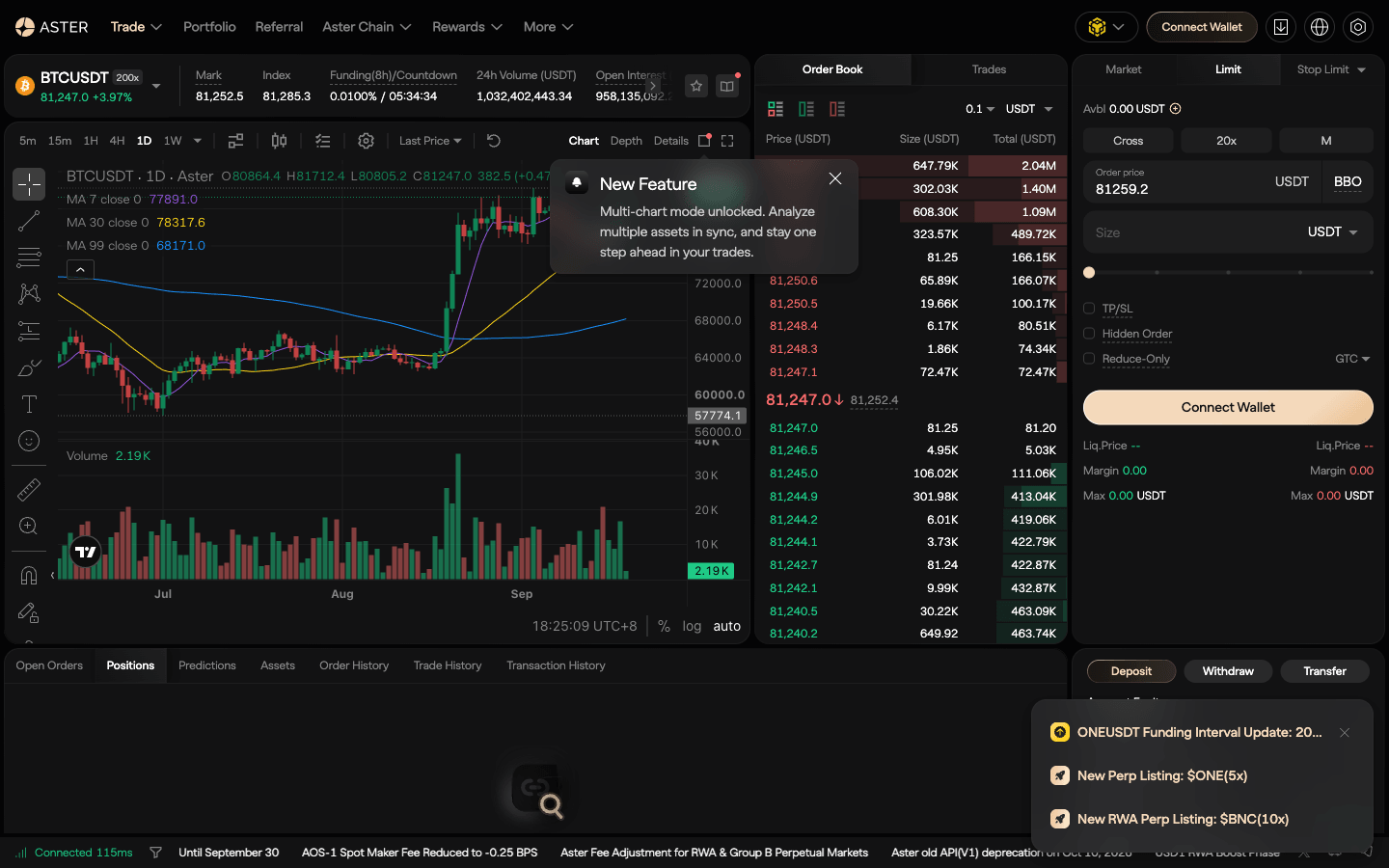
| Aster | DEX | USDT (577), USD1 (25), U (2) | No | Multi-Assets Mode lets BTC, ETH, BNB, SOL and ASTER count as collateral at a haircut |
| GMX | DEX | Linear USD PnL; collateral = a pool token (e.g. ETH or USDC) | No (docs: “GMX V2 uses linear PnL math”) | Long ETH with ETH collateral behaves partly inverse-like |
| Binance | CEX | USDⓈ-M | Yes: COIN-M, 20 perps + 10 quarterly | BTCUSD_PERP = $100 per contract |
| Bybit | CEX | USDT and USDC linear | Yes: 22 inverse perps + 4 inverse futures | BTCUSD up to 100x. Not available in Japan since 2026 |
| OKX | CEX | USDT (489 swaps) | Yes: 15 inverse swaps | BTC-USD-SWAP = $100 per contract |
| Deribit | CEX | USDC (140 perps) | Yes: 2 (BTC-PERPETUAL, ETH-PERPETUAL) | Inverse contracts are $10 (BTC) and $1 (ETH) |
Counted from public APIs on October 15, 2026, 06:55–06:57 UTC: Hyperliquid meta per dex (main-dex count is fetched at build time), Lighter orderBooks and assetDetails, Aster fapi exchangeInfo, Binance dapi, Bybit v5 instruments-info, OKX public instruments, Deribit get_instruments. GMX from its trading docs. Bybit closed its service for Japan residents in 2026 (Bybit announcements).
Why DEXs stay linear: one stablecoin balance can margin every market at once, liquidation engines only have to value one currency, and on-chain settlement in USDC or USDT is simple to audit. Coin collateral arrives through the side door instead, as multi-asset margin:
- Aster: Multi-Assets Mode (cross margin only) values BTC, ETH and BNB at 95%, SOL at 90% and ASTER at 80%. Losses create a negative USDT balance, which is auto-exchanged from your other assets once it passes −$10,000. This is the closest DEX analogue to coin-M: you post BTC and trade, but settlement stays linear in USDT.
- Lighter: with Multi-Asset Margin (requires a Unified Trading Account), ETH and XAUT count at a 70% LTV, capped at 2,000 ETH and 500 XAUT per user. Positions still settle in USDC.
- GMX: you choose the collateral token of a pool, for example ETH or USDC in an ETH market. Its docs are explicit that PnL is linear; ETH collateral just adds ETH exposure on top of the position. GMX trades against a liquidity pool rather than an order book; AMM vs order-book DEXs explains what that changes for price and fees.
Pick your stablecoin: USDC or USDT
USDC: Hyperliquid, BTC up to 40x and funding every 1 hour. Join with HOLYGRAIL for 4% off fees on the first $25M; the code is accepted until your account passes $10,000 of volume.
USDT, or BTC as collateral: Aster runs 577 USDT-margined perps (0% maker / 0.04% taker on general crypto pairs), and its Multi-Assets Mode counts BTC at 95%. Our code: DTLpLc.
11. Hyperliquid: quanto contracts and portfolio margin
Hyperliquid’s contract specifications describe “one main style of margining for perpetual contracts: USDC margining, USDT denominated linear contracts. That is, the oracle price is denominated in USDT, but the collateral is USDC.” Because “no conversions with the USDC/USDT exchange rate are applied, these contracts are technically quanto contracts where USDT pnl is denominated in USDC.” In practice: a BTC long that gains 1,000 USDT of price move pays you 1,000 USDC. As long as USDT and USDC trade near parity, you can treat it as a plain linear contract; the quanto effect only matters if one stablecoin de-pegs from the other.
The exceptions are HYPE-USD and PURR-USD, the only perps whose oracle is denominated in USDC, because their most liquid spot market is Hyperliquid’s own spot book. HIP-3 markets (builder-deployed perps such as trade.xyz stocks) may choose any quote asset as collateral; on October 15, 2026 every HIP-3 dex with live markets (xyz, para, io and mkts, 162 live perps between them) used USDC. Dexs set up with USDH, USDe or USDT0 collateral had no live markets.
Portfolio margin is Hyperliquid’s closest thing to coin margining. Accounts with more than $5M of weighted volume or more than $10,000 of account value can let spot BTC (LTV 50%) and HYPE (LTV 65%) back perp positions: when your USDC runs short, the system borrows USDC against the coins automatically. The upper limit is stated as $25M of account value in the docs and $5M in the support FAQ. The docs’ own example is the carry trade: hold 1 BTC spot, short 1 BTC perp, and the spot and perp PnL offset each other. The account is liquidatable when its portfolio margin ratio exceeds 95%. Borrowed USDC pays interest (5% APY base, rising steeply above 80% utilization), so this is not free leverage. Details: cross vs isolated margin and portfolio margin.
12. The inverse-short hedge, and how to build it on a DEX
The main reason to use coin-margined contracts is to lock in the dollar value of coins you do not want to sell: miners covering costs, funds with BTC mandates, long-term holders expecting a drawdown. Post your BTC, short the same dollar amount 1x, and your balance stays flat in dollars (table in section 5). You keep the coins, you are never liquidated by a rally, and funding is the ongoing cost or income.
On a DEX you get the same economics with a linear short:
- Hold the coin as spot (on Hyperliquid you can deposit native BTC or buy spot BTC on its spot book).
- Open a USDC-margined short of equal size at low leverage, and keep enough USDC margin for a strong rally, or use portfolio margin so the spot BTC backs the short.
- Rebalance when the price moves a lot: the linear short’s size is in coins, so it stays matched to your spot coins; the USDC margin is what needs topping up in a rally.
- Watch funding: when longs pay shorts (positive funding), the hedge earns; when funding turns negative it costs you. See how to hedge crypto with perpetuals.
The difference from a true inverse short: on a DEX the hedge lives in two legs (spot plus a USDC position), so a sharp rally draws on your USDC margin while the spot leg’s gain sits in BTC, unless portfolio margin connects them.
13. Which should you use?
Use USDT-margined (linear) if you:
- are new to futures, or trade short-term, and want PnL and liquidation math that matches your calculator;
- expect a bear or sideways market, or simply do not want your margin exposed to the coin;
- trade several pairs and want one collateral balance;
- trade on a DEX (it is the only option on Hyperliquid, Lighter, Aster, dYdX and edgeX);
- want to report PnL in dollars or yen without converting every trade from BTC.
Use coin-margined (inverse) if you:
- hold BTC or ETH and want to hedge it without selling (1x inverse short);
- are bullish, want to accumulate the coin itself and accept that a long is double exposure;
- have access to a CEX that lists them; check the venue’s restricted-country list first (Bybit, for example, no longer serves Japan).
For most traders reading this, the answer is linear. It is simpler, BTC traded roughly 15 times more volume on linear contracts than on inverse ones at Binance and Bybit on October 15, 2026, and it is what the perp DEXs offer. On a DEX that means Hyperliquid with code HOLYGRAIL for USDC margin (4% off fees on your first $25M) or Aster for USDT. If you are choosing a venue, the best DEX guide and the perp DEX ranking compare them, and DEX vs CEX fees covers the cost side. New to DEXs? Start with what is a DEX, or perpetuals vs spot trading.
14. FAQ
How do I calculate PnL on a USDT-margined perpetual versus a coin-margined perpetual?
USDT-margined (linear): PnL = position size in coins × (exit price − entry price), paid in USDT; a short uses (entry − exit). Coin-margined (inverse): PnL = number of contracts × contract value in USD × (1 / entry − 1 / exit), paid in the coin; a short flips the sign. Example, a $10,000 BTC long from $80,000 that exits at $88,000: linear 0.125 BTC × (88,000 − 80,000) = +1,000 USDT; inverse 100 contracts × $100 × (1/80,000 − 1/88,000) = +0.011364 BTC, which is +$1,000 at the exit price. Both are before trading fees and funding.
What is the difference between coin-margined and USDT-margined futures?
The difference is the collateral and settlement currency. A USDT-margined (linear) contract uses a stablecoin as collateral and pays profit and loss in that stablecoin, so a $10,000 long gains $1,000 on a 10% rise and loses $1,000 on a 10% fall. A coin-margined (inverse) contract is sized in dollars but uses the coin itself as collateral and pays PnL in the coin, so the coin amount you win or lose is non-linear and your collateral moves with the market.
Is an inverse perpetual the same as a coin-margined one, and a USDT perpetual the same as a linear one?
In practice, yes. Exchanges use “coin-margined”, “COIN-M” and “inverse” for the same design: the contract is quoted in USD (for example $100 per BTCUSD contract on Binance) and settled in the coin. “Linear”, “USDT-margined”, “USDT-M” and Binance’s “USDⓈ-M” describe the stablecoin design; USDC-margined contracts are linear too.
Is coin-margined or USDT-margined better in a bull or bear market?
A coin-margined long gains twice in a bull market, from the position and from the rising value of the coin collateral, and loses twice in a bear market. USDT-margined collateral keeps its dollar value, so it suits bear and sideways markets, short-term trading and anyone who measures results in dollars. A 1x coin-margined short is not a bearish bet: it only keeps the dollar value of the coins you post flat.
Can I use USDT to trade coin-margined contracts?
Not directly. A coin-margined contract is margined in its own coin, so to trade BTCUSD you must first convert USDT to BTC and move it into the coin-margined wallet, and ETHUSD needs ETH. Each coin is a separate balance. USDT-margined contracts avoid that: one USDT (or USDC) balance margins every pair. On DEXs there is no coin-margined option at all; Aster and Lighter accept some coins as collateral, but PnL is still settled in stablecoins.
Are Hyperliquid perpetuals coin-margined?
No. Hyperliquid’s contract specifications describe its perps as USDC-margined, USDT-denominated linear contracts. Because no USDC/USDT conversion is applied, they are technically quanto contracts: the price is in USDT and the PnL is paid 1:1 in USDC. HYPE-USD and PURR-USD are the only USDC-denominated perps. BTC or HYPE can back perps only through portfolio margin, which borrows USDC against them (BTC at a 50% LTV).
Which DEX offers coin-margined (inverse) perpetuals?
None of the large order-book perp DEXs we checked on October 15, 2026: Hyperliquid, Lighter, Aster, dYdX and edgeX all settle in stablecoins. Hyperliquid, Lighter, dYdX and edgeX use USDC; Aster uses USDT for 577 of its markets and USD1 for 25. GMX lets you post ETH or BTC as collateral, but its docs say it uses linear PnL math. Inverse contracts remain a CEX product (Binance COIN-M, Bybit, OKX, Deribit).
Is there a trading platform where I don’t need a broker and can use stablecoins as collateral?
Yes: a perpetual DEX (decentralized exchange). Instead of opening an account with a broker, you connect a self-custody wallet, deposit stablecoins and trade perpetual futures against them. Hyperliquid, Lighter, dYdX and edgeX take USDC as collateral; Aster takes USDT (and USD1). Your funds sit in the exchange’s on-chain contracts rather than with an intermediary, but you still carry smart-contract, liquidation and stablecoin risk, and you should check whether your country restricts these venues. How decentralized exchanges work: what is a DEX.
Is it better to have USDT or USDC as margin?
For perps, the venue decides: Hyperliquid and Lighter take USDC, Aster takes USDT (and USD1), and Binance and Bybit offer both. Both are dollar stablecoins, from different issuers (Tether for USDT, Circle for USDC), so the practical risk is a de-peg: if your margin stablecoin trades below $1, your collateral is worth less in dollars even with no open position. On Hyperliquid prices are in USDT and PnL is paid in USDC, so a gap between the two would also change what a price move pays.
Is USDT considered a stablecoin?
Yes. USDT (Tether) is a stablecoin designed to track the US dollar 1:1, and it is the margin asset of most “USDT-margined” contracts on CEXs and on Aster. “Stable” describes the target, not a guarantee; it is why exchanges value it slightly below $1 in multi-asset margin and why Hyperliquid documents its USDT-priced, USDC-settled perps as quanto contracts.
How risky is 100x leverage?
At 100x your initial margin is 1% of the position, so a 1% move against a linear position wipes it out, and liquidation comes earlier, when equity falls to the maintenance margin. An inverse long with coin collateral at 100x reaches zero after about a 0.99% drop. A 1% BTC move is ordinary intraday noise. Hyperliquid caps BTC at 40x and Lighter at 50x; edgeX allows 100x, as does Bybit’s inverse BTCUSD (100x).
Why does a coin-margined long get liquidated sooner?
Because the collateral falls with the position. At 10x, a linear long reaches zero equity after a 10% drop, but an inverse long with coin collateral reaches it after about 9.1%, and even a 1x inverse long is wiped out by a 50% drop. The same effect helps shorts: an inverse short with coin collateral survives a larger rally.
Why is the BTCUSD (coin-M) price different from BTCUSDT?
They are separate order books priced in different units: BTCUSD in US dollars, BTCUSDT in Tether, which trades a fraction away from $1. Each also has its own funding rate. At 06:56 UTC on October 15, 2026, Binance’s BTCUSD_PERP index price was $80,724.25 and its BTCUSDT index $80,828.61, a 0.13% gap. Aster valued 1 USDT at $0.9987 a minute earlier, which alone makes a bitcoin about 0.13% dearer in USDT than in dollars.
Can I build an inverse-style hedge on a DEX?
Yes, approximately. Hold spot BTC and open a USDC-margined short of the same size; the combined dollar value stays roughly flat, minus funding. On Hyperliquid, portfolio margin (account value above $10,000 or weighted volume above $5M) lets the spot BTC collateralize the short at a 50% LTV, which is the closest DEX equivalent of a coin-margined short.
Start trading linear perps on a DEX
Hyperliquid for depth: code HOLYGRAIL, 4% off fees on your first $25M. Want zero fees? Lighter charges 0% on Standard accounts; code 718610TD: first week of Premium fees rebated if you upgrade. Prefer USDT margin? Aster with code DTLpLc.
Disclosure: HOLYGRAIL, 718610TD and DTLpLc are our referral codes; we earn a share of fees paid by referred accounts. Contract counts, volumes and prices were read from the exchanges’ public APIs on October 15, 2026; PnL and liquidation figures are our own arithmetic before fees and funding. Not financial advice.