
Quick picks (October 2026)
- Hyperliquid: best overall. Perps up to 40x on BTC plus spot margin (USDC loans against BTC or HYPE) on one balance; 0.045% taker.
- Lighter: best for zero-fee perps (0% / 0% on Standard accounts), BTC up to 50x.
- Aster: best for maximum leverage, BTC up to 200x in Pro mode and 1001x in 1001x mode.
- edgeX: 100x on BTC and ETH with an email login.
- dYdX: fully on-chain order book on its own chain, BTC up to 50x.
- GMX: pool-based, oracle-priced trading on Arbitrum, up to 100x.
Trade perps and spot margin in one account
Hyperliquid offers perps, spot and USDC borrowing against BTC or HYPE on the same balance. Code HOLYGRAIL takes 4% off your fees on the first $25M of volume.
We earn a commission when you sign up through our links; it never raises your fees.
Quick answers: holding cost, funding, fees, leverage, gold and FX
Which perps DEX is cheapest for holding positions long term?
Aster (Pro) for BTC, Lighter (Standard) for ETH, over the 30 days to October 14, 2026. A $10,000 long held that month cost, funding plus a taker round trip: BTC Aster (Pro) $44.99, Lighter (Standard) $56.91, Hyperliquid $82.05; ETH Lighter (Standard) $44.52, Aster (Pro) $55.94, Hyperliquid $85.05. On a long hold, funding costs more than trading fees because it is charged every hour or interval on the full position, so the cheapest venue is the one where your side pays the least funding, and that ranking changes from month to month. If you are short, read it the other way: the venue with the highest funding paid shorts the most.
Which perps DEX has the lowest funding rates?
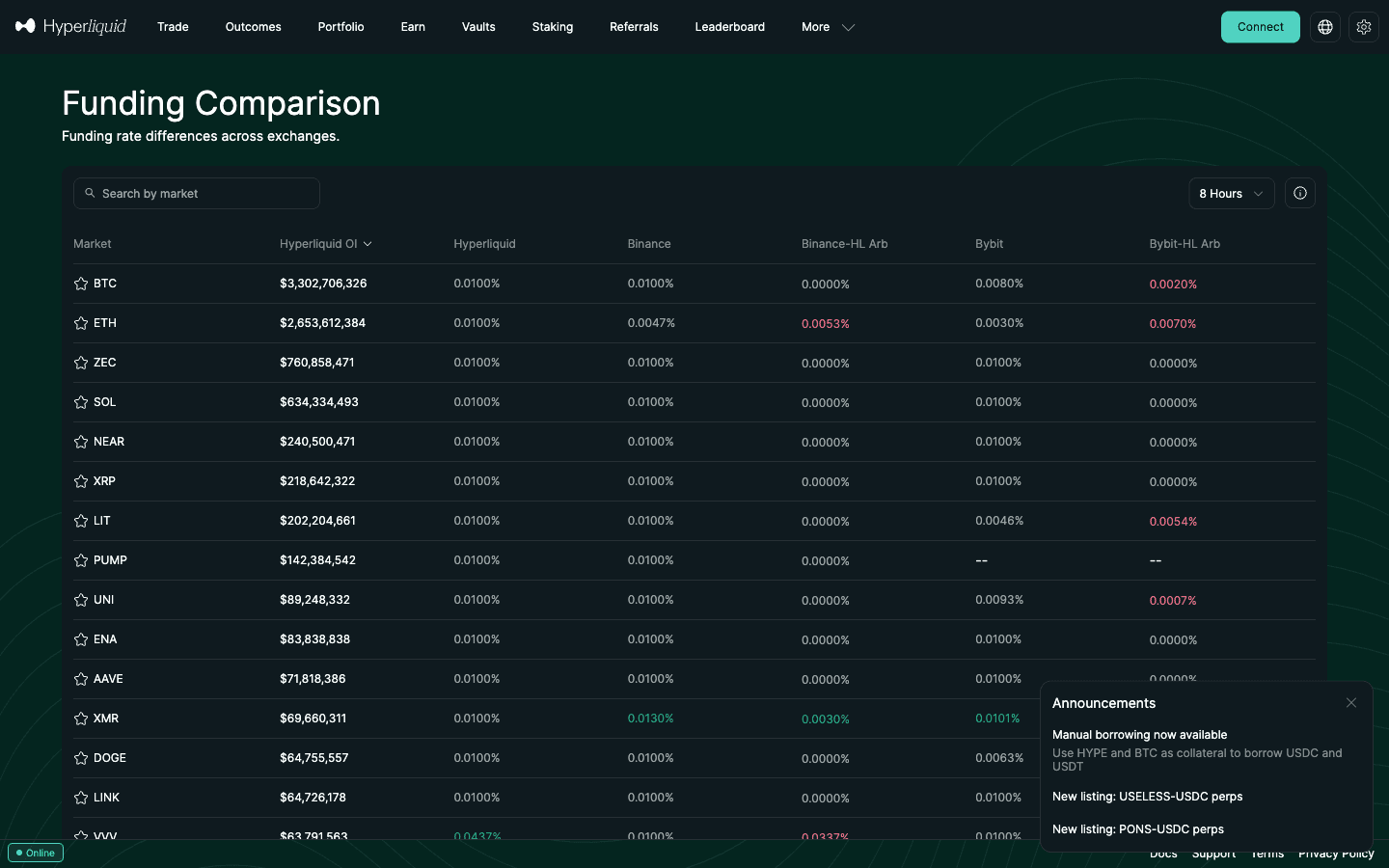
Aster on BTC, Lighter on ETH, over the same 30 days. Total funding a long paid: BTC Aster 0.370%, Lighter 0.569%, Hyperliquid 0.731%; ETH Lighter 0.445%, Aster 0.479%, Hyperliquid 0.760%. Aster settles funding every 8 hours, Hyperliquid and Lighter every hour, and every venue’s rate follows its own demand, so check the live rate before a long hold. Low funding helps longs; shorts collect more where it is high. How the rate is set: crypto funding rates explained.
How do fees compare across perps DEXs?
Lighter is cheapest: zero trading fees on Standard accounts. At base tier, opening and closing $10,000 with market orders costs Lighter (Standard) $0.00, Aster (Pro, VIP 1) $8.00, Hyperliquid $9.00, edgeX $9.00, dYdX $10.00, and $8.00–$12.00 on GMX in position fees (plus price impact). Lighter's zero fees come with a 300 ms delay on taker orders; Hyperliquid's 0.045% taker drops to $8.64 per round trip with a 4% referral discount, and maker orders are cheaper on the venues that charge takers (0.015% on Hyperliquid, 0% on Aster). Spot margin on Hyperliquid adds interest on the loan instead of funding. Two-venue detail: Lighter vs Aster fees.
Which perps DEX lets you trade with the highest leverage?
Aster: up to 1001x on BTC in its separate pool-based 1001x mode and 200x on its Pro order book (on the first $400 of notional). Next come edgeX and GMX (100x and 100x), then Lighter and dYdX (50x and 50x) and Hyperliquid (40x on BTC, 50x on trade.xyz’s FX markets). At 100x a 1% move wipes out your margin, so the cap is a ceiling, not a target.
Which perps DEX has the tightest spreads on gold and forex?
Aster quoted the tightest gold spread and Lighter was cheapest to trade in our October 15, 2026 snapshot: XAUUSDT and XAUUSD1 at a median 0.02 bps, and a $10,000 market order on Lighter XAU cost about $0.19 because Standard accounts pay no fee. Hyperliquid’s xyz:GOLD had the deepest book ($4.1M within ±10 bps) but charges 9 bps taker. Forex: see the gold and FX table.
Which DEXs offer unified margin across spot and perpetuals?
Hyperliquid and Lighter. Hyperliquid’s Unified account and portfolio margin put spot and cross-margin perps on one balance (portfolio margin also borrows against HYPE and BTC automatically); Lighter’s Unified Trading Account shares USDC margin between spot and perps. Aster’s Multi-Asset Mode pools coins as perp collateral only. Details: unified margin compared.
Which exchange offers spot margin with the best borrow terms?
Hyperliquid, among DEXs: the only venue here that lends stablecoins against your coins, at 5% APY while the pool is below 80% utilization (USDC: 78.3% on October 15, 2026). Binance and Bybit charged about 4.8% and 3.9% a year on USDT that day and lend coins for shorting, but they are custodial and require ID. Rates and the kink: borrow interest.
| Question | Short answer | Numbers behind it |
|---|---|---|
| Cheapest to hold long term | Aster (Pro) for BTC longs, Lighter (Standard) for ETH (30 days to October 14, 2026) | BTC long, 30 days, $10,000: Aster (Pro) 0.370% funding + $8.00 fees; Lighter (Standard) 0.569% funding + $0.00 fees; Hyperliquid 0.731% funding + $9.00 fees |
| Lowest funding | Aster (BTC), Lighter (ETH) | 30-day sums paid by a long: BTC Aster 0.370%, Lighter 0.569%, Hyperliquid 0.731%; ETH Lighter 0.445%, Aster 0.479%, Hyperliquid 0.760% |
| Lowest trading fees | Lighter Standard (0% / 0%) | Taker round trip on $10,000: Lighter (Standard) $0.00, Aster (Pro, VIP 1) $8.00, Hyperliquid $9.00, edgeX $9.00, dYdX $10.00; GMX $8.00–$12.00 |
| Highest leverage | Aster (1001x in 1001x mode, 200x in Pro) | BTC caps: edgeX 100x, GMX 100x, Lighter 50x, dYdX 50x, Hyperliquid 40x |
| Gold: tightest spread / cheapest / deepest | Aster / Lighter / Hyperliquid | Lighter XAU $0.19, Aster XAUUSDT $1.26, Aster XAUUSD1 $1.26, Hyperliquid PAXG $4.62, Hyperliquid xyz:GOLD $9.12 per $10,000 market order |
| Unified spot + perps margin | Hyperliquid, Lighter | Hyperliquid portfolio margin: HYPE 65%, BTC 50% loan-to-value; Lighter ETH and XAUT 70% |
| Spot margin borrow rate | Hyperliquid 5% APY (DEX) | USDC utilization 78.3%; Binance USDT about 4.8%, Bybit about 3.9% a year |
Funding: sums of the 720 hourly payments (Hyperliquid, Lighter) and 90 eight-hour payments (Aster) from September 15, 00:00 UTC to October 14, 23:00 UTC, 2026, read from each venue’s public API on October 15. Gold books: median of 20 snapshots on October 15, 2026 (method below). Fees, leverage caps and loan-to-value from each venue’s docs and API (dates in the registry); caps fall as position size grows (leverage tiers). Next month’s funding can rank the venues differently.
Short or running a carry? Hyperliquid paid shorts the most
Over the same 30 days, a Hyperliquid short received 0.731% on BTC and 0.760% on ETH, more than on Lighter or Aster. Hyperliquid also has the deepest DEX perp books, and spot margin on the same balance. Join with code HOLYGRAIL before your first trade: 4% off fees on your first $25M of volume.
We earn a commission when you sign up through our links; it never raises your fees.
1. Best DEXs for margin and leverage trading (October 2026)
Ranked for someone who wants to trade with borrowed money or leverage without handing custody to an exchange. The first question is whether a venue lets you borrow (true spot margin) or only offers leverage through perpetual futures; after that, liquidity, fees, leverage limits and track record decide the order. For a pure volume league table, see our live perpetual DEX ranking.
1. Hyperliquid: best overall for margin trading
Best for: perps, spot and spot margin on one balance
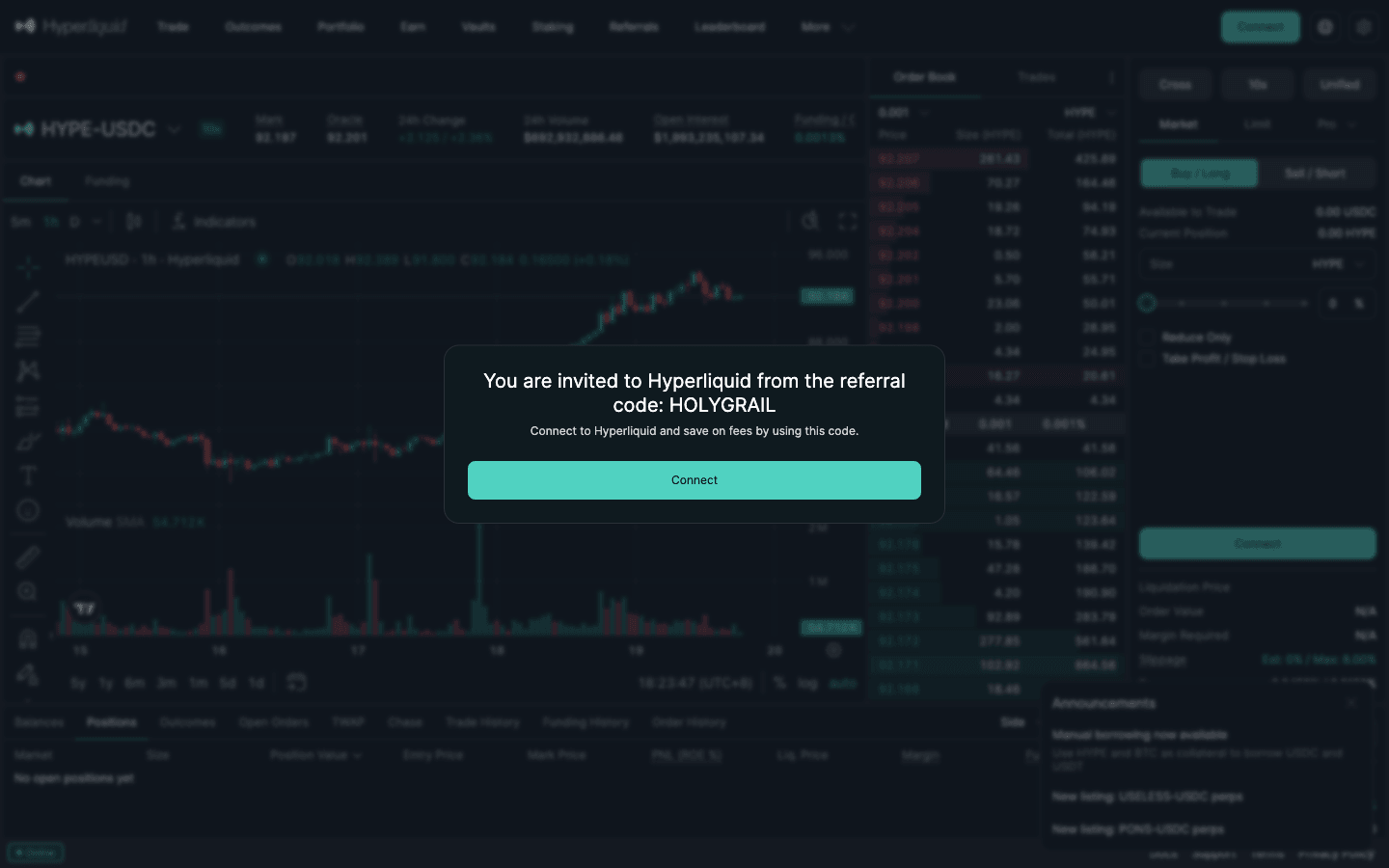
Hyperliquid runs a fully on-chain order book on its own layer-1 and is the most liquid perp DEX in our live ranking: $4.03B of perp volume in the 24 hours to October 20, 2026, and $4–8B on a typical September 2026 day. It is the only venue here with both kinds of margin: perps up to 40x on BTC and 25x on ETH, and manual or portfolio-margin borrowing of USDC and USDT against BTC (50% loan-to-value) or HYPE (65%). Stablecoin loans cost 5% APY while the pool is below 80% utilization. Base fees are 0.045% taker / 0.015% maker on perps and 0.070% / 0.040% on spot, with no gas on orders. Sign in with a wallet or an email; no ID. Watch-outs: spot margin tops out around 2x on BTC, only stablecoins can be borrowed (so no spot shorts), and in 2025 market-manipulation episodes (JELLY, POPCAT) hit the community HLP vault rather than user balances.
2. Lighter: best for zero-fee perps
Best for: active traders who want to pay nothing per trade
Lighter is an order-book perp and spot DEX built as its own zk-rollup on Ethereum. Standard accounts pay 0% maker and 0% taker; the price is latency (300 ms for taker orders). Premium accounts pay 0.028% taker / 0.004% maker for faster fills. BTC and ETH go up to 50x. There is no borrow market, so leverage comes from perps; deposited ETH can count toward margin after a haircut. Code 718610TD: first week of Premium fees rebated. Its terms exclude the US, Canada, the UK and several other countries.
3. Aster: best for maximum leverage
Best for: very high leverage and hidden orders
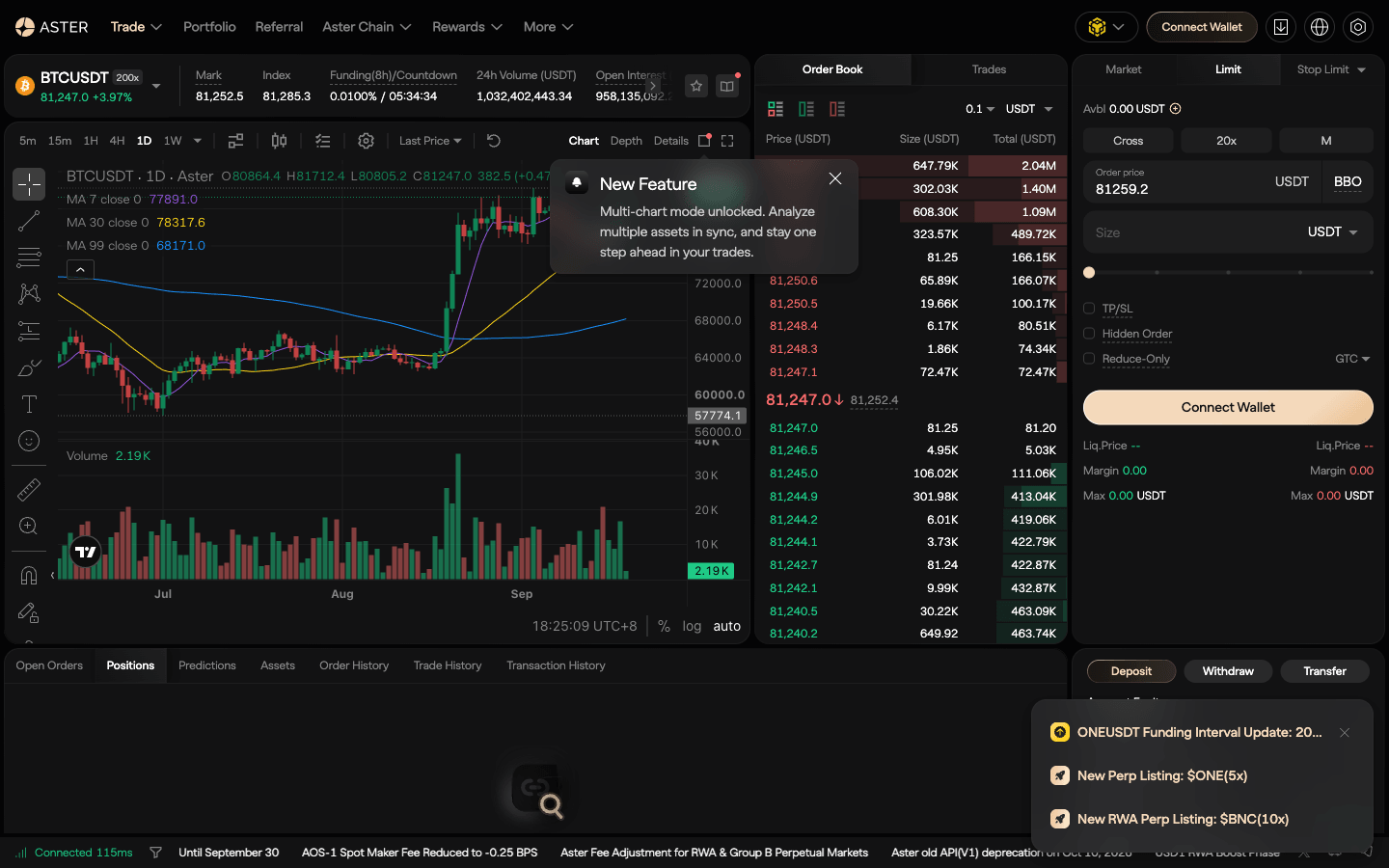
Aster (APX and Astherus became Aster in March 2025) has several perp modes. Pro mode is a normal order book: BTC up to 200x on the first $400 of notional and 150x up to $300,000, at 0.040% taker and 0% maker (VIP 1). The separate pool-based 1001x and Shield modes go up to 1001x on BTC, each with its own fee model. Hidden orders keep your size off the public book. There is no borrow market. Code DTLpLc rebates 5% of your fees. High leverage is the feature and the risk: see how risky 100x is below.
4. edgeX: 100x on BTC and ETH with an email login
Best for: high leverage on majors and US stock perps
edgeX is an order-book perp DEX on a StarkEx rollup. BTC and ETH go up to 100x, base fees are 0.045% taker / 0.040% maker, and funding settles every 4 hours. It also lists US stock and ETF perps next to crypto. You can sign in with a wallet or an email. No borrow market. Referee benefit on code HOLYGRAIL: none published.
5. dYdX: fully on-chain order book on its own chain
Best for: traders who want decentralization over speed
dYdX v4 runs its order book on its own Cosmos chain. BTC and ETH go up to 50x, fees start at 0.050% taker / 0.010% maker (referred accounts start at 0.040% taker), and sign-in works with Google, email or a wallet. It has the longest history of the six, but its liquidity has thinned, and in October 2025 the chain halted for about eight hours after a liquidation edge case. It excludes the US, Canada and the UK. We hold no dYdX code. Head to head: Hyperliquid vs dYdX.
6. GMX: pool-based trading on Arbitrum
Best for: oracle-priced trades without an order book
GMX V2 lets you trade against liquidity pools at oracle prices on Arbitrum and Avalanche, with leverage up to 100x. It is the closest thing among perp DEXs to margin trading: positions borrow from the liquidity pool, so you pay a borrow fee while one is open, plus funding and a 0.04%–0.06% position fee on open and close (plus price impact). A V1 vulnerability let about $42M be withdrawn in July 2025; the attacker returned the funds in exchange for a bug bounty, and V2 was not affected. GMX referral codes take 5–10% off open and close fees; we hold none. Details: Hyperliquid vs GMX.
What about Drift? Drift used to be Solana’s main venue with perps and spot borrowing in one account. It was exploited in April 2026 and its program is paused; a fork called Velocity has launched separately. We leave both out until they have a track record again. Spot-only swap DEXs such as Uniswap and Jupiter do not offer margin at all.
How we ranked
Checked on October 15, 2026. We scored each venue on six things, in this order: (1) whether you can borrow for spot margin as well as trade perps; (2) liquidity, from our live perp DEX ranking; (3) base fees; (4) maximum BTC leverage and how liquidation works; (5) track record and incidents; (6) access: sign-up without ID and which countries the terms exclude. Fees, leverage caps and loan-to-value ratios come from each venue’s docs, fee pages or public API. We earn referral commissions from Hyperliquid, Lighter, Aster and edgeX; dYdX and GMX are in the list without a code.
2. Spot margin vs perp leverage by venue
Spot margin and perp leverage are different products, so the table shows them in separate columns. Only Hyperliquid has both.
| DEX | Type / chain | Spot margin (borrowing) | Max perp leverage (BTC) | Base taker / maker | KYC and access | Referral benefit |
|---|---|---|---|---|---|---|
| Hyperliquid | Order book on its own L1 (HyperCore) | Yes: borrow USDC/USDT against BTC (50% LTV, about 2x) or HYPE (65%, about 2.9x) | 40x | 0.045% / 0.015% (spot 0.070% / 0.040%) | None; terms exclude the US, Ontario, sanctioned regions | 4% off fees on your first $25M (HOLYGRAIL) |
| Lighter | Order book, zk-rollup on Ethereum | No borrow market; with a Unified Trading Account, deposited ETH or XAUT counts as perp margin after a haircut | 50x | 0% / 0% (Standard); 0.028% / 0.004% (Premium) | None; terms exclude the US, Canada, the UK and others | First week of Premium fees rebated |
| Aster | Order book (Pro mode) plus pool-based 1001x and Shield modes | No borrow market | 200x (first $400), 150x to $300,000; 1001x in 1001x mode | 0.040% / 0% (Pro, VIP 1) | None in the normal sign-up; terms exclude the US, Canada, the UK and others | 5% |
| edgeX | Order book, StarkEx rollup | No borrow market | 100x | 0.045% / 0.040% | None; terms exclude the US, Canada and others | None published |
| dYdX | Order book on its own Cosmos chain | No borrow market | 50x | 0.050% / 0.010% | None; excludes the US, Canada, the UK and others | No code from us (referred accounts start at 0.040% taker) |
| GMX | Liquidity pool, oracle prices; Arbitrum and Avalanche | No spot borrowing, but open positions pay a borrow fee to the pool (plus funding) | Up to 100x | 0.04%–0.06% position fee | None (wallet) | 5–10% off open/close fees with a GMX code (we hold none) |
From each venue’s docs, fee pages and public API, re-checked between September 24 and October 15, 2026. Leverage caps fall as position size grows; full tables in our leverage tiers comparison. Restricted countries are the ones each venue’s terms name; all also exclude sanctioned persons.
No KYC is not “no rules”. These DEXs ask for no identity documents because you trade from your own wallet and the venue never holds an account in your name. But every one of them lists restricted countries in its terms, your on-chain activity is public, and profits are taxable where you live. If your country is on a venue’s list, use another venue; we don’t give advice on getting around geo-blocks. More in our no-KYC trading guide. Comparing with Binance or Bybit? See DEX vs CEX fees.
Pick a venue and start with a small position
Hyperliquid for perps plus spot margin (code HOLYGRAIL, 4% off fees), Lighter for zero-fee perps (718610TD), Aster for maximum leverage (DTLpLc).
3. Gold and FX perps: tightest spreads and cheapest books (October 15, 2026)
On gold, every order book we measured quoted within a fraction of a basis point, so the fee, not the spread, decides what a trade costs. Aster’s XAUUSDT and XAUUSD1 quoted the tightest (median 0.02 bps, one price tick); Lighter’s XAU was cheapest to trade because Standard accounts pay no fee; and Hyperliquid’s xyz:GOLD, the trade.xyz gold market, had the deepest book, about 2 times Lighter’s within ±10 bps, at a 9 bps taker fee. On forex, Lighter was cheaper for a $10,000 order on EUR/USD and GBP/USD and Hyperliquid’s trade.xyz markets were cheaper on USD/JPY, while Hyperliquid’s FX books were 4–20 times deeper within ±10 bps, which matters more as size grows.
Gold perps: spread, depth and cost per $10,000
| Venue · market | Cost of a $10,000 market order | Median spread | Depth ±10 bps | Taker fee | Max leverage |
|---|---|---|---|---|---|
| Lighter · XAU | $0.19 | 0.39 bps | $1.8M | 0 bps (Standard) | 25x |
| Aster · XAUUSDT | $1.26 | 0.02 bps | $1.1M | 1.25 bps | 100x (first $50,000) |
| Aster · XAUUSD1 | $1.26 | 0.02 bps | $2.4M | 1.25 bps | 20x |
| Hyperliquid · PAXG | $4.62 | 0.24 bps | $722K | 4.5 bps | 10x |
| Hyperliquid · xyz:GOLD (trade.xyz) | $9.12 | 0.24 bps | $4.1M | 9 bps | 25x |
Forex perps: spread, depth and cost per $10,000
| Venue · market | Cost of a $10,000 market order | Median spread | Depth ±10 bps | Taker fee | Max leverage |
|---|---|---|---|---|---|
| Lighter · EURUSD | $0.38 | 0.76 bps | $110K | 0 bps (Standard) | 50x |
| Hyperliquid · xyz:EUR (trade.xyz) | $1.79 | 1.78 bps | $487K | 0.9 bps | 50x, isolated |
| Lighter · USDJPY | $2.18 | 4.37 bps | $76K | 0 bps (Standard) | 50x |
| Hyperliquid · xyz:JPY (trade.xyz) | $1.85 | 1.90 bps | $1.5M | 0.9 bps | 50x, isolated |
| Lighter · GBPUSD | $0.87 | 1.74 bps | $89K | 0 bps (Standard) | 50x |
| Hyperliquid · xyz:GBP (trade.xyz) | $1.65 | 1.51 bps | $474K | 0.9 bps | 50x, isolated |
Twenty order-book snapshots one minute apart, October 15, 2026, 06:57–07:16 UTC (a Thursday, around the London open), from the Hyperliquid, Lighter and Aster public APIs. Spread: best ask minus best bid over the mid price, median of the 20 snapshots (19 for xyz:GOLD, where one read failed). Depth: bids plus asks within 10 bps of the mid, as each venue counts notional (size × price, in USDC or USDT), median. Cost: half the spread plus the taker fee; $10,000 fits in the top levels of every book, so price impact is left out. Fees and caps from each venue’s docs and API. One weekday morning is a sample, not an average: books thin out at weekends and around market closes.
- Spreads are mostly tick size. Hyperliquid quotes gold in $0.1 steps (one tick is 0.24 bps at the snapshot price), Aster and Lighter in $0.01 steps, so a one-tick spread looks wider on Hyperliquid without costing much.
- Fees decide small trades. xyz:GOLD is not in HIP-3 growth mode, so it pays the standard HIP-3 taker fee (9 bps, 0.09%); trade.xyz’s FX markets are in growth mode at 0.009%. Aster charges a flat 0.0125% taker on real-world-asset perps and nothing for makers; Lighter Standard charges nothing. A 4% HOLYGRAIL discount applies to Hyperliquid fees.
- Depth decides large trades. Above roughly $100,000, the ±10 bps column matters more than the fee: Hyperliquid’s FX books were 4–20 times deeper than Lighter’s in this sample.
- Volume, 24 hours to the snapshot: Aster XAUUSD1 $326.8M, Hyperliquid xyz:GOLD $93.8M, Lighter XAU $34.7M, Aster XAUUSDT $6M.
- Aster forex (EUR/USD, GBP/USD) runs only in its pool-based Shield mode (up to 500x) and 1001x mode (200x, 0.02% to open and to close). There is no public order book, so there is no spread to measure.
Gold on Hyperliquid has its own rules: trade.xyz prices xyz:GOLD from external markets Sunday 6 PM to Friday 5 PM ET and from its own book outside those hours, with a daily maintenance window. Setup, weekend pricing and PAXG vs xyz:GOLD: how to trade gold on Hyperliquid. How builder-deployed markets such as trade.xyz’s work and what they charge: Hyperliquid HIP-3 markets explained; stocks on the same deployer: trade.xyz stock perps.
Trade gold and FX perps
Hyperliquid for the deepest gold book (xyz:GOLD up to 25x) and FX up to 50x: code HOLYGRAIL takes 4% off fees. Lighter for zero-fee XAU and FX on Standard accounts: code 718610TD.
We earn a commission when you sign up through our links; it never raises your fees.
Perps vs spot margin, the short version. A $10,000 BTC long on Hyperliquid perps cost about $2.29 a day in funding at the 90-day average to October 15, 2026 (funding is paid on the full notional). Borrowing $5,000 USDC on Hyperliquid to hold the same $10,000 of spot BTC cost about $0.68 a day at the October 15, 2026 rate of 5% APY (interest only on the loan). Add fees and the perp is cheaper for about three days, spot margin afterwards. But spot margin on Hyperliquid tops out around 2x on BTC, cannot short, and its rate can jump to 52.5% APY if the USDC pool reaches 90% utilization. Perps: up to 40x, shorts that earn funding when it is positive, and one-click hedging.
4. How perps and spot margin work
Spot margin trading is leverage in its oldest form. You deposit collateral, borrow cash, and buy more of the asset than your own money would allow. You own real coins; the lender owns a claim on your account. You pay interest on the loan until you repay it, and if the collateral falls too far relative to the debt, the lender (or the protocol) sells it.
A perpetual future is a derivative with no expiry date. You post collateral and open a position whose profit and loss follows the price of the asset; nothing is borrowed and no coins are delivered. To keep the contract’s price close to the spot price, longs and shorts exchange funding at fixed intervals: when the perp trades above spot, longs pay shorts, and when it trades below, shorts pay longs.
| Perpetual futures | Spot margin | |
|---|---|---|
| What you hold | A contract that tracks the price; no coins change hands | The actual coins, bought partly with borrowed money |
| Carrying cost | Funding, paid or received every hour (Hyperliquid) on the full position | Interest on the borrowed amount only |
| Who you pay | The traders on the other side (peer to peer) | The lenders (and the protocol’s 10% cut on Hyperliquid) |
| Going short | Same as going long: sell the contract | Borrow the coin and sell it; needs a lender for that coin |
| Leverage on Hyperliquid BTC | Up to 40x | About 2x at most (BTC loan-to-value 50%) |
| Liquidation trigger | Equity below maintenance margin (BTC 1.25% of notional) | Debt above 75% of BTC collateral (partial), or portfolio margin ratio above 95% |
| Can you withdraw the coins? | No, there are no coins | Only down to the collateral the loan still needs (Health Factor ≥ 100%) |
Hyperliquid docs (funding, liquidations, portfolio margin, manual borrows), checked September 25–27, 2026; portfolio margin and account modes re-read October 15, 2026.
Almost all crypto leverage on decentralized exchanges now runs through perps. Among the order-book DEXs we cover, Hyperliquid is the one with an explicit, interest-bearing borrow market on the same account (USDC and USDT loans against BTC and HYPE), which makes it a clean place to compare the two. Lighter’s Multi-Asset Margin works differently: deposited ETH counts toward your margin after a haircut. New to perps? Start with what are perpetual futures, perps vs spot trading and what a DEX is.
5. The perp cost: funding
Hyperliquid computes funding as an 8-hour rate and pays one eighth of it every hour. The rate has two parts: a fixed interest component of 0.01% per 8 hours (0.00125% per hour, which the docs describe as 11.6% APR paid to shorts, “the difference in cost to borrow USD versus spot crypto”) and a premium that follows how far the perp trades from the oracle price. Funding is peer to peer; Hyperliquid collects nothing from it. It is capped at 4% per hour and applied to the position size times the oracle price.
What that meant in practice over the 90 days to October 15, 2026 (2,160 hourly BTC rates, July 17 06:00 to October 15 05:00 UTC, from the Hyperliquid info API):
- BTC funding summed to 2.0616%, or about 0.0229% a day, a little below the 0.03%-a-day baseline.
- 91% of BTC hours were positive: longs paid, shorts received.
- ETH summed to 2.2006% and SOL to 1.7086% over the same period. Over the 30 days to October 14, BTC was 0.731%.
The key property: funding is charged on the full notional, including the part paid for with your own money. A $10,000 perp long costs the same funding whether you hold it at 2x or 20x. More: Hyperliquid funding explained and how to avoid funding bleed.
6. The margin cost: borrow interest
On Hyperliquid you can borrow USDC or USDT against HYPE or BTC held on HyperCore: manually from a Standard or Unified account, or automatically under portfolio margin. The rules, from the docs:
- Collateral and loan-to-value: HYPE 65%, BTC 50%. Supplied HYPE and BTC earn no interest; supplied USDC and USDT earn the supply rate.
- Rate formula (stablecoins): APY = 0.05 + 4.75 × max(0, utilization − 0.8), compounded continuously and indexed hourly. The protocol keeps 10% of interest as a liquidation buffer.
- Live on October 15, 2026 (06:57 UTC, Hyperliquid API): USDC pool $543M supplied, $425.4M borrowed, utilization 78.3%, so the borrow rate was still the 5% floor and suppliers earned 3.52%. That is 1.7 points below the kink, up from 62.3% on September 26. USDT0 was also at 5% (utilization 69.8%). No one was borrowing against the HYPE or BTC pools themselves; they serve as collateral.
The formula has a kink. Below 80% utilization the rate is 5%. At 85% it is 28.75%, at 90% it is 52.5% and at 100% it is 100% APY. That is the main risk of spot margin as a carrying strategy: the cost is low until the pool gets crowded, then very high. Portfolio margin also has caps (for example a 50M USDC per-user borrow cap and a 500M USDC global cap in the docs), and when they are hit, extra margin must come from your own balance.
For reference, centralized exchanges publish their margin rates too. On October 15, 2026 Binance’s public margin data showed a VIP 0 daily interest rate of 0.013203% for USDT (about 4.8% a year) and 0.001177% for BTC; Bybit’s public API showed an hourly borrow rate of 0.000446% for USDT (about 3.9% a year) at the No-VIP level. Both are custodial exchanges that hold your coins, and Binance requires identity verification from all new users.
Other DEXs. Aster has no spot borrow market, but in its Multi-Asset Mode a USDT or USD1 balance may go negative to fund perp margin: the first $1,000 is free, and beyond it you pay 4% a year, charged hourly (Aster docs, read October 15, 2026). That is cheaper than Hyperliquid’s floor, but the “loan” can only margin perps and cannot buy spot. Lighter publishes no borrow rate: with a Unified Trading Account its Multi-Asset Margin counts ETH and XAUT toward perp margin at a 70% loan-to-value. For the Aster mechanics, see our Aster margin trading guide.
7. Cost over 1 day, 1 week and 1 month
Example: $10,000 of BTC exposure with $5,000 of your own money (2x). Perp funding at the 90-day average (0.0229% a day); Hyperliquid perps 0.045% taker / 0.015% maker, spot 0.070% taker; borrowing is simple interest on $5,000. Price moves excluded.
| Position | 1 day | 1 week | 30 days |
|---|---|---|---|
| Perp long, taker in/out, funding at the 90-day average | $11.29 | $25.03 | $77.72 |
| Perp long, maker in/out, funding at the 90-day average | $5.29 | $19.03 | $71.72 |
| Perp long at the funding baseline (0.03%/day), taker | $12.00 | $30.00 | $99.00 |
| Hyperliquid spot margin: borrow $5,000 USDC at 5% APY, spot taker in/out | $14.68 | $18.79 | $34.55 |
| Binance margin (VIP 0): interest on $5,000 USDT only | $0.66 | $4.62 | $19.80 |
| Bybit margin (No VIP): interest on $5,000 USDT only | $0.54 | $3.75 | $16.06 |
Funding from the Hyperliquid API (90 days to October 15, 2026); fees from Hyperliquid’s fee schedule; borrow rates from the Hyperliquid API, Binance public margin data and Bybit’s public API, October 15, 2026. Binance and Bybit rows show interest only; add each exchange’s spot trading fees. A HOLYGRAIL referral code takes 4% off the Hyperliquid fee components.
How to read it:
- Short holds favour perps. The perp’s entry and exit fees ($9.00 taker) are lower than spot’s ($14.00), and one day of funding is only a few dollars.
- Long holds at low leverage favour spot margin. Funding on $10,000 accrues about $2.29 a day; interest on $5,000 at 5% about $0.68. With these numbers the lines cross after roughly three days. After a month, the perp has cost about $78 and Hyperliquid spot margin about $35.
- Funding is not fixed. At the 0.03%-a-day baseline, the perp costs $99.00 a month; in a crowded market funding can run several times higher, and when it turns negative, perp longs are paid. The 5% borrow rate is not fixed either (see the kink above).
- Higher leverage narrows the gap. At 5x ($8,000 borrowed), interest on the loan grows but funding on the perp stays the same. Hyperliquid spot margin cannot reach 5x on BTC at all.
8. Shorting: where perps win clearly
A $10,000 BTC short for 30 days, same periods and rates:
| Way to short | Carrying cost / income | Trading costs | Net before price move |
|---|---|---|---|
| Perp short on Hyperliquid (funding at the 90-day average) | Receives about $68.72 | Taker round trip $9.00 | About +$59.72 |
| Binance margin short: borrow BTC at 0.001177%/day | Pays about $3.53 | Spot trading fees | About −$3.53 plus fees |
| Hyperliquid spot short | Not possible: only USDC/USDT can be borrowed | — | — |
When funding is positive, which it was in 91% of BTC hours in our sample, a perp short is paid to hold. A margin short needs someone to lend you the coin, pays interest to them and receives nothing from the market. Hyperliquid only lends stablecoins, so on that venue the perp is the only way to be short. This is also why the carry trade (long spot, short perp) exists: the short perp collects the funding that longs pay. See our guide to Hyperliquid funding rate arbitrage (spot–perp carry, basis and cross-venue spreads); for opening and managing a short step by step, see how to short crypto.
Short or hedge in one click
Hyperliquid perps: BTC up to 40x, hourly funding, 0.045% taker / 0.015% maker, 4% less with code HOLYGRAIL. No KYC: connect a wallet or log in with email.
9. Liquidation: different triggers, different distances
Perps. On Hyperliquid, a position is liquidated when account equity falls below maintenance margin, which is half the initial margin at maximum leverage: 1.25% of notional for BTC (40x max), 2% for ETH. Liquidations first go to the order book as market orders and you keep any margin left over; there is no clearance fee. Using the docs’ formula, a 2x isolated BTC long ($10,000 notional, $5,000 margin) is liquidated after a fall of about 49%; at 10x, about 8.9%; at 20x, about 3.8%.
Spot margin. The trigger is the size of the debt against the collateral. For manual borrows, partial liquidation starts when the borrowed value exceeds the collateral weighted by a liquidation threshold of (1 + LTV) ÷ 2: 75% for BTC and 82.5% for HYPE. A 2x BTC position ($10,000 of BTC, $5,000 borrowed) reaches that threshold when BTC falls about 33%. Under portfolio margin, the account becomes liquidatable when the portfolio margin ratio exceeds 0.95, and either the perp positions or the spot borrows may be liquidated first. Interest also accrues on the debt, slowly moving the liquidation price closer.
So at the same low leverage, spot margin on Hyperliquid is liquidated sooner than a perp, because its thresholds are built around volatile collateral. At high leverage perps are far more fragile, simply because they allow it. Tools: liquidation price calculator, cross vs isolated margin.
10. Leverage limits
- Hyperliquid perps: BTC 40x (20x above $150M notional), ETH 25x, SOL 20x and XRP 20x, HYPE 10x, most alts 3–10x.
- Hyperliquid spot margin: bounded by loan-to-value. With BTC at 50%, repeatedly borrowing and buying converges on 2x (1 ÷ (1 − 0.5)); with HYPE at 65%, on about 2.9x. Only HYPE and BTC count as collateral; only USDC and USDT can be borrowed.
- Other DEXs: Lighter BTC and ETH 50x; Aster BTC up to 200x on the first $400 of notional and 150x up to $300,000 (1001x in its separate 1001x mode); edgeX 100x; dYdX 50x; GMX up to 100x. Full tables: leverage tiers compared.
High available leverage is not a reason to use it. The same move that costs a 2x trader 10% of equity wipes out a 10x trader. Our liquidation price calculator shows how to pick a ratio from your stop distance.
11. Using both: unified margin and the carry trade
Hyperliquid’s portfolio margin (for accounts with more than $10,000 of value or $5M of weighted volume; the docs cap account value at $25M, the support FAQ at $5M) margins spot balances and all cross-margin perp positions together. The docs’ example: hold 1 BTC spot and short 1 BTC perp at 10x. You pay interest only on the perp’s initial margin, while earning funding on the full position; as BTC rises, the account automatically borrows USDC against the appreciating BTC to cover the perp loss. It is the most capital-efficient way to run a delta-neutral funding trade on a DEX. Risks the docs spell out: funding can turn, interest accrues, spot and perp prices can drift, borrowed balances cannot be withdrawn, and liquidation order is not deterministic.
Unified margin compared: Hyperliquid, Lighter, Aster
Hyperliquid and Lighter do; Aster unifies collateral for perps only. Checked against each venue’s docs on October 15, 2026:
| Venue · mode | What is unified | Borrowing | Limits |
|---|---|---|---|
| Hyperliquid · Unified account | One balance per asset for spot and all cross-margin perps, including HIP-3 markets such as trade.xyz (USDC margins the main perps, xyz perps and USDC spot pairs) | None automatic; manual USDC/USDT borrows against HYPE or BTC | Recommended mode for most users; 50,000 user actions a day |
| Hyperliquid · Portfolio margin | Spot balances and every cross-margin perp position margined together; idle USDC earns the supply rate | Automatic, against HYPE and BTC: HYPE 65%, BTC 50% loan-to-value, at 5% APY below the kink | Account value above $10,000 (or $5M weighted volume); per-user and global borrow caps |
| Lighter · Unified Trading Account | USDC margin shared between spot and perps; Multi-Asset Margin adds ETH and XAUT as perp margin, with one health check for perps and spot collateral | No borrow market or published rate | ETH and XAUT at 70% loan-to-value, with user and global supply caps; enabled on the web app |
| Aster · Multi-Asset Mode | Several coins pooled as collateral across all perp positions (cross margin only); the spot account stays separate | Negative USDT/USD1 balances: free to $1,000, then 4% a year | Each coin counts at a haircut (BTC 95%) |
Sources: Hyperliquid docs “Account abstraction modes”, “Portfolio margin” and the portfolio-margin support FAQ; Lighter docs “Unified Trading Accounts” and “Multi-Asset Margin”; Aster docs “Single-Asset Mode & Multi-Asset Mode”; all read October 15, 2026. Lighter’s docs say spot trading with non-USDC collateral is not live yet.
For a carry trade or a hedged spot holding, that difference decides the venue: under Hyperliquid’s portfolio margin or Lighter’s Multi-Asset Margin, a spot coin and a short perp sit under one health check, so a rally in the coin offsets the loss on the short; on a venue with separate spot and perp accounts, the short can be liquidated while the spot gain sits in another wallet. Head to head on the two order books: Hyperliquid vs Lighter.
12. Which to use when
- Day trades and swing trades up to a few days: perps. Lower entry/exit fees than spot, instant shorts, no loan to manage.
- Holding a leveraged long for weeks at 2x or less: spot margin is usually cheaper to carry while borrow utilization is low. Check the borrow rate and funding before you choose; if funding is near zero or negative, the perp wins.
- Shorting or hedging a portfolio: perps. On Hyperliquid, the only option; elsewhere a put can do the job, compared in crypto perps vs options.
- Leverage above 2–3x: perps (and think twice about the leverage). Which venue: see the picks above.
- You want the actual coins (to withdraw later, to hold long term): spot, with or without a small loan.
- Funding / basis trades: both, combined under portfolio margin.
13. FAQ
What is the best DEX for margin trading?
Hyperliquid, as of October 2026. It is the only venue on our list where you can do both kinds of margin trading from one balance: perpetual futures up to 40x on BTC at 0.045% taker / 0.015% maker, and real spot margin by borrowing USDC or USDT against BTC or HYPE. For zero trading fees pick Lighter (0% on Standard accounts, BTC up to 50x); for the highest leverage, Aster (BTC up to 200x in Pro mode, 1001x in its separate 1001x mode); dYdX and GMX are the long-standing alternatives.
Which is better for margin trading, a DEX or a centralized exchange?
A centralized exchange such as Binance, Bybit or Kraken offers classic spot margin: you can borrow many coins, including BTC to short it, and rates are published per coin. In exchange you hand over custody and pass identity verification. A DEX keeps your funds in your own wallet and needs no ID, but leverage on it comes almost entirely from perpetual futures; Hyperliquid is the exception with stablecoin borrowing against BTC and HYPE. For shorting and leverage above 2x, DEX perps are usually cheaper to carry when funding is positive; for long-term leveraged longs at low leverage, compare the borrow rate with the funding rate first.
How risky is 100x leverage?
Very. At 100x your margin is 1% of the position, so a 1% move against you wipes it out, and the exchange liquidates you before that, when equity falls to the maintenance margin. Over the 89 days from June 29 to September 25, 2026, BTC traded more than 1% below its daily opening price on 43 days and more than 2% below it on 19 days (Binance daily candles). A 100x long opened at the daily open would have been wiped out on at least 43 of the 89 days, roughly half of them. Even Hyperliquid's 40x cap on BTC leaves only about 1.25% of room, because maintenance margin there is half the initial margin.
Do I need KYC to trade with leverage on a DEX?
No identity documents are needed on the DEXs in our ranking: you connect a self-custody wallet (some also accept an email login). That does not mean anyone may use them. Each venue lists restricted countries in its terms (Hyperliquid, for example, excludes the US, Ontario and sanctioned regions), your on-chain activity is public, and taxes still apply. If your country is restricted, pick another venue; do not try to get around a geo-block.
What is the difference between perpetual futures and margin trading?
Margin trading means borrowing money (or coins) to buy (or sell) the real asset, and you pay interest on what you borrow. A perpetual future is a contract that tracks the price without an expiry; you post collateral, never own the coin, and pay or receive funding with the other side of the market every funding interval. Perps allow far higher leverage and make shorting as easy as buying; margin keeps you in the actual asset and charges only for the borrowed part.
Is funding cheaper than margin interest?
It depends on leverage and holding time. Funding is charged on the whole position, interest only on the borrowed part. On a $10,000 BTC long with $5,000 of your own money, Hyperliquid funding at its average for the 90 days to October 15, 2026 cost about $2.29 a day, while borrowing $5,000 USDC on Hyperliquid at 5% APY cost about $0.68 a day. With Hyperliquid’s trading fees included, the perp is cheaper for holds of up to about three days and spot margin is cheaper after that.
Which is better for shorting crypto?
Perpetuals, in most markets. Shorting a perp needs no lender, and when funding is positive (91% of hours for BTC on Hyperliquid over the 90 days to October 15, 2026) shorts receive funding instead of paying it. A $10,000 BTC perp short received about $68.72 over an average 30 days in that period, while borrowing BTC on Binance to short it would have cost about $3.53 in interest at the October 15 rate. Hyperliquid itself does not lend BTC, so a spot short is not possible there.
How does Hyperliquid spot margin work?
Hyperliquid lets you borrow USDC or USDT against HYPE (65% loan-to-value) or BTC (50%) held on HyperCore, either manually from a Standard or Unified account or automatically under portfolio margin. The stablecoin borrow rate is 5% APY while pool utilization is below 80% and rises steeply above it (0.05 + 4.75 × (utilization − 0.8)). On October 15, 2026 USDC utilization was 78.3%, so the rate was still 5%, but only 1.7 points below the kink.
Which gets liquidated first at the same leverage?
On Hyperliquid at 2x, spot margin. A 2x BTC perp in isolated margin is liquidated after a fall of roughly 49%, because maintenance margin is only 1.25% of notional. A 2x spot-margin long on BTC hits the 75% partial-liquidation threshold after a fall of about 33%. At high perp leverage the picture reverses: a 20x perp is liquidated after roughly a 4% move.
Can I use perps and spot margin together?
Yes. Hyperliquid’s portfolio margin margins spot balances and cross-margin perp positions together in one account, which is what makes a cash-and-carry trade efficient: hold spot BTC, short the BTC perp, collect funding and pay interest only on what you borrow. Profit and loss on the two legs offset each other, but you still carry funding, interest and basis risk.
Which perps DEX has the tightest spreads on gold and forex?
On gold, every book we measured on October 15, 2026 quoted within a fraction of a basis point, so fees decided the cost: Lighter XAU was cheapest (about $0.19 per $10,000 market order, zero fees on Standard accounts) and Hyperliquid’s xyz:GOLD had the deepest book; the gold and FX section above has the full tables. On forex, Lighter was cheaper for a $10,000 order on EUR/USD and GBP/USD and Hyperliquid’s trade.xyz markets were cheaper on USD/JPY, while Hyperliquid’s FX books were 4–20 times deeper within ±10 bps, which matters more as size grows.
Which decentralized exchanges offer unified margin across spot and perpetuals?
Hyperliquid and Lighter. Hyperliquid’s Unified account uses one balance per asset for spot and cross-margin perps, and its portfolio margin adds automatic borrowing against HYPE and BTC (65% and 50% loan-to-value), for accounts with more than $10,000 of value or $5M of weighted volume (the docs cap account value at $25M). Lighter’s Unified Trading Account shares USDC margin between spot and perps, and its Multi-Asset Margin counts ETH and XAUT (70% loan-to-value) toward perp margin. Aster’s Multi-Asset Mode pools several coins as perp collateral, but its spot account stays separate.
Which exchange offers spot margin with the best borrow terms?
Among DEXs, Hyperliquid: it is the only one here with a stablecoin borrow market, at 5% APY while utilization stays below 80% (USDC was at 78.3% on October 15, 2026). Centralized exchanges were cheaper that day (Bybit about 3.9% a year on USDT, Binance about 4.8%) and also lend coins for shorting, but they hold your funds and require ID. Aster charges 4% a year on negative USDT balances beyond $1,000 in Multi-Asset Mode, which works like a loan for perp margin only.
What is the best perps DEX for traders outside the US?
Hyperliquid for most traders: the deepest DEX books, perps up to 40x on BTC, spot margin on the same balance, and no ID check. Its terms exclude the US, Ontario and sanctioned regions; Lighter, Aster, edgeX and dYdX also exclude the US and several other countries (the list is in each venue’s terms and in our table above). If your country is excluded, choose another venue rather than working around the block.
Is margin trading safer than perpetual futures?
Not by nature. Both can lose more than you expect if leverage is high or the price gaps. Margin trading limits leverage (about 2x on Hyperliquid BTC), which is a safety feature, but it adds interest-rate risk: on Hyperliquid the borrow rate jumps from 5% to 52.5% APY if utilization reaches 90%. Perps add funding risk and allow dangerous leverage. The safer choice is the one sized so that a normal move cannot liquidate you.
Open a Hyperliquid account
The best DEX for margin trading: perps, spot and stablecoin borrowing in one self-custodial account. Code HOLYGRAIL: 4% off fees on your first $25M. Prefer zero trading fees on perps? Lighter with 718610TD.
Disclosure: HOLYGRAIL (Hyperliquid, edgeX), 718610TD (Lighter) and DTLpLc (Aster) are our referral codes; we earn a share of referred accounts' fees at no cost to you. Funding, order-book and borrow data were read from the Hyperliquid, Lighter and Aster APIs and Binance and Bybit public data on October 15, 2026; rates and books change continuously. Not investment advice.