
Short answer. Hyperliquid taxes work like any other crypto trading taxes where you live. Closing a perp realizes a gain or loss, funding and fees belong in the same records, and HYPE you receive from the airdrop or staking is generally income when you get it. Hyperliquid sends no 1099 and reports nothing to any tax authority, so you report it yourself from your own exports: the Trade History and Funding History CSVs plus your deposit and withdrawal hashes. In the US the IRS has no perp-specific guidance, and Section 1256's 60/40 split generally doesn't fit. Plan for short-term treatment and confirm it with a CPA. This is general information, not tax advice.
Hyperliquid tax at a glance
Usually taxable or reportable
- Closing, partly closing or being liquidated out of a perp (realized PnL)
- Funding received, and funding paid as a cost
- Selling or swapping spot tokens, HYPE included
- HYPE airdrop, staking rewards, maker rebates and referral rewards you receive
- Swapping ETH or BTC into USDC to fund the account
Usually not taxable by itself
- Opening a position
- Unrealized PnL on an open position
- Depositing or withdrawing your own USDC (keep the hashes)
- Moving funds between your own spot and perp balances or sub-accounts
Unsettled: ask a professional
- Capital vs ordinary treatment of perps and funding (US)
- HLP and user-vault deposits and withdrawals
- Wash-sale and straddle questions
- Trader tax status or business treatment for high volume
Trading on Hyperliquid anyway? Code HOLYGRAIL takes 4% off your trading fees on your first $25M of volume, which means fewer costs to record. Open Hyperliquid →
We earn a commission when you sign up through our links; it never raises your fees.
Does Hyperliquid report to the IRS or send a 1099?
No. Hyperliquid has no customer accounts in the traditional sense. You connect a wallet, and nobody collects your name or tax ID, so there is nothing to put on a form. The US rules point the same way:
- Form 1099-DA is for custodial brokers. Brokers must report gross proceeds on Form 1099-DA for digital-asset transactions on or after January 1, 2025, and basis for certain transactions on or after January 1, 2026. The IRS states that the final regulations do not include reporting requirements for brokers commonly known as decentralized or non-custodial brokers that do not take possession of the assets being sold.
- The separate DeFi broker rule is gone. The IRS rule extending broker reporting to certain DeFi front-ends ("Gross Proceeds Reporting by Brokers That Regularly Provide Services Effectuating Digital Asset Sales", published December 30, 2024) was disapproved by Congress and has "no force or effect" (Public Law 119-5, approved April 10, 2025).
- Even custodial brokers don't report everything yet. IRS Notice 2024-57 lists transactions brokers need not report until further guidance, including short sales and notional principal contracts. That is a sign of how unsettled derivative-style crypto transactions still are.
No form does not mean no record. Every fill, funding payment and transfer on Hyperliquid's own chain is public and tied to your address, and that address usually links back to an exchange where you did KYC when you bought the USDC. Japan works the same way: domestic registered exchanges issue an annual transaction report (年間取引報告書), and a DEX does not. The records are your job, and they are much easier to collect as you go than to rebuild in March.
What is taxable when you trade perps on Hyperliquid
A perpetual future is a derivative: you post collateral (USDC on Hyperliquid and Lighter, USDT and others on Aster), and your profit or loss is settled in that collateral when you close. That makes the tax picture simpler than spot trading in one way, because no coin changes hands, and harder in another, because funding and fees arrive as hundreds of small entries. The events to track, in general terms:
| Event | What usually happens for tax | What to record |
|---|---|---|
| Opening a position | Generally no gain or loss yet; you've entered a contract | Time, market, side, size, price, fee |
| Closing (fully or partly) | Realizes a gain or loss in the collateral currency | Exit price, size, closed PnL, fee |
| Liquidation | A forced close; realizes the loss, including any liquidation fee | Same as a close |
| Funding received / paid | A gain or a cost of holding the position; classification varies (see below) | Each payment: time, market, amount, rate |
| Trading and builder fees | Generally a cost of the trade | Fee per fill, in the asset charged |
| Deposits / withdrawals / bridging your own USDC | Generally not a sale if nothing is swapped | Tx hash, chain, amount, network fee |
| Swapping into collateral (e.g. ETH → USDC) | A disposal of the asset you gave up | Both legs, USD value at the time |
| Spot trades (e.g. buying and selling HYPE) | Normal crypto disposals when you sell or swap | Lots and cost basis |
| HYPE airdrop, staking rewards, rebates | Generally income at fair market value when received (US) | Amount, time, USD value |
| HLP or user-vault deposit / withdrawal | No specific guidance; usually settled when you withdraw | Amounts in and out, dates |
One conversion step catches people out. Your PnL is in USDC, but your tax return is in your home currency. Record the exchange rate you use for each realized amount, or follow your tax authority's conversion rule, and apply it consistently. If you also hold spot coins, you need a cost-basis method your tax authority accepts (Japan's NTA, for example, allows only the total-average or moving-average method) and must apply it across every venue, because the DEX will not track your lots for you.
How are perpetual futures taxed in the US?
Start with what the IRS actually says on its digital assets page (last reviewed September 2, 2026):
- Digital assets are property, not currency, and income from digital assets is taxable.
- You must report digital-asset transactions whether or not they result in a gain or loss, and keep records of every purchase, receipt, sale and exchange.
- The digital-asset question on Form 1040 is a "Yes" if you received digital assets as a reward or award, from staking, or from an airdrop following a hard fork, or if you sold, exchanged or otherwise disposed of any. Moving assets between your own wallets or accounts is a "No", unless you paid the transfer fee in a digital asset.
- Forms: dispositions of capital assets go on Form 8949 and Schedule D; other ordinary income such as staking goes on Schedule 1.
What the page does not address is perpetual futures, and neither does any other IRS guidance. Three questions follow.
Are Hyperliquid perps Section 1256 contracts (60/40)?
Probably not. Section 1256 taxes gains on qualifying contracts as 60% long-term and 40% short-term and marks open positions to market at year-end. But a regulated futures contract must be traded on or subject to the rules of a qualified board or exchange: an SEC-registered national securities exchange, a CFTC-designated contract market, or another market the Treasury approves. Hyperliquid is none of these, and its Terms exclude US persons. The section also expressly excludes swaps and "similar agreements". Whichever way a perp is characterized, the 60/40 split is generally out of reach, and the US CPA guides that rank for "Hyperliquid taxes" reach the same conclusion.
Capital gain or ordinary income?
Practitioners use two frameworks. The common one treats each close as the disposition of a capital position, reported on Form 8949 and Schedule D. Almost every perp position is held for a year or less, so the result is short-term, and per IRS Topic 409 net short-term gains are taxed at ordinary income rates. If your capital losses exceed your gains, up to $3,000 a year ($1,500 married filing separately) offsets other income and the rest carries forward. The other framework treats a perp like a swap (a notional principal contract), under which periodic payments such as funding tend to be ordinary. Neither has been confirmed by the IRS. Pick one with your adviser and apply it consistently every year.
Wash sales and residency
Section 1091 covers losses from wash sales of "stock or securities", and IRS digital-asset guidance does not extend it to crypto. Nothing addresses perps either, including Hyperliquid's HIP-3 perps that track stocks (you hold a cash-settled contract, not the shares), so don't build a strategy on loss harvesting without advice. Hyperliquid's Terms of Use exclude US persons, but using a VPN does not change your tax position: what you owe depends on your citizenship and residence, not on the venue or your IP address.
How are funding payments taxed?
Funding is taxable, but no official guidance says how to classify it. The IRS digital-asset page and Japan's NTA FAQ never mention perpetual-futures funding. Funding is paid between longs and shorts, not to the exchange: every hour on Hyperliquid, every hour on Lighter and every 8 hours on Aster's BTC perp. In practice you'll see two treatments:
- Part of the position's result. Funding received raises, and funding paid lowers, the gain or loss on the position it relates to.
- Separate income and expense. Funding received is ordinary income when it is paid to you, and funding paid is a cost or loss. CoinTracker's and CoinTracking's Hyperliquid guides describe received funding this way. It also fits the swap framework above.
The safe approach is to keep funding as its own ledger. It comes as a separate export anyway (Hyperliquid's Funding History), so it can be reported either way without double counting. An actively held position generates 24 funding rows a day per market on Hyperliquid, so a year of one position is thousands of rows. Background: Hyperliquid funding explained, crypto funding rates explained.
HYPE airdrop, staking and the HLP vault
Is the HYPE airdrop taxable?
At genesis, HYPE went to 94,019 user addresses (Hyperliquid API, tokenDetails; details in our Hyperliquid airdrop guide). The IRS has no ruling on points-based airdrops. The closest is Rev. Rul. 2019-24, which holds that a taxpayer has ordinary income under §61 from an airdrop of new cryptocurrency following a hard fork. The Form 1040 question also treats receiving a digital asset "as a reward, award" as a reportable transaction. The approach US practitioners generally take is ordinary income equal to the fair market value when you gained control of the tokens. That value becomes your cost basis, and a later sale is a separate capital gain or loss. If you received HYPE and never reported it, raise it with a CPA; an amended return is the usual fix.
HYPE staking rewards
Rev. Rul. 2023-14 holds that a cash-method taxpayer includes the fair market value of staking rewards in income in the year they gain dominion and control, valued at that date and time. Record each reward with its USD value; it goes on Schedule 1. Staking also cuts your trading fees (HYPE staking tiers), which is a lower cost rather than income.
HLP and user vaults
Depositing USDC into HLP or a user vault gives you a share whose value moves with the vault's trading. The HLP deposit is locked for 4 days. No IRS guidance covers vault shares. A common approach recognizes the gain or loss when you withdraw (amount out minus amount in); others look through to the vault's trades. Keep every deposit and withdrawal: the API's userNonFundingLedgerUpdates request lists them. More on how vaults work: Hyperliquid vaults.
How to export your Hyperliquid tax records (and Lighter, Aster)
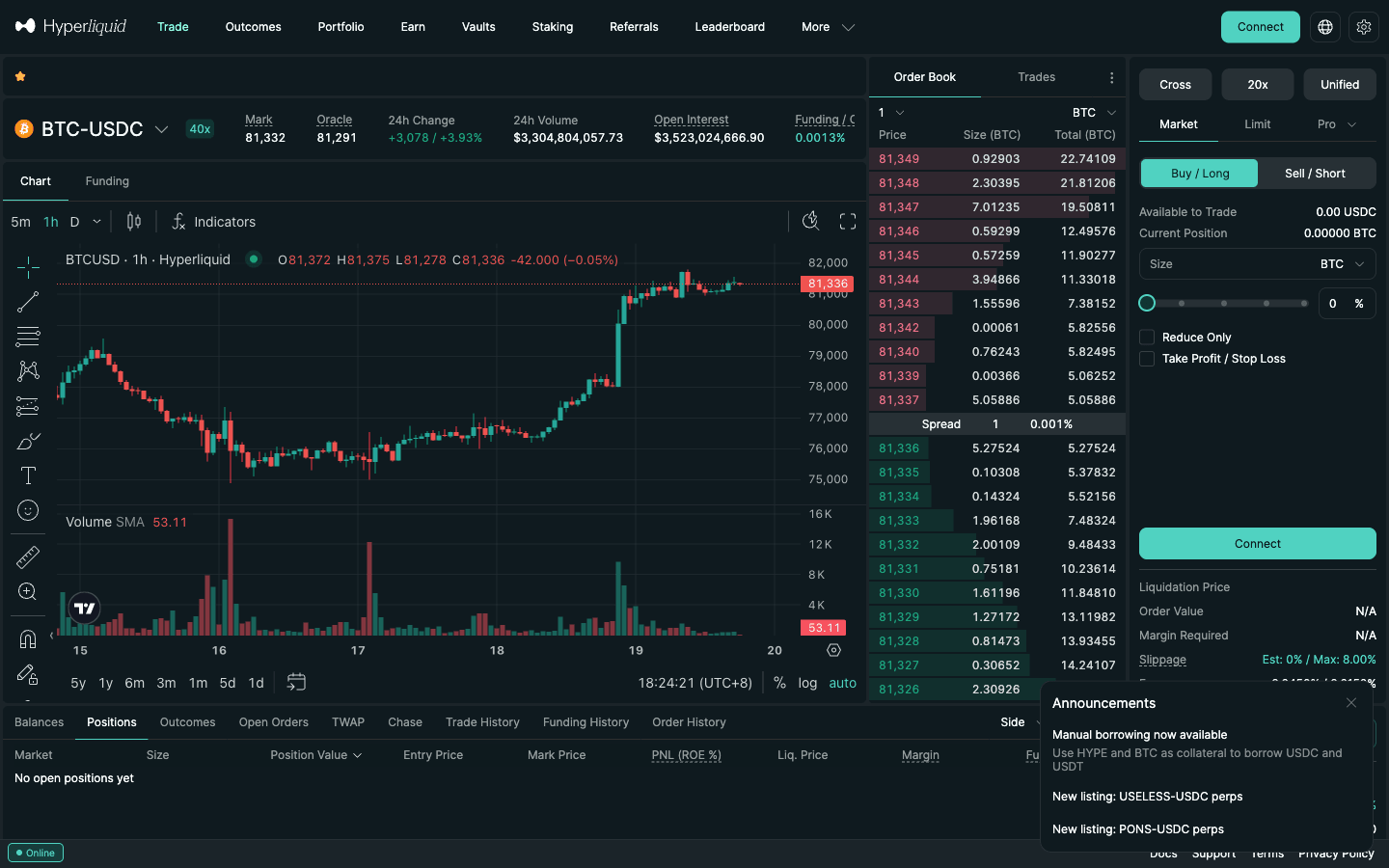
Hyperliquid: two CSV buttons and the API
We checked the Hyperliquid app on September 25, 2026. Under the chart on the trade page:
- Trade History tab → Export as CSV. Columns shown: Time, Market, Direction, Price, Size, Trade Value, Fee, Closed PNL. An "Export More" option sits next to it for longer ranges.
- Funding History tab → Export as CSV. Columns: Time, Market, Size, Side, Payment, Rate.
- Deposits, withdrawals and transfers: keep the transaction hashes from the source chain (Arbitrum, Ethereum, Base…). The API's
userNonFundingLedgerUpdatesrequest returns deposits, transfers and withdrawals for an address.
For heavy traders the API is the reliable archive. userFillsByTime returns up to 2,000 fills per request, and Hyperliquid's docs say only the 10,000 most recent fills are available. A bot or scalper can pass that in weeks, so schedule a weekly or monthly export and keep the raw files. userFunding returns funding payments by time range. These are read-only requests by wallet address; never put a private key in an export script. Step by step: Hyperliquid trade history CSV export guide.
Two Hyperliquid-specific gotchas. Sub-accounts and vaults have their own addresses and histories, so export each one. And if you trade through a third-party front-end (Based, Liquid, Phantom and others), your fills still live on Hyperliquid under your address, but those apps add their own builder fee on top, and it belongs in your costs.
Lighter and Aster
Lighter (a zk-rollup order book) and Aster (its own Aster Chain) keep trade, order and funding history in the account area of their apps and expose it through their APIs (Lighter's API is documented at docs.lighter.xyz; Aster runs a Binance-style futures API). Look for an export or download option in each history panel; where there is none, pull the data through the API or copy it out regularly. Lighter Standard accounts pay 0% taker / 0% maker, so your Lighter ledger will be mostly PnL and funding. Aster charges 0.04% taker / 0% maker on order-book perps, in the collateral asset or in AFEE, its fee-offset token. On spot you can pay in ASTER for a 5% discount. Either can add a second currency to your fee records.
The ledger your accountant needs
Three venues means three formats. Normalize everything into one table before you import it anywhere:
| Column | Why it matters |
|---|---|
| timestamp_utc | Venues export in UTC or local time; mixing them misplaces trades around midnight and year-end |
| venue, account | Separates sub-accounts, vaults and exchanges |
| market, side, size, price | Reconstructs every position |
| fee, fee_asset | Costs, in the asset actually charged |
| closed_pnl | Realized result per closing fill |
| funding_amount | One row per payment, from the funding export |
| income_type | Airdrop, staking reward, rebate: income at fair market value |
| transfer_hash | Links deposits and withdrawals to on-chain proof |
| fx_rate | Conversion to your home currency |
Reconcile once a month. The sum of closed PnL, minus fees, plus net funding, should explain the change in your account balance after deposits and withdrawals. If it doesn't, an export is missing, usually a sub-account or a period beyond the API's fill limit.
Fees, with a worked Hyperliquid example
Fees are a cost of trading nearly everywhere. What varies is where they go: as a separate expense, or folded into the cost and proceeds of each trade. Before you deduct fees, check whether your export's PnL figure is already net of them. Hyperliquid's Trade History export has a separate Fee column next to Closed PNL, and the app's own help text says "Closed PNL includes fees and rebates" (checked September 27, 2026). Subtracting the Fee column from Closed PNL again would count fees twice; check one round trip in the app to confirm how the figures relate. At the base tier Hyperliquid charges 0.045% taker / 0.015% maker. A trader with $2M of annual taker volume pays about $900 in fees, and that belongs in the records. Fee details: Hyperliquid fees, lowest-fee DEXs.
You open a $20,000 BTC long on Hyperliquid with a market order, hold it for 48 hours, and close it with a resting limit order 2% higher.
| Item | Calculation | Amount |
|---|---|---|
| Entry fee (taker, 0.045%) | $20,000 × 0.045% | $9.00 |
| Funding paid (baseline 0.00125%/hour) | 48 × 0.00125% × $20,000 | $12.00 |
| Exit fee (maker, 0.015%) | $20,400 × 0.015% | $3.06 |
| Price gain | $20,400 − $20,000 | $400.00 |
| Net result | $400.00 − $9.00 − $12.00 − $3.06 | $375.94 |
Depending on your country and method, you might report a $400.00 gain with $24.06 of costs, or $375.94 net, or split funding out as a separate item. Whatever the format, you need to be able to show all three numbers: price gain, fees and funding. Joining with a referral code would cut both fees by 4% (to $8.64 and $2.94). In real markets funding is rarely exactly the baseline: from August 26 to September 25, 2026, 72% of BTC's hourly rates on Hyperliquid sat at the baseline and the 30-day total was 0.77% (see our trading-hours study).
Pay less in the costs you have to record
Hyperliquid with code HOLYGRAIL takes 4% off your trading fees on your first $25M of volume, and its two CSV exports make year-end simple.
We earn a commission when you sign up through our links; it never raises your fees.
Japan: what the NTA FAQ says
Japan's National Tax Agency publishes an FAQ on the tax treatment of crypto assets (「暗号資産等に関する税務上の取扱いについて(FAQ)」, last revised December 2025). The points that matter for DEX perp traders:
- Crypto trading profits are taxable income, as a rule miscellaneous income (雑所得), taxed together with salary and other income at progressive rates (FAQ 2-2). Since the December 2025 revision, if annual crypto trading revenue exceeds ¥3 million, it is in principle business income where books are kept, or business-related miscellaneous income where they are not.
- Crypto margin trading does not get FX's separate 20% taxation: it is excluded from the separate-taxation special rule and taxed in aggregate with other income (FAQ 2-12). NTA Tax Answer No.1521 adds that cash-settled derivatives that are neither exchange-traded nor dealt with a registered Type I dealer are generally miscellaneous income, and can be netted only within miscellaneous income. That logic also covers Hyperliquid's stock and gold perps.
- Losses in miscellaneous income cannot be offset against salary or other income (FAQ 2-11), and there is no carryforward.
- Fees paid when selling are a necessary expense (FAQ 2-3).
- Airdrops: the FAQ has no airdrop question. Assets acquired other than by purchase are valued at market value when acquired (FAQ 1-5), staking rewards are income at market value (FAQ 1-7), and tokens from a chain split with no market price at the time are valued at ¥0 and taxed when sold (FAQ 1-6). Which of these a given airdrop follows is a judgment call.
- Tax reform: Japan's FY2026 tax reform (the income-tax amendment was enacted and promulgated on March 31, 2026) taxes sales of specified crypto to Japan-registered crypto businesses separately at 20% (15% income tax + 5% resident tax, plus the special reconstruction income tax). It applies from January 1 of the year after the amended Financial Instruments and Exchange Act takes effect; that act (passed July 15, 2026) comes into force on a date set by cabinet order within one year of promulgation, not yet set as of September 29, 2026 (if it takes effect in 2027, the new rules start on January 1, 2028). Under our reading of the text, DEX and overseas-exchange trades are outside the scope and stay comprehensively taxed.
Our Japanese version of this page goes further: filing steps, the ¥200,000 rule for salaried workers, a tax table for ¥500,000 / ¥1 million / ¥10 million of profit, and penalties for not filing. Read it in Japanese.
UK and other countries
United Kingdom. HMRC's Cryptoassets Manual says that where a cryptoasset derivative has been entered into, the guidance in that manual will not generally apply, because a derivative creates contractual rights and obligations rather than ownership of the token (CRYPTO10150). Companies fall under the derivative-contract rules; for individuals HMRC points to its Corporate Finance Manual at CFM50070. In other words, UK perps are not simply "crypto capital gains", and it is worth a specialist's view.
Everywhere else. Rules differ widely. Some countries tax crypto derivatives as capital gains, some as income, some depending on how often you trade, and a few not at all for individuals. We don't summarize them in a line each, because a one-line summary is where most tax articles go wrong. Look for your tax authority's official crypto guidance, check whether it mentions derivatives or margin trading specifically, and bring the three ledgers above to a local adviser. What doesn't change from country to country is the record-keeping: complete fills, funding and transfers, in UTC, with a consistent currency conversion.
Crypto tax software that supports Hyperliquid
Five of the first-page Google results for "Hyperliquid taxes" are tax-software integration pages. Here is what each vendor's own Hyperliquid page says it imports (read September 27, 2026). These are vendor claims, and we have no affiliation with any of them:
| Tool | How it says it imports Hyperliquid |
|---|---|
| CoinTracker | Wallet-address sync that it says detects perps, funding and spot trades; CSV import in its own format as a fallback. Its page notes some funding transactions were missed by blockchain scanners. |
| CoinLedger | Public wallet address (also read-only API or CSV). It lists bridge deposits and withdrawals, vault activity, HYPE staking, liquidations and perps. |
| CoinTracking | CSV upload of the three Hyperliquid exports: Trade History, Funding History, and Deposits and Withdrawals. |
| Koinly | API (paste your public address) or CSV. |
| Awaken | Public EVM wallet address (0x…). |
| Coinpanda | Wallet address via API, or CSV. It warns that the Hyperliquid API does not return a complete record, so you may have to add missing transactions by hand. |
| Summ (formerly Crypto Tax Calculator) | Hyperliquid tax guide covering trading, bridging, staking and the airdrop (page dated February 6, 2025). |
Whichever you use: a generic "EVM wallet" import won't see trades on Hyperliquid's own chain unless the tool has a Hyperliquid-specific connector, and wallet sync can miss transactions (CoinTracker and Coinpanda say so on their own pages). Keep your own CSV exports as the source of truth, reconcile the tool's totals against them, and check how the tool classifies funding before you file.
Year-end checklist
- Export Trade History and Funding History CSVs from every venue, sub-account and vault.
- On Hyperliquid, pull older fills through the API before they pass the 10,000-fill limit.
- Save deposit and withdrawal transaction hashes and network fees.
- Record HYPE airdrop, staking rewards and rebates at their USD value on the day received.
- Normalize to one UTC ledger and add the currency conversion you use.
- Reconcile PnL, fees and funding against balance changes.
- Check whether each venue's PnL column is before or after fees (Hyperliquid's Closed PNL includes fees and rebates), so fees are counted once.
- Keep the raw files; never edit the originals.
- Get professional advice if you had liquidations, vaults, many venues or large volume.
FAQ
Does Hyperliquid report to the IRS or send a 1099?
No. Hyperliquid issues no Form 1099 and no annual tax statement, and it does not report your activity to the IRS or any other tax authority. The IRS says its final broker regulations (Form 1099-DA) do not include reporting requirements for decentralized or non-custodial brokers, and the separate DeFi broker rule was disapproved by Congress in April 2025 (Public Law 119-5). Your trades are still public on Hyperliquid's chain and linked to your wallet address, and you are still required to report them yourself.
How are Hyperliquid perps taxed in the US? Are they Section 1256 contracts?
The IRS has published no guidance on perpetual futures. Section 1256's 60/40 treatment applies to regulated futures contracts traded on or under the rules of a qualified board or exchange (an SEC-registered exchange, a CFTC-designated contract market or a market the Treasury approves), and swaps are excluded. A Hyperliquid perp generally fits neither route, so most practitioners do not apply 60/40. The common working approach is to report each close as a capital gain or loss, which is short-term (taxed at ordinary rates) because perps are rarely held over a year. Confirm your approach with a CPA.
Are funding payments on Hyperliquid taxable?
Yes, funding belongs in your tax records, but no IRS or Japanese NTA guidance names perpetual-futures funding. In practice it is handled in one of two ways: as part of the position's gain or loss, or with funding received reported as ordinary income and funding paid as a cost or loss. Hyperliquid pays funding every hour, so export the Funding History CSV separately and apply one method consistently.
Is the HYPE airdrop taxable?
In the US it is generally treated as ordinary income at fair market value when you received it. The IRS has no ruling on points-based airdrops. Its closest guidance, Rev. Rul. 2019-24, says new cryptocurrency received in an airdrop following a hard fork is ordinary income, and the digital-asset question on Form 1040 treats receiving a digital asset as a reward or award as a reportable transaction. The value you report becomes your cost basis, and selling the HYPE later is a separate capital gain or loss. Japan has no airdrop-specific FAQ; see the Japan section.
How are HYPE staking rewards and the HLP vault taxed?
For staking rewards, the IRS ruled in Rev. Rul. 2023-14 that a cash-method taxpayer includes the fair market value of staking rewards in income when they gain dominion and control over them. No IRS guidance covers the HLP vault or user vaults. Record every deposit and withdrawal with its date and USD value, and treat the result consistently (a common approach recognizes the gain or loss when you withdraw).
How much tax will I pay if I withdraw crypto from Hyperliquid?
Withdrawing your own USDC from Hyperliquid to your own wallet is not a sale, so the withdrawal itself generally creates no tax. The IRS counts a transfer between your own wallets or accounts as a "No" on the digital-asset question unless you paid the transfer fee in a digital asset. Tax arises from what happened before the withdrawal (closed trades, funding, rewards) and from selling or swapping crypto afterwards.
Will I be taxed on $1,000 of crypto profit?
If you are a US taxpayer, yes: there is no minimum for reporting, and the IRS says you must report digital-asset transactions whether or not they produce a gain or loss. A short-term gain (held one year or less, which covers almost every perp trade) is taxed at your ordinary income rate, per IRS Topic 409. In Japan, a salaried worker with year-end adjustment generally does not need to file an income-tax return if other income, including crypto, is ¥200,000 or less, but may still need to file for resident tax.
Can I avoid crypto taxes legally by using a DEX or a VPN?
No. Tax depends on where you are resident, not on whether the exchange checked your ID or where your IP address appears. DEX trades are recorded on-chain and can be linked to exchanges where you did KYC. The legal ways to lower the bill are ordinary ones: deduct fees, use losses where your country allows it (in the US, net capital losses offset gains and up to $3,000 a year of other income), and keep records good enough that you never overpay.
Does the wash sale rule apply to Hyperliquid trades?
Section 1091 covers losses from wash sales of "stock or securities", and IRS digital-asset guidance does not extend it to crypto. Nothing addresses perps specifically. Treat any strategy built on selling and immediately re-buying at a loss as a question for your CPA.
How do I download my full Hyperliquid history for taxes?
On app.hyperliquid.xyz, the Trade History tab under the chart has "Export as CSV" (time, market, direction, price, size, trade value, fee, closed PnL), and so does the Funding History tab (time, market, size, side, payment, rate). For large histories use the public API: userFillsByTime returns up to 2,000 fills per request, but only the 10,000 most recent fills are available, so export regularly. Export each sub-account and vault separately.
Are trading fees tax-deductible?
Fees are generally part of the cost of a trade. Japan's NTA FAQ lists the fee paid when selling crypto as a necessary expense. In the US, fees usually adjust the basis or proceeds of the disposition. Either way, record the fee on every fill. Hyperliquid's export has a separate Fee column, but the app says "Closed PNL includes fees and rebates", so don't deduct the Fee column again from Closed PNL.
Can I offset Hyperliquid losses against my salary?
It depends on the country. In the US, net capital losses reduce other income by up to $3,000 a year ($1,500 if married filing separately) and the rest carries forward (IRS Topic 409). In Japan, no: crypto profits are generally miscellaneous income, and NTA FAQ 2-11 says a miscellaneous-income loss cannot be offset against salary or other income.
Clean records start with the venue
Hyperliquid (code HOLYGRAIL, 4% off fees on your first $25M) exports fills and funding to CSV in one click each. Lighter's Standard account (code 718610TD) charges 0% fees, so there are fewer fee lines to record.
Open Lighter → · Open Aster → (DTLpLc)
Disclosure: HOLYGRAIL (Hyperliquid), 718610TD (Lighter) and DTLpLc (Aster) are our referral codes; we earn a share of referred accounts' fees at no extra cost to you. We have no relationship with the tax tools listed. This article is general information based on the official pages cited as of September 27, 2026. It is not tax, legal or accounting advice; tax rules depend on your residence and circumstances.