
A crypto referral program pays you for bringing a new user to an exchange. Centralized exchanges mostly pay a one-off bonus to both of you (Gemini $50 each once your friend trades $100; Kraken up to $20 each), while decentralized exchanges (DEXs) pay you a share of every trading fee your referee pays, for as long as they trade: 10% on Hyperliquid, 10% by default on Aster, 10%–20% of Premium and advanced-order fees on Lighter (the app says up to 30%), 30%–50% of taker fees on dYdX and 20%–50% of the UI fee on OKX DEX. DEX income is referees × their volume × the fee rate × your share, so one active trader doing $250,000 a month is worth roughly $7 to $56 a month to you depending on the venue. To get your own DEX code you first need an account on that DEX, and on Hyperliquid $10,000 of your own volume.
Short version. 1) CEX programs pay once; DEX programs pay a % of fees, usually for as long as the referee trades (Hyperliquid: first $1B of their volume; Aster: 365 days). 2) Creating a DEX code can require trading first: $10,000 of volume on Hyperliquid, dYdX and Extended. 3) Apps do not cancel your code: on Hyperliquid the referrer still earns 10% of Hyperliquid's part of the fee on orders placed through apps (not of the app's builder fee), and the referee keeps their 4% discount. The catch is timing: apps such as Phantom often set their own Hyperliquid referral code on accounts that have none, so enter a code on Hyperliquid before you start using an app. 4) Payouts are small and frequent: Hyperliquid claims above $1, Lighter weekly with a $1 minimum, Aster next day. 5) Self-referral and wash trading get you banned. 6) Disclose, and treat payouts as taxable income.
Step 1: sign up with a code, then earn your own
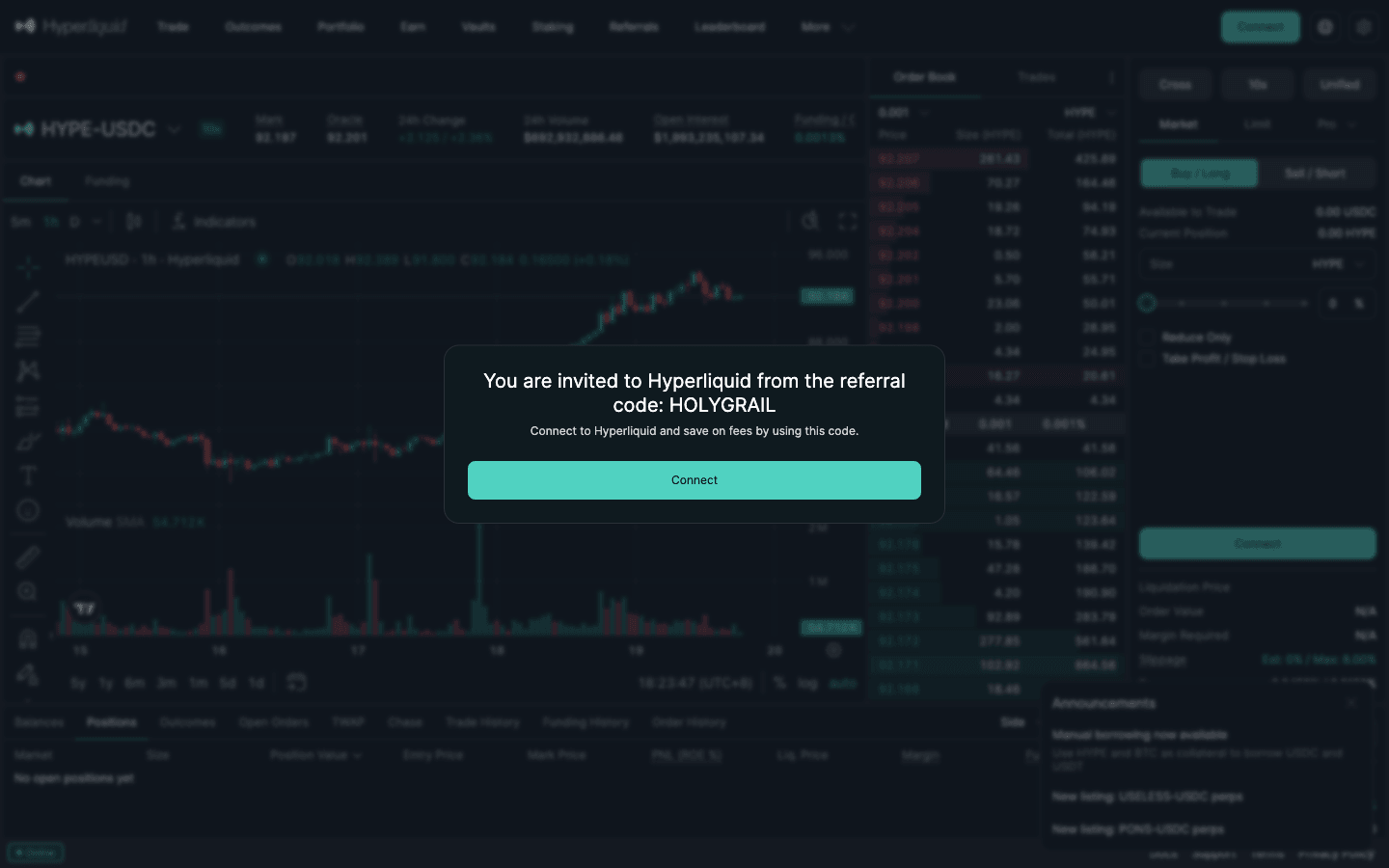
Open Hyperliquid with our code HOLYGRAIL: you get 4% off fees on your first $25M of volume, and after $10,000 of your own volume you can create your own code.
We earn a commission when you sign up through our links; it never raises your fees. Our codes appear on this page as examples.
1. How crypto referral programs work
Every exchange, centralized or not, uses referrals as a growth budget: it pays existing users to bring new ones instead of paying for ads. A decentralized exchange has no sales team at all, so its program is often its main acquisition channel. The mechanics are nearly identical everywhere:
- You get a code or link. On Hyperliquid that is
app.hyperliquid.xyz/join/YOURCODE; on Lighter a?referral=parameter; on Aster a/referral/link. - A new user signs up with it. The exchange binds their account or wallet to your code. On Lighter the binding is permanent and cannot be added later; on Polymarket Perps an account keeps the first code it is given; on OKX DEX the binding is per device.
- They meet the condition. On a CEX that is identity verification plus a first purchase or trade; on a DEX it is simply trading, because each fill generates a fee and your program sends you a share of it.
- The referee often gets something too: 4% off on Hyperliquid, a free Premium week on Lighter, 10% off on Liquid and 10% on fomo, 5% off on Ondo Perps, a better starting fee tier on dYdX, or a matching sign-up bonus on a CEX.
If you are new to how these venues work, start with what is a DEX.
2. CEX sign-up bonuses vs DEX fee shares
Most results for “crypto referral program” are centralized exchanges’ own refer-a-friend pages. They pay a fixed amount once, after your friend verifies ID and buys or trades a minimum. DEX programs work the other way round: nothing up front, a percentage of every fee afterwards. Here is what each side pays, from the official pages on September 27, 2026:
| Program | What you get | Condition | How long |
|---|---|---|---|
| Coinbase | Crypto or cash bonus; the amount “varies based on country” (not published on the help page) | Referee makes a qualifying card or bank purchase within 90 days of verifying ID | One-off; paid in 5–15 days |
| Kraken | Up to $20 in USDG each, you and your friend | Friend deposits fiat and buys non-stablecoin crypto within 15 days | One-off; capped at 10–20 referrals |
| Gemini | $50 each (US) | Friend trades $100 in their first 30 days | One-off |
| Crypto.com Exchange | Up to $2,000 in CRO per friend, by the size of their first CRO lockup ($100 at 10,000 CRO), plus 50% of their net fees for 12 months | Friend passes Advanced KYC and locks at least 1,000 CRO | Bonus once; fee share ends after 12 months |
| Binance | Referral Lite: up to $1,000 in fee-rebate vouchers; Referral Pro: up to 50% commission | Friend buys $50+ of crypto and trades $100+ (Lite) | Vouchers once; Pro commission while they trade |
| Hyperliquid (DEX) | 10% of every fee the referee pays; referee gets 4% off | You need $10,000 of your own volume to create a code | Each referee’s first $1B of volume |
| Lighter / Aster / dYdX (DEX) | 10%–20% (Lighter Premium and advanced-order fees; the app says up to 30%), 10% default (Aster), 30%–50% of taker fees (dYdX) | None beyond a trading account (dYdX: $10,000 of volume) | Permanent (Lighter), 365 days (Aster), lifetime (dYdX) |
Sources: help.coinbase.com (simple referral), kraken.com/referrals, gemini.com/referrals, Crypto.com Exchange help article (dated July 20, 2026), binance.com referral page (offers vary by region), and each DEX’s docs, all read September 27, 2026. CEX amounts are promotions that change often and differ by country; Gemini’s $50 is its US offer.
Why a fee share compounds
A flat bonus is paid once and ends. A fee share keeps paying for every month the referee trades. Take one friend who trades $250,000 of perpetual futures (perps) a month. Through Gemini you would get $50 once. Through Hyperliquid you get about $10.80 a month, so about $130 in the first year, and it keeps going until that referee has traded $1B. A friend who never trades is worth nothing on a DEX, and a CEX bonus also needs a first trade or purchase. The rule of thumb: CEX bonuses suit friends who will buy once and hold; DEX fee shares suit people who actually trade.
Two more differences matter if you publish content. Coinbase deactivates codes promoted with search ads on Coinbase keywords, Kraken bans paid search, social ads and sponsored posts, and in Japan Coincheck lists blog posts, affiliate use and ads as fraud, SBI VC Trade forbids publishing your code on websites or social media, and bitFlyer and BitTrade void rewards obtained through affiliate schemes. DEX programs are built to be shared publicly; Aster’s terms simply make the referrer responsible for the legal side of promoting leveraged trading in their region. For the cost side, see DEX vs CEX trading fees.
3. Types of crypto referral programs
| Type | How it pays | Examples (September 2026) |
|---|---|---|
| Flat sign-up bonus | A fixed amount to one or both sides once the friend verifies ID and buys or trades a minimum. | Coinbase, Kraken, Gemini; in Japan Coincheck and bitFlyer |
| Percentage fee share | A cut of every trading fee the referee pays, for a period or a volume cap. | Hyperliquid 10%, Aster 10%, Ondo Perps 10%, Polymarket Perps 20% |
| Tiered fee share | The cut rises with the number or volume of your referees. | Lighter 10%/20% (app: up to 30%), dYdX 30%/40%/50%, OKX DEX 20%→50% |
| Affiliate or partner program | Higher, negotiated rates for creators and communities, usually by application. | Aster affiliates 20%, Liquid up to 50%, Extended (invite-only), Binance Referral Pro |
| Front-end (builder-fee) share | An app built on a DEX shares the extra fee it charges on top of the exchange fee. | Based 60% (tiers up to 76%), Liquid, fomo 25% |
| Points and seasonal campaigns | Points, airdrop credit or a limited-time bonus instead of (or on top of) cash. | Extended (2.5% of referees’ points) |
Front-end rates look high because the pie is different: Based and Liquid share the extra fee they add on top of Hyperliquid’s fee, not Hyperliquid’s fee itself. Points programs (Extended) are worth whatever the points turn into, which is not known in advance. Exchanges also pay out through short prize contests rather than referrals, usually scored by trading volume or realized PnL; the fees on that volume are certain, the prize is not.
4. What each DEX referral program pays (verified September 2026)
| Venue | You earn | Referee gets | To create a code | Payout | Duration | Our code |
|---|---|---|---|---|---|---|
| Hyperliquid | 10% of the fees referees pay (after their 4% discount) | 4% off fees on the first $25M | $10,000 of your own volume | Accrues in the fee asset; claim once above $1 | First $1B of each referee’s volume | HOLYGRAIL |
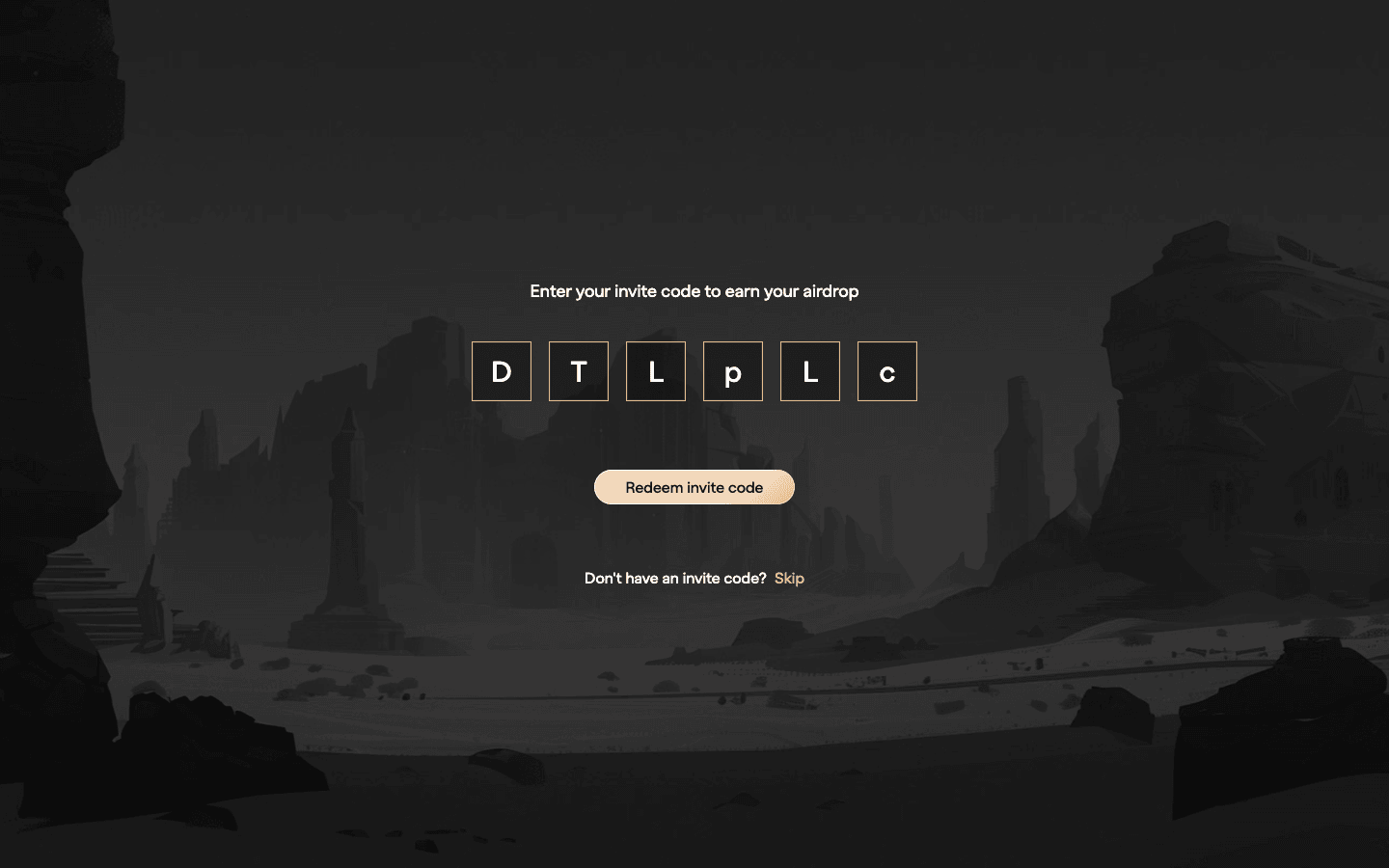
| Aster | 10% default, splittable with the referee; approved affiliates 20% from VIP 1 referees (10% VIP 2+) | Only what the referrer shares (default 0%; 5% of fees with our code DTLpLc) | None; generate on the Referral page | Next day, in the asset the fee was paid in | 365 days | DTLpLc |
| Lighter | 10% Bronze / 20% Silver of Premium and advanced-order fees (the app says up to 30%) | First week of Premium fees rebated ($10M cap) | None | Weekly (Mondays) as L2 transfers, $1 minimum | Permanent attribution | 718610TD |
| dYdX | 30% of referee taker fees; 40% at $1M and 50% at $10M of referred 30-day volume | Starts at fee tier 3 (0.04% / 0.005%) | $10,000 of your own volume | USDC, continuously | Lifetime; caps of $2M volume and $10,000 commission per referee per 30 days | none |
| OKX DEX | 20% to 50% of the OKX DEX UI fee, 6 levels by invitees’ monthly volume (50% at $10M) | Up to 20% of your commission, if you pass it on | None; OKX Web3 wallet | Instantly, in the fee token, to your wallet | While bound (binding is per device) | none |
| Extended | 2.5% of the points referees generate (points, not cash); invite-only affiliates earn rebates on net fees | 10% off fees on the first $50M | $10,000 of your own volume | Points; affiliate rebates per Extended | — | none |
| Based (HL front-end) | 60% of the Based builder fee (0.025% on perps), tiers up to 76% | None published | None; affiliate portal | Per Based’s portal | Lifetime | HOLYGRAIL |
| Liquid (HL front-end) | Up to 50% of Liquid’s fee | 10% off Liquid’s fees for life | None; Rewards Hub | USDC, claim any time | Lifetime | JV2EN2CX |
| fomo | 25% of referee fees | 10% off fees | None; in-app | In-app | — | DailyWiseKite |
| Ondo Perps | 10% of referee fees | 5% off fees | None | In-app | — | AGHSGT |
| Polymarket Perps | 20% of referee fees, no cap | None | A Perps account; 10 invites, rising to 25, then 100/250/500 with volume | Weekly | — | none |
| edgeX | Level-based (rate shown only when logged in) | None published | None | Daily settlement | — | HOLYGRAIL |
Sources: each program’s docs, app or on-chain parameters (dYdX), checked September 26–27, 2026 (Lighter re-checked October 14, 2026); OKX DEX FAQ updated August 5, 2026. Programs change their terms without notice; all of them reserve the right to. Hyperliquid’s proposed staking referral program is not live.
Notes that change the numbers:
- Hyperliquid: the 10% is calculated on what the referee actually pays after their 4% discount, and it stops after the referee’s first $1B of volume. Full walkthrough in section 5.
- Lighter: most users stay on the free Standard account, which pays no trading fees, so there is nothing to share. You earn when referees choose Premium or pay for advanced order types on Standard. Silver needs 15 referees who were each active on 5 days or more. The app advertises up to 30%, but on October 14, 2026 the docs listed no tier above Silver (the former Gold tier and its 50-referee requirement had been removed), so treat 20% as the published ceiling. See Lighter referral code.
- Aster: the default dashboard setting is “You receive 10%, invitee 0%”, and the split is each referrer’s choice, so an Aster percentage only means something with a date. Our code DTLpLc gives you 5% of your fees back (set September 29, 2026). See Aster referral code.
- edgeX: the referrer rate is level-based and shown only when logged in; for the person signing up: None published. How to apply ours and what it does: edgeX referral code.
- OKX DEX: commission comes only from token swaps that carry OKX’s UI service fee, and your actual rate is your level’s rate minus whatever you pass to the invitee (up to 20%). A referee who clears cookies, reinstalls the app or switches device can lose the binding. We hold no OKX code.
- Extended: the open program pays points, not cash; cash rebates are for affiliates, who join only by invitation from the team or an existing affiliate. We hold no Extended code.
- Front-ends (Based, Liquid, fomo) charge their own fee on top of Hyperliquid’s and share a big part of it. Reviews: Based, Liquid, fomo.
5. The Hyperliquid referral program, step by step
Hyperliquid is the largest perp DEX and its program is the simplest to explain, so it is the one most people search for. The rules, from Hyperliquid’s docs and app (checked September 26–27, 2026):
- Using a code: open a join link or enter a code at app.hyperliquid.xyz/referrals before your account has traded $10,000. After that the Enter Code button is locked for good. You get 4% off all fees on your first $25M of volume.
- Creating a code: once you have traded $10,000 yourself, the Create Code button unlocks. Share
app.hyperliquid.xyz/join/YOURCODE. - What you earn: 10% of your referees’ fees, less the discount they receive, on each referee’s first $1B of volume.
- Claiming: rewards accrue in every quote asset and can be claimed once they exceed $1; they land in your spot balance.
- Exclusions: vaults and sub-accounts get no discount (they are separate accounts), while orders placed through apps with a builder code still count: you earn 10% of Hyperliquid’s part of the fee, not of the app’s builder fee (section 9).
- Checking it by API: the public info endpoint returns a wallet’s referral state with
{"type": "referral", "user": "0x…"}: who referred it (referredBy), its volume, unclaimed and claimed rewards, and, for a referrer, the list of referred users.
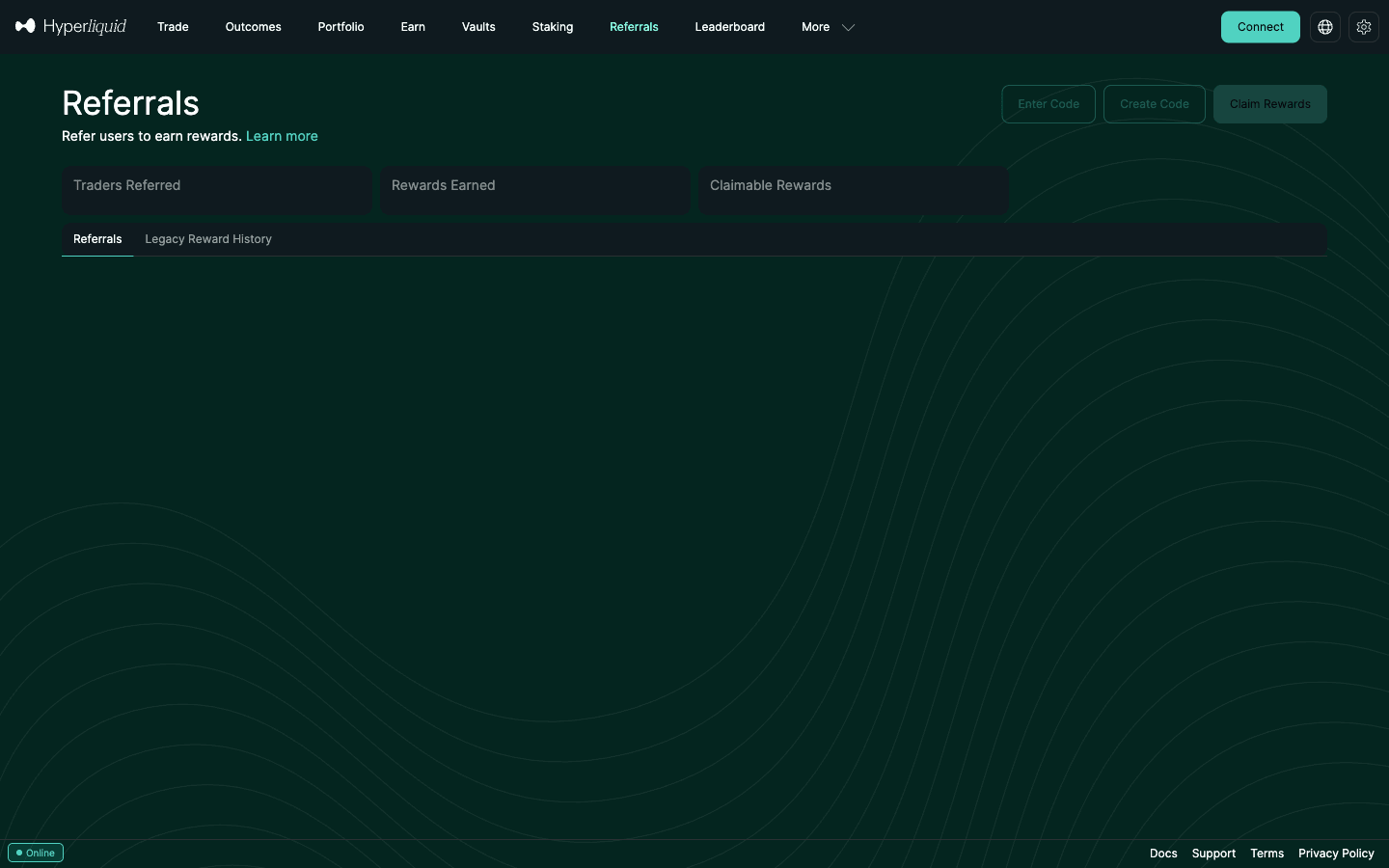
Our code is HOLYGRAIL. Everything about using it, including what to do if the Enter Code button is already locked, is on our Hyperliquid referral code page; fees are covered in Hyperliquid fees.
6. What one referee is worth: the maths
The formula is simple: monthly income = Σ (referee volume × fee rate × your share). Taking one referee who trades $250,000 of notional a month at each venue’s base taker fee:
| Program | Fee the referee pays | Your share | You earn per month |
|---|---|---|---|
| Hyperliquid (HOLYGRAIL) | 0.0432% taker (0.045% − 4%) | 10% | ≈ $10.80 |
| Aster (default) | 0.04% taker | 10% | ≈ $10 (≈ $20 as approved affiliate) |
| Lighter | 0% Standard / 0.028% Premium | 10% of Premium (and advanced-order) fees | $0 on Standard; ≈ $7 on Premium |
| dYdX | 0.04% taker (referee tier 3) | 30% | ≈ $30 |
| Based | 0.025% builder fee | 60% | ≈ $37.50 |
| Liquid | 0.05% Liquid fee, 10% off | up to 50% | up to ≈ $56.25 |
| Ondo Perps | 0.025% promo / 0.05% base, 5% off | 10% | ≈ $6–$12 |
Our calculation from published rates, September 2026. Maker fills pay less; volume tiers and staking discounts reduce the fee (and your share) further.
Worked example on Hyperliquid: $250,000 × 0.045% = $112.50 of fees, minus the referee’s 4% discount = $108 actually paid. 10% of that is $10.80. (Our own referral dashboard confirms the ratio: on September 25, 2026 the API reported referrer rewards of 10% of the fees counted for our referee.) Ten such referees are $108 a month; a hundred are $1,080. Now the reality check: $250,000 a month is an active trader (for example $2,500 of margin at 10x, turned over ten times). Many sign-ups deposit, try a trade or two, and stop. Your income will come from a small number of heavy traders.
Trade on Hyperliquid at the lowest cost
The simplest program for everyone involved: referee 4% off the first $25M, referrer 10%. Our code: HOLYGRAIL.
7. Hyperliquid vs Lighter vs Aster: head-to-head
These are the three perp DEXs most readers compare, and the three programs are built very differently. Two claims you will see elsewhere are wrong: “anyone can create a Hyperliquid code” (you need $10,000 of your own volume first) and “Lighter pays on every trade” (plain market and limit orders on its default Standard account pay no fees, so there is nothing to share).
| Hyperliquid | Lighter | Aster | |
|---|---|---|---|
| Our code | HOLYGRAIL | 718610TD | DTLpLc |
| Referrer share | 10% of referee fees, net of their 4% discount | 10% Bronze / 20% Silver of gross fees (Premium, Plus, advanced orders on Standard); the app says up to 30%, requirement not published | 10% default, splittable; approved affiliates 20% from VIP 1 referees (10% VIP 2+) |
| Referee benefit | 4% off all fees on the first $25M of volume | First week of Premium fees rebated ($10M volume cap) | Only the share the referrer passes on (dashboard default 0%; 5% of fees with our code DTLpLc) |
| Fee base (taker / maker) | 0.045% / 0.015% at tier 0 | Standard 0% / 0%; Premium 0.028% / 0.004% | 0.04% / 0% on USDT perps |
| Duration | Each referee’s first $1B of volume | Permanent attribution | 365 days |
| To create a code | $10,000 of your own volume | Any account | Any account |
| Payout | Accrues per quote asset; claim once above $1, lands in spot balance | Mondays as L2 transfers, $1 minimum | Next day, in the fee asset |
| Does not count | Vaults and sub-accounts; on orders placed through apps, the app’s builder fee (Hyperliquid’s part still counts) | Trades with non-zero integrator fees; Standard trades pay 0% | Zero-fee, self-trade and liquidation volume |
| Referee can add the code later? | Yes, until the account has traded $10,000 | No, sign-up only | Offered on the invite screen at sign-up |
Official docs and apps, checked September 26–27, 2026 (Lighter’s referral tiers re-checked October 14, 2026). Fee bases are each venue’s entry-level rates.
Worked example: one trader doing $1M a month
Take one referee who trades $1M of notional a month, 70% with market orders and 30% with limit orders, at each venue’s entry-level rates:
| Venue | Referee’s monthly fees | Your share | You earn / month | Per year |
|---|---|---|---|---|
| Hyperliquid | $315 + $45 = $360, minus 4% = $345.60 | 10% | $34.56 | ≈ $415 |
| Lighter, Standard | $0 | 10%–20% (app: up to 30%) | $0 | $0 |
| Lighter, Premium | $196 + $12 = $208 | 10% / 20% / 30% (app top rate, requirement unpublished) | $20.80 / $41.60 / $62.40 | ≈ $250 – $499 ($749 at the app’s top rate) |
| Aster | $280 (maker 0%) | 10% kept (half if split 50/50) | $28 ($14) | ≈ $336 ($168) |
Our calculation: Hyperliquid $700k × 0.045% + $300k × 0.015%; Lighter Premium $700k × 0.028% + $300k × 0.004%; Aster $700k × 0.04% (maker 0%). Volume tiers, staking discounts and Lighter’s manual tier upgrades change the result.
The range on Lighter, from $0 to about $499 a year at the published Silver rate (about $749 if the app’s unpublished top rate applies), is the whole story of that program: it only pays if your referees choose Premium or use advanced order types. Hyperliquid pays less per dollar of fees than Lighter’s top rates, but every one of its trades pays a fee and it is the largest venue, so an active Hyperliquid referee is the most dependable. Aster sits in between, with the twist that you decide how much of the 10% to hand back.
8. How to choose a referral program
Use this checklist before you put a code anywhere:
- Reward type vs your audience. Friends who buy once: a flat CEX bonus. Active traders: a DEX fee share. Mobile-first readers: a front-end app’s program (Based, Liquid, fomo), because they will trade there anyway.
- Rate and tiers. What is the base share, and what does it take to reach the next tier (Lighter: 15 active referees for 20%; dYdX: $1M of referred 30-day volume for 40%; OKX DEX: $10M a month for 50%)?
- Duration and caps. Hyperliquid stops at $1B per referee, Aster after 365 days, Crypto.com’s fee share after 12 months; dYdX caps each referee at $10,000 of commission per 30 days.
- Payout. Currency, frequency and minimum: claim above $1 (Hyperliquid), weekly with $1 minimum (Lighter), next day (Aster), fee-rebate vouchers (Binance Lite).
- Exclusions. Builder fees (on Hyperliquid you earn on its part of an app order’s fee, not the app’s), integrator fees, zero-fee pairs, self-trades, liquidations, device-based binding.
- What the referee gets. A real discount (4% on Hyperliquid, 10% on Liquid) converts better than a code that only pays you.
- Venue trust and access. Would you trade there yourself? Is it available where your readers live? Each venue’s terms exclude some regions (Hyperliquid: the US, Ontario and sanctioned regions).
9. Builder codes: what you earn when referees trade through apps
This is the rule most referral guides get wrong, and so did this page until October 2026. Hyperliquid lets apps built on it attach a builder code to each order: an extra fee (up to 0.1% on perps and 1% on spot) that the app keeps. One sentence in Hyperliquid’s docs says “builder codes override referral codes for that order”, but it sits on the page for a proposed staking referral program that Hyperliquid marks as not implemented, and the fee formula on its fees page has no builder-code condition. We checked real mainnet fills and referral states on October 1, 2026: the referrer still earns 10% of Hyperliquid's part of the fee on orders placed through apps (not of the app's builder fee). For referees who trade almost only through apps, the referrer’s reward matched 10% of (total fee − builder fee) over their whole history, and the referee kept the 4% discount on Hyperliquid’s part of the fee (the referral discount also applies to orders placed through apps with a builder code).
So a referee who joins with your code and then trades through a mobile app, a Telegram bot or a trading terminal still earns you money; you earn on a smaller slice than the total they pay, because the builder fee is the app’s. What does zero you out is your code never reaching their account: apps such as Phantom often set their own Hyperliquid referral code on accounts that have none, so enter a code on Hyperliquid before you start using an app. If you read the referral API yourself, note that cumRewardedFeesSinceReferred includes the builder fee, so your reward looks like less than 10% of it for app traders. Lighter is stricter: it excludes trades with non-zero integrator fees from referral kickbacks.
- Desktop readers: send them to app.hyperliquid.xyz with your code. It is also the cheapest way for them to trade (no builder fee), so your interests line up.
- Mobile readers: Hyperliquid has no official iOS app, so many will use a front-end anyway. Send them to your Hyperliquid join link before they connect an app with the same wallet, such as Based or Liquid: your code keeps earning on their app orders and they keep the 4% discount. If they also sign up to the app with that app’s own referral code, you earn a share of the app’s builder fee as well (Based pays 60% of its fee, Liquid up to 50%), and both codes apply to the same order. fomo is different: it has no wallet connection (Apple, Google or email only) and creates its own wallet and Hyperliquid account, so your Hyperliquid code cannot apply there; only a fomo code earns (25% of fomo’s fees).
- Bots and terminals: check whether they add a builder fee (
/builderCodesin the app shows which builders a wallet has approved). More in the builder codes guide.
10. How payouts work
- Hyperliquid: rewards accrue in every quote asset and can be claimed at app.hyperliquid.xyz/referrals once they exceed $1; claimed rewards land in your spot balance. Builder fees are claimed through the same process.
- Lighter: paid weekly as L2 transfers for the previous Monday–Sunday (UTC), $1 minimum. Kickbacks are discretionary.
- Aster: calculated in real time and transferred to your Aster account the next day, in the asset the referee paid fees in.
- dYdX: USDC, paid continuously by the protocol, for the lifetime of the referral.
- OKX DEX: sent to your OKX Web3 wallet in the fee token as soon as the invitee’s trade completes.
- Liquid: USDC in the Rewards Hub, claim any time. Polymarket Perps: weekly.
11. How to get your own code, step by step
You cannot refer anyone to a DEX before you have an account there yourself, so the first step is always to sign up (with someone’s code, to get the referee discount).
- Hyperliquid: sign up (enter a code before $10,000 of volume), trade $10,000, then create a code at app.hyperliquid.xyz/referrals.
- Aster: open the Referral page, generate a link and choose the split. High-volume referrers can apply for the 20% affiliate rate through the form linked in Aster’s docs.
- Lighter: copy your referral link from the app; tiers are reviewed weekly.
- dYdX: trade $10,000, then create your link at dydx.trade/referrals.
- OKX DEX: open the referral page in the OKX Web3 wallet; high-volume inviters can apply for a higher level from the Affiliate Dashboard.
- Front-ends: Based (affiliate portal), Liquid (Rewards Hub), fomo (profile, gift icon).
- Polymarket Perps: your Perps code is also your invite code; you start with 10 invites.
Before you promote a venue, use it yourself. You will write better, and you will spot the traps your readers will hit (minimum deposits, restricted regions, wallet quirks). Hyperliquid’s own walkthrough: how to use Hyperliquid.
12. Where referrals really come from
dYdX publishes its affiliate leaderboard, which gives an honest picture of the distribution. On September 27, 2026 the top affiliate had earned $97,500 from 796 referred users; number 50 on the list had earned $3,120. A handful of referrers with real audiences earn most of the money.
- Useful content for people who already trade: fee comparisons, how-to guides, answers to specific errors. Someone searching “Hyperliquid fees” is closer to signing up than someone scrolling a feed. Our own approach is on this site: fees, DEX comparison, perp DEX ranking.
- Communities you are genuinely part of: a trading Discord, a newsletter, a study group. One trusted recommendation beats a hundred code drops.
- Match the venue to the reader: mobile-first readers to an app with a program, desktop traders to the exchange, people who want zero fees to Lighter (and accept that plain Standard orders earn you nothing).
- Do not: post codes in unrelated threads, promise returns, hide the commission, or push leverage on beginners. It does not convert, and several programs remove referrers who mislead.
13. Rules, disclosure and taxes
- No self-referral, no wash trading. Aster revokes all rewards for self-referral; Lighter disqualifies abuse and forfeits pending rebates; Polymarket Perps does not let you apply your own code; OKX DEX blacklists manipulation.
- Restricted regions. Each exchange’s terms exclude some users (Hyperliquid: the US, Ontario and sanctioned regions). Do not target them, and never suggest ways around a venue’s restrictions.
- Advertising rules. Coinbase deactivates codes promoted with ads on Coinbase keywords; Kraken bans paid search, social ads and sponsored posts for referral links.
- Disclose. The FTC says affiliates should disclose clearly and conspicuously, close to the link, in words people understand (“I earn a commission if you sign up through this link”), not just “affiliate link”.
- Taxes. In the US, digital assets received as payment for services are ordinary income at fair market value when received (Schedule C for independent contractors). In Japan, ongoing referral income is generally miscellaneous income (雑所得). Record the date and USD value of every payout; our DEX tax reporting guide covers exports. Not tax advice.
Pick the venue, use a code, then earn your own
Hyperliquid HOLYGRAIL (4% off) · Lighter 718610TD (free Premium week) · Aster DTLpLc
FAQ
How do crypto referral programs work?
You share a code or link. When a new user signs up with it and meets the conditions, the exchange pays you. Centralized exchanges mostly pay a one-off bonus to both sides (Gemini $50 each after a $100 trade, Kraken up to $20 each). Decentralized exchanges pay a share of every fee the referee pays: 10% on Hyperliquid, 10% by default on Aster, 10%–20% of Premium and advanced-order fees on Lighter (the app says up to 30%), 30%–50% of taker fees on dYdX and 20%–50% of the UI fee on OKX DEX.
Which crypto referral program is the best?
It depends on who you refer. For friends who will buy once and hold, a flat CEX bonus (Gemini $50 each) pays more up front. For people who trade actively, a DEX fee share pays for as long as they trade: an active Hyperliquid referee at $250,000 a month earns you about $10.80 a month for up to $1B of their volume, and dYdX (30%–50%) and front-end apps (Based 60%, Liquid up to 50%) pay more per dollar. For the reader, Hyperliquid’s own app with a referral code is the cheapest way to trade on Hyperliquid (no builder fee, 4% off).
How much can you earn from a DEX referral code?
It depends almost entirely on how much your referees trade. At $250,000 of monthly volume per referee, one referee earns you roughly $10.80 a month on Hyperliquid, $10 on Aster, $30 on dYdX and $37.50 through Based, by our calculation from each program’s published rates (September 2026). On dYdX’s public leaderboard on September 27, 2026 the top affiliate had earned $97,500 from 796 referred users, and number 50 had earned $3,120. Most sign-ups trade far less than that.
What is the Hyperliquid invite code?
Hyperliquid calls it a referral code. Ours is HOLYGRAIL (app.hyperliquid.xyz/join/HOLYGRAIL): it gives you 4% off fees on your first $25M of volume. You must enter a code before your account has traded $10,000; after that the Enter Code button is locked. Once you have traded $10,000 yourself you can create your own code at app.hyperliquid.xyz/referrals.
How can I get $10 free in crypto?
The closest thing is a CEX sign-up bonus, which always comes with conditions: Kraken pays up to $20 in USDG to both sides after the new user deposits fiat and buys crypto within 15 days, and Gemini pays $50 each after a $100 trade in 30 days (US). DEXs do not hand out free money; what a DEX referral code gives you is a fee discount, such as 4% off on Hyperliquid or 10% off on Liquid.
Which app gives $100 per referral?
None of the programs we checked pays a flat $100 per referral. Crypto.com pays $100 in CRO when your friend’s first CRO lockup is 10,000 CRO, and up to $2,000 for the largest lockups. Gemini pays $50 per referral. DEX programs pay per trade instead, so a single active trader can be worth more than $100 over a year, and an inactive one is worth nothing.
How do I get $200 free on Coinbase?
Coinbase’s help page does not promise a fixed amount: the referral bonus “varies based on country”, requires the new user to make a qualifying purchase by bank transfer, debit or credit card within 90 days of verifying their identity (Coinbase Advanced purchases do not count), and is paid within 5–15 days. Check the amount shown in your own Invite Friends page before promising anyone a number.
Why did I earn nothing from a referee who trades a lot?
Check whose code is on their account. Trading through a third-party app (Based, Liquid, Phantom, a bot platform) is not the problem on Hyperliquid: the referrer still earns 10% of Hyperliquid's part of the fee on orders placed through apps (not of the app's builder fee) (checked against mainnet fills on October 1, 2026). Two cases cover most of it. First, your code may never have reached their account, so they are not your referee at all: apps such as Phantom often set their own Hyperliquid referral code on accounts that have none, so enter a code on Hyperliquid before you start using an app, and a code cannot be entered after $10,000 of volume. Second, a real referee stops earning you anything after their first $1B of volume, and their vaults and sub-accounts are separate accounts that the referral does not cover (vaults and sub-accounts). On Lighter, trades with integrator fees are excluded and plain Standard market and limit orders pay no fees. Aster excludes zero-fee, self-trade and liquidation volume. On OKX DEX a referee who clears cookies or changes device can lose the binding.
Can I use my own referral code?
No. Aster, Lighter and Polymarket Perps explicitly ban self-referral, and Aster says all rewards are revoked if it is detected. Lighter disqualifies wash trading and forfeits pending rebates, and OKX DEX blacklists manipulation. Use the discounts designed for you instead: a referee discount as a new user, staking discounts, volume tiers.
Is referral income taxable?
Generally yes. In the US the IRS treats digital assets received for services as ordinary income at their fair market value when received (Schedule C for independent contractors, Schedule 1 for other income). In Japan ongoing referral rewards are generally miscellaneous income (雑所得). Keep a record of each payout’s date and USD value; this is not tax advice.
Disclosure: we hold referral codes for Hyperliquid (HOLYGRAIL), Lighter, Aster, edgeX, Based, Liquid, fomo and Ondo Perps, shown on this page as examples, and earn a share of fees from people who sign up through them; it never raises your fees. We have no code for dYdX, OKX DEX, Extended, Polymarket Perps or any centralized exchange listed here. Terms were checked in each program’s official pages or app on September 26–27, 2026 and can change at any time.