
Lighter explorers: direct links (all free; nothing to sign; checked October 15, 2026)
| Tool | Open | Use it for |
|---|---|---|
| Official Lighter explorer | app.lighter.xyz/explorer | Batches, blocks, logs (trades, deposits, withdrawals), any account by index or 0x address |
| Same explorer, second domain | lighter.exchange/explorer | The same web app on Lighter’s other official domain |
| Etherscan (Lighter contract) | etherscan.io › 0x3B4D…5ca7 | The commit, verify and execute transactions of every batch; escape-hatch functions |
| Litscan | litscan.io | Third-party explorer and analytics: markets, leaderboard, integrators |
| LighterPulse | lighterpulse.xyz/explorer | Third-party dashboard: blocks, L1 batches, funding, liquidations |
| Explorer API | explorer.elliot.ai/api | The data behind the explorer, as JSON (90 weighted requests a minute) |
1. What the Lighter explorer shows
Lighter is a perpetuals and spot exchange built as a zero-knowledge rollup on Ethereum: a sequencer matches orders in milliseconds, and the results are proven and settled on Ethereum in batches. The explorer is the public window onto both halves. The home page has four counters and three live tables:
- Totals. On October 15, 2026 at 04:39 UTC the explorer API reported 248,321 batches, 356,439,814 blocks, 135,057,980,891 transactions and 996,737 accounts (shown as “Total users”). The transaction count includes every order, modify and cancel, not only fills, which is why it is so much larger than the number of trades.
- Recent batches, each with 1,600 blocks and a three-dot status: committed, verified, executed.
- Recent blocks, with their transaction count and the status of the batch they belong to.
- Market stats at the latest block: mark price, index price, open interest and funding rate for every market.
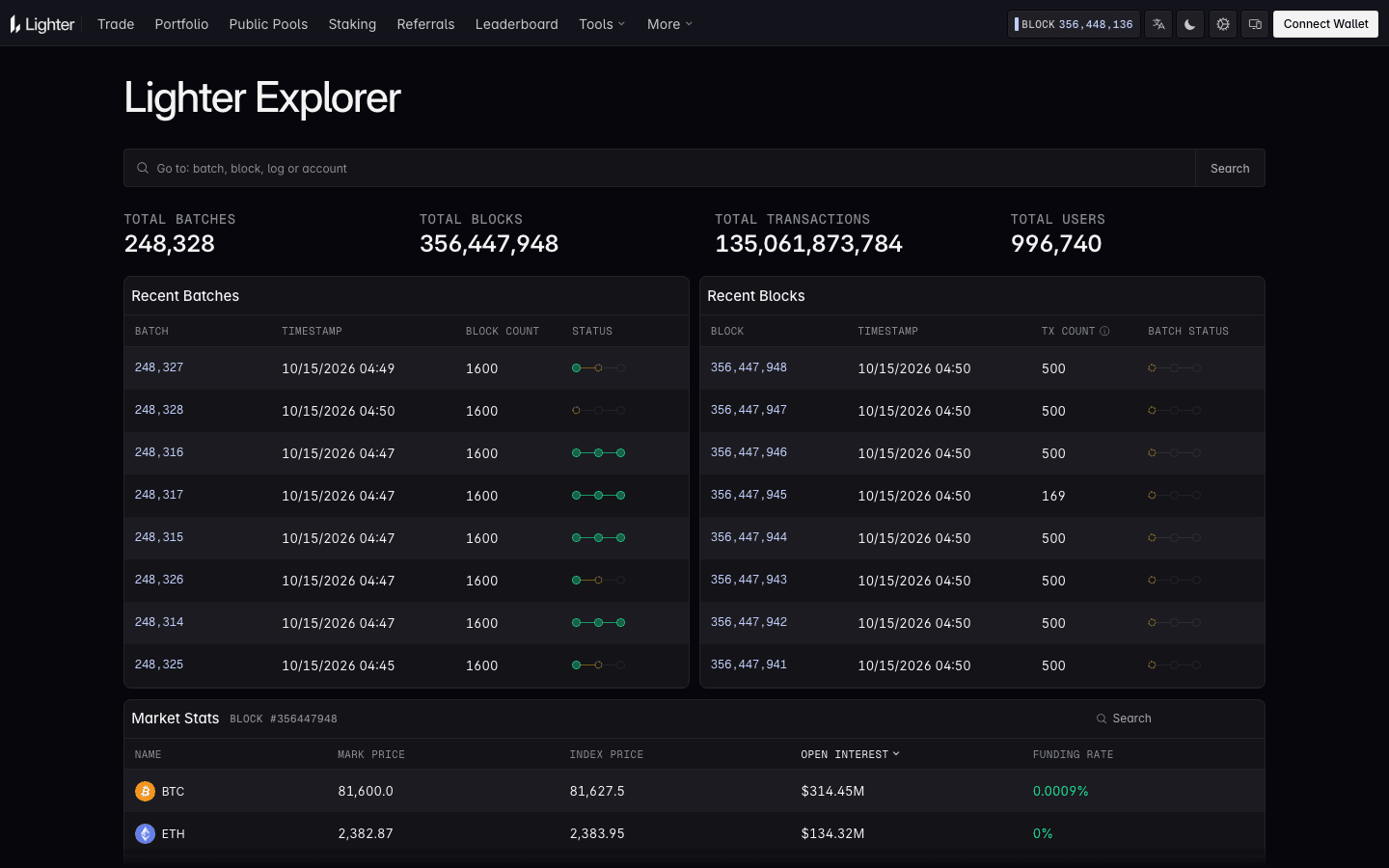
One search box (“Go to: batch, block, log or account”) accepts all four kinds of input. Every page has a stable URL, so you can bookmark or share it: /explorer/accounts/<index or 0x address>, /explorer/blocks/<number>, /explorer/batches/<number> and /explorer/logs/<hash>. The lookup box at the top of this page builds those links for you.
What it does not show: open orders, liquidation prices and your order history (orders that never filled leave no log). Those come from the app’s Portfolio page or the public API (section 9).
2. “Lighter Scan”: official vs third-party explorers
Lighter does not run anything called “Lighter Scan”. The phrase usually means the official explorer, or Litscan (litscan.io), a community site whose name is one letter away. Lighter’s API documentation lists Litscan on its Third-Party Resources page for its per-integrator analytics, and adds that every listed tool is run by independent third parties and that Lighter does not guarantee their accuracy. Searching “lighter explorer” also brings up cigarette-lighter products, so check the domain before you click.
| Tool | Run by | Shows | Best for |
|---|---|---|---|
| Official explorer | Lighter | Batch status with Ethereum hashes, blocks, every log, account positions and balances | Proving that a trade, deposit or withdrawal happened and reached Ethereum |
| Etherscan | Etherscan (reads Ethereum) | Lighter’s contract: batch commits (blob transactions), proof verification, execution, priority transactions | Checking the Ethereum side yourself; reading desertMode |
| Litscan | Third party, listed on Lighter’s API docs “Third-Party Resources” page | Markets, leaderboard, per-integrator volume and fees, account and address search | Rankings and integrator analytics |
| LighterPulse | Third party (“Not affiliated with Lighter”) | Open interest, volume, funding, liquidations, LIT staking, LLP, blocks and L1 batches | A quick market dashboard |
| L2BEAT | Independent rollup tracker | Risk summary of the rollup: stage, data availability, exit path | Judging custody risk before you deposit |
| 0xArchive, Tardis.dev | Paid data providers, listed on the same docs page | Historical order books, trades, funding and open interest | Backtests and research |
Read on October 15, 2026. LighterPulse states on every page that it is “built on the public Lighter API” and “not affiliated with Lighter”, and that links opening Lighter’s app from its site carry a referral code. Our links carry ours (718610TD), and we say so in the disclosure below. L2BEAT rated Lighter Stage 0 when we last checked: the exit path to Ethereum exists, but upgrades are still controlled by the team.
Rule of thumb: use the official explorer or Etherscan to prove something happened, and third-party dashboards to browse. All of them read the same public data, but only the first two are the source.
3. What each field means
| Field | Meaning |
|---|---|
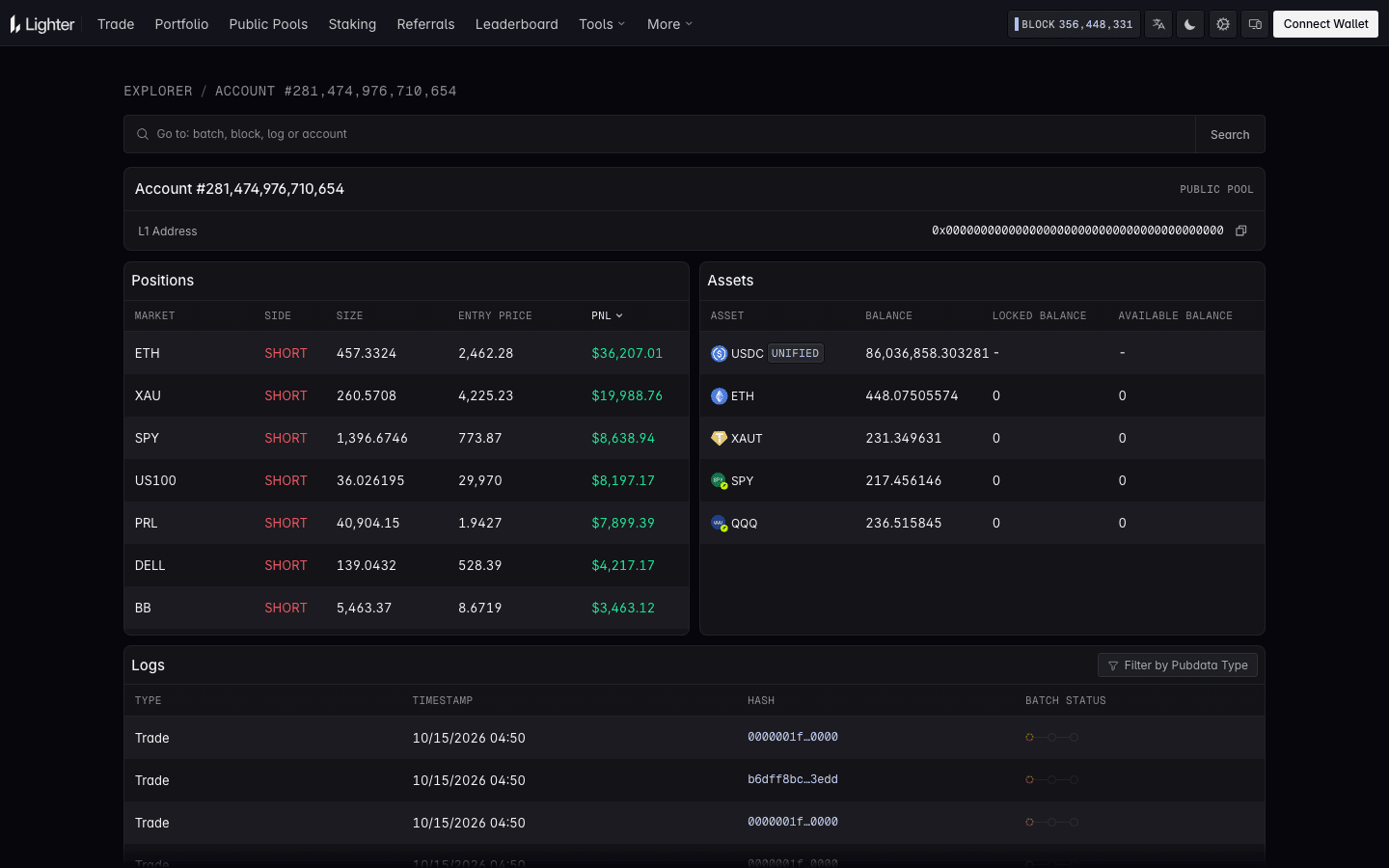
| Account index | Lighter’s integer id for an account. Your main account and every sub-account have their own index; the API and every log use the index, not your wallet address. Main accounts have short indexes (up to about 760,000 on October 15, 2026). Sub-accounts, public pools and system accounts use 15-digit indexes, e.g. the LLP liquidity pool is 281,474,976,710,654; system accounts also carry a label. |
| L1 address | The Ethereum address that owns the account. Pasting it into the search box opens its main account. A public pool shows the zero address. |
| Block | A group of transactions from the sequencer. Its TX COUNT includes every order, modify and cancel; the largest blocks we saw held 500. |
| Log | A state change inside a block: a trade, a deposit, a withdrawal, a transfer, a leverage change. Orders that never fill create no log, which is why a block of 500 transactions can show only 3 logs. |
| Pubdata type | The kind of log, as published to Ethereum: Trade, Trade with Funding, Liquidation Trade, L1 Deposit, Withdraw, L2 Transfer, L2 Update Leverage and so on. The account page can filter by it. |
| Batch | 1,600 blocks (about 770,000 transactions in the batches we sampled) that are proven together and posted to Ethereum as one unit. |
| Batch status | Three dots: committed (the batch data is on Ethereum), verified (Ethereum accepted the zero-knowledge proof), executed (the contract applied the new state). No dot yet means the batch is still pending. The API also uses nothing_to_execute. |
| Maker / taker fee | The fee rate each side paid, shown in percent. The API stores it as an integer in millionths of notional (28 = 0.0028%). |
| Fee account | Where fees went; “Lighter Fee Collector” for normal fills. |
| Is taker ask | “Yes” means the taker sold (hit the bid); “No” means the taker bought. |
| Route type | PERPS or SPOT: which balance a deposit or withdrawal used. |
The fee fields hint at the account type behind a fill, but they do not prove it. A taker fee of 0% points to a Standard account, which can be a main account, a sub-account or a public pool. Premium takers pay up to 0.028% (less with staked LIT) and Plus accounts 0.005%. Some fills match none of these. The taker in the trade log below paid 0.01%, which is the rate a Standard account pays on TWAP, Chase and Iceberg orders, so that is the likeliest explanation. The Lighter fees guide has the full schedule.
4. How to look up a Lighter account
- Paste the wallet address or the account index into the search box. A 0x address opens its main account; a number opens the account with that index.
- Read the header: the account index, a label (MAIN ACCOUNT, PUBLIC POOL, or a system account such as the Lighter Fee Collector) and the owning L1 address.
- Positions lists market, side, size, entry price and unrealized PnL. Assets lists each balance; USDC used as cross collateral is marked UNIFIED.
- Logs lists every state change of the account, newest first, with its batch status. Filter by Pubdata Type narrows it to trades, deposits, withdrawals or transfers.
- Sub-accounts are separate. Each sub-account has its own 15-digit index and its own page. If a position seems to be missing, it may sit in a sub-account. The public API call
accountsByL1Addresslists every index one address owns.
5. How to verify a fill
- Open your account and filter the logs by Trade (liquidations appear as Liquidation Trade).
- Open the entry. The log page shows the block, time, market, size, price, the maker and taker account indexes, both fee rates, the fee account and whether the taker sold.
- Match it to the app’s trade history by time, size and price. The explorer shows times in your browser’s time zone, while the API and most exports use UTC.
- Check the status. Pending means the trade is final on Lighter but not yet on Ethereum; once its batch shows all three dots it is settled there too.
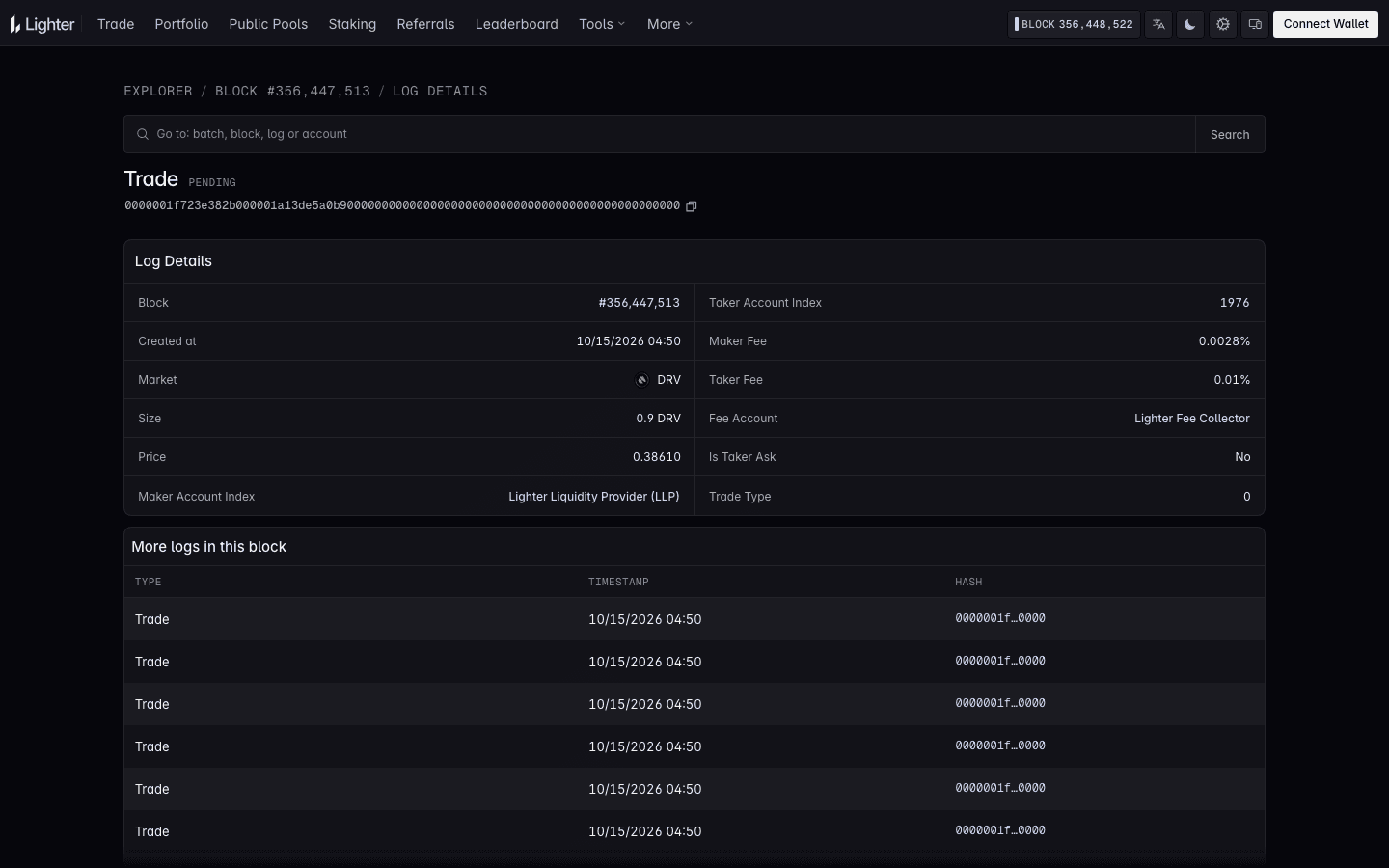
A trade with funding (Trade with Funding) is a fill that also settled funding accrued on the position since its last change. Lighter settles funding hourly; the funding rate guide explains the formula.
Trade on the venue you can audit
Every fill on Lighter is a public log that ends up proven on Ethereum. Open an account with code 718610TD: Standard trading costs 0%, and the code gives you the first week of Premium fees rebated if you move to Premium.
We earn a commission when you sign up through our links; it never raises your fees.
6. How to verify a deposit
A credited deposit appears as an L1 Deposit log with the L1 address, account index, asset, accepted amount and route type (perps or spot). Filter your account’s logs by L1 Deposit to find it.
- From Ethereum: the deposit is a call to Lighter’s contract, so you can first confirm the transaction on Etherscan and then wait for the log.
- From another chain (Arbitrum, Base, Solana, Tron, Bitcoin and others): the funds pass through a bridge first. If no log exists yet, the bridge has not credited the deposit; the app’s deposit screen shows that progress.
- The accepted amount can be lower than what you sent when a bridge swap or slippage took a cut; the API docs recommend sending a little more than the minimum.
- New accounts: the first credited deposit creates the account, so a new wallet has no account page until then.
Minimums by chain and typical times are in our Lighter deposit and withdrawal guide.
7. How to verify a withdrawal
Lighter has two withdrawal paths, and they look different in the explorer:
- Secure withdrawal (to Ethereum): a Withdraw log with the asset, amount, source account and route type. Once its batch is executed, the log shows the batch number and the withdrawal is final on Ethereum. The protocol’s delay was 1,684 seconds (about 28 minutes) when we called
withdrawalDelayon October 15, 2026. Lighter usually claims the funds to your wallet for you; if not, you can callwithdrawPendingBalanceon the contract yourself. - Fast withdrawal (USDC to Arbitrum): technically a transfer to Lighter’s fast-withdraw pool with your destination address attached, so it shows up as a transfer rather than a Withdraw log, and the USDC arrives on Arbitrum in about 15–20 seconds.
If a secure withdrawal stays pending for much longer than the current delay, check the batch it belongs to: the batch page shows which of the three Ethereum steps is missing.
8. How proofs reach Ethereum, and the escape hatch
Each batch goes through three Ethereum transactions, all sent to Lighter’s contract 0x3B4D…5ca7, and the batch page links each one to Etherscan:
- Commit. The batch’s state changes are posted as an EIP-4844 blob transaction. That data is enough for anyone to rebuild every account’s balance and positions without Lighter.
- Verify. Ethereum checks the zero-knowledge proof that every trade, liquidation and funding payment in the batch followed the exchange’s rules.
- Execute. The contract applies the new state root. Withdrawals in the batch become claimable.
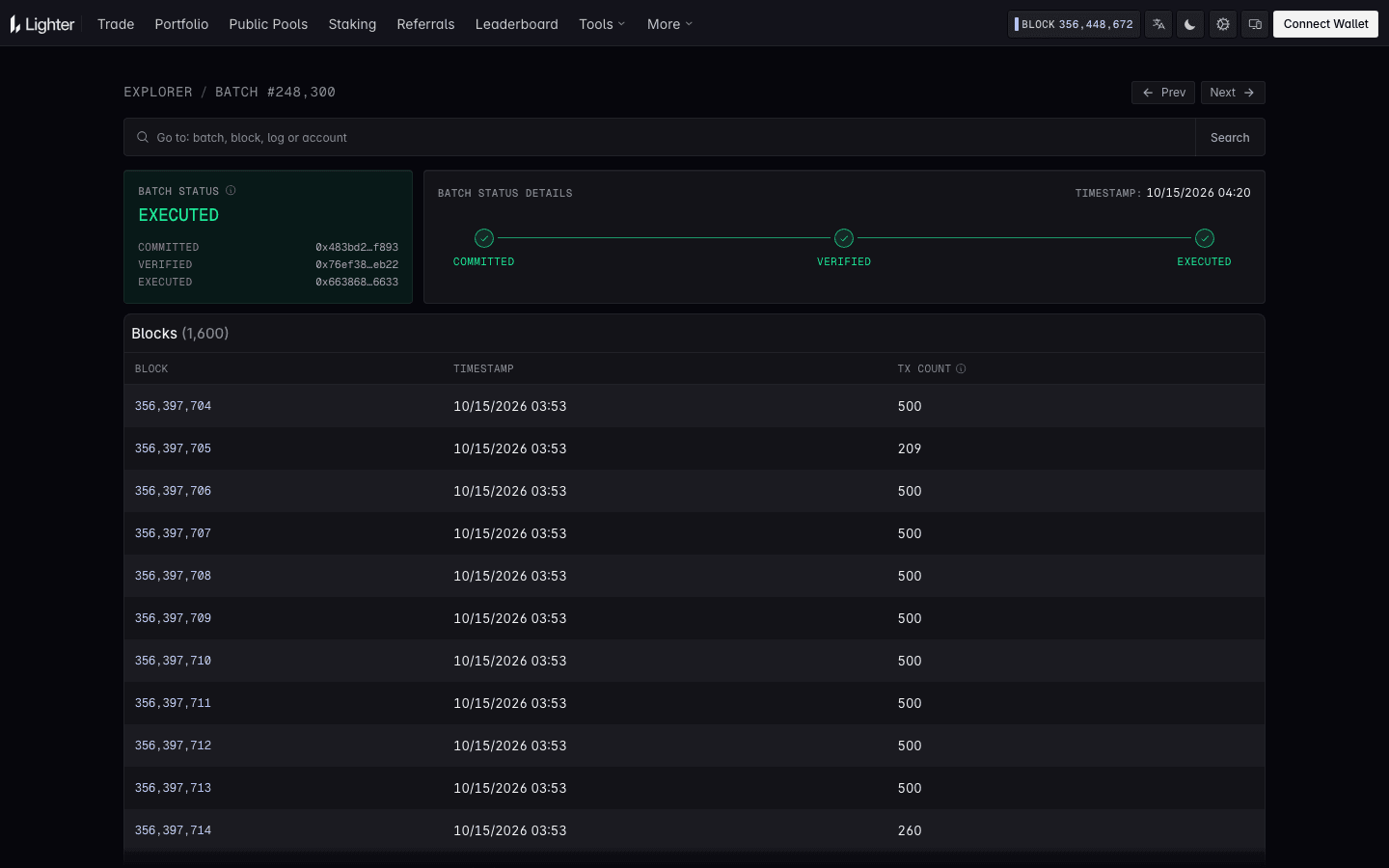
How long it takes. In three batches we timed on October 15, 2026, commit to execution took 17–20 minutes, and the first block of each batch reached execution 25–30 minutes after it was produced. Your trade is final on Lighter immediately; this delay is how long it takes until Ethereum has proven it.
The escape hatch. Lighter’s docs describe a priority request queue on Ethereum: you can send a withdrawal, a public-pool exit or a reduce-only IOC order directly to the contract, and the sequencer must process it within a set time. If it does not, the contract enters Escape Hatch mode (called desert mode in the contract): it freezes, and users rebuild their state from the data on Ethereum and withdraw everything with a proof. You can check the flag yourself on Etherscan under Read as Proxy → desertMode; it read false on October 15, 2026. This is the main custody difference from exchanges that run their own chain; the trade-offs are in our Lighter review.
9. The API alternative
Everything in the explorer is also available as JSON, without an API key:
| You want | Call |
|---|---|
| Network totals | GET https://explorer.elliot.ai/api/total |
| Latest batches / one batch with its Ethereum hashes and timestamps | /batches · /batches/248300 |
| Anything from one search string | /search?q=VALUE (block, batch, hash, address or index) |
| An account’s logs, filtered | /accounts/INDEX_OR_ADDRESS/logs?limit=50&offset=0&pub_data_type=WithdrawV2 |
| Positions with liquidation price, funding paid and margin mode | GET https://mainnet.zklighter.elliot.ai/api/v1/account?by=index&value=INDEX |
| Every account index of one wallet | /api/v1/accountsByL1Address?l1_address=0x… |
Explorer API limits (rate-limits page, updated October 13, 2026): 90 weighted requests per minute for every account type; search costs 3, accounts/* 2, everything else 1. All calls above were tested on October 15, 2026.
For market data (trades, order books, candles, funding and liquidations), use the main REST and WebSocket API: our Lighter API guide lists the endpoints, parameters and limits, with a working example.
10. Limits and gotchas
- Everything is public. Positions, PnL, balances and history are readable by anyone who has your address or index. Trading without KYC is not anonymity.
- Times are local. The explorer shows your browser’s time zone; the API returns UTC.
- Transactions are not trades. Block and network transaction counts include every order, modify and cancel. Count logs of type Trade if you want fills.
- Pending is not failed. A pending log is final on Lighter and waiting for its batch to be proven on Ethereum.
- Robinhood Chain is a separate exchange. Lighter on Robinhood Chain has its own endpoints and chain ID, so its accounts do not appear on the mainnet explorer; Litscan links a separate site for it.
- Never sign anything to view data. The explorer needs no wallet connection. A “Lighter scan” site that asks you to connect and sign is a phishing risk; the official front ends are app.lighter.xyz and lighter.exchange.
Using Hyperliquid as well? The same lookups there work differently (one address, no account index): see our Hyperliquid explorer guide.
FAQ
What is the official Lighter explorer?
The official explorer is part of the Lighter web app at app.lighter.xyz/explorer (the same page also loads on lighter.exchange/explorer). It shows batches with their Ethereum commit, verify and execute transactions, blocks, logs (trades, deposits, withdrawals, transfers) and any account by its index or Ethereum address, with positions and balances. It is free and needs no wallet connection.
Is there a “Lighter Scan”?
Lighter does not run a product called Lighter Scan. People searching for it usually want the official explorer at app.lighter.xyz/explorer, or Litscan (litscan.io), a third-party explorer and analytics site that Lighter’s API documentation lists under Third-Party Resources with the note that Lighter does not guarantee its accuracy.
Is Litscan official?
No. Litscan is built and run by an independent team. Lighter’s API docs list it on the Third-Party Resources page for its per-integrator analytics, and state that everything on that page is operated by third parties, not by Lighter. Use the official explorer when you need proof that something happened.
How do I find my Lighter account index?
Paste your Ethereum wallet address into the search box of the official explorer: it opens your main account and shows the index in the header, after “Account #”. Sub-accounts have their own indexes; the public API call accountsByL1Address returns all of them for one address.
How do I verify a Lighter withdrawal?
Open your account in the explorer, filter the logs by Withdraw, and open the entry. It shows the asset, amount, source account and route type, and the batch it belongs to. When that batch shows Executed, the withdrawal is final on Ethereum. On October 15, 2026 the API's withdrawalDelay was 1,684 seconds (about 28 minutes). A fast withdrawal (USDC to Arbitrum) appears as a transfer to Lighter's fast-withdraw pool, with your destination in the memo, not as a Withdraw log.
Why does my Lighter trade say pending?
Pending means the trade is final on Lighter (the sequencer executed it) but its batch has not yet been committed and proven on Ethereum. That normally takes minutes: in three batches we timed on October 15, 2026 the first block was executed on Ethereum 25–30 minutes after it was produced.
Can anyone see my Lighter positions?
Yes. Anyone who knows your account index or wallet address can open your positions, entry prices, unrealized PnL, balances and full log history in the explorer, and the public API adds liquidation prices. There is no private mode, so keep strategy accounts separate from addresses linked to your identity.
What happens to my funds if Lighter stops working?
You can send withdrawals and reduce-only orders straight to Lighter’s Ethereum contract as priority requests. If the sequencer does not process them in time, the contract enters Escape Hatch (desert) mode and freezes; users then rebuild their balances from the data Lighter posted to Ethereum and withdraw with a proof. The contract’s desertMode flag was false on October 15, 2026.
Is there a Lighter explorer API?
Yes. The explorer reads from explorer.elliot.ai/api, which answers /total, /batches, /blocks, /search?q=, /accounts/{index or address}/logs and /positions, and /logs/{hash} without an API key. All account types get 90 weighted requests per minute there. For market data (trades, order books, candles, funding) use the main REST and WebSocket API instead.
Does the Lighter explorer show liquidation prices?
Not on the account page, which lists side, size, entry price and PnL. The public REST endpoint /api/v1/account?by=index&value=YOUR_INDEX returns each position’s liquidation price, margin mode and total funding paid, with no key needed.
Add Hyperliquid as your second venue
Hyperliquid has the deepest perp order books among DEXs, and its explorer works the same way: every fill is public. Join with code HOLYGRAIL for 4% off your fees on the first $25M of volume. The code must be entered before your first $10,000 of volume.
Prefer Lighter? Open Lighter with code 718610TD.
Disclosure: 718610TD (Lighter) and HOLYGRAIL (Hyperliquid) are our referral codes; we earn a share of referred accounts’ fees at no cost to you. Links to Lighter’s official explorer on this page also carry 718610TD. We have no relationship with Litscan, LighterPulse, L2BEAT, Etherscan, 0xArchive or Tardis.dev. Explorer screens, API responses and Ethereum transactions were read on October 15, 2026 (UTC); counters and timings are dated snapshots. Nothing here is financial advice.