
Lighter’s key features are free trading on the default Standard account (0% maker / 0% taker), an Advanced order menu with Conditional, TWAP, Scale, Atomic, Chase Limit and Iceberg orders, perpRFQ for large trades, Public Pools and the LLP, multi-asset margin, and zero-knowledge proofs that make every match and liquidation verifiable on Ethereum. The catch is speed: free accounts wait 300 ms on taker orders, and a paid Premium account (0.028% taker) cuts that to 140 ms. On September 25, 2026 Lighter listed 210 perpetual and 10 spot markets and traded about $1.67B in 24 hours.
Short version. Trading itself is gasless: orders are signed messages, not Ethereum transactions. Pick an account type first: Standard (free, slower), Premium (0.004% / 0.028%, 140 ms, 64 sub-accounts) or Plus (0.005% both sides, bigger API limits). Then use the tools: TWAP, Iceberg and Chase for execution (0.01% on Standard), Atomic baskets for pair trades, perpRFQ for size, Public Pools or the LLP for passive exposure, ETH or XAUT as collateral, and RWA perps on gold, FX and stocks around the clock. Your exit is guaranteed by an Ethereum escape hatch.
Try every feature on a free account
Open Lighter with referral code 718610TD. Standard trading is free; if you switch to Premium, your first week of Premium fees is rebated (up to $10M of volume).
We earn a commission when you sign up through our links; it never raises your fees.
1. Lighter features at a glance
| Feature | What it does | Cost or condition |
|---|---|---|
| Advanced order menu | Conditional, TWAP, Scale, Atomic, Chase Limit, Iceberg | Free except TWAP, Chase, Iceberg (0.01% on Standard) |
| perpRFQ | Request quotes from market makers for size, side hidden | 1 bps (0.01%) on Standard |
| Public Pools | Deposit into a whitelisted operator’s strategy, no lock-up | Operator takes a share of profits |
| LLP (Lighter Liquidity Pool) | Protocol pool: insurance fund, liquidations, RWA liquidity | Requires staked LIT (1 LIT → 10 USDC capacity) |
| Unified Trading Account + Multi-Asset Margin | One margin across spot and perps; ETH or XAUT as collateral | Web only; 70% LTV |
| Sub-accounts and API keys | Separate strategies; up to 256 API keys per account | 4 sub-accounts on Standard, 64 on Premium |
| RWA, pre-IPO and pre-launch perps | Gold, oil, FX, US and Korean stocks, indices, private companies | Pre-IPO and pre-launch are isolated-only |
| Gasless trading | Orders, cancels and edits are signed messages, not Ethereum transactions | No gas per order; deposits and withdrawals have chain costs |
| ZK proofs + escape hatch | Matching and liquidations proven; exit directly on Ethereum | Built into the protocol |
| Lighter Mobile app | iOS and Android | Trading features only in supported regions |
Sources: docs.lighter.xyz, apidocs.lighter.xyz, the app order ticket and store listings, September 25, 2026. Scroll sideways on mobile.
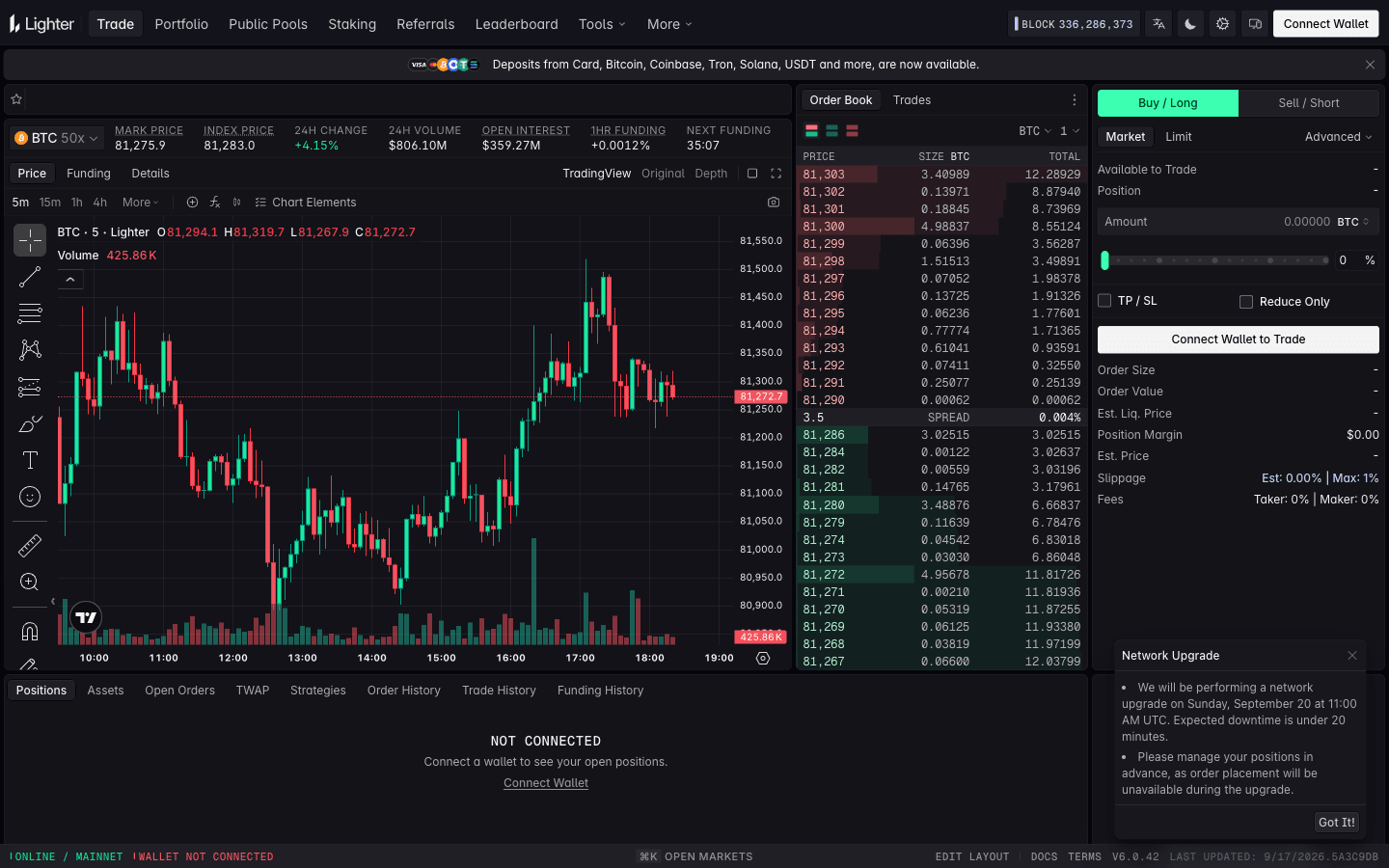
Lighter is a decentralized exchange built as an application-specific zk-rollup: a sequencer matches orders at exchange speed, a prover generates proofs of every batch, and Ethereum verifies them. You sign in with an Ethereum wallet, trade without paying gas per order, and keep custody. If you are new to exchanges of this kind, start with what a DEX is; if you already trade, the sections below go feature by feature.
2. Standard, Premium and Plus accounts
Most exchanges charge by volume tier. Lighter makes you choose an account type, and the price of zero fees is latency. All three types share the same order books.
| Account | Taker | Maker | Latency | Sub-accounts | Best for |
|---|---|---|---|---|---|
| Standard (default) | 0% | 0% | 300 ms taker / 300 ms cancel; maker not delayed | 4 | Retail, swing trading, most manual traders |
| Premium (opt-in) | 0.0280% | 0.0040% | 140 ms taker; no added delay on cancels and post-only | 64 | Scalpers, market makers, latency-sensitive bots |
| Plus (opt-in) | 0.005% | 0.005% | 300 ms taker / 200 ms maker and cancel | 16 | Latency-tolerant bots that need higher rate limits |
Sources: docs.lighter.xyz “Trading Fees” and apidocs.lighter.xyz “Account Types”, September 25, 2026; latencies re-read on both on October 6, 2026. Premium fees are at 0 staked LIT.
- LIT staking discounts (Premium only). Staking 1,000 LIT takes 2.5% off; 10,000 LIT 10%; 30,000 LIT 15%; 100,000 LIT 20%; and 500,000 LIT 30%, which gives 0.0028% maker / 0.0196% taker. The stake is counted per Ethereum address across the main account and all sub-accounts. LIT Fee Credits let you rent a higher tier for a chosen period instead of staking the full amount; the upfront LIT payment is streamed to stakers.
- Switching. You change type in the app or through the
changeAccountTierAPI call. Downgrades are limited to once every 24 hours; upgrades have no cooldown. - Which to pick. If you hold positions for hours or days, 300 ms does not matter and Standard is the cheapest venue you can find. If you scalp, quote both sides or run a fast bot, Premium’s 140 ms and free cancels matter more than 0.028%. The full cost maths is in our Lighter fees guide.
3. Lighter order types: the full menu
The order ticket has three tabs, Market · Limit · Advanced, plus TP / SL and Reduce Only checkboxes; under Limit → Advanced you get Post Only and Good till Time. Matching is strict price-time priority, proven with SNARKs. On a Standard account regular market, limit and TP/SL orders cost 0%; taker orders wait 300 ms.
| Order type | Where | What it does | Maker or taker | Options |
|---|---|---|---|---|
| Market | Market tab | Fills now against the book; max slippage set in the ticket (default 1%) | Taker | Reduce-only or attached TP/SL (not both) |
| Limit | Limit tab | Rests at your price or better | Maker if it rests, taker if it crosses | Post-only, Good-Til-Time or IOC; reduce-only or TP/SL |
| Stop-loss / take-profit | TP / SL box | Market order when the mark price hits the trigger | Taker | Reduce-only |
| Stop-loss limit / take-profit limit | TP / SL box or Advanced → Conditional | Limit order placed when the mark price hits the trigger | Depends on fill | Good-Til-Time, reduce-only |
| Conditional | Advanced | Standalone trigger + limit price (stop entries, breakouts) | Depends on fill | Reduce-only |
| TWAP | Advanced | Market slices every 30 s over 5 min to 30 days | Taker; 0.01% on Standard | Reduce-only; Advanced TWAP styles |
| Scale | Advanced | Ladder of limit orders between a start and end price | Maker if resting | Order count, size skew |
| Iceberg / Chase Limit | Advanced | Large limit shown in chunks / limit that re-prices to the best bid or ask | Mostly maker; 0.01% on Standard | Run in your browser tab |
| Atomic | Advanced | Long and short legs across markets in one transaction | Per leg | Optional TWAP, auto-balance |
| RFQ (perpRFQ) | Eligible markets | Market makers quote a size without seeing your side | 0.01% on Standard | Whitelisted addresses |
Lighter docs “Order Types & Matching” and the app order ticket (v6.0.46), September 25, 2026; fees from the registry. Scroll sideways on mobile.
- Market: the ticket shows an estimated and a maximum slippage (1% by default, up to 10%); an order that would slip further is cancelled. Reduce Only and TP/SL cannot be combined on one order (“Stop loss / take profit is not available on reduce-only orders”).
- Limit: Post Only cancels an order that would cross instead of filling it as a taker (it matters on Premium: 0.004% maker vs 0.028% taker). Good-Til-Time keeps it until an expiry you choose (the ticket pre-filled 28 days); IOC fills what it can and cancels the rest. A reduce-only limit fills only as far as your position goes, which makes it the cleanest take-profit.
- Rules: every perp order needs $10 of notional and a minimum base size (0.00007 BTC, 0.002 ETH, 0.055 SOL). The fat-finger check rejects a sell limit below 95% of max(mark, best bid) and a buy limit above 105% of min(mark, best ask).
The Advanced menu
- Conditional: a standalone trigger price plus a limit price. Use it for stop entries on a breakout or a stop-limit exit. Triggers use the mark price, not the last trade.
- TWAP: splits a large order into market slices every 30 seconds for 5 minutes to 30 days. Advanced TWAP adds Passive, Neutral and Aggressive styles and randomised slicing, and runs in your browser tab.
- Scale: a ladder of limit orders between a start and an end price, with an order count and a size skew. Good for building into a range.
- Atomic: a basket of long and short legs across several markets executed in one transaction, all legs or none. It is the cleanest way to put on a pair trade or a hedge. Markets in isolated-margin mode cannot be included.
- Chase Limit: keeps re-pricing a limit order to stay near the best bid or ask, within a maximum distance from the index price.
- Iceberg: shows only a chunk of a large limit order and refills it as it fills. Tick post-only so it never crosses as a taker.
Cost on Standard. Regular market, limit and TP/SL orders stay free. The app says RFQ, Chase, Iceberg and TWAP orders “include a fee on Standard account”, and the ticket showed 0.01% (1 bps) on September 25, 2026; you sign a one-time message to authorise it. Chase Limit, Iceberg and Advanced TWAP run from your browser, so closing the tab stops them, and orders they left on the book expire after one hour. There is no named trailing stop or OCO order; a TP and SL on the same position behave like an OCO pair.
Stop-loss and take-profit on Lighter
Stops trigger on the mark price, not the last trade: a stop-loss sell (closing a long) fires when mark ≤ trigger, a take-profit sell when mark ≥ trigger, and the mirror for shorts. Each comes as a market form (you get out, subject to the TP/SL max slippage, 1% by default; if price runs past it the stop does not execute) or a limit form (you control the worst price, but a gap can leave it unfilled; Good-Til-Time expiry available). For SL/TP limits the fat-finger check uses the trigger price, so the limit can sit at most 5% beyond the trigger. There is no named trailing stop or OCO order; a TP and SL on the same position act like an OCO pair, and Lighter cancels the leftover with “Order canceled due to position close”.
Why the last-line stop should be a market stop. Below the maintenance margin, partial liquidation first cancels all your open orders, stops included, then closes positions and charges up to a 1% liquidation fee to the LLP. A stop-limit still resting at that point does nothing. Worked example with BTC's 2% initial / 1.2% maintenance margin (public API, September 25, 2026), 0.1 BTC long at $84,000: at 50x the maintenance level sits near $83,320, so the liquidation engine is your stop; at 10x it sits near $76,518, leaving room for a tactical stop-limit (trigger $82,700, limit $82,500, reduce-only) plus a stop-market at $81,500 as the exit that must fill. On a Standard account both cost 0%.
Does Lighter have hedge mode? No: use sub-accounts
Lighter is one-way (net) only. An account's API positions list has one entry per market with a sign of 1 (long) or −1 (short): we checked a live account with positions in 195 markets and found 195 entries. Selling while long reduces the long; going through zero flips the sign. To hold a long and a short on the same market, open the second leg in a sub-account (4 on Standard, 16 on Plus, 64 on Premium). Each has its own margin and liquidation price, so set the margin mode before trading (Lighter rejects a change on a market with a position or open order, error 21132) and close each leg where it lives with Reduce-Only. Example: long 10 SOL at about $120 in the main account; post-only sell 10 SOL in a “hedge” sub-account before a data release. At 5x each leg ties up $240, both legs pay or receive hourly funding (netting to about zero), trading costs 0% on Standard, and you keep the original entry. Aster's order-book perps do have a One-Way / Hedge switch (Aster order types); Hyperliquid, like Lighter, is one-way (why).
Worked examples
- A long with a bracket. Buy 0.1 BTC at $84,000 with TP $88,000 and SL $82,000: stop-out about −$200 plus slippage, take-profit about +$400. At 10x it uses about $840 of margin; fees 0% on Standard.
- 1 ETH over an hour with TWAP. 3,600 ÷ 30 + 1 = 121 slices of about 0.00826 ETH (about $22 at $2,680), above the 0.002 ETH and $10 minimums. Stretched over a day each slice would fall below the minimum. TWAP carries 0.01% on Standard.
- Scaling into a range. Scale-buy 0.5 ETH between $2,600 and $2,500 with 5 orders: rungs $25 apart, more size at the bottom with a skew.
4. perpRFQ for large trades
When the visible book is too thin for your size, perpRFQ lets you ask market makers for liquidity directly. You pick the RFQ order type on an eligible market and enter a side and a size. Market makers see only the size, not the side, and have 10 seconds to respond; the ticket then shows an estimated price and slippage, and you have 2 minutes to execute through the order book. Your address must be whitelisted, and RFQ orders cost 1 bps on Standard accounts.
Eligible markets on September 25, 2026 included BTC, ETH, SOL, XRP, ZEC, LINK, SUI, DOGE, BNB and PAXG among the crypto perps, and XAU, XAG, WTI, Brent, SPY, QQQ, TSLA, NVDA, AAPL, MSFT and other RWAs. Hiding the side is the point: a market maker cannot shade the quote against you because it does not know whether you are buying or selling.
TWAP, Iceberg and RFQ for 0.01%
Market, limit and TP/SL orders are free on Standard; the execution tools cost 1 bps. Sign up with code 718610TD.
5. Public Pools, LLP and LIT staking
Public Pools
Public Pools let you put money behind someone else’s strategy. A whitelisted operator trades pooled capital from a sub-account; depositors receive pool shares and redeem them when they withdraw. The operator sets an operator fee (a share of profits taken when depositors withdraw) and must keep a minimum operator share: with a 10% minimum and $10,000 of the operator’s own money, depositors can add up to $90,000. There is no lock-up; you can withdraw at any time. Public Pools cannot hold isolated positions. Treat a pool like any fund: check the operator’s history and drawdowns, and remember that losses are shared too.
LLP (Lighter Liquidity Pool)
The LLP is the protocol’s own pool. It acts as the insurance fund, takes over accounts that fall below the close-out margin, receives liquidation fees (up to 1% on partial liquidations), and is the main liquidity provider on RWA markets. Its collateral is split into strategy buckets (for example crypto perps, FX and equities) so a loss in one bucket cannot drain the others. Since the LIT launch, LLP deposits are open only to LIT stakers: each staked LIT lets you deposit up to 10 USDC. Staking itself currently pays a fixed 6% APR, and unstaking has a 3-day lock-up. The docs note that the LLP fully backstops ADL events, so depositors carry that risk. More detail in our Lighter LLP and staking guide and insurance fund and ADL guide.
6. Unified Trading Account and multi-asset margin
By default Lighter keeps spot and perp balances apart (a “Simple Trading Account”), and perps are margined only in USDC. Enabling a Unified Trading Account (web app only for now) pools spot and perp USDC into one margin. On top of that, Multi-Asset Margin lets you post non-USDC assets as collateral:
| Asset | Loan-to-value | Liquidation threshold | Liquidation fee | Per-user cap | Global cap |
|---|---|---|---|---|---|
| USDC | 100% | 100% | None | None | None |
| ETH | 70% | 85% | 2% | 2,000 ETH | 10,000 ETH |
| XAUT (tokenised gold) | 70% | 85% | 2% | 500 XAUT | 2,000 XAUT |
Source: docs.lighter.xyz “Multi-Asset Margin”, September 25, 2026. At launch it supports perpetual futures only.
Two uses the docs spell out: a basis trade (deposit ETH, short the ETH perp, earn funding while delta-neutral) and a leveraged spot long (use the extra margin to buy more ETH). Example: 10 ETH at about $2,690 is $26,900, which counts as roughly $18,830 of margin at 70% LTV. One health check covers both perps and collateral, so if ETH falls, your margin and your collateral shrink together; that is exactly when a leveraged ETH long gets liquidated faster.
7. Sub-accounts, API keys and self-trade prevention
- Sub-accounts: each Ethereum wallet has a main account and can create sub-accounts: 4 on Standard, 16 on Plus and 64 on Premium. Standard sub-accounts cannot be deleted, so name them with care. Use them to separate a bot from manual trades or to isolate risky size. Sub-accounts share the main address’s account tier. Hedging one market long in one sub-account and short in another is covered in our sub-account hedge section.
- API keys: every account or sub-account can register up to 256 API keys (a few indexes are reserved for the web and mobile apps). Keys sign orders without your wallet key; secure withdrawals can only go back to your own address, while fast withdrawals and transfers to other addresses need the Ethereum key’s signature. Read-only tokens can be issued for dashboards. See the Lighter API trading guide and trading bot guide.
- Self-trade prevention: since May 31, 2026 the default is cancel maker: if your order crosses your own resting order, the resting one is cancelled and your order keeps filling against the rest of the book. Cancel taker, cancel both and reduce both can be set per order.
8. RWA, pre-IPO and pre-launch markets
Lighter trades far more than crypto. Its RWA perps trade 24/7 and cover commodities (gold, silver, platinum, copper, WTI and Brent oil, natural gas), FX (EUR/USD, USD/JPY, USD/KRW and others), US and Korean stocks (NVDA, TSLA, SK Hynix, Samsung) and indices (US500, US100), plus a US 10-year yield market. They support cross and isolated margin, and leverage does not change outside the underlying market’s trading hours, although the docs warn that volatility can jump at the open. Maximum leverage from the API on September 25, 2026:
| Market | BTC | ETH | SOL | HYPE / XRP | XAU (gold) | EUR/USD | US500 | NVDA |
|---|---|---|---|---|---|---|---|---|
| Max leverage | 50x | 50x | 25x | 20x | 25x | 50x | 50x | 20x |
Source: Lighter public API orderBookDetails (minimum initial margin fraction), September 25, 2026. The docs’ contract-spec table is older (it still shows gold at 15x); the API is what the exchange enforces. More in Lighter leverage limits.
- Pre-IPO markets let you trade private companies; the market list on September 25, 2026 included OPENAI and ANTHROPIC. They are isolated-margin only, priced only by Lighter’s internal mechanism with no price caps, and funding uses a premium multiplier of 1/100. After an IPO they convert to normal markets once a stable price feed exists.
- Pre-launch markets (tokens before they list) are also isolated-only. They charge no liquidation fee; below the close-out margin an account is auto-deleveraged directly instead of being taken over by the LLP.
Volume is concentrated in the majors: in the 24 hours to 08:23 UTC on September 25, 2026 BTC traded about $803M and ETH $285M of Lighter’s $1.67B; gold did $32M. Check the book before sizing on anything smaller, or use perpRFQ.
9. ZK proofs and the escape hatch
This is the feature that separates Lighter from most exchanges, central or decentralized. Deposits and the canonical state root (balances, positions, pools, order books) live in smart contracts on Ethereum. Lighter executes user-signed transactions in batches, generates a succinct proof for each batch, and posts state updates with compressed data blobs to Ethereum; the contracts only update after the proof verifies. In plain terms: the operator cannot skip the order queue, liquidate you early or invent a balance without the proof failing, and anyone can rebuild every account from the data on Ethereum.
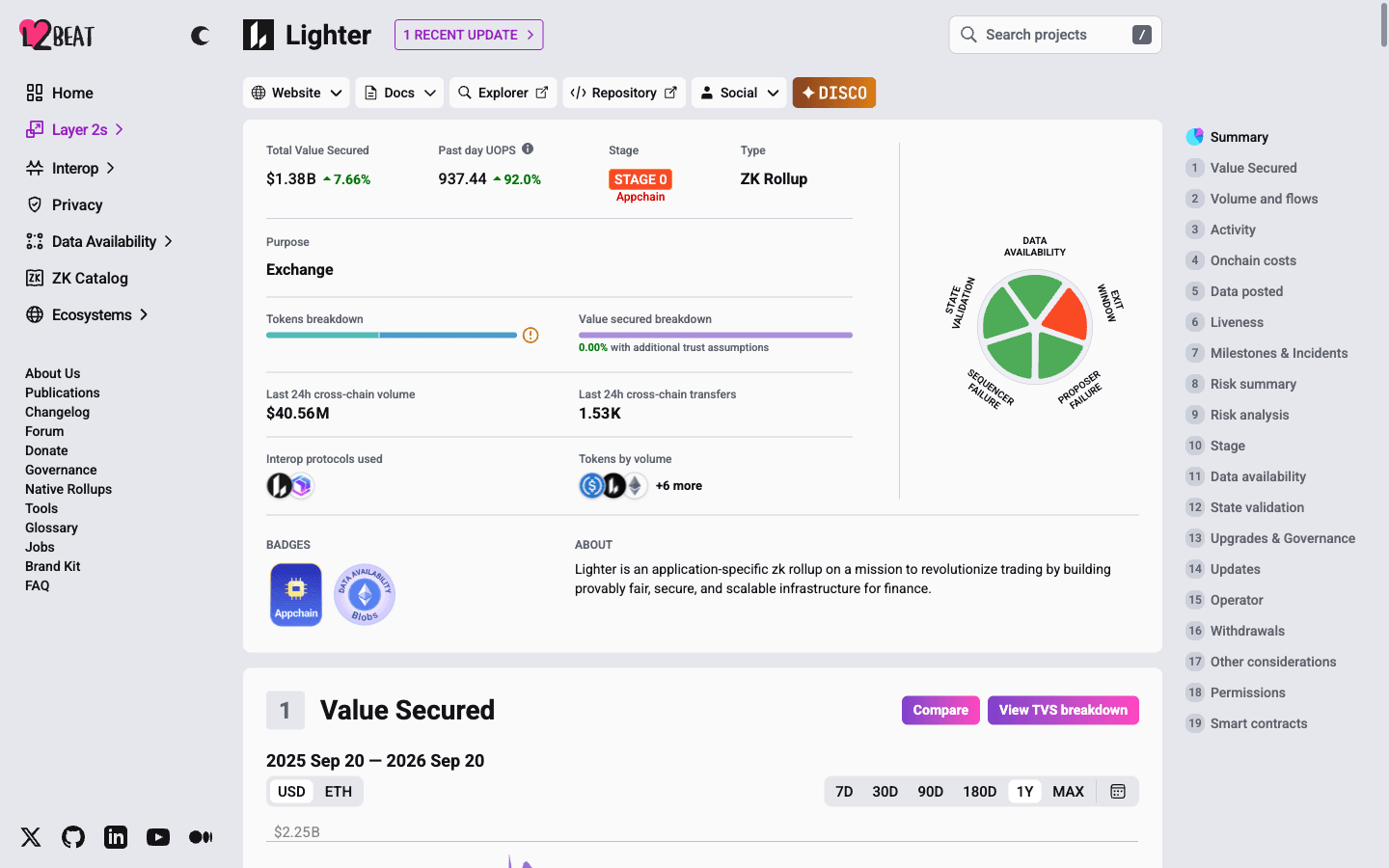
The escape hatch handles the worst case. You can submit critical actions (withdrawals, public pool exits, reduce-only IOC orders, cancel-all) through a priority request queue on Ethereum, and the sequencer must process them within a set time. If it does not, the contract enters Escape Hatch mode and freezes; users then prove their balances, positions and pool shares from the posted data and withdraw the full value directly on Ethereum, with no help from the Lighter team. It is a guarantee a centralized exchange cannot give you. Do note the limits: L2BEAT rates Lighter a Stage 0 rollup and lists no exit window, because a multisig can upgrade the contracts instantly, so you are still trusting the team not to push a harmful upgrade.
10. Gasless trading: why orders cost no gas
Placing, cancelling and editing orders on Lighter costs no gas, and you do not approve a wallet pop-up for each order. That follows from the architecture above:
- Orders are signed messages, not Ethereum transactions. Every exchange operation is a user-signed transaction sent to Lighter’s sequencer, which orders them first in, first out and executes them off Ethereum. The signing is done by an API key registered to your account (the web and mobile apps use reserved key slots), so your wallet is needed for setting the account up and for some transfers and withdrawals, not for each order.
- Lighter pays for Ethereum settlement in bulk. Hundreds of thousands of execution proofs are aggregated into a single batch proof, which the docs describe as “efficient and cost-effective verification on Ethereum”, and state updates are posted as compressed data blobs. That cost is carried by the protocol, not charged per order.
- No gas auction on your fills. Because orders never enter a public blockchain mempool, a volatile minute does not make an order more expensive or leave it stuck. The limits you meet instead are the Standard account’s latency (300 ms taker, 300 ms cancel) and API rate limits (60 requests per minute on Standard).
Moving money in and out is where chain costs appear:
| Action | What you pay | Minimum and notes |
|---|---|---|
| Place, cancel or edit an order | No gas. Trading fee 0% on Standard (0.01% on TWAP, Chase, Iceberg and RFQ) | $10 minimum order |
| Deposit to your universal deposit address | The source chain’s normal transfer cost, plus any bridge or swap slippage | $3–$10 depending on chain; the docs suggest sending slightly more than the minimum |
| Deposit directly to the Ethereum contract | Ethereum gas for your ERC-20 approval and deposit transactions | 1 USDC (or equivalent) |
| CCTP deposit (Arbitrum, Base, Avalanche, Arc) | Source-chain transfer cost | 5 USDC; about 15–20 minutes |
| Fast withdrawal | Signed with your Ethereum key; paid out on Arbitrum | USDC only, 4 USDC minimum |
| Secure withdrawal | Goes through Ethereum and becomes claimable after a delay; Lighter usually claims it for you, but when Ethereum gas is high you may need to claim it in the app and pay the gas | 1 USDC minimum; the delay endpoint read 1,758 s (about 29 min) on September 25, 2026 |
| Transfer to another Lighter account | transferFeeInfo returned 0 USDC on September 25, 2026 | 1 USDC minimum; transfers to another L1 address need the Ethereum key’s signature |
| Escape-hatch request | Ethereum gas for the priority transaction you send yourself | Only needed if the sequencer ignores you |
Sources: docs.lighter.xyz “Technical Architecture”, apidocs.lighter.xyz “Deposits, Transfers and Withdrawals”, public API withdrawalDelay and transferFeeInfo, September 25, 2026. Lighter publishes no withdrawal-fee table, so check the amount you will receive before you confirm.
This is also true of the other big order-book DEXs: Hyperliquid orders are gas-free on its own chain (withdrawals to Arbitrum cost 0.2 USDC plus a little gas), and Aster charges no gas on trades on Aster Chain (withdrawal gas from about 1 USDT). What sets Lighter apart is that on the Standard account the trading fee is zero as well, so a gasless order is also a free one. For a step-by-step funding walkthrough, see the Lighter deposit and withdrawal guide.
11. Mobile app, deposits and language
- Lighter Mobile is published by Elliot Technologies on the App Store (first released January 13, 2026; version 1.1.3 on September 21, 2026) and on Google Play. The listing says wallet-based trading features are available only in selected supported regions; elsewhere the app is a market-data viewer. The mobile web app works everywhere the service is offered. Details in our Lighter mobile guide.
- Deposits go through universal deposit addresses from Ethereum, Arbitrum, Base, Solana, BNB Chain, Tron, Bitcoin and more (minimums from $3 to $10), converted to USDC for perps. Fast withdrawals via Arbitrum need at least 4 USDC; secure withdrawals go through Ethereum. See the deposit and withdrawal guide.
- Funding is paid every hour, capped at 0.5% per hour.
- Language: the web app has a Japanese option among its languages.
12. Trading strategies that use Lighter's features
Lighter's feature set changes which strategies make sense, mainly because the fee line on a Standard account is zero while latency and rate limits are not. Below are five approaches that lean on specific Lighter features, each with the numbers that decide whether it works. None of this is a promised return: the arithmetic only shows where the costs are.
1. Manual scalping on the free Standard account, and its limits
A scalp aims at small moves, so fees decide whether the edge survives. Take a trader who risks 0.15% per trade, targets 1.5× that, and wins 55% of the time. The expected value is 0.55 × 1.5R − 0.45 × R = 0.375R, about 0.056% of position size per trade. Twenty trades a day is roughly 1.1% gross. On a venue charging a 0.045% taker fee (Hyperliquid tier 0), twenty market-order round trips cost 20 × 2 × 0.045% = 1.8%, more than the whole edge. On Lighter Standard the fee is 0%, so the edge is only reduced by spread and slippage.
What Standard does not give you:
- Speed. Taker orders and cancels wait 300 ms; maker orders are not delayed (docs, October 6, 2026). For a manual trader that is invisible; for a strategy that must cancel before the price moves, it is decisive.
- Rate limits. A Standard account is limited to 60 REST requests per rolling minute, and that includes sending orders; it can hold at most 50 pending orders (10 per market) and 250 active orders (30 per market). A bot that quotes continuously outgrows this quickly.
- Liquidity outside BTC and ETH. At 16:13 UTC on September 25, 2026, the BTC book had a 0.01 bp spread and a simulated $100,000 market buy averaged 0.47 bp above mid; ETH was 0.45 bp wide with a $100,000 buy at 0.46 bp. SOL, one of the five busiest markets by volume, was 2.2 bp wide and a $100,000 buy cost 2.0 bp. Scalp the books that can take your size (see volume and liquidity by market).
- Timing. Liquidity is not flat through the day: on Hyperliquid's BTC market, 12:00–17:00 UTC carried 38.6% of the last 30 days' volume and the quietest hour (04:00 UTC) traded about a fifth of the busiest. Measured hours are in our best time to trade crypto guide.
When to switch to Premium. If latency or limits bind, Premium cuts taker latency to 140 ms, removes the added delay on cancels and post-only orders, and moves order sending to a separate, much larger quota (4,000 transactions a minute at 0 LIT staked, up to 72,000 at 500,000 LIT; rate-limits page, October 15, 2026). The price is 0.028% taker / 0.004% maker before LIT discounts. A market-making bot that posts post-only orders pays only the 0.004% maker fee; a taker bot pays 0.028%, still below most venues' entry taker fee. Plus (0.5 bps both sides) keeps Standard's latency but raises the API limits.
2. TWAP for entries and exits that should not move the price
TWAP slices an order into market orders every 30 seconds for anywhere from 5 minutes to 30 days, so the number of slices is duration ÷ 30 s + 1. A $200,000 BTC entry over one hour becomes 121 slices of about $1,650, each far below the size that moves a 0.01 bp BTC book. On a Standard account TWAP carries a 0.01% fee (the app showed it on September 25, 2026), so that hour costs about $20, compared with roughly $10–15 of slippage for a single $200,000 market order on the same book (a simulated $100,000 buy cost 0.47 bp and $1M cost 1.26 bp). TWAP pays off on thinner markets, such as mid-cap alts and RWAs, where one market order would walk the book much further. Advanced TWAP styles (Passive, Neutral, Aggressive) run in your browser tab, so keep it open.
3. perpRFQ for size on thinner markets
perpRFQ lets you ask whitelisted market makers for a quote without revealing your side; they have 10 seconds to respond and you have 2 minutes to execute. On Standard it costs a 1 bps points fee. The decision rule is simple: use RFQ when the quoted slippage plus 1 bp is lower than what the visible book would cost. On BTC the book already absorbed a simulated $1M buy at about 1.3 bp on September 25, 2026, so RFQ adds little there. The eligible list also includes RWAs such as XAU, WTI, SPY, NVDA and TSLA and mid-cap perps such as ONDO, ENA and NEAR, where resting depth is a fraction of BTC's, which is where RFQ earns its fee.
4. Sub-accounts and Atomic orders for hedges and pair trades
Lighter nets positions per account, so a long and a short in the same market cancel out. To run a hedge beside a directional trade, or a bot beside manual positions, put them in separate sub-accounts (4 on Standard, 16 on Plus, 64 on Premium; Standard sub-accounts cannot be deleted). For a two-leg idea, such as long ETH and short BTC, the Atomic order sends every leg in one transaction that fills completely or not at all, which avoids being left with one leg open in a fast market. Isolated-margin markets cannot be included in an Atomic basket.
5. Cross-venue spreads and funding: Lighter as the free leg
When the same perp trades at different prices on two venues, a trader can buy the cheap one and sell the expensive one. Because the Lighter leg costs nothing on Standard, the whole fee budget is the other venue's fee: 0.045% × 2 = 0.09% on Hyperliquid at tier 0 (0.0864% with a referral code), plus slippage on both books. Between two deep BTC books the gap is normally a few basis points and closes quickly, so this needs automation, capital on both venues and the Standard account's 300 ms latency is a real handicap. Funding differences are the slower version of the same idea, but check the numbers first: over the 30 days to September 25, 2026, BTC longs paid 0.7640% on Lighter and 0.7664% on Hyperliquid, almost identical. More in the funding-rate arbitrage guide.
Swing trading: funding is the cost to watch
For positions held for days, Lighter's zero fee matters less than funding, which is paid every hour between longs and shorts with no exchange cut. Lighter's fundings endpoint records the default crypto rate as 0.0012% an hour, about 0.029% a day or 0.29% over a 10-day hold; the cap is 0.5% an hour. BTC longs paid 0.7640% over the 30 days to September 25, 2026 (97.2% of hours positive). Scaling into a swing with several entries is free on Standard: five $10,000 taker adds cost $0, against $22.50 at Hyperliquid's tier-0 taker rate and $25 at Binance USDⓈ-M's Regular rate.
What not to build a strategy on: points. Lighter's docs say "Sybil, self-trading, and similar activities will not earn points", its referral rules disqualify wash trading, and its docs are inconsistent about whether a points season is running. Trade for the trade, not for a farm.
Run these strategies on a free account
Standard accounts pay 0% maker and 0% taker; switch to Premium any time. Code 718610TD: your first week of Premium fees is rebated.
Need the other leg? Hyperliquid with HOLYGRAIL (4% off your first $25M).
13. How Lighter compares with Hyperliquid and Aster
| Feature | Lighter | Hyperliquid | Aster (Pro) |
|---|---|---|---|
| Base fees (taker / maker) | 0% / 0% Standard; 0.028% / 0.004% Premium | 0.045% / 0.015% | 0.04% / 0% |
| Max leverage BTC | 50x | 40x | 150x up to $300,000 notional (200x on the first $400); 1001x in the separate 1001x mode |
| TWAP / Scale / Chase | Yes / Yes / Yes | Yes / Yes / Yes | Yes / Yes / Yes (docs) |
| Iceberg / Atomic basket / RFQ | Yes / Yes / Yes | No / No / No | No / No / No |
| Trailing stop | No | Yes | Yes |
| Hidden orders | No | No | Yes |
| Built-in grid bot | No | No | Yes |
| Pools / vaults | Public Pools (no lock-up), LLP (LIT stakers) | User vaults, HLP | Vaults (AOS3, user-run), ALP (1001x mode) |
| Verifiability | ZK proofs on Ethereum + escape hatch | Own L1 (validators) | Own L1 (Aster Chain) |
Sources: each venue’s docs and public API, September 25, 2026. Hyperliquid fees at tier 0; Aster fees for Crypto General perps at VIP 1.
Lighter wins on cost and on execution tools for size (Iceberg, Atomic, RFQ) and is the only one of the three that proves its matching. Hyperliquid has the deepest book ($4–8B of daily perp volume), a native trailing stop and the biggest app ecosystem. Aster has hidden orders, a built-in grid bot and far higher leverage; see our Lighter vs Aster comparison. For the whole field, see the best DEX guide.
14. FAQ
What are Lighter DEX’s main features?
Lighter is a zk-rollup perpetuals and spot exchange that proves its order matching and liquidations with zero-knowledge proofs verified on Ethereum. On top of free trading on the default Standard account it offers an Advanced order menu (Conditional, TWAP, Scale, Atomic, Chase Limit, Iceberg), perpRFQ for large trades, Public Pools, the LIT-staker LLP, a Unified Trading Account with ETH or XAUT as collateral, sub-accounts, RWA and pre-IPO markets, a mobile app and an Ethereum escape hatch (September 2026).
Are Lighter’s advanced orders free?
Mostly. On a Standard account regular market, limit and TP/SL orders are 0% maker and 0% taker. The app names TWAP, Chase, Iceberg and RFQ as the order types that carry a 0.01% (1 bps) fee on Standard accounts; you sign a one-time message authorising it. On Premium you pay the Premium maker/taker fees (0.004% / 0.028% before LIT discounts).
What is the difference between Lighter Standard and Premium?
Standard is free (0% / 0%) but taker orders and cancels wait 300 ms (maker orders are not delayed, October 2026), and you can create up to 4 sub-accounts. Premium charges 0.004% maker and 0.028% taker at 0 staked LIT (down to 0.0028% / 0.0196% at 500,000 LIT), cuts taker latency to 140 ms, removes added latency on cancels and post-only orders, and allows 64 sub-accounts and far higher API limits.
What is perpRFQ on Lighter?
A request-for-quote tool for large trades on eligible markets (BTC, ETH, SOL and other large crypto perps, plus RWAs such as XAU, SPY and NVDA). You enter side and size; market makers see only the size and have 10 seconds to respond; you then have up to 2 minutes to execute through the order book. Your address must be whitelisted and Standard accounts pay 1 bps.
Can I use ETH as collateral on Lighter?
Yes, through Multi-Asset Margin, which requires a Unified Trading Account (enabled on the web app only). ETH and XAUT count at a 70% loan-to-value for opening positions and 85% for the liquidation threshold, with a per-user cap of 2,000 ETH or 500 XAUT. At launch it supports perpetual futures only.
What happens to my funds if Lighter goes down?
Lighter keeps deposits and the canonical state root in Ethereum smart contracts. You can submit withdrawals, pool exits or reduce-only IOC orders through a priority queue on Ethereum that the sequencer must process within a set time. If it does not, the contract enters Escape Hatch mode and freezes, and users can prove their balances and positions from the data Lighter posted to Ethereum and withdraw directly.
Is trading on Lighter gasless?
Yes for trading. Orders, cancels, modifications and leverage changes are signed messages that go to Lighter’s sequencer, not Ethereum transactions, so you pay no gas per order; Lighter pays the Ethereum cost of posting its batched proofs. Moving money in and out is different: a deposit pays the source chain’s normal transfer cost, a direct deposit to the Ethereum contract needs your own Ethereum transactions, and a secure withdrawal may need you to pay Ethereum gas to claim it when gas is high.
Is scalping on Lighter’s free Standard account a good idea?
For manual scalping on BTC and ETH, often yes: the fee is 0%, so a small edge is not eaten by a 0.045%-type taker fee, and the books were tight (0.01 bp on BTC, 0.45 bp on ETH on September 25, 2026). The limits are latency (300 ms taker, 300 ms cancel) and the Standard API cap of 60 requests a minute. Bots that need speed or many orders should move to Premium (0.028% taker / 0.004% maker, 140 ms) or Plus (0.5 bps, higher limits).
How do I set a stop loss on Lighter?
Tick the TP / SL box in the order ticket before you place the entry, or add it to an open position. When the mark price reaches the stop-loss trigger, Lighter sends a market order (or a limit order in the stop-loss limit form) that only reduces the position. Keep the last-line stop as a market stop: below maintenance margin, partial liquidation cancels all open orders first.
Does Lighter have hedge mode?
No. Each account holds one signed position per market (the API reports a sign of 1 for long or -1 for short), so a sell while long reduces the long. To hold a long and a short on the same market, open the second leg in a sub-account: 4 on a Standard account, 16 on Plus and 64 on Premium, each with its own margin, liquidation price and hourly funding.
Start on Lighter
Free Standard trading, the full Advanced menu and an Ethereum escape hatch. Referral code 718610TD: first week of Premium fees rebated if you upgrade.
Want the deepest on-chain book instead? Open Hyperliquid with code HOLYGRAIL for 4% off fees on your first $25M of volume (how the code works, Hyperliquid fees).
Disclosure: 718610TD and HOLYGRAIL are our referral codes; we earn a share of fees paid by referred accounts (on Lighter, Premium fees and Standard advanced-order fees). Features, fees, limits and market data were checked in Lighter’s docs, API docs, public API and app store listings on October 14, 2026.