
Lighter charges 0% maker and 0% taker on every perpetual and spot market for its default Standard account, so a $10,000 market order costs $0 in fees. The price of “free” is speed: Standard taker orders are delayed 300 ms. Traders who need faster fills can opt into Premium at 0.0040% maker / 0.0280% taker (140 ms), cut by up to 30% by staking LIT. For the exchange as a whole (what Lighter is, safety, wallets, sign-up), see our Lighter DEX review.
Lighter fees at a glance (verified October 19, 2026)
Sources: docs.lighter.xyz Trading Fees and the public API (on October 19, 2026, all 213 active perp and 10 active spot markets returned taker_fee and maker_fee 0.0000). Premium, Plus and the referral discount are explained below; the perp fee calculator runs your own numbers.
Short version. Pick Standard unless you trade fast markets, run bots that need Premium rate limits, or quote as a market maker. Zero fees do not mean zero cost: in our September 26, 2026, 20:40–20:41 UTC measurement a $10,000 BTC round trip cost $0.87 all-in on Standard (spread, slippage and one hour of funding), against $5.60 in Premium fees alone and $9.00 in Hyperliquid base-tier fees. On thin markets the book costs more than any fee. Premium discounts need at least 1,000 staked LIT (about $4,770) for 2.5% off, so staking for fees only pays at large volume. With invite code 718610TD, 10% of any Premium fees you pay comes back every Monday.
Trade on Lighter at 0% fees
Sign up with invite code 718610TD. Standard is free; if you switch to Premium or Plus, 10% of the fees you pay is rebated in USDC every Monday.
We earn a commission when you sign up through our links; it never raises your fees.
1. Lighter account types and rate limits (Standard, Plus, Premium)
Lighter has no volume tiers. You pick an account type, and the type sets your fee, your order latency and your API limits. Standard is the default; Plus and Premium (now labelled “Premium/Advanced” in Lighter’s docs) are opt-in and switched in the app or with the changeAccountTier endpoint. The type belongs to your Ethereum (L1) address, so sub-accounts share it.
| Standard (default) | Plus (opt-in) | Premium (opt-in) | |
|---|---|---|---|
| Maker / taker fee | 0% / 0% | 0.005% / 0.005% (0.5 bps each side) | 0.0040% / 0.0280% at 0 LIT; down to 0.0028% / 0.0196% |
| Taker latency | 300 ms | 300 ms | 140 ms |
| Maker latency | None (not delayed) | 200 ms | None on post-only orders |
| Cancel / modify latency | 300 ms | 200 ms | None (0 ms) |
| sendTx per minute | Inside the 60 requests/min limit | 4,000 | 4,000–72,000, by staked LIT |
| Read requests per minute | 60 (not weighted, sendTx included) | 24,000 weighted | 24,000 weighted |
| Sub-accounts | 4 (cannot be deleted) | 16 | 64 |
| Open-order caps | 50 pending / 250 active per account (10 / 30 per market) | 500 pending / 750 active per account (100 / 250 per market) | 1,000 pending / 1,500 active per account (100 / 1,000 per market) |
| Volume quota | Not applied | Applies | Applies |
| Switching rule | Upgrade at any time. Any other change is allowed once 24 hours have passed since your last change. | ||
Sources: docs.lighter.xyz Trading Fees and apidocs.lighter.xyz Account Types for fees and latencies (latencies checked October 6, 2026, when the two doc sites gave the same latencies and Plus limits); apidocs.lighter.xyz Rate Limits (updated October 13, 2026) and Volume Quota for API limits, order caps and the quota, checked October 15, 2026. Premium fees at 0 staked LIT; the same schedule applies to perps and spot, with no volume tiers and no maker rebates. Pending orders are orders acknowledged but not yet on the book, such as take-profit, stop-loss and TWAP orders.
The volume quota. On Plus and Premium, order transactions (create, modify, cancel-all and grouped orders) also draw on a volume quota: new accounts start with 1,000 transactions, every $2 of trading volume adds one more, and the balance stacks up to 15,000,000 without expiring, shared across all sub-accounts. Single cancels do not use it, so a new account can place roughly 1,000 order transactions, plus one free transaction every 15 seconds, before it needs more traded volume, whatever its per-minute limit says.
Lighter rate limits in practice
For a manual trader the limits never bind: 60 requests a minute is one a second. They matter for bots. A Standard bot that polls prices and sends orders shares one 60-per-minute budget, so a market-making or grid bot runs out quickly; Plus and Premium move order sending into its own bucket per L1 address, so heavy data reads no longer block your orders. Premium's sendTx ceiling rises in steps with staked LIT, from 4,000 to 72,000 a minute at 500,000 LIT. Read-heavy apps that do not trade can apply for a free Builder account (240,000 weighted reads a minute). Over a limit, the API answers HTTP 429 (or 405) and you wait out a cooldown, so build in backoff. Code examples are in the Lighter API trading guide.
Going Premium or Plus for the limits? Sign up through our invite link (code 718610TD) first: referred accounts get 10% of their fees rebated in USDC every Monday (Lighter referral docs, October 19, 2026).
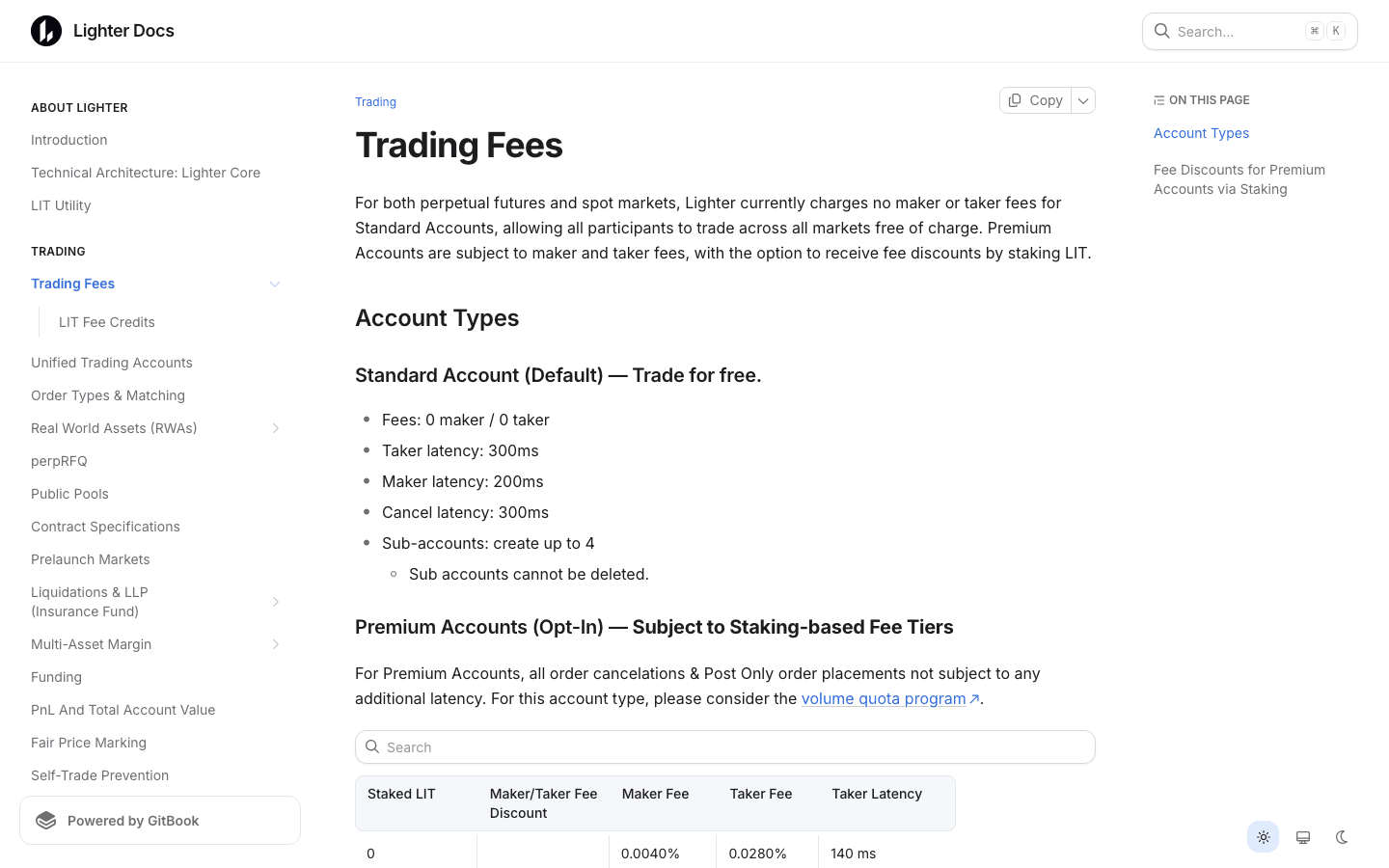
Lighter on Robinhood Chain has its own schedule. The Robinhood Chain deployment is a separate exchange instance with its own API. Its Standard account is also 0% maker / 0% taker, but its Premium account starts higher, at 0.0120% maker / 0.0350% taker with 200 ms taker latency, and discounts by 14-day trading volume instead of staked LIT (apidocs.rh.lighter.xyz, re-read October 19, 2026). Everything else on this page, and our invite code, refers to the main exchange at app.lighter.xyz.
2. Standard: what 0% really means
On Standard you pay no trading fee on normal orders, and because Lighter is a zk-rollup that batches trades and proves them on Ethereum, you pay no gas per order or cancel either. What you give up is speed: every taker order waits 300 ms before it reaches the matching engine, and so does every cancel or modify; maker orders that rest on the book are not delayed. For a swing trader or anyone placing a handful of orders a day, that delay is invisible. For a scalper in a fast market it is a real cost: a market that moves while your order waits fills you at a worse price, and a resting order you try to cancel stays live for 300 ms.
Standard accounts also have tighter API limits: 60 requests per minute (sendTx included), 50 pending and 250 active orders per account. Enough for a simple bot, not for market making. And the zero fee does not remove the spread. On BTC and ETH Lighter’s books absorbed a $100,000 market order for about 0.4–0.6 bp versus mid in our September 25 snapshots; on thin alts the spread can be many times that. On a 0%-fee account the spread is your trading cost, so limit orders matter even more. See the Lighter markets list for depth by market.
Is “0% fees” misleading? The latency cost
Critics say it is. A post on X that ranks for “lighter fees” calls the 300 ms delay a hidden cost, and a December 2025 opinion piece on Bitget News puts Standard’s real cost at 6–12 bp per trade against 0.2–2 bp on Premium. Those figures are a model built on assumptions about volatility and adverse selection, not a measurement. Here is what can be measured and what cannot:
- Measured: the book. On September 26, 2026, 20:40–20:41 UTC, a $10,000 BTC market buy followed by a market sell cost a median $0.75 against mid (0.75 bp of one side’s notional), ETH $0.72 and SOL $0.99 (table below). On Premium, the same round trip adds $5.60 of taker fees.
- Not measurable from public data: how far the price moves against you during the 300 ms wait. If you enter at a random moment, that move is as likely to help as to hurt, so it averages out. If you trade because the price just moved (news, liquidation cascades, arbitrage between venues), faster traders reach the book first and the delay costs you every time. That is the case the critics describe, and it is the case Premium is built for.
The practical test: Premium pays for itself only if its 140 ms fills improve your price by more than 2.8 bps per taker fill. To find out, run the same strategy on both account types for a few days and compare fills; with invite code 718610TD, 10% of the Premium fees you pay in that test comes back.
3. Premium fees by staked LIT
Premium fees fall as you stake more LIT. The stake is counted per L1 address, across the main account and all its sub-accounts, and every tier keeps 140 ms taker latency:
| Staked LIT | Discount | Maker | Taker | Taker fee on $10,000 |
|---|---|---|---|---|
| 0 | — | 0.0040% | 0.0280% | $2.80 |
| 1,000 | 2.5% | 0.0039% | 0.0273% | $2.73 |
| 3,000 | 5% | 0.0038% | 0.0266% | $2.66 |
| 10,000 | 10% | 0.0036% | 0.0252% | $2.52 |
| 30,000 | 15% | 0.0034% | 0.0238% | $2.38 |
| 100,000 | 20% | 0.0032% | 0.0224% | $2.24 |
| 300,000 | 25% | 0.0030% | 0.0210% | $2.10 |
| 500,000 | 30% | 0.0028% | 0.0196% | $1.96 |
Source: docs.lighter.xyz Trading Fees, September 25, 2026.
Is staking for fees worth it? At $4.77 per LIT (CoinGecko, September 25, 2026), the 1,000 LIT tier costs about $4,770 and saves 0.0007 percentage points of taker fee: $0.07 per $10,000, or $70 per $10M of taker volume. The 10,000 LIT tier (about $47,700) saves $2.80 per $100,000. Stakers also earn a fixed 6% APR in LIT and can deposit into the LLP (10 USDC per staked LIT), which is usually the bigger reason to stake. Unstaking takes 3 days. If you need a tier only for a while, LIT Fee Credits let you pay LIT up front to rent a tier for a chosen period; the payment is streamed to stakers. The Lighter LLP and staking guide covers staking in depth.
What Premium buys besides speed: no added latency on cancels and post-only orders, 64 sub-accounts, much higher rate limits (24,000 weighted requests per minute, and 4,000 to 72,000 sendTx per minute depending on staked LIT), higher order caps (1,500 active orders per account), and the volume-quota program for high-frequency traders. Accounts with 500,000+ effective LIT can also bypass CloudFront for a direct route to the exchange.
4. What is not free on Standard
- Advanced order types. Lighter’s referral docs say “fees paid to access advanced order types via a Standard account are also counted”, so some advanced orders carry a fee on Standard. When we selected TWAP in the ticket (logged out, September 25, 2026) the fee line read “Taker 0.01% | Maker 0.01%”, while Market and Limit showed 0%. The Advanced menu also holds Conditional, Scale, Atomic, Chase Limit and Iceberg orders; read the fee line in the ticket before you submit any of them. The order types guide explains each one.
- perpRFQ. Large orders on eligible markets can request quotes from market makers, who answer within 10 seconds; you then have 2 minutes to execute. The docs: “RFQ orders are subject to a 1 bps points fee for Standard Accounts.” The address must be whitelisted.
- Integrator fees. If you trade Lighter through a third-party front-end, that app may add its own fee (capped at 10 bps on perps and 1% on spot under Lighter’s partner program). Since September 14, 2026, partner-attributed trades from Standard accounts are rejected.
5. Other costs: funding, liquidation, deposits, withdrawals
| Cost | How it works on Lighter (September 2026) |
|---|---|
| Funding | Paid hourly between longs and shorts, peer to peer; no exchange fee on funding. Premium sampled once a minute; RWA markets use half the premium weight |
| Liquidation | Partial liquidation fee of up to 1%, paid to the LLP (the insurance fund) |
| Deposits | No Lighter fee listed; source-chain gas and bridge/swap slippage. Minimums $5 for a new account on most chains ($3 for existing on EVM chains and Solana, $10 for Bitcoin) |
| Secure withdrawal | Via Ethereum, 1 USDC minimum; arrives after a delay (the API’s withdrawalDelay read 1,603 s ≈ 27 min at 17:06 UTC); no fee table published |
| Fast withdrawal | USDC only, 4 USDC minimum, completes via Arbitrum; the fee depends on your account type and is shown in the withdraw dialog when logged in (Lighter publishes no table; the fee endpoint requires authentication, re-checked September 26, 2026) |
| Transfers | Between Lighter accounts, 1 USDC minimum; the public transfer-fee endpoint returned 0 |
More in the Lighter deposit and withdrawal guide, the Lighter funding and holding-cost guide and our cross-venue withdrawal fees comparison.
Zero fees, 200+ perps, one USDC balance
Standard is free on every market, from BTC to gold and the S&P 500. Invite code 718610TD.
6. What a $10,000 round trip really costs (measured)
A zero fee leaves three costs: the spread, slippage as your order walks the book, and funding while you hold. We measured all three from Lighter’s public API on September 26, 2026, 20:40–20:41 UTC: five order-book snapshots per market, ten seconds apart, simulating a $10,000 market buy and a $10,000 market sell against the book, plus the funding rate settled for the last full hour.
| Market | Spread + slippage, buy and sell (median, range) | Funding, 1 hour | All-in, Standard | All-in, Premium (0 LIT) |
|---|---|---|---|---|
| BTC | $0.75 ($0.39–$2.57) | $0.12 (0.0012%, longs paid) | $0.87 | $6.47 |
| ETH | $0.72 ($0.56–$1.31) | $0.12 (0.0012%, longs paid) | $0.84 | $6.44 |
| SOL | $0.99 ($0.58–$1.37) | $0.12 (0.0012%, longs paid) | $1.11 | $6.71 |
| HYPE | $1.77 ($1.27–$2.76) | $0.12 (0.0012%, longs paid) | $1.89 | $7.49 |
| XRP | $3.90 ($3.24–$5.33) | $0.11 (0.0011%, shorts paid) | $4.01 | $9.61 |
| XAU (gold) | $0.69 ($0.22–$0.93) | $0.04 (0.0004%, longs paid) | $0.73 | $6.33 |
| SPY (S&P 500) | $2.30 ($2.21–$2.43) | $0.04 (0.0004%, longs paid) | $2.34 | $7.94 |
| PENGU | $19.58 ($16.38–$22.30) | $0.12 (0.0012%, longs paid) | $19.70 | $25.30 |
| ANTHROPIC (pre-IPO) | $35.00 ($30.82–$39.80) | $0.00 | $35.00 | $40.60 |
Source: Lighter public API (orderBookOrders, fundings at 1-hour resolution), September 26, 2026, 20:40–20:41 UTC. Costs are against mid for a $10,000 position opened and closed with market orders; funding is what the paying side paid for the hour settled at 20:00 UTC (the receiving side earned it). Premium adds 0.0280% taker on both fills ($5.60). Latency cost is not included (see above). Books change by the second: treat this as a dated snapshot, not a quote.
What the table says. On BTC, ETH, SOL and gold, spread and slippage for the whole round trip came to under $1 in the median snapshot (about $1 with an hour of funding), less than the $5.60 a Premium account pays in fees and a fraction of the $9.00 in Hyperliquid base-tier fees or the $10.00 on Binance USDⓈ-M futures (fees only; those venues have spreads too). On a small-cap coin like PENGU or a pre-IPO market like ANTHROPIC, the book cost $19.58 and $35.00: there the “0% fee” is not what you pay, and limit orders or perpRFQ matter more than the account type. Funding is small per hour but compounds: at 0.0012% an hour, holding a $10,000 BTC long for a day would cost about $2.88 if the rate stayed put. The funding rates guide explains how the rate moves.
7. Lighter fees vs Hyperliquid, Aster, Binance and Bybit
Base-tier perpetual futures fees and what you give up for them (fees verified September 25–26, 2026):
| Exchange | Maker | Taker | Fee on a $10,000 market order | Who holds your funds | KYC |
|---|---|---|---|---|---|
| Lighter Standard | 0% | 0% | $0 | Self-custody (your wallet) | None |
| Lighter Premium (0 LIT) | 0.0040% | 0.0280% | $2.80 | Self-custody | None |
| Hyperliquid tier 0 | 0.015% | 0.045% | $4.50 | Self-custody | None |
| Hyperliquid + code HOLYGRAIL | 0.0144% | 0.0432% | $4.32 | Self-custody | None |
| Aster (crypto perps) | 0% | 0.04% | $4.00 | Self-custody | None |
| Binance USDⓈ-M futures (Regular) | 0.02% | 0.05% | $5.00 | Exchange holds your funds | Required |
| Binance USDC-M futures (Regular, promotional) | 0% | 0.04% | $4.00 | Exchange holds your funds | Required |
| Bybit perpetuals (Non-VIP) | 0.02% | 0.055% | $5.50 | Exchange holds your funds | Required |
Sources: exchange fee pages (Binance futures fee schedule, Bybit fee rates, Hyperliquid and Aster docs, Lighter docs). Lowest published tier; VIP tiers, token discounts and CEX referral programs lower CEX fees. “None” for KYC means the exchange does not collect identity documents because you trade from your own wallet; restricted-region rules in each venue’s terms still apply, and fiat on-ramps require KYC. More in DEX vs CEX fees and Lighter vs Binance Futures.
Worked scenarios against the DEXs we cover, fees only:
| Scenario | Lighter Standard | Lighter Premium (0 LIT) | Hyperliquid tier 0 | Hyperliquid + HOLYGRAIL | Aster |
|---|---|---|---|---|---|
| $10,000 market order | $0 | $2.80 | $4.50 | $4.32 | $4.00 |
| $10,000 limit order filled as maker | $0 | $0.40 | $1.50 | $1.44 | $0 |
| $100,000 round trip, both market | $0 | $56 | $90 | $86.40 | $80 |
| $1M a month taker volume | $0 | $280 | $450 | $432 | $400 |
| $10M a month taker volume | $0 | $2,800 | $4,500 (tier 0 assumed) | $4,320 | $4,000 |
Hyperliquid 0.045% taker / 0.015% maker below $5M 14-day volume (lower tiers above that); HOLYGRAIL = 4% off on the first $25M. Aster 0% maker / 0.04% taker on crypto pairs. Lighter Premium 0.0280% / 0.0040% at 0 LIT. Funding and spread excluded.
Fees are not the whole cost. Depth matters for size. In our order-book snapshots on September 25, 2026 (09:07–09:13 UTC), a simulated $100,000 BTC market buy cost about 0.06 bp versus mid on Hyperliquid and 0.44–0.48 bp on Lighter; a $1M BTC buy cost 0.8–1.0 bp on Hyperliquid and 0.9–1.4 bp on Lighter. Add the fee and Lighter Standard still wins on BTC at those sizes (1.4 bp vs about 5.5 bp all-in for a $1M buy), but on thinner markets and bigger orders the book can matter more than the fee. Latency is the other cost: Hyperliquid’s docs cite a 0.2 s median end-to-end for co-located orders, while a Standard Lighter taker order waits 300 ms by design.
If you are choosing between the two, read Hyperliquid vs Lighter; for all venues, the perp fee calculator and the lowest-fee DEX ranking. Trading on Solana? Lighter vs Jupiter compares Lighter with Jupiter Perps on fees and leverage.
Lighter vs Binance Futures: side by side
The question behind most “Lighter fees” searches: is a zero-fee, self-custodial DEX really cheaper than the world's largest futures exchange once depth and funding are counted?
| Lighter | Binance USDⓈ-M futures | |
|---|---|---|
| Type | Self-custodial perp DEX (zk-rollup, proofs verified on Ethereum) | Centralized exchange; Binance holds your funds |
| Account / KYC | EVM wallet or email; no identity documents | Identity verification: every new Binance user must complete identity verification before depositing or trading |
| Perp fees (entry tier) | Standard 0% / 0%; Premium 0.0040% / 0.0280% | USDⓈ-M 0.02% / 0.05%; 10% off paying in BNB |
| Speed trade-off | Standard adds 300 ms to taker orders; Premium 140 ms | No published speed bump |
| Max leverage, BTC | 50x | 150x up to 300,000 USDT of position, lower above |
| Funding | Every 1 hour; cap 0.5% per hour | Every 8 hours on BTC; cap 0.3% per interval |
| 24h volume (Sep 25, 2026) | $1.65B | ≈ $68.5B across USDⓈ-M symbols |
| Referral benefit | Code 718610TD: 10% of your trading fees rebated every Monday from sign-up | Not covered here (we hold no Binance code) |
| Trading fees | Lighter Standard | Lighter Premium | Binance (Regular) |
|---|---|---|---|
| $10,000 round trip, market orders | $0 | $5.60 | $10.00 ($9.00 with BNB) |
| $10,000 round trip, limit orders | $0 | $0.80 | $4.00 ($3.60 with BNB) |
| 20 market round trips a day for 30 days ($10k each) | $0 | $3,360 | $6,000 before any VIP tier |
| $1M BTC market buy: fee + measured slippage | $0 + ≈ $119 | $280 + ≈ $119 | $500 + ≈ $10 |
Fees from the registry (Lighter docs, Binance fee schedule). Slippage from our depth test on September 25, 2026 (below); Binance VIP tiers need both 30-day volume and a BNB balance.
Depth and funding narrow the gap. Binance traded about 40 times Lighter's volume that day, and its books are deeper:
| Market | Lighter spread | Lighter $1M buy vs mid | Binance spread | Binance $1M buy vs mid | 30-day funding, Lighter / Binance |
|---|---|---|---|---|---|
| BTC | 0.01 bp | +0.012% | 0.01 bp | +0.001% | 0.763% / 0.542% |
| ETH | 0.77 bp | +0.019% | 0.04 bp | +0.007% | 0.656% / 0.380% |
| SOL | ≈ 1 bp | +0.063% | 0.83 bp | +0.047% | 0.471% / 0.232% |
Lighter orderBookOrders and Binance fapi depth(1000), September 25, 2026, 13:15–13:25 UTC. Funding = what a long paid over August 26 – September 25, 2026 (Lighter hourly, Binance every 8 hours).
So: at retail sizes Lighter Standard is the cheaper venue by the whole fee, and at $1M on BTC its zero fee still more than covers the extra slippage. A long held for weeks, though, paid more funding on Lighter than on Binance in that month, about $22 more per $10,000 on BTC. What you trade for the fee saving is custody and identity: Binance holds your funds and requires verification; on Lighter you keep custody and carry smart-contract and rollup risk instead. The CEX-to-DEX migration guide covers moving USDC across. Open Lighter with code 718610TD, or compare Hyperliquid vs Binance if you want deeper books with a 4% referral discount.
8. Which account should you pick?
| You are… | Pick | Why |
|---|---|---|
| Swing or position trader, a few orders a day | Standard | 0% fees; 300 ms does not matter on your timeframe |
| Manual scalper in fast markets | Try Premium for a few days (10% of fees rebated with a referral code), then compare fills | 140 ms taker and instant cancels; costs 2.8 bp per taker fill |
| API bot placing many orders but not latency-sensitive | Plus | Higher rate limits than Standard for 0.5 bp |
| Market maker | Premium, with LIT staked | No delay on post-only and cancels, 64 sub-accounts, maker 0.0040% or less |
| Large taker orders on thin markets | Standard with perpRFQ (1 bps), or split with limit orders | Avoid walking the book |
You can upgrade at any time; downgrading is limited to once every 24 hours, and the account type applies to the whole L1 address including sub-accounts.
9. How to switch account type and use the referral discount
- Sign up through our invite link before your first login. On October 19, 2026 the app showed “You’re invited! Invite code 718610TD … Create your Lighter account with this invite to get a 10% discount on trading fees. Choose your account type after creating and verifying your account.”
- After your first deposit, choose the account type in the app (API users can call
changeAccountTier). You can upgrade at any time; other changes need 24 hours since the last one. - From sign-up, 10% of the trading fees you pay (Premium, Plus or paid advanced orders) is rebated every Monday as an L2 transfer, covering the previous Monday-to-Sunday week. The $1 payout minimum applies, and Lighter calls every rebate discretionary.
- Stay on Premium only if the faster fills pay for the fee; otherwise switch back to Standard, where there is nothing to pay or rebate.
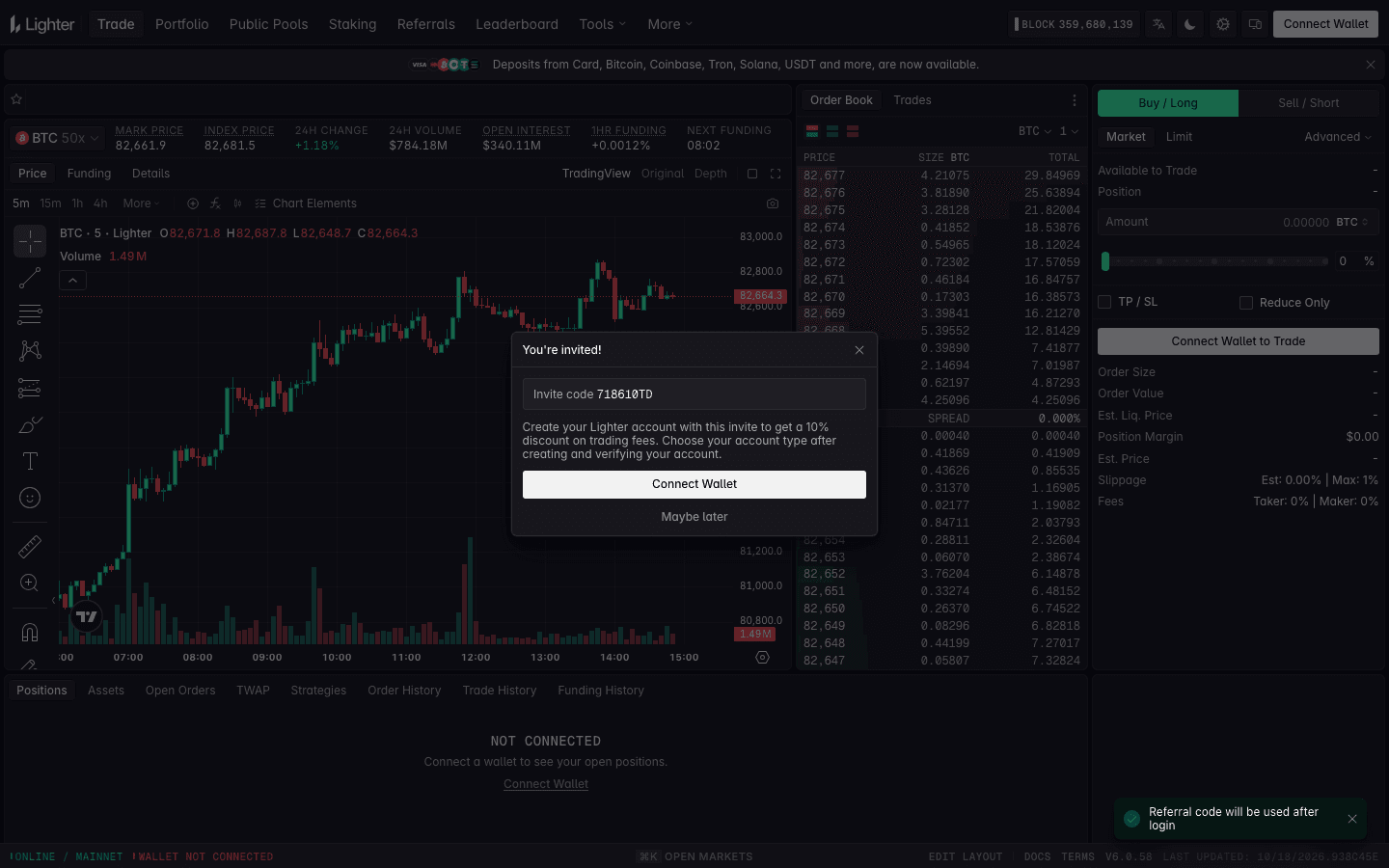
Referral codes work only at sign-up and cannot be changed later. More in the Lighter referral code guide, and the five sign-up steps with screenshots are in how to use Lighter.
10. How Lighter makes money: fee revenue and LIT buybacks
A zero-fee exchange still needs revenue. Lighter’s comes from Premium and Plus accounts (traders who pay for speed and rate limits, mostly professionals), fees on some advanced orders from Standard accounts, liquidation fees of up to 1% that go to the LLP, and LIT Fee Credits (paid to stakers). The docs say trading-fee revenue funds LIT buybacks, executed as daily 24-hour TWAPs. A September 2026 press release for the Bitwise Lighter Staking ETP quoted Lighter as charging “retail traders no trading fees, generating revenue instead from professional market makers, liquidations and treasury income”. The model is the reverse of most exchanges: slow order flow is free, fast order flow pays.
How much Lighter earns in fees. If you searched “Lighter fees” as an investor, this is the number you want. DefiLlama’s API (at September 26, 2026, 20:42 UTC) counted $182,428 of fees in the last 24 hours, $5.2M over 30 days and $80.5M since tracking began; protocol revenue, the part Lighter keeps, was $4.5M over 30 days and $62.2M in total. The Robinhood Chain instance is tracked separately ($1.7M of fees and $1.5M of revenue over 30 days). Dashboards such as Token Terminal and Blockworks use their own methods, so their totals differ. Rising fee revenue means more LIT bought back; it does not mean higher fee rates for traders, which are unchanged on the official page.
Lighter’s points program, which once rewarded activity, is not running on the main exchange; see Lighter points and LIT.
11. FAQ
Is Lighter really zero-fee?
Yes for normal orders on the default Standard account: 0% maker and 0% taker on every perpetual and spot market, and no gas on orders or cancels. The trade-off is latency: taker orders and cancels wait 300 ms; maker orders are not delayed. Some advanced order types are not free on Standard (the TWAP ticket showed 0.01% taker and maker on September 25, 2026, and perpRFQ carries 1 bps), and you still pay funding, spread, liquidation fees if liquidated, and deposit gas. In our September 26, 2026, 20:40–20:41 UTC measurement, a $10,000 BTC round trip cost $0.87 all-in on Standard, including spread and one hour of funding.
What is the difference between maker and taker fees?
A maker order rests on the order book (a limit order that does not fill immediately) and adds liquidity; a taker order fills against a resting order (a market order, or a limit order priced through the book) and removes liquidity. Most exchanges charge takers more. On Lighter Standard both are 0%; the difference is latency (300 ms for takers, none for makers). On Premium, makers pay 0.0040% and takers 0.0280%, a 7-to-1 gap, so resting limit orders are far cheaper there.
What are Lighter Premium fees?
Premium accounts pay 0.0040% maker and 0.0280% taker with no LIT staked, with 140 ms taker latency and no added latency on cancels or post-only orders. Staking LIT cuts both rates: 2.5% off at 1,000 LIT, 5% at 3,000, 10% at 10,000, 15% at 30,000, 20% at 100,000, 25% at 300,000 and 30% at 500,000 LIT (0.0028% / 0.0196%). There are no volume tiers and no maker rebates.
What is the Lighter Plus account?
Plus is an opt-in tier for API users who do not need speed but want higher rate limits: 0.5 bps (0.005%) maker and taker, with its own latency (300 ms taker, 200 ms maker and 200 ms cancel), 4,000 sendTx per minute, 24,000 weighted read requests per minute and 16 sub-accounts. Both Lighter doc sites listed these figures (checked October 6, 2026). Standard accounts are limited to 60 requests per minute.
What are Lighter’s rate limits?
Standard accounts get 60 REST requests per rolling minute, sendTx included. Plus and Premium accounts get 24,000 weighted read requests per minute plus a separate sendTx bucket checked per L1 address: 4,000 a minute on Plus and 4,000–72,000 on Premium, depending on staked LIT (fee credits count as staked LIT). Builder accounts, free on application, get 240,000 weighted reads. On Plus and Premium, order transactions also draw on a volume quota: new accounts start with 1,000 transactions, every $2 of trading volume adds one more, and the balance stacks up to 15,000,000 without expiring. Open orders are capped too: Standard 50 pending / 250 active per account (10 / 30 per market). Going over a limit returns HTTP 429 or 405 (rate-limits page, checked October 15, 2026).
What is a Lighter Premium account?
Premium is Lighter’s opt-in paid account for fast traders: 0.0040% maker / 0.0280% taker with no LIT staked, cut by up to 30% with 500,000 staked LIT. In return you get faster taker fills (140 ms) and instant cancels (no added delay on cancels or post-only orders), 64 sub-accounts, 4,000–72,000 sendTx per minute and higher order caps (1,000 pending / 1,500 active per account (100 / 1,000 per market)). Standard maker orders are not delayed either, so Premium’s edge is taker speed and cancels. The docs now label it “Premium/Advanced”. Switch in the app or with changeAccountTier; with invite code 718610TD, 10% of the fees you pay is rebated every Monday.
Does the Lighter referral code reduce fees?
Not on Standard, where there is nothing to discount. On paid accounts, yes: Lighter’s referral docs and the app’s invite dialog (checked October 19, 2026) give referred users 10% of their trading fees, rebated every Monday from sign-up, so Premium at 0 LIT works out to 0.0036% maker / 0.0252% taker after the rebate. The same docs page still opens with the older line about the first week of Premium fees rebated, so the offer your invite shows may differ. The code must be used at sign-up through the invite link; it cannot be added later, and rebates are discretionary.
Are Lighter withdrawals free?
Lighter publishes no withdrawal fee table (re-checked September 26, 2026). Secure withdrawals go through Ethereum with a 1 USDC minimum and a delay (the API showed about 27 minutes on September 25, 2026); fast withdrawals are USDC-only via Arbitrum with a 4 USDC minimum, and their fee depends on your account and is shown in the withdraw dialog only when you are logged in. Some guides quote per-account fast-withdrawal fees; we could not confirm them from an official source, so check the dialog before you confirm. Transfers between Lighter accounts have a 1 USDC minimum; the public transfer-fee endpoint returned 0.
Is Lighter cheaper than Hyperliquid?
On fees, yes at each venue’s starting tier, and Lighter Standard’s 0% taker fee is lower than every Hyperliquid taker tier. A $10,000 market order costs $0 on Lighter Standard, $2.80 on Lighter Premium, $4.50 on Hyperliquid’s base tier ($4.32 with the 4% HOLYGRAIL discount) and $4.00 on Aster. Premium is a different story at high volume: Hyperliquid’s top tiers (taker down to 0.024%) undercut Premium’s 0.0280% taker at 0 LIT. For large orders the order book matters too: in our September 25 snapshots a $1M BTC market buy cost 0.9–1.4 bp versus mid on Lighter and 0.8–1.0 bp on Hyperliquid, so on size the gap narrows.
Lighter vs Binance: which is cheaper?
On fees, Lighter. A $10,000 market order costs $0 on Lighter Standard and $5.00 on Binance USDⓈ-M futures at the Regular tier (0.02% maker / 0.05% taker). Binance’s 0% maker rate applies to its USDC-margined futures (0% maker / 0.04% taker at Regular, a promotional rate on Binance’s fee page), not to USDT pairs. The other differences matter as much: Binance holds your funds and requires identity verification; Lighter is self-custodial and needs only a wallet, but its Standard orders are delayed 300 ms.
Does Lighter charge fees on spot trading?
No, not on Standard: the official fee page applies the same 0% maker / 0% taker to spot and perpetual markets, and Premium uses the same ladder on both. For comparison, Binance spot charges 0.1% at the Regular tier and Hyperliquid spot 0.07% taker at tier 0. Deposit gas and spread still apply.
How does Lighter make money if trading is free?
From Premium and Plus accounts (per-trade fees for speed and rate limits), fees on some advanced orders from Standard accounts, liquidation fees of up to 1% that go to the LLP, and LIT Fee Credits, whose proceeds go to LIT stakers. DefiLlama counted $5.2M of fees and $4.5M of protocol revenue over the 30 days to September 26, 2026, 20:42 UTC. Lighter’s docs say trading fee revenue funds LIT buybacks via daily 24-hour TWAPs.
Start on Lighter
0% maker and taker on Standard; 10% of any Premium or Plus fees rebated weekly with invite code 718610TD.
Need the deepest on-chain books for size? Hyperliquid with code HOLYGRAIL takes 4% off your fees on the first $25M of volume (how it works). For the full field, see the best DEX guide; new to DEXs, start with what a DEX is.
Disclosure: 718610TD and HOLYGRAIL are our referral codes; we earn a share of fees paid by referred accounts (on Lighter, Premium fees and Standard advanced-order fees). Fee schedules, latencies and rate limits were read in Lighter’s docs and public API on October 19, 2026 (app screenshots and the measured round trip carry their own dates); they can change. Not financial advice.