
The best DEX for scalping is Hyperliquid for depth and Lighter for zero fees. Lighter’s default Standard account charges 0% maker and 0% taker on every perp market, at the price of a 300 ms delay on taker orders. Hyperliquid has the deepest DEX order books ($4–8B of perp volume a day), 0.045% taker and 0.015% maker, 4% less with code HOLYGRAIL. For maker-only scalping, Aster charges 0% maker at every tier. Fees and limits come from each exchange’s official docs (verified September 25–27, 2026); order-book and hourly data from their public APIs.
Short version. A taker round trip on $10,000 costs $0 on Lighter Standard, $5.60 on Lighter Premium, $8 on Aster, $8.64 on Hyperliquid with code HOLYGRAIL and $9 without. On Binance, OKX and Bybit the same trade costs $10 to $11 at their regular tiers. On BTC all three DEX books absorbed $100k within half a basis point, so fees, not depth, decide small scalps. Speed: Lighter Standard adds 300 ms; Premium 140 ms; Hyperliquid processes cancels first in every block. Best hours: weekdays 13:00–17:00 UTC. Most serious scalpers keep two venues: Lighter for free BTC/ETH clips, Hyperliquid for alts and size.
Pick your scalping venue
Hyperliquid with code HOLYGRAIL (4% off fees on your first $25M) for depth; Lighter with 718610TD for 0% fees.
We earn a commission when you sign up through our links; it never raises your fees.
1. The 5 best DEXs for scalping, ranked
- Hyperliquid — Best overall for scalping. Deepest DEX books ($4–8B/day, 178 perps as of October 20, 2026), cancels processed before takers in every block, 0.015% maker via Chase and post-only orders, 0.045% taker (4% less with code HOLYGRAIL).
- Lighter — Best zero-fee scalping DEX. Standard accounts pay 0% maker and taker on every market; taker orders wait 300 ms. Premium: 140 ms for 0.028% taker.
- Aster — Best for maker-only scalping. 0% maker at every VIP level, a native Chase order that stays post-only, 0.04% taker.
- edgeX — Fast engine, costly maker side. Claims “microsecond latency” for its matching engine (edgeX V2 docs; no end-to-end figure published), but charges 0.04% maker next to 0.045% taker, so post-only scalping saves little.
- dYdX — Established, slower. 0.05% taker / 0.01% maker at tier 1; its docs put order-to-trade at about one block (~800 ms).
The ranking weighs what a scalper pays on every trade (round-trip fees, especially on the maker side), how quickly orders fill and cancel, and how much size the book absorbs near the mid price. Volume and market count come next. Pick by how you trade:
| You are… | Use | Why |
|---|---|---|
| Manual scalper, BTC/ETH, market orders | Lighter Standard | 0% taker; the 300 ms delay rarely matters at human speed |
| Scalping many alts, or $250k+ clips | Hyperliquid | Deepest books and the widest market list; Chase and post-only orders pay 0.015% maker |
| Maker-only (post-only) scalper | Aster Pro or Lighter Standard | 0% maker on both; Aster has no speed bump on cancels |
| Latency-sensitive bot | Hyperliquid API or Lighter Premium | Cancels processed first in each Hyperliquid block; Premium 140 ms and 0 ms cancel delay |
| High leverage on small size | Aster Pro | 150x on BTC up to $300,000 of notional (you should still not use it) |
2. What makes a DEX good for scalping (and why AMMs are not)
Four things decide whether a venue works for scalping: a central limit order book (so you can post limit orders and choose to be the maker), low round-trip fees, ideally with a cheap or free maker side, fast fills and cancels, and tight spreads with depth on the markets you trade. Every venue ranked above is an order-book perp DEX.
Swap DEXs built on automated market makers (AMMs) fail almost every test. On Uniswap you pay the pool fee on each swap (0.05% or 0.3% in the common v3 tiers), plus gas and price impact, and you wait for a block to confirm. A public-mempool swap can also be sandwiched by MEV bots (see sandwich attack protection). There is no maker side to earn and no resting stop-loss. Pool-based perps are better but still costly for scalping: GMX charges 0.04%–0.06% to open and again to close, and Jupiter Perps 0.06% each way, plus borrow fees. The full comparison is in order book vs AMM, and the wider list of spot and perp venues is on our best DEX page.
3. Why fees decide scalping: the break-even math
A scalp holds for seconds or minutes and targets a small move, often 0.1–0.5%. Every trade pays a round trip — one fee to open, one to close — and on a taker-only venue that is two taker fees. Take a scalp that aims for +0.4% and stops out at −0.2% (a 2:1 reward-to-risk). With round-trip cost c, a winner nets 0.4% − c and a loser costs 0.2% + c, so the break-even win rate is (0.2% + c) ÷ 0.6%:
- Zero fees (Lighter Standard, or maker-only on Aster): 33.3%.
- Aster taker (0.08% round trip): 46.7%.
- Hyperliquid taker (0.09%): 48.3%; 47.7% with code HOLYGRAIL.
- Binance USDⓈ-M taker, regular tier (0.1%): 50.0%.
A 15-point gap in the win rate you need is, for many scalping systems, the entire edge. It is also the honest answer to “can scalping be profitable?”: only if your system wins more often than the break-even line your fees draw. The same logic explains why maker orders matter so much: a Hyperliquid scalper who enters and exits with post-only orders pays 0.0288% per round trip with the code and needs about 38.1%.
4. Cost per round trip: DEXs vs Binance, Bybit and OKX
| Venue and fill type | Fee per side | $10,000 round trip | Break-even win rate (+0.4% / −0.2%) |
|---|---|---|---|
| Lighter Standard (taker or maker) | 0% | $0 | 33.3% |
| Aster Pro, maker both sides | 0% | $0 | 33.3% |
| Paradex Retail (300 ms speed bump) | 0% | $0 | 33.3% |
| Lighter Premium, maker both sides | 0.004% | $0.80 | 34.7% |
| Hyperliquid, maker both sides (with code) | 0.0144% | $2.88 | 38.1% |
| Binance USDⓈ-M, maker both sides (CEX) | 0.02% | $4 | 40.0% |
| Lighter Premium, taker both sides | 0.028% | $5.60 | 42.7% |
| Hyperliquid, maker in / taker out (with code) | 0.0144% + 0.0432% | $5.76 | 42.9% |
| Aster Pro VIP 2, taker (500 ASTER held) | 0.035% | $7 | 45.0% |
| Aster Pro VIP 1, taker | 0.04% | $8 | 46.7% |
| Hyperliquid tier 0, taker (with code HOLYGRAIL) | 0.0432% | $8.64 | 47.7% |
| Hyperliquid tier 0, taker (no code) | 0.045% | $9 | 48.3% |
| edgeX Regular, taker | 0.045% | $9 | 48.3% |
| Binance USDⓈ-M Regular, taker (CEX) | 0.05% | $10 | 50.0% |
| OKX perpetuals Regular, taker (CEX) | 0.05% | $10 | 50.0% |
| dYdX tier 1, taker | 0.05% | $10 | 50.0% |
| Bybit perpetuals Non-VIP, taker (CEX) | 0.055% | $11 | 51.7% |
Fee schedules from the Hyperliquid, Lighter, Aster, edgeX, dYdX and Paradex docs and the Binance, Bybit and OKX fee pages, verified September 25–27, 2026 (facts registry). Hyperliquid “with code” = 4% referral discount on the first $25M of volume. Regular or entry tiers, no token discounts (BNB, MNT, HYPE, LIT) assumed. Slippage and funding excluded.
Three lessons. On the taker side Lighter Standard is unbeatable and Lighter Premium (0.028%) is the cheapest paid option. On the maker side the ranking changes: Aster and Lighter Standard are free, and Hyperliquid’s 0.015% maker rate is a third of its taker rate — the reason Hyperliquid scalpers live on post-only and Chase orders. And the big CEXs are not cheaper for a new scalper: Binance, OKX and Bybit charge 0.05%–0.055% taker at their regular tiers. They get cheaper only at VIP volumes (Binance VIP 2 needs $10M of 30-day volume for 0.04%). What CEXs still offer is a fiat on-ramp and account support, in exchange for KYC and custody of your funds. Full schedules: Hyperliquid fees, Lighter fees, Aster fees, DEX vs CEX fees.
5. What a real scalping day costs
Assume 20 round trips a day of $10,000 each: 40 fills and $400,000 of daily notional, or $5.6M over 14 days.
| Venue | Per day | Per 30 days |
|---|---|---|
| Hyperliquid, all taker (code / no code) | $172.80 / $180 | $5,184 / $5,400 |
| Hyperliquid, all maker with code | $57.60 | $1,728 |
| Hyperliquid tier 1 (> $5M 14-day), taker with code | $153.60 | $4,608 |
| Lighter Standard | $0 | $0 |
| Lighter Premium, all taker / all maker | $112 / $16 | $3,360 / $480 |
| Aster VIP 1, all taker / all maker | $160 / $0 | $4,800 / $0 |
| Aster VIP 2, all taker | $140 | $4,200 |
| Binance USDⓈ-M Regular (CEX), all taker / all maker | $200 / $80 | $6,000 / $2,400 |
| Bybit Non-VIP (CEX), all taker | $220 | $6,600 |
This is where the venues separate. A taker scalper at this pace pays $4,800 to $5,400 a month on Aster or Hyperliquid, $6,000 on Binance and nothing on Lighter Standard. The same scalper working maker orders pays $1,728 on Hyperliquid and nothing on Aster. After about two weeks the $5.6M of rolling volume lifts a Hyperliquid account into tier 1 (0.040% / 0.012%) and an Aster account to the VIP 2 volume bar (0.035% taker, if 500 ASTER is also held).
Zero-fee scalping on Lighter
Standard accounts pay 0% / 0%. Sign up with code 718610TD and your first week from sign-up can be a free Premium trial (140 ms fills, Premium fees rebated), so you can measure whether the speed is worth paying for.
6. Hyperliquid: fee tiers for high-volume scalpers
Hyperliquid’s tiers use rolling 14-day weighted volume (spot volume counts double), and they matter for scalpers because scalpers climb them:
| Tier | 14-day volume | Taker | Maker |
|---|---|---|---|
| Tier 0 | ≤ $5M | 0.045% | 0.015% |
| Tier 1 | > $5M | 0.040% | 0.012% |
| Tier 2 | > $25M | 0.035% | 0.008% |
| Tier 3 | > $100M | 0.030% | 0.004% |
| Tier 4 | > $500M | 0.028% | 0% |
| Tier 5 | > $2B | 0.026% | 0% |
| Tier 6 | > $7B | 0.024% | 0% |
Source: Hyperliquid docs “Fees” (perpetuals), verified October 19, 2026.
- Referral: code
HOLYGRAILtakes 4% off your fees on the first $25M of volume (not on vaults or sub-accounts). - HYPE staking stacks on top: 5% off above 10 HYPE (Wood), rising to 40% above 500,000 HYPE (Diamond). At tier 0 that moves taker from 0.045% to between 0.0428% and 0.0270%.
- Maker rebates for accounts with more than 0.5%, 1.5% or 3% of 14-day maker volume: -0.001%, -0.002% and -0.003%. Relevant only to professional market makers.
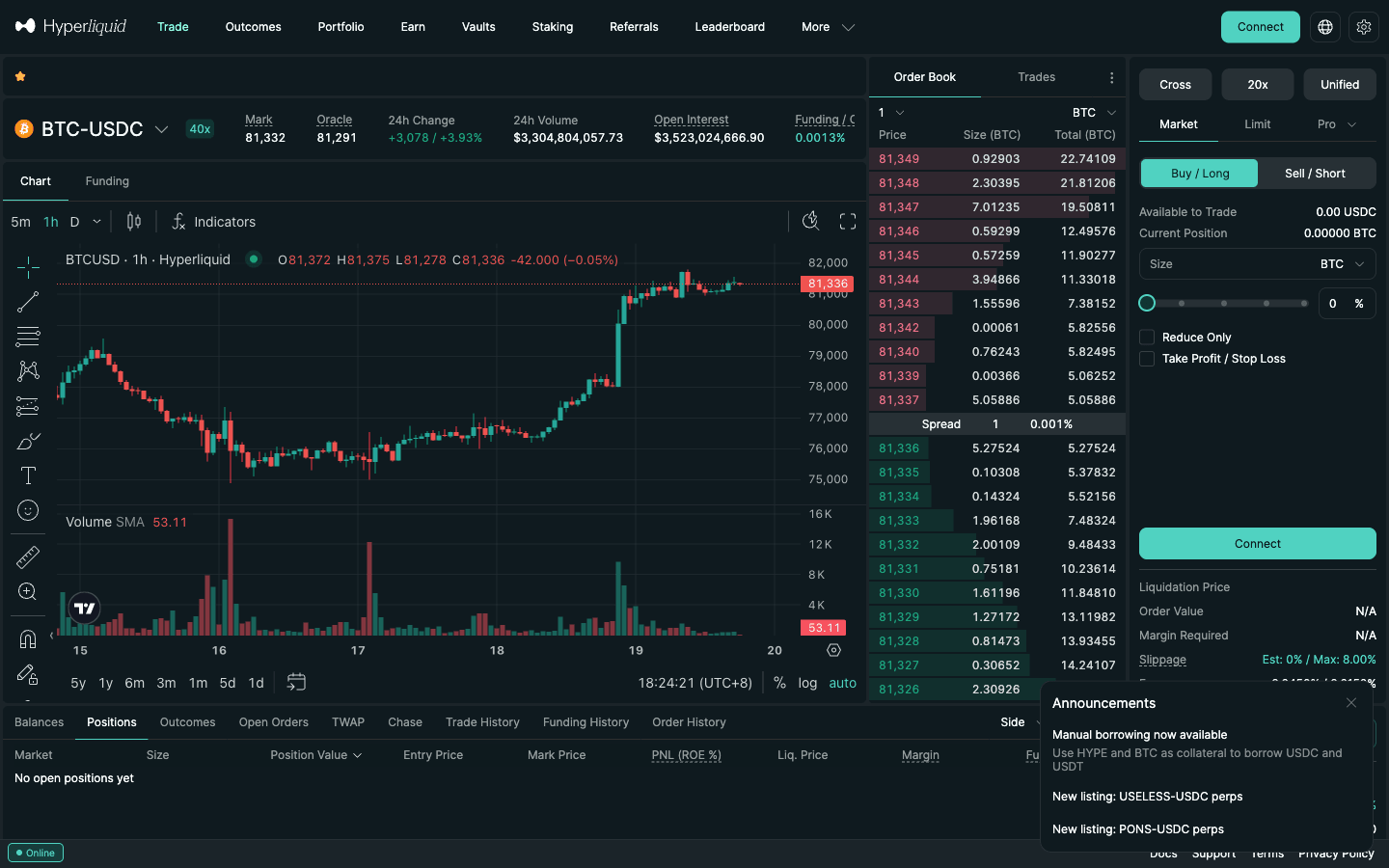
Hyperliquid prices are limited to five significant figures, so BTC trades in whole-dollar ticks and its quoted spread (about 0.12 bp) is wider than Lighter’s or Aster’s $0.10. For a taker that is a fraction of a basis point; for a maker it means each tick is worth a little more. Our maker rebate strategy and order types guide go deeper.
7. Speed and fill quality: which DEX is fastest, and what it costs
None of these venues charges gas per order, so the old “gas per trade” objection to DEX scalping is gone. Speed is the real difference, and the venues publish different kinds of number: Hyperliquid a measured end-to-end latency, Lighter deliberate delays by account type, Aster and dYdX a block time.
| Venue | Order-to-fill (published) | Added taker / cancel delay | Ordering rule that protects makers |
|---|---|---|---|
| Hyperliquid | 200 ms median, 900 ms p99 end-to-end (co-located client) | None; an IOC priority fee cuts about 45 ms per basis point | Within each block: cancels first, then new GTC and IOC orders |
| Lighter Standard (0% fees) | Not published as a total | Taker +300 ms, cancel +300 ms, maker +0 ms | The delay itself: fast takers cannot pick off resting quotes |
| Lighter Premium | Not published as a total | Taker 140 ms, cancel and post-only 0 ms | Delay by account type |
| Aster (Pro order book) | No order latency published; Aster Chain blocks every 50 ms | Not documented | Not documented |
| dYdX | About 800 ms from order to trade (one block) | None published | — |
Official docs (Hyperliquid hypercore and priority-fee pages, docs.lighter.xyz trading fees, docs.asterdex.com Aster Chain overview, dYdX docs); each figure carries its own check date in our facts registry. Hyperliquid fills that slip are usually capped by order type: TP/SL market orders use up to 10% slippage tolerance and TWAP sub-orders up to 3%, so put a limit price on TP/SL orders in thin markets.
So which is the fastest DEX for scalping? On published numbers, Lighter Premium and Hyperliquid, with Lighter Standard deliberately slower in exchange for zero fees. API limits that bind a scalping bot are in section 8.
What latency costs is adverse selection. A market order that waits 300 ms can arrive after the price has moved; a resting quote that takes 300 ms to cancel can be filled by someone faster just before a move. For a human scalper clicking entries on 1-minute candles, this is small next to reaction time. For a bot quoting both sides, it is the reason to pay for Lighter Premium or to use Hyperliquid.
8. API and high-frequency scalping: rate limits and latency by venue
Once a scalping strategy runs as a bot, the limit that binds first is usually the venue's rate limit or latency, not its fee. A strategy that turns over $1M a day pays $450 at 0.045%, $400 at 0.04% and nothing at 0%. It can also be throttled out of the market by a 60-requests-a-minute cap, or picked off by a 300 ms cancel delay. Here is what each venue publishes, read from the official API docs and live endpoints on September 25, 2026.
| Hyperliquid | Lighter Standard | Lighter Premium | Aster (Pro API) | |
|---|---|---|---|---|
| Published latency | Co-located order end-to-end: 200 ms median, 900 ms p99; cancels and ALO about 380 ms end to end | 300 ms taker, 300 ms cancel/modify; maker orders not delayed | 140 ms taker; no added delay on cancels or post-only orders | No order latency published; the chain is described as "50ms block latency" |
| Order-entry limit | Per address: 1 action per 1 USDC traded since the account was created, plus a 10,000 starting buffer; after that, 1 action every 10 s. Cancels get extra headroom | 60 requests per rolling minute, order transactions included | sendTx 4,000 a minute at 0 staked LIT, up to 72,000 at 500,000 LIT, plus a volume quota: 1,000 to start, +1 per $2 traded | 1,200 orders a minute and 300 per 10 seconds per account |
| Read / IP limit | 1,200 REST weight a minute per IP (l2Book 2, most info calls 20) | 60 requests a minute | 24,000 weighted requests a minute | 2,400 request weight a minute per IP |
| WebSocket | 10 connections, 1,000 subscriptions, 2,000 messages a minute per IP | Per IP: 255 connections, 500 subscriptions per connection, 5,000 per IP, 200 client messages a minute | 200 streams per connection, 10 incoming messages a second, connections dropped after 24 h | |
| Open-order caps | 1,000 + 1 per $5M of volume, max 5,000 | 250 active (30 per market) | 1,500 active (1,000 per market) | 200 open orders on BTCUSDT (plus 10 algo orders) |
| Colocation / priority | "No DMM program, special rebates / fees, or latency advantages." Paid priority exists for everyone: IOC priority fees (about 45 ms faster per 1 bp, up to 8 bp) and a gossip-priority auction for reading data (about 25 ms per slot). Both fees are burned | "For best colocation, use AWS Tokyo ap-northeast-1a (apne1-az4)". Direct access that skips AWS CloudFront is available on request to Premium accounts on the top staking tier | No colocation guidance in the docs | |
Sources: Hyperliquid docs hypercore/overview.md, rate-limits-and-user-limits.md, optimizing-latency.md, priority-fees.md, trading/market-making.md; apidocs.lighter.xyz rate-limits.md (updated October 13, 2026), account-types.md, volume-quota-program.md, get-started.md; docs.lighter.xyz trading-fees.md; Aster fapi exchangeInfo rateLimits and BTCUSDT filters (live, September 25, 2026), docs.asterdex.com overview and the Aster API docs. Lighter's latency figures were re-read on both doc sites on October 6, 2026, when they agreed; its rate limits on the rate-limits page on October 15, 2026.
How Hyperliquid's address budget works in practice. Every USDC you trade adds one action to your allowance, so a bot that places $100 orders needs a 1% fill rate to break even on requests. That makes spam expensive and filled orders cheap. A batch of n orders counts as one request against the IP limit but as n against the address limit. Sub-accounts are treated as separate users, each with its own budget. Cancels keep working after you hit the limit, so you can always flatten. The docs add two more rules. Cancels and ALO (post-only) orders sent at the same moment as IOC/GTC orders almost always execute first. The "fast" cancel flag has no downside except that it cannot cancel trigger orders. Details and code: Hyperliquid rate limits and WebSocket guide.
Lighter sells speed and throughput as a product. Standard's 60 requests a minute is fine for a human or a slow grid bot. It is not enough for quoting. Premium removes the cancel delay and scales order throughput with staked LIT. Its volume quota also rewards trading: $10M of volume adds 5M order transactions. The quota is shared across sub-accounts and never expires. Cancels do not use quota, and one free transaction comes every 15 seconds. The one official colocation statement among these venues is Lighter's AWS Tokyo zone. Tokyo-based bots start close to the sequencer. See the Lighter API guide.
Aster uses Binance-style limits (weight per minute, orders per 10 seconds). New integrations use the V3 API, which requires a completed main-wallet deposit before authenticated endpoints work (error −5050 otherwise, since September 1, 2026). It publishes no latency figure, so measure your own order-to-acknowledgement times before sizing up.
Matching the venue to the strategy, per the published limits:
- Turnover-heavy but latency-tolerant (minute-bar statistical strategies, grids, TWAP-style execution): Lighter Standard if 60 requests a minute is enough, because zero fees can make 5–10 bp edges viable. Otherwise use Hyperliquid, whose allowance grows with every dollar traded.
- Quoting at the touch: Lighter Premium (no cancel delay, 140 ms taker, Tokyo colocation) or Hyperliquid (cancels and ALO prioritised over takers, optional priority fees).
- Two-sided quoting on mid-caps: Aster's 0% maker fee, within 1,200 orders a minute.
Many API traders run on more than one venue and route by edge. None of the three charges gas per order. More in our DEX trading bots guide and Hyperliquid API guide.
9. Which crypto to scalp: spread and depth
The best crypto for scalping is the one where crossing the spread costs least and a normal move is larger than your fees: BTC first, then ETH, SOL and, on Hyperliquid, HYPE. To show the gap, we read Hyperliquid’s impact prices, the price to buy and to sell the funding impact size (20,000 USDC for BTC and ETH, 6,000 USDC for other coins), for the ten most traded perps twenty times between 22:27 and 22:32 UTC on September 26, 2026, a Saturday night, and took the median. The range shows how far each spread jumped in those five minutes:
| Hyperliquid perp | Impact spread, buy vs sell: median (min–max) | 24h volume | Max leverage |
|---|---|---|---|
| BTC | 0.12 bp (0.12–0.45) | $871M | 40x |
| ETH | 0.37 bp (0.37–2.12) | $253M | 25x |
| HYPE | 0.67 bp (0.11–3.86) | $166M | 10x |
| XRP | 0.77 bp (0.66–2.06) | $93M | 20x |
| SOL | 0.82 bp (0.82–1.79) | $227M | 20x |
| ZEC | 0.98 bp (0.60–3.45) | $304M | 10x |
| WLD | 3.89 bp (3.04–5.89) | $60M | 10x |
| ENA | 4.02 bp (0.37–6.54) | $83M | 10x |
| NEAR | 4.18 bp (0.26–9.59) | $189M | 10x |
| PUMP | 6.85 bp (2.28–9.14) | $70M | 10x |
Hyperliquid info API metaAndAssetCtxs (impactPxs, dayNtlVlm) and meta (maxLeverage), 20 reads 15 seconds apart, September 26, 2026, 22:27–22:32 UTC. Weekend volumes run well below weekdays.
BTC and ETH cost less than half a basis point to cross; HYPE, XRP, SOL and ZEC under one. WLD, ENA and NEAR cost about 4 bp and PUMP almost 7 bp, which is as much as a Hyperliquid taker fee on its own, with a 10x leverage cap and sharper wicks. The ranges matter as much as the medians: NEAR’s spread swung between 0.3 and 9.6 bp within five minutes, while BTC’s barely moved. For larger clips the cross-venue depth snapshot below shows the same order. We pulled all three public order books twice on September 25, 2026 (09:07 and 09:13 UTC) and simulated market buys. “vs mid” is the average fill price above the mid price, including the half-spread; 1 bp = 0.01%.
| Metric | Hyperliquid | Lighter | Aster |
|---|---|---|---|
| BTC spread | $1 (0.12 bp) | $0.10 (0.01 bp) | $0.10 (0.01 bp) |
| BTC $100k market buy vs mid | +0.06 bp | +0.44 to +0.48 bp | +0.03 to +0.14 bp |
| BTC $1M market buy vs mid | +0.8 to +1.0 bp | +0.9 to +1.4 bp | +0.4 to +0.5 bp |
| ETH spread | $0.10 (0.37 bp) | $0.06–$0.09 (0.2–0.3 bp) | $0.01 (0.04 bp) |
| ETH $100k market buy vs mid | +0.2 to +0.4 bp | +0.4 to +0.6 bp | +0.6 to +1.2 bp |
| ETH $1M market buy vs mid | +0.2 to +1.6 bp | +1.0 to +1.8 bp | +1.1 to +2.6 bp |
| SOL spread | $0.01 (0.85 bp) | $0.001–$0.007 (0.1–0.6 bp) | $0.01 (0.85 bp) |
| SOL $100k market buy vs mid | +0.5 to +2.0 bp | +0.9 to +1.1 bp | +0.4 to +1.1 bp |
| SOL $1M market buy vs mid | +2.5 to +4.0 bp | +4.8 to +6.1 bp | +2.6 to +2.9 bp |
| 24h volume BTC / ETH / SOL | $3.48B / $973M / $281M | $779M / $248M / $56M | $554M / $322M / $110M |
Hyperliquid l2Book (20 price levels), Lighter orderBookOrders (250 resting orders per side), Aster depth (1,000 levels) on September 25, 2026; ranges show the two snapshots. Volumes 09:09 UTC. Books change by the second: treat this as an order of magnitude.
For a $10,000–$100,000 scalp on BTC or ETH, every venue filled within about one basis point of mid — a quarter or less of a single taker fee. Depth starts to separate the venues at $1M on SOL, where Lighter’s book cost about twice as much as Hyperliquid’s or Aster’s, and on long-tail alts, where Hyperliquid carries far more volume than the other two. See the slippage guide for how to check a book before sizing up.
10. Best time to scalp crypto
Crypto trades around the clock, but scalping works best when the market moves and the books are full. We pulled 30 days of hourly BTC perp candles from Hyperliquid (August 27 to September 26, 2026):
- Busiest: weekdays 13:00–17:00 UTC (9 a.m. to 1 p.m. in New York, 22:00–02:00 in Tokyo), the London–New York overlap. The 14:00 UTC hour averaged $285M of BTC volume.
- Quietest: the Asian afternoon, 03:00–07:00 UTC. The 04:00 UTC hour averaged $54M, about a fifth of the peak.
- Range, which is what a scalper sells: the average hourly high-to-low range was 0.95% at 14:00 UTC and 0.35% at 04:00 UTC. A 0.09% taker round trip eats about a tenth of the peak-hour range but a quarter of the quiet-hour range.
- Weekends: hourly BTC volume averaged $47M against $138M on weekdays, so spreads widen and moves are thinner.
Fees do not change by the hour; spread, slippage and the room for a target after fees do. Scheduled US data (CPI, FOMC) moves the market in seconds and can blow through stops, so either trade those minutes on purpose or stand aside. Hourly funding on Hyperliquid and Lighter settles on the hour. The full hour-by-hour and day-of-week data, plus event times, is in our guide to the best time to trade crypto.
11. Order types for scalpers
| Order type | Hyperliquid | Lighter | Aster Pro |
|---|---|---|---|
| Post-only | ALO | Post Only (Limit → Advanced) | Post-only |
| IOC / reduce-only | Yes / yes | Yes / yes | Yes / yes |
| Auto-repricing maker order | Chase: re-prices one tick inside the best bid/ask; up to 5 active; runs in the browser tab | Chase Limit: runs in the browser tab (0.01% on Standard) | Chase order: always post-only, re-prices every second |
| TP/SL on the position | Yes (market or limit) | Yes (trigger on mark price) | Yes |
| Trailing stop | Yes | No named trailing stop or OCO | Yes |
| Hidden / iceberg | No native iceberg | Iceberg (browser, 0.01% on Standard) | Hidden orders |
| Scale / TWAP | Scale; TWAP 5 min–7 days | Scale; TWAP 5 min–30 days | Scaled; TWAP |
From the Hyperliquid order-types docs and app, the Lighter app (v6.0.46) and docs, and the Aster trading page, docs and API, September 25, 2026.
The key tool for a fee-paying venue is the auto-repricing post-only order: Hyperliquid’s Chase and Aster’s Chase follow the best bid or ask and only ever fill as a maker, which turns a 0.045% taker entry into a 0.015% maker entry (Hyperliquid) or a free one (Aster). The second tool is reduce-only IOC for exits that cannot accidentally flip your position. On Lighter Standard, where market orders are free, the logic is simpler: take liquidity and keep your limit orders for take-profits.
12. Funding on short holds
Funding is exchanged at fixed times, so a scalp that opens and closes between two funding times pays none:
- Hyperliquid: every 1 hour, at one eighth of the 8-hour rate; the interest baseline is 0.01% per 8 hours (0.00125% per hour), and the cap is 4% per hour.
- Lighter: every 1 hour, capped at 4% per 8 hours (0.5% per hour).
- Aster: every 8 hours on BTC, ETH and SOL (00:00, 08:00, 16:00 UTC; many alts 1–4 hours). At 09:13 UTC on September 25, 2026 the last BTCUSDT rate was 0.0046% per interval.
Example: a $10,000 BTC scalp that crosses one Hyperliquid funding time at the baseline pays about $0.13, and one crossing Aster’s 16:00 UTC timestamp at 0.0046% pays about $0.46. Both are small next to the $8.64–$9 Hyperliquid taker round trip. Funding only matters when you scalp crowded markets where the hourly rate is many times the baseline; check the market header before you hold through the hour. More in funding rates explained.
13. Leverage and liquidation distance
Maximum leverage on BTC: Hyperliquid 40x (up to $150M), Lighter 50x at any size, Aster 150x up to $300,000 of notional (200x only on the first $400). A rough rule for how far price can move before liquidation is initial margin minus maintenance margin:
- Hyperliquid BTC at 40x: 2.5% − 1.25% = about 1.25%.
- Lighter BTC at 50x: 2% − 1.2% = about 0.8%.
- Aster BTC at 150x: 0.67% − 0.33% = about 0.34%.
- Any venue at 5x: about 18–20% — far outside a normal scalping stop.
Scalpers profit from many small wins, not from one leveraged bet; a wick that stops a 5x trade merely costs the stop, while the same wick liquidates a 150x one and adds a liquidation fee. Most scalpers stay between 3x and 10x. Venue-by-venue tiers are in our DEX leverage tiers comparison.
14. A zero-fee scalping playbook on Lighter
Zero taker fees change how you scalp: market entries and exits cost nothing, so tighter targets become viable and scaling in costs no extra fees. A simple, testable setup:
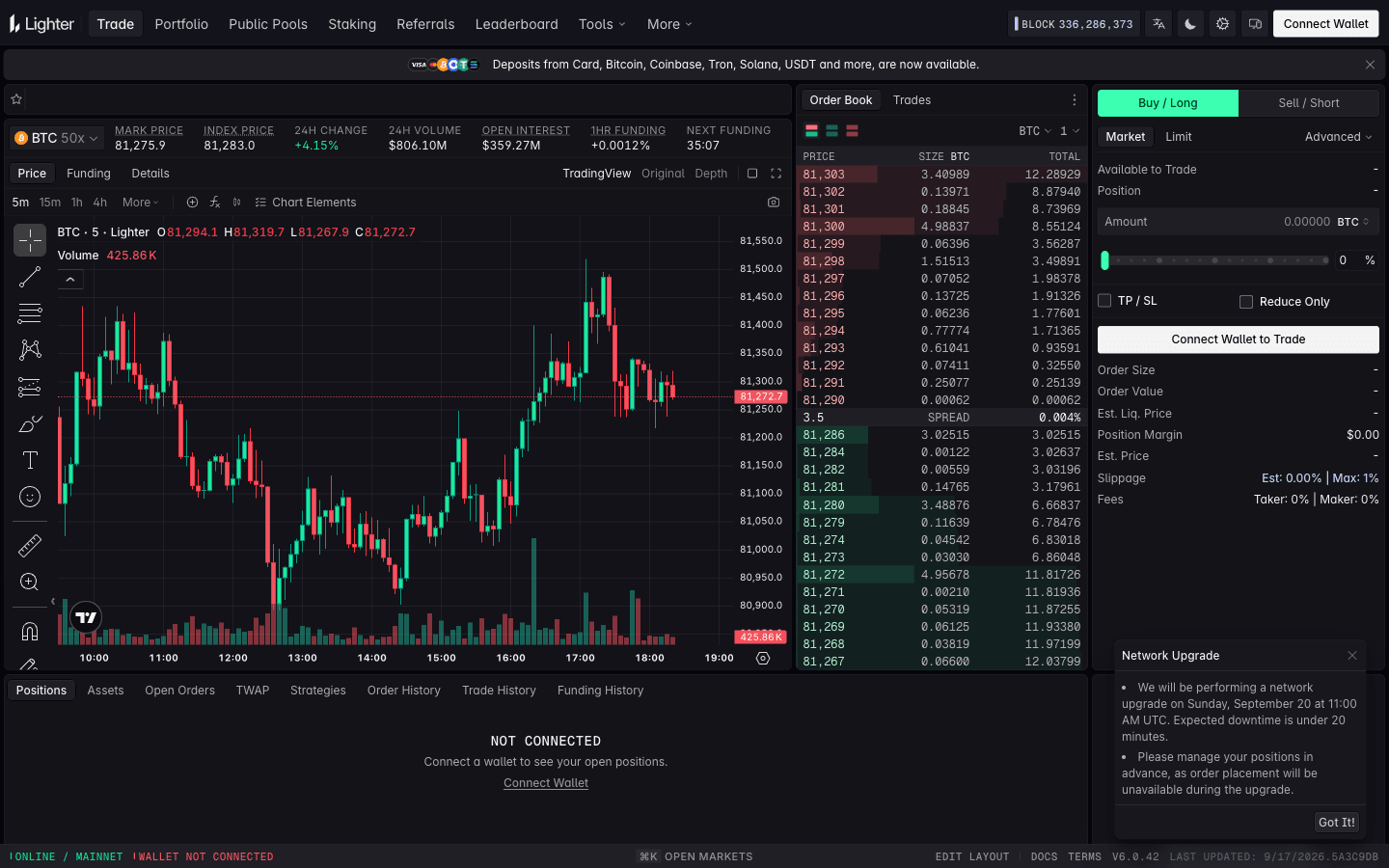
- Account: Lighter Standard, USDC collateral (sign-up guide, deposit guide). BTC and ETH have the deepest books and 50x caps; SOL (25x) is the most liquid alt. The minimum order is $10.
- Size and leverage: 3–5x; never risk more than 1% of the account per trade (a $50 maximum loss on $5,000).
- Timing: trade the 13:00–17:00 UTC weekday window, when the hourly range is widest; skip the quiet Asian afternoon.
- Entry: a momentum candle on 15-second to 1-minute charts with rising volume, and a spread inside the maximum you set for the pair. Enter with a market order; on Standard it costs nothing.
- Exit: take-profit at +0.3–0.5%, stop at about half the target on the other side. Place both as TP/SL on the position so they trigger on the mark price.
- Discipline: at most three positions at once; stop for the day after a 2% drawdown; keep a journal of win rate and average hold time.
Fee example: $5,000 at 5x controls $25,000 per trade. Fifty round trips at that size cost $0 on Lighter Standard and $1,125 at Hyperliquid’s 0.045% taker rate (50 × 2 × $25,000 × 0.045%). This is a fee comparison, not a return forecast. Entry setups and the break-even table are in the next section.
15. Scalping strategies that survive fees
For a scalp with target T, stop S and round-trip cost c, the win rate you need to break even is (S + c) ÷ (T + S). Applied to three common 2:1 shapes at each venue’s base fees:
| Venue and fill type | Round trip | +0.2% / −0.1% | +0.3% / −0.15% | +0.4% / −0.2% |
|---|---|---|---|---|
| Lighter Standard, market or limit | 0% | 33.3% | 33.3% | 33.3% |
| Aster Pro, maker in and out | 0% | 33.3% | 33.3% | 33.3% |
| Hyperliquid, maker in and out (code HOLYGRAIL) | 0.0288% | 42.9% | 39.7% | 38.1% |
| Lighter Premium, taker in and out | 0.056% | 52.0% | 45.8% | 42.7% |
| Aster Pro, taker in and out | 0.08% | 60.0% | 51.1% | 46.7% |
| Hyperliquid, taker in and out (code HOLYGRAIL) | 0.0864% | 62.1% | 52.5% | 47.7% |
| Hyperliquid, taker in and out (no code) | 0.09% | 63.3% | 53.3% | 48.3% |
Break-even win rate; base tier, no staking discount, slippage and funding excluded. “Code HOLYGRAIL” = the 4% referral discount on your first $25M. Run your own stop and target in the risk reward calculator.
The fill type is part of the strategy: on Hyperliquid and Aster, enter with post-only limits at your level and use market orders only for stops; on Lighter Standard taker entries cost nothing. Three setups that keep the target well above the fee:
- Order-book imbalance at a level. Mark the level (day high or low, round number, range edge) on a 5- or 15-minute chart. When price trades into it, sellers print and the bids at the level keep refilling for several seconds, bid one tick above with a post-only order; stop just beyond the level (typically 0.08–0.15% on BTC in active hours), target the range mid or the next ask cluster and at least 2× the stop. A single book snapshot means little: on Hyperliquid BTC on September 25, 2026 the book within 2 bp of mid flipped from 70% bids to 47% ask-heavy in 16 seconds. What counts is persistence.
- VWAP bands. Anchor VWAP at 00:00 UTC (or at a CPI release) and keep it fixed. On a trend day, buy the first pullback to VWAP or the first lower band with a stop under the pullback low; on a range day with flat VWAP, fade the second band back to VWAP. Skip the fade when the band touch comes with a volume spike and a strong close outside it: that is a breakout.
- Breakout retest. After a 30–60 minute range on the 5-minute chart, wait for a 1-minute close beyond the edge on clearly higher volume, then a return to the broken edge. Place a post-only order there, stop back inside the range by more than a typical 1-minute range (about 0.05–0.1% on BTC), take part at 2× risk and trail the rest. No retest, no trade.
Journal every trade with its setup tag, maker or taker on each side, the fee from the Trade History CSV and the net R multiple: within a few weeks it shows which setup pays after fees. Hourly windows for these setups are in section 10; order types in section 11.
16. edgeX, dYdX, Paradex and Drift for scalping
Other lists name more venues as scalping picks. Here is what their official docs say, and why they rank below the top three for most scalpers:
- edgeX is often labelled “best for scalpers”. Its docs claim “microsecond latency” for its matching engine (edgeX V2 docs; no end-to-end figure published). The fee schedule is the catch: 0.045% taker and 0.04% maker at the regular tier, so a post-only round trip still costs $8 on $10,000. Its top VIP tier drops to 0.02% / 0.015%. BTC leverage goes to 100x. Code
HOLYGRAILworks there too, with no published referee discount. - dYdX: 0.05% taker and 0.01% maker at tier 1, maker rebates at its top tiers, and an order-book chain where, per its docs, order-to-trade takes at least one block (about 800 ms). A solid venue for patient maker scalping, slower for takers.
- Paradex: Retail accounts pay 0% with a 300 ms speed bump on orders and cancels and a cap of 1,000 orders a day. Exceed it and the account is charged like Pro (0.045% taker). It is a zero-fee alternative to Lighter Standard for a low-frequency manual scalper, with a thinner book; where that thin book starts to cost more than Hyperliquid's fee is measured in Paradex vs Hyperliquid.
- Drift is not an option now. It was exploited on April 1, 2026; Drift’s recovery plan puts user losses at $295M, and the Drift program is paused. Details in our Solana perp DEX guide.
17. Verdict by venue
- Hyperliquid — best all-round scalping DEX. The deepest books, the widest market list (178 perps as of October 20, 2026), cancels first in every block, Chase orders for 0.015% maker fills, and fee tiers that scalpers actually reach. Use code
HOLYGRAILfor 4% off. Head-to-heads: Hyperliquid vs Lighter, Hyperliquid vs Aster. - Lighter — best zero-fee scalping DEX. 0% on both sides by default; the right choice for manual BTC/ETH scalping and any strategy dominated by market orders. Upgrade to Premium only if you measure that 300 ms is costing you more than 0.028%.
- Aster — best for maker-only scalping and high leverage on small size. 0% maker at any size, a native Chase order, trailing stops and hidden orders; 0.04% taker. Full comparison with Lighter: Lighter vs Aster.
- edgeX and dYdX are usable but not scalping-first: edgeX charges 0.04% even to makers, and dYdX 0.05% taker at the base tier.
- Binance, Bybit and OKX are the CEX alternative: similar or higher regular-tier fees, a fiat on-ramp and support, but KYC and custody of your funds.
18. FAQ
What is the best DEX for scalping in 2026?
Hyperliquid overall, Lighter for zero fees. Lighter’s default Standard account charges 0% maker and 0% taker, with a 300 ms delay on taker orders, which suits manual BTC and ETH scalping. Hyperliquid suits scalping many markets or larger size: $4–8B of daily perp volume across 178 markets (as of October 20, 2026), 0.045% taker and 0.015% maker at the base tier (4% less with code HOLYGRAIL), and cancels processed first in every block. Aster is the maker-only choice with 0% maker fees at every tier.
What are the top 5 DEXs for scalping?
1. Hyperliquid (depth, cancels first, 0.015% maker). 2. Lighter (0% fees on Standard, 140 ms on Premium). 3. Aster (0% maker, 0.04% taker). 4. edgeX (fast matching engine, but 0.04% maker). 5. dYdX (0.05% taker, about 800 ms per block). All five are order-book perp DEXs; AMM swap DEXs such as Uniswap are not suitable for scalping.
Is there a zero-fee crypto scalping exchange?
Yes. Lighter’s Standard account charges 0% on both sides on every perp and spot market; it is the published default, not a promotion. The trade-off is latency (taker orders wait 300 ms and cancels 300 ms; maker orders are not delayed) and a 60-requests-per-minute API limit. Paradex Retail is also 0% with a 300 ms speed bump and a cap of 1,000 orders a day. Aster charges 0% to makers but 0.04% to takers.
Is a DEX or a CEX cheaper for crypto scalping?
At the entry tier, the cheapest DEX options beat the big CEXs. A $10,000 taker round trip costs $10 on Binance USDⓈ-M, $10 on OKX and $11 on Bybit at their regular tiers, against $8.64 on Hyperliquid with code HOLYGRAIL and $0 on Lighter Standard. CEXs still lead on fiat on-ramps and customer support, and they require KYC; DEXs keep your funds in your own wallet.
What is the fastest DEX for scalping?
On published figures, Hyperliquid (a median of 200 ms end to end for a co-located client, 900 ms at p99, with cancels processed before new orders) and Lighter Premium (140 ms taker, 0 ms added to cancels). Lighter Standard adds 300 ms to taker orders in exchange for zero fees. For a human clicking a chart, a few hundred milliseconds rarely decides a trade; for a bot quoting both sides it does. Our fastest-DEX guide compares the published numbers in detail.
What is the best time to scalp crypto?
Weekdays from 13:00 to 17:00 UTC (9 a.m. to 1 p.m. in New York), when London and New York overlap. Over the 30 days to September 26, 2026, Hyperliquid BTC perp volume averaged $285M in the 14:00 UTC hour against $54M at 04:00 UTC, and the average hourly price range was 0.95% against 0.35%. A wider range leaves more room for a target after fees. Weekends averaged about a third of weekday volume. Avoid the minutes around CPI and FOMC releases unless that is your strategy.
What crypto is best for scalping?
BTC first, then ETH, SOL and, on Hyperliquid, HYPE. They have the tightest spreads and the most volume, so crossing the spread costs less than 1 basis point. Over twenty reads on September 26, 2026 (22:27–22:32 UTC), the median cost of crossing Hyperliquid’s impact spread was 0.12 bp on BTC, 0.37 bp on ETH, 0.67 bp on HYPE and 0.82 bp on SOL, but 3.9 to 6.9 bp on WLD, ENA, NEAR and PUMP, whose spreads also jumped as high as 6 to 10 bp within those five minutes. Thin alts also carry lower leverage caps and sharper wicks.
What timeframe is best for scalping crypto?
Most scalpers read 15-second to 5-minute charts and hold for seconds to a few minutes. The chart matters less than the ratio of target to cost: a target should be several times your round-trip fee. With Hyperliquid’s 0.09% taker round trip, a 0.1% target leaves almost nothing; with zero fees on Lighter Standard, or maker fills on Hyperliquid and Aster, targets of 0.2–0.5% become workable.
Can crypto scalping be profitable after fees?
Only if your edge beats the break-even win rate that your fees set. For a scalp that targets +0.4% and stops at −0.2%, the break-even win rate is 33.3% with zero fees, 46.7% on Aster’s 0.04% taker fee, 48.3% on Hyperliquid’s 0.045% taker fee (47.7% with code HOLYGRAIL) and 50.0% on Binance’s regular 0.05%. Maker fills on Hyperliquid bring it to 38.1%. Many scalpers lose money; that gap is often their whole edge.
How much money do I need to start scalping on a DEX?
Very little to start: the minimum order is $10 on Hyperliquid and $10 on Lighter, 5 USDT on Aster Pro, and Hyperliquid accepts deposits from 5 USDC. Fees scale with position size, not account size, so a $500 account pays the same percentage as a $50,000 one. Risk at most 1% of the account per trade and use 3–10x at most; on a small account that means small positions.
What leverage should a scalper use?
Less than the maximum. Hyperliquid allows 40x on BTC, Lighter 50x and Aster 150x up to $300,000 of notional, but a 50x BTC position on Lighter is liquidated after roughly a 0.8% move and a 150x Aster position after about 0.34%. Scalpers usually size positions with 3–10x so that a normal wick does not reach the liquidation price.
Should I use a referral code for scalping?
Yes, because scalpers pay more fees than anyone. Hyperliquid code HOLYGRAIL cuts fees 4% on your first $25M of volume. Lighter code 718610TD gives you a free Premium trial week that starts at sign-up (Premium fees paid that week are rebated, up to $10M of volume). Aster code DTLpLc gives you 5% of your Aster Perps fees back as a next-day rebate (taker fills only, since maker is 0%).
Which DEX is best for high-frequency or API scalping?
It depends on what limits you. Lighter Premium offers 140 ms taker latency, no cancel delay and 4,000 to 72,000 order transactions a minute depending on staked LIT, and Lighter’s API docs name AWS Tokyo ap-northeast-1a as the best colocation zone. Hyperliquid documents a 200 ms median end-to-end latency for co-located clients, gives each address one action per 1 USDC traded plus a 10,000 buffer, and executes cancels and post-only orders before takers. Aster allows 1,200 orders a minute but publishes no latency figure. Lighter Standard is free but capped at 60 requests a minute.
Set up both scalping venues
Hyperliquid HOLYGRAIL for depth and maker fills; Lighter 718610TD for free market orders; Aster DTLpLc for 0% maker and 5% of taker fees back.
Disclosure: HOLYGRAIL (Hyperliquid, edgeX), 718610TD (Lighter) and DTLpLc (Aster) are our referral codes; we earn a share of referred accounts’ fees (on Lighter only from Premium and advanced-order fees). Fees, latency figures and order types come from each exchange’s documentation and app; depth, volume and hourly data from their public APIs (September 25–27, 2026). Not investment advice: leveraged scalping can lose money quickly.