
Short answer. Hyperliquid, Lighter, Aster, edgeX and dYdX all have bot APIs (compared below). For most algorithmic traders Hyperliquid is the best starting point: deep books, an API wallet that can trade but cannot withdraw, an official Python SDK and a published 200 ms median latency. Lighter Premium suits high-frequency market making (140 ms taker latency, 24,000 weighted requests a minute), and Aster is the easiest port for a Binance bot. If you don't code, the exchanges' built-in TWAP, Scale and grid orders, or tools like WunderTrading, Bitsgap and Hummingbot, do the job.
Cut every bot fill by 4%
Bots trade a lot, so the fee rate matters more than for manual traders. Open Hyperliquid with code HOLYGRAIL: 0.045% taker becomes 0.0432% and 0.015% maker becomes 0.0144% on your first $25M of volume, including API orders from your main account.
We earn a commission when you sign up through our links; it never raises your fees.
1. Which perps DEX has an API for automated trading?
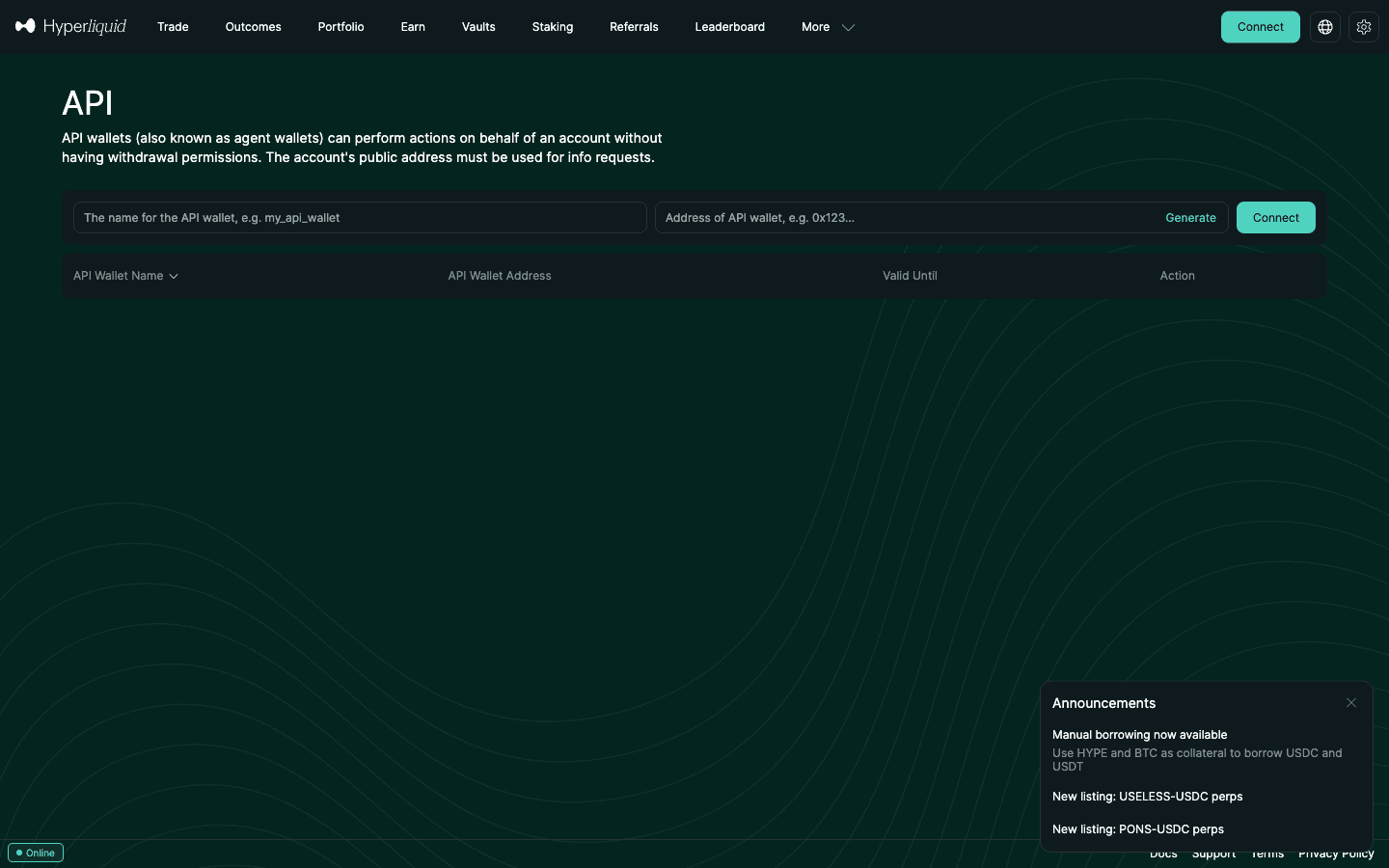
All the large order-book perps DEXs do: Hyperliquid, Lighter, Aster, edgeX and dYdX each publish REST and WebSocket APIs for placing, cancelling and streaming orders. The easiest to start with is Hyperliquid: reading data needs no key, bots sign with an API wallet that can trade but cannot withdraw, and the official Python SDK covers orders, WebSocket streams and market data (step by step in our Hyperliquid API guide). Open the account with code HOLYGRAIL before the bot's first order, because a code cannot be added after $10,000 of volume: join Hyperliquid with HOLYGRAIL.
All five below let a program place, amend and cancel orders and stream the order book and your fills. What separates them for a bot is the credential it holds (can it withdraw?), how many requests it may send, how fast an order lands, and what each fill costs. Every number here was read from the venue's own docs or public API; "not published" means we could not find an official figure.
| Venue | Bot credential | APIs and SDKs | Rate limits | Latency (official) | Base maker / taker | Testnet |
|---|---|---|---|---|---|---|
| Hyperliquid API guide | API (agent) wallet: trades, cannot withdraw. 3 named per account + 2 per sub-account, valid up to 180 days | REST + WebSocket. Official Python SDK (0.24.0); community TypeScript and Rust SDKs; CCXT | 1,200 REST weight/min per IP; per address 1 action per 1 USDC traded + 10,000 buffer | 200 ms median, 900 ms p99 end-to-end (co-located client) | 0.015% / 0.045% (0.0144% / 0.0432% with HOLYGRAIL) | Yes |
| Lighter API guide | API key per index: trades; can only make secure withdrawals to your own address. Read-only tokens available | REST + WebSocket. Official Python and Go SDKs; CCXT, Hummingbot | Standard 60 requests/min; Premium 24,000 weighted/min + 4,000 order tx/min (0 LIT staked) | Standard 300 ms on taker orders, 300 ms on cancels, maker orders not delayed; Premium 140 ms taker | Standard 0% / 0%; Premium 0.004% / 0.028% | Yes |
| Aster API guide | V3 API wallet (agent), EIP-712 signing; permissions per wallet (spot, perps, withdraw; withdraw needs an IP whitelist) | Binance-style REST + WebSocket. Official V3 code examples (JavaScript, Python) on GitHub; CCXT | 2,400 weight/min per IP; 1,200 orders/min and 300 per 10 s per account | Not published | 0% / 0.04% (crypto pairs, VIP 1) | Yes |
| edgeX Review | API key + passphrase + secret (HMAC) and a Signer Key (EIP-712) that signs orders, withdrawals and transfers; no trade-only key documented | V2 REST + WebSocket. Official Python and Go SDKs; not in CCXT | No numbers published | Not published (docs say "microsecond" matching, no end-to-end figure) | 0.040% / 0.045% (regular tier) | No public testnet (the V2 docs mention one; its site is access-restricted) |
| dYdX Review | Permissioned keys: extra trading keys that can be barred from withdrawals and limited to chosen markets | Node gRPC/REST + Indexer REST/WebSocket. Official TypeScript, Python and Rust clients; CCXT, Hummingbot | 4,000 short-term orders + cancels per 5 blocks; 50 stateful orders per 100 blocks; Indexer 100 requests/10 s per IP | About one block, ~800 ms order to trade | 0.01% / 0.05% (tier 1) | Yes |
Sources, read September 26–27, 2026: Hyperliquid docs (API, rate limits and user limits, HyperCore overview, fees) and PyPI; apidocs.lighter.xyz (API keys, rate limits) and docs.lighter.xyz (trading fees); Aster fapi/v1/exchangeInfo, github.com/asterdex/api-docs and docs.asterdex.com (fees); edgeX API Docs V2 (authentication, L2 signature) and pro.edgex.exchange/vip; docs.dydx.xyz (rate limits, permissioned keys, fees, FAQ) and the chain's live clob/block_rate parameters. Fees are the entry tier before volume discounts.
Two more venues appear in AI answers to this question: Aevo (api-docs.aevo.xyz) and Orderly (orderly.network/docs), the order-book infrastructure behind several front ends. Both publish trading APIs; we have not tested them and hold no code with them.
2. Which perps DEX is best for algorithmic trading?
For most algorithmic traders, Hyperliquid: it combines deep order books, a trade-only API wallet, an official Python SDK and a published 200 ms median latency, at 0.015% maker / 0.045% taker before discounts. Lighter Premium is the better fit for high-frequency market making, and Aster for porting a Binance bot with the fewest changes. If you choose Hyperliquid, sign up with HOLYGRAIL first: your bot's fills then cost 0.0144% / 0.0432% for the first $25M of volume. By use case:
- Best overall: Hyperliquid. (Setup, market data and order code: Hyperliquid API guide.) Deep books: its perps traded $4.03B in the 24 hours to October 20, 2026 (our last data refresh), so a strategy can size up without moving the price much. The API wallet is the cleanest bot credential of the five (trade-only, expiring), the Python SDK is official, and API orders from your main account keep the
HOLYGRAILdiscount. Weak spot: address-based limits tie your request budget to your traded volume. - High-frequency market making: Lighter Premium. 0.004% maker, 140 ms taker latency, the highest published request limits, and maker-only API keys whose post-only orders and cancels skip the speed bump. The zero-fee Standard account is fine for slow bots but capped at 60 requests a minute.
- Porting a Binance bot: Aster. Endpoints, parameters and error codes follow Binance Futures, so a bot written for Binance (or through CCXT) needs the fewest changes; the main new piece is EIP-712 signing with an API wallet.
- Fully on-chain and open source: dYdX. Every order goes through a Cosmos chain with open-source node and clients, and permissioned keys let you split trading from withdrawals. Slower (about a block per trade), and we hold no referral code there.
- edgeX: official Python and Go SDKs and a Binance-like order model, but the documented Signer Key can also sign withdrawals and no rate limits are published, so run it only on a dedicated account with limited funds.
3. How to start a DEX trading bot in 5 steps
- Pick the venue and open the account with a code. On Hyperliquid a referral code can only be added before your account passes $10,000 of volume, and a bot gets there fast, so join with
HOLYGRAILfirst. Deposit USDC from your own wallet (Hyperliquid's minimum is 5 USDC). - Create a trade-only credential. A Hyperliquid API wallet at app.hyperliquid.xyz/API, an Aster V3 API wallet without withdrawal permission, a Lighter API key at index 4 or higher, or a dYdX permissioned key. Store it in an environment variable, never in code or a chat.
- Start from the official SDK or a no-code tool. Built-in TWAP, Scale and grid orders need no key at all; WunderTrading, Bitsgap or Hummingbot if you want signals or market making; the SDKs if you write your own.
- Run it on testnet. Hyperliquid, Lighter, Aster and dYdX all run testnets. Test order placement, partial fills, reconnects and what happens when the API returns an error.
- Go live small, with a kill switch. Cap the capital, set Hyperliquid's scheduleCancel or Aster's countdownCancelAll, log every order, and compare your results net of fees and funding before scaling up.
4. Built-in bots on each DEX (no code)
Hyperliquid, Aster and Lighter ship algorithmic order types inside the normal order ticket. They run on the exchange (or, for Chase, in your browser tab), need no API key and, on Hyperliquid and Aster, cost only the normal trading fee.
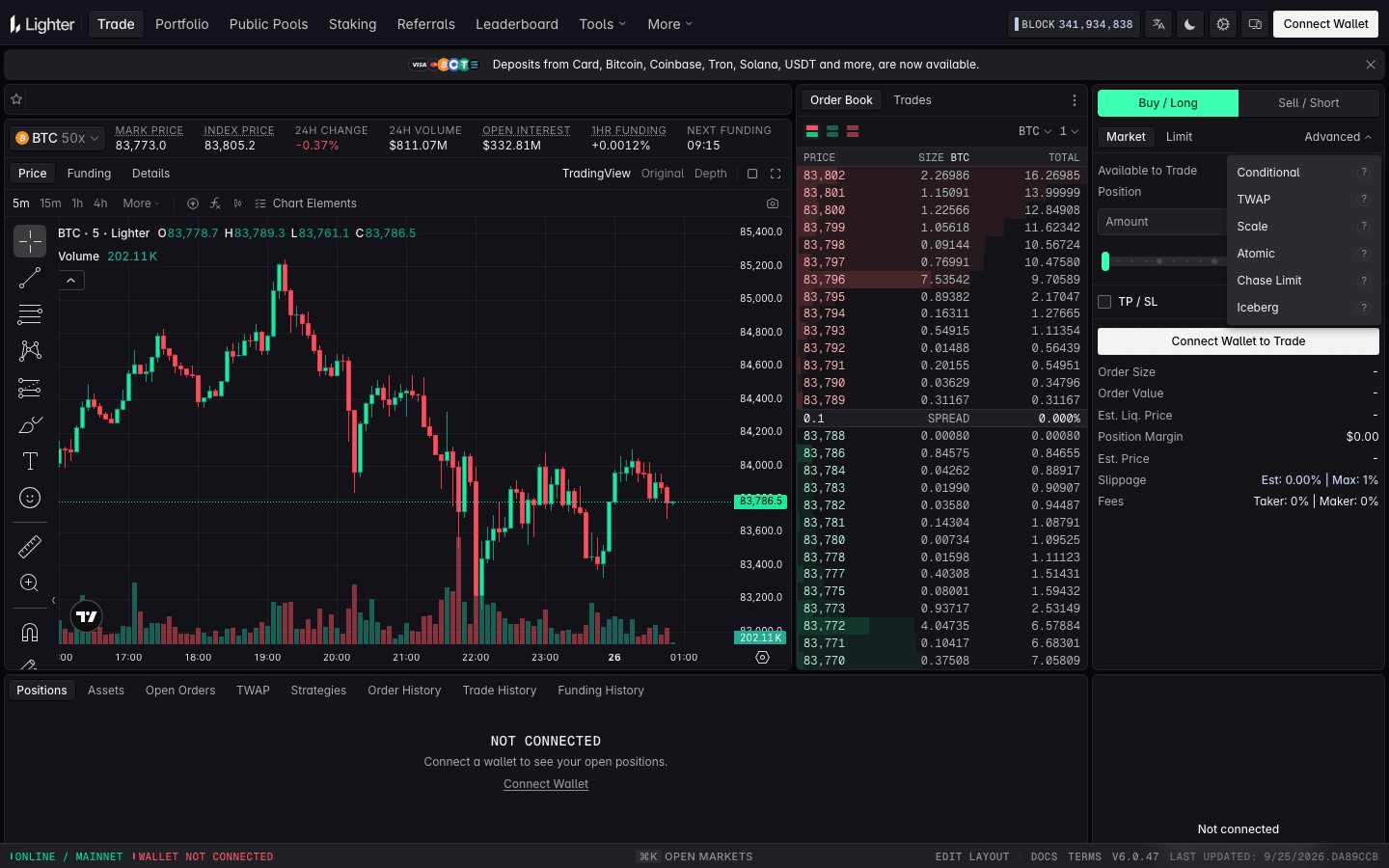
| Hyperliquid | Aster | Lighter | |
|---|---|---|---|
| TWAP | Suborders at least every 30 s; 5 min to 7 days; $100 minimum; max 3% slippage per suborder; optional randomize, trigger and max/min price | 1 minute to 7 days; the API lists a TWAP minimum notional of 1,000 on 582 of 584 perps | One slice every 30 s; 5 min to 30 days; Passive, Neutral or Aggressive style |
| Ladder of limit orders | Scale: start and end price, total orders, size skew | Scaled Order: up to 110 sub-orders; equal, increasing, decreasing or random sizes | Scale |
| Grid bot | No native grid (use Scale, or a third-party bot) | Yes: neutral, long or short; auto parameters from Bollinger bands, grid count from ATR; trigger price and stop loss; Grid 2.0 runs each grid in its own sub-account | No native grid (third-party bots exist) |
| Chase / peg | Chase: re-prices a post-only order, runs in the browser tab, max 5 active | Chase Order: always post-only, re-prices every second | Chase Limit and Iceberg run in the browser tab; orders left behind expire in 1 h |
| Other | Trailing stop (perps), TP/SL on mark price | Trailing stop, hidden orders, TP/SL | Conditional, Atomic, TP/SL on mark price |
| Extra cost | None beyond trading fees | None beyond trading fees | Standard accounts pay a fee on advanced orders (the ticket showed 0.01% taker and maker for TWAP) |
Sources: Hyperliquid docs (trading/order-types) and the live order form; Aster docs (TWAP, Scaled Order, Chase Order, Grid Trading, Grid 2.0) and fapi/v1/exchangeInfo; Lighter order ticket and referral docs ("fees paid to access advanced order types via a Standard account are also counted"). Checked September 25–27, 2026. edgeX's order ticket offers limit, market and conditional orders with post-only and reduce-only, but no TWAP or grid; dYdX offers limit, market, stop and take-profit orders, and its chain has accepted TWAP orders since the v9.0 upgrade, but has no native grid.
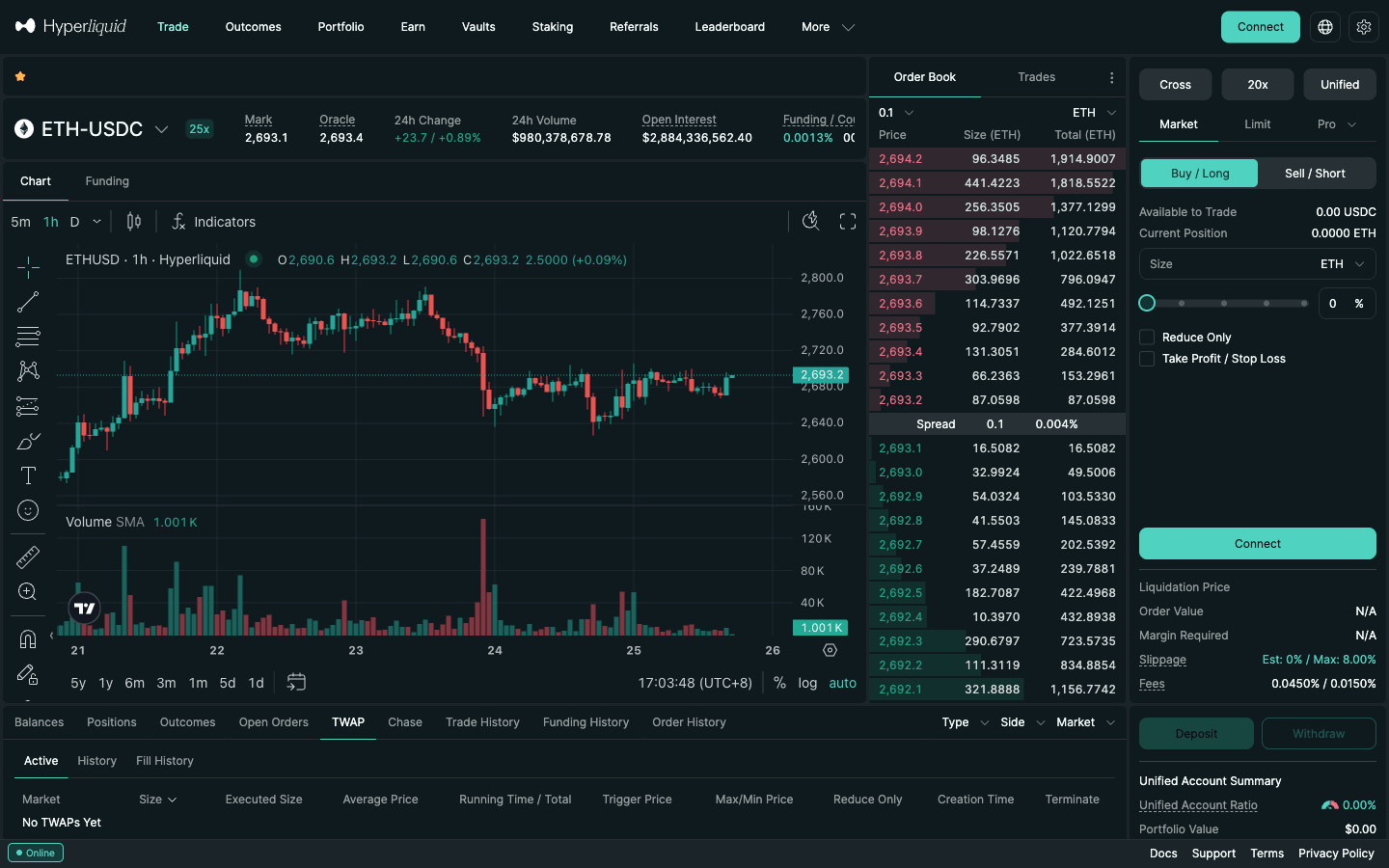
Aster's grid is the only full native grid bot of the three. A grid cannot start if you already have open orders or a position on that symbol, if you are in hedge mode, or if you already have 10 active grids. The Grid Marketplace lets you copy another user's parameters as a one-time snapshot, not a live follow. Aster API and grid guide.
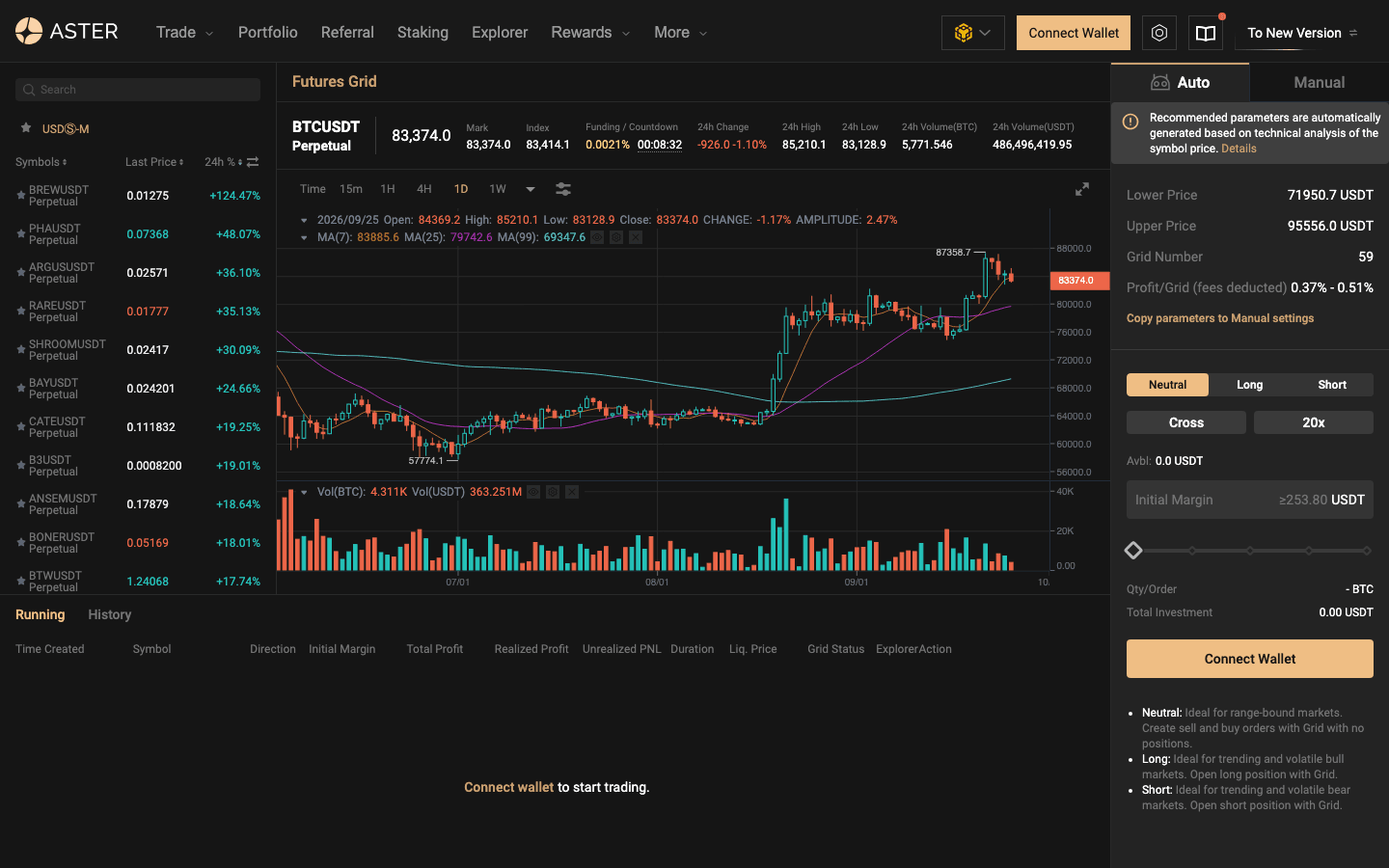
Hyperliquid's TWAP and Scale cover most of what beginners want from a bot: TWAP for spreading a large entry or a DCA over up to a week, Scale for a one-shot ladder that behaves like a grid's first half. How to set them: Hyperliquid TWAP and iceberg-style orders. Grids, market making and strategies that go beyond one order type are in the Hyperliquid trading bot guide.
5. Third-party bots that really connect
We checked each vendor's own site or documentation on September 25–27, 2026. A vendor that mentions a coin (for example HYPE) is not the same as a vendor that connects to the exchange, so this list only includes tools that name the DEX as a connection.
| Tool | DEXs | Bots | Cost | How it connects |
|---|---|---|---|---|
| WunderTrading | Hyperliquid | Signal (TradingView), Grid, DCA, Market Neutral, terminal | 0.035% builder fee per Hyperliquid trade; Premium features included, no subscription | API (agent) wallet + builder-fee approval |
| Bitsgap | Hyperliquid | GRID, DCA, COMBO and DCA Futures bots, terminal | Subscription (pricing page: from $23/month); 7-day Pro trial | Exchange connection from the Bitsgap account |
| 3Commas | Hyperliquid listed among its exchanges | DCA, Grid, Signal bots | Starter $20/month (spot only); futures from the $50/month Pro plan | Exchange API connection |
| Gunbot | Hyperliquid, dYdX, Aster listed as DeFi exchanges | Rule-based spot and futures strategies, TradingView alerts | One-time lifetime licence; runs on your own computer or server | Your exchange credentials, stored locally |
| Hummingbot (open source) | Hyperliquid, Lighter (spot and perps), dYdX v4 | Market making, arbitrage, your own strategies | Free; the client attaches a 0 bps builder code on Hyperliquid (attribution only) | Hyperliquid API keys; Lighter API key index; dYdX secret phrase |
| CCXT (library) | Hyperliquid (certified), Lighter, Aster, dYdX | Whatever you code | Free (MIT licence) | Your keys, your code |
| Dextrabot | Hyperliquid; Lighter | Grid, market making, copy trading | Hyperliquid: builder fee 0.01% (grid, market maker), 0.055% (copy trade); Lighter: 0.12 ETH/month subscription | API wallet + builder-fee approval |
Sources: wundertrading.com/en/hyperliquid-trading-bot; bitsgap.com/crypto-trading-bot/hyperliquid and /pricing; 3commas.io/hyperliquid-trading-bot (plan table); gunbot.com/exchanges and home page; hummingbot.org/exchanges; the CCXT README on GitHub; docs.dextrabot.com/dextrabot/fees. September 25–27, 2026. Popular CEX tools such as Cryptohopper (its exchange list has no perp DEX) and Pionex (bots run only on Pionex's own exchange) do not connect to these DEXs.
- WunderTrading is the simplest way to turn TradingView alerts into Hyperliquid orders. Its page says you must approve its builder fee before orders can be routed, and that the approval can be revoked on-chain. On a $10,000.00 trade the 0.035% adds $3.50 to Hyperliquid's $4.50 taker fee.
- Bitsgap brings its CEX-style GRID, DCA and COMBO bots to Hyperliquid with a subscription instead of a per-trade fee. After connecting, check app.hyperliquid.xyz/builderCodes to see whether any builder fee was approved.
- 3Commas lists Hyperliquid in its supported exchanges; its entry plan is spot only, so futures bots need at least the Pro plan.
- Hummingbot is the standard open-source framework for market making. Its Hyperliquid connectors support LIMIT, LIMIT_MAKER and MARKET orders in one-way mode, accept Hyperliquid API keys instead of the wallet private key, and include a testnet connector. The Lighter connectors ask for your account index, API key index and account tier. The dYdX v4 connector asks for the account's secret phrase, so use a dedicated dYdX account.
- CCXT lists Hyperliquid as a certified exchange (with WebSocket support in CCXT Pro) and supports Lighter, Aster and dYdX, so a strategy already written against Binance through CCXT can be pointed at a DEX with modest changes.
Copy trading is a bot too: Hyperliquid user vaults and Lighter Public Pools let your deposit follow a trader automatically. See Hyperliquid copy trading and DEX copy trading.
6. Builder fees, integrator fees and your referral discount
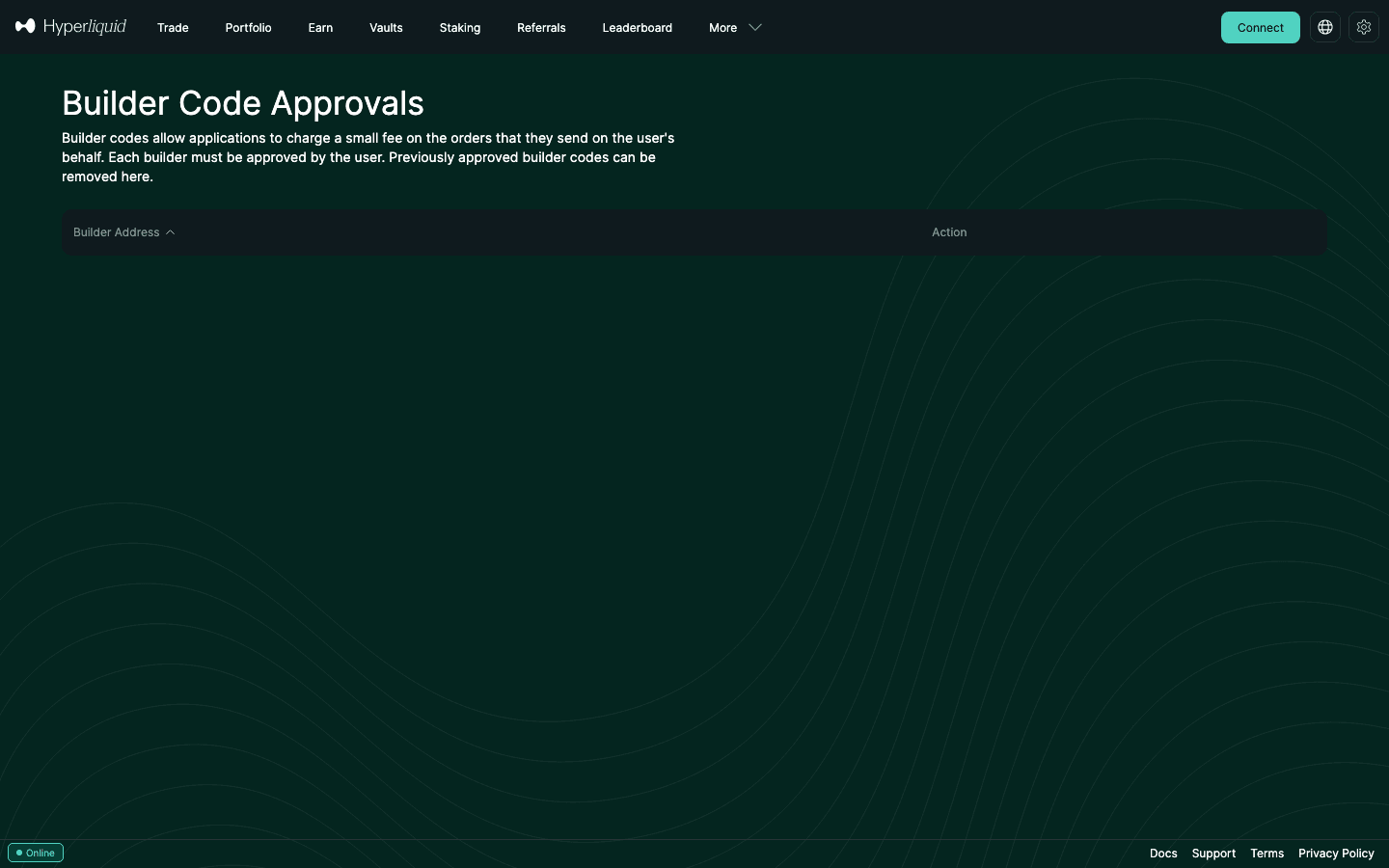
Third-party tools make money by attaching a fee to your orders. On Hyperliquid this is a builder fee: up to 0.1% on perps and 1% on spot, approved once by your main wallet (ApproveBuilderFee), with at most 10 active approvals. You can see and remove approvals at app.hyperliquid.xyz/builderCodes. A builder code does not cancel your Hyperliquid referral code: the referral discount also applies to orders placed through apps with a builder code, so the 4% still comes off Hyperliquid's part of the fee (the builder fee itself is not discounted), and the referrer still earns 10% of Hyperliquid's part of the fee on orders placed through apps (not of the app's builder fee). A bot that trades through your own API wallet on your main account, with no builder code, pays your normal fee tier minus the same discount. Hyperliquid stops accepting a code after $10,000 of volume, so sign up with HOLYGRAIL before you connect any bot; note that referral discounts never apply to sub-accounts or vaults.
On Lighter the equivalent is an integrator fee (up to 10 bps on perps and 1% on spot). Since September 14, 2026, partner-attributed trades from Standard accounts are rejected, and trades that carry integrator fees are excluded from referral kickbacks and rebates. In practice, a third-party Lighter bot that charges a fee needs a Premium account.
| $10,000.00 market order on Hyperliquid perps | Exchange fee | Tool fee | Total |
|---|---|---|---|
| Web app or your own API wallet, code HOLYGRAIL | $4.32 | $0.00 | $4.32 |
| Web app or your own API wallet, no code | $4.50 | $0.00 | $4.50 |
| Dextrabot grid (0.01%) | $4.50 | $1.00 | $5.50 |
| WunderTrading (0.035%) | $4.50 | $3.50 | $8.00 |
| Maximum builder fee allowed (0.1%) | $4.50 | $10.00 | $14.50 |
Running your own bot? Keep the discount
API orders from your main Hyperliquid account get the same 4% referral discount as manual orders. Join with HOLYGRAIL before your account passes $10,000 of volume; after that a code can no longer be added.
Estimate (all market orders, tier 0, no staking): the code saves about $18 a month at $1M of monthly volume and about $180 a month at $10M, until the discount’s $25M volume cap is used (about 25 months at $1M, 2.5 at $10M): about $450 in total at tier 0. For your own volume and order mix: Hyperliquid fee calculator.
Open Hyperliquid with HOLYGRAIL →Zero-fee Standard account and Premium for market making: Lighter (718610TD) · Native grid bot and Binance-style API: Aster (DTLpLc) · Python and Go SDKs: edgeX (HOLYGRAIL)
7. DCA bots: perps or spot?
Dollar-cost averaging buys a fixed amount on a schedule so that your entry is the average of many prices. On a perp DEX you can DCA into a perpetual long, but the costs differ from spot in one important way: funding. Hyperliquid charges funding every hour; its interest component alone is 0.00125% an hour (about 11% a year) paid by longs whenever the premium is flat. Over the 30 days to September 25, 2026, BTC funding on Hyperliquid added up to 0.7664%; spot has no funding at all.
Worked example: $10,000 of BTC over 30 days, $333 a day.
| Hyperliquid BTC perp (1x) | Hyperliquid spot (UBTC/USDC) | Lighter BTC perp (Standard) | |
|---|---|---|---|
| Trading fees for the 30 buys | $4.50 taker / $1.50 maker | $7.00 taker / $4.00 maker | $0 with market or limit orders; TWAP carries a fee on Standard |
| Funding while building (average ~$5,000 held) | ≈ $38 at last month's rate | $0 | Hourly funding (varies) |
| Holding $10,000 for a further year | ≈ $920 at last month's rate | $0 | Hourly funding (varies) |
| Native way to automate | TWAP (max 7 days) repeated, or a bot | A bot, or manual orders | TWAP up to 30 days |
So for long-term accumulation, spot DCA wins: fees are a rounding error, but funding on a perp long compounds into hundreds of dollars a year. Perp DCA fits three cases: a short campaign measured in days or weeks, building a short hedge against spot you already hold (shorts receive the funding that longs pay when it is positive), or a period when funding is negative. Keep leverage at 1–3x; a DCA that is supposed to average down should never be liquidated on the way. Variants worth knowing: time-weighted (same amount on a fixed schedule, the easiest to automate with TWAP), price-weighted (larger buys further below your target, which Scale or Aster's decreasing-size scaled order can do in one ticket) and volatility-adjusted (smaller buys when funding and ranges are elevated). On Solana, Jupiter's swap box has a DCA tab for spot tokens.
8. Fee math for a grid bot
A grid earns the spacing between its levels on each completed buy-and-sell cycle, minus two fills' worth of fees. With a 0.5% spacing and $1,000 per level, each cycle earns $5.00 gross.
- Hyperliquid, both legs maker: 2 × $0.15 = $0.30 in fees, $4.70 net. Both legs taker: $0.90, $4.10 net. With HOLYGRAIL: $0.29 / $0.86.
- Aster, both legs maker: $0.00 (maker is 0% on crypto perps); both taker: $0.80.
- Lighter Standard: $0.00 on plain limit orders, but a grid bot on the API is limited to 60 requests a minute, and Standard taker orders and cancels wait 300 ms (maker orders are not delayed).
- Through a third-party bot on Hyperliquid: add the builder fee on each leg: $0.20 per cycle at Dextrabot's 0.01%, $0.70 at WunderTrading's 0.035%.
The larger cost is the one the fee table hides: when price leaves the range, a neutral grid becomes a one-directional position that also pays funding. Always set the grid's stop loss. Full fee schedules: Hyperliquid fees.
9. Each API in detail
- Hyperliquid. Public REST and WebSocket API; official Python SDK (hyperliquid-python-sdk 0.24.0) and community TypeScript and Rust SDKs listed in the docs. Bots sign with an API wallet, which "can perform actions on behalf of an account without having withdrawal permissions"; you get 3 per master account plus 2 per sub-account, each valid for at most 180 days. Limits: 1,200 REST weight per minute per IP, and per address one action per 1 USDC traded plus a 10,000-request buffer; WebSocket up to 10 connections per IP and 1,000 subscriptions. Guides: Hyperliquid API, API wallet security and TradingView webhooks.
- Lighter. REST and WebSocket at mainnet.zklighter.elliot.ai; official Python SDK (lighter-sdk) and Go SDK; nonces per API key. API keys can trade and request secure withdrawals, which only go to the address that created the account; fast withdrawals and transfers need the wallet's own signature. Standard accounts: 60 requests per minute. Premium: 24,000 weighted requests and 4,000 order transactions per minute at 0 LIT staked, and up to 251 maker-only keys per account. The docs disagree on how many key indexes the apps reserve (0–1 on Get Started, 0–3 on the API keys page), so start bot keys at index 4. Guides: Lighter API and Lighter trading bots.
- Aster. The V3 "Pro API" signs with an API wallet (agent) via EIP-712; permissions are set per wallet (spot, perps, withdraw), and withdrawal permission requires an IP whitelist. No new V1 (key and secret) API keys since March 25, 2026, the app announces the V1 API's deprecation on October 10, 2026, and since September 1, 2026 authenticated V3 endpoints need a completed deposit from the main wallet. Official V3 examples live in the asterdex/API-demo repository; the older aster-connector-python library uses V1 keys. Limits: 2,400 weight a minute per IP, 1,200 orders a minute and 300 per 10 seconds per account. Guide: Aster API trading.
- edgeX. API V2 at edgex-prod-v2.edgex.exchange with public market data, private account and order endpoints, and public and private WebSockets. Private calls use HMAC headers from an API key, passphrase and secret created under API Management → Perps V2 → SDK Signer; orders, withdrawals and transfers are additionally signed with EIP-712 by the Signer Key from the same dialog. Official SDKs: edgex-python-sdk (install version 2.0.0 or later for V2) and edgex-golang-sdk. More: edgeX review.
- dYdX. Orders are Cosmos transactions sent to a full node (gRPC/REST); market data and your fills come from the Indexer (REST and WebSocket). Official clients for TypeScript, Python and Rust live in dydxprotocol/v4-clients. Short-term orders (valid for a few blocks) are the market-maker path, with a budget of 4,000 places and cancels per 5 blocks; long-term and conditional orders are limited to 50 per 100 blocks. Permissioned keys let a bot key trade chosen markets without withdrawal rights. More: dYdX review and Hyperliquid vs dYdX.
10. Safety: keys, kill switches, testnets
- Never share your seed phrase or main private key with a bot, a website, an AI chat or a "support" contact. Every legitimate tool above works with a trade-only key, except where noted (Hummingbot's dYdX connector, edgeX's Signer Key): use a dedicated account with limited funds there.
- Use trade-only credentials: a Hyperliquid API wallet, an Aster V3 API wallet without withdrawal permission, a dedicated Lighter API key index, a dYdX permissioned key. Use one API wallet per bot process; Hyperliquid's docs warn not to reuse an old API wallet address, because pruned nonce state can allow replays.
- Add a dead man's switch. Hyperliquid's scheduleCancel cancels all open orders at a time you set (at least 5 seconds ahead, up to 10 triggers a day); Aster's countdownCancelAll does the same per symbol; Lighter's SDK has cancel-all options; dYdX short-term orders expire on their own after a few blocks.
- Revoke what you no longer use: builder-fee approvals on Hyperliquid's Builder Codes page, expired or unused API wallets, old Aster agents, old dYdX authenticators.
- Test first. Hyperliquid, Lighter, Aster and dYdX all run testnets, and Hummingbot has testnet connectors for Hyperliquid and Lighter. Hyperliquid testnet guide.
- Size for failure. Assume the bot will one day run into a gap, an outage or a bug, and cap the capital it can reach.
11. Which bot for which trader
- Beginner, sideways market: Aster's native grid with its stop loss, or a Scale ladder on Hyperliquid. No code, no extra fee.
- Large entries or DCA over days: Hyperliquid TWAP (up to 7 days) or Lighter TWAP (up to 30 days).
- TradingView strategies: WunderTrading on Hyperliquid, accepting the 0.035% builder fee, Bitsgap or Gunbot, or your own webhook server with an API wallet (TradingView integration).
- Market making or arbitrage: Hummingbot or the SDKs; Hyperliquid for depth, Lighter Premium for low maker fees (0.004%) and high rate limits. See multi-DEX arbitrage bots.
- Your own quant strategy: Hyperliquid's Python SDK with an API wallet, then add a second venue through CCXT once it works.
- Hands-off: a vault or pool rather than a bot; see our passive income guide.
To compare the exchanges themselves, see the best DEX guide and the perp DEX ranking; new to DEXs, start with what is a DEX.
Start with the most mature DEX API
Native TWAP, Scale and Chase, the most mature API, and 4% off every fill on your first $25M with code HOLYGRAIL.
Also: Lighter (718610TD) · Aster (DTLpLc) · edgeX (HOLYGRAIL)
FAQ
Which perps DEX has an API for automated trading?
All the large order-book perp DEXs do. Hyperliquid, Lighter, Aster, edgeX and dYdX each publish REST and WebSocket APIs for placing, cancelling and streaming orders, with official SDKs or code examples: Hyperliquid has an official Python SDK and API wallets that cannot withdraw; Lighter has official Python and Go SDKs; Aster has a Binance-style API with V3 API wallets; edgeX has official Python and Go SDKs; dYdX has official TypeScript, Python and Rust clients. Rate limits range from 60 requests a minute on a free Lighter Standard account to 24,000 weighted requests a minute on Lighter Premium (September 27, 2026).
Which perp DEX is best for algorithmic trading?
For most bots, Hyperliquid: deep order books, a trade-only API wallet, an official Python SDK and a documented 200 ms median end-to-end latency, at 0.015% maker / 0.045% taker. For high-frequency market making, Lighter Premium (0.004% maker, 140 ms taker latency, maker-only API keys). To port a Binance bot with the fewest changes, Aster, whose API mirrors Binance Futures. dYdX suits builders who want a fully on-chain order book and permissioned keys.
What is the best crypto trading bot for a DEX?
For most people the best bot is the one already built into the exchange, because it adds no extra fee and needs no API key: Hyperliquid's TWAP, Scale and Chase orders, Aster's grid bot, TWAP and scaled orders, and Lighter's TWAP (up to 30 days) and Scale orders. For TradingView signals or DCA logic, WunderTrading supports Hyperliquid for a 0.035% builder fee per trade and Bitsgap runs its GRID, DCA and COMBO bots on Hyperliquid on a subscription; for market making, Hummingbot has Hyperliquid, Lighter and dYdX connectors; for your own code, use the official SDKs with a trade-only key.
What is the best Hyperliquid trading bot?
Start with the native order types: TWAP sends suborders at least every 30 seconds for 5 minutes to 7 days, and Scale lays a ladder of limit orders between two prices. For signals and DCA, WunderTrading routes orders to Hyperliquid with a 0.035% builder fee. For open-source market making, Hummingbot's hyperliquid and hyperliquid_perpetual connectors, which accept API keys. Whatever you use, give it an API wallet, which can trade but cannot withdraw.
Can I use bots to trade crypto on a DEX?
Yes. Perp DEXs publish their APIs precisely so that bots, market makers and apps can trade, and their docs cover rate limits, signing and dedicated bot keys. The same rules apply as for manual trading: the venue's restricted-persons list (Hyperliquid's terms exclude, for example, the US and Ontario), your local tax rules, and the risk that a bug trades much faster than you can. Start on a testnet with a trade-only key.
Do third-party bots cost more on Hyperliquid?
Often. Apps and bots can attach a builder fee of up to 0.1% on perps and 1% on spot, which you approve once with your main wallet. WunderTrading charges 0.035% and Dextrabot's grid bot 0.01% on top of Hyperliquid's own 0.045% taker fee. You can see and revoke approvals on the Builder Codes page. Your Hyperliquid referral discount still applies on those orders: the referral discount also applies to orders placed through apps with a builder code, so the 4% comes off Hyperliquid's part of the fee (the builder fee itself is not discounted).
Does Lighter support trading bots?
Yes. Lighter has a public API with official Python and Go SDKs, API keys per account, and Hummingbot and CCXT connectors. Standard (zero-fee) accounts are limited to 60 requests a minute and TWAP carries a 0.01% fee there; Premium accounts get 24,000 weighted requests and 4,000 order transactions a minute. Since September 14, 2026, partner-attributed trades from Standard accounts are rejected, so third-party Lighter bots that add an integrator fee need a Premium account.
Can ChatGPT build a trading bot?
An AI assistant can write a working bot skeleton against an official SDK in minutes, and some venues now publish AI-agent kits (Lighter's lighter-agent-kit and Aster's aster-skills-hub on their official GitHub). What it cannot do is pick a profitable strategy for you or catch every edge case in order handling. Run anything AI-written on a testnet first, read the code, and never paste a private key or seed phrase into a chat.
Do trading bots actually make money?
A bot only executes rules faster and more consistently than you; it does not create an edge. Grid bots earn in sideways markets and lose when price leaves the range, DCA bots average your entry but do not prevent drawdowns, and every fill pays fees (and perp positions pay funding). Treat any vendor's backtest or win rate with suspicion, measure your own results net of fees, and cap the capital a bot can reach.
How do I keep a trading bot from draining my wallet?
Never give a bot or a website your seed phrase or main private key. On Hyperliquid, authorise an API (agent) wallet, which can trade but cannot withdraw and expires after at most 180 days. On Aster, use V3 API wallets without withdrawal permission. On Lighter, create a dedicated API key index (it can only make secure withdrawals to your own address). On dYdX, add a permissioned key that cannot withdraw. On edgeX, the documented Signer Key also signs withdrawals, so use a separate account with limited funds. Add a dead man's switch (Hyperliquid scheduleCancel, Aster countdownCancelAll) so open orders are cancelled if the bot stops.
Disclosure: HOLYGRAIL (Hyperliquid, edgeX), 718610TD (Lighter) and DTLpLc (Aster) are our referral codes; we earn a share of referred accounts' fees. We hold no code with dYdX, Aevo or Orderly, and have no affiliation with WunderTrading, Bitsgap, 3Commas, Gunbot, Hummingbot, CCXT or Dextrabot. Features, limits and fees were checked on the vendors' and exchanges' own pages on September 25–27, 2026 and change often. Automated trading can lose money quickly; nothing here is financial advice.