Hyperliquid Copy Trading (2026): How to Copy a Trader with Apps and Bots
Short answer
Hyperliquid has no copy-trade button. To copy a wallet, you connect a third-party copy app such as Hyperdash, Dexly or HyperX, which mirrors the leader’s trades from your own Hyperliquid account through an API wallet that cannot withdraw, and adds a builder fee (Hyperdash: 0.05% per copied trade).
The official alternative is a vault: you deposit USDC, the leader trades the pooled account and keeps 10% of your profits (1-day lock-up; see Hyperliquid vaults). Either way, 100% of the losses are yours: no route caps or refunds them, and with an app you also fill after the leader, usually at a worse price.
Join Hyperliquid with HOLYGRAIL before you connect a copy app
Why first: apps such as Phantom often set their own Hyperliquid referral code on accounts that have none, so enter a code on Hyperliquid before you start using an app (no code can be added after $10,000 of volume). HOLYGRAIL takes 4% off Hyperliquid’s fee on your first $25M, copy-app orders from that account included; the app’s builder fee is not discounted.
Rules and fees checked October 6, 2026.
How to copy a trader on Hyperliquid with copy apps or your own bot: the steps, what they cost, who holds your money and how to choose a trader to copy.
By BLTZ · Published · Updated · Rules checked against the Hyperliquid docs · Tool fees read on each tool’s own site on September 27, 2026 · How we verify
Hyperliquid copy trading: key facts by route (October 6, 2026)
Route
Who holds the funds
Cost
Lock-up
Does HOLYGRAIL apply?
Vault (official, app.hyperliquid.xyz/vaults)
The vault: a shared Hyperliquid account. The leader trades it but cannot withdraw your share
10% of your profits when you withdraw; nothing on losses (HLP: no profit share)
1 day after your last deposit (HLP 4 days)
No: referral discounts do not apply to vaults and sub-accounts
Copy app in your own wallet (Hyperdash “Use Existing”, Dexly, HyperX)
You: your own Hyperliquid account. The app’s API wallet can place orders but cannot withdraw
Hyperliquid fee (0.045% taker, base tier) + the app’s builder fee (Hyperdash 0.05%; protocol cap 0.1%)
None: stop copying any time (Hyperdash’s Stop closes every open position in that wallet)
Yes, on Hyperliquid’s part of the fee, if the account joined with HOLYGRAIL before you connected the app
Copy app with an app-managed wallet (Hyperdash “Create New”, pvp.trade)
A separate wallet the app creates and manages for you
Hyperliquid fee + the app’s fee (Hyperdash 0.05%; pvp.trade 0.025%–0.04% at level 1, plus 10% of your profit to the leader)
None
No: it is a different Hyperliquid account from the one you joined with
Your own bot
You: your own account, with an API wallet you create
Your Hyperliquid fees + hosting
None
Yes in a main account opened with the code; no in a sub-account
Sources: Hyperliquid docs (vault depositors and leaders, protocol vaults, referrals, builder codes) and docs.hyperdash.com/copy-trade, re-read October 6, 2026; pvp.trade’s fee from its docs (September 27, 2026); the HOLYGRAIL column from our mainnet fill check (October 1, 2026). “HOLYGRAIL applies” means the 4% referral discount on Hyperliquid’s part of the fee.
We earn a commission when you sign up through our links; it never raises your fees. We have no affiliate relationship with any copy trading app on this page.
1. How do I copy trade on Hyperliquid? Step by step
Copy any wallet with an app or bot
Open a Hyperliquid account with code HOLYGRAIL first, before you connect any copy app, and deposit USDC. Decide whether the copy runs in your main account, a sub-account or a separate wallet; keeping it apart from the rest of your money limits what a bad leader or a leaked key can touch. With Hyperdash it matters more: its Stop closes every open position in the wallet, including your own trades. The setup that keeps both the isolation and the referral discount is a separate wallet that holds only the copy funds and joins Hyperliquid with HOLYGRAIL as its own main account (a sub-account loses the discount; see section 3).
Pick a tool from the table below and check its builder fee before you sign anything.
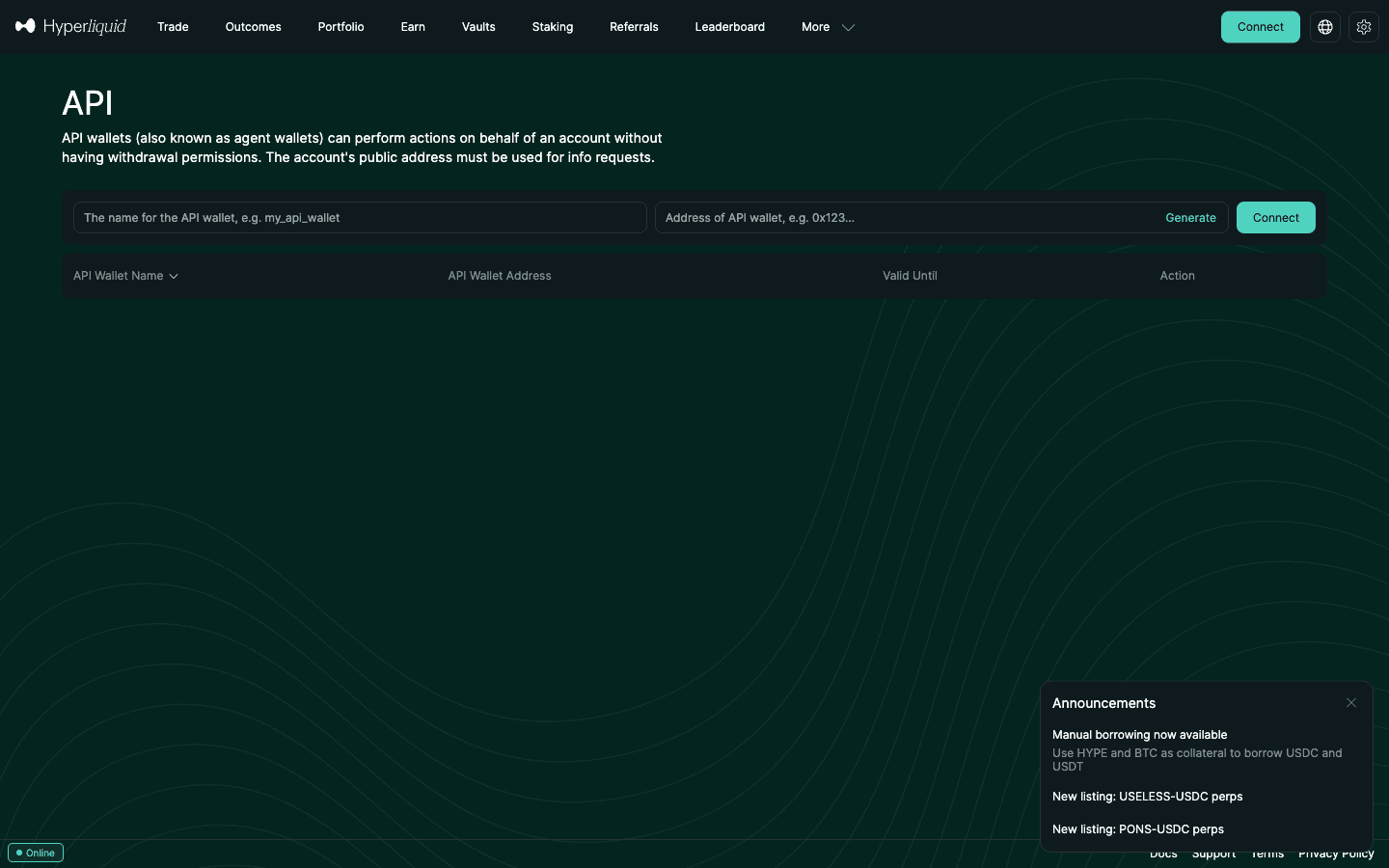
Approve an API wallet (the app does this from your wallet, or you create one at app.hyperliquid.xyz/API). Give it an expiry: at most 180 days.
Approve the builder fee. Your main wallet has to sign this approval itself (an API wallet cannot); the protocol caps it at 0.1% on perps, and you can hold up to 10 builder approvals at once.
Choose the trader (see how to choose; to test a strategy on past data first, see how to backtest on Hyperliquid) and set the copy ratio or fixed amount, a maximum notional per market, a leverage cap and a drawdown pause.
Monitor daily for the first week: compare your positions with the leader’s and close anything the leader no longer holds.
Stop and revoke when you are done: stop the copy (Hyperdash’s Stop closes every open position in that wallet; other apps may leave positions open), close anything left, and revoke the API wallet (or let it expire).
Would rather not manage an API key? The official alternative is a trader’s vault (section 6).
Step 3: the API wallet page. Name the key after the app, set Valid Until, and delete it when you stop copying. Captured September 2026.
2. What is the best Hyperliquid copy trading app? Tools and fees compared
These are the copy trading tools that rank for “hyperliquid copy trading” and “hyperliquid copy trade bot”, described only by what each one states on its own site or docs on September 27, 2026. We hold no referral code for any of them. “Builder fee” means a fee the app adds to each order on top of Hyperliquid’s own fee (explained in the next section).
Tool
Type
Custody
How it copies
Cost
Hyperliquid vaults (official)
Pooled account
Your share sits in the vault
The leader trades one account that you own part of
10% of profits; HLP free
Hyperdash
Web app
Your own wallet via API key, or a wallet Hyperdash manages
Copytrade or countertrade up to 10 traders per wallet; leverage cap, max worse entry, asset filters
0.05% builder fee on copy trades (0.015% on normal perp trades)
Dexly
Web + iOS/Android app
Your wallet; agent wallet authorisation
Mirrors leaderboard wallets; drawdown pause, max position size
Copy page says "no platform fees", yet the enable-copy flow asks you to approve a builder fee; rate not published
HyperX
Web + Android, iOS via TestFlight
Your wallet; builder-fee approval required
Ratio, leverage limit, margin range, TP/SL per copy
Builder fee required; rate not published on the site
pvp.trade
Telegram bot
Bot-held wallet (keys in Turnkey enclaves, exportable)
Copy or countertrade other PVP users who opted in
10% of your profit to the leader + PVP fee 0.025%–0.04% (level 1)
Perpex
Android app (Celebit Ltd)
Not stated on the store listing
“Copy trade, grid bots & perps on Hyperliquid”
Not published on the listing
Your own bot
Code
Your account; API wallet you create
Subscribe to the leader’s fills, replay scaled orders
Your fees + hosting
Two notes on the table. Hyperdash’s “Create New” option puts your copy funds in a wallet managed under your Hyperdash account; “Use Existing” keeps them in your own wallet (it needs at least 100 USDC, an API key valid 180 days and unified account mode). And bot platforms such as WunderTrading (0.035% builder fee on Hyperliquid orders) run signal, DCA and grid bots on Hyperliquid, which is automation rather than copying a wallet. CopyLiquid, which appears in several press releases for this search, was still pre-launch and selling a token presale when we checked in September 2026; there was nothing to test.
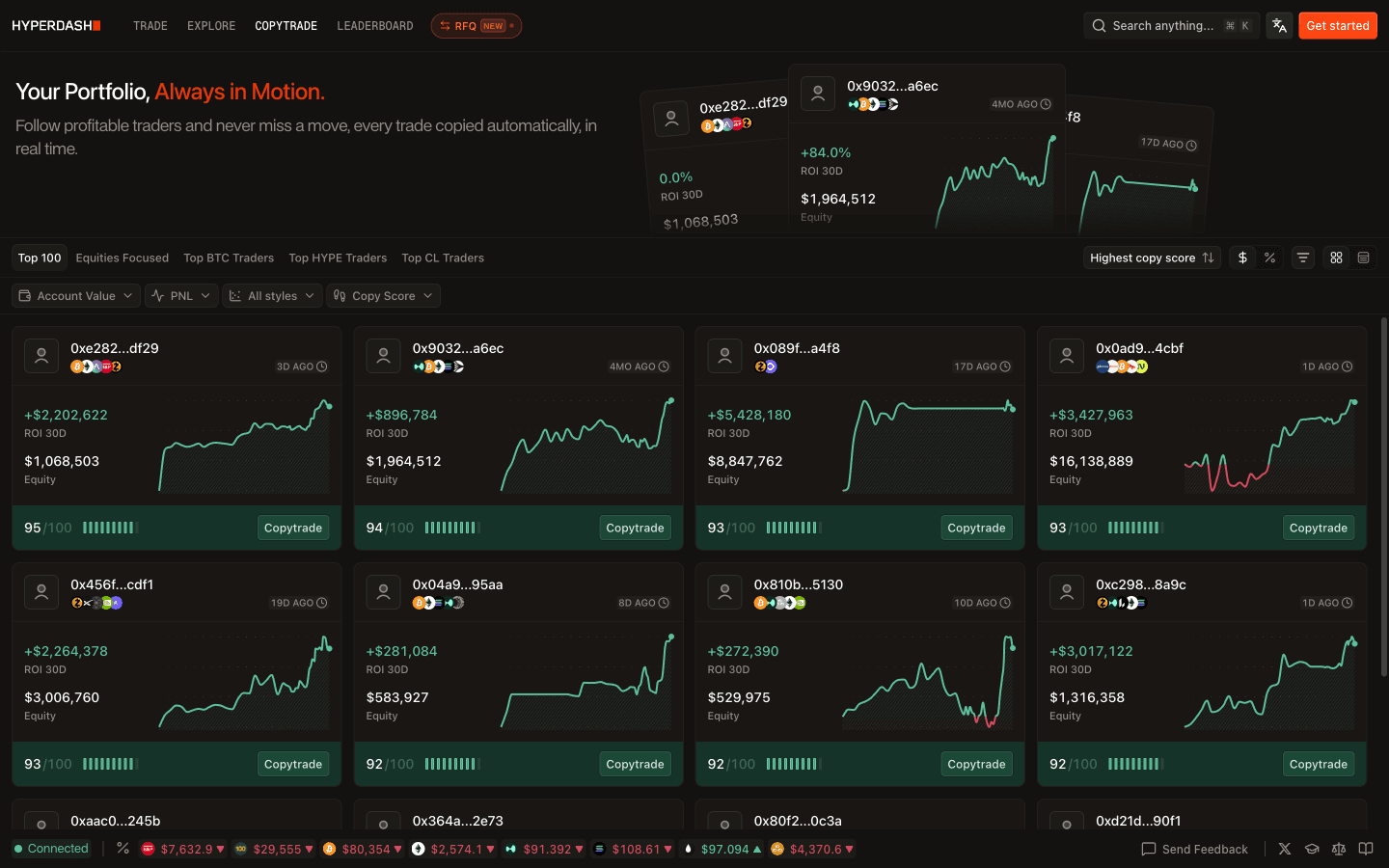
Hyperdash’s Copytrade screen ranks leaders by a proprietary copy score with 30-day ROI and equity. The score is the app’s opinion; the positions behind it are on-chain and checkable.
fomo and Based: follow traders, but no copy button
Two consumer apps come up in the same searches. Neither copies trades, and the referral rules differ, so the order you sign up in matters.
fomo is a social trading app with Hyperliquid perps: every trade appears in a public feed, you can follow traders and get notified when they buy or sell above a threshold you set, and a leaderboard ranks users. Its help centre states that fomo does not have a copy trading feature; you place every order yourself. Also, fomo has no wallet connection (Apple, Google or email only) and creates its own wallet and Hyperliquid account for you, so a Hyperliquid code such as HOLYGRAIL cannot apply there. fomo has its own referral instead, and our fomo link takes 10% off its fees (see the fomo app review).
Based is a native iOS/Android front-end on Hyperliquid (0.025% builder fee on perps). Based’s documentation lists no copy trading feature; what it adds for someone following traders is order tooling such as trailing stops, TWAP and scale orders, plus a Telegram bot. You connect your own Hyperliquid wallet, so join Hyperliquid with HOLYGRAIL first: the 4% then stays on Hyperliquid’s part of the fee for orders you place through Based. Based’s own referral code (also HOLYGRAIL, but a separate code in Based’s programme) is here.
3. What does copy trading on Hyperliquid cost?
Every order a third-party app sends for you can carry a builder code: a fee that goes to the app, charged on top of Hyperliquid’s fee. You approve a maximum rate once with your main wallet, and the protocol caps it at 0.1% on perps. Copy apps are paid this way, so “no platform fee” on a landing page does not mean “no fee”. Look at the builder-fee approval you are asked to sign.
Worked example, one copied $10,000 taker fill through Hyperdash: Hyperliquid taker 0.045% + Hyperdash copy builder fee 0.05% = 0.095%, or $9.50. The same order placed yourself on Hyperliquid costs $4.50, or $4.32 with the 4% referral discount. If the copying account was opened with a referral code, the copied order gets that discount too, on Hyperliquid’s part only: 0.0932%, or $9.32. At the 0.1% cap an app could charge 0.145% all-in. A leader who trades in and out 50 times a month on your full size costs you that fee 100 times.
Where the referral discount applies. Hyperliquid’s docs state that referral discounts “do not apply to vaults or sub-accounts because those are treated as independent accounts”. A builder code does not switch the discount off: the referral discount also applies to orders placed through apps with a builder code. We checked this on mainnet fills on October 1, 2026: referred accounts paid exactly 4% less than their rate on Hyperliquid’s part of builder-coded fills, while the app’s builder fee was charged in full. (An older Hyperliquid page, a staking-referral proposal marked as not implemented, says builder codes override referral codes; the fills show otherwise, and the referrer’s reward is kept on them too.) So the 4% from HOLYGRAIL reduces every order in a main account opened with the code: the trades you place yourself on app.hyperliquid.xyz, the orders your own bot sends, and the orders a copy app sends from that account through an API wallet. It does not reach a vault, a sub-account, or a separate wallet that a copy app creates or manages for you; that is a different Hyperliquid account, which needs its own code, and a code cannot be entered after $10,000 of volume. One more catch: apps such as Phantom often set their own Hyperliquid referral code on accounts that have none, so enter a code on Hyperliquid before you start using an app. For a self-built bot that is a real trade-off: a sub-account isolates the bot from the rest of your money but loses the discount. To get both, run the bot from a separate wallet that is its own main account, opened with the code.
Vault deposits and copied orders both start from a Hyperliquid account. Join with code HOLYGRAIL for 4% off Hyperliquid’s fee on your first $25M of volume on everything traded in your main account: your own trades, your bot’s orders and the orders a copy app sends from it with its builder code. Enter the code before you connect any app.
4. How is it different from Binance or Bybit copy trading?
Centralised exchanges sell copy trading as a product: pick a lead trader, allocate, and the exchange’s own engine clones their futures trades into your account. Hyperliquid is an on-chain order book. Every order must be signed by a key, so nothing trades in your account unless you gave it a key, and every fill, position and balance of every address is public, so nobody can hide a track record.
Hyperliquid
Binance / Bybit copy trading
Who places your orders
Your own account signs them (you, an app’s API wallet, or a vault leader)
The exchange’s copy engine
Custody
Self-custody; an API wallet cannot withdraw
The exchange holds your funds
Track record
Every fill of every address is public on-chain
Reported by the exchange
Account
Wallet; no KYC
Exchange account with identity verification
Base taker fee
0.045% (0.0432% with a referral code)
Binance USDⓈ-M 0.05% · Bybit 0.055%
Leader’s cut
Vaults: 10% of profits. Apps: usually none to the leader (builder fee to the app); pvp.trade gives its leaders 10% of followers’ profits
Profit share set by the lead trader
CEX fee figures are the regular-tier futures taker rates from each exchange’s fee page (registry, September 2026). For a fuller fee comparison see DEX vs CEX trading fees.
5. Vaults, apps or your own bot: how do the routes compare?
Vaults
Copy app / hosted bot
Your own bot
Where your USDC sits
Inside the vault (a shared Hyperliquid account)
Your own Hyperliquid account (or a wallet the app manages)
Your own Hyperliquid account
What you approve
A deposit
An API wallet (signs orders, cannot withdraw) plus a builder fee
An API wallet you generate yourself
Cost
10% of your profits to the leader (HLP: 0%)
Your taker fee (0.045% base) + the app's builder fee (capped at 0.1%)
Your own fees + hosting
Lag vs the leader
None: you are in the same account
Seconds; you fill after the leader, usually as a taker
Depends on your bot; still after the leader
Control over size / stops
None
Copy ratio, max size, leverage cap, drawdown pause (varies by app)
Total
Exit
Withdraw after the 1-day lock-up (HLP 4 days)
Stop copying any time; depending on the app, Stop closes every open position in that wallet (Hyperdash) or leaves positions for you to close
Kill the bot; close positions yourself
Who you trust
The leader’s trading
The leader’s trading + the app’s execution and key handling
Your own code
6. Does Hyperliquid have copy trading? Its official route is vaults
Hyperliquid has no “copy this trader” button; its built-in alternative is depositing into a trader’s vault, where the leader trades a pooled account, keeps 10% of your profits and locks each deposit for 1 day, with no lag and no keys but no control over size or stops. The largest vaults, their APR and how to deposit are in our guide to Hyperliquid vaults; the rest of this page is about copying wallets with apps and bots.
7. How do Hyperliquid copy trading apps and bots work?
If the trader you want to follow does not run a vault (most leaderboard accounts do not), the alternative is mirroring. A copy app watches the leader’s address, sees each fill, and submits a scaled order from your account. What makes this possible without handing over your private key is the API wallet:
You approve a separate signing key at app.hyperliquid.xyz/API (or the app does it through the approveAgent action). An account can hold 1 unnamed and up to 3 named API wallets, plus 2 per sub-account.
Each named key can carry an expiry of at most 180 days. Set one.
The key can place, modify and cancel orders. It cannot send USDC to another address: the only transfer an agent can sign must go back to the same account.
Revoking is instant: approve a new key under the same name, or let it expire. Never reuse an old agent address.
What a mirror bot cannot fix for you
The Reddit thread that ranks third for this search, a developer’s lessons from months of running a Hyperliquid copy bot, makes the key point: copying is an exit problem more than an entry problem. Entry lag of under a minute barely changed results; the edge leaked on how positions were closed. The rules that follow from it:
Close only when the source is net flat. Leaders scale out in pieces. A bot that closes your whole position on the leader’s first partial exit turns a winning trader into a losing copy. Mirror partial exits proportionally and close fully only when the leader holds zero in that coin and direction.
Use a catastrophe stop, not a tight stop. A normal stop-loss cuts trades the leader holds through a drawdown, so you keep their losers and miss their winners. Set a wide account-level stop that only protects against disaster.
Reconcile positions. If the bot misses an event (disconnect, rejected order, rate limit), you end up holding what the leader already closed. Check your positions against the leader’s on a schedule and flatten the difference. Apps with a drawdown pause are worth the minute of setup.
Mind the $10 minimum order. A small copy account scales the leader’s small trades below $10; those copies are skipped and your book drifts from the leader’s.
Skip minute-flippers. You fill after the leader, usually as a taker at a worse price and with the builder fee on top. On a leader who scalps for 0.1%, that gap is the whole edge.
The leader can see you too. Copied wallets are public; some large leaders know they are followed and trade around it.
Copy apps are the right route when you want your own stops and sizing, you want to follow a wallet with no vault, and you are comfortable managing an API key. Read the API key security guide first.
8. How do I build my own Hyperliquid copy trading bot?
Everything a hosted copy app does is available to you directly, and the pieces are small:
Signal. Open a WebSocket to Hyperliquid and subscribe to userFills for the leader’s address; every fill arrives with coin, side, size and price. The REST fallback is the userFillsByTime info request. Limits per IP: 1,200 weight per minute on REST, 10 WebSocket connections, 1,000 subscriptions, and at most 10 unique users across user-specific subscriptions.
Sizing. Read the leader’s clearinghouseState for their account value, divide yours by it, multiply each fill by that ratio, cap it by your per-market notional limit, and round to the asset’s size decimals. Drop orders that fall under $10 and log them, so you know where you drift.
Execution. Sign with an API wallet from app.hyperliquid.xyz/API and submit through the exchange endpoint. The official Python SDK handles signing and nonces. Use IOC limit orders a few ticks through the book rather than pure market orders so a stale signal cannot fill at any price.
Safety. A separate task that compares your positions with the leader’s every few seconds and flattens anything they no longer hold, a net-flat rule for exits, and a hard stop on account drawdown. Note the address-based limit: one request per 1 USDC traded cumulatively, with a 10,000-request starting buffer, so a small account that spams cancels will hit it.
9. Which traders are worth copying on Hyperliquid?
Whichever route you choose, the selection problem is the same, and Hyperliquid gives you better data than any CEX copy product:
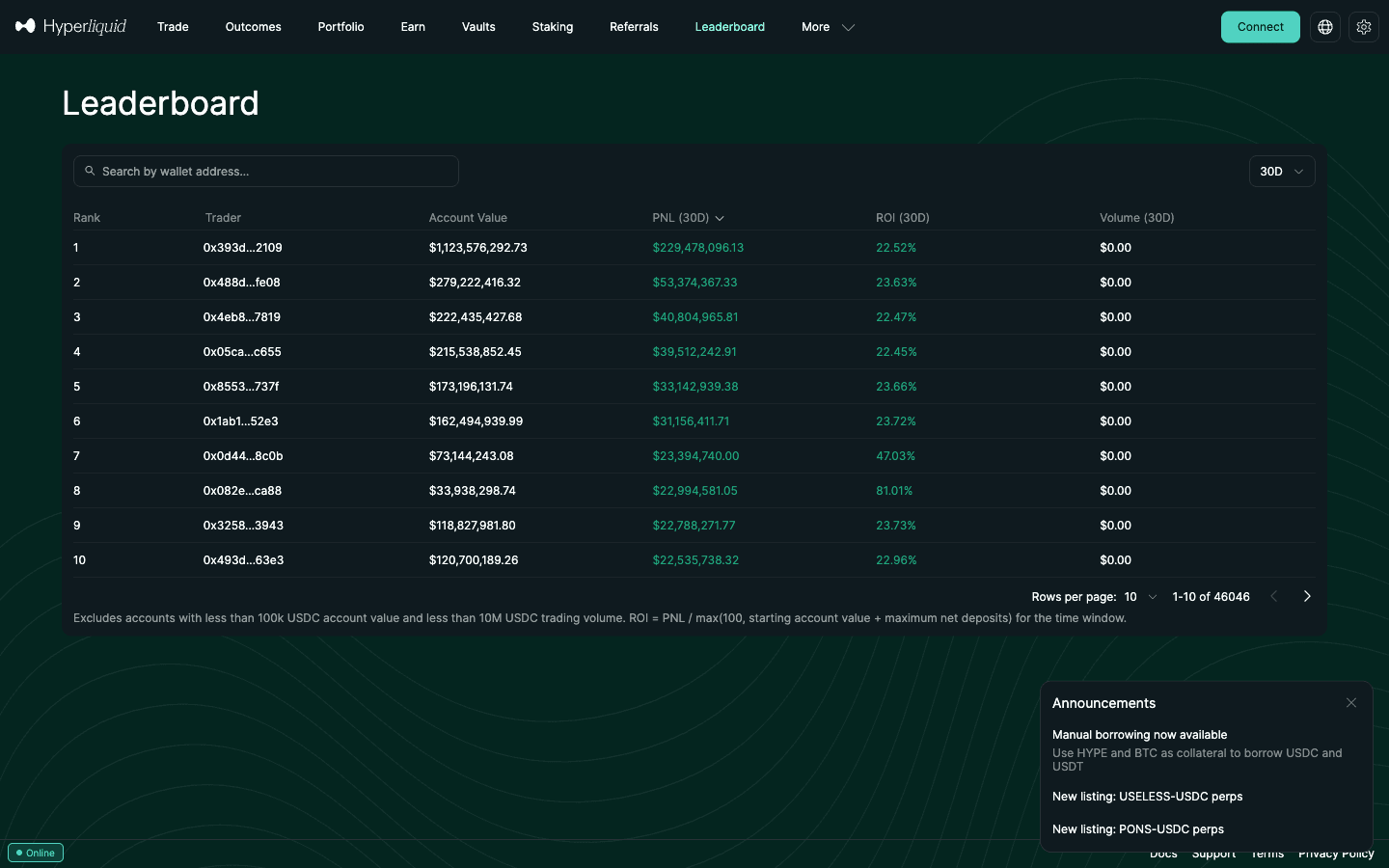
Start at app.hyperliquid.xyz/leaderboard. It lists accounts unless they have less than $100,000 of account value and less than $10M of volume (47,443 rows on October 20, 2026), with PnL, ROI and volume per window. ROI is PnL divided by the larger of $100 and starting value plus maximum net deposits, so fresh deposits do not inflate it. Every column, and today’s top 10 traders with holders removed: how to read the Hyperliquid leaderboard.
Skip rows with $0 volume. On October 20, 2026, 0 of the top 10 accounts by 30-day PnL (and 3 of the top 50) had traded nothing in 30 days. Those are holders whose balance rose with their tokens, not traders you can copy. Sort by ROI or filter on volume before reading names.
Open the address on its vault page or in an explorer: markets traded, leverage, average holding time, open positions right now, and the shape of the account-value curve over months, not weeks.
Prefer boring. A curve that grinds up through at least one sharp market move beats a vertical line. For vaults, prefer age above a year and depositors who have stayed. For wallets, prefer position sizes that will still fill when a crowd copies them.
Reject on leverage and concentration. A leader at 10x across thin altcoins can lose most of the account in one wick; one at 2–5x on BTC and ETH is far harder to wipe out. See the leverage limits by asset.
Correct for survivorship bias. Vaults that blew up are closed and vanish from the list, so the surviving list looks better than the odds you face. Judge a leader on drawdowns survived, not on the best APR shown today.
Remember the leader’s incentives. A vault leader must hold only 5% of the vault but earns 10% of depositors’ profits with no cap, so taking big risks with your money can pay them more than it costs them. A leader with a large share of their own money in the vault is better aligned.
The official leaderboard, 30-day window. Read the volume column first: accounts with zero volume are not trading.
For live whale positions, see our Hyperliquid whale tracker, which is rebuilt from the same public data several times a day.
10. How much should I copy, and when should I stop?
Cap copy trading at a fixed sleeve of your trading money, and never use funds you may need during a vault’s lock-up.
Split across two or three leaders with different styles (BTC/ETH swing, alt momentum, market-neutral) rather than one hot wallet.
Write the exit rule before you deposit: for example, leave when the leader’s drawdown from peak exceeds the worst drawdown they showed when you joined.
Review monthly. A vault whose depositors keep leaving while APR stays flat is being left by people who see something you do not.
Keep your own discretionary trading in the main account and take the fee discounts there: 4% off with HOLYGRAIL, plus 5–40% for staked HYPE (see Hyperliquid fees). Neither applies inside a vault, and the referral discount also skips sub-accounts; it does apply to the orders an app sends from your main account with its builder code, on Hyperliquid’s part of the fee.
11. Can I copy trade on Hyperliquid from my phone?
Hyperliquid has an official Android app and the web app at app.hyperliquid.xyz, which works in a phone browser and includes Vaults; there is no official iOS app yet (Hyperliquid app guide). For copying wallets on a phone, Dexly publishes iOS and Android apps, HyperX has an Android app and an iOS beta on TestFlight, and Perpex is on Google Play; Hyperdash runs in a mobile browser. If you want a native app for your own trading next to your copy setup, Based is a Hyperliquid front-end for iOS and Android that adds a 0.025% builder fee on perps (our code HOLYGRAIL works there; see the Based app review). It is not a copy tool.
12. Which copy trading route should you use?
If you…
Use
Want zero lag and zero maintenance, and accept no control over size or stops
Want to follow a specific leaderboard wallet that has no vault
A copy app with an API wallet and a drawdown pause, after checking its builder fee
Already run code against the API and want full control
Your own bot on the Python SDK
Want a guaranteed return
None of these; no copy model on Hyperliquid promises one
Copy trading on other perp DEXs works differently again. The cross-venue comparison is in the DEX copy trading guide, and hosted automation more broadly in best DEX trading bots.
Start with the account your copy trading will run on
Whichever route you pick, deposits and orders start in a Hyperliquid account. Join with code HOLYGRAIL for 4% off Hyperliquid’s fee on your first $25M of volume in that account, including orders placed through apps with a builder code. Enter it before your first trade or app connection.
Not as a “copy this trader” button. Hyperliquid’s official version is vaults: you deposit USDC, the vault leader trades the pooled balance, and you receive your share of the PnL minus a 10% profit share, with a 1-day lock-up. Copying any other wallet is done by third-party apps and bots, which trade your account through an API wallet that can place orders but cannot withdraw.
How do I copy trade on Hyperliquid?
For a vault: open app.hyperliquid.xyz/vaults, read a vault’s PnL, drawdown, age and depositors, click Deposit, and withdraw after the 1-day lock-up. For any other wallet: join Hyperliquid with a referral code such as HOLYGRAIL, then pick an app (Hyperdash, Dexly, HyperX), connect that same wallet (ideally one that holds only the copy funds and joined with the code as its own main account, so an app’s Stop cannot close your other positions), approve an API wallet with an expiry and the app’s builder fee, choose the trader, set copy ratio, maximum size and a drawdown pause, then monitor and revoke the key when you stop. Order matters: Apps such as Phantom often set their own Hyperliquid referral code on accounts that have none, so enter a code on Hyperliquid before you start using an app.
What is the best Hyperliquid copy trading app?
There is no single best one; choose by custody and by the fee you can see. Hyperdash publishes its copy fee (a 0.05% builder fee), copies or countertrades up to 10 traders per wallet, can run in your own wallet (at least 100 USDC), and its Stop closes every open position in that wallet, not only the copied ones. Dexly has iOS and Android apps and a drawdown pause; HyperX sets ratio, leverage and TP/SL per copy; neither publishes its builder-fee rate. pvp.trade copies inside Telegram from a bot-held wallet and gives the leader 10% of your profit. If you would rather not run an app at all, a vault is Hyperliquid’s official route. Whichever you pick, read the builder-fee approval before signing and connect a wallet that holds only your copy funds and already joined Hyperliquid with a code. We have no affiliate relationship with any of these apps.
Is copying a trader through a Hyperliquid vault safe?
The rules are enforced by the exchange; the trading is not safe. The leader trades the vault but cannot withdraw depositors’ funds, must keep at least 5% of it and takes 10% of profits only, but you share its losses in full and cannot leave during the 1-day lock-up. Only vaults listed at app.hyperliquid.xyz/vaults are official.
Is there a Hyperliquid copy trading bot?
Yes. Hyperdash, Dexly and HyperX run hosted copy bots that watch a leader’s fills and place scaled orders from your account; pvp.trade does it inside Telegram. You can also build one on the official Python SDK by subscribing to the leader’s userFills WebSocket channel. In every case your order lands after the leader’s, usually as a taker.
What does Hyperliquid copy trading cost?
Vaults: 10% of your profits, nothing on losses, nothing for HLP. Apps: Hyperliquid’s taker fee (0.045% at the base tier) plus the app’s builder fee, which the protocol caps at 0.1% on perps. Hyperdash charges 0.05% on copy trades, so one copied taker fill costs 0.095%, or $9.50 per $10,000. If the account the copy runs in was opened with a referral code, it is 0.0932% ($9.32): the referral discount also applies to orders placed through apps with a builder code, but only Hyperliquid’s part of the fee is discounted, not the builder fee. Slippage from filling after the leader often costs more than either fee.
What is the minimum to copy trade on Hyperliquid?
Every Hyperliquid perp order must be worth at least $10, so a copy account must be large enough that your scaled-down version of the leader’s smallest trade still clears $10; otherwise the copy is skipped. Hyperdash asks for at least 100 USDC in a connected wallet. The official depositor docs state no minimum vault deposit.
Can I stop copy trading on Hyperliquid at any time?
In an app, yes: stop or unfollow and no new trades are mirrored. What happens to open copied positions depends on the app: Hyperdash’s Stop closes every open position in the wallet, including any you opened yourself, while other apps can leave positions open for you to close, so copy from a wallet that holds only the copy funds and check it. Revoke or let the API wallet expire afterwards. In a vault, you can withdraw only 1 day after your last deposit (4 days for HLP), and a withdrawal may force the vault to close part of its positions.
Is Hyperliquid copy trading safe?
There are two separate risks. Market risk: you take the leader’s losses in full, through a vault or a bot, and a leveraged leader can be liquidated. Key risk: an app’s API wallet can open any position in the account it is approved for until it expires or you revoke it. Use a separate account for copying, set an expiry (at most 180 days), and revoke keys you no longer use.
Is copy trading legal?
Copying trades is not illegal in itself, but whether you may use Hyperliquid depends on where you live. Its interface terms (§1.6) exclude residents of the United States and Ontario, Canada, and sanctioned jurisdictions, and forbid using a VPN to hide your location. Outside those, you are responsible for local rules and taxes. This is not legal advice.
Is copy trading really profitable?
Usually less than the leader’s record suggests. You pay fees the leader already paid, you fill later and at worse prices, and you exit differently. A self-built bot documented on Reddit found that copies earned about half of the source wallet’s edge, mostly lost on exits. Past vault returns also suffer from survivorship bias: closed and failed vaults disappear from the list. Profitable copying is possible, but the default outcome is worse than the chart you copied.
Which trader is best to copy on Hyperliquid?
There is no single best trader. Filter the official leaderboard for accounts with real 30-day volume, then prefer a long history through at least one market crash, moderate leverage on liquid markets, position sizes your account can mirror, and a style you can follow (not a minute-by-minute scalper). For vaults, prefer age, stable depositors and a leader holding well above the 5% minimum.
Is Hyperliquid copy trading real or a scam?
The mechanics are real: vault rules are enforced by the exchange, and every leader’s fills are public. The scams sit around it: websites calling themselves “Hyperliquid vaults” that are not listed at app.hyperliquid.xyz/vaults, token presales for copy-trading platforms that do not exist yet, and anyone promising a fixed return or asking for your seed phrase. A real copy tool never needs your private key or a withdrawal permission.
Is there a Hyperliquid copy trading app for mobile?
Dexly publishes iOS and Android apps with copy trading, HyperX has an Android app and an iOS beta on TestFlight, and Perpex is an Android app; Hyperdash works in a mobile browser. Hyperliquid itself has an official Android app and the web app, where vaults are available, but no per-trade copy feature. For your own trading on a phone, Based is a native app on Hyperliquid with a 0.025% builder fee.
What does Reddit say about Hyperliquid copy trading?
The r/algotrading thread that ranks for this search is a developer’s 10 lessons from months of running a self-built Hyperliquid copy bot. The main one: entry latency barely mattered; the edge leaked on exits. Close a copied position only when the source wallet is net flat in that coin, avoid tight stop-losses that cut the leader’s winners short (use a wide catastrophe stop), and skip wallets that flip positions every minute. Treat any return figure in a thread as unverified.
Disclosure: HOLYGRAIL is our referral code on Hyperliquid and Based; we earn a share of referred accounts’ trading fees, and it never raises yours. We have no affiliate relationship with Hyperdash, Dexly, HyperX, pvp.trade, Perpex or WunderTrading; their features and fees are quoted from their own sites on September 27, 2026 and can change. Vault, API-wallet, builder-fee and referral rules come from Hyperliquid’s official documentation. Copy trading in any form can lose your full deposit; nothing here is investment advice.