
Hyperliquid's docs are blunt about the purpose: "Testnets are useful for technical testing, but systems can only be hardened through real economic use." The testnet is a full copy of the stack, HyperCore (order books, clearinghouse, vaults, staking) and the HyperEVM, run by the same HyperBFT consensus code as mainnet. Use it to learn the order ticket, to test bots and contracts, and to rehearse spot, HIP-3 or HIP-4 deployments. It is not a realistic simulator of fills and it is not an airdrop farm: the points program's last phase ended in November 2024 and the Hyperliquid airdrop of HYPE landed on November 29, 2024.
How to use the Hyperliquid testnet: step-by-step
The whole setup takes about ten minutes if you already have a funded mainnet account, and about twenty if you do not. The order matters, because step 1 is what unlocks the faucet in step 4.
- Deposit on mainnet with the wallet you will test with. Any amount from the 5 USDC minimum counts. Connect a wallet (the Connect dialog offers Default Wallet, WalletConnect, OKX Wallet and Coinbase Wallet, plus email login) at app.hyperliquid.xyz, click Enable Trading, then Deposit USDC on Arbitrum. Our Hyperliquid bridge guide covers every deposit route, including from a CEX, and how to use Hyperliquid walks through the first mainnet trade.
- Open the testnet app. Go to app.hyperliquid-testnet.xyz and click Connect with the same wallet.
- Enable Trading on testnet. The testnet is a separate deployment, so it asks for a fresh Enable Trading signature (gas-less, moves nothing). This registers your address on the testnet clearinghouse.
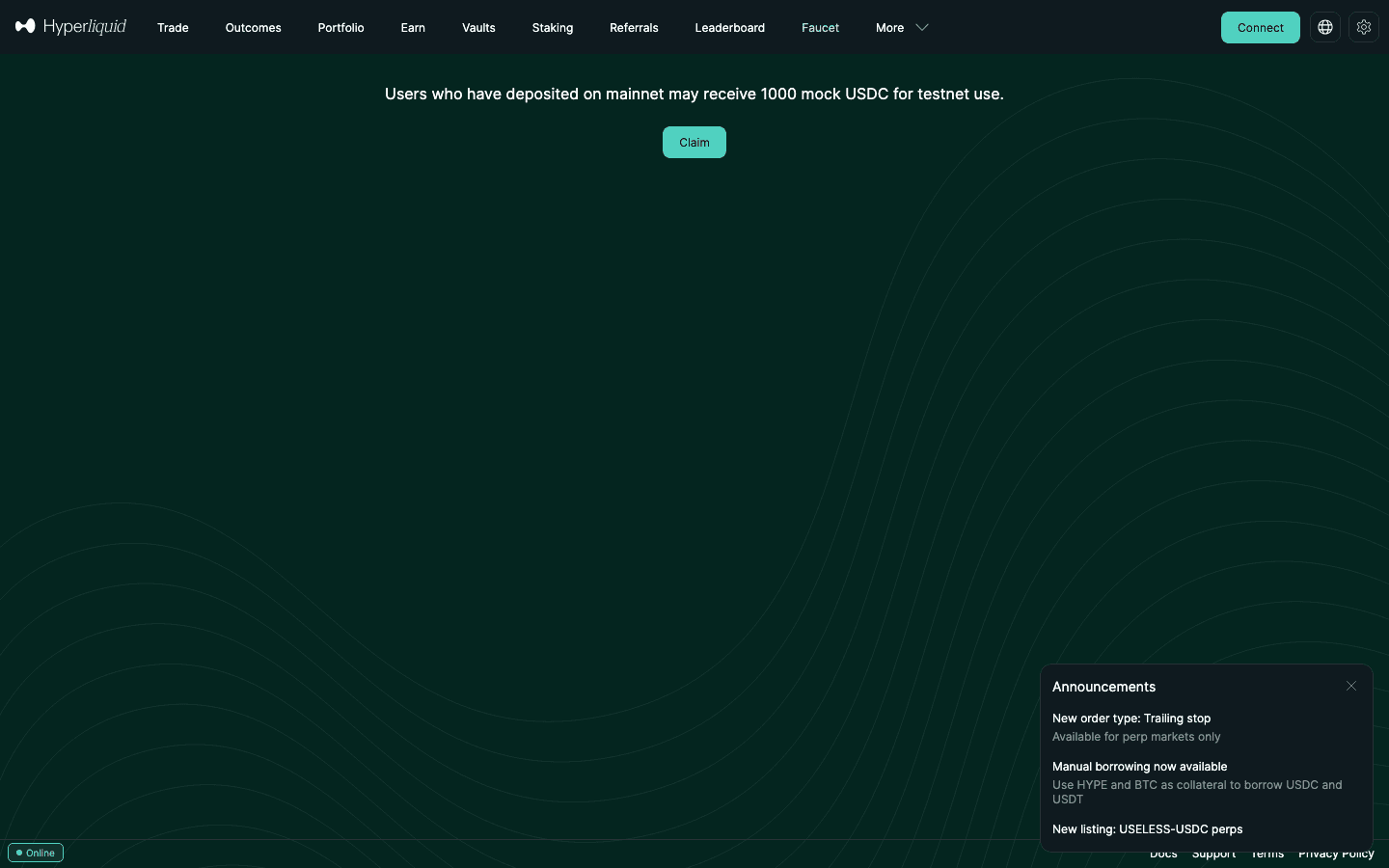
- Claim the faucet. Visit app.hyperliquid-testnet.xyz/drip and press Claim. Because the address deposited on mainnet, the faucet credits 1,000 mock USDC to your testnet Perps balance. The docs mention a single 1,000 USDC amount and no refill schedule, so do not plan on repeated claims.
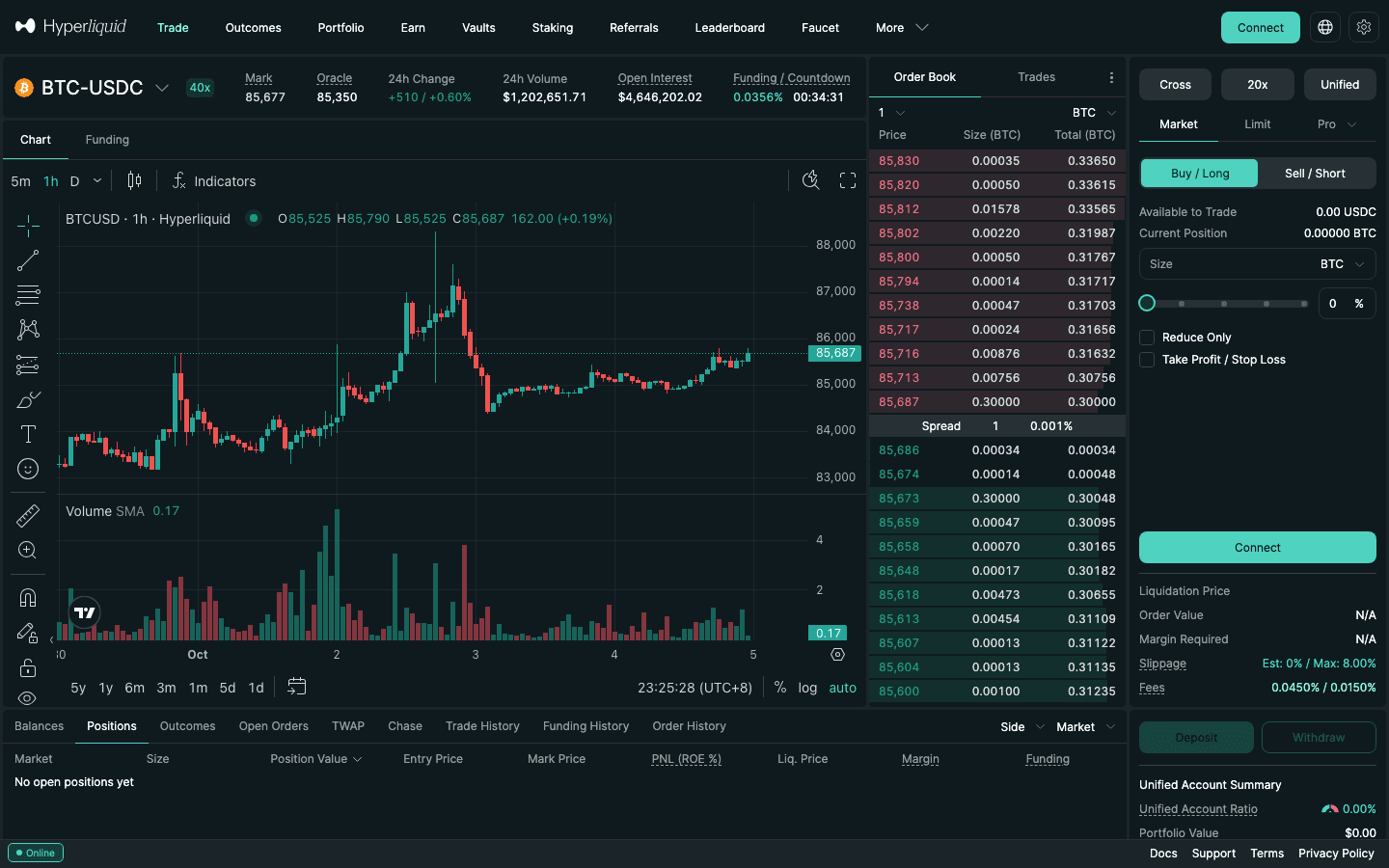
- Place a first order. On the Trade page pick BTC, set 2x isolated, and submit a small limit order below the mark price. Watch it appear under Open Orders, cancel it, then repeat as a market order. You now have a position, a funding accrual and a liquidation price to study.
- Optional: get test HYPE and add the HyperEVM testnet. Either buy a little HYPE with mock USDC on the testnet spot book and use "Transfer to/from EVM", or claim it from a HyperEVM testnet faucet. Network settings are in the links box at the top and in the endpoints table.
Hyperliquid testnet faucet: 1,000 mock USDC (official)
"Hyperliquid faucet" means two different things, and most confusion comes from mixing them up. The official faucet at app.hyperliquid-testnet.xyz/drip gives mock USDC, the money you trade with on HyperCore, and only to addresses that have deposited on mainnet. The HyperEVM faucets give test HYPE, the gas token of chain 998, with no Hyperliquid deposit (next section). If you only want to practise trading, you need the first. If you deploy or call contracts on chain 998, you need the second.
What happens when you press Claim: the page sends your address to the testnet API ({"type":"claimDrip"}) and shows the reply. A green "Drip confirmed." means the 1,000 mock USDC is on its way to your testnet Perps balance. A red message is the refusal, and for an address with no mainnet history it reads "Cannot claim drip because user 0x… does not exist on mainnet." (we triggered it with a fresh, empty address on October 19, 2026).
Want the 1,000 mock USDC? The only way is a mainnet deposit from the same address. Join with code HOLYGRAIL first (4% off fees on your first $25M); the app refuses codes once your account passes $10,000 of volume.
The official rule most guides get wrong
The official faucet page and the docs, re-read on October 19, 2026, say exactly two things: you must have deposited on mainnet with the same address, and such users "may then receive 1,000 mock USDC for testnet use" at app.hyperliquid-testnet.xyz/drip. Three claims that still circulate are wrong against today's docs:
- "You need 0.1 HYPE (or any HYPE balance) on mainnet." The requirement is a deposit history, not a HYPE balance. This outdated line is repeated by some Japanese guides and AI answers.
- "You can claim again every few hours." That is how the third-party HYPE faucets work (Quicknode every 12 hours, Chainstack every 24 hours). The official USDC faucet names one amount and no refill schedule.
- "Any wallet can claim 10,000 USDC on Arbitrum Sepolia." That describes an old setup. Today the faucet is on the Hyperliquid testnet itself and checks your mainnet deposit history.
So a brand-new wallet is refused, and a wallet that deposited once is accepted. A wallet that only ever received a transfer from another Hyperliquid account has made no deposit of its own, so by the docs' wording it should not qualify, although the server's refusal for a fresh address speaks of the user not existing on mainnet; we have not tested that case. The mock USDC lands in your testnet account and can be moved between Perps and Spot, into vaults, into sub-accounts or to the HyperEVM like real USDC.
Email login users: export the wallet first
If you signed up with email, Privy generated different wallet addresses for mainnet and testnet. The testnet address has no deposit history, so the faucet refuses it. The fix from the docs: on mainnet, open the settings dropdown → Export Email Wallet → copy the private key → import it into Rabby or MetaMask → connect that extension wallet to the testnet app. Now the address matches the one that deposited on mainnet. Treat that exported key like any hot-wallet key: it controls your real mainnet funds too.
HyperEVM testnet faucet: test HYPE for gas
Short answer: for HyperEVM testnet gas, use Quicknode's faucet (pick Hyperliquid, then Testnet). It needs no account, no mainnet balance and no Hyperliquid deposit, and allows one claim every 12 hours. Hyperliquid's own HyperEVM tools page lists exactly two test-HYPE faucets, Chainstack and Quicknode, under "Faucet (testnet HYPE for gas)". Test HYPE pays for transactions on chain 998; it never shows up as trading money on the testnet order books.
| HYPE faucet | In the official docs | Amount | Requirement | How often |
|---|---|---|---|---|
| Quicknode | Yes | Base drip shown after you enter an address | None: no account, no mainnet balance. Optional signup 2x, paid plan up to 4x | Once per wallet per network every 12 hours |
| Chainstack | Yes | Up to 1 HYPE (tops the balance up to 1 HYPE) | A Chainstack API key, and 0.08 ETH on Ethereum mainnet with a history of holding ETH | Every 24 hours |
| Thirdweb (chain 998 page) | No (third-party) | 0.01 HYPE | Connect a wallet on the chain page | Per day |
| Testnet spot book (no faucet) | Docs route | Any amount you buy | Mock USDC from the official faucet (needs a mainnet deposit) | Any time |
Docs list (builder-tools/hyperevm-tools) and each faucet's own page re-read on October 19, 2026. Third-party faucets change their drip size and conditions without notice, so check the page before you plan around it.
- Quicknode (faucet.quicknode.com/hyperliquid): connect a wallet or paste an address, choose Hyperliquid and Testnet, pass the bot check. The base amount appears after you enter the address; an optional Hyperliquid signup step gives 2x the drip and paid Quicknode plans up to 4x. One claim every 12 hours, counted per address per network.
- Chainstack (faucet.chainstack.com/hyperliquid-testnet-faucet): up to 1 HYPE every 24 hours; it tops the balance up to 1 HYPE rather than adding 1 on top. You need a free Chainstack API key, and the receiving address must hold 0.08 ETH on Ethereum mainnet and must not have been recently empty. Good for a developer wallet, useless for a fresh one.
- Thirdweb (the chain-998 page): 0.01 HYPE per day after connecting a wallet. Not in Hyperliquid's list. The same page links
testnet.purrsec.comas explorer, which returned HTTP 404 on October 19, 2026. - No faucet at all: with mock USDC from the official faucet, buy a little HYPE on the testnet spot book and use Transfer to/from EVM on the Balances table. That is the same route the docs give for mainnet gas ("buy HYPE on HyperCore and then transfer it to the HyperEVM").
Skip other "Hyperliquid faucet" sites in search results. A faucet only needs your public address; one that asks you to sign a message, approve a token or enter a seed phrase is not a faucet. One unofficial faucet that ranks for "hype testnet faucet" reported itself disabled with a zero balance through its own API when we checked on October 4, 2026, so we do not link it.
Open question we have not tested: whether test HYPE from a third-party faucet, moved from the HyperEVM to HyperCore and sold on the testnet spot book, is a way to get mock USDC without a mainnet deposit. We will not claim it either way until we have done it ourselves, and testnet spot liquidity may be too thin for it anyway.
Faucet not working? 6 fixes
Match what you see to the row. The first four are the official mock-USDC faucet at /drip; 5 and 6 are the HyperEVM (test HYPE) faucets; the messages are the exact strings from the testnet app and its API, read on October 19, 2026.
1 Red message: "Cannot claim drip because user 0x… does not exist on mainnet."
Cause: the address you connected has never been a Hyperliquid mainnet user. Fix: deposit at least 5 USDC on mainnet from that address, then press Claim again. Open mainnet with HOLYGRAIL before the deposit so the 4% fee discount is set while your volume is under $10,000.
2 Same message, but you did deposit
Cause: the testnet app is connected to a different address: an email login (Privy makes a separate testnet address), another account in your wallet, a hardware wallet on a different derivation path, or a watch-only address. Fix: compare the address top-right in both apps; email users export the email wallet (above). Ask the API what the address is (it answers missing, user, agent, vault or subAccount): "agent" means you connected an API wallet, so connect the main wallet instead.
3 The button says "Already claimed mock USDC" but you have no mock USDC
Cause: the app swaps the button to that label as soon as you press Claim, whatever the server answers, so it also appears after a refusal. Fix: reload /drip, press Claim once and read the toast. Mock USDC lands in the Perps balance on the Portfolio page. If it is already there, you have claimed: the docs name one 1,000 USDC amount and no refill.
4 "Something went wrong." or nothing happens
Cause: the request never got an answer, usually because the testnet is restarting after a node upgrade, or your connection or a browser extension blocked it. Fix: check the testnet is up (below), then retry.
5 Quicknode or Chainstack rejects the request
Cause: the cooldown has not passed (Quicknode 12 hours per address per network, Chainstack 24 hours), the wrong network is selected, the bot check failed or the faucet wallet is low. Fix: select Hyperliquid + Testnet, wait out the cooldown or use the other faucet.
6 Chainstack says the address is not eligible, or a smart wallet never receives
Cause: Chainstack wants an API key and 0.08 ETH on Ethereum mainnet with a history of holding ETH; Quicknode notes smart-contract and multisig wallets can fail where a normal address succeeds. Fix: claim to a normal wallet address (EOA), and use Quicknode if the address holds no ETH.
To check an address before you claim (fix 1 and 2), ask the mainnet info endpoint for its role. "missing" means the faucet will refuse it:
curl -s -X POST https://api.hyperliquid.xyz/info \
  -H "Content-Type: application/json" \
  -d '{"type":"userRole","user":"0xYOUR_ADDRESS"}'
"Hyperliquid testnet down?" How to check
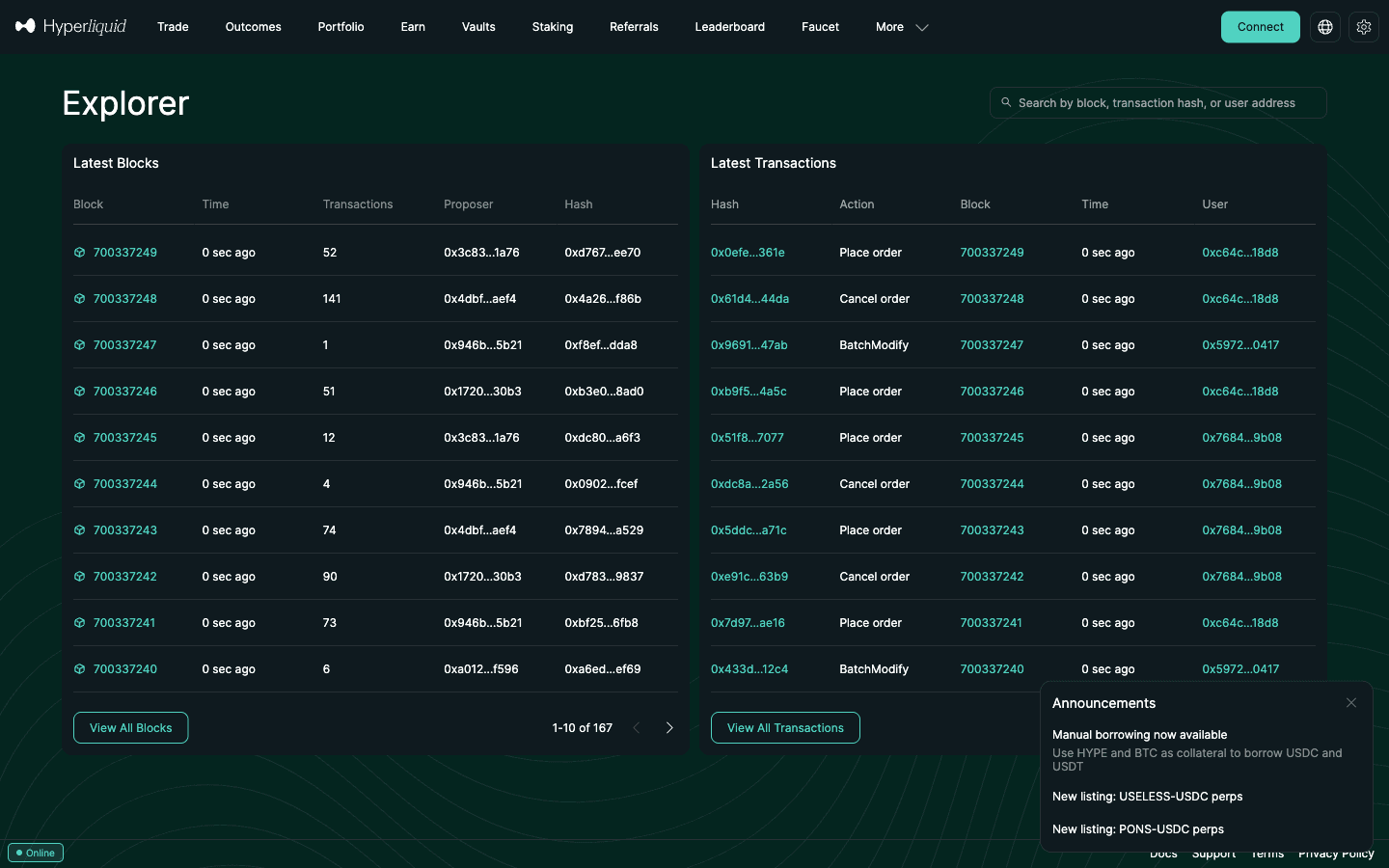
Testnet gets new node versions first, so short outages and restarts happen. Before you blame your code: open app.hyperliquid-testnet.xyz/explorer and check that the latest block is seconds old; query the info endpoint (below) and see whether it answers; call eth_blockNumber on the RPC twice a few seconds apart and check the number moves. If all three are stuck, the testnet is down or restarting; wait rather than re-sending signed actions. If only your bot fails, it is usually a nonce, chain-field or asset-ID problem (see endpoints).
curl -s -X POST https://api.hyperliquid-testnet.xyz/info \
  -H "Content-Type: application/json" \
  -d '{"type":"meta"}'
Returns the testnet perp universe (names, size decimals, max leverage, margin tables). Swap in {"type":"spotMeta"} for the spot token and pair IDs.
Chain ID 998, RPC, API and explorer: testnet vs mainnet
| Item | Testnet | Mainnet |
|---|---|---|
| Web app | app.hyperliquid-testnet.xyz | app.hyperliquid.xyz |
| Faucet | app.hyperliquid-testnet.xyz/drip | — |
| Explorer (HyperCore) | app.hyperliquid-testnet.xyz/explorer | app.hyperliquid.xyz/explorer |
| REST API | https://api.hyperliquid-testnet.xyz | https://api.hyperliquid.xyz |
| WebSocket | wss://api.hyperliquid-testnet.xyz/ws | wss://api.hyperliquid.xyz/ws |
| Signed-action chain field | "hyperliquidChain": "Testnet" | "hyperliquidChain": "Mainnet" |
| HyperEVM chain ID | 998 (0x3e6) | 999 (0x3e7) |
| HyperEVM JSON-RPC | https://rpc.hyperliquid-testnet.xyz/evm | https://rpc.hyperliquid.xyz/evm |
| HYPE spot ID (order asset = 10000 + ID) | 1035 | 107 |
| Node binaries | binaries.hyperliquid-testnet.xyz/Testnet/hl-visor | binaries.hyperliquid.xyz/Mainnet/hl-visor |
Adding the HyperEVM testnet (chain 998) to MetaMask or Rabby
The HyperEVM testnet is a normal EVM chain, so any wallet extension can talk to it. Add a custom network with: network name Hyperliquid Testnet, chain ID 998, RPC URL https://rpc.hyperliquid-testnet.xyz/evm, currency symbol HYPE. Chainlist (chain 998) also has an entry ("Hyperliquid EVM Testnet"); on October 19, 2026 it listed five RPCs, the official one among them, and flagged chain ID 998 as reused by another project, so check that the network name says Hyperliquid before you approve. We queried the official RPC again on October 19, 2026: eth_chainId returned 0x3e6 and the chain was at block 67.3 million. The docs note that the official mainnet RPC (rpc.hyperliquid.xyz/evm) has no WebSocket JSON-RPC support; if you need subscriptions, third-party RPCs (Thirdweb's https://998.rpc.thirdweb.com, Quicknode, Chainstack) may.
Gas on the HyperEVM testnet is paid in test HYPE. Get it from a faucet above, or buy HYPE with mock USDC on the testnet spot book and use Transfer to/from EVM on the Balances table (or send HYPE to the system address 0x2222222222222222222222222222222222222222, which works for HYPE only; other tokens sent there are lost).
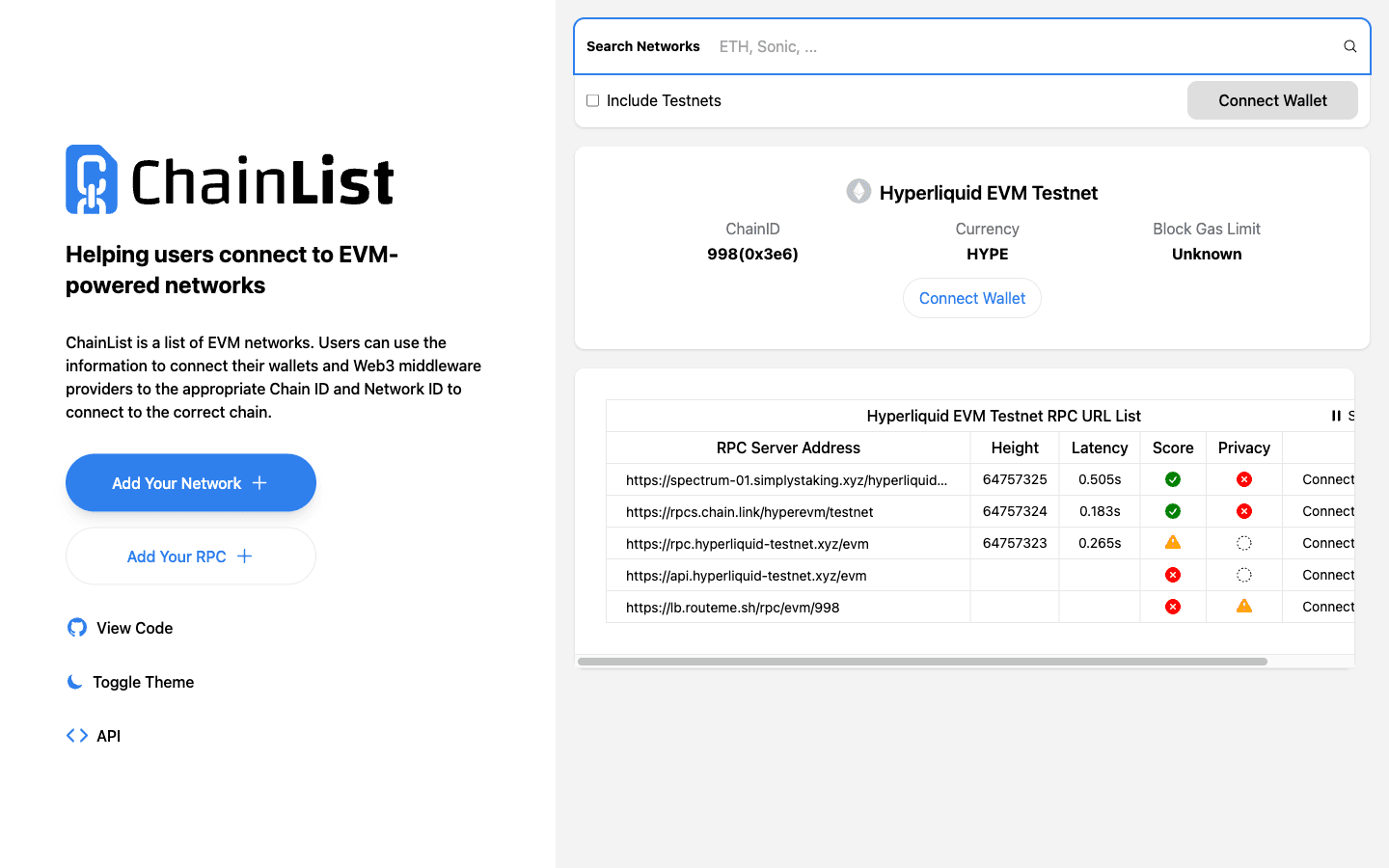
HyperEVM testnet explorer ("testnet scan")
For trading activity use the official HyperCore explorer at app.hyperliquid-testnet.xyz/explorer (how to read it: Hyperliquid explorer guide, testnet section). For EVM transactions on chain 998 there is currently no working explorer we can recommend: the official HyperEVM tools page lists only mainnet explorers (Blockscout/Hyperscan, HyperEVMScan, Owlscan), and testnet.purrsec.com, which Thirdweb and older tutorials still link, returned HTTP 404 on October 19, 2026. Until that changes, confirm a transaction with eth_getTransactionReceipt against the RPC, or with Foundry's cast receipt.
Deploying contracts: big blocks
The HyperEVM splits throughput into small blocks every 1 second (3M gas limit) and big blocks every 1 minute (30M gas limit). A contract that does not fit in a small block will fail until you switch your address to big blocks with the HyperCore action {"type": "evmUserModify", "usingBigBlocks": true}, and optionally estimate gas with the bigBlockGasPrice RPC method. The flag is per user, so switch it back afterwards. Like any HyperCore action it needs an existing Core user, which an address becomes by receiving a Core asset such as USDC. Some older tutorials quote a 2M small-block limit; the docs now say 3M.
Two details that bite bot developers
First, every signed action (orders, withdrawals, transfers, agent approvals) carries a hyperliquidChain field that must read "Testnet" on testnet; a mainnet-signed payload is rejected, and the SDK constants for the testnet URL set this for you. Second, asset IDs differ: HYPE spot is 1035 on testnet versus 107 on mainnet, and on October 4, 2026 the testnet listed 1,330 spot pairs against 330 on mainnet. Always pull the meta from the environment you are trading against instead of hard-coding IDs. Our Hyperliquid API guide covers signing and rate limits, and its endpoints-by-network table lists every testnet and mainnet host. A HyperEVM error with code 10055 comes from the HyperCore ↔ HyperEVM boundary (nonce errors, insufficient funds, duplicate hashes or underpriced replacements, per the HyperEVM docs).
How the testnet differs from mainnet: leverage, liquidations, liquidity
The docs publish separate testnet margin tiers that are "lower than mainnet, for ease of testing". The notional thresholds are about 5,000 to 15,000 times smaller, so you hit tier step-downs with a 1,000 USDC balance:
| Asset | Testnet max leverage by notional | Mainnet max leverage by notional |
|---|---|---|
| BTC | 40x up to $10k · 25x up to $50k · 10x above | 40x up to $150M · 20x above |
| ETH | 25x up to $20k · 10x up to $50k · 5x above | 25x up to $100M · 15x above |
| DOGE, TIA, SUI, kSHIB, AAVE, TON | 10x up to $20k · 5x above | Where tiered: DOGE, SUI, AAVE 10x up to $20M; kSHIB, TON 10x up to $3M; 5x above |
| ARB, ATOM, AVAX, FARTCOIN, ICP, TAO | 10x up to $10k · 5x above | Where tiered: AVAX, FARTCOIN 10x up to $20M; ARB 10x up to $3M; 5x above. Others use a single fixed max leverage |
And a snapshot of the two environments when we queried both info APIs on October 4, 2026 (15:23 UTC). Testnet marks mix an oracle price with the thin testnet book: BTC's testnet oracle tracks the real market, so BTC marked close to mainnet; HYPE has a testnet oracle of its own (about $31.5 that day), so HYPE marked about 20% below mainnet, and BTC funding was almost 30 times higher.
| Metric (Oct 4, 2026) | Testnet | Mainnet |
|---|---|---|
| Active perp markets (non-delisted) | 158 | 178 |
| 24h perp notional volume (main perp DEX) | ≈ $2.6 million | ≈ $2.1 billion (a Sunday) |
| BTC 24h volume | ≈ $1.2 million | ≈ $650 million |
| BTC mark price | $85,719 | $85,435 |
| HYPE mark price | $72.24 | $90.05 |
| BTC hourly funding | 0.0353% | 0.00125% |
| Spot pairs listed | 1,330 | 330 |
| Where the liquidity comes from | Other testers and test market makers | Real market makers, HLP, users |
| What a fill is worth | Nothing | Real money |
- Liquidations: partial liquidation (20% chunks, then a 30-second cooldown) applies to positions above 10,000 USDC on testnet versus 100,000 USDC on mainnet, so you can watch the mechanism with a modest position.
- Liquidity: the book is whatever other testers and test market makers post. On October 4, 2026 testnet BTC did about $1.2M of 24-hour notional versus about $650M on mainnet, and the visible testnet book held about 0.3 BTC on each side. Slippage, spread and funding on testnet say nothing about mainnet.
- Resets and downtime: new node versions ship to testnet first, so expect occasional restarts and behaviour that differs from mainnet for a few days.
Testnet vs mainnet: what carries over
Short answer: only your address. Balances, volume, points and referral settings on testnet stay on testnet; the one real thing in the whole setup is the mainnet deposit that unlocks the faucet.
| Item | Carries over to mainnet? | Why (source) |
|---|---|---|
| Your wallet address | Yes | The same key controls the same 0x address on both networks. Exception: email logins, where Privy creates a different testnet address (export the email wallet). |
| Mock USDC, test HYPE, positions, vault shares | No | Testnet-only balances. The docs call the faucet money "mock USDC for testnet use"; nothing bridges to mainnet. |
| Points or airdrop credit | No | The official points page lists only past periods (closed alpha to October 31, 2023; season one November 1, 2023 to May 1, 2024; L1 phase May 29 to November 2024). No program counts testnet activity. |
| Trading volume → fee tier | No | Fee tiers come from your rolling 14-day mainnet volume (fees page). Testnet volume does not count, and testnet HYPE staking gives no mainnet staking discount. |
| Referral code and referral volume | No | The code that cuts your mainnet fees is set on mainnet (HOLYGRAIL: 4% off your first $25M). The testnet app has its own Referrals page, but nothing entered there reaches mainnet. |
| API (agent) wallets and nonces | No | Every approval is a signed action that names hyperliquidChain "Testnet" or "Mainnet", so an agent approved on testnet must be approved again on mainnet. |
| Your mainnet deposit | Stays on mainnet | It is real money in your mainnet account, tradable or withdrawable, and it is what unlocks the 1,000 mock USDC. |
Sources re-read on October 19, 2026: Hyperliquid docs points page, trading fees page ("Fees are based on your rolling 14 day volume"), testnet faucet page and API signing docs. More on the past points seasons and the November 29, 2024 HYPE distribution in the Hyperliquid airdrop guide; the fee tiers themselves are in Hyperliquid fees explained.
Testnet → mainnet checklist
Everything that works on testnet has a mainnet twin with different numbers. Tick these off before the first real order:
- Referral code before the first trade or app. Open mainnet through app.hyperliquid.xyz/join/HOLYGRAIL with the wallet you will trade from. The Hyperliquid referral code guide explains why the order matters: codes are refused after $10,000 of volume, and apps such as Phantom often set their own Hyperliquid referral code on accounts that have none.
- The right wallet. If you exported an email-wallet key to use testnet, that key now sits in a browser extension and controls real funds. Consider a fresh wallet for size.
- Deposit route and minimum. USDC on Arbitrum, at least 5 USDC; the deposit guide covers exchange withdrawals, Unit (BTC, ETH, SOL) and email logins.
- Endpoints and chain fields (bots).
api.hyperliquid.xyz,"hyperliquidChain": "Mainnet", HyperEVM chain 999. Re-read asset IDs frommetaandspotMeta: HYPE spot is 107 on mainnet, not 1035. The side-by-side table is in the Hyperliquid API guide (testnet vs mainnet endpoints). - Leverage and liquidation numbers. Mainnet BTC allows 40x up to $150M notional (testnet: 40x only up to $10k), and partial liquidation starts at 100,000 USDC instead of 10,000. Re-check your size and liquidation price; our liquidation price calculator does the maths.
- Prices and funding. Testnet marks and funding are their own (see the October 4 snapshot in the differences section). Do not carry a testnet funding or PnL result over to mainnet.
- Fees. Base tier 0.045% taker / 0.015% maker; with HOLYGRAIL, 4% off on your first $25M of volume. A USDC withdrawal to Arbitrum costs 0.2 USDC plus a tiny HyperEVM gas fee in HYPE. The Hyperliquid fees guide has every tier.
- Verify the first real order. Start at 1–3x with size you would not miss, then find the fill under your address in the Hyperliquid explorer.
Ready to leave the testnet?
Open Hyperliquid mainnet with code HOLYGRAIL: 4% off fees on your first $25M of volume. The same deposit unlocks the testnet USDC faucet if you have not claimed it yet.
More for traders and developers
Background and deeper material, collapsed so the answers above stay short. Tap a heading to open it.
New on the Hyperliquid testnet (October 2026)
Much of the news that mentions the testnet is about features being trialled there before, or alongside, mainnet. What the official docs said when we read them on October 4, 2026:
- HIP-4 outcome markets (prediction markets). Outcomes are fully collateralised Yes/No contracts that settle within a fixed range, with no leverage or liquidations; Yes and No share one merged order book. Outcomes already trade on mainnet: the public
outcomeMetaendpoint listed 233 outcomes in 20 questions on September 26, 2026. The HIP-4 page still says fees are zero "for initial testing", but the fees page describes outcome fees charged when a position is closed or settled (not when it is opened), so check the fee line in the order ticket. The permissionless side is what the docs still label testnet-only: the HIP-4 deployer actions that let a staked deployer create its own markets from validator-approved templates. The same mainnet endpoint already listed three deployer venues (out, txyz, skew) on September 26, 2026, so the rollout is under way; if you want to launch a market, rehearse it on testnet first. - HIP-3 cross margin. Builder-deployed perp DEXs (HIP-3) can enable cross margin per asset. The docs warn that enabling it is irreversible and that mainnet validators only allow it on assets with enough liquidity and a reliable oracle. The docs also describe HIP-3* venues (allow-lists and proxied user actions), labelled testnet-only.
- What the testnet app itself announces. Opening app.hyperliquid-testnet.xyz on October 19, 2026 still showed three announcements: a trailing stop order type (perps only; live on mainnet since September 21, 2026, see our trailing stop tutorial), "Manual borrowing now available" and a USELESS-USDC perp listing. The top menu also has an Outcomes tab (HIP-4) and a Faucet link.
- HyperCore manual borrows (lending). Press reports on August 26, 2026 said Hyperliquid rolled out manual lending on testnet first. The official FAQ documents it: supply HYPE (LTV 65%) or BTC (LTV 50%) as collateral and borrow USDC or USDT, with interest indexed hourly. Test the health-factor and liquidation behaviour on testnet before you borrow real money.
Feature sets on testnet change often, so treat this list as dated. The Hyperliquid app guide covers what is live for traders on mainnet today.
Bot checklist: what the testnet can and cannot validate
If you are moving an API bot to mainnet, this is the split we use. Anything in the "No" rows has to be measured on mainnet with tiny size.
| Check | Testnet proves it? | Note |
|---|---|---|
| Signing, agent (API) wallets, nonces | Yes | Same EIP-712 flow; only the chain field and URL change |
| Order placement, cancels, modify, TP/SL, TWAP | Yes | Every order type exists on testnet |
| WebSocket subscriptions, reconnects, state recovery | Yes | Kill the socket on purpose and check your bot rebuilds its state |
| Rate-limit handling | Mostly | Same documented limits; your own traffic pattern matters more than the environment |
| Liquidation handling and margin logic | Yes, faster | Lower tiers and a 10,000 USDC partial-liquidation threshold make it easy to trigger |
| HyperEVM contracts, CoreWriter, precompiles | Yes | Chain 998; use big blocks for large deployments |
| Fill quality, slippage, spread, queue position | No | Testnet books are thin and made by other testers |
| Funding PnL and strategy profitability | No | Testnet prices and funding do not track mainnet closely enough |
| Latency to mainnet validators | No | Different network and node set; measure on mainnet with tiny size |
| Hard-coded asset IDs | No — they differ | HYPE spot is 1035 on testnet vs 107 on mainnet; always read the meta |
The wiring (agent wallets, nonces, WebSocket subscriptions, rate limits) is in the Hyperliquid API trading bot guide; keep your main wallet's key off the server with an agent wallet as described in API key security.
A practice routine that transfers to mainnet
With 1,000 mock USDC and lower leverage caps, spend the balance on process, not PnL. Each step below maps to a mainnet skill:
- Order ticket, all types. Market, limit, post-only (ALO), IOC, stop-market, stop-limit, TP/SL attached to a position, TWAP ($100 minimum total size, duration from 5 minutes to 7 days). Cancel each. Our order types guide lists what every field means.
- Cross vs isolated. Open one position in each mode; add margin to the isolated one; watch the liquidation price update. Then read cross vs isolated margin to confirm what you saw.
- Get liquidated on purpose. A small high-leverage position on testnet BTC (40x up to $10k notional) will be liquidated on a normal intraday move. Watch the mark price, the liquidation price and what remains afterwards, then read the fill in the testnet explorer.
- Transfers and withdrawals. Move USDC Spot ↔ Perps, create a sub-account, transfer to it, then submit a testnet withdrawal (the same
withdrawflow, signed with chain "Testnet"). On mainnet a USDC withdrawal to Arbitrum costs a flat 0.2 USDC fee plus a tiny HyperEVM gas fee in HYPE; on testnet nothing real moves. - Vaults. Deposit into a testnet vault and note the lock-up. On mainnet it is 4 days for HLP and 1 day for user vaults (see the vaults guide).
- HyperEVM. Move HYPE to the EVM, send it back through
0x2222…2222, and if you build, deploy a contract against chain 998 before touching 999. - Bots. Run the SDK against
api.hyperliquid-testnet.xyz: authenticate an agent wallet, place and cancel, handle a partial fill, force a WebSocket disconnect and verify state recovery (see the bot checklist above).
When each step is boring, you are ready: deposit on mainnet with a referral code while your account is still under $10,000 of volume (HOLYGRAIL gives 4% off fees on your first $25M), and start at 1–3x with size you would not miss. Base-tier fees are 0.045% taker and 0.015% maker.
Running a Hyperliquid testnet node
If you are here from a "testnet node" search: there are no node-runner rewards, and the testnet has no incentivised phase (nodes.guru lists it as ended). Running a non-validating node is purely for data access and infrastructure testing. Per the official hyperliquid-dex/node README (September 20, 2026), a non-validator needs 16 vCPUs, 128 GB RAM and a 500 GB SSD on Ubuntu 24.04, with ports 4001 and 4002 open to the public and Tokyo as the lowest-latency region. You write a one-line ~/visor.json setting the chain to Testnet, download hl-visor from binaries.hyperliquid-testnet.xyz/Testnet/hl-visor, verify the GPG signature, and run run-non-validator. Expect roughly 100 GB of logs per day at default settings. Validator specs are 32 vCPUs, 128 GB RAM and 1 TB SSD.
Paper trading options: Hyperliquid testnet, TradingView and other DEX testnets
"Paper trading" means practising with simulated money. For a Hyperliquid trader there are three honest options, and each teaches a different thing: the Hyperliquid testnet teaches the real order ticket, TradingView Paper Trading teaches chart-based entries and exits, and tiny live size teaches real fills. Other DEXs run their own testnets too. Checked against the official pages on September 25, 2026:
| Option | Public testnet / simulator | Test funds | Notes |
|---|---|---|---|
| Hyperliquid | Yes: app.hyperliquid-testnet.xyz | 1,000 mock USDC; requires a mainnet deposit from the same address | Full perps + spot + API + HyperEVM (chain 998); lower leverage tiers; testnet-only experimental features |
| Aster | Yes: asterdex-testnet.com (BNB Chain Testnet) | 1,000 USDT + 1,000 ASTER per day from the faucet page | No deposits, withdrawals or internal transfers on testnet |
| Lighter | Yes: testnet.app.lighter.xyz (chain ID 300) | None described in the docs | API testnet.zklighter.elliot.ai/api/v1; the API docs tell you to switch BASE_URL |
| TradingView Paper Trading | Not a testnet: a simulator inside Supercharts | Simulated balance, no deposit | Free; not connected to any DEX, so no DEX order book, funding or margin tiers |
TradingView Paper Trading: chart practice, not DEX practice
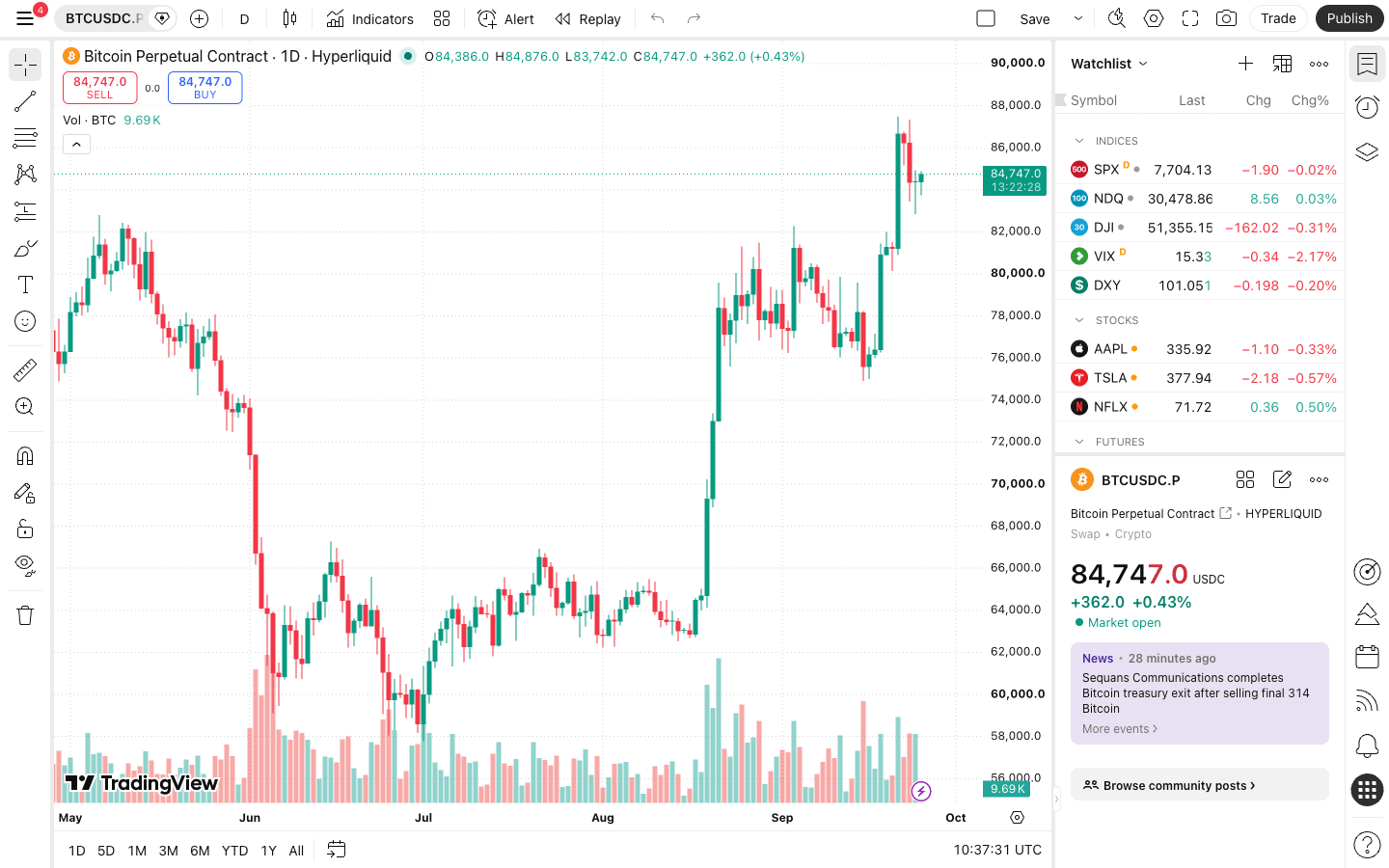
TradingView's help centre describes Paper Trading as a demo account with "no deposits and no real money involved", available to all users. Open Supercharts, click Trade, choose Paper Trading and click Connect; you can then trade from the order ticket (market, limit or stop, with stop loss and take profit), from the depth-of-market window, or by dragging orders on the chart. Two limits matter: Hyperliquid perp charts exist there (for example HYPERLIQUID:BTCUSDC.P), but Hyperliquid is not a TradingView broker, so no order placed in TradingView reaches Hyperliquid; and the simulator knows nothing about Hyperliquid's hourly funding, fee tiers, margin tiers or depth. Drill the when of a trade there and the how on testnet. Our Hyperliquid × TradingView guide covers charts and webhook alerts.
Aster and Lighter testnets
Aster documents a testnet at www.asterdex-testnet.com on BNB Chain Testnet, whose faucet page lets each user claim 1,000 test USDT and 1,000 test ASTER once per day, with no mainnet-deposit requirement in the docs. It does not support deposits, withdrawals or internal transfers yet. For mainnet, the Aster referral code is DTLpLc; see our Aster beginner tutorial.
Lighter documents a developer testnet for its zk app-chain (chain IDs 304 mainnet, 300 testnet; REST https://testnet.zklighter.elliot.ai/api/v1/; app testnet.app.lighter.xyz) but no faucet, so treat it as a place to exercise the SDK. For hands-on practice, small size on Lighter mainnet is the cheaper classroom: the default Standard account charges 0% maker and 0% taker on perps (advanced orders such as TWAP carry a small fee), so a tiny round trip costs only the spread and you learn real fills. Join with code 718610TD (Lighter sign-up guide).
How to get the most out of paper trading
- Fix the account size. Treat the 1,000 mock USDC as your whole account and track percentage returns, not dollars.
- Log every trade: entry reason, exit reason, PnL, the fee you would have paid on mainnet (0.045% taker / 0.015% maker at the base tier) and how you felt. Our trading psychology and journal guide has a template.
- One strategy at a time for 50–100 trades before switching, so the results mean something.
- Rehearse the worst case: a wick through your stop, a WebSocket disconnect while a bot has open orders, a liquidation. Testnet is the only place where that costs nothing.
- Graduate in steps: testnet mechanics → TradingView setups → tiny live positions at 1–3x → normal size. Our risk management guide covers sizing.
The psychological gap. Fake money does not produce real fear or greed, and no simulator fixes that. What paper trading does fix is mechanical error: the wrong order type, a stop on the wrong side, forgetting Reduce Only, misreading leverage. Once those actions are automatic, tiny live size is where the emotional training happens.
Decision: testnet or small size on mainnet?
| You want to… | Use | Why |
|---|---|---|
| Learn the order ticket, margin modes, TP/SL | Testnet | Free, identical UI, and lower leverage tiers make liquidations easy to trigger |
| Validate a bot's signing, order flow, reconnects | Testnet | Same API shape; a bug costs nothing. Then re-run on mainnet with tiny size |
| Deploy a spot token, HIP-3 market, HIP-4 outcome or EVM contract | Testnet first, always | The docs tell spot deployers to rehearse "the exact deployment on testnet first"; mainnet deployment gas is not refundable |
| Judge slippage, spread, funding or fill quality | Mainnet, small size | Testnet liquidity is a tiny fraction of mainnet and tells you nothing |
| Practise risk discipline with real stakes | Mainnet, 1–3x, tiny size | Losing $5 teaches what losing $0 never will |
| Earn points or an airdrop | Neither | No program exists as of October 2026 |
Limits and gotchas
- One 1,000 USDC amount is all the docs mention, with no refill schedule; do not plan on unlimited refills.
- No real bridge. The testnet bridge contract is separate; never send real USDC to a testnet address or to chain 998.
- Test HYPE is not USDC. Third-party faucets fund HyperEVM gas; they do not top up your trading balance.
- Key hygiene. An exported email-wallet key controls your mainnet funds too. Store it properly or move mainnet funds to a fresh wallet afterwards.
- Pre-EIP-155 wallets. The HyperEVM docs warn against using wallets that have previously sent pre-EIP-155 transactions.
- No KYC, but not no rules. The interface terms exclude the US, Ontario and sanctioned regions; see our no-KYC trading guide for what that does and does not mean.
Hyperliquid testnet FAQ
Does Hyperliquid have a testnet?
Yes. The Hyperliquid testnet runs at app.hyperliquid-testnet.xyz: a full copy of Hyperliquid (HyperCore order books plus the HyperEVM, chain ID 998) with valueless funds. There is no sign-up form or whitelist: deposit on mainnet once, connect the same wallet to the testnet app, sign Enable Trading, then claim 1,000 mock USDC at app.hyperliquid-testnet.xyz/drip.
Is the Hyperliquid testnet free?
Yes. Testnet trading and gas cost nothing real. The only real-money step is the one-time mainnet deposit (minimum 5 USDC) that unlocks the mock-USDC faucet, and that deposit stays yours on mainnet: you can trade with it or withdraw it. Test HYPE for HyperEVM gas is free from the Quicknode faucet without any deposit (Chainstack also needs an API key and 0.08 ETH on Ethereum mainnet).
Are Hyperliquid testnet coins worth anything?
No. Mock USDC and test HYPE exist only on the testnet, cannot be bridged to mainnet and have no market value; the "prices" on the testnet order books are set by other testers. Nothing you hold or trade on testnet converts into real tokens, fee tiers or rewards. Treat anyone offering to buy or sell testnet tokens as a scam signal.
Is there a Hyperliquid testnet airdrop?
No. Hyperliquid's points program ran from the closed alpha in 2023 (points up to October 31, 2023), through the first season (November 1, 2023 to May 1, 2024), to the L1 phase (May 29 to November 2024) and the HYPE airdrop happened on November 29, 2024. The official points page, re-read on October 19, 2026, lists only those past periods: there is no active points program on mainnet or testnet. Anyone selling a "testnet airdrop farm" is guessing or scamming.
Why is the Hyperliquid faucet not working?
Read the red message, not the button. "Cannot claim drip because user 0x… does not exist on mainnet." means the connected address has no account on mainnet: deposit with that address (or connect the address that did deposit; email logins must export their wallet first). "Something went wrong." means the request did not get through, so wait and retry. The button switches to "Already claimed mock USDC" as soon as you press Claim, even when the claim was refused. On third-party HYPE faucets the usual causes are the cooldown (Quicknode 12 hours, Chainstack 24 hours), a failed bot check, the wrong network, an empty faucet wallet, or a smart-contract or multisig wallet.
What does "Cannot claim drip because user does not exist on mainnet" mean?
It is the testnet API's reply to Claim when the address has never been a Hyperliquid mainnet user. Check the address with the info endpoint ({"type":"userRole"} returns missing, user, agent, vault or subAccount): "missing" means you need a mainnet deposit from that address (minimum 5 USDC); "agent" means you connected an API wallet instead of your main wallet.
How much do I need to deposit on mainnet to use the testnet faucet?
The docs set no amount: any deposit from the same address qualifies. Hyperliquid's USDC deposit minimum is 5 USDC (smaller deposits are lost), so deposit at least that. The deposit stays yours on mainnet.
How do I get testnet USDC on Hyperliquid?
Open app.hyperliquid-testnet.xyz/drip with a wallet that has already deposited on Hyperliquid mainnet. The official faucet credits 1,000 mock USDC to that same address. Addresses with no mainnet deposit are refused, so a small real deposit (minimum 5 USDC) is the first step.
Is there a HyperEVM (HYPE) testnet faucet?
Yes, but it is a different faucet from the mock-USDC one. Test HYPE is the gas token of the HyperEVM testnet (chain 998). The official docs list two faucets: Quicknode (faucet.quicknode.com/hyperliquid, pick Testnet; one claim every 12 hours, no account or mainnet balance needed) and Chainstack (up to 1 HYPE every 24 hours, API key and 0.08 ETH on Ethereum mainnet required). Thirdweb's chain page also drips 0.01 HYPE per day. Unofficial faucets that appear in search results are not listed here. None of them gives mock USDC for trading.
What is the Hyperliquid testnet chain ID and RPC URL?
The HyperEVM testnet has chain ID 998 (hex 0x3e6) and the official JSON-RPC endpoint https://rpc.hyperliquid-testnet.xyz/evm, with HYPE as the gas token (18 decimals). Third-party RPCs include Thirdweb's https://998.rpc.thirdweb.com. Mainnet HyperEVM is chain ID 999 at https://rpc.hyperliquid.xyz/evm. The HyperCore trading API is separate: https://api.hyperliquid-testnet.xyz.
Does testnet trading count for points, fee tiers or referrals?
No. Fee tiers use your 14-day mainnet volume, the points program ended in November 2024, and the referral code that discounts your fees is set on mainnet. Testnet activity carries over to nothing; only your mainnet deposit is real.
Does Hyperliquid require KYC?
No. Neither mainnet nor testnet asks for identity verification: a self-custody wallet or an email login is the account. The interface terms do exclude residents of the United States, Ontario (Canada) and sanctioned jurisdictions, and you remain responsible for local rules and taxes.
Can I deposit real USDC to the Hyperliquid testnet?
No. The testnet has its own bridge contract and mock tokens. Never send real USDC or real HYPE to a testnet address or to chain 998; it will not arrive and cannot be recovered. Real funds go to mainnet only.
Is the Hyperliquid testnet the same as mainnet?
Same interface, order types, API structure and fee logic, but not the same numbers. Max leverage tiers are much lower (BTC 40x only up to $10k notional), partial liquidation starts at 10,000 USDC instead of 100,000, asset IDs differ, and volume is a tiny fraction of mainnet. Use it to learn mechanics, not to benchmark slippage.
Can I test my trading bot on the Hyperliquid testnet?
Yes. Point the SDK at https://api.hyperliquid-testnet.xyz (WebSocket wss://api.hyperliquid-testnet.xyz/ws), set hyperliquidChain to "Testnet" in signed actions, and fetch asset IDs from the testnet meta endpoint because they differ from mainnet. Testnet validates code paths; it cannot validate fills, slippage or profitability.
Can I paper trade Hyperliquid on TradingView?
Partly. TradingView carries Hyperliquid perp charts (for example HYPERLIQUID:BTCUSDC.P), but Hyperliquid is not a TradingView broker, so orders cannot be sent to Hyperliquid from TradingView. TradingView Paper Trading is its own free simulator; it does not model Hyperliquid funding, fee tiers or margin tiers. Use the testnet for the Hyperliquid order ticket itself.
Done practising? Trade with 4% lower fees
Open Hyperliquid mainnet with code HOLYGRAIL: 4% off fees on your first $25M in volume, applied automatically. The same deposit also unlocks the testnet faucet.
Disclosure: HOLYGRAIL, 718610TD and DTLpLc are our referral codes; we earn a share of referred accounts' fees. We have no relationship with Quicknode, Chainstack or Thirdweb. Testnet URLs, the faucet rule, chain IDs and the docs' faucet list were re-checked on October 19, 2026; leverage tiers, node specs, third-party faucet terms and market snapshots are dated where they appear.