
Updated October 2026 · Verdicts and every fee, profit share and lock-up below are dated and sourced.
Short answer. The best crypto copy trading platform for most self-custody traders is Hyperliquid: user vaults charge a fixed 10% profit share, lock you in for only 1 day, and show every fill on-chain, and copy apps can mirror any public wallet. Aster vaults let the manager set 0–100% profit share and the lock-up; Lighter public pools have no lock-up. Bybit, Bitget and Binance offer the easiest one-click copying (Binance pays lead traders a 10% profit share), but the exchange holds your money and you must pass KYC. In every model you carry 100% of the losses.
Start with Hyperliquid vaults
Open Hyperliquid with code HOLYGRAIL: 4% off your own trading fees on your first $25M of volume, then browse vaults at app.hyperliquid.xyz/vaults.
We earn a commission when you sign up through our links; it never raises your fees.
1. Best crypto copy trading platforms compared
Six ways to copy a trader in 2026, decentralized options first. The DEX rows come from each protocol’s documentation; the exchange rows from Bybit’s and Binance’s own copy-trading pages, read on September 30, 2026. Bybit and Bitget do not publish one profit-share rate that applies to every lead trader, so we describe those cells rather than guess a number.
| Platform | How you copy | Custody | KYC | Leader’s cut | Lock-up | Minimum | Transparency |
|---|---|---|---|---|---|---|---|
| Hyperliquid vaults | Deposit USDC into a vault a leader trades | Self-custody wallet; funds sit in the on-chain vault | No (wallet) | 10% of profits; nothing on losses | 1 day (HLP 4 days) | None documented for depositors | Every fill, position and PnL public on-chain |
| Hyperliquid copy apps (Hyperdash, Dexly, HyperX…) | App mirrors a chosen wallet through an API wallet you approve | Funds stay in your own account | No (wallet) | App's builder fee per trade (Hyperdash 0.05%; protocol cap 0.1%) | None: stop any time | Hyperdash: 100 USDC in the wallet | Leader wallet public on-chain |
| Aster vaults (AOS3) | Deposit into a manager-run vault | Self-custody wallet; funds in the vault account | No (wallet) | Set by manager, 0–100% of realized profits | Default 1 day; every top-up resets it | 100 USDT / USDF / USD1 / U | Public, Private or Flexible mode |
| Lighter public pools | Deposit into a pool a whitelisted operator trades | Self-custody wallet; funds in the pool | No (wallet) | Operator fee, set per pool, on profits at withdrawal | None | Not documented | Operator trades from a sub-account |
| Bybit / Bitget copy trading | Exchange engine clones a lead trader’s orders | Exchange holds your funds | Yes (identity verification) | Profit share to the lead trader, set on the platform | Depends on the product | Set per product / trader | Exchange-reported ROI, drawdown, Sharpe ratio |
| Binance futures copy trading | Exchange engine copies a lead portfolio | Exchange holds your funds | Yes (identity verification) | 10% profit share to the lead trader | Depends on the product | Set per portfolio | Exchange-reported ROI, 30-day max drawdown, AUM |
Trading costs sit on top of the leader’s cut. Base taker fees on the venues above: Hyperliquid 0.045% (0.0432% with a referral code), Aster 0.04% taker / 0% maker, Lighter 0% on a Standard account, versus Binance USDⓈ-M 0.05%, Bybit 0.055% and Bitget 0.06% at the regular tier. Our DEX vs CEX fee comparison breaks these down. Broker apps such as eToro also sell copy trading (CopyTrader), mostly across stocks with some crypto; they are outside the scope of this crypto-exchange comparison.
2. Which platform should you pick?
- Best overall for self-custody: Hyperliquid vaults. A fixed 10% profit share, a 1 day lock-up, a leader who must keep at least 5% of the vault, and a track record nobody can edit. Start here if you want to copy a trader without handing an exchange your money.
- Best for copying any wallet: Hyperliquid copy apps. If the trader you want does not run a vault, apps such as Hyperdash mirror their public address into your account. Our hyperliquid copy trading guide compares the apps and their fees.
- Most flexible terms: Aster vaults. The manager sets profit share, lock-up, privacy and redemption mode. Good vaults exist, but you must read every setting before depositing.
- Easiest exit: Lighter public pools. No lock-up at all; the trade-off is that only protocol-whitelisted operators can run a pool, so the choice is small.
- Easiest one-click copying: Bybit, Bitget or Binance. Big leaderboards and simple sliders, but custodial, KYC-gated and unavailable in some countries (Bybit, for example, put Japan residents in close-only mode from March 23, 2026, 12:00 JST, which ended copy trading there).
3. How copy trading works (CEX and DEX)
Centralized exchanges sell copy trading as a product: you pick a lead trader, set an amount, and the exchange’s engine opens and closes the same futures positions in your account, scaled to your allocation. The exchange also reports the trader’s statistics. Perpetual DEXs cannot work that way, because every order has to be signed by a key. In practice there are three models, and they carry very different risks:
- Vaults / pools. You deposit collateral into an account the leader trades. You own a share of the vault’s net asset value, so their PnL is your PnL, minus a profit share. This is the native model on Hyperliquid (user vaults), Aster (AOS3 vaults) and Lighter (public pools).
- API mirroring. An app or bot watches a target wallet’s fills and submits proportional orders from your account using an API wallet you approved. Your funds never leave your account, but execution lag and sizing are your problem.
- Manual following. Leaderboards and public vault pages show live positions; you decide what to replicate. Slowest, but you keep full control over size, entry and stop.
Copy trading is not the same as signal groups (someone tells you what to trade and you place the order) or trading bots (you copy an algorithm, not a person). If you are new to decentralized exchanges, start with what a DEX is and our best DEX comparison.
4. How to start copy trading in 4 steps
- Open an account and fund it. Connect a wallet (or sign in with email) at Hyperliquid through our HOLYGRAIL link and deposit USDC; the walkthrough is in how to use Hyperliquid.
- Choose how to copy. A vault (app.hyperliquid.xyz/vaults) if you want the leader to trade pooled money under fixed rules; a copy app if you want a specific wallet mirrored into your own account.
- Vet the trader. Sort by age or TVL, not APR, and check max drawdown, leverage, track-record length and how long other depositors have stayed (section 10).
- Deposit and set your exit rule. Put in only money you can leave for at least the 1 day lock-up, and decide in advance at what drawdown you will withdraw.
5. CEX vs DEX copy trading: pros and cons
DEX vaults and copy apps
- + Self-custody: vault shares or your own account, no exchange balance.
- + No identity verification at the venue.
- + Every fill, position and PnL is public; track records cannot be edited.
- + Leader’s own stake is enforced (5% minimum on Hyperliquid).
- − Lock-ups (Hyperliquid 1 day, Aster 1 day by default and resettable).
- − Mirroring apps fill after the leader and add a builder fee.
- − Smart-contract and protocol risk; no customer support desk.
CEX copy trading (Bybit, Bitget, Binance)
- + One-click setup with sliders for amount, leverage and stop-loss.
- + Large leaderboards and more markets.
- + Customer support and fiat on-ramps.
- − The exchange holds your funds and can freeze or restrict the account.
- − KYC required; the product is withdrawn in some countries.
- − Statistics are reported by the exchange, not verifiable on-chain.
- − Lead-trader profit share on top of fees (10% on Binance).
6. Hyperliquid vaults: the rules that matter to a depositor
Hyperliquid runs two kinds of vaults. Protocol vaults such as HLP, the community market-making and liquidation vault, have no fee and no profit share; they are covered in our HLP guide. User vaults are the copy-trading product: any trader can create one, and depositors ride that trader’s strategy. For apps and bots that copy a wallet instead, see hyperliquid copy trading.
Leader economics
- The leader receives 10% of the vault’s profits. There is no management fee and no fee on losses.
- Creating a vault costs 10,000 USDC (distributed like trading fees) plus a minimum 100 USDC deposit, a real barrier to spam vaults.
- The leader must keep at least 5% of the vault at all times; a withdrawal that would drop them below it is rejected. A leader whose vault loses 50% loses 50% of their own stake too.
- These vaults can only trade validator-operated perpetuals: no spot and no HIP-3 markets. The docs now call HyperCore user vaults the "legacy" product; builders can also deploy vaults on HyperEVM with wider access, so check which type a vault is before assuming these rules apply.
Your share and what you actually receive
The docs give the example: you deposit 100 USDC into a vault holding 900 USDC, so you own 10%. The vault grows to 2,000 USDC with no other flows. Your 10% is 200 USDC; the leader’s 10% profit share on your 100 USDC gain is 10 USDC; you withdraw 190 USDC. If the vault has open positions when you withdraw, some are closed at market, so expect slippage on top.
Lock-up and withdrawal mechanics
- User vaults: 1 day lock-up. HLP: 4 days after your most recent deposit.
- On withdrawal, if the vault has enough free margin, positions are untouched. If not, open orders are cancelled first, then 20% of positions are closed repeatedly until your withdrawal can be paid. Leaders can also opt to always close positions proportionally so liquidation prices stay stable for remaining depositors.
- The vault page at
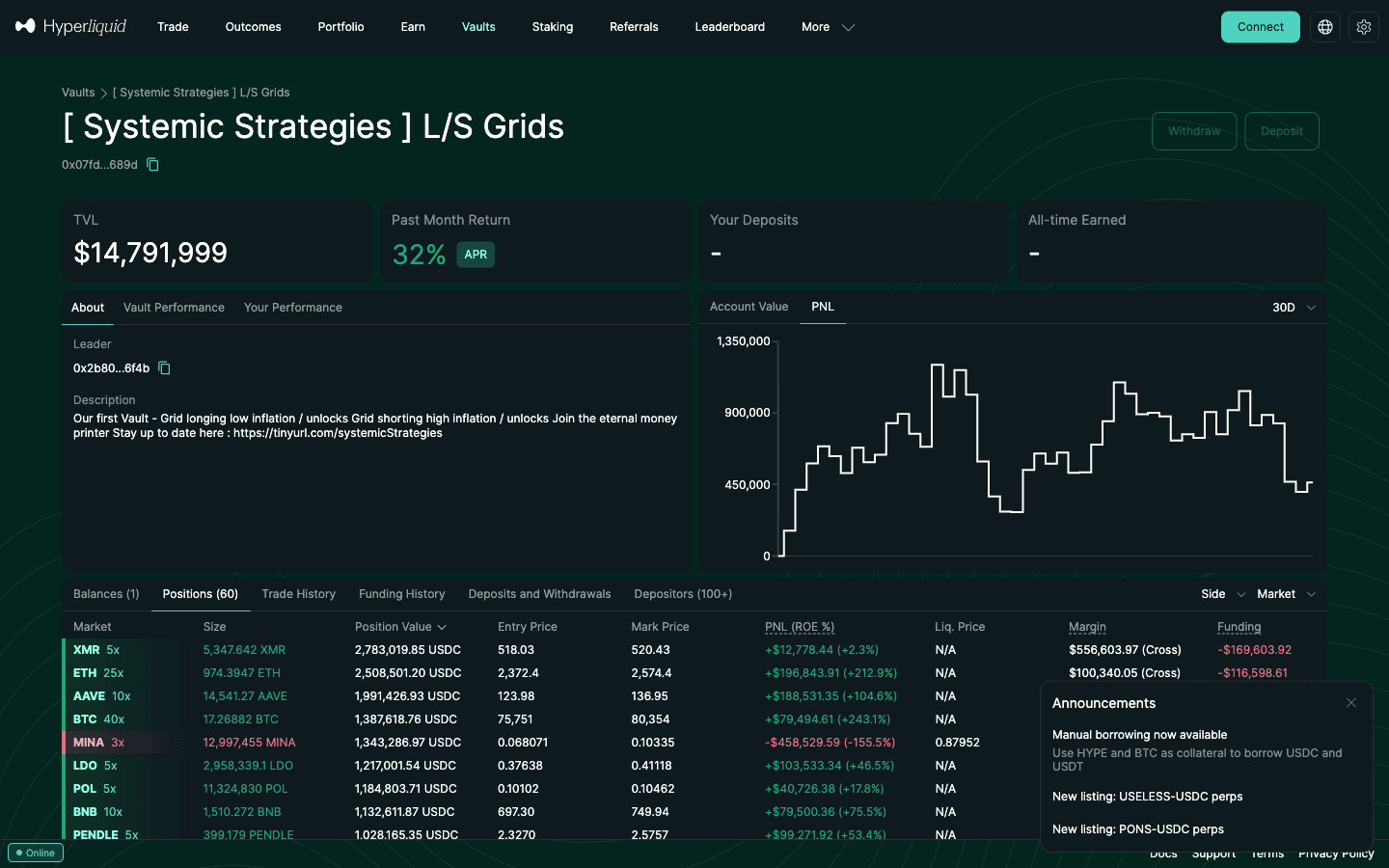
app.hyperliquid.xyz/vaultsshows APR, TVL, PnL, max drawdown, volume, open positions, trade history, and how many depositors there are and for how long. Use all of it before depositing.
One fee detail: the 4% referral discount does not apply to vaults. The vault pays the leader’s own tier rate on every trade (see Hyperliquid fees), and that cost is already inside the PnL you see. A step-by-step deposit walkthrough is in the Hyperliquid vaults guide.
7. Aster vaults (AOS3): more flexible, so read the settings
Aster’s vault standard gives the manager far more knobs than Hyperliquid does, and the core settings are permanent once the vault is created. The manager stakes 100 ASTER and invests at least $100 to create one. Before you deposit, check these five settings on the vault page:
- Profit share: 0–100%. Charged only on realized investor profits: when you redeem with a gain, when the manager runs a Fund Distribution (at most once every 24 hours), or at vault closure. Nothing on losses, nothing on unrealized PnL. A 20% share on a 1,000 USDT deposit that grows to 1,300 means 60 USDT to the manager and 1,240 to you.
- Lock-up: default 1 day, configurable. Critically, every new deposit resets the lock-up for your entire position. Topping up a 7-day-lock vault on day 6 restarts the clock on all of your money.
- Minimum manager ownership: default 10%. If the manager’s share falls below it, new deposits and manager redemptions are disabled until it is restored. The 100 ASTER stake is burned if lifetime PnL is zero or negative at closure.
- Privacy mode: Public, Private or Flexible. In Private mode you cannot see positions, orders or balances; you are trusting the metrics panel alone. Flexible lets the manager switch at any time. Prefer Public vaults unless you know the manager.
- Auto Close on Redeem. ON: your redemption closes a proportional slice of every position at market immediately (fast, but with slippage). OFF: the system uses free margin first, then open orders, then reduces positions only if needed.
Other rules: minimum deposit 100 USDT / USDF / USD1 / U in the single asset the manager chose; vaults trade perpetuals only; vault accounts do not inherit the manager’s VIP tier, cannot bind referral codes and are excluded from points programs. If a vault is liquidated and its balance reaches zero or below, deposits are disabled. Fees inside the vault are Aster’s standard order-book rates: 0% maker, 0.04% taker on USDT perps at VIP 1.
8. Lighter public pools
Lighter’s version is more restrictive on the supply side and more liberal on the demand side. Operators are whitelisted by the protocol, so you cannot spin up a pool yourself, and they trade from a sub-account of their own account. The operator sets an operator fee (a percentage of profits taken when participants withdraw) and a minimum operator share; the docs’ example is 10%, meaning a 10,000 USDC operator deposit caps outside capital at 90,000 USDC. Pools cannot use isolated margin. For depositors the key difference is no lock-up: you receive pool shares and can redeem them at any time. Pool trades pay Lighter’s fee schedule: 0% on a Standard account, 0.028% taker / 0.004% maker on Premium.
9. Wallet mirroring: copying a trader without a vault
If the trader you want to follow does not run a vault, copy apps and bots watch their address (all Hyperliquid fills are public) and replay proportional orders from your account. On Hyperliquid this works through API wallets (also called agent wallets): you approve a separate signing key, with an expiry of up to 180 days, and the app signs orders with it. An account can have 1 unnamed and up to 3 named API wallets. The only agent-signable transfer in the docs requires the destination to be your own address, which limits what a leaked key can do with your funds; it can still open any position it likes, so revoke keys you no longer use. Read the API key security guide before approving anything.
Apps charge through a builder fee added to each order (capped by the protocol at 0.1% on perps). One copied $10,000 taker fill through Hyperdash costs 0.045% + 0.05% = 0.095%, or $9.50; the same order placed yourself costs $4.50, or $4.32 with the referral discount. Telegram bots such as pvp.trade instead pay leaders 10% of followers’ profits. The tools, their fees and setup steps are compared in our Hyperliquid copy trading guide and the Hyperdash guide.
What a vault handles for you, a mirror bot does not:
- Latency and slippage. The leader fills first; your order lands seconds later, usually as a taker, at a worse price. On a scalping leader this alone can turn a profitable book into a losing one.
- Sizing. Scale by your equity divided by the leader’s equity, then cut further. A leader at 20x on a $1M account and you at 20x on $5,000 have the same liquidation distance but very different tolerance for a bad fill.
- Stale signals. If the bot disconnects while the leader flattens, you are left holding full size. Every mirror setup needs an independent stop and a maximum-position cap enforced on your side.
10. How to choose a trader to copy
Exchange leaderboards and vault pages show the same handful of metrics. Binance’s copy-trading page lists 30-day PnL, ROI, AUM, 30-day max drawdown (MDD) and days leading; Bybit’s adds a 30-day Sharpe ratio; Hyperliquid and Aster vault pages show PnL, max drawdown, TVL and depositors. Read them in this order:
- Max drawdown first, ROI second. If you could not sit through that drawdown again on your own deposit, do not copy. A huge ROI with a large drawdown usually means high leverage.
- Risk-adjusted return. Sharpe ratio or return divided by drawdown beats raw ROI. Two traders with the same ROI can carry very different risk.
- Track-record length in months, not days. A 90-day history through at least one sharp market move is a sensible minimum. On the day we checked, several of Binance’s “High ROI” portfolios had only about three weeks of history.
- Leverage and concentration. Open positions are visible on Hyperliquid and on Public-mode Aster vaults. A vault at 10x on thin alts can lose most of its value in one wick; one at 2–3x on BTC/ETH cannot.
- Trade frequency. A leader who trades dozens of times a day is expensive to follow: each fill costs you fees and slippage the leader’s own ROI does not show.
- AUM, depositors and skin in the game. Hyperliquid forces 5%; Aster defaults to 10%; Lighter sets a minimum operator share. A leader with a large share of their own money in the vault behaves differently from one at the floor, and old depositors who have not left are a better signal than new money.
11. Is copy trading profitable?
Sometimes, but a follower almost always earns less than the leader, for four reasons:
- Profit share. If a Hyperliquid vault makes +20% in a month, a depositor keeps about 18% after the 10% share. If it loses 20%, the depositor loses the full 20%.
- Fees and slippage. Mirroring apps fill after the leader and add a builder fee ($9.50 per copied $10,000 taker fill on Hyperdash, versus $4.50 placed yourself).
- Timing. Most people start copying after a hot streak and stop after a drawdown, which locks in the worst part of the curve.
- Survivorship. Leaderboards rank recent ROI. Many high-ROI accounts are short-lived, high-leverage bets that happened to win; the ones that blew up are no longer on the list.
Treat copy trading as delegating risk, not as income. The questions about “$100 or $1,000 a day” that fill search results have no honest answer: nobody can promise daily returns, and anyone who does is selling something (section 13).
12. Copy trading without KYC
Vaults and copy apps on decentralized exchanges need a wallet, not an ID: Hyperliquid, Aster and Lighter never open an account in your name, so there is nothing to verify. That is a consequence of self-custody, not a loophole, and it comes with limits:
- Restricted countries still apply. Hyperliquid’s Terms exclude the US, Ontario (Canada) and sanctioned jurisdictions (plus citizens of sanctioned jurisdictions); Aster and Lighter publish their own lists. Using a VPN to hide your location breaks those terms (Hyperliquid Terms §3.1.5). We do not suggest ways around them.
- Not anonymous. Every deposit, trade and withdrawal is public on-chain and can be linked to the exchange account you funded from.
- Getting USDC usually involves KYC. Fiat on-ramps and centralized exchanges verify identity; only the DEX step does not.
- Taxes still apply to vault profits and copied trades.
More detail, including which venues restrict which countries, is in our no-KYC exchange guide.
13. Scams and wallet approvals
Copy trading attracts fraud because it promises other people’s profits. The common patterns: fake copy-trading websites that ask you to deposit into their address, Telegram or Discord “VIP signal” groups that guarantee daily returns, and fake apps that ask you to sign a token approval or permit that lets them drain your wallet. Rules that avoid all three:
- Never send funds to a person or a website’s address to be “traded for you”. Legitimate vaults are deposited into from inside the exchange’s own app.
- Only use copy tools that trade through an API wallet you approve on the exchange, with an expiry, and never sign a token approval, a transfer or a withdrawal for a copy tool. Never type your seed phrase anywhere.
- Read the builder-fee approval. On Hyperliquid you sign a maximum fee rate for the app; the protocol caps it at 0.1% on perps.
- Revoke API wallets and builder-fee approvals when you stop copying.
14. Risks specific to DEX copy trading
- Full loss participation. Every model here passes losses through 1:1. A vault leader who gets liquidated takes depositors with them.
- Lock-ups in fast markets. 1 day is short, but Aster managers can set longer and any top-up resets it. You may be unable to exit exactly when you most want to.
- Withdrawal slippage. Redeeming from a vault with open positions closes part of them at market. In a thin market that cost is yours.
- Opacity. Aster Private-mode vaults hide positions, orders and balances, so you see only the metrics panel. Check what a vault or pool page actually shows before you deposit; otherwise you are underwriting a track record, not a strategy.
- Exchange and smart-contract risk. Vault funds sit on the exchange like any other balance; the DEX’s own risk (upgrades, outages, bridge issues) applies. Our perpetual risk-management guide covers how to size venue exposure.
- No referral discount and no points. Fee discounts and campaigns attach to your own trading, not to vault deposits, on both Hyperliquid and Aster.
15. A sensible allocation plan
- Treat copy trading as one sleeve of the account with a fixed cap, and never deposit money you would need inside the lock-up window.
- Split across two or three leaders with different styles (BTC/ETH swing vs. alt momentum vs. market-neutral) rather than one hot vault.
- Set an exit rule in advance: for example, withdraw if the drawdown from peak exceeds the max drawdown the vault showed when you deposited.
- Review monthly. Rotate out of vaults whose depositor count is falling while returns are flat: other people are seeing something.
- Keep your own discretionary account separate and use the referral discount there: 4% off with HOLYGRAIL on Hyperliquid.
Open a Hyperliquid account with 4% lower fees
Code HOLYGRAIL takes 4% off your fees on your first $25M of volume. Browse vaults at app.hyperliquid.xyz/vaults once you are in.
Prefer Aster vaults? Join with code DTLpLc for 5% of your Aster Perps trading fees back: asterdex.com. Lighter public pools: code 718610TD gets your first week of Premium fees rebated: app.lighter.xyz.
FAQ
What is copy trading in crypto?
Copy trading means your account automatically follows an experienced trader: their trades are replicated in your account in proportion to the amount you allocate, or you deposit into a vault they trade. On centralized exchanges (Bybit, Bitget, Binance) the exchange runs the copying. On decentralized exchanges it is done with vaults (Hyperliquid, Aster, Lighter) or with apps that mirror a public wallet through an API wallet you approve.
Which crypto exchange is best for copy trading?
It depends on what you want to trust. For self-custody, public track records and no KYC, Hyperliquid is the strongest DEX option: user vaults charge a fixed 10% profit share with a 1 day lock-up, and copy apps can mirror any wallet. Aster vaults let the manager choose the terms; Lighter pools have no lock-up. Bybit, Bitget and Binance offer one-click copying of futures traders, but the exchange holds your money and requires identity verification.
Is copy trading profitable?
It can be, but followers usually do worse than the leader they copy. You pay the leader’s profit share (10% on Hyperliquid vaults, 10% to lead traders on Binance), extra fees, and slippage from filling after the leader, while losses reach you in full. Leaderboards are ranked by recent ROI, which favors lucky, high-leverage accounts. Nothing guarantees a profit.
Is copy trading illegal?
Copy trading itself is a normal product, offered openly by exchanges. What is restricted is who may use a given platform: each venue lists restricted countries in its terms (Hyperliquid, for example, excludes the US, Ontario (Canada) and sanctioned jurisdictions (plus citizens of sanctioned jurisdictions)), and some exchanges have withdrawn copy trading from certain countries. Check the terms for where you live; this is not legal advice.
Can you copy trade without KYC?
Yes, on decentralized exchanges. Hyperliquid, Aster and Lighter vaults and wallet-mirroring apps need a wallet, not an ID. That does not make them anonymous or available everywhere: on-chain activity is public, buying the USDC usually goes through a verified exchange, taxes still apply, and each venue’s restricted-country list still binds you. Using a VPN to get around those lists breaks the terms (Hyperliquid Terms §3.1.5).
Does Hyperliquid have copy trading?
Not as a “copy this trader” button. Hyperliquid offers user vaults: you deposit USDC, the vault leader trades the pooled balance, and you receive your share of the PnL minus a 10% profit share, with a 1 day lock-up (4 days for the protocol vault HLP). Third-party apps such as Hyperdash also mirror any wallet through an API wallet you approve.
Can I lose money copy trading on a DEX?
Yes. Vault depositors share losses in full and in proportion to their stake; the leader takes 10% of the upside on Hyperliquid but carries none of your downside. A leveraged vault can be liquidated. Past APY on the vault page is not a guarantee.
Is there a lock-up on DEX copy trading vaults?
Hyperliquid user vaults: 1 day after your most recent deposit; HLP: 4 days. Aster vaults: 1 day by default, but the manager can set longer, and every new deposit resets the lock-up for your whole position. Lighter public pools have no lock-up. Mirroring apps have none either: you stop copying and close your positions.
Does the referral discount apply to vault deposits?
No. Hyperliquid’s 4% referral discount applies to your own trading account, not to vaults or sub-accounts, and Aster vault accounts cannot bind referral codes either. Inside your own Hyperliquid account it covers the trades you place yourself and, because the referral discount also applies to orders placed through apps with a builder code, the orders a copy app sends from that account too (on Hyperliquid’s part of the fee, not the app’s builder fee).
Disclosure: HOLYGRAIL, DTLpLc and 718610TD are our referral codes; we earn a share of referred accounts’ fees. Vault rules and fees come from the official Hyperliquid, Aster and Lighter documentation; CEX figures from Binance’s and Bybit’s own pages; checked between September 25 and September 30, 2026; the referral discount on builder-coded app orders was checked on mainnet fills on October 1, 2026. Nothing here is investment advice; vault deposits and copied positions can lose their full value.