Best Time to Trade Crypto and Perpetual Futures: Hours, Sessions and Days, Measured (2026)
Short answer. The best time to trade crypto and perpetual futures is 13:00–17:00 UTC on a weekday: 9 a.m.–1 p.m. in New York, 2–6 p.m. in London, 22:00–02:00 in Tokyo. That is the London–New York overlap.
The 14:00 UTC hour averaged $293M of BTC perp volume on Hyperliquid, 5.4x the quietest hour (04:00 UTC, $55M). The worst times are the Asian afternoon (03:00–07:00 UTC) and weekends, when volume falls to about a third. Fees don't change by the hour. Spread, slippage, liquidation risk and funding exposure do. From November 1, 2026 (US winter time) the window moves one hour later in UTC, to 14:00–18:00.
Data: 720 hourly Hyperliquid BTC perp candles, Aug 26 – Sep 25, 2026 (re-checked October 6, 2026).
Trade the London–New York window on the deepest DEX book
Hyperliquid traded $4–8B of perps a day in September 2026. Join with code HOLYGRAIL for −4% on fees on your first $25M of volume, every hour of the day.
How the code works: Hyperliquid referral code. We earn a commission when you sign up through our links; it never raises your fees.
Crypto never closes, but its liquidity has a clock. We pulled 30 days of hourly BTC, ETH, SOL and HYPE perp volume from Hyperliquid's public API and lined it up against the Asian, London and New York sessions, funding times, the CME futures schedule and the US macro calendar.
By BLTZ · Published · Updated · Data: Hyperliquid API, Aug 26 – Sep 25, 2026 (720 hourly candles per coin) · How we verify
Best time to trade crypto: key facts. Hyperliquid BTC perp, Aug 26 – Sep 25, 2026 (US summer time). From November 1, 2026 (US winter time) the best window is 14:00–18:00 UTC: still 9 a.m.–1 p.m. in New York, 23:00–03:00 in Tokyo.
UTC
New York
Tokyo
Measured
Best window
13:00–17:00
9 a.m.–1 p.m.
22:00–02:00
Peak hour 14:00 UTC: $293M per hour; 12:00–17:00 UTC (incl. the 12:30 US data hour) = 38.6% of daily volume
Worst window
03:00–07:00
11 p.m.–3 a.m.
12:00–16:00
Quietest hour 04:00 UTC: $55M per hour; 9.3% of volume in 4 hours
Best day
Tue–Fri (UTC days)
Mon 8 p.m. – Fri 8 p.m.
Tue 09:00 – Sat 09:00
Weekdays $3.35B a day vs weekends $1.16B (34%); Saturday quietest
Interval: 1 hour on Hyperliquid and 1 hour on Lighter; 8 hours on Binance BTCUSDT and 8 hours on Aster BTCUSDT (other Aster pairs vary)
Our calculation from Hyperliquid's public API (candleSnapshot, 1h). New York times are EDT (UTC−4) until November 1, 2026. Weekend detail: weekends, spreads and the Monday open.
Which crypto trading windows are best and worst?
#
Window (UTC)
New York
London
Tokyo
BTC volume per hour (share of day)
Avg 1h range
Verdict
1
12:00–17:00
8 a.m.–1 p.m.
1–6 p.m.
21:00–02:00
7.7% per hour (38.6% in 5 h)
0.79%
Best: deepest books, US data and stock open
2
17:00–21:00
1–5 p.m.
6–10 p.m.
02:00–06:00
4.4% per hour (17.5%)
0.50%
Good; FOMC statements at 18:00
3
08:00–12:00
4–8 a.m.
9 a.m.–1 p.m.
17:00–21:00
3.7% per hour (14.6%)
0.51%
Fair; a bump at 08:00–09:00 as Europe starts
4
21:00–00:00
5–8 p.m.
10 p.m.–1 a.m.
06:00–09:00
2.8% per hour (8.5%)
0.43%
Thin: after the US close
5
00:00–08:00
8 p.m.–4 a.m.
1–9 a.m.
09:00–17:00
2.6% per hour (20.7%); 03:00–07:00 only 2.3%
0.44%
Thinnest, above all 03:00–07:00
–
Saturday and Sunday
all day
about 34% of a weekday
–
Trade small, use limit orders
Our calculation from 720 hourly Hyperliquid BTC-USDC perp candles, August 26 – September 25, 2026. An even spread would be 4.2% of daily volume per hour. Local times are summer time (EDT, BST), which applies until October 25 (UK) and November 1 (US), 2026. For your own city, see section 4.
1. What hour has the most crypto volume?
Most "best time to trade crypto" articles repeat forex session folklore. We measured it instead. The table below comes from Hyperliquid's public candleSnapshot endpoint: 720 complete one-hour BTC-USDC perp candles from August 26, 07:00 UTC to September 25, 07:00 UTC, 2026, with notional volume computed as base volume × average of open and close. Hyperliquid is the largest perp DEX, so its order flow is a fair proxy for on-chain perp activity; BTC alone traded $82.8B in the window, about $2.76B a day. The "range" column is the average high-to-low move inside the hour, a simple volatility gauge. The last column repeats the volume share for ETH.
UTC
New York (EDT)
London (BST)
Tokyo (JST)
BTC avg volume / hour
Share of day
Avg range
ETH share
00:00
8 p.m.
01:00
09:00
$75M
2.7%
0.48%
3.1%
01:00
9 p.m.
02:00
10:00
$92M
3.3%
0.56%
3.5%
02:00
10 p.m.
03:00
11:00
$80M
2.9%
0.53%
2.9%
03:00
11 p.m.
04:00
12:00
$65M
2.4%
0.40%
2.2%
04:00
12 a.m.
05:00
13:00
$55M
2.0%
0.35%
2.0%
05:00
1 a.m.
06:00
14:00
$73M
2.7%
0.42%
2.4%
06:00
2 a.m.
07:00
15:00
$62M
2.3%
0.39%
2.1%
07:00
3 a.m.
08:00
16:00
$69M
2.5%
0.41%
2.7%
08:00
4 a.m.
09:00
17:00
$130M
4.7%
0.66%
3.4%
09:00
5 a.m.
10:00
18:00
$116M
4.2%
0.56%
4.4%
10:00
6 a.m.
11:00
19:00
$78M
2.8%
0.41%
2.7%
11:00
7 a.m.
12:00
20:00
$79M
2.9%
0.41%
2.5%
12:00
8 a.m.
13:00
21:00
$177M
6.4%
0.69%
5.7%
13:00
9 a.m.
14:00
22:00
$220M
8.0%
0.87%
8.2%
14:00
10 a.m.
15:00
23:00
$293M
10.6%
0.99%
9.9%
15:00
11 a.m.
16:00
00:00
$197M
7.1%
0.76%
6.2%
16:00
12 p.m.
17:00
01:00
$179M
6.5%
0.63%
6.9%
17:00
1 p.m.
18:00
02:00
$121M
4.4%
0.55%
4.3%
18:00
2 p.m.
19:00
03:00
$172M
6.2%
0.62%
6.7%
19:00
3 p.m.
20:00
04:00
$110M
4.0%
0.45%
4.4%
20:00
4 p.m.
21:00
05:00
$80M
2.9%
0.40%
3.9%
21:00
5 p.m.
22:00
06:00
$70M
2.6%
0.41%
3.2%
22:00
6 p.m.
23:00
07:00
$92M
3.3%
0.47%
3.5%
23:00
7 p.m.
00:00
08:00
$73M
2.6%
0.42%
3.0%
Source: api.hyperliquid.xyz candleSnapshot (BTC and ETH, 1h), fetched September 25 and re-checked September 27, 2026. Each hour is the candle that starts at that time. New York and London times are daylight time (UTC−4, UTC+1), which applies until November 1 and October 25, 2026 respectively (see section 3).
Three things stand out:
The US morning dominates. The five hours from 12:00 to 17:00 UTC carried 38.6% of all BTC volume in 21% of the day, and ETH (37.0%) looks the same. The single busiest hour was 14:00 UTC, which is 10 a.m. in New York, half an hour after the US stock market opens.
Busy hours are also the volatile hours. The average one-hour BTC range was 0.99% at 14:00 UTC against 0.35% at 04:00 UTC. Deep liquidity doesn't mean calm prices. It means you can get in and out near the quoted price while prices move.
The dead zone is the Asian afternoon, not only "after New York". Many guides name 21:00–00:00 UTC as the quiet window. The data agree that it is thin (8.5% of volume in three hours), but the quietest stretch was 03:00–07:00 UTC, noon to 4 p.m. in Tokyo: 9.3% of volume in four hours, with the lowest single hour at 04:00 UTC. There is a smaller bump at 08:00–09:00 UTC as Europe starts its day, and at 00:00–01:00 UTC as Asia opens.
Means are pulled up by a handful of event hours, so we also checked medians: the median 13:00 UTC hour on a weekday was $242M of BTC, the median 04:00 UTC weekday hour $59M. The pattern holds without the outliers.
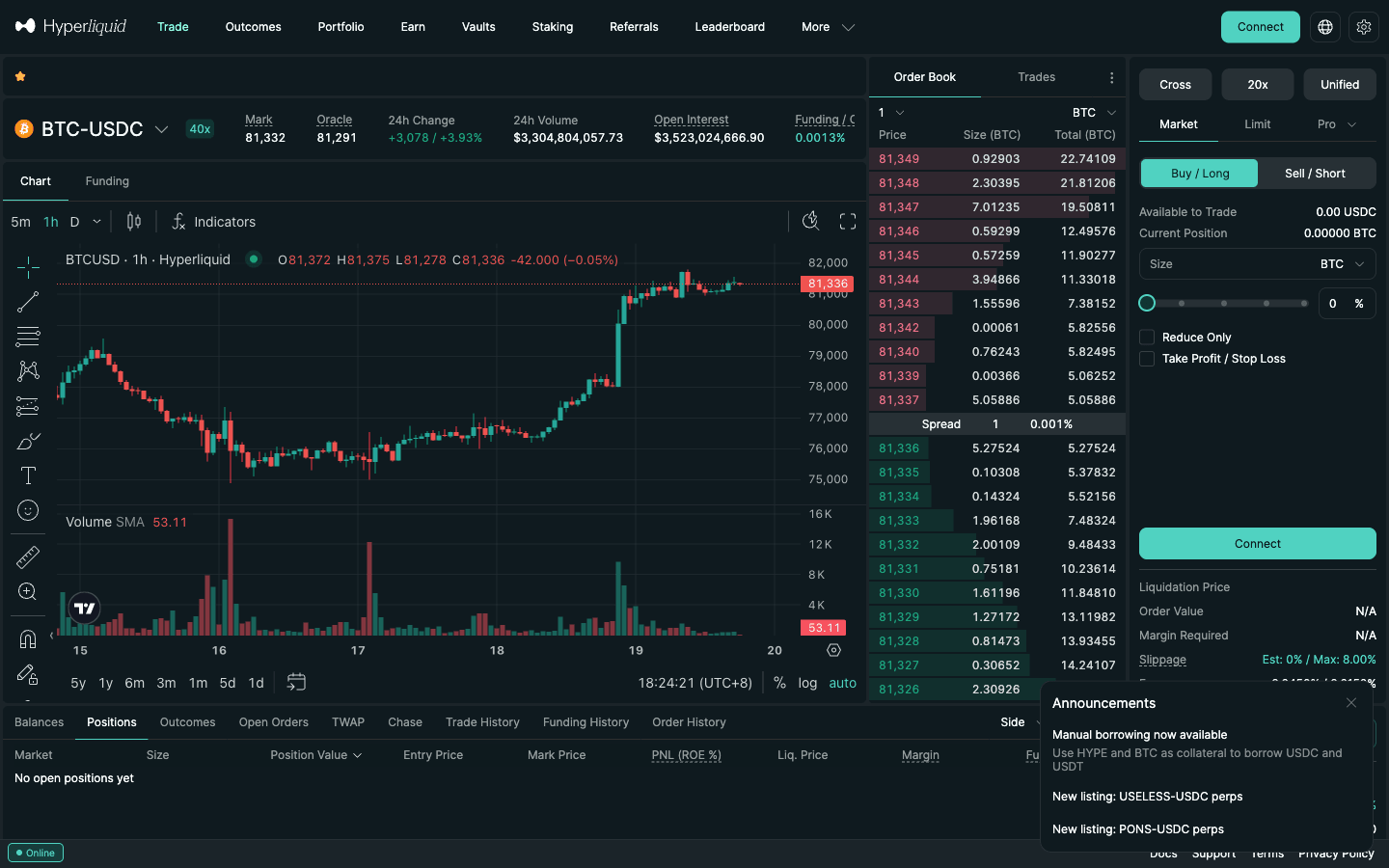
Hyperliquid's BTC-USDC page on the 1h chart: the volume bars under the price show the same intraday spikes as our table, the header shows the current hourly funding rate, and the order book shows the live spread (September 2026).
2. What is the best time to trade perpetual futures?
A perpetual future tracks spot and trades on the same liquidity clock, so the answer starts the same: 13:00–17:00 UTC on a weekday. About half of the search results for "best time to trade futures" are about CME stock-index futures (ES, NQ), though, and those answers (trade the cash open, avoid the 5–6 p.m. break) don't carry over to crypto. Perps add three clocks of their own.
Clock 1: funding checkpoints
Longs and shorts pay each other funding on a fixed schedule. On 8-hour venues (Binance, Bybit and Aster's BTCUSDT) the checkpoints are 00:00, 08:00 and 16:00 UTC, and a position open at that instant pays or receives the whole interval. On Hyperliquid and Lighter funding is paid every hour, so the checkpoint effect is one-eighth as large. Practical rule: on an 8-hour venue, don't open on the paying side in the minutes before a checkpoint. Details and caps are in section 9.
Clock 2: liquidation cascades in thin hours
Perps are leveraged, and a liquidation is a market order the exchange sends for you. In a deep book it moves the price a little; in the Asian afternoon or on a Saturday, when BTC volume on Hyperliquid was about a third of the weekday level, the same liquidation eats through more price levels and can trigger the next one. That is why wicks cluster in quiet hours and why a stop placed a normal distance away gets hit more easily at weekends. Hold less leverage into thin hours, use isolated margin, and check your liquidation price before you go to sleep.
Clock 3: CME hours and the bitcoin benchmark
Traditional futures have breaks; perp DEXs don't. CME's E-mini S&P 500 trades Sunday 6:00 p.m. to Friday 5:00 p.m. ET, with a daily 5:00–6:00 p.m. ET maintenance break. CME Bitcoin futures, by contrast, now trade 24/7 except Saturday 2:00–4:00 a.m. CT and a 4:00–4:02 p.m. CT pause Monday to Friday (CME contract specs, checked September 27, 2026). Hyperliquid, Lighter and Aster have no scheduled pause at all. The one CME rhythm that still matters for crypto is the CME CF Bitcoin Reference Rate (BRR), which settles CME's bitcoin futures. It is computed from trades on constituent exchanges during 3:00–4:00 p.m. London time every day (CF Benchmarks methodology, version of August 24, 2026). That is 14:00–15:00 UTC while the UK is on summer time and 15:00–16:00 UTC from October 25. In our sample, 14:00 UTC was also the busiest hour of the day. The US stock open falls in the same hour, so we can't say which drives it. Either way, it is an hour of deep books and big moves. See DEX perps vs CME futures for the product differences.
Perps timing in one line: enter in the London–New York overlap, avoid opening right before 8-hour funding checkpoints, and cut leverage before weekends and before the 12:30 / 18:00 UTC US releases.
3. What are the crypto trading sessions?
Crypto has no opening bell, so "sessions" are shorthand for when each region's traders, market makers and the traditional markets they watch are awake. The boundaries below are conventions; the volume shares are measured from the same 30-day Hyperliquid BTC data.
Window (UTC)
Tokyo (JST)
London (BST)
New York (EDT)
What is going on
BTC volume share
00:00–08:00
09:00–17:00
1 a.m.–9 a.m.
8 p.m.–4 a.m.
Asian session: Tokyo, Seoul, Hong Kong, Singapore
20.7% in 8 h
08:00–12:00
17:00–21:00
9 a.m.–1 p.m.
4 a.m.–8 a.m.
London / European morning
14.6% in 4 h
12:00–17:00
21:00–02:00
1 p.m.–6 p.m.
8 a.m.–1 p.m.
London–New York overlap: US data at 8:30, stocks open 9:30, BRR fix 3–4 p.m. London
38.6% in 5 h
17:00–21:00
02:00–06:00
6 p.m.–10 p.m.
1 p.m.–5 p.m.
US afternoon, stock close at 4 p.m., FOMC at 2 p.m. on meeting days
17.5% in 4 h
21:00–00:00
06:00–09:00
10 p.m.–1 a.m.
5 p.m.–8 p.m.
After the US close, before Tokyo opens
8.5% in 3 h
Daylight saving shifts the US and European windows, not Asia's. Japan, Singapore and Hong Kong have no daylight saving. Europe's clocks go back on October 25, 2026 and the US clocks on November 1, 2026. From then until March, everything tied to New York happens one hour later in UTC: the 8:30 a.m. data releases at 13:30 UTC, the 9:30 a.m. stock open at 14:30 UTC (23:30 in Tokyo), and FOMC statements at 19:00 UTC (04:00 the next morning in Tokyo). If you trade from Asia, your "busy window" moves an hour later in winter.
4. When is the best time to trade crypto in my time zone?
The busy window is anchored to the New York morning, so it is easiest to remember in New York time: 9 a.m. to 1 p.m. ET, all year. Converted:
City (time zone)
Until Oct 24, 2026 (UTC 13:00–17:00)
From Nov 1, 2026 (UTC 14:00–18:00)
New York (ET)
9 a.m.–1 p.m.
9 a.m.–1 p.m.
Chicago (CT)
8 a.m.–12 p.m.
8 a.m.–12 p.m.
Los Angeles (PT)
6 a.m.–10 a.m.
6 a.m.–10 a.m.
London (UK)
2 p.m.–6 p.m.
2 p.m.–6 p.m.
Berlin / Paris (CET)
3 p.m.–7 p.m.
3 p.m.–7 p.m.
Dubai (UTC+4)
5 p.m.–9 p.m.
6 p.m.–10 p.m.
Mumbai (IST, UTC+5:30)
6:30 p.m.–10:30 p.m.
7:30 p.m.–11:30 p.m.
Singapore / Hong Kong (UTC+8)
9 p.m.–1 a.m.
10 p.m.–2 a.m.
Tokyo / Seoul (UTC+9)
10 p.m.–2 a.m.
11 p.m.–3 a.m.
In the week between October 25 and November 1, 2026 Europe is already on winter time while the US is not, so London and Berlin see the window one hour earlier (1–5 p.m. and 2–6 p.m.). The winter column assumes the window keeps its New York anchor, as the US data releases and the stock open do.
In your time zone:enable JavaScript to convert 9 a.m.–1 p.m. New York time to your local time.
5. What is the best day of the week to trade crypto? Weekends: volume, ranges, spreads and the Monday open
Short answer: Tuesday to Friday. Crypto trades on Saturday and Sunday, but far fewer people do. Counting only complete UTC days in our window, with the average open-to-close BTC move for each weekday:
Day (UTC)
Days in sample
Avg BTC perp volume per day (Hyperliquid)
Avg BTC move, 00:00→24:00 UTC
Monday
4
$3.03B
+2.03%
Tuesday
4
$3.36B
−1.52%
Wednesday
4
$3.24B
−0.43%
Thursday
5
$3.33B
+0.94%
Friday
4
$3.82B
+0.45%
Saturday
4
$0.95B
+0.32%
Sunday
4
$1.36B
−0.19%
Weekend days averaged $1.16B against $3.35B on weekdays, about 34%. ETH was less extreme at 53%. The busy US-morning hours lose the most: the median 13:00 UTC hour fell from $242M on weekdays to $41M at weekends, while the late-evening hours barely changed. Friday topped this sample, but two of its four days carried scheduled US data (the September 4 jobs report and the September 11 CPI release), so treat the ordering of weekdays as noise; the weekday/weekend gap is the robust result.
The price column is there because "best day to buy" is a common question, and it shows why a month of data can't answer it. Monday's +2.03% average comes mostly from one +6.7% day, and all four Tuesdays fell, but four observations per weekday is far too few to call a pattern. Studies of "day-of-week effects" in crypto disagree with each other for the same reason. Choose the day for liquidity, not for a direction.
What this means in practice: a weekend order book is thinner at every price level, so the same market order moves the price more, stop-losses are more likely to be hit by a single wick, and a liquidation cascade has less resting liquidity to absorb it. Funding keeps running at weekends too. Sunday evening UTC, when Asia's Monday begins, is when volume starts to return. The longer windows below show the same gap.
Weekends over 90 days and 52 weeks: quieter, but not for altcoins
The 30-day table is short, so we also pulled 2,160 hourly candles covering 90 complete UTC days (June 27 to September 24, 2026: 64 weekdays and 26 weekend days) and 364 daily candles covering 52 full weeks (September 27, 2025 to September 25, 2026). Over 90 days BTC perps on Hyperliquid averaged $1.08B a weekend day against $2.75B a weekday (39%), and the average daily high-low range was 1.58% against 3.40%. Over 52 weeks weekend volume was 47% of the weekday level, and only 3.8% of weekend days closed more than 3% from their open, against 16.5% of weekdays.
Perp (90 days)
Avg daily volume (weekday / weekend)
Avg daily range (weekday / weekend)
Hours with >1% range
Largest 1-hour move
BTC
$2.75B / $1.08B (39%)
3.40% / 1.58%
10.9% / 2.1%
4.01% / 1.40%
ETH
$1.18B / $0.57B (48%)
4.43% / 2.69%
19.5% / 9.8%
5.86% / 3.01%
SOL
$0.27B / $0.17B (63%)
4.75% / 3.75%
27.9% / 15.5%
3.44% / 5.10%
Hyperliquid API candleSnapshot (1h), fetched September 25–26, 2026. Volume = contracts × average of open and close. “Largest 1-hour move” is the largest open-to-close change of a single hourly candle.
The further you go from Bitcoin, the less the weekend calms things down: SOL kept 63% of its volume and nearly 80% of its range, and its largest hourly move came on Saturday, August 22, 2026, when it traded from 100.09 down to 87.69 within the 05:00 UTC hour. Thin weekends also make each dollar traded move the price more; the worst weekend day in 52 weeks, Saturday, January 31, 2026, took BTC down 6.54% open to close.
Direction: over 52 weeks BTC closed up on 52.9% of weekend days and 46.9% of weekdays, Sunday averaged +0.21%, and no day of the week passed a basic significance test. “Sunday dumps” did not show up in the data.
Do spreads widen at weekends? Measured on Hyperliquid
We took Hyperliquid order-book snapshots on Saturday evening, September 26, 2026 (22:55–23:01 UTC, one of the quietest windows of the week) and compared them with the same measurement on Friday, September 25. “$1M market buy” is the average fill of a simulated $1M market buy against the book, compared with the mid price.
Market
Spread (Fri / Sat)
$1M market buy vs mid (Fri / Sat)
BTC
0.12 bp / 0.12 bp
0.012% / 0.003%
ETH
0.37 bp / 0.37 bp
0.0027% / 0.0085%
SOL
0.85 bp / 0.83 bp
0.068% / 0.034%
xyz:SP500 (index perp)
— / 0.13 bp
0.015% / 0.041%
xyz:GOLD
— / 0.23 bp
0.034% / 0.057%
Hyperliquid API l2Book; Saturday figures are medians of three to six snapshots. 1 bp = 0.01%. Single snapshots move a lot from minute to minute.
On crypto majors the spread did not widen. BTC sat at one tick on both days (0.119 bps), with about $23–29M resting within 0.1% of mid on each side on Saturday evening. What changes is flow: fewer orders pass through the book, so a large order or a liquidation meets fewer counterparties.
On stock and commodity perps it did. With their home markets closed, a $1M buy of xyz:SP500 cost about 2.7 times Friday’s figure and xyz:GOLD about 1.7 times.
Stops: Hyperliquid triggers TP/SL on the mark price, which references external exchanges, so one wick in a thin book is less likely to fire a crypto stop. A market TP/SL accepts up to 10% slippage; a stop-limit set at the trigger can be skipped in a fast move. Place weekend stops outside a normal weekend range (BTC averaged 2.38% a weekend day over 52 weeks).
The Monday open and the CME gap
Crypto itself does not gap. BTC trades continuously, so the “gap” is just the weekend’s move. From Friday 21:00 UTC to Sunday 22:00 UTC over 12 weekends, BTC moved 0.52% on average (at most 1.64%), ETH 1.33% (at most 3.52%) and SOL 2.13% (at most 4.84%). Weekend activity picks up from Sunday 20:00 UTC (hourly BTC volume roughly doubled versus the same Saturday hours) as futures-linked markets reopen at 22:00 UTC and Monday starts in Asia. The CME gap is fading: CME now lists its crypto futures and options on Globex 24/7 except Saturday 2:00–4:00 a.m. CT and a 4:00–4:02 p.m. CT pause Monday to Friday, so new weekend gaps of the old kind should no longer form.
The real Monday event on a perp DEX is on stock and commodity perps such as trade.xyz’s xyz:NVDA or xyz:SP500. While their home markets are closed they trade on an internal price inside discovery bounds, then snap back to the external price at the reopen: NVDA’s Monday 00:00 UTC reopen hour moved 0.49% on average (at most 1.25%) over 13 weekends, the S&P 500 perp 0.14% (at most 0.32%). Keep leverage low on anything whose home market is shut. Details in our trade.xyz guide.
Funding does not take the weekend off: Hyperliquid charges it every hour, and over 90 days the BTC rate averaged about the same on weekends as on weekdays. If you trade small weekend moves, fees matter more than usual: Hyperliquid with code HOLYGRAIL cuts 4% off your first $25M of volume, and Lighter’s Standard account charges 0% taker (open Lighter).
6. Is the best time different for BTC, ETH and altcoins?
We ran the same 30-day window for ETH, SOL and HYPE (Hyperliquid's own token). Every one of them peaked in the same hour:
Perp (Hyperliquid)
30-day volume
Busiest hour (UTC)
Quietest hour
Busiest ÷ quietest
Share in 12:00–17:00 UTC
Weekend vs weekday volume
Avg 1h range, 12–17 vs 03–07 UTC
BTC
$82.8B
14:00
04:00
5.4×
38.6%
34%
0.79% vs 0.39%
ETH
$37.5B
14:00
04:00
4.9×
37.0%
53%
1.04% vs 0.52%
HYPE
$15.8B
14:00
04:00
4.1×
35.3%
53%
1.52% vs 0.84%
SOL
$9.5B
14:00
07:00
4.7×
33.4%
53%
1.25% vs 0.74%
Source: api.hyperliquid.xyz candleSnapshot, 1h, August 26 – September 25, 2026 (SOL and HYPE fetched September 27, 2026). Our calculation.
Two differences matter. Altcoins are less concentrated in the US morning: SOL did 33.4% of its volume in 12:00–17:00 UTC against BTC's 38.6%, with relatively more in the Asian hours. And altcoin weekends are less dead: ETH, SOL and HYPE kept about half their weekday volume, BTC only a third. But altcoin books are much thinner to begin with: SOL traded about $0.32B a day on Hyperliquid against $2.76B for BTC. A size that is invisible in BTC at 04:00 UTC can move an altcoin. So the timing rule matters more for altcoins, not less. Trade them in the overlap, and use limit orders outside it. For Solana-native venues, see best Solana perp DEXs; for current volume and funding on every Hyperliquid market, see our Hyperliquid markets data.
7. Is there a best time of day to buy crypto?
This is where most guides make claims they can't support. We averaged the one-hour BTC return (close ÷ open − 1) for each hour of the day over the 30 days. The three best and three worst hours:
Hour (UTC)
New York
Avg 1h BTC return
Hours that closed up
13:00 (best)
9 a.m.
+0.198%
63%
08:00
4 a.m.
+0.106%
53%
14:00
10 a.m.
+0.082%
57%
01:00
9 p.m.
−0.078%
43%
18:00
2 p.m.
−0.079%
40%
22:00 (worst)
6 p.m.
−0.087%
43%
All hours
–
+0.009%
51.5%
It looks like a pattern, but it isn't one you can bank on. BTC rose 6.5% over the window, so the average hour was slightly positive anyway. Each hour has only 30 observations, and none of them, not even 13:00 UTC, passed a basic significance test (a t-statistic of 2 or more). We also checked when the day's low was printed: the 12:00–17:00 UTC block held the low on 8 of 29 days and the high on 9, only slightly more than the 6 you would expect by chance for five hours of the day. The volatile hours make both the lows and the highs.
So the honest answer to "best time to buy crypto", "cheapest time to buy" or "should I buy at night" is: there is no reliably cheap hour. What you can control is execution cost. Buy with limit orders during the deep hours, split larger buys into pieces over time (a TWAP order does this automatically), and don't send market orders into a thin weekend or late-night book.
8. When do CPI, jobs reports and FOMC move crypto?
The biggest hours of the month are not random. Two of the four busiest BTC hours in our window line up exactly with scheduled US releases, and the jobs report stands out in ETH:
September 11, 12:00 UTC — the August CPI report (released 8:30 a.m. ET = 12:30 UTC): $1.00B of BTC in one hour, range 2.75%. ETH's following hour traded $549M with a 6.2% range.
September 16, 18:00 UTC — the FOMC statement (2:00 p.m. EDT), at which the Fed raised its target range by a quarter point: $931M, range 2.0%.
September 4, 12:00 UTC — the August jobs report (8:30 a.m. ET): ETH $380M, range 3.9%.
A normal hour in the same window averaged $115M. The upcoming dates, from the BLS and Federal Reserve calendars:
Event
Date (2026)
Time UTC
Time JST
US jobs report (Employment Situation)
Oct 2
12:30
21:30
US CPI
Oct 14
12:30
21:30
FOMC statement
Oct 28
18:00
03:00 (Oct 29)
US jobs report
Nov 6
13:30
22:30
US CPI
Nov 10
13:30
22:30
US jobs report
Dec 4
13:30
22:30
FOMC statement
Dec 9
19:00
04:00 (Dec 10)
US CPI
Dec 10
13:30
22:30
Sources: bls.gov release schedules (CPI, Employment Situation, 8:30 AM ET) and federalreserve.gov FOMC calendar, checked September 25, 2026. Times after November 1 reflect US standard time. Schedules can change; check the official calendar the week before.
Around these releases spreads can widen for a few seconds, funding can jump, and leveraged positions on both sides get liquidated. If you don't trade the news itself, either be flat or cut leverage before the release and add stops that allow for a 2–3% hourly range.
9. When are funding payments made?
Funding is the other clock that matters for perps. It is paid between longs and shorts, not to the exchange, and when it is paid depends on the venue:
Sources: Hyperliquid and Lighter funding docs, Aster funding-rate doc, Aster and Binance fundingRate API history for BTCUSDT (September 23–25, 2026); edgeX public metadata API and Pacifica funding docs (checked September 27, 2026).
Why the interval matters for timing. On an 8-hour venue, a position open at the settlement instant pays or receives the whole interval, even if it was opened seconds earlier. Aster's docs even warn of a 15-second tolerance: open at 16:00:05 UTC and you may still be charged. On hourly venues the same mistake costs one-eighth as much, and funding accrues smoothly over the day instead of in three lumps.
What funding actually cost in September. Hyperliquid's baseline is 0.00125% per hour (0.01% per 8 hours). Over our 30-day window, 72% of BTC's 720 hourly rates sat exactly at that baseline, 93% were positive (longs paid shorts), and the highest was 0.009% in one hour. The 30-day total was 0.77%: a $10,000 BTC long held for the whole month paid about $77 of funding, more than 8 round trips of taker fees ($9.00 each at 0.045%). For ETH the total was 0.83%. Time-of-day matters less than holding time: every hour you hold is an hour of funding. Details in Hyperliquid funding explained and crypto funding rates explained.
10. Do trading costs change with the time of day?
Cost
Hyperliquid
Lighter
Aster (order book)
Changes by hour?
Taker / maker fee (base)
0.045% / 0.015%
0% / 0% (Standard)
0.04% / 0%
No
Gas per order
None
None
None
No
Funding interval
1 hour
1 hour
8 hours (default)
The rate does; the schedule doesn't
Spread and depth
Tightest and deepest 12:00–17:00 UTC on weekdays; thinnest 03:00–07:00 UTC and at weekends
Yes
Hourly price range
BTC averaged 0.99% at 14:00 UTC vs 0.35% at 04:00 UTC (Hyperliquid, 30 days)
Yes
Fees are fixed per trade: a $10,000 taker round trip on Hyperliquid costs $9.00 at the base tier (0.09%), or $8.64 with a referral code, whatever the hour. Lighter's Standard account charges nothing; its Premium account 0.028% taker. Only the implicit costs move with the clock. For BTC on Hyperliquid they are small for retail size even off-peak: in an order-book snapshot at 07:59 UTC on Friday, September 25 (one of the quieter hours), the spread was $1 (about 0.1 basis point) and the 20 price levels on each side, within about $20 of the mid, held roughly $5.1M of asks and $4.7M of bids. A $10,000 BTC order fills within a few dollars of the quote at almost any hour. Timing starts to matter for orders in the hundreds of thousands, for altcoins with thinner books, and at weekends, when the whole book has less behind it. Two practical rules follow: in thin hours, switch to limit orders (which also pay Hyperliquid's 0.015% maker fee instead of 0.045%), and size down. Fee details: Hyperliquid fees, Lighter fees, lowest-fee DEXs.
Cut the part of the cost that doesn't depend on timing
Hyperliquid with HOLYGRAIL: 4% off every fee on your first $25M. If you scalp many times a day, Lighter's Standard account charges 0% (code 718610TD: first week of Premium fees rebated if you upgrade).
11. What is the best time for scalping, swing and news trading?
Scalping and day trading
Scalpers live on spread and depth, so trade 12:00–17:00 UTC on weekdays and avoid the minutes around 12:30 UTC data releases unless that is your strategy. Fees decide whether scalping works at all: a 0.1% target barely clears a 0.09% taker round trip on Hyperliquid, while on Lighter Standard it is all profit before slippage. Hyperliquid's advantage is depth when you size up. See best DEX for scalping.
Swing trading
Holding for days makes the hour of entry less important and funding more important. Enter when the book is deep and you have the day's information (the European morning or the US session), avoid adding size into the Saturday lull, and check the funding rate before holding a crowded position over a weekend. Crypto daily candles are usually drawn in UTC, so the daily close is 00:00 UTC (09:00 JST, 8 p.m. New York in summer).
News trading
The spikes in section 8 are the opportunity and the risk: a 2–6% hourly range within minutes, liquidations on both sides and funding that can jump. Keep leverage low, use limit orders or small market orders, and never place a stop so close that the release candle alone triggers it.
Large orders and long-term buying
If you need to move size, do it in the US morning and slice it. Hyperliquid has a built-in TWAP order that splits a parent order over time (see our TWAP and iceberg orders guide). Long-term buyers gain little from hunting the "right hour" (section 7); regular buys with limit orders in liquid hours keep execution costs down.
12. When should you trade stock perps?
Stock and index perps on DEXs trade around the clock, but the underlying market does not. Aster's documentation is explicit: its US stock perps trade normally during the regular session (9:30 a.m.–4:00 p.m. New York time); in pre-market, post-market and overnight hours, limit orders more than 5% more aggressive than the mark price are rejected and market orders fill only up to 5% from the mark. Overnight, at weekends and on US public holidays, an EWMA-smoothed mark price applies. For stock perps, the "best time" is simply the US cash session, 13:30–20:00 UTC (22:30–05:00 JST) until November 1 and 14:30–21:00 UTC afterwards. On Hyperliquid, stock perps come from builders under HIP-3 (for example trade.xyz) and follow the rules of each deployer.
13. How do you plan a trading session?
Know your window. 9 a.m.–1 p.m. New York time: 13:00–17:00 UTC now, 14:00–18:00 UTC from November 1.
Check the calendar every Monday. CPI, the jobs report and FOMC days are the busiest and most volatile hours of the month.
Read the funding rate and interval before you enter. On 8-hour venues, avoid opening on the paying side just before 00:00, 08:00 or 16:00 UTC.
Thin hours: limit orders, smaller size. 03:00–07:00 UTC and weekends had a fraction of the volume, and altcoins suffer most.
Weekend positions: less liquidity to absorb a liquidation cascade. Use isolated margin and lower leverage (see risk management and position sizing).
Log your trades with timestamps. After 50 trades, check which hours your strategy actually makes money in. Hyperliquid lets you export your trade history as CSV.
FAQ
What is the best time to trade perpetual futures?
On a weekday between 13:00 and 17:00 UTC (9 a.m.–1 p.m. New York, 2–6 p.m. London), the London–New York overlap. Perps follow the same liquidity clock as spot: in 30 days of Hyperliquid BTC perp data (Aug 26–Sep 25, 2026) the 14:00 UTC hour averaged $293M of volume, 5.4 times the quietest hour. On top of that, check the funding schedule (00:00, 08:00 and 16:00 UTC on 8-hour venues, every hour on Hyperliquid and Lighter) and cut leverage into weekends and scheduled US releases. Trading fees do not change by the hour: Hyperliquid charges 0.045% taker / 0.015% maker at the base tier whenever you trade.
Is it better to trade crypto at night?
It depends on where your night is. For US traders, night (10 p.m.–4 a.m. New York, 02:00–08:00 UTC) is the thinnest part of the day: the quietest hour, 04:00 UTC, averaged $55M of BTC perp volume on Hyperliquid against $293M at the 14:00 UTC peak (Aug 26 – Sep 25, 2026). For traders in Japan, Korea, Singapore or Hong Kong, the evening is the best time: 22:00–02:00 in Tokyo is the London–New York overlap. Night trading itself is not cheaper or more profitable; what changes is depth. In thin hours use limit orders, trade smaller and leave stops more room.
What time does crypto volume peak in my time zone?
The peak is anchored to the New York morning: the busiest hour was 14:00 UTC, 10 a.m. in New York, 3 p.m. in London and 11 p.m. in Tokyo, and the 12:00–17:00 UTC block carried 38.6% of all BTC perp volume on Hyperliquid in Aug 26 – Sep 25, 2026. After US clocks change on November 1, 2026 the same New York hours are one hour later in UTC (14:00–18:00), so the peak hour moves to midnight–1 a.m. in Tokyo and the window to 11 p.m.–3 a.m. The table in section 4 converts the window for nine cities, and the box under it shows it in your own time zone.
Do fees change by time of day?
No. Exchange fees are fixed per trade, whatever the hour: Hyperliquid charges 0.045% taker / 0.015% maker at the base tier (4% less on your first $25M of volume with a referral code), Lighter's Standard account 0%, and Aster 0.04% / 0%. What changes by the hour is the implicit cost: spread and slippage are lowest in the deep 12:00–17:00 UTC window and highest in thin hours and at weekends. Funding is charged for as long as you hold (interval: 1 hour on Hyperliquid and 1 hour on Lighter, 8 hours on Binance BTCUSDT and 8 hours on Aster BTCUSDT), so holding time matters more than the clock.
What time of day is crypto most traded?
The US morning. The five hours from 12:00 to 17:00 UTC carried 38.6% of all Hyperliquid BTC perp volume in our 30-day sample (ETH 37.0%), and the single busiest hour was 14:00 UTC, 10 a.m. in New York. The quietest hour was 04:00 UTC ($55M on average, against $293M at 14:00).
What is the worst time to trade crypto?
The thinnest windows are the Asian afternoon, 03:00–07:00 UTC (noon to 4 p.m. in Tokyo), and weekends. Saturday BTC volume on Hyperliquid averaged $0.95B against $3.35B on an average weekday in our sample. Thin books mean wider spreads and more slippage on market orders, so trade smaller and use limit orders then.
What is the best day of the week to trade crypto?
Tuesday to Friday for liquidity. Weekdays averaged $3.35B of BTC perp volume a day on Hyperliquid in September 2026 against $1.16B at weekends (about 34%); Monday was slightly lower than the rest of the week and Saturday was the quietest day. The direction of the market by weekday was noise: with four or five days of each weekday in the sample, no day was reliably up or down.
Is crypto more volatile on weekends?
Usually less, but with fatter surprises. Over the 90 days to September 24, 2026, BTC's average daily high-low range on Hyperliquid was 1.58% on weekend days against 3.40% on weekdays; over 52 weeks it was 2.38% against 3.94%. Only 3.8% of weekend days closed more than 3% from their open, against 16.5% of weekdays. Altcoins calm down much less: SOL kept 63% of its weekday volume and nearly 80% of its range, and its largest hourly move in the sample came on a Saturday.
Does crypto go up on weekends, or drop on Sundays?
Neither, reliably. Over 52 weeks to September 25, 2026, BTC closed higher on 55.8% of Saturdays and 50% of Sundays (UTC), and on 52.9% of weekend days overall against 46.9% of weekdays. No day of the week passed a basic significance test; the trend of the period mattered far more than the calendar.
Is there still a CME gap in Bitcoin?
The classic CME gap came from CME's crypto futures closing over the weekend. CME now lists its crypto futures and options for 24/7 trading on Globex (24/7 except Saturday 2:00–4:00 a.m. CT and a 4:00–4:02 p.m. CT pause Monday to Friday), so new weekend gaps of the old kind should no longer form. On perp DEXs the real Monday event is on stock and commodity perps, which switch from internal back to external pricing when their home markets reopen.
Is there a best time of day to buy crypto?
Not one you can rely on. We averaged the 1-hour BTC return for each hour of the day over 30 days: the best hour (13:00 UTC, +0.20%) and the worst (22:00 UTC, −0.09%) are both within normal noise, and no hour passed a basic significance test. What you can control is cost: buy with limit orders in the deep hours (13:00–17:00 UTC), split large buys over time, and avoid market orders in thin weekend books.
Why do crypto prices drop at night?
They don't, reliably. Across the US night (02:00–08:00 UTC, 10 p.m.–4 a.m. New York) the average hourly BTC return in our 30-day sample ranged from −0.05% to +0.05%, and no hour of the day was statistically different from zero. What changes at night is depth: with a fraction of the daytime volume, one large sell order or a cluster of liquidations moves the price further, so sharp overnight wicks are easier to notice. Use limit orders and leave stops room for thin books.
When are crypto funding payments made?
On Hyperliquid, Lighter and Pacifica funding is paid every hour. Binance and Aster BTCUSDT settle every 8 hours at 00:00, 08:00 and 16:00 UTC (Aster can shorten the interval on volatile pairs), and edgeX every 4 hours. On an 8-hour venue, opening on the paying side just before a settlement means paying a full interval at once; on hourly venues the effect is small.
What time do US economic reports move crypto?
US CPI and the monthly jobs report are released at 8:30 a.m. New York time (12:30 UTC in summer, 13:30 UTC after US clocks change on November 1, 2026). FOMC statements come at 2:00 p.m. (18:00 UTC in summer, 19:00 UTC in winter). In our sample, the CPI hour on September 11 traded $1.0B of BTC on Hyperliquid and the FOMC hour on September 16 $931M, against a normal-hour average of $115M.
Is 6 p.m. a good time to trade futures?
For CME stock-index futures, 6 p.m. New York time is the reopen after the daily break (E-mini S&P 500: Sunday 6:00 p.m. to Friday 5:00 p.m. ET, with a daily 5:00–6:00 p.m. ET maintenance break), so liquidity is thin for the first hour. Crypto is different: CME Bitcoin futures now trade 24/7 except Saturday 2:00–4:00 a.m. CT and a 4:00–4:02 p.m. CT pause Monday to Friday, and perp DEXs have no scheduled break at all. 6 p.m. New York is 22:00 UTC in summer, one of the thinner hours for crypto (3.3% of daily BTC volume on Hyperliquid), so it is a poor time for large market orders.
Are perpetual futures risky?
Yes, mainly because of leverage. A leveraged perp position is liquidated when losses eat its margin, and funding is charged every hour or every 8 hours for as long as you hold it. Timing adds to the risk: in thin hours and at weekends the same liquidation removes more of the order book, so cascades move prices further. Use isolated margin, low leverage and a stop, and size positions so that a 2–3% hourly move (normal around CPI and FOMC) does not liquidate you.
Can I trade crypto 24/7 on a DEX?
Yes. Perp DEXs such as Hyperliquid, Lighter and Aster never close, and there is no daily maintenance break in the protocol. Stock perps are the exception to "same conditions all day": Aster, for example, caps order prices at 5% from the mark and switches to an EWMA-smoothed mark outside US market hours and at weekends.
Ready for the next busy session?
Open Hyperliquid with code HOLYGRAIL (4% off fees on your first $25M). Wallet or email sign-in, gas-free orders, hourly funding.
Or: Lighter (0% Standard fees, 718610TD) · Aster (DTLpLc)
Disclosure: HOLYGRAIL (Hyperliquid), 718610TD (Lighter) and DTLpLc (Aster) are our referral codes; we earn a share of referred accounts' fees at no extra cost to you. Volume, return and funding figures are our own calculation from Hyperliquid's public API for the dated window; past patterns do not guarantee future liquidity or prices. Not investment advice.