Position size = (account × risk %) ÷ stop distance. $10,000 × 1% = $100 of risk; with a stop 2% from entry that is $100 ÷ 0.02 = $5,000 of position, or 0.0609 BTC at $82,073. Leverage is not in the formula: it only sets the margin you post, and it has to be low enough that the liquidation price sits well beyond your stop, or the exchange closes you out before the stop can work.
This guide is the strategy behind the number: how much to risk, where the stop belongs, when volatility or Kelly should shrink the position, and how leverage, fees and minimum orders change the plan on a DEX. To size a live trade with each venue's fees, minimum orders, size steps and liquidation rules applied, use the tool:
Position Size Calculator — Enter account, risk, entry and stop: get the size in coins with fees inside the risk budget, the venue minimum and max leverage, and a liquidation-vs-stop check for Hyperliquid, Lighter, Aster and edgeX. — Open the calculator →1. The sizing formula in four steps
Every risk-based sizing method, whether for stocks, forex or crypto, runs the same three steps. Crypto perps add one more: a liquidation price you must keep out of the way.
- Dollar risk = account balance × risk per trade. Use the equity actually on the exchange, not unrealized profit you are counting on. $10,000 × 1% = $100. (Some traders fix a dollar amount instead; the arithmetic is the same.)
- Stop distance = |entry − stop| ÷ entry. A long at $82,073 with a stop at $80,432 has a stop distance of 2.0%. For a short the stop sits above entry; the arithmetic is the same.
- Notional = dollar risk ÷ stop distance = $100 ÷ 0.02 = $5,000. Size in coins = notional ÷ entry = 0.0609 BTC. Round down to the market’s size step: on Hyperliquid BTC trades in steps of 0.00001.
- Margin = notional ÷ leverage, and check that the liquidation price is at least twice as far away as the stop (section 4).
If you prefer coins directly: size = dollar risk ÷ (entry − stop) = $100 ÷ $1,641 = 0.0609 BTC. The two versions are identical. The percent version is easier to reuse because it ignores the coin’s price: a 2% stop gives the same $5,000 of notional on ETH at $2,411.80 or SOL at $105.23.
Position Size Calculator — Run these four steps on a real order: the tool rounds to the venue's size step, puts the entry and stop fees in the budget, checks the minimum order and max leverage, and compares liquidation with your stop. — Open the calculator →2. Perps vs CME-style futures: what changes
“How to calculate position size for futures” usually means CME-style contracts, where each contract has a fixed dollar value per point: contracts = dollar risk ÷ (stop distance in points × dollar value per point), rounded down to a whole contract. If a contract were worth $5 a point and your stop sat 20 points away, each contract would risk $100, so a $100 budget allows one.
Crypto perpetual futures on Hyperliquid, Lighter and Aster are simpler: they are linear, USD-margined contracts where one contract is one coin, and you can trade fractions down to the size step. The formula from section 1 applies unchanged, and the result is the number you type in the size field. Coin-margined (inverse) contracts are different: size is quoted in USD and profit and loss settle in the coin, so the dollar value of your risk moves with the price. See coin-margined vs USDT-margined perps.
Margin is not risk. The margin the exchange locks ($500 at 10x in the example) is not what you stand to lose at the stop ($100), and it is not a cap on your loss either: if the stop slips or you have none, you can lose all of an isolated position’s margin, and in cross margin more of the account.
3. Worked table: BTC at five stop distances
Account $10,000, risk 1% ($100), long BTC at Hyperliquid’s mark of $82,073 (October 20, 2026, 03:53 UTC). “With fees” includes a base-tier taker round trip (0.09% of notional). The leverage column is the highest whole number that keeps liquidation at least twice as far away as the stop.
| Stop distance | Notional (no fees) | Notional (with fees) | BTC size (with fees) | Max leverage (2× rule) | Margin at that leverage | Liquidation distance |
|---|---|---|---|---|---|---|
| 0.5% | $20,000 | $16,949 | 0.20651 BTC | 40x (cap) | $424 | 1.27% |
| 1% | $10,000 | $9,174 | 0.11178 BTC | 31x | $296 | 2.00% |
| 2% | $5,000 | $4,785 | 0.05829 BTC | 19x | $252 | 4.06% |
| 3% | $3,333 | $3,236 | 0.03943 BTC | 13x | $249 | 6.52% |
| 5% | $2,000 | $1,965 | 0.02393 BTC | 8x | $246 | 11.39% |
Our arithmetic. Maintenance margin 1.25% (Hyperliquid BTC: half the initial margin at the 40x cap). Max leverage = 1 ÷ (1 − (1 − 2 × stop) × (1 − maintenance)), rounded down and capped at 40x.
Three things to take from it. The tighter the stop, the bigger the position for the same $100: a 0.5% stop allows four times the notional of a 2% stop. Fees bite hardest on tight stops: at 0.5% they cut the size by about 15%, at 5% by about 1.8%. And the margin you need is small in every row: a correctly sized trade does not need high leverage, only the willingness to leave most of the balance idle.
Account-size quick reference
Same rule (1% risk, 2% stop) across account sizes, with margin at 5x and the round-trip taker cost on Hyperliquid / Aster / Lighter Standard:
| Account | Risk (1%) | Notional (no fees) | Notional (HL fees) | Margin at 5x | Round trip HL / Aster / Lighter |
|---|---|---|---|---|---|
| $1,000 | $10 | $500 | $478 | $100 | $0.45 / $0.40 / $0 |
| $5,000 | $50 | $2,500 | $2,392 | $500 | $2.25 / $2.00 / $0 |
| $10,000 | $100 | $5,000 | $4,785 | $1,000 | $4.50 / $4.00 / $0 |
| $50,000 | $500 | $25,000 | $23,923 | $5,000 | $22.50 / $20.00 / $0 |
4. Stop distance vs leverage: the liquidation check
Take the $5,000 BTC position from the 2% row and open it at different leverage settings. The loss at the stop ($80,432) stays $100 in every line. What moves is the margin you post and the isolated liquidation price.
| Leverage | Margin | Liquidation price | Distance | Verdict vs a 2% stop |
|---|---|---|---|---|
| 2x | $2,500 | $41,556 | −49.37% | Comfortable: liquidation more than 2× the stop distance away |
| 3x | $1,667 | $55,408 | −32.49% | Comfortable: liquidation more than 2× the stop distance away |
| 5x | $1,000 | $66,490 | −18.99% | Comfortable: liquidation more than 2× the stop distance away |
| 10x | $500 | $74,801 | −8.86% | Comfortable: liquidation more than 2× the stop distance away |
| 19x | $263 | $78,738 | −4.06% | Highest leverage that passes the 2× rule |
| 25x | $200 | $79,787 | −2.78% | Liquidation only 0.78% past the stop |
| 40x | $125 | $81,034 | −1.27% | Liquidated before the stop is reached |
Isolated long at $82,073, maintenance margin 1.25%: liquidation = entry × (1 − 1/leverage) ÷ (1 − maintenance). Our arithmetic.
At 40x the position is liquidated at $81,034, before the $80,432 stop is ever reached. That is the trap of sizing from leverage instead of from risk: the stop you planned never gets a chance to work, and you lose the whole margin instead of $100.
Why twice the stop distance rather than just “beyond the stop”? Stops on perps become market orders when they trigger and can slip in a fast move; Hyperliquid’s market TP/SL orders allow up to 10% slippage (a cap, not the expected fill). Funding also drains isolated margin and pulls the liquidation price toward the market over time. The 2× buffer absorbs both. Formulas for cross margin and a dedicated liquidation price calculator are in our liquidation guide; per-asset caps are in the leverage tiers comparison.
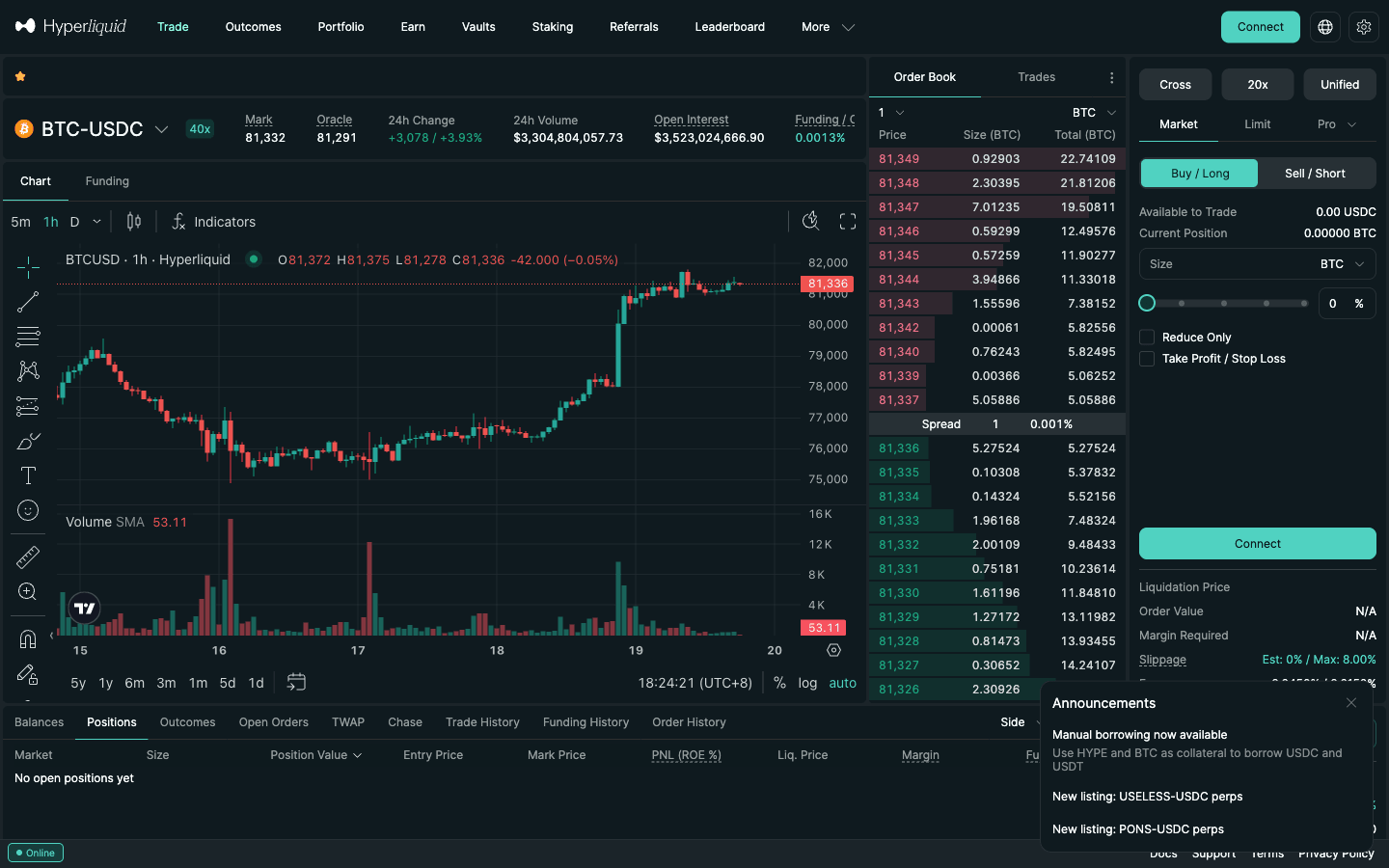
Sized the trade? Place it where the book is deepest
Hyperliquid shows Order Value, Margin Required and the Liquidation Price before you submit, with a $10 minimum order. Join with code HOLYGRAIL for 4% off trading fees on your first $25M of volume.
We earn a commission when you sign up through our links; it never raises your fees.
5. Take-profit and risk : reward
The stop decides the size; the target decides whether the trade is worth taking. Risk : reward = (target − entry) ÷ (entry − stop). With the 2% stop and a target 6% above entry, the ratio is 1 : 3: the $5,000 position makes about $300 at the target and loses $100 at the stop, before fees. The position size calculator shows both after fees, and the risk reward calculator turns them into the win rate each ratio needs on each venue; fees matter more than people expect on tight setups.
| Risk : reward | Break-even win rate (before costs) | At a 40% win rate, per 10 trades |
|---|---|---|
| 1 : 1 | 50% | 4 × 1R − 6 × 1R = −2R |
| 1 : 1.5 | 40% | 4 × 1.5R − 6 × 1R = 0R |
| 1 : 2 | 33.3% | 4 × 2R − 6 × 1R = +2R |
| 1 : 3 | 25% | 4 × 3R − 6 × 1R = +6R |
Break-even win rate = 1 ÷ (1 + R). R = the dollar risk of one trade. Our arithmetic.
Risk Reward Calculator — Enter entry, stop and target: get the R:R before and after round-trip fees, the break-even win rate and the expectancy at your win rate, for Hyperliquid, Lighter, Aster, edgeX, Binance and Bybit. — Open the calculator →Place the target where the market gives you a reason (a prior high, a liquidity level, a measured move), not where the ratio looks nice. If the nearest sensible target gives less than about 1 : 1.5, the usual answer is to skip the trade, not to tighten the stop until the ratio works: a stop inside normal noise just raises the loss rate. Set the target and stop together as a TP/SL order (TP/SL on Hyperliquid), and use the PnL calculation guide to check realized results.
6. Fees, funding and slippage in the size
A stop-out costs more than the stop distance. The real loss is notional × (stop distance + entry fee + exit fee + slippage), plus any funding paid while the trade was open. Size on the stop alone and every loss is a little bigger than planned. Fold the costs in:
notional = dollar risk ÷ (stop distance + 2 × fee rate + expected slippage)
- Trading fees. Hyperliquid charges 0.045% taker / 0.015% maker at the base tier (under $5M of 14-day volume), and code HOLYGRAIL takes 4% off on your first $25M. Aster charges 0.04% taker / 0% maker on its Pro order book. Lighter’s Standard account charges 0% on both sides. A Hyperliquid taker round trip eats 36% of your risk on a 0.25% stop, 18% on 0.5%, 9% on 1% and 4.5% on 2%, which is why tight-stop traders use limit orders or zero-fee venues. Details: Hyperliquid fees.
- Funding. Hyperliquid and Lighter settle funding every hour; Aster’s BTC perp every 8 hours. The baseline is 0.00125% per hour, $10.50 a week on a $5,000 position. BTC longs on Hyperliquid actually paid 0.7219% of notional over the 30 days to September 30, 2026: $36.10 on $5,000, or 36% of a $100 risk budget. For swing trades, add expected funding to the cost side or cut size. See Hyperliquid funding explained.
- Slippage. Hyperliquid’s BTC and ETH books are deep: in a snapshot at 13:53 UTC on September 30, 2026, a $100k market buy would have filled on average 0.0006% above mid on BTC and 0.0018% on ETH (our arithmetic from the public order book). Small caps can cost far more; if your size is large relative to the visible book, split the entry or add a slippage allowance.
Minimums matter at the other end. Hyperliquid rejects perp orders under $10, Lighter’s perps have a $10 minimum, and Aster’s minimum notional is 5 USDT, though BTCUSDT’s 0.001 BTC step is about $82. With a $500 account and 1% risk, a 5% stop gives $100 of notional: fine on Hyperliquid and Lighter, one step of BTC on Aster only if the price is under $100,000.
Tight stops? Cut the fee drag
On Hyperliquid, maker orders cost 0.015% and code HOLYGRAIL takes 4% off every fee on your first $25M. For zero trading fees on perps, Lighter’s Standard account charges 0% maker and taker; join with 718610TD.
7. Volatility-based stops (ATR)
A fixed stop distance ignores how much the market is moving. The Average True Range (ATR) fixes that: set the stop a multiple of ATR away, and the position shrinks automatically when volatility rises. Only the stop distance changes:
notional = dollar risk ÷ (ATR multiple × ATR as % of price)
From Hyperliquid BTC candles on September 30, 2026 (14-period ATR), with a 2× ATR stop and $100 of risk:
- 1-hour chart: ATR 0.58%, stop 1.16% → about $8,621 of notional (0.105 BTC); the 2× liquidation rule allows up to 28x.
- 4-hour chart: ATR 1.00%, stop 2.00% → about $5,000 of notional (0.061 BTC); the 2× liquidation rule allows up to 19x.
- Daily chart: ATR 2.69%, stop 5.38% → about $1,859 of notional (0.023 BTC); the 2× liquidation rule allows up to 8x.
The same logic explains why alts need smaller positions. Over the 90 days to September 29, 2026 the average daily high-to-low range on Hyperliquid was 2.79% for BTC, 3.84% for ETH, 4.36% for SOL and 5.65% for HYPE. A stop that survives normal noise on HYPE must be about twice as wide as on BTC, so the notional for the same dollar risk is about half. Indicator settings: technical indicators for perp DEXs.
8. How much to risk per trade, and in total
The risk percentage is the one input the formula cannot choose for you. Losing streaks decide it. With a 40% win rate, the chance of at least eight losses in a row somewhere in 100 trades is about 49%; with a 50% win rate it is 17%. Eight straight losses cost 7.7% of the account at 1% risk, 14.9% at 2%, 33.7% at 5% and 57.0% at 10%. Recovering takes more than the loss: a 20% drawdown needs +25%, a 50% drawdown needs +100%.
- 0.5–1% per trade while you are building a record or trading high-leverage intraday setups.
- 1–2% per trade once your journal shows a positive expectancy over a meaningful sample. The often-quoted 3-5-7 rule (3% per trade, 5% total, winners bigger than losers) sits at the aggressive end for leveraged perps.
- Cap total open risk (“portfolio heat”) at a few percent. Two 1% longs on BTC and ETH are close to one 2% bet, because the coins usually move together; in cross margin their losses also share the same equity.
- Recalculate from current equity. After a loss the same percentage gives a smaller position, which is exactly what protects you. Never size up to “win it back”.
More on drawdown rules and journaling: risk management for perp DEXs and trading psychology and plan.
9. Four sizing methods compared
Every method below ends in the same formula, notional = dollar risk ÷ stop distance; they differ only in how the dollar risk (or the stop) is chosen. Pick one, write it down and apply it to every trade, because switching methods after a loss is how "sizing" turns into revenge trading.
| Method | Dollar risk per trade | Strength | Weakness |
|---|---|---|---|
| Fixed fractional (1% rule) | A fixed % of current equity, e.g. 1% | Shrinks automatically in a drawdown, grows with the account; easy to audit | Ignores volatility: the same % on a quiet BTC day and a wild HYPE day |
| Fixed dollar | The same amount every trade, e.g. $100 | Simplest; easy to compare results in R | Does not shrink after losses: ten losses cost 10% of the start, not 9.6% |
| Volatility-based (ATR) | Fixed %, but the stop is a multiple of ATR, so size falls when volatility rises | Stops outside normal noise; equalises risk across coins | Needs an ATR reading per coin and timeframe; wide stops on alts mean small positions |
| Kelly-capped | A fraction of the Kelly bet, never above the fixed-% ceiling | Ties size to a measured edge | The edge is an estimate; full Kelly on a wrong estimate overbets badly (section 10) |
A practical combination for perps: fixed fractional at 0.5–1% of current equity, with the stop placed by structure or 1.5–2× ATR, and a cap on total open risk across correlated positions. Kelly only ever lowers that number, never raises it. Whichever you choose, the size comes out of the same arithmetic as section 1, and leverage is chosen last, low enough that liquidation sits well beyond the stop.
10. Kelly criterion and compounding
Kelly gives the fraction of capital that maximises long-run growth when the odds are known: f* = (b × p − q) ÷ b, with p the win rate, q = 1 − p and b the average win divided by the average loss. With p = 0.55 and b = 2, f* = 32.5% of the account per trade, which shows why it is dangerous for leveraged crypto: p and b come from a finite, noisy trade log, and overestimating them makes full Kelly oversize badly. If you use it at all, use a quarter or half of f*, only with a few hundred trades of the same setup, and only as a ceiling on top of your 1–2% rule.
The table shows what the formula asks for at a few combinations of win rate and payoff (b = average win ÷ average loss, after fees). Our arithmetic:
| Win rate p | Payoff b | Full Kelly f* | Half Kelly | Quarter Kelly |
|---|---|---|---|---|
| 40% | 2 : 1 | 10.0% | 5.0% | 2.5% |
| 45% | 1.8 : 1 | 14.4% | 7.2% | 3.6% |
| 50% | 1.5 : 1 | 16.7% | 8.3% | 4.2% |
| 55% | 2 : 1 | 32.5% | 16.3% | 8.1% |
| 60% | 1 : 1 | 20.0% | 10.0% | 5.0% |
Even a modest edge produces Kelly numbers far above the 1–2% that survives a losing streak. And the inputs are fragile. Suppose 60 logged trades show a 45% win rate at 1.8 : 1, so full Kelly says 14.4%. If the true win rate is 40% (well inside the noise of 60 trades), the real optimum is 6.7%: the "full Kelly" bet is 2.2 times too large, and its expected log growth per trade is negative (−0.12% against 0.39% at the true optimum). Quarter Kelly on the same estimate (3.6%) still grows (0.31% per trade). That asymmetry is why practitioners use a fraction of Kelly and cap it at their normal risk rule: on a perp with leverage, the stop sizes the loss, Kelly at most trims the percentage.
Compounding is simply sizing from current equity. With the journal example from our trading psychology guide (40% winners at +2.2R, 60% losers at −1.05R, +0.25R per trade), 100 trades on $10,000 end at (our arithmetic):
| Risk per trade | Fixed dollar risk | Fixed fraction of current equity |
|---|---|---|
| 1% | $12,500 | ≈ $12,676 |
| 2% | $15,000 | ≈ $15,667 |
The real value is on the downside: ten straight losses cost 9.6% at 1% of current equity (10% with fixed dollars) and 18.3% at 2% (vs 20%). Compound the risk percentage, never the leverage. A +10% then −10% move leaves 1x at −1% but 5x at −25%; for constant leverage the “volatility drag” is roughly leverage² × σ² ÷ 2 per day, which with BTC’s daily volatility of 2% (90 days to September 29, 2026) is 0.02% a day at 1x, 0.18% at 3x and 0.50% at 5x. Costs come off the top too: a $10,000 account at 3x ($30,000 notional) with one taker round trip a day on Hyperliquid pays $810 in 30 days, 8.1% of equity ($777.60 with the referral discount, $270 as maker), and holding a 3x BTC long for a year at the last 12 months’ funding (5.953%) would cost $1,786.
11. Hyperliquid vs Lighter vs Aster: sizing inputs
The formula is the same everywhere; the inputs differ. These are the values our position size tool loads for each market, from each venue’s docs and public API (Lighter and Aster market data read September 30, 2026).
| Hyperliquid | Lighter | Aster (Pro order book) | |
|---|---|---|---|
| Max leverage BTC / ETH / SOL / HYPE | 40x / 25x / 20x / 10x | 50x / 50x / 25x / 20x | BTC 150x up to $300,000 notional (200x only up to $400); SOL 100x up to $50,000 |
| Maintenance margin BTC / ETH / SOL / HYPE | 1.25% / 2% / 2.5% / 5% | 1.2% / 1.2% / 2.4% / 3% | Steps up with size: BTC 0.33% to $300,000, 0.5% to $800,000 |
| Base taker / maker fee | 0.045% / 0.015% | 0% / 0% (Standard account) | 0.04% / 0% |
| Round-trip taker cost on $5,000 | $4.50 | $0 | $4.00 |
| Minimum order | $10 notional | $10 notional | 5 USDT notional; BTC quantity step 0.001 (≈ $82 at $82,073) |
| Size step BTC / ETH / SOL / HYPE | 0.00001 / 0.0001 / 0.01 / 0.01 | 0.00001 / 0.0001 / 0.001 / 0.01 | 0.001 / 0.001 / 0.01 / 0.01 |
| Funding interval | Every hour | Every hour | Every 8 hours on BTC |
| Margin modes | Cross (default) or isolated | Cross or isolated | Cross (default) or isolated |
- Hyperliquid defaults to cross margin. For a trade sized from a stop, isolated margin makes the liquidation check exact; in cross, the liquidation price depends on your whole account and ignores the leverage setting. See cross vs isolated margin.
- Lighter has one maintenance rate per market with no size tiers; below maintenance it starts partial liquidation, and below the close-out margin (0.8% on BTC) its LLP takes the position over. Zero fees on the Standard account remove the fee term from the formula.
- Aster steps maintenance margin and maximum leverage with position size (brackets), so the size tool picks the bracket that matches your notional. Its 1001x mode is a separate product with its own liquidation rules; keep it out of this formula. Details: Aster margin and leverage guide.
12. Checklist and common mistakes
- Current equity on the exchange, not counting unrealized profit you hope to keep.
- Risk for this trade (0.5%, 1% or 2%) and total open risk after it.
- Stop at the invalidation point, outside normal noise (1–2× ATR on your timeframe).
- Notional = risk ÷ (stop distance + round-trip fees); coins = notional ÷ entry, rounded down.
- Leverage low enough that liquidation is at least 2× the stop distance away.
- Stop-loss placed with the order, not “in your head”.
- Funding for the expected holding time, and any scheduled event (CPI, FOMC) inside it.
- Size above the venue minimum and small relative to visible book depth.
Common mistakes: sizing from leverage (“I’ll use 20x”) instead of from risk; moving the stop further away after entry without cutting size; using the same notional on BTC and a small cap with twice the volatility; forgetting that correlated positions add up; ignoring fees on sub-1% stops; and trusting the margin number as your maximum loss.
13. FAQ
Can TradingView calculate crypto position size?
Yes. TradingView’s Long Position and Short Position drawing tools take your account size and risk (as a percentage or an amount) in their settings and show the quantity, the risk/reward ratio and the P&L at the target and stop. They do not know your exchange’s fees, minimum order, maintenance margin or liquidation price, so check those with our position size tool (it applies each venue’s rules) before you place the order.
What leverage should I use for a given stop-loss?
Pick leverage low enough that the liquidation price is at least twice as far from entry as your stop. On Hyperliquid BTC (maintenance margin 1.25%) that means about 31x or less for a 1% stop, 19x for 2%, 13x for 3% and 8x for 5%. Wider stops need lower leverage.
How much should I risk per trade in crypto?
Most traders risk 0.5–2% of the account per trade and cap the total open risk at a few percent. The number comes from losing streaks, not from the setup: with a 40% win rate the chance of eight losses in a row somewhere in 100 trades is about 49%, and eight straight losses cost 7.7% of the account at 1% risk, 14.9% at 2% and 33.7% at 5%. Start at 0.5–1% until your trade log shows a positive expectancy.
Should I size from a fixed percentage or from volatility?
Use both: the percentage decides how many dollars you may lose, volatility decides where the stop goes. An ATR-based stop sits outside normal noise, so a volatile coin gets a wider stop and therefore a smaller position for the same dollar risk. Fixed-fractional sizing with a volatility stop is the most common combination for perps; Kelly is a ceiling, not a target.
How does the risk-reward ratio fit into position sizing?
The stop sets the size and the target sets the ratio: (target − entry) ÷ (entry − stop). Size the position from the stop first, then check that the target pays enough for your win rate. Before costs a ratio R breaks even at 1 ÷ (1 + R) wins; fees push that up, most on tight stops. The risk reward calculator shows the win rate a ratio needs after fees on each venue.
What is the 3-5-7 rule in trading?
It is a rule of thumb, not a standard, and versions differ. The common form: risk at most 3% of the account on any single trade, keep total risk across all open positions at or below 5%, and make sure winners are larger than losers (the 7 is usually quoted as a 7% profit target). For leveraged crypto perps, 3% per trade is at the aggressive end; 0.5–2% per trade with a 5% cap on total open risk is the more common setting.
Is the 1% rule too conservative?
It is a starting point that survives normal losing streaks. With a 40% win rate, the chance of eight losses in a row somewhere in 100 trades is about 49%. Eight straight losses cost 7.7% of the account at 1% risk, 14.9% at 2% and 33.7% at 5%. Many traders use 0.5–2% and cap total open risk at a few percent.
Should I use the Kelly criterion to size crypto trades?
Only as a ceiling, and only after a long, honest trade log. Kelly assumes your win rate and payoff are known exactly; in practice they are estimates, and overestimating them makes full Kelly oversize badly. Most practitioners use a quarter or half of the Kelly fraction, and many never let it exceed their normal 1–2% risk rule.
Does compounding work with leveraged crypto trading?
Compound the risk percentage, not the leverage. Sizing each trade from current equity shrinks losses in a drawdown: ten straight losses cost 9.6% at 1% of current equity versus 10% with fixed dollars. Raising leverage to compound faster backfires, because volatility drag grows with the square of leverage and fees scale with notional.
Put the numbers to work
Hyperliquid: 178 perp markets (as of October 20, 2026), isolated or cross margin, a $10 minimum order and the deepest on-chain BTC book. Code HOLYGRAIL takes 4% off your fees on the first $25M.
New to perps? Start with what a DEX is and how to use Hyperliquid, or compare venues in the best DEX guide. Referral terms: the HOLYGRAIL code guide. Charting on TradingView: Hyperliquid and TradingView.
Disclosure: HOLYGRAIL (Hyperliquid), 718610TD (Lighter) and DTLpLc (Aster) are our referral codes; we earn a share of fees paid by referred accounts, and it never raises your fees. Fees, leverage caps, margin rates, minimums and size steps come from the official docs and APIs (see the dates above); prices are Hyperliquid marks fetched when the page was built; tables are our arithmetic. Not financial advice.