
Quick picks (September 2026)
- Hyperliquid — best overall Binance alternative for perps (code
HOLYGRAIL, 4% off fees) - Lighter — best for zero trading fees (code
718610TD) - Aster — best for a Binance-like interface and hedge mode (code
DTLpLc) - edgeX — best for high leverage on larger positions, plus stock and FX perps (code
HOLYGRAIL) - Bybit — closest centralized copy of Binance Futures (not for US residents)
- OKX — same base futures fees as Binance, large perp list
- Kraken — regulated futures, including a US derivatives entity
- Coinbase — US Perps on a CFTC-registered exchange
Start with the #1 pick: Hyperliquid, 4% off fees
Join through code HOLYGRAIL before your first trade: 4% off trading fees on your first $25M of volume. Hyperliquid stops accepting a code once an account passes $10,000 of volume.
We earn a commission when you sign up through our links; it never raises your fees.
1. The 8 best Binance alternatives, ranked
Most “best Binance alternatives” lists are written by an exchange that ranks itself first and only compare centralized exchanges. We rank for one reader: a futures trader leaving Binance. Decentralized perp exchanges come first because they fix the two problems that push people off Binance (custody and access) at a lower base fee; centralized exchanges follow for readers who need fiat, a regulator or US access. We hold referral codes for the four DEXs and none for the four CEXs.
1. Hyperliquid — best overall Binance alternative for perps
Best for: Binance Futures users who want the same order-book experience with self-custody and lower base fees.
Hyperliquid is an order-book perpetuals exchange on its own layer-1 chain. It is by far the largest on-chain perp venue: $216.95B of the $626.46B traded across all perp DEXs in the 30 days to September 27, 2026 (DefiLlama), and $4.03B of 24-hour perp volume with $11.05B of open interest across 178 live markets (October 20, 2026). The screen is the familiar chart, book and order ticket, with stop, take-profit, trailing-stop, scale and TWAP orders.
- Pros: 0.045% taker / 0.015% maker (0.0432% / 0.0144% with
HOLYGRAILon your first $25M); no KYC at the venue; 0.2 USDC flat USDC withdrawal (plus tiny gas); funding every hour; deepest DEX books on BTC and ETH. - Cons: 40x on BTC (up to $150M of notional) against 150x on Binance; no hedge mode; no fiat on-ramp; its Terms (§1.6) exclude the US, Ontario and sanctioned regions, and state it is not licensed or registered anywhere.
Full head-to-head: Hyperliquid vs Binance. Open Hyperliquid with HOLYGRAIL →
2. Lighter — best for zero trading fees
Best for: active traders and scalpers who want to stop paying fees.
Lighter is an order-book perp DEX built as a zk-rollup that settles to Ethereum, with 213 active perp markets (October 19, 2026). The default Standard account pays 0% maker and 0% taker; the trade-off is a 300 ms delay on taker orders. Premium accounts pay 0.028% taker / 0.004% maker with lower latency.
- Pros: zero fees on Standard; 50x on BTC and ETH; hourly funding; deposits from many chains; a Japanese-language option in the app. Code
718610TDrebates your first week of Premium fees if you upgrade. - Cons: taker latency on Standard; fewer order types than Hyperliquid; its Terms exclude the US, Canada, the UK, China, North Korea, Russia, Ukraine, Cuba, Iran, Venezuela, Sudan, Belarus, Myanmar and Syria, plus sanctioned regions.
Details: Lighter vs Binance Futures. Open Lighter with 718610TD →
3. Aster — best for a Binance-like interface and hedge mode
Best for: Binance users who want the same layout, hedge mode and USDT collateral on a DEX.
Aster runs order-book perps (Pro mode) with one-way or hedge position modes, email login and USDT margin, and had 585 perps trading (September 27, 2026). Fees are 0% maker and 0.04% taker on the standard pair group; BTC goes to 150x up to $300,000 of notional (200x only below $400).
- Pros: hedge mode (Hyperliquid has none); zero maker fee; large market list; funding every 8 hours on BTC like Binance. Code
DTLpLc. - Cons: the referee discount is set by the referrer, so it is not a fixed promise; the separate 1001x mode has different fees; its Terms exclude the US, Canada, the UK, China, North Korea, Russia, Ukraine, Cuba, Iran, Venezuela and Syria, plus sanctioned regions.
Details: Aster vs Binance perpetuals. Open Aster with DTLpLc →
4. edgeX — best for high leverage on larger positions
Best for: traders who miss Binance-style leverage but want self-custody.
edgeX is a self-custodial order-book perp exchange on its own Ethereum-anchored rollup, with 177 tradable contracts (September 27, 2026), including US stock, FX and gold perps. BTC and ETH go to 100x (BTC up to $1M of notional). Fees at the Regular tier are 0.045% taker / 0.04% maker; funding settles every 4 hours; the minimum deposit is 10 USDC.
- Pros: 100x on BTC held up to $1M of notional, the widest 100x band among our DEX picks (Aster is higher on small size but drops below 100x above $800,000); stock, FX and gold perps; email (MPC) login or any EVM wallet; no KYC.
- Cons: the maker fee is higher than on Hyperliquid, Lighter or Aster; edgeX publishes no discount for referred users; its Terms (updated March 24, 2026) exclude the US, Ontario and sanctioned jurisdictions.
5. Bybit — closest centralized copy of Binance Futures
Best for: traders who want a CEX with Binance-level leverage and a similar product range.
Bybit charges 0.055% taker / 0.020% maker to Non-VIP users, allows 150x on BTCUSDT, lists 845 linear perpetuals (September 27, 2026) and settles funding every 8 hours. It is a full-service exchange with fiat on-ramps and a support desk.
- Pros: leverage and product range close to Binance; fiat on-ramps; customer support and account recovery.
- Cons: custodial (about $1.5B was stolen from Bybit in February 2025, attributed by the FBI to North Korea); KYC; it does not serve the US, mainland China, Hong Kong, Singapore, Canada and sanctioned regions, and it moved Japanese residents to close-only on March 23, 2026 and force-closed their positions on July 22, 2026.
Compare: Hyperliquid vs Bybit.
6. OKX — same base futures fees as Binance
Best for: CEX users who want Binance’s fee level and a long list of USDT-margined perps.
OKX’s Regular futures rate is 0.050% taker / 0.020% maker, the same as Binance’s. BTC-USDT perpetuals go to 100x, and OKX listed 489 USDT-margined perpetual swaps (September 27, 2026). Its prices are one of the CEX inputs to Hyperliquid’s mark price, alongside Binance and Bybit.
- Pros: deep books; the same base rate as Binance; a large derivatives menu.
- Cons: custodial with KYC; lower BTC leverage than Binance or Bybit; US residents are served by a separate entity, OKX US, under its own terms.
7. Kraken — regulated futures, including in the US
Best for: traders who want a long-established, regulated exchange and are willing to accept lower leverage in some regions.
Kraken’s futures fees start at 0.050% taker / 0.020% maker (lowest 30-day volume tier), it lists over 350 futures contracts and advertises up to 100x leverage, which varies by contract and region. Its offshore crypto perpetuals are not available in the US; US traders use Kraken Derivatives US, a CFTC-registered futures commission merchant (NFA ID 0309379) offering CME-cleared micro contracts.
- Pros: regulated entities in several regions; fiat on- and off-ramps; support.
- Cons: custodial with KYC; leverage and products differ by country.
8. Coinbase — US Perps on a regulated exchange
Best for: US residents who want perpetual-style futures under US rules.
Coinbase Derivatives is a CFTC-registered Designated Contract Market listing “US Perps” (perpetual-style futures for US customers). Its spot order book (Coinbase Advanced / Exchange) starts at 0.60% taker / 0.40% maker at the lowest volume tier, so it is expensive for small active traders.
- Pros: the clearest regulatory status for US residents; strong fiat rails.
- Cons: custodial with KYC; high spot fees at low volume; a much smaller perp menu than Binance.
2. Comparison table: fees, leverage, markets, KYC, US access
| Venue | Type / custody | Taker / maker (base) | BTC max leverage | Perp markets | Funding (BTC) | KYC | US residents |
|---|---|---|---|---|---|---|---|
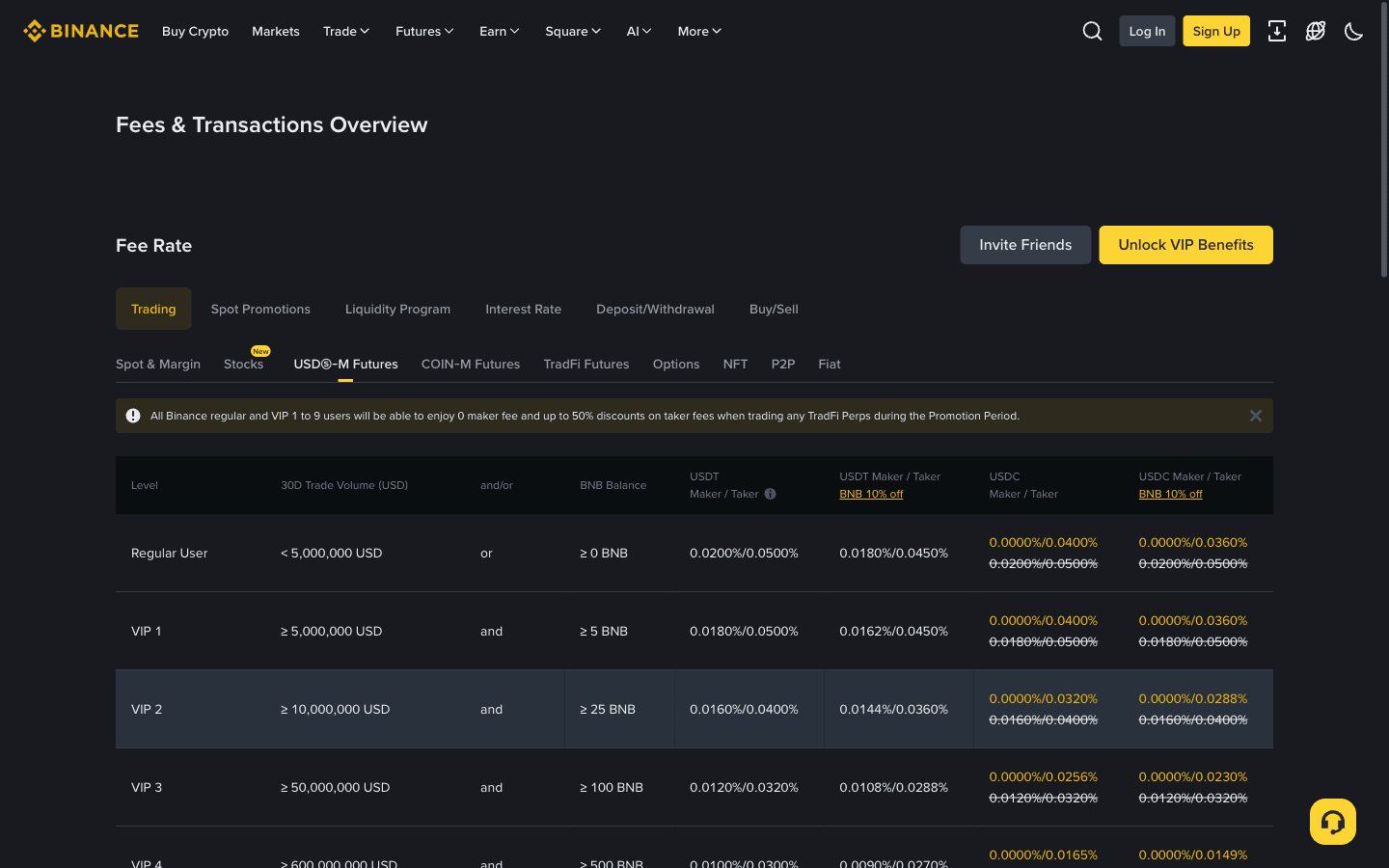
| Binance (baseline) | CEX / exchange | 0.050% / 0.020% (BNB: 0.045% / 0.018%) | 150x (to 300,000 USDT) | 570 + 201 TradFi | 8 hours | Yes | No (Binance.US is separate) |
| Hyperliquid | DEX / you (own L1) | 0.045% / 0.015% (code: 0.0432% / 0.0144%) | 40x (to $150M) | 178 (live) | 1 hour | No | No (Terms §1.6) |
| Lighter | DEX / you (zk-rollup on Ethereum) | 0% / 0% Standard | 50x | 213 | 1 hour | No | No (Terms) |
| Aster | DEX / you | 0.04% / 0% | 150x (to $300,000) | 585 | 8 hours | No | No (Terms) |
| edgeX | DEX / you (own rollup) | 0.045% / 0.04% | 100x (to $1M) | 177 | 4 hours | No | No (Terms) |
| Bybit | CEX / exchange | 0.055% / 0.020% | 150x | 845 | 8 hours | Yes | No (excluded) |
| OKX | CEX / exchange | 0.050% / 0.020% | 100x | 489 USDT-margined | — | Yes | Separate OKX US |
| Kraken | CEX / exchange | 0.050% / 0.020% | Up to 100x (by region) | Over 350 futures | — | Yes | Via Kraken Derivatives US |
| Coinbase | CEX / exchange | Spot 0.60% / 0.40% | — | US Perps | — | Yes | Yes (US Perps) |
Base (lowest-volume) tier for each venue. Sources: each exchange’s fee page, leverage/risk-limit endpoint, instrument list and terms, read September 27, 2026 (Lighter’s market count October 19, 2026); Hyperliquid’s market count is fetched when the page is built (October 20, 2026). “—” = not compared here. Market counts move daily.
3. How to choose a Binance alternative
| Criterion | Why it matters | What to check |
|---|---|---|
| Custody | On a CEX your balance is a claim on the company; on a DEX it sits in your wallet. | Can you withdraw without anyone’s approval? What happens if the venue halts? |
| All-in cost | Fees are only half the bill; funding can cost more over weeks. | Maker/taker at your volume tier, referral discount, funding interval and recent funding. |
| Leverage and depth | Max leverage only applies to small positions; depth decides your slippage. | The leverage bracket at your position size, not the headline number. |
| Access and legality | Exchanges exit countries; using one you are excluded from risks a freeze. | The restricted-countries clause in the terms, and your local regulator. |
| Fiat in and out | DEXs take crypto only. | A regulated exchange in your country to buy USDC and cash out. |
| Order types and modes | Strategies built on hedge mode or FOK orders need them. | Hedge mode, TP/SL, trailing stops, TWAP, API. |
| Support and recovery | A DEX has no password reset. | Are you comfortable managing a seed phrase or hardware wallet? |
Hyperliquid tops our ranking for most people leaving Binance, but not for every reason to switch. If you want zero-fee trading, Aster's 1001x mode, stock perps or a Solana venue instead, our Hyperliquid alternatives guide matches each reason to the venue that fits it.
4. By region: US, EU and Japan
- United States. Hyperliquid, Lighter, Aster, edgeX and Bybit exclude US residents in their terms. Use a US-regulated venue instead: Coinbase, whose derivatives exchange is a CFTC-registered Designated Contract Market listing “US Perps” (perpetual-style futures for US customers), or Kraken Derivatives US, a CFTC-registered futures commission merchant (NFA ID 0309379) offering CME-cleared micro contracts. Do not use a VPN to get around a venue’s restrictions; Hyperliquid’s Terms ban it explicitly (which countries Hyperliquid restricts).
- European Union. Crypto-asset service providers need authorisation under MiCA; check a centralized exchange against ESMA’s interim MiCA register before you move funds to it.
- Japan. Binance’s global platform was discontinued for residents of Japan on December 1, 2023; they were moved to Binance Japan, which is registered with Japan’s FSA as a crypto-asset exchange (Kanto Local Finance Bureau No. 00031). Bybit moved Japanese residents to close-only in March 2026. For the Japanese picture (domestic exchanges, tax and the Payment Services Act), see our Japanese guide to overseas exchanges and Binance alternatives in Japan.
5. Why traders leave Binance
Three reasons come up again and again. Access: Binance states that all new users must complete identity verification before depositing or trading, and centralized exchanges regularly exit whole countries (Binance left Japan in 2023; Bybit did in 2026). Custody: on a centralized exchange your collateral is a claim on the company; the roughly $1.5B theft from Bybit in February 2025 is the reminder most traders cite. Cost: on-chain order books now charge less than the big exchanges’ base rates and have enough depth for normal position sizes.
A decentralized exchange answers all three differently: you connect a wallet, the venue never holds an account in your name, and trades settle on a public ledger. For perpetual futures the relevant DEXs are order-book venues, not swap pools, so the trading experience is close to Binance Futures. New to perps? Start with what perpetual futures are. The rest of this guide shows the exact move to the #1 pick and what changes.
6. How to move from Binance to Hyperliquid (about 15 minutes)
Step 1 — Get a wallet (or use email)
Hyperliquid’s Connect dialog offers Log in with Email, a browser wallet, WalletConnect, OKX Wallet and Coinbase Wallet. For anything beyond a test amount use a wallet you control: Rabby (what Hyperliquid points new users to) or MetaMask, ideally paired with a Ledger, Trezor or Keystone. The seed phrase is the account: write it on paper, keep it offline, and never type it into a website. Email login creates a wallet for you; export its key from the settings menu (Export Email Wallet) so you are not tied to the inbox. More in the best wallet for Hyperliquid.
Step 2 — Withdraw USDC on Arbitrum from Binance or Bybit
- Buy or convert to USDC on the exchange (perp collateral on Hyperliquid is USDC, not USDT).
- Withdraw to your wallet address and choose the Arbitrum One network. Binance's public fee list showed 0.6 USDC for a USDC withdrawal on Arbitrum, with a 3 USDC minimum, on October 15, 2026. Hyperliquid’s wallet deposit accepts USDC on Arbitrum only; email login also accepts USDC on Ethereum, Base and Polygon.
- Also withdraw a few dollars of ETH on Arbitrum. Hyperliquid’s onboarding docs list “USDC and ETH (gas to deposit) on Arbitrum” as what you need. Arbitrum gas was 0.02 gwei on September 25, 2026, so a transfer costs cents.
- Send a small test first. Exchanges usually ask where a withdrawal is going; your own wallet is the clean answer.
Step 3 — Open Hyperliquid and deposit
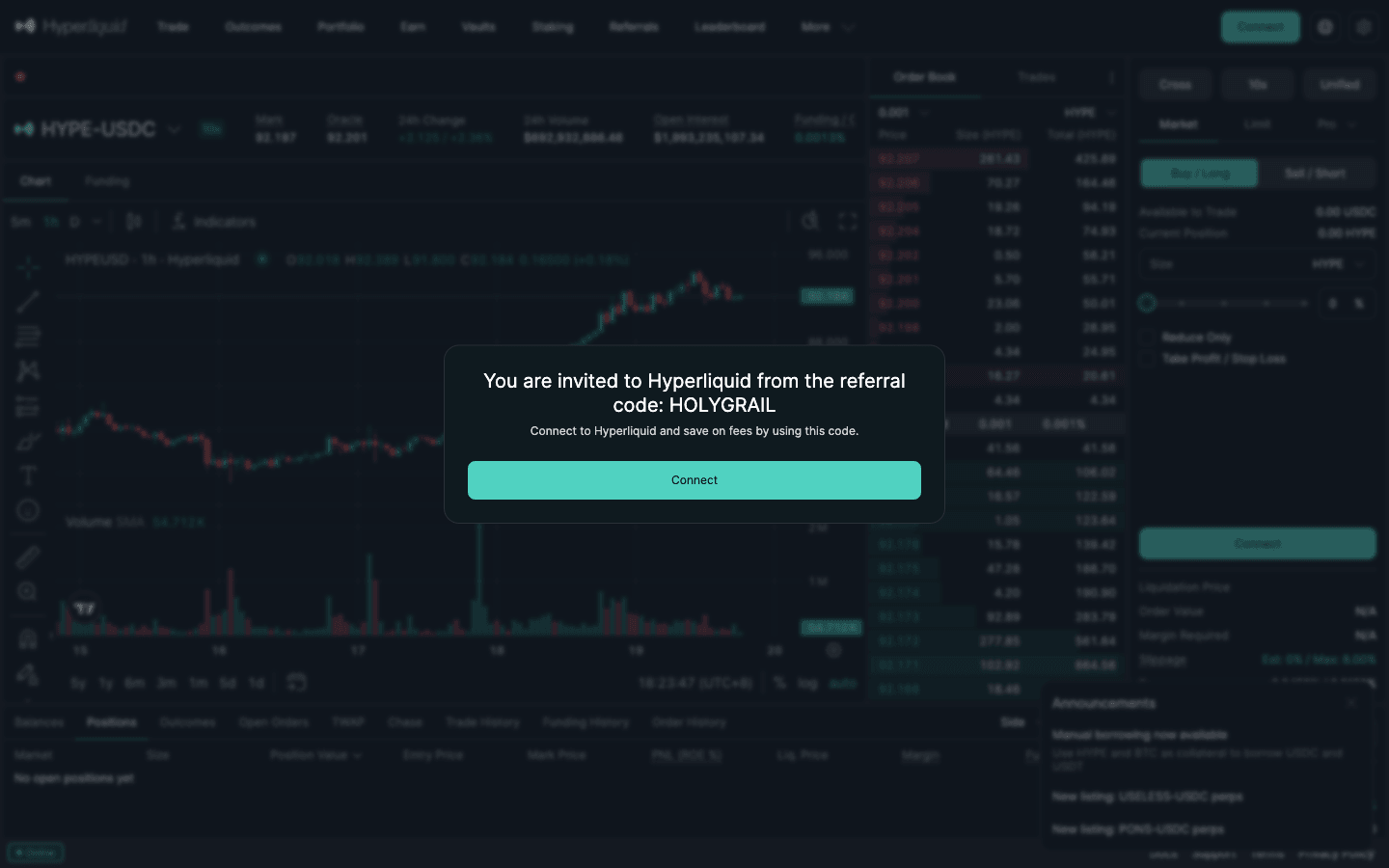
- Open Hyperliquid through the HOLYGRAIL link so the 4% referral discount is attached before you trade.
- Connect, then click Enable Trading. It is a signature, not a transaction, so it costs no gas.
- Click Deposit, choose USDC from Arbitrum, enter at least 5 USDC and approve in your wallet. Hyperliquid’s docs are explicit that less than that is lost. The default route uses Circle’s CCTP, which deducts a flat 0.20 USDC, and funds arrive in under a minute.
Details for every chain and asset, including native BTC, ETH and SOL through Unit, are in the Hyperliquid deposit guide.
Step 4 — Place your first order
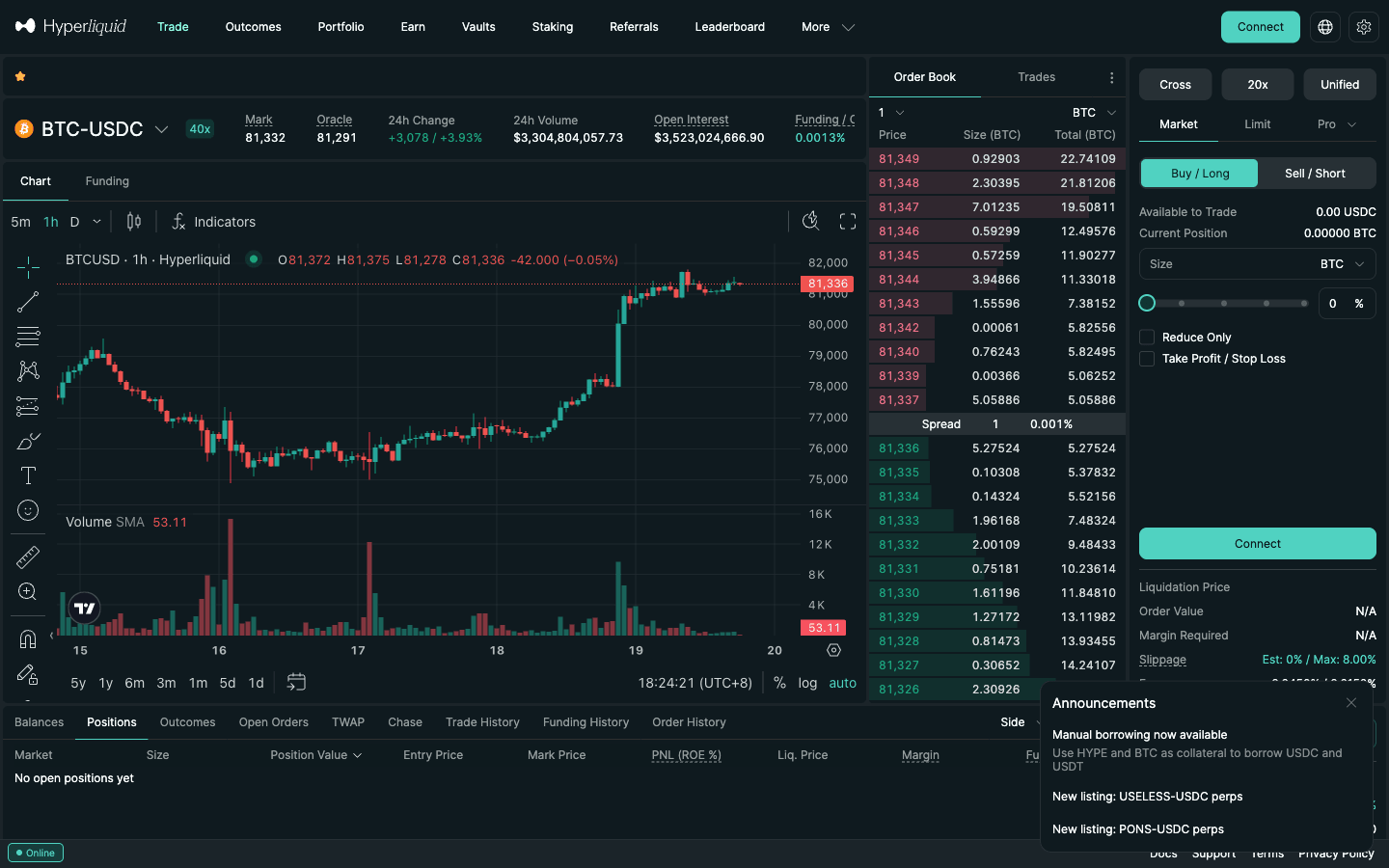
- Open the BTC perp. Next to the order form you will see the margin-mode button (Cross by default), the leverage button and the Unified account button.
- Set leverage. For the first week, 2–3x is plenty: at 40x the maintenance margin on BTC is 1.25%, so a move of little more than 1% can liquidate an isolated position.
- Choose Limit, type price and size (minimum order value $10), tick Take Profit / Stop Loss and fill in TP Price and SL Price. Check the Liquidation Price and Margin Required lines, then Place Order.
- A resting limit order pays the maker fee (0.015%). A market order pays taker (0.045%) and has a default maximum slippage of 8%, which you can lower.
Step 5 — Test a withdrawal
Before you move serious size, withdraw a small amount back to Arbitrum. Hyperliquid charges a flat 0.2 USDC plus a tiny HyperEVM gas fee, and the app says it arrives within 5 minutes (withdrawal guide). Knowing the exit works is the whole point of self-custody.
7. Order types: Binance → Hyperliquid map
Binance’s own help page lists 11 futures order types, and its API exposes five time-in-force values for BTCUSDT (GTC, IOC, FOK, GTX = post-only, GTD). Here is where each lands on Hyperliquid:
| Binance Futures | Hyperliquid equivalent | Notes |
|---|---|---|
| Limit (GTC) | Limit, TIF GTC | Default |
| Market | Market | Max slippage 8% by default, adjustable |
| Post Only (GTX) | Limit, TIF ALO | “Add liquidity only”; rejected if it would match |
| IOC | Limit, TIF IOC | Same behaviour |
| FOK, GTD | None | Hyperliquid’s API has only Alo / Ioc / Gtc |
| Stop-Limit / Stop Market | Stop Limit / Stop Market (Pro menu) | Triggered by the mark price |
| Take Profit (limit / market) | Take Limit / Take Market | Mark-price trigger |
| Limit TP/SL (strategy) | TP/SL checkboxes on Market and Limit | Children placed when the parent fills; one cancels the other |
| Trailing Stop | Trailing Stop (Pro menu) | Perps only; UI only, not in the API |
| Scaled Order | Scale | Start/end price, number of orders, size skew |
| TWAP | TWAP | 5 minutes to 7 days, $100 minimum, 3% max slippage per slice |
| Reverse / Conditional | Not in the order menu | Close and reopen; use Stop/Take triggers |
| Iceberg (via algo) | None native | No display-size field; TWAP is the closest tool |
Sources: Binance FAQ “Binance Futures Order Types” (updated April 7, 2026) and fapi exchangeInfo; Hyperliquid docs trading/order-types and the live order form, September 2026.
One behavioural difference matters for stops: Hyperliquid triggers TP/SL on the mark price, a median that includes Binance, OKX and Bybit prices, and fills market TP/SL with up to 10% slippage tolerance. Walkthroughs: Hyperliquid order types and conditional orders.
Ready to place the first order?
Open Hyperliquid through HOLYGRAIL and your first $25M of volume pays 0.0432% taker instead of 0.045%. Prefer zero fees? Try Lighter with 718610TD.
8. Margin modes, leverage and accounts
| Binance / Bybit feature | On Hyperliquid |
|---|---|
| Cross / Isolated margin | Both; Cross is the default, set per market |
| Hedge mode (long and short on one symbol) | Not available; positions are one-way. Use a sub-account for an opposite leg (or Aster, which has hedge mode) |
| Multi-Assets mode | Unified Account (default): one USDC balance margins perps and spot; spot BTC does not margin a perp |
| Portfolio Margin | Portfolio margin (beta): HYPE, BTC, USDC, USDT as collateral; needs >$5M weighted volume or >$10k account value |
| Sub-accounts | Up to 10 after $100,000 of volume; share the master’s fee tier; no referral discount on sub-accounts |
| API keys | API (agent) wallets: can trade, cannot withdraw; valid up to 180 days |
| Leverage on BTC / ETH / SOL | 40x / 25x / 20x; most alts 10x, 5x or 3x |
| Liquidation | Market orders to the book; no clearance fee; you keep what is left of the margin |
The hedge-mode gap trips up more Binance users than anything else: on Hyperliquid a sell order on BTC while you are long simply reduces the long. See one-way positions, hedging and cross vs isolated margin and sub-accounts.
9. Fee math on a real month of trading
Take a trader who opens and closes a $10,000 BTC position 20 times a month: $400,000 of volume, at each venue’s base tier.
| Venue | Taker rate | Monthly fees (all taker) | Same volume as maker |
|---|---|---|---|
| Bybit (Non-VIP) | 0.055% | $220.00 | $80.00 |
| Binance (Regular) | 0.050% | $200.00 | $80.00 |
| OKX (Regular) | 0.050% | $200.00 | $80.00 |
| Binance paying in BNB | 0.045% | $180.00 | $72.00 |
| edgeX (Regular) | 0.045% | $180.00 | $160.00 |
| Hyperliquid (tier 0) | 0.045% | $180.00 | $60.00 |
| Hyperliquid + HOLYGRAIL | 0.0432% | $172.80 | $57.60 |
| Aster (Pro, VIP 1) | 0.04% | $160.00 | $0.00 |
| Lighter Standard | 0% | $0.00 | $0.00 |
Funding is the other half. Binance and Bybit settle BTC funding every 8 hours; Hyperliquid and Lighter every hour. Over the 30 days to September 25, 2026 a BTC long paid 0.7664% on Hyperliquid, 0.5421% on Binance and 0.4421% on Bybit, so $76.64, $54.21 and $44.21 on $10,000 held all month. If you hold leveraged longs for weeks, funding can outweigh the fee saving; if you trade intraday, fees dominate. Full breakdown: Hyperliquid fees, DEX vs CEX fees, or model your own mix in the fee calculator.
10. What you lose and what you gain
What you lose
- Fiat. No bank deposit or card-to-balance flow on the venue itself; you still need a regulated exchange to turn money into USDC and back.
- Account recovery. No password reset, no support desk that can move funds for you. Lose the key and the funds are gone.
- Protections tied to a licensed, KYC’d account. Hyperliquid’s Terms state it is not licensed or registered anywhere; disputes go to arbitration. There is no regulator to complain to.
- Some tools. Hedge mode, FOK/GTD, iceberg orders, 150x leverage and hundreds of long-tail pairs.
What you gain
- Self-custody of collateral, with a withdrawal that costs 0.2 USDC plus a little gas and does not need anyone’s approval.
- No KYC at the venue (the on-ramp still has it): a wallet is the account.
- Transparency: every fill, liquidation and funding payment is on a public ledger; fees go to HLP and the Assistance Fund, not a company treasury.
- Lower base fees and liquidations with no clearance fee.
Risks do not disappear, they change shape: smart-contract and bridge risk, oracle and market-manipulation incidents (Hyperliquid’s HLP absorbed losses in the JELLY and POPCAT episodes in 2025) and phishing. Read the DEX security checklist before moving large balances, and the no-KYC guide for what “no KYC” does and does not mean. Many traders end up with two accounts: Hyperliquid for majors and Lighter for fee-free scalping (Hyperliquid vs Lighter vs Aster).
11. Migration mistakes to avoid
- USDC on the wrong chain. A wallet-connected Hyperliquid deposit takes Arbitrum USDC only. Base or Ethereum USDC needs email login or a bridge first (bridge guide).
- Depositing under 5 USDC. It is lost, not refunded.
- No ETH on Arbitrum. You cannot sign the deposit transaction without it.
- Expecting hedge mode. A short on the same coin closes your long.
- Carrying CEX leverage habits. Start at 2–3x and learn how mark-price triggers behave.
- Joining without the referral link. The code cannot be added after $10,000 of volume and cannot be changed once set.
- Ignoring tax records. A DEX sends no annual statement; export Trade History and Funding History as CSV from the app (tax reporting guide).
12. FAQ
What is the best alternative to Binance?
For perpetual futures, Hyperliquid: the largest on-chain perp exchange ($216.95B of the $626.46B traded on all perp DEXs in the 30 days to September 27, 2026, per DefiLlama), a Binance-style order book with stop, take-profit, trailing-stop, scale and TWAP orders, 0.045% taker (0.0432% with a referral code) versus 0.050% at Binance, and no account to open. If you need fiat deposits, a regulator or support, the closest centralized alternatives are Bybit and OKX offshore, and Kraken or Coinbase in the US.
Which platform is best for crypto futures trading?
It depends on what you need. Lowest fees: Lighter (0% maker / 0% taker on the Standard account). Deepest on-chain liquidity: Hyperliquid. Highest order-book leverage on a DEX: Aster (150x on BTC up to $300,000 of notional) for small positions, edgeX (100x up to $1M) for larger ones. Highest leverage overall: Binance and Bybit (150x on BTC at both). Regulated US access: Coinbase (US Perps) or Kraken Derivatives US.
Is Bybit better than Binance?
For futures they are close. Bybit charges 0.055% taker / 0.020% maker to Non-VIP users against Binance’s 0.050% / 0.020%; both allow 150x on BTCUSDT, and both settle BTC funding every 8 hours. Bybit lists 845 linear perps, Binance 570 crypto perps plus 201 TradFi perps (September 27, 2026). Bybit does not serve the US, mainland China, Hong Kong, Singapore, Canada and sanctioned regions, and it moved Japanese residents to close-only in 2026. Neither is self-custodial.
Which is better, OKX or Binance?
On base futures fees they are identical: 0.050% taker / 0.020% maker at Regular on both. Binance allows 150x on BTCUSDT up to 300,000 USDT, OKX 100x on BTC-USDT. OKX lists 489 USDT-margined perpetual swaps. US residents are served by a separate company, OKX US, under its own terms. For self-custody, both are beaten by a DEX such as Hyperliquid.
Is Binance or Coinbase better?
They serve different people. Coinbase is the regulated US choice: Coinbase Derivatives is a CFTC-registered Designated Contract Market listing “US Perps” for US customers. Its Advanced/Exchange spot fees start at 0.60% taker / 0.40% maker at the lowest volume tier, far above Binance’s futures rates. Binance offers more markets and higher leverage but is not available to US residents (Binance.US is a separate company).
What is safer than Binance?
No venue is risk-free, but the risk changes shape. Binance keeps its SAFU insurance fund (valued at $1B in 2022) and paid about $283M to users liquidated during the October 2025 collateral depeg, yet funds on any CEX are a claim on the company. A self-custodial DEX removes that counterparty risk (withdrawals need nobody’s approval) and adds smart-contract, bridge, oracle and key-management risk. Keep only trading margin on any venue.
What is the best Binance alternative in the US?
Hyperliquid, Lighter, Aster, edgeX and Bybit all exclude US residents in their terms, so use a US-regulated venue: Coinbase (US Perps on a CFTC-registered DCM) or Kraken Derivatives US (a CFTC-registered FCM with CME-cleared micro futures). Never use a VPN to get around a venue’s restrictions; it breaks the terms and can freeze your funds.
How do I move my funds from Binance to a DEX?
Withdraw USDC from Binance on the Arbitrum One network to your own wallet (Rabby or MetaMask), together with a little ETH on Arbitrum for gas; Binance's public fee list showed 0.6 USDC for that withdrawal (minimum 3 USDC) on October 15, 2026. Open Hyperliquid, connect the wallet, click Enable Trading (a free signature) and deposit at least 5 USDC. It arrives in about a minute.
Do I need KYC to trade on Hyperliquid?
No. Your wallet (or an email-created wallet) is the account and Hyperliquid never holds an account in your name. The centralized exchange you withdraw from still requires identity verification, trading is public on-chain, and taxes still apply. Hyperliquid’s Terms (§1.6) exclude residents of the US, Ontario and sanctioned regions.
Is trading on a DEX cheaper than Binance Futures?
On published base rates, yes for most users: Binance charges 0.050% taker / 0.020% maker to Regular users (0.045% / 0.018% paying in BNB), Hyperliquid 0.045% / 0.015% (0.0432% / 0.0144% with a referral code), Aster 0.04% / 0% and Lighter Standard 0% / 0%. Funding is separate and can cost more than fees: in the 30 days to September 25, 2026 a BTC long paid 0.77% on Hyperliquid versus 0.54% on Binance.
Which Binance order types does Hyperliquid not have?
Hyperliquid has limit, market, stop limit, stop market, take limit, take market, trailing stop (perps only), scale, TWAP and post-only (ALO) orders. It has no FOK or GTD time-in-force, no hedge mode (positions are one-way) and no native iceberg order. Maximum leverage is lower: 40x on BTC versus 150x on Binance and 150x on Bybit.
What happens if I lose my wallet?
There is no password reset. Whoever holds the seed phrase or private key controls the funds, and no support desk can recover them. Write the seed phrase on paper, keep it offline, consider a hardware wallet for larger balances, and export the key of an email-login wallet so you are not dependent on the email.
Make the move
Hyperliquid with HOLYGRAIL: 4% off fees on your first $25M, your own keys, and the deepest on-chain order book. Also on our list: Lighter (718610TD), Aster (DTLpLc) and edgeX (HOLYGRAIL).
Disclosure: HOLYGRAIL (Hyperliquid, edgeX), 718610TD (Lighter) and DTLpLc (Aster) are our referral codes; we earn a share of referred accounts’ fees at no cost to you. We have no referral relationship with Bybit, OKX, Kraken or Coinbase. Fees, leverage, market counts and terms were read from each venue’s official pages and public APIs on September 27, 2026. Not investment, legal or tax advice.