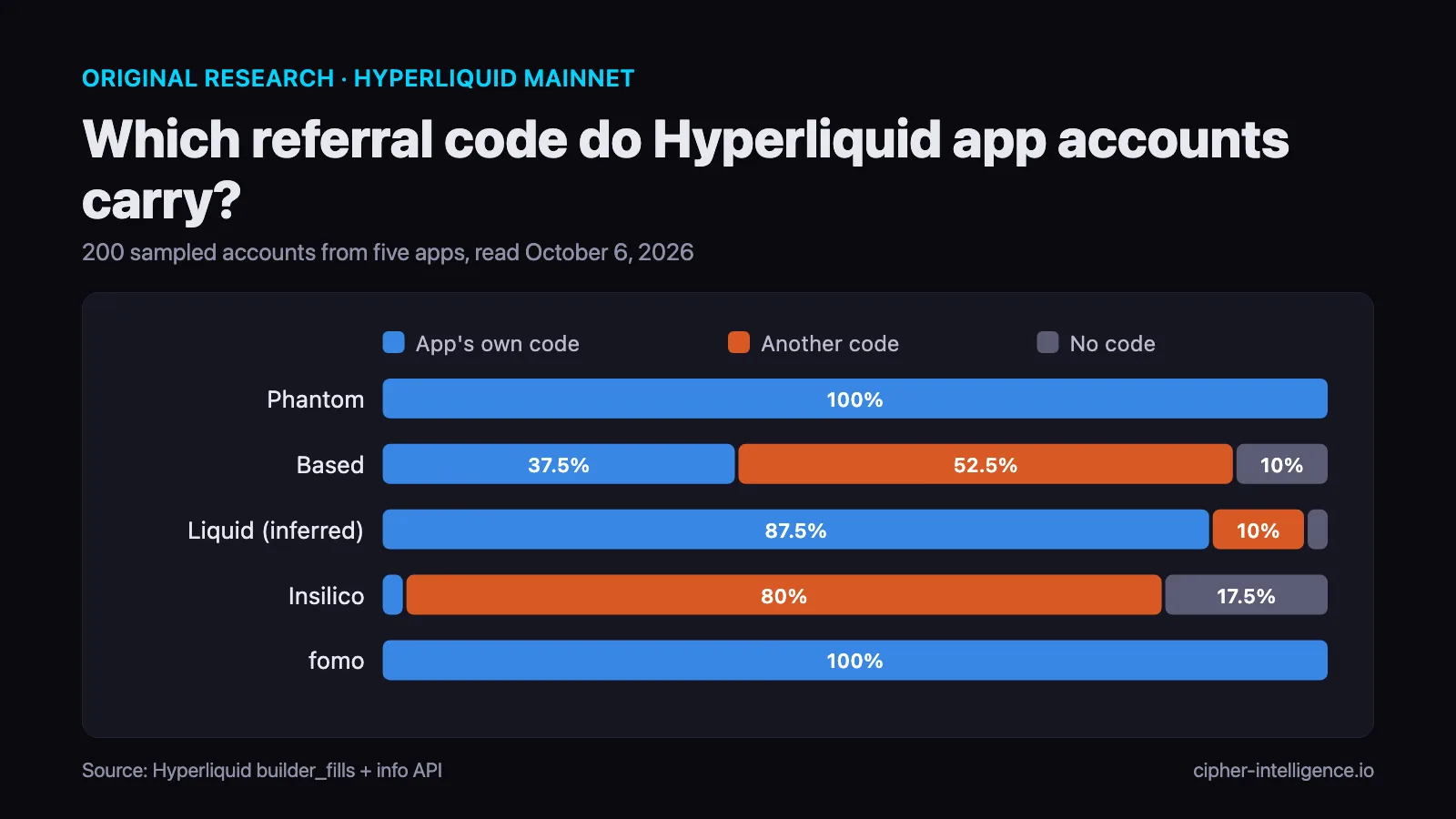
Findings (200 accounts from 5 apps, measured October 6, 2026):
- The referee discount survives app orders. On builder-coded fills, accounts with a 4% referral discount paid a median 0.96x their own rate for Hyperliquid’s part of the fee (all 129 accounts within ±0.5% of that); accounts without a discount paid 1.00x. The app’s builder fee comes on top.
- The referrer is paid on app orders, on Hyperliquid’s part only. Across 28 referees who traded only through apps over 45 minutes, referrer rewards grew by 10.0% of fee minus builder fee, but only 4.6% of the total fee.
- Apps often attach their own codes. Share of sampled accounts carrying the app’s own code: Phantom 100%, Liquid (inferred) 87.5%, Based 37.5%, Insilico 2.5%.
- fomo creates its own account. 100% of fomo accounts carried the same code, TRYFOMO (attributed to fomo), so no outside Hyperliquid code applies there.
What to do: set a code on app.hyperliquid.xyz before you start using an app. Join with HOLYGRAIL → Steps, the $10,000 limit and how to check it: Hyperliquid referral code HOLYGRAIL.
1. The question, and why we asked it
Many traders never open app.hyperliquid.xyz. They trade through wallets and apps (Phantom, MetaMask, Based, Liquid, fomo and many others) that attach a builder code to each order and collect a builder fee on top of Hyperliquid’s own fee. A common claim, repeated on many referral pages, is that a builder code switches off the trader’s referral code for that order: the trader loses the 4% discount and the referrer earns nothing.
The claim has a real source. A Hyperliquid documentation page says “builder codes override referral codes for that order”. But that page describes a proposed staking referral program, and its header says there is “no definitive implementation” of it for mainnet. The live fee formula in the fees documentation applies (1 - activeReferralDiscount) with no builder condition. Documentation can lag behind the chain in either direction, so we measured what mainnet actually does.
We have a stake in the answer, and we were wrong about it once. Until October 1, 2026, some of our own pages repeated the “builder codes override referral codes” line. A first check on fills from September 29–30 contradicted it, and we corrected those pages. This study re-runs that check with a fresh, seeded sample, a fifth app, and a published script, so that anyone can verify the result without trusting us.
2. Data and method
All data is public and was read without an API key, with a generic User-Agent and no wallet connection.
| Step | Source | What we took |
|---|---|---|
| A. App activity | stats-data.hyperliquid.xyz/Mainnet/builder_fills/<builder>/<day>.csv.lz4, October 3–5, 2026 (UTC days) | Every fill each app sent: account, market, price, size, taker or maker, builder fee. Plain USDC perps only (HIP-3 and spot have other fee formulas). |
| Sample | Same files | 40 accounts per app among accounts with at least 3 fills, ordered by a SHA-256 hash of the address with the fixed seed “cipher-2026-10”, so the sample is set by the seed, not picked by hand. |
| B. Account state | api.hyperliquid.xyz/info: referral, userFees | The referral code on the account; the account’s own maker and taker rate before the referral discount; its active referral discount. |
| B. Fills | userFillsByTime, from October 4, 2026 (48 hours) | Each fill’s total fee and builder fee. Builder-coded fills only, notional of at least $50, positive fee. |
| C. Referrer rewards | referral for each referrer, read twice 45 minutes apart (run from 14:44 to 15:41 UTC, October 6, 2026) | The reward credited per referee (cumFeesRewardedToReferrer), compared with the referee’s fills in between. A referee counts only if every one of those fills went through an app. Referees: the sampled accounts, plus the 40 most active accounts per app on October 5, 2026 (most sampled accounts pay too little in 45 minutes to measure). |
Formulas. For each builder-coded fill: Hyperliquid’s part of the fee rate = (fee − builder fee) ÷ (price × size). Dividing it by the account’s own rate (taker if the fill crossed the spread, maker otherwise) gives a ratio: 1.00 means the full rate, 0.96 means a 4% discount. We take each account’s median ratio. For referrers: Δreward ÷ Σ(fee − builder fee) over the window, which would be 10% if the referrer earns 10% of Hyperliquid’s part, and Δreward ÷ Σ(total fee), which would be 10% if the builder fee counted too.
Reproduce it. Download the script (with its LZ4 decoder in a lib/ folder next to it) and run node hl-referral-builder-study.mjs --dates 2026-10-03,2026-10-04,2026-10-05 --sample 40 --delta-top 40 --wait-min 45 --seed cipher-2026-10 --out-dir out. It needs Node 22+, no dependencies and no key. The aggregate results are in this CSV (CC BY 4.0). Neither file contains a trader’s address.
3. The five apps in the sample
Builder addresses are public, but the apps do not publish which address is theirs. All five addresses carry an app label in DefiLlama’s open-source fee adapters, and we checked each with Hyperliquid’s API: three own a referral code named after the app (PURPS, SHIFU, INSILICO). fomo’s address owns a code with no referrals, and Liquid’s owns none, so Liquid rests on the label and its fee levels and is marked as inferred.
| App | Perp fills, October 3–5, 2026 | Accounts | Notional | Builder fees | Most common builder fee (share of fills) |
|---|---|---|---|---|---|
| Phantom | 65,667 | 5,478 | $64.8M | $32,400 | 0.05% (100%) |
| Based | 5,776 | 226 | $4.72M | $989 | 0.025% (90%), 0% (7%) |
| Liquid (inferred) | 14,146 | 630 | $20.3M | $6,650 | 0.05% (25%), 0.045% (24%) |
| Insilico | 33,164 | 202 | $49.9M | $4,990 | 0.01% (100%) |
| fomo | 58,068 | 2,904 | $83.3M | $35,000 | 0.05% (84%), 0.01% (15%) |
Plain USDC perps in the daily builder_fills files, October 3–5, 2026. How each address is attributed: Phantom: labelled “phantom-perps” by DefiLlama; the address itself owns the referral code PURPS; Based: labelled “based-app” by DefiLlama; the address itself owns the referral code SHIFU, which Based’s web app sets (read in its code on October 1, 2026); Liquid (inferred): inferred: labelled “liquid-perps” by DefiLlama, but the address owns no referral code; its 0.05% builder fee and 0.045% for referred users match Liquid’s published rates, and Liquid’s web app sets TRADEXYZ; Insilico: labelled “insilico” by DefiLlama; the address itself owns the referral code INSILICO; fomo: labelled “fomo-social-trading-perps” by DefiLlama; the address owns the code FOMOFAMILY (no referrals), and TRYFOMO, owned by another address, is the code every sampled fomo account carried, so we attribute it to fomo.
4. Which code do app accounts carry?
A Hyperliquid account has at most one referral code, set once. We read it for every sampled account:
| App | Sampled | App’s own code | Another code | No code |
|---|---|---|---|---|
| Phantom · PURPS | 40 | 40 (100%) | 0 (0%) | 0 (0%) |
| Based · SHIFU | 40 | 15 (37.5%) | 21 (52.5%) | 4 (10%) |
| Liquid (inferred) · TRADEXYZ | 40 | 35 (87.5%) | 4 (10%) | 1 (2.5%) |
| Insilico · INSILICO | 40 | 1 (2.5%) | 32 (80%) | 7 (17.5%) |
| fomo · TRYFOMO | 40 | 40 (100%) | 0 (0%) | 0 (0%) |
| All | 200 | 131 (65.5%) | 57 (28.5%) | 12 (6%) |
The share of accounts carrying the app’s own code ranges from 100% (Phantom) to 2.5% (Insilico). That is consistent with apps setting their own code on accounts that arrive without one, which we also read in the code of the Based and Liquid web apps (October 1 check): Based sets its code only when the account has none, so accounts that arrive with a code keep it. Phantom is itself the wallet, and fomo creates the wallet, so their users rarely arrive with a code of their own. “Another code” covers every other referrer; we do not publish which ones.
5. Does the referee keep the discount on app orders?
Yes. Here is Hyperliquid’s part of the fee on builder-coded fills, divided by each account’s own rate:
| App | Accounts with app fills | Fills used | With discount: median ratio (n) | Without discount: median ratio (n) |
|---|---|---|---|---|
| Phantom | 31 | 700 | 0.9600 (30) | 1.0000 (1) |
| Based | 29 | 1,557 | 0.9600 (21) | 1.0000 (8) |
| Liquid (inferred) | 31 | 346 | 0.9600 (30) | 1.0000 (1) |
| Insilico | 33 | 4,658 | 0.9600 (22) | 1.0000 (11) |
| fomo | 26 | 709 | 0.9600 (26) | — (0) |
| All | 150 | 7,970 | 0.9600 (129) | 1.0000 (21) |
Fills from October 4, 2026 to October 6, 2026. Accounts with no qualifying app fill in the window have no ratio. 12 accounts had a referrer but no active discount; 12 of them were above the $25M discount cap.
Every one of the 129 accounts with a discount had a median within ±0.5% of 0.96, and every one of the 21 accounts without one within ±0.5% of 1.00, whichever app sent the order. So for a tier-0 taker with a code, an app order costs 0.0432% for Hyperliquid plus the app’s builder fee, not 0.045% plus the builder fee.
6. Is the referrer paid on app orders?
Yes, on Hyperliquid’s part of the fee. Each dot pair below is one referee: the change in the referrer’s recorded reward for that referee, divided by Hyperliquid’s part of the fees the referee paid in the same window (blue) and by the total fee including the builder fee (orange). Rows are sorted by the builder fee’s share of the referee’s fees.
| App | Referees checked | Fees paid | of which builder fees | Referrer reward | ÷ Hyperliquid’s part | ÷ total fee |
|---|---|---|---|---|---|---|
| Phantom | 8 | $127.86 | $68.15 | $5.97 | 10.00% | 4.67% |
| Based | 3 | $295.90 | $136.17 | $15.97 | 10.00% | 5.40% |
| Liquid (inferred) | 5 | $50.48 | $25.75 | $2.47 | 10.00% | 4.90% |
| Insilico | 4 | $91.08 | $18.29 | $7.28 | 10.00% | 7.99% |
| fomo | 8 | $510.72 | $327.99 | $18.27 | 10.00% | 3.58% |
| All | 28 | $1,076.03 | $576.36 | $49.97 | 10.00% | 4.64% |
Window of 45 minutes on October 6, 2026. Not checked: 103 × referee not in the referrer’s list (the API returns at most 5,000 referees per referrer); 216 × under $1 of fees in the window; 20 × HIP-3 or spot fills in the window; 3 × referee above $1B lifetime volume (no reward by rule); 1 × traded only outside apps in the window (no builder-coded fill).
Every one of the 28 referees, all trading only through apps in the window, came out at 10.00% of Hyperliquid’s part, to two decimals, across all 5 apps. If the builder fee counted toward the reward, the orange dots would sit at 10%. They sit lower, and the further the more of a referee’s fees went to the app; the blue dots stay at 10% throughout. That matches Hyperliquid’s wording, “10% of referred users’ fees, less any fee discount they receive”, with “fees” meaning Hyperliquid’s fee, not the app’s. One side effect for anyone checking their own referrals: the API field cumRewardedFeesSinceReferred includes builder fees, so reward ÷ that field looks lower than 10% for app traders.
7. Limitations
- Sample. 200 accounts from 5 apps, one seed. Shares per app are estimates with wide error bars at 40 accounts each; the fee results (0.96 and 10%) are mechanical and showed no app-specific exception.
- Attribution. No app confirmed its address to us; the labels are DefiLlama’s, checked against the referral codes the addresses own. The builder we call Liquid owns no code and is inferred from the label and its fee levels. TRYFOMO is attributed to fomo because every sampled fomo account carries it, not because fomo documents it. MetaMask, Trust Wallet and other large builders are not in this sample.
- Timing.
userFeesreturns the rate at the time of reading; a tier or staking change inside the window shows up as an outlier. Referrer snapshots are not atomic, so fills landing mid-request can shift a single referee’s ratio slightly; the totals are less affected. - What we cannot see. The data shows which code an account carries, not who set it or when. We do not know how apps decide, beyond the web-app code we read for Based and Liquid. Hyperliquid can change any of this without notice; the dates above are when it was true.
- Privacy. We read individual accounts to compute aggregates, but publish no address, no individual referrer and no per-trader amount.
8. What it means for traders
- Set your code first. Open a join link on app.hyperliquid.xyz with the wallet you will use, enable trading and deposit, before you connect that wallet to an app. Once an app has set its code, yours can no longer be added, and after $10,000 of volume no code can be entered at all.
- Connect the same wallet. In apps that let you connect an external wallet (Based, Liquid), the account and its code come with you. An email or social login creates a new account without your code.
- On fomo, use fomo’s code. fomo makes the account, so a Hyperliquid code from elsewhere cannot apply. Its own referral program cuts its fee.
- Check your own account. The builder fee checker shows the code on any address and which apps can charge it. In any fill, (fee − builderFee) ÷ notional should be 0.96 × your rate if a discount is active.
Set a code before your first app
Code HOLYGRAIL takes 4% off Hyperliquid’s part of your fees for the first $25M of volume, on app.hyperliquid.xyz and in apps you connect with the same wallet.
We earn a share of referred accounts’ Hyperliquid fees; it never raises yours.
9. Disclosure and corrections
We run the Hyperliquid referral code HOLYGRAIL, so we benefit when readers use it, and a finding that codes survive app orders is good for us. That is why the method is fixed in advance by a seed, the script is downloadable and the data is public: the conclusions hold for any referral code, not just ours, and you can check them yourself. The study was commissioned, reviewed and published by BLTZ, the editor of this site, who is responsible for it. The data was collected by the published script; the analysis and the draft were prepared with automated (AI-assisted) tooling, and every number on this page is generated from the data file. If you find an error, write to us on X (@bltzman); corrections will be dated on this page.
Related corrections: on October 1, 2026 we removed the claim that app orders lose the referral discount from our referral code guide, the builder codes guide and other pages, after the first mainnet check.
FAQ
Is the Hyperliquid fee discount kept on orders placed through Phantom, Based or Liquid?
Yes, on Hyperliquid’s part of the fee. In our October 6, 2026 sample, accounts with a referral discount paid a median 0.96x their own Hyperliquid rate on fills placed through apps (the 4% discount), and accounts without one paid 1.00x. The app’s builder fee is added on top and is not reduced by the Hyperliquid code.
Does the referrer still earn when the referee trades through an app?
Yes. For 28 referees whose every fill in a 45-minute window went through an app, the referrers’ recorded rewards grew by 10.0% of Hyperliquid’s part of their referees’ fees (fee minus builder fee), against 4.6% of the total fee. The referrer gets 10% of Hyperliquid’s part; nothing is paid on the app’s builder fee.
Why does my account show an app’s referral code instead of mine?
A Hyperliquid account carries one referral code, and it cannot be changed once set. Several apps set their own code on accounts that have none: in our sample, 100% of Phantom accounts carried Phantom’s code and 87.5% of the accounts of the builder we attribute to Liquid carried TRADEXYZ. To use another code, open its join link on app.hyperliquid.xyz before you start using an app, and before your account passes $10,000 of volume.
Does a Hyperliquid referral code work on fomo?
No. fomo creates its own wallet and Hyperliquid account when you sign up, and 100% of the fomo accounts in our sample carried the same code, TRYFOMO, which we attribute to fomo. On fomo, the code that counts is fomo’s own referral program.
Can I re-run this study?
Yes. Everything comes from public endpoints (Hyperliquid’s daily builder_fills files and its info API). The script and the aggregate CSV are linked in the methodology section; it needs Node 22 or later, no API key and about an hour including the referrer window.
Disclosure: HOLYGRAIL is our Hyperliquid referral code; we earn 10% of Hyperliquid’s part of referred accounts’ fees at no cost to them. Data: Hyperliquid public endpoints, read October 6, 2026. Not investment advice.