
Quick answer. Hyperliquid is the better choice for most perp traders: a central limit order book on its own chain with 0.045% taker / 0.015% maker fees, no gas on orders and 12–31 times GMX’s daily volume in our September 2026 snapshots. GMX is the better choice if you want trades filled at the oracle price with capped price impact, up to 100x leverage, or collateral other than USDC, straight from an Arbitrum or Avalanche wallet. The main trade-off is depth and simple fees on Hyperliquid versus predictable fills and a longer smart-contract track record on GMX.
Choose Hyperliquid if you…
- trade often, or use limit orders (0.015% maker)
- trade size or altcoins and need a deep book
- want no borrow fee and no gas per order
- run a bot, or want to copy a trader through vaults
Choose GMX if you…
- want oracle-priced fills with a known worst case
- need more than 40x on BTC or ETH (up to 100x)
- want to post BTC, ETH or USDT as collateral
- prefer audited contracts on Arbitrum or Avalanche
Trade on Hyperliquid with 4% off
Join with code HOLYGRAIL to get 4% off every trading fee on your first $25M of volume. The discount applies automatically.
We earn a commission when you sign up through our links; it never raises your fees.
1. Hyperliquid vs GMX at a glance
The last column says which venue has the edge on each line. Hyperliquid wins most rows on cost, depth and tools. GMX wins on leverage, collateral choice and how its security is set up.
| Hyperliquid | GMX v2 | Edge | |
|---|---|---|---|
| Model | Central limit order book on its own L1 (HyperCore) | Trades fill against GM / GLV liquidity pools at the Chainlink Data Streams oracle price | Different by design |
| Chains | Hyperliquid L1; USDC in from Arbitrum, Ethereum, Base, Polygon; native BTC / ETH / SOL deposits | Arbitrum, Avalanche, MegaETH; GMX Account from Ethereum, Base, BNB; GMTrade on Solana | GMX (trade from your L2 wallet) |
| Trading fee | 0.045% taker / 0.015% maker (tier 0), down to 0.024% / 0% with volume | 0.04% if your trade reduces the long/short imbalance, 0.06% if it widens it, on open and close | Hyperliquid for limit orders; close on market orders |
| Holding cost | Hourly funding between longs and shorts | Adaptive funding plus a borrow fee paid by the larger side | Hyperliquid (no borrow fee) |
| Price impact / slippage | Walk the order book (spread + depth) | None at entry; net price impact settled at close, capped at 50 bps on BTC, ETH, SOL | GMX for predictability, Hyperliquid for size |
| Network fee | None on orders | Keeper execution fee per order (unused part refunded) | Hyperliquid |
| Max leverage | BTC 40x · ETH 25x · SOL 20x · HYPE 10x | Up to 100x; TradFi 10–100x by session | GMX |
| Collateral (margin) | USDC for the main perps; portfolio margin adds HYPE, BTC, USDT for eligible accounts | Either token of the market’s pool (e.g. BTC or USDC in BTC-USDC); GMX Account takes USDC, USDT, ETH | GMX (more flexible) |
| Order types | Market, limit, post-only, IOC, stop/take market and limit, scale, chase, trailing stop, TWAP | Market, limit, stop market, TWAP, TP/SL, all executed by keepers at the oracle price | Hyperliquid |
| Markets | 178 perps (October 20, 2026), spot pairs, HIP-3 stocks and commodities | 117 listed perp markets on Arbitrum (crypto + gold, silver, oil, natgas, QQQ, SPY, SPCX), plus swaps | Hyperliquid |
| 24h perp volume | $4.03B (October 20, 2026) | $94M on Sep 26, 2026 18:10 UTC ($609M on Sep 25) | Hyperliquid, 12–31x |
| Open interest | $11.05B (October 20, 2026) | $261M long + short on Sep 26, 2026 | Hyperliquid |
| Passive side | HLP ($179.1M, 3.5% APR, October 20, 2026) and user vaults | GM / GLV pools receive 63% of fees and take the other side of trader PnL | Depends on risk appetite |
| Copy trading | User vaults: follow a trader, leader keeps 10% of profits | No built-in copy trading | Hyperliquid |
| KYC and access | No KYC; excludes the US, Ontario and sanctioned regions | No KYC; excludes U.S. persons and sanctioned territories | Tie |
| Security model | Own proof-of-stake chain: 35 validators, Hyper Foundation 47.3% of stake | Audited smart contracts on public chains (Arbitrum, Avalanche, MegaETH) | GMX (less concentrated) |
| Track record | Live since 2023; March 2025: HLP loss on an ETH whale, validators delisted JELLY | Live since 2021; V2 unaffected by the July 2025 V1 exploit ($42M) | Both have incidents |
| Fee discounts | Referral 4% (first $25M); HYPE staking 5–40% | Referral code 5–10% off position fees only | Hyperliquid |
| Main trade-off | Depth, fees and tools, but a younger chain with a concentrated validator set | Oracle fills, high leverage and flexible collateral, but thin books outside BTC/ETH and more fee lines |
GMX: docs.gmx.io, gov.gmx.io and arbitrum.gmxapi.io (stats across all networks, market list), read September 26, 2026, 18:10 UTC. Hyperliquid: docs and api.hyperliquid.xyz; volume, open interest, market count and HLP figures refresh at every build and carry their own date. Hyperliquid volume usually runs $4–8B a day on weekdays and less at weekends.
2. How each one works: order book vs GM pools
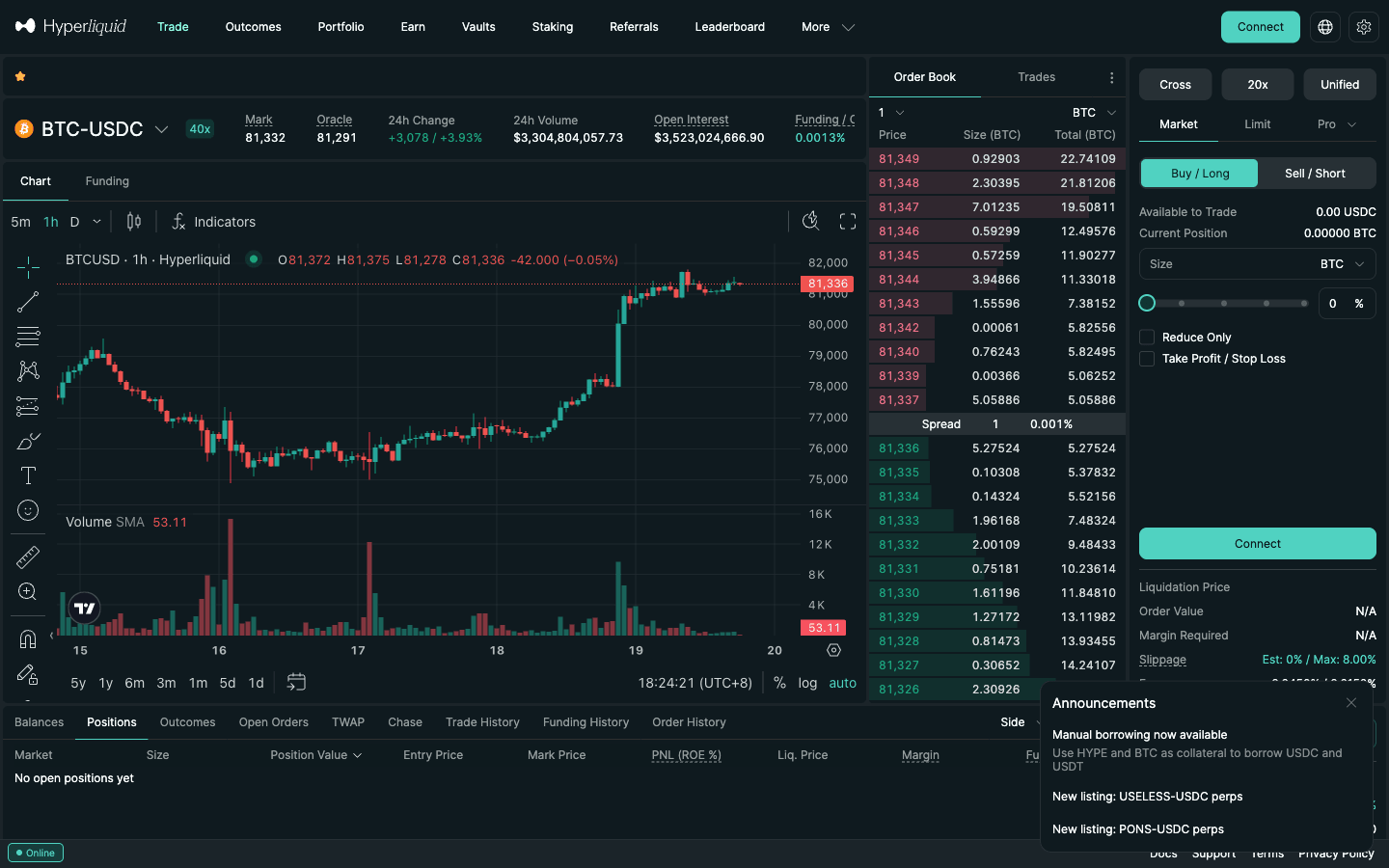
Hyperliquid runs its own layer 1. HyperCore keeps an order book for every market in chain state and matches orders by price and time, like a centralized exchange. HyperEVM sits beside it for smart contracts. Your counterparty is another trader or market maker. Orders, cancels, funding and liquidations cost no gas. Arbitrum is only one of several places to deposit USDC from.
How GMX works. GMX v2 is a set of smart contracts on Arbitrum, Avalanche and MegaETH. It has no order book. Each market is backed by a GM pool of two tokens, such as BTC for longs and USDC for shorts. A GLV vault spreads liquidity across several GM markets. The pool is the counterparty to every position, and every trade is priced at the Chainlink Data Streams oracle price rather than against a book: longs enter at the oracle’s ask and shorts at its bid. Each trade takes two transactions. You submit a request, and a keeper executes it. You pay the keeper’s gas as a “network fee”, and the unused part is refunded. With Express Trading you sign off-chain and can pay that gas in USDC.
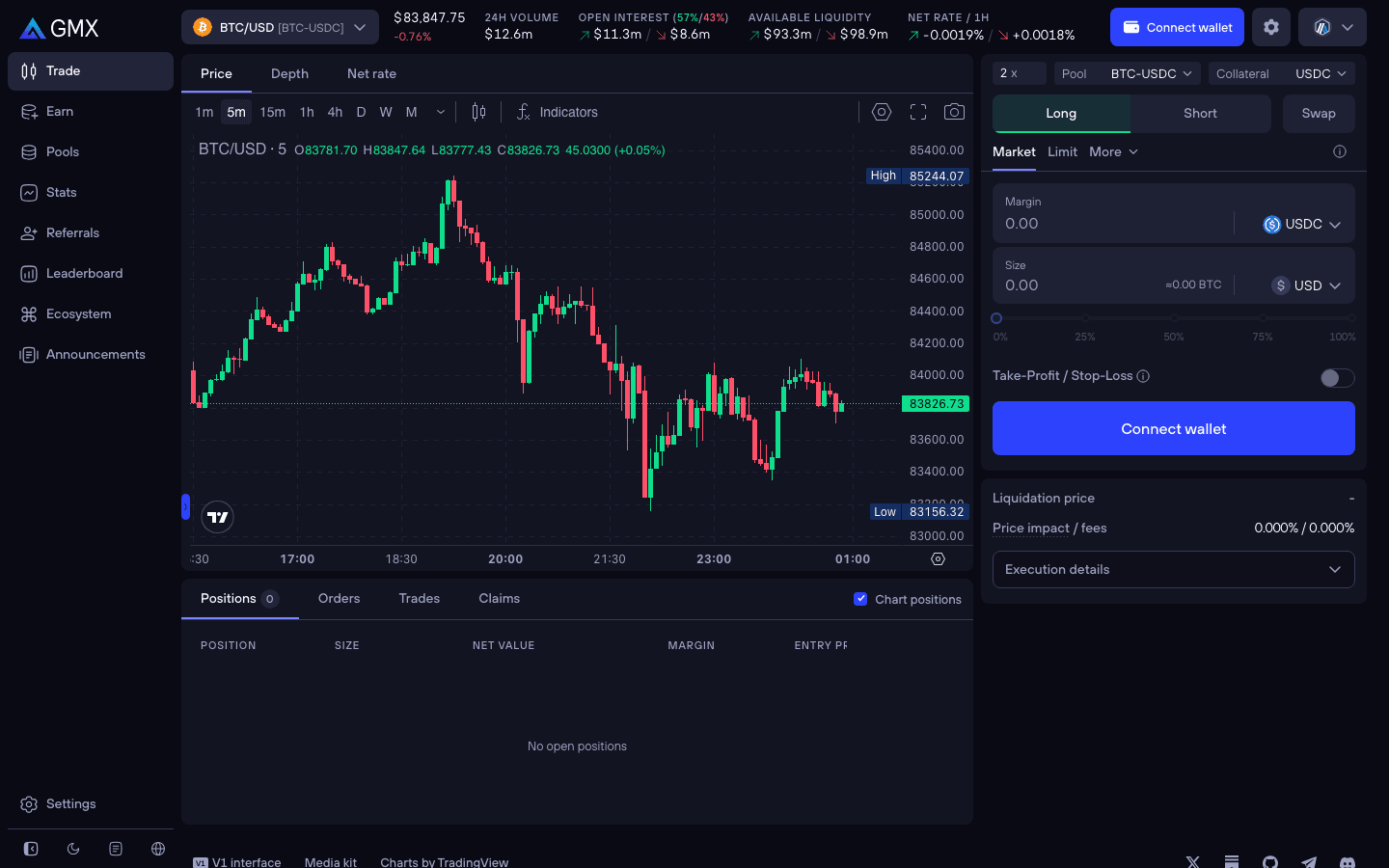
This one design choice explains most of the table above. An order book gives you maker fees, a visible spread and depth that grows with activity. An oracle pool gives you the index price, with only the oracle’s own bid/ask spread, however large your order. The pool then charges for the risk it takes through position fees, borrow fees and price impact tied to its long/short balance. Background: AMM vs order book DEXs.
3. GMX v1 (GLP) vs v2 (GM and GLV)
Many guides still describe GLP, the single multi-asset pool behind GMX v1. That version is gone. GMX’s docs say V1 trading and GLP liquidity have been phased out since July 2025: you can no longer buy GLP, only redeem it. Everything on this page is GMX v2. Each market has its own isolated GM pool, so an LP carries only the markets they choose. GLV vaults bundle several GM pools and shift liquidity between them automatically. For traders, v2 added price impact settled at close, a borrow fee paid only by the larger side, and adaptive funding.
4. Fees: GMX v2 line by line, Hyperliquid in two lines
- Position fee: 0.04% or 0.06% of size, charged on open, close, increase and partial decrease. You pay 0.04% when your trade reduces the gap between long and short open interest, and 0.06% when it widens it. This is not a maker/taker split: it is the same for every order type. TradFi markets have their own rates. Gold, silver, WTI and Brent charge 0.01% / 0.02% during on-hours and 0.04% / 0.06% off-hours.
- Price impact. There is none at entry, because your entry is the oracle price. Net price impact is worked out from the pool imbalance your open and close create, and it is settled when you close. It can be positive, so you get paid for rebalancing the pool, or negative. Negative impact is capped per market: 50 bps on BTC, ETH, SOL and a few others, and 75–1,000 bps on thinner markets. Positive impact is capped at 40 bps. If you pay more than the cap, the excess becomes a claimable rebate after five days.
- Borrow fee. This is charged per second, and only the side with more open interest pays. The rate rises with pool utilization. Many markets use a linear model that reaches its 45%, 50%, 55% or 65% annual tier only at 100% utilization; kinked markets typically charge 45–55% a year at 75% utilization and 100–130% at 100%.
- Funding. GMX uses adaptive funding. The rate drifts up while one side dominates and decays when open interest balances. On Arbitrum, a keeper sets the maximum rate by reading funding on Hyperliquid, Binance, Bybit, OKX, Coinbase and Trade.xyz, within a 15% to 300% APR band.
- Swap fee of 0.05% / 0.07% if your collateral has to be swapped. Single-token pools have no swap fee.
- Network fee for the keeper on every order, including TP/SL orders. The fee for TP/SL orders that never trigger is refunded.
Hyperliquid has two lines instead of six: a taker or maker fee on each fill (0.045% / 0.015% at tier 0, down to 0.024% / 0% with volume), and hourly funding paid between longs and shorts. Full schedule: Hyperliquid fees.
5. Worked example: $10,000 of BTC
A $10,000 BTC position opened and closed with market orders and held for 24 hours, using the rates both venues showed on the morning of September 25, 2026. GMX’s BTC/USD [BTC-USDC] pool showed a net rate of −0.0013% per hour for longs (funding plus borrow) and +0.0008% per hour for shorts. Hyperliquid BTC funding was at its 0.00125%/h baseline, where it still sat on September 26.
| $10,000 BTC, held 24 hours | Hyperliquid | GMX (Arbitrum) |
|---|---|---|
| Open + close fees | $9.00 ($8.64 with HOLYGRAIL); $3.00 with limit orders | $8.00–$12.00 (0.04–0.06% × 2); $7.60–$11.40 with a 5% referral discount |
| Execution | Spread + book depth: ≈ $0.10 on BTC at this size | Oracle price; net price impact at close (small on BTC when the pool is balanced) |
| Network fees | None | Keeper fee on each order |
| 24h holding cost, long | ≈ $3.00 funding at the 0.00125%/h baseline | ≈ $3.12 net (funding + borrow, −0.0013%/h) |
| 24h holding cost, short | ≈ −$3.00 (you receive funding at the baseline) | ≈ −$1.92 net (+0.0008%/h received) |
| Total, long held 24h | ≈ $12 | ≈ $11–15 + keeper fees |
| Total, short held 24h | ≈ $6 | ≈ $6–10 + keeper fees |
Rates move every hour, so treat these as one reading, not a forecast. GMX: app.gmx.io trade page and arbitrum-api.gmxinfra.io/markets/info. Hyperliquid: metaAndAssetCtxs and l2Book.
Reading it. On a one-day BTC trade the two land close together, and the GMX position fee is only 0.04% if you trade against the crowd. That is why “which is cheaper” has no single answer. Hyperliquid pulls ahead in three cases. You use limit orders: $3.00 round trip versus a minimum of $8.00. You trade size: a $1M BTC market buy on Hyperliquid averaged 0.013% from mid on September 25, while on GMX large orders run into the price-impact cap and open-interest limits. Or you trade altcoins, where GMX’s pools are small. GMX’s edge is predictability: you get the oracle price, with only the oracle’s own narrow bid/ask spread, and a known worst case on price impact.
Plug in your own numbers with the DEX fee calculator.
6. Liquidity, volume and open interest
At 18:10 UTC on September 26, 2026, a Saturday, Hyperliquid had $2.90B of 24-hour perp volume across 178 markets. GMX’s stats API, which covers every deployment, showed $94.0M: $53.5M on Arbitrum, $36.1M on GMTrade (Solana), $4.3M on Avalanche and nothing on MegaETH. That is about 31 times less. A day earlier the gap was 12.5 times ($7.62B against $609M), because GMTrade briefly carried $547M. GMX’s Solana volume swings a lot from day to day, while its Arbitrum volume was steadier ($57M and $54M on the two days). The build-time Hyperliquid figure in the table above is $4.03B (October 20, 2026).
Open interest is where you need to read the definitions. GMX reports longs and shorts separately and adds them: $138.5M long + $123.0M short = $261.5M, of which Solana was $207.0M and Arbitrum $51.6M. Hyperliquid’s API gives one open-interest number per market. Summed at mark prices it came to about $13.0B. The two totals aren’t built the same way, as our open interest guide explains, but the gap is still roughly fiftyfold.
For GMX, the number that limits you is available liquidity, not volume. On September 25 the BTC-USDC pool showed about $97M available for longs and $99M for shorts, and the Arbitrum pools held $177M in total. Anything outside BTC and ETH is thin. Hyperliquid’s depth grows with market makers, which is why a $1M BTC order barely moves the price. The venue-by-venue picture is in our perp DEX ranking.
7. Leverage, collateral and liquidation
GMX allows up to 100x on major crypto markets. Its TradFi markets change by session: gold, silver, WTI and Brent allow 100x on-hours and 25x off-hours, QQQ and SPY 50x and 25x, natural gas 40x and 20x, and SPCX 10x. A position is liquidated when remaining collateral, after losses, fees and capped negative price impact, falls below the market’s minimum of 0.25–1% of size. Liquidations use oracle prices, so a brief wick on one exchange does not trigger them. In synthetic markets, auto-deleveraging can close profitable positions if pending profit grows too large for the pool.
Hyperliquid caps BTC at 40x (20x above $150M), ETH at 25x, SOL at 20x and HYPE at 10x. Maintenance margin is half the initial margin at max leverage, which is 1.25% on BTC. Liquidation first sends market orders to the book, and any collateral left after the fill stays yours. See leverage limits by asset and the liquidation price calculator.
Collateral is a real difference. On GMX you choose the collateral token from the market’s pool, for example BTC or USDC in the BTC-USDC market, and the GMX Account accepts USDC, USDT and ETH. GMX’s docs call it a multi-collateral market with linear, USD-based PnL. Posting ETH as collateral on an ETH long adds to your ETH exposure, and your liquidation price then moves with the collateral too. Hyperliquid’s main perps are margined in USDC (HIP-3 markets can use their own quote asset, such as USDT). Portfolio margin lets eligible accounts use HYPE, BTC, USDC and USDT together, with HYPE counted at 65% of value and BTC at 50%.
A reality check on 100x: a 1% move against you wipes out your margin, and on GMX the borrow fee is charged on the full position size while you hold. High leverage on GMX works best for short, deliberate trades.
Maker fees, deep books, no keeper fees
Rest a limit order on Hyperliquid for 0.015%, or trade BTC with one of the deepest on-chain books behind it. Code HOLYGRAIL takes 4% off.
8. Order types, bots and copy trading
Hyperliquid offers what you would expect on a CEX: market, limit, stop market, stop limit, take market, take limit, scale (a ladder of limits), chase (a post-only order that follows the best bid or ask), trailing stop and TWAP (sub-orders every 30 seconds or more, over 5 minutes to 7 days). Options include reduce-only, GTC, post-only (ALO), IOC and TP/SL. See Hyperliquid order types.
GMX has market, limit, stop market, TWAP and TP/SL orders. None of them rests in a book. When the oracle price reaches your trigger, a keeper executes the order at that oracle price. GMX’s docs warn that limit, stop, TWAP and TP/SL orders are not guaranteed to execute, for example when a fast move skips past the trigger. There is no post-only order and no queue priority, and a stop-loss can lose the race to a liquidation.
Bots. Hyperliquid is the easier home for most automated strategies. It has a public API with agent wallets and a median end-to-end latency of about 0.2 seconds (Hyperliquid API guide). GMX publishes an SDK, REST and GraphQL APIs, and subaccounts for one-click trading, and it describes itself as built for AI agents. It suits slower, directional bots rather than market making. More: best DEX trading bots.
Copy trading. Hyperliquid’s user vaults let you deposit alongside a trader and share their PnL. The leader keeps 10% of profits, must hold at least 5% of the vault, and deposits are locked for 1 day. GMX’s documentation describes no copy-trading feature. See Hyperliquid copy trading and the vaults guide.
9. Safety, decentralization and track record
Neither venue holds your funds in an account in your name, but they carry different kinds of risk.
- Hyperliquid: a young chain run by a small validator set. Hyperliquid has operated since 2023 (its first vaults launched that year). It is secured by HyperBFT proof-of-stake. On September 26, 2026 the API listed 35 validators, 27 active, and the five Hyper Foundation validators held 47.3% of staked HYPE. Its docs list one audit, of the legacy bridge contract by Zellic, plus a bug bounty program. The matching engine runs in the node software, and the docs list no audit of it.
- Hyperliquid incidents. On March 12, 2025 a trader withdrew unrealized profit from a large ETH long and was then liquidated. Hyperliquid said there was “no protocol exploit or hack”, but HLP lost about $4M in 24 hours, and max leverage was cut to 40x on BTC and 25x on ETH. On March 26, 2025, after what Hyperliquid called suspicious market activity in JELLY, a squeeze that left HLP holding a large short, the validator set voted to delist the market and settle it. The Hyper Foundation made users whole, apart from flagged addresses. The intervention protected HLP, but it showed that a small group can change a market’s outcome.
- GMX: audited contracts on public chains. GMX has run since 2021 on Arbitrum, and later on Avalanche and MegaETH, so it inherits those chains’ security. Its docs list V2 audits by Guardian (eight engagements between October 2022 and September 2023, and ongoing reviews), ABDK, Certora, Dedaub and Sherlock, plus an Immunefi bug bounty. Governance runs through the GMX DAO.
- GMX incident. On July 9, 2025 a vulnerability in GMX V1 on Arbitrum let about $42M of the roughly $46M in GLP be withdrawn. According to the DAO’s write-up, the funds were returned after GMX’s outreach, less a bug bounty, V2 was not affected, and V1 was wound down.
In short, Hyperliquid’s risk is concentration: a small, foundation-heavy validator set that can act quickly, for better or worse. GMX’s risk is smart-contract risk plus oracle and pool design. If “more decentralized” is your deciding factor, GMX wins. If execution quality is, Hyperliquid does. Our perp risk management guide covers position sizing on either.
10. Being the house: HLP vs GM/GLV pools
Both venues let you earn from traders, but the risks are not the same.
- Hyperliquid HLP runs the exchange’s market-making and liquidation strategies. It held $179.1M with a 3.5% APR (October 20, 2026), and deposits are locked for 4 days. The March 2025 losses above show its tail risk: one bad liquidation can wipe out weeks of returns.
- GMX GM pools are the counterparty to every trade in their market and receive 63% of trading, liquidation, borrow and swap fees on Arbitrum and Avalanche. When traders win, the pool pays. Each GM pool is isolated, so you only carry the markets you deposit into. GLV vaults spread capital across several markets and shift it automatically.
- Fully backed vs synthetic. In a fully backed market such as ETH/USD on an ETH-USDC pool, the pool holds the asset it pays out in. In a synthetic market such as DOGE/USD on an ETH-USDC pool, GMX’s docs warn that a fast rally in DOGE can make pending profits grow faster than the pool’s ETH. Open-interest caps and auto-deleveraging exist for that case.
- Token exposure. A GM pool holds the long and short tokens, so its value also moves with ETH or BTC, not just with fees and trader PnL.
Which pool is “best” depends on what you want to hold. HLP is a USDC position exposed to one strategy’s PnL. A GM pool is a basket of two tokens plus trader PnL. Compare yields and lock-ups in our DEX passive income guide.
11. Chains, wallets, KYC and access
- GMX on Arbitrum, Avalanche, MegaETH. Connect a wallet, such as Rabby, WalletConnect or GMX’s passkey wallet, and trade with the funds already in it. You don’t deposit first. Gas is ETH, or AVAX on Avalanche. With Express Trading you can pay gas in USDC or WETH instead.
- GMX Account. From Ethereum, Base or BNB Chain you can deposit into a GMX Account that settles on Arbitrum markets. Stargate and LayerZero handle the bridging, so Stargate’s liquidity limits apply.
- GMTrade (Solana). GMX’s stats API lists the Solana deployment, GMTrade, as a network, with buybacks in the GT token rather than GMX.
- Hyperliquid. Log in with an EVM wallet or email, then deposit USDC from Arbitrum, Ethereum, Base or Polygon (5 USDC minimum), or native BTC, ETH or SOL. After that, trading costs no gas. Withdrawing USDC to Arbitrum costs 0.2 USDC plus a tiny HyperEVM gas fee. Setup: how to use Hyperliquid and the deposit guide.
- KYC. Neither venue asks for ID to trade: you connect a self-custody wallet and the exchange never opens an account in your name. That is not anonymity, since on-chain activity is public, and the exchange or on-ramp you fund from will have done KYC. See no-KYC DEX trading.
- Access. GMX’s terms (last modified August 20, 2026) exclude U.S. persons and embargoed or sanctioned territories. Hyperliquid’s terms exclude the United States, Ontario and sanctioned regions. Check the rules where you live.
12. HYPE vs GMX token
GMX (about $8.35 on September 26, 2026) gets 27% of protocol fees through open-market buybacks. Distribution to stakers is suspended: the bought-back GMX sits in the treasury until GMX reaches $90, and stakers build up “staking power” in the meantime. HYPE (about $91.9) is staked to secure Hyperliquid’s validators. Staking rewards come from an emissions reserve, and protocol fees go to HLP and to the assistance fund, which buys HYPE. HYPE staking also cuts your Hyperliquid trading fees by 5–40%. GMX staking gives no fee discount. More: Hyperliquid staking.
13. Discounts and referrals
Hyperliquid: a referral code takes 4% off taker and maker fees on your first $25M of volume. HYPE staking stacks 5–40% on top, and 14-day volume tiers take the taker fee down to 0.024%. Our code is HOLYGRAIL.
GMX: a referral code gives 5% (tier 1) or 10% (tiers 2–3) off opening and closing fees. It does not apply to borrow or funding fees. We do not hold a GMX code (see DEX referral programs compared).
14. GMX vs Hyperliquid: which one should you use?
- Choose Hyperliquid if you trade actively, use limit orders, trade more than a few hundred thousand dollars at a time, want altcoins, spot or sub-accounts, run a bot, or want to follow a trader through a vault. There are no borrow or keeper fees, and a referral discount on top.
- Choose GMX if you want oracle-priced fills with a capped worst case, leverage above 40x on BTC or ETH, collateral in BTC, ETH or USDT, 24/7 gold, oil or SPY perps with leverage that shifts by session, or you want to trade straight from an Arbitrum or Avalanche wallet on audited contracts.
- Beginners will find Hyperliquid easier to follow, with one balance, two fee lines and a visible book. Keep leverage low on either.
- Using both is common. Many traders execute on Hyperliquid and provide liquidity to GM/GLV pools or HLP.
More match-ups: Hyperliquid vs dYdX (another order book), Hyperliquid vs Jupiter Perps (another oracle-pool design), Aster vs dYdX vs GMX, and the full field on best DEXs in 2026. If you are weighing GMX because you want to leave Hyperliquid, our Hyperliquid alternatives guide matches each reason to switch with the venue that does it best. New to DEXs? Start with what is a DEX.
15. FAQ
Is Hyperliquid better than GMX?
For most traders, yes. Hyperliquid has far deeper markets (12–31x GMX’s daily volume in our September 25–26, 2026 snapshots), maker fees of 0.015%, no gas on orders, no borrow fee and a full set of order types. GMX is better if you want oracle-priced fills with a capped worst case, leverage up to 100x, collateral other than USDC, or to trade from an Arbitrum or Avalanche wallet without depositing anywhere.
Is Hyperliquid cheaper than GMX?
Usually, but the gap on a single market order is small. A $10,000 round trip costs $9.00 in taker fees on Hyperliquid ($8.64 with a referral code, $3.00 with limit orders) versus $8.00–$12.00 in position fees on GMX, plus a keeper network fee per order. Holding costs were close on BTC on September 25, 2026: GMX’s BTC-USDC pool charged longs a net −0.0013% per hour, near Hyperliquid’s 0.00125% baseline funding. Hyperliquid wins clearly for limit-order traders and for anyone trading size or altcoins.
Which has more liquidity, Hyperliquid or GMX?
Hyperliquid, by a wide margin. At 18:10 UTC on September 26, 2026 (a Saturday) Hyperliquid showed $2.90B of 24-hour perp volume and GMX $94M across all deployments, about 31 times less. On September 25 the figures were $7.62B and $609M (12.5x), when GMTrade on Solana briefly carried $547M. Hyperliquid reported about $13B of open interest; GMX $261M, and GMX’s figure adds longs and shorts together.
Which offers higher leverage?
GMX: up to 100x on major crypto markets, and 100x on gold, silver and oil during on-hours (25x off-hours). Hyperliquid caps BTC at 40x, ETH at 25x and SOL at 20x. On GMX a position is liquidated when remaining collateral falls below 0.25–1% of size, after fees and capped negative price impact.
What is GMX and how does it work?
GMX is a decentralized perpetual and spot exchange on Arbitrum, Avalanche and MegaETH, with a Solana deployment called GMTrade. It has no order book. Liquidity providers deposit tokens into GM pools (or GLV vaults that spread across pools), and every trade fills against a pool at the Chainlink Data Streams oracle price. You send an order request and a keeper executes it in a second transaction. The pool earns 63% of fees on Arbitrum and Avalanche and pays out when traders win.
Does GMX have zero slippage?
Not quite. GMX has no order book to walk and no entry price impact, because entries fill at the Chainlink oracle price: longs at the oracle’s ask, shorts at its bid, a spread GMX’s docs describe as typically a few basis points that can widen in volatile markets. Market orders still carry slippage between request and keeper execution (default tolerance 1%, maximum 5%), and net price impact from the pool imbalance is charged or paid when you close, capped at 50 bps on BTC, ETH and SOL. Some single-token pools, such as ETH/USD [WETH-WETH], have no position price impact at all.
How risky are GM pools and HLP?
Both make you the counterparty. GM and GLV pools pay out when traders win and hold the pool tokens, so their value also moves with ETH or BTC; synthetic markets (for example DOGE backed by ETH and USDC) can outrun their backing in a fast rally, which is why GMX uses open-interest caps and auto-deleveraging. HLP runs Hyperliquid’s market-making and liquidation strategies; on March 12, 2025 it lost about $4M in a day on one large ETH liquidation. Deposits in HLP are locked for 4 days.
Is Hyperliquid safe? Is it more centralized than GMX?
Hyperliquid has run since 2023 and its engine is fast and deep, but it is more centralized than GMX. Its chain had 35 validators (27 active) on September 26, 2026, and the five Hyper Foundation validators held 47.3% of staked HYPE. In March 2025 the validator set voted to delist the JELLY market and settle it, and HLP lost about $4M in a day on one ETH liquidation. GMX runs as audited contracts on public chains, but its V1 lost about $42M to an exploit in July 2025 (most funds returned, less a bug bounty; V2 unaffected).
Which is better for beginners?
Hyperliquid is simpler to reason about: one USDC balance, a taker or maker fee, hourly funding and a visible order book. GMX adds a borrow fee, price impact at close, keeper fees and a choice of pool and collateral token. Beginners should start on either with low leverage; 100x on GMX means a 1% move against you wipes out the margin.
Can you copy trade on GMX?
Not natively. GMX’s documentation describes no copy-trading or vault-follow feature. On Hyperliquid, user vaults let you deposit alongside a trader: the leader keeps 10% of profits, must hold at least 5% of the vault, and deposits are locked for 1 day.
Which is easier for a trading bot?
Hyperliquid, for most strategies. It has an order book with post-only and IOC orders, API agent wallets and a median end-to-end latency of about 0.2 seconds, so market-making and high-frequency bots port over from CEXs. GMX suits slower, directional bots: its SDK, REST APIs and subaccounts work well, but every order is a two-step request that a keeper executes at the oracle price, and limit or trigger orders are not guaranteed to fill.
What is GMTrade?
GMTrade is the GMX deployment on Solana. GMX’s own stats API counts it as a network. Its volume swings widely: $547M of GMX’s $609M on September 25, 2026, but $36M of $94M a day later, while it held most of GMX’s open interest ($207M on September 26). Its buybacks use the GT token rather than GMX.
Does GMX have a referral code?
GMX referral codes give traders 5% (tier 1) or 10% (tiers 2–3) off position fees, not borrow or funding fees. We do not hold a GMX code. On Hyperliquid, code HOLYGRAIL gives 4% off all trading fees on your first $25M of volume.
Open your Hyperliquid account
178 perp markets (as of October 20, 2026), gas-free orders, maker fees from 0.015%, and 4% off with HOLYGRAIL.
Prefer oracle pools? GMX (plain link, since we have no GMX code).
Disclosure: HOLYGRAIL is our Hyperliquid referral code, and we earn a share of referred accounts’ fees at no cost to you. We have no referral relationship with GMX. Figures come from docs.gmx.io, gov.gmx.io, the GMX APIs and app, the Hyperliquid docs, API and official announcements, and CoinGecko, checked on September 26, 2026. Volumes and rates change constantly. Not investment advice.