Best Perp DEX 2026: Live Perp DEX List & Ranking by Volume, Open Interest and Fees
Short answer.Hyperliquid is the best perp DEX overall and the largest: $7.62B of 24-hour volume and $15.02B of open interest in the latest build (41.6% of the volume across the 20 venues tracked here), and $216.95B of 30-day volume on DefiLlama (September 27, 2026).
Next by 24-hour volume right now: Variational Omni, Lighter, Aster and Pacifica, each between $826M and $3.00B a day. Cheapest on paper: Lighter Standard, Paradex Retail orders and Variational Omni at 0% / 0%. All perp DEXs together traded $626.46B in the 30 days to September 27, 2026 (DefiLlama). The full perp DEX list by volume is the first section below.
Taker 0.045% → 0.0432% with the code, on your first $25M of volume. Enter it before you pass $10,000 of volume, and before connecting a third-party Hyperliquid app: apps often set their own code on accounts that have none.
The best perp DEX for most traders in 2026 is Hyperliquid: it is #1 by 24-hour volume and #1 by open interest in our live table and did about 35% of all perp DEX volume over 30 days. Below is a live ranking of 20 perp DEXs by 24-hour volume and open interest, with base fees and leverage caps checked against each venue's own docs.
By BLTZ · Published · Updated · Live ranking data as of Tue, 20 Oct 2026 00:59 UTC, rebuilt every 6 hours · How we verify
Perp DEX list: 20 venues by 24h volume
Every perp DEX we track, largest first, from the build on Tue, 20 Oct 2026 00:59 UTC. Volume share is each venue's slice of the $18.30B traded across this list in 24 hours; open interest is what traders were holding at that moment. We hold a referral code on 4 of them; the order comes only from the data. Chain, model, Vol/OI, BTC leverage caps and base fees for each venue are in the detailed ranking table. Looking for the cheapest venue rather than the biggest? Lighter Standard, Paradex Retail orders and Variational Omni charge 0% / 0%; Hyperliquid is 0.0432% taker with HOLYGRAIL (lowest fees compared).
Source: CoinGecko /derivatives/exchanges (BTC-denominated) converted at Hyperliquid's BTC mid, rebuilt every 6 hours. Code links carry our referral codes; the edgeX code HOLYGRAIL belongs to edgeX's own program.
Rising venues: Variational, Extended, GRVT and Pacifica
Four newer venues that ranked in the top half of this list in our September 26 and October 15, 2026 snapshots; each line shows where it stands in the current build. We hold no referral code for any of them, so there is no sign-up link here; the facts are from each venue's docs or API.
Variational Omni: #2 by 24-hour volume in this build ($3.00B, 16.4% of the list), $1.85B of open interest. RFQ venue on Arbitrum: one liquidity provider (OLP) quotes every trade, so there is no order book. 0% maker / 0% taker across 500+ crypto, stock and commodity markets (the cost is the quoted spread); funding capped at 2% per hour; weekly points end no later than the end of Q4 2026. (docs.variational.io, read October 15, 2026)
Extended: #8 by 24-hour volume in this build ($490M, 2.7% of the list), $185M of open interest. Order book on Starknet with a flat 0% maker / 0.025% taker schedule, BTC up to 50x and funding every hour. Its own referral program gives referees 10% off fees. (docs.extended.exchange, Extended market API, read October 15, 2026)
GRVT: #9 by 24-hour volume in this build ($454M, 2.5% of the list), $440M of open interest. Order book (plus RFQ) on a zkSync validium. Level-1 perps -0.0001% maker (a rebate) / 0.045% taker; BTC up to 50x on the first $600,000 of notional; BTC funding every 8 hours. Its token generation event was on July 30, 2026. (GRVT market-data API, help.grvt.io, read October 15, 2026)
Pacifica: #5 by 24-hour volume in this build ($826M, 4.5% of the list), $121M of open interest. Solana-native order book: 0.015% maker / 0.040% taker at the base tier, BTC and ETH up to 50x, funding every hour capped at 4%. (docs.pacifica.fi, Pacifica API, read October 14, 2026)
What is the best perp DEX? Picks by use case
The ranking tells you who is biggest; this tells you where to start. One line per use case, with the numbers that justify it. The long-form buyer's guide, including spot DEXs and Hyperliquid apps, is our best DEX 2026 comparison. New to perps? What are perpetual futures covers funding, leverage and liquidation.
No order book: fills at the oracle price on Arbitrum, Avalanche and MegaETH (CoinGecko's "GMX (Solana)" entry is GMTrade, a separate Solana venue); up to 100x; 0.04%–0.06% position fee
We earn a commission when you sign up through our links; it never raises your fees. Codes: Hyperliquid HOLYGRAIL (4% off your first $25M of volume), Lighter 718610TD (first week of Premium fees rebated), Aster DTLpLc (5% of fees rebated), edgeX HOLYGRAIL (edgeX's own program), Ondo Perps AGHSGT.
Which perp DEX has the lowest fees?
Lighter Standard, Paradex Retail orders and Variational Omni charge 0% maker / 0% taker, the lowest headline rates among the venues whose fees we have verified. Among venues that charge every account, Hyperliquid is 0.015% / 0.045%, or 0.0144% / 0.0432% with the referral code HOLYGRAIL, on the deepest books in the category. Base rates for a new account, before volume tiers or token staking:
No code; cost is in the RFQ spread quoted by its liquidity provider (OLP)
—
October 6, 2026
Lighter Standard's 0% comes with 300 ms of added latency on taker orders (maker orders are not delayed); Premium cuts taker latency to 140 ms. Paradex's 0% applies to Retail orders (web app or interactive API), with a 300 ms speed bump and up to 1,000 orders per 24 hours. Variational Omni has no trading fee; you pay the spread in the RFQ quote from its liquidity provider, so compare the fill with the mid price. *Aster's 200x applies to the first $400 of BTC notional. edgeX's rates are its Regular tier on the VIP page. A 0% fee on a thin book can cost more than a paid fee on a deep one: spread and slippage are paid on every fill. Discounts, volume tiers and sources are in the full fee schedules; try your own size in the fee calculator.
Lighter Standard, for a BTC long on the numbers we measured. A swing trade pays the fee once on the way in and once on the way out, and funding for every hour in between. A $10,000 BTC long held for the 7 days to October 15, 2026 (October 8 to 14, UTC) cost $4.84 on Lighter Standard (no fee, $4.84 of funding), $11.40 on Aster with code DTLpLc and $19.24 on Hyperliquid with code HOLYGRAIL, taker orders both ways. Lighter's 300 ms taker delay does not matter on a trade held for days. Hyperliquid still wins when the size is large enough for depth to cost more than the fee gap, or when the market you swing is only listed there. Open Lighter (code 718610TD) →
Which perp DEX is cheapest for holding positions long-term?
For a BTC long over the last 30 days, Aster. Over a month, funding costs more than the trading fee: across the 30 days to October 15, 2026, a long paid 0.3699% in funding on Aster, 0.5691% on Lighter Standard and 0.7305% on Hyperliquid; on Aster and Hyperliquid that was about 5 to 8 times the round-trip fee. Total for a $10,000 position: $44.59 on Aster, $56.91 on Lighter Standard and $81.69 on Hyperliquid. Funding changes week to week, so the cheapest venue to hold on can change. A short collects the same payments, which makes Hyperliquid the best-paid of the three for a hedge over that window. Check the current rates with the funding rate calculator before you open. Open Aster (code DTLpLc) →
$10,000 BTC long, taker in and out
Round-trip fee
Funding paid every
7 days: funding / total
30 days: funding / total
Lighter Standard
$0.00 0% taker
1 hour
0.0484% · $4.84
0.5691% · $56.91
Aster + DTLpLc
$7.60 0.038% taker after the rebate
8 hours
0.0380% · $11.40
0.3699% · $44.59
Hyperliquid + HOLYGRAIL
$8.64 0.0432% taker
1 hour
0.1060% · $19.24
0.7305% · $81.69
Funding is the signed sum of every BTC payment from September 15 to October 14, 2026 (UTC), read from each venue's public API on October 15, 2026; positive means a long paid and a short received. Fees are base rates for a new account after our referral codes. Excludes spread and slippage. Cheapest: Lighter Standard for 7 days (October 8 to 14, UTC), Aster for 30 days.
Regional availability. Hyperliquid, Lighter, Aster and edgeX all exclude US persons, and the other excluded countries differ: Lighter and Aster also exclude the UK and Canada, while Hyperliquid and edgeX exclude only Ontario in Canada and do not name the UK in their terms (the FCA has had Hyperliquid on its Warning List since May 21, 2026, so UK users trade without Ombudsman or FSCS protection). The venue-by-venue table is in which perp DEXs you can use outside the US; we do not give advice on getting around a geo-block.
1. What is the largest perp DEX by volume? Live ranking
This is the detailed view of the list above, with chain, execution model, Vol/OI and base fees. The table is rebuilt from CoinGecko's derivatives-exchange feed every time the site is built (every 6 hours), so the numbers are at most a few hours old. Max leverage is the BTC cap from each venue's docs where we have verified it; base fees are maker / taker for a new account with no discounts. "See venue" or "—" means we could not verify it from a primary source and will not guess.
Total across the 20 venues: $18.30B 24h volume, $22.89B open interest, BTC reference price $82,074. Source: CoinGecko /derivatives/exchanges, Hyperliquid allMids. Vol/OI: under 0.5 position-heavy, 0.5–2 typical, over 2 fast turnover (check for incentive volume). *Aster's 200x applies to the first $400 of BTC notional (150x up to $300,000); its 1001x mode is a separate product. †GRVT's 50x applies to the first $600,000 of BTC notional, with lower caps above that. CoinGecko's pair count for Hyperliquid includes HIP-3 builder markets; the core perp list is 178 markets as of October 20, 2026. "Sign up" links carry our referral codes.
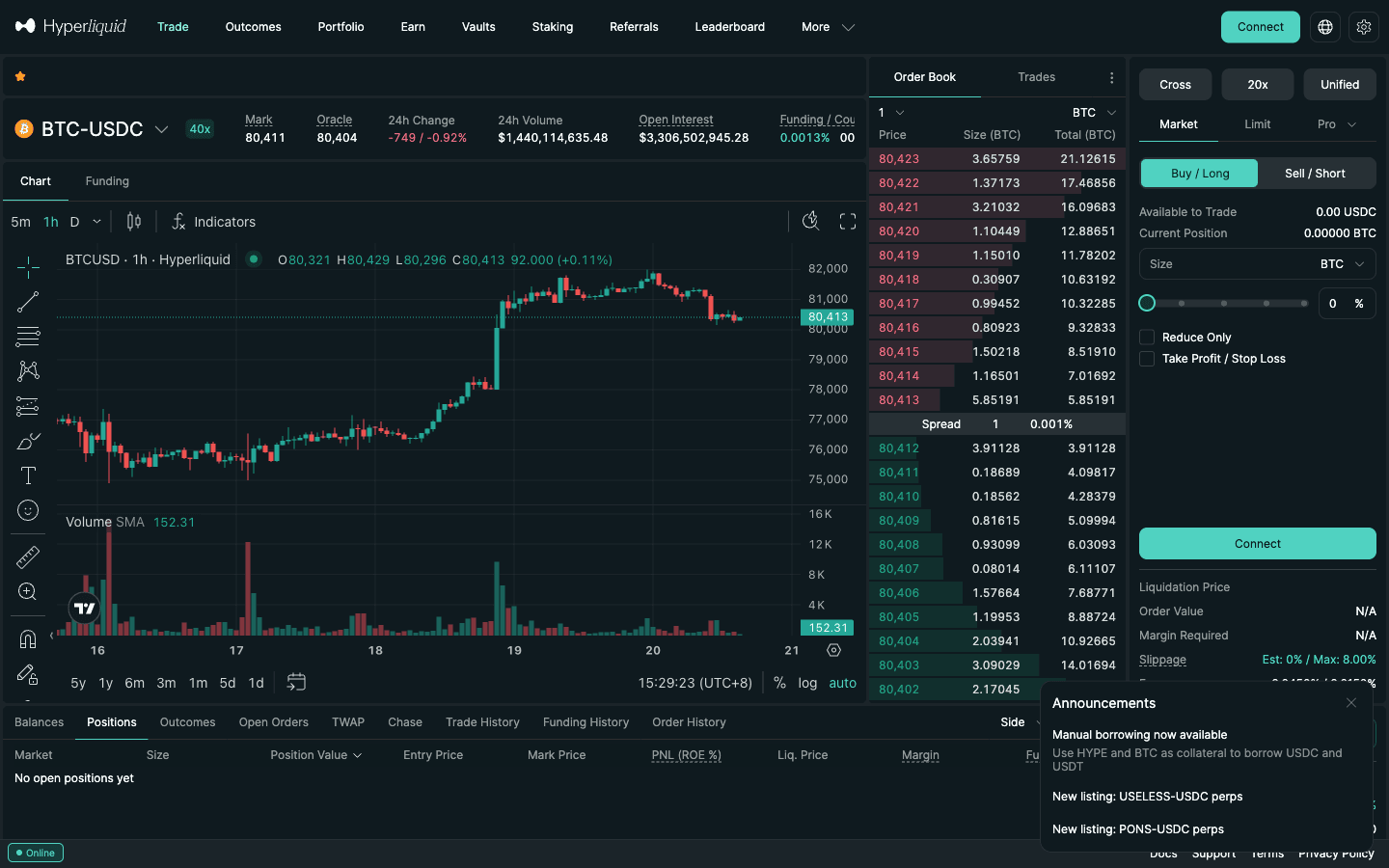
Hyperliquid's trade page (September 2026): the on-chain order book behind about 35% of all perp DEX volume over 30 days.
Is perp DEX volume real? (wash trading checks)
Volume is the easiest number on this page to fake: a wash trade has the same owner on both sides and adds volume without changing who holds what. Three checks catch most of it:
Volume ÷ open interest. Wash trades open and close at once, so they add volume but no open interest. On September 25, 2026, CoinGecko put the big centralized exchanges and the leading DEXs at roughly 1–3.5×; a venue turning its open interest over several times a day is not proof of washing (scalpers and market makers do the same), but it is the first number to question.
Maker and taker are the same trader. Hyperliquid and Lighter cancel orders that would fill against the same account (self-trade prevention, per their docs read September 25, 2026), so a wash trader needs several accounts. Hyperliquid's public trade feed carries the buyer and seller address of every fill: the same pair of addresses trading back and forth at the same size is the pattern to look for, and the Hyperliquid explorer shows whether both were funded from one wallet.
Points-farming inflation. When rewards are paid on volume and fees are low, looping trades can cost less than the expected reward: on a zero-fee venue such as Lighter Standard (0% taker) the direct cost is nothing. Lighter's points page and Aster's campaign terms both exclude self-trading, but they cannot filter all of it, which is why DefiLlama publishes a normalized figure next to reported volume (see the method below).
How to read the Vol/OI column above: under 0.5 means positions are held (hard to fake, since open interest needs real margin), 0.5–2 is a typical liquid market, and over 2 means fast turnover, worth a look at depth and normalized volume before you treat the venue's rank as liquidity. For your own order size, the book depth matters more than any headline: see order book liquidity and price impact.
2. How is this perp DEX ranking built?
Volume is the first filter because liquidity is the product on a perpetuals venue: deeper books mean tighter spreads, less slippage at size and funding that tracks spot. We rank by 24-hour volume from CoinGecko's derivatives feed, which is BTC-denominated; we convert it at Hyperliquid's BTC mid price at build time. Open interest is the value of open positions as each venue reports it to CoinGecko; trackers measure it differently, so compare venues within one source. The site rebuilds every 6 hours, so the order you see is never older than that. Four things distort raw volume, and we show them rather than hide them.
Reported vs normalized volume. DefiLlama shows both. On September 27, 2026, Lighter reported $2.05B of 24-hour volume but normalized to $1.51B; edgeX reported $870.7M against $742.7M normalized. CoinGecko applies its own filters and counting, so the same venue can look very different across trackers: that evening DefiLlama put Hyperliquid's 24-hour volume at $7.33B while CoinGecko showed $3.32B. Compare venues within one source, as the table does. Points programs are one reason reported volume runs high; which ones are live right now is in our perp DEX airdrops ranking.
Incentive volume and Vol/OI. Venues running points campaigns attract volume that exists to farm a token (Lighter's docs still describe a Season 2 schedule of 200,000 points a week, although its market-maker page says Season 2 ended on December 26, 2025; several newer venues run farming campaigns). Open interest is the sanity check: it costs real margin to hold, so it is harder to inflate. That is why the table has a Vol/OI column. Hyperliquid's open interest ($15.02B) is larger than every other venue in the table combined.
Sub-venues and mirrors. Lighter appears twice (its own rollup and a Robinhood Chain deployment); GMX appears once per chain. We keep them separate because that is how the data source reports them. HIP-3 builder markets on Hyperliquid are counted inside Hyperliquid.
One day vs one month. A single day can be noisy, especially at weekends. For a steadier view, here are the largest 30-day totals on DefiLlama's perps dashboard on September 27, 2026 (read from the 11 venues with the most open interest):
Perp DEX
30-day volume (DefiLlama)
Share of all perp DEX volume
Hyperliquid
$216.95B
34.6%
Aster
$68.13B
10.9%
Lighter (both chains)
$53.91B
8.6%
Variational
$50.94B
8.1%
edgeX
$39.9B
6.4%
All perp DEXs
$626.46B
100%
Base fees and leverage caps are not scraped: each one is a record in our facts registry with the official source and the date we read it, re-checked at least every 30 days. More on the mechanics in the wash-trading checks above and what open interest tells you.
3. What are the top perp DEXs? Each one in detail
Hyperliquid — the category leader
Hyperliquid runs its own L1 with the order book, clearinghouse and liquidations on-chain (HyperCore) and an EVM alongside it (HyperEVM). The public API lists 178 core perp markets (October 20, 2026) plus builder-deployed HIP-3 markets for stocks, commodities and indices. Orders, cancels and funding are gas-free. Fees are 0.045% taker / 0.015% maker at tier 0, falling with 14-day volume, minus 4% with a referral code and 5–40% for staking HYPE; fees go to the HLP vault, the HYPE assistance fund and market deployers rather than a company. Max leverage is 40x on BTC, 25x on ETH, 20x on SOL. The trade-off is concentration risk: a large share of the category now depends on one chain and one validator set. Full review: Hyperliquid; fees: Hyperliquid fees explained; first trade: how to use Hyperliquid.
Aster — order book, privacy mode and 1001x
Aster had $68.13B of 30-day volume on DefiLlama (September 27, 2026), second only to Hyperliquid. Its Pro order book charges 0% maker / 0.04% taker on USDT perps (0.04% taker on USD1 perps; paying in ASTER saves 5% on spot fees only), and it is one of the few order-book venues with encrypted orders, so resting orders are not visible on-chain for others to trade against. BTC leverage on Pro goes to 200x for the first $400 of notional and 150x up to $300,000; Shield Mode offers AMM-style private execution and a separate 1001x one-click product goes to 1001x on BTC/USD with a capped ROI. CoinGecko counts 613 perp pairs, the widest listing in the table. Review: Aster.
Lighter — zero fees, verifiable matching
Lighter is a zk-rollup whose order matching and liquidations are proven rather than trusted. The default Standard account pays 0% maker / 0% taker on perps and spot with 300 ms taker latency; the opt-in Premium account pays 0.004% / 0.028% for 140 ms fills and LIT-staking discounts. Leverage goes to 50x on BTC and ETH and 25x on SOL (above Hyperliquid's 40x on BTC; edgeX and Aster Pro go higher), and it lists RWA perps (US equities, indices, pre-IPO names). Check the live points page before assuming an incentive is running, and note the gap between Lighter's reported and normalized volume above. Review: Lighter.
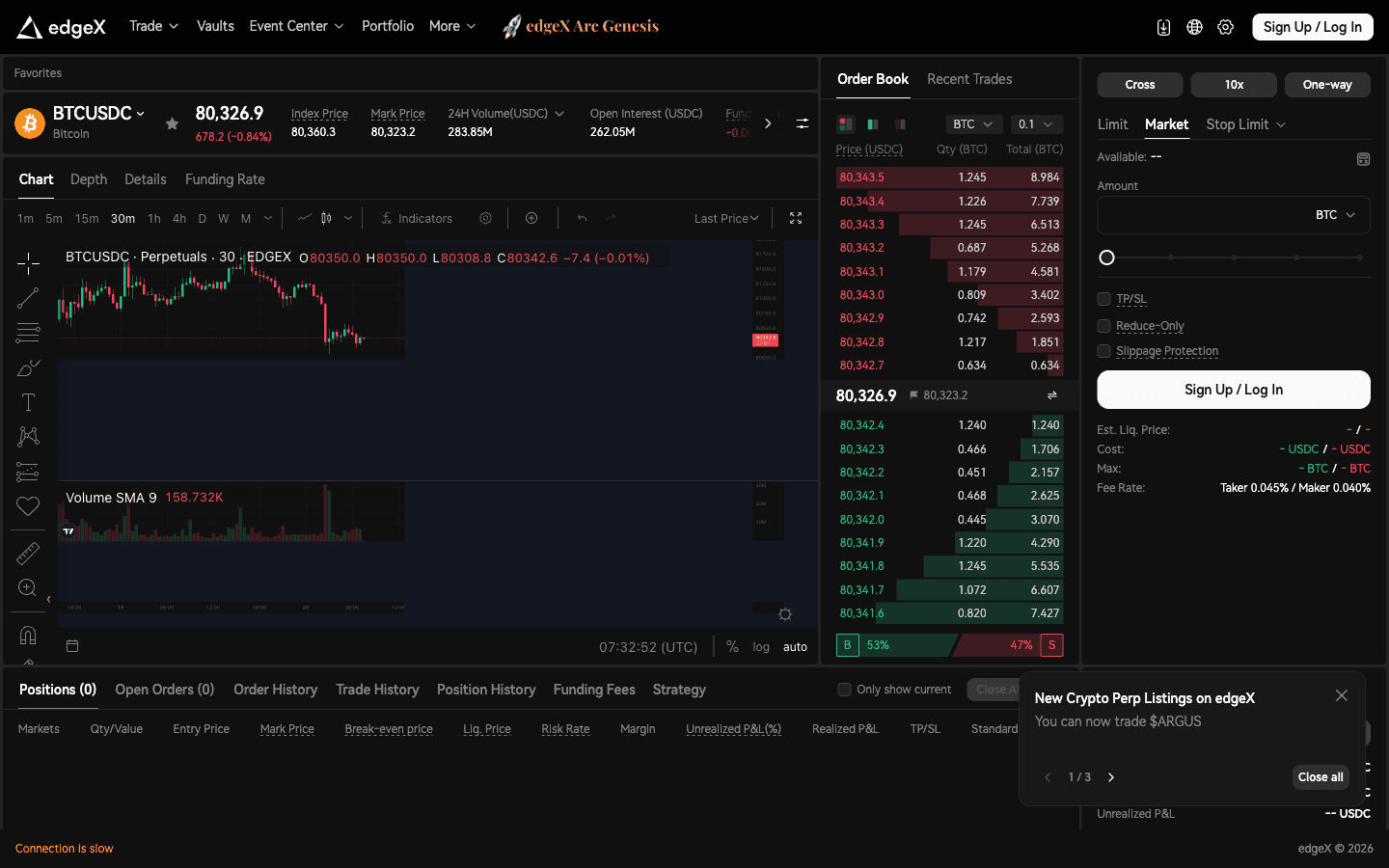
edgeX (September 2026): an order-book perp DEX with fees tiered by rolling 30-day volume.
edgeX — the execution-quality pick
edgeX runs an order-book venue on its own stack with settlement on Ethereum, trading $636M in the last 24 hours across 187 perp pairs on CoinGecko's count, and $39.9B over 30 days on DefiLlama. BTC and ETH go to 100x. Its fee schedule is tiered by rolling 30-day volume, updated daily at 00:00 UTC, with sub-account volume aggregated to the main account and settlement gas paid by the venue; the per-tier rates are published on its VIP page rather than in the docs; the Regular tier there is 0.04% maker / 0.045% taker (October 14, 2026). It has a reputation for even, predictable fills rather than one headline feature. edgeX referral code: HOLYGRAIL (edgeX's own program, separate from the Hyperliquid code of the same name): open edgeX.
These fill out the next tier and move a lot week to week. Variational Omni is a 2025 launch with 575 listed pairs; it is #3 by open interest in the current table ($1.85B). GRVT is an order-book venue on a zkSync validium, #9 by 24-hour volume right now with a Vol/OI of 1.03. Pacifica is the largest Solana-native order book in the table, which removes the bridging step for SOL-based collateral. ApeX Omni, Extended (Starknet) and Backpack (a wallet-plus-exchange with a Solana perp book) are order-book venues whose share changes often; use the live table rather than a static list.
dYdX, GMX, Paradex, Ostium — the earlier generation and the specialists
dYdX defined the order-book perp DEX and now runs its own Cosmos chain; its on-chain fee parameters set tier 1 at 0.010% maker / 0.050% taker, reaching negative maker fees at the top tiers, with BTC up to 50x. Its CoinGecko volume in this build was $36M. GMX is the original oracle-priced pool model on Arbitrum and Avalanche, where liquidity providers take the other side; its Solana deployment (GMTrade) is out-trading the Arbitrum original in this build. Paradex charges retail traders 0% on perps, spot and options and Pro/API traders 0.003% maker / 0.045% taker, with DIME-staking discounts. Ostium is an Arbitrum venue focused on real-world-asset perps priced by oracle. Head-to-heads: Hyperliquid vs dYdX, Hyperliquid vs GMX, Hyperliquid vs Paradex.
4. Head-to-head comparisons
The ranking says who is biggest; a head-to-head says which of two venues fits your trading. Each page compares the venues in its title on fees, leverage, markets and more.
CoinGecko does not classify every venue as a derivatives exchange, so a few names you will see on DefiLlama are missing above. Jupiter Perps is Solana's pool-based venue (oracle pricing, no order book, 0.06% to open or close a position, with 75% of fees going to JLP liquidity providers) and the natural pick if your capital already routes through Jupiter — see Hyperliquid vs Jupiter. Drift is a Solana hybrid of order book and AMM. Polymarket Perps is listed by CoinGecko, but with no open interest and a 24-hour volume far out of line with every other venue when we checked on September 27, 2026, so we leave it out of the ranking; our Polymarket Perps review covers it. Antarctic is in the table but works more like a CEX account than its docs suggest — see our Antarctic review before depositing. HIP-3 builder markets on Hyperliquid (for example the equity perps deployed by trade.xyz) are sometimes listed as separate exchanges by trackers; in our table they are part of Hyperliquid.
6. How does perp DEX volume compare with centralized exchanges?
The "DEXs will never have liquidity" argument is now a question of degree. DefiLlama tracked $17.66B of perp DEX volume in 24 hours, $626.46B over 30 days and $14.51B of open interest on September 27, 2026, with volume up 8.43% week on week. CoinGecko's derivatives list the same evening put Binance Futures at about $26.65B of 24-hour volume, OKX at $10.08B and Bybit at $7.48B. Keep each ratio inside one tracker: on CoinGecko's count, Hyperliquid's $3.32B of 24-hour volume was about 12% of Binance Futures'. On open interest the gap is much narrower: Hyperliquid held $16.8B against Binance Futures' $34.8B, about 48%. DefiLlama counts differently (it put Hyperliquid at $7.33B for 24 hours that evening), so dividing its DEX total by CoinGecko's Binance figure would overstate the DEX share. The full custody, KYC and fee comparison is in DEX vs CEX.
7. How do you choose a perp DEX?
Six factors decide it, in this order. For ready-made picks by trader type, see the best DEX guide.
Depth on the pairs you trade. Open the L2 book at your size on the top three venues. A 0% fee on a thin book costs more than 0.045% on a deep one: crossing a 2 bp spread twice is already 4 bp. Read the slippage guide.
Fee for your order style. Takers: Lighter Standard 0%, Paradex retail 0%, Aster 0.04%, Hyperliquid 0.045% (0.0389% with referral plus Bronze staking). Makers: Lighter, Aster and Paradex 0%, Hyperliquid 0.015%. Try the fee calculator.
Execution model: order book or oracle pool. Order books (Hyperliquid, Lighter, Aster Pro, edgeX, Paradex, dYdX) match buyers and sellers with price-time priority, so your fill depends on real depth. Oracle-priced pools (GMX, Jupiter Perps, Ostium) fill you at an oracle price against a liquidity pool, which removes wick risk from thin books but adds price-impact and borrow fees that grow with pool utilisation, and makes the oracle a critical dependency. See AMM vs order book.
Leverage and liquidation design. Lighter 50x BTC/ETH, Hyperliquid 40x BTC / 25x ETH, edgeX 100x, Aster 200x on small BTC positions (1001x mode is a separate product). Higher leverage only moves the liquidation price closer; what matters is how liquidations are handled: Hyperliquid liquidates through the order book first and falls back to a backstop liquidator vault, while Lighter uses partial liquidations backed by the LLP insurance fund.
Chain and funding path. Hyperliquid accepts USDC from Arbitrum, Ethereum, Base and Polygon plus native BTC, ETH and SOL; Solana-native traders avoid bridging entirely on Pacifica, Backpack or Jupiter. Withdrawals from Hyperliquid to Arbitrum cost 0.2 USDC plus a tiny gas fee.
Where you live. Every venue in the table names restricted jurisdictions in its terms (the US is excluded almost everywhere; Lighter, Aster and Pacifica also exclude the UK and Canada). Check the list before you deposit; our no-KYC DEX guide tabulates them.
Before you deposit: five checks
Use the official URL (bookmark it) and a wallet you use only for trading; never sign a message you do not understand.
Find out who holds the funds: an on-chain bridge or rollup contract, a validator set, or an operator. Read the withdrawal path before the deposit path.
Check the oracle and liquidation rules for the market you trade, especially on new or thin listings.
Look at open interest and Vol/OI in the table above, not just volume.
Start with an amount you can afford to lose and test a small withdrawal first. The full list is in our DEX security checklist.
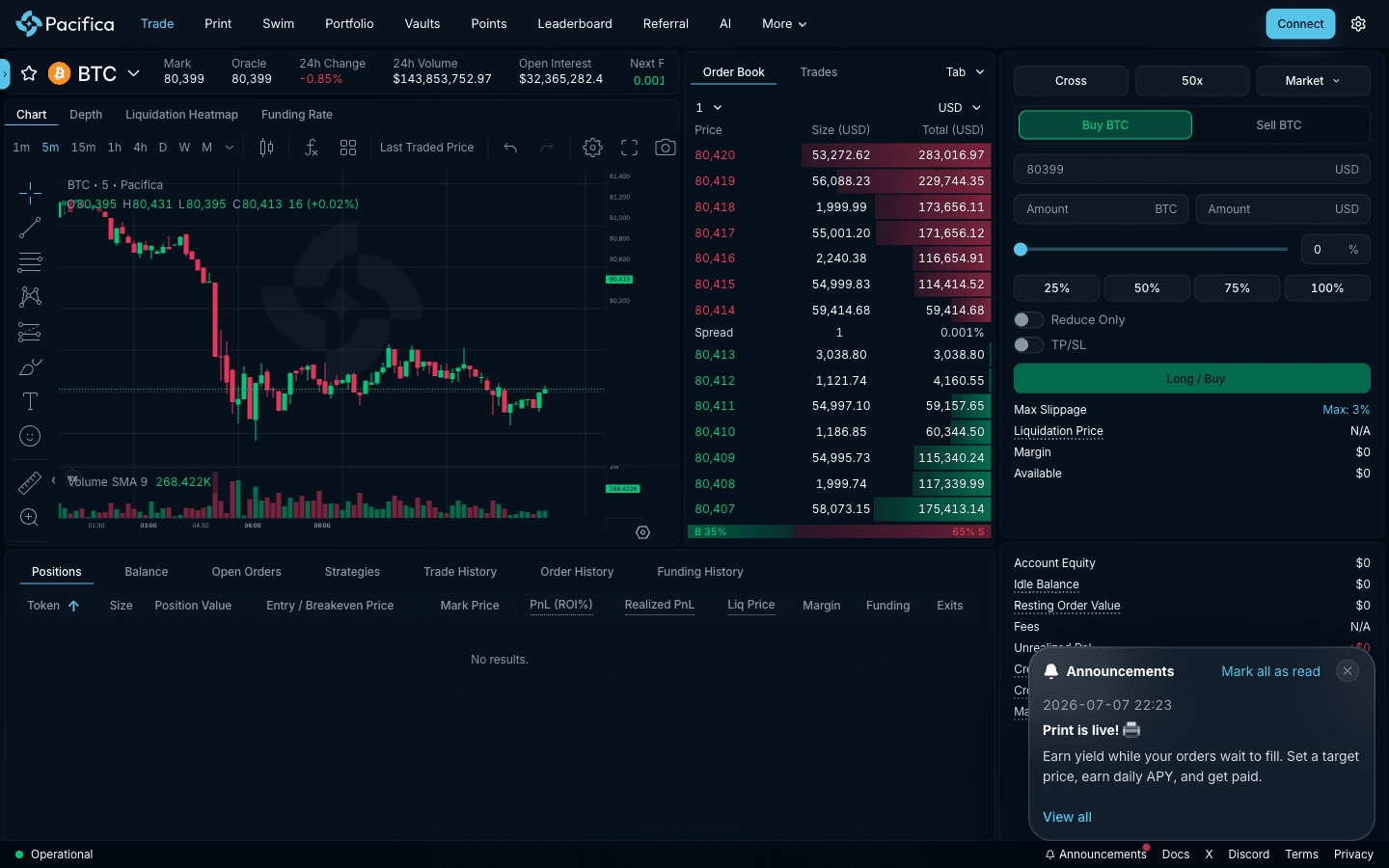
Pacifica (September 2026): a Solana-native order-book perp DEX, no bridge needed for SOL collateral.
8. What does each perp DEX charge? Full fee schedules
Premium 0.004% / 0.028% with LIT staking discounts; first week of Premium fees rebated via referral
docs.lighter.xyz (October 19, 2026)
Aster (USDT perps)
0%
0.04%
USD1 perps 0.04% taker; the 5% ASTER-payment discount is spot only
docs.asterdex.com (October 19, 2026)
Paradex (retail)
0%
0%
Pro/API: 0.003% / 0.045%, up to 30% off staking DIME, 40% off paying in DIME
docs.paradex.trade (October 15, 2026)
Pacifica
0.015%
0.040%
Top volume tier 0% / 0.028%
api.pacifica.fi (October 15, 2026)
dYdX (tier 1)
0.010%
0.050%
Taker 0.025% and a -0.007% maker rebate from $100M 30-day volume; -0.011% maker from $200M
dYdX chain fee params (October 15, 2026)
GMX (position fee)
0.04% if the trade balances long/short open interest, 0.06% if it adds to the imbalance
Plus price impact and borrow fees; referral discount 5%–10%
docs.gmx.io (October 15, 2026)
edgeX (Regular)
0.04%
0.045%
Lower VIP tiers by trading volume; sub-accounts share the main account's tier
pro.edgex.exchange/vip (October 14, 2026)
Lowest fees in dollars: a $10,000 round trip on 13 fee schedules
Two $10,000 fills, open and close, at the base rate a new account pays, sorted by taker cost. The maker column is the cost if both orders rest on the book (post-only) and fill as maker.
Highest entry taker fee here; referees start at a lower tier
Base-tier perp fees from each venue's documentation or fee API, as stored in our facts registry (verification dates in the schedule table above). Excludes spread, slippage, funding and withdrawal fees. Variational's cost is the quoted spread, not a fee.
Three things the table does not show. Depth: the zero-fee venues have thinner books, so a large market order can lose more to slippage than it saves in fees; at $10,000 on BTC the difference is small. Maker orders: a Hyperliquid trader who makes both sides with HOLYGRAIL pays $2.88 per $10,000 round trip, against $8.64 taker. Volume: every schedule here falls with 14- or 30-day volume, and Hyperliquid's HYPE staking discount stacks with the referral code. Model your own size in the DEX fee calculator, and compare with Binance and Bybit in DEX vs CEX fees.
Join Hyperliquid with code HOLYGRAIL — the discount applies to your first $25M of volume. Prefer zero fees? Lighter code 718610TD: first week of Premium fees rebated. Aster: referral code DTLpLc (5% of fees rebated). edgeX: code HOLYGRAIL (edgeX's own referral program).
For most traders, Hyperliquid. It ranks #1 by 24-hour volume in our live table and #1 by open interest ($15.02B of open interest on Tue, 20 Oct 2026 00:59 UTC). DefiLlama counted $216.95B of Hyperliquid volume over the 30 days to September 27, 2026, about 35% of all perp DEX volume. Base fees are 0.045% taker / 0.015% maker, 4% lower with the referral code HOLYGRAIL (0.0432% / 0.0144%). Lighter is the pick if fees decide everything (0% / 0% on Standard accounts), Aster if you want high leverage or hidden orders, and edgeX if you want a second order book. Our full buyer's guide by use case is at /exchanges/.
Which perp DEX has the lowest fees?
Among the venues whose fees we have verified, Lighter Standard, Paradex Retail orders and Variational Omni on the headline rate: 0% maker and 0% taker. Each 0% has a catch. Lighter Standard adds 300 ms to taker orders (maker orders are not delayed), and its Premium account (140 ms taker latency) pays 0.004% / 0.028%. Paradex's 0% applies to Retail orders (web app or interactive API), with a 300 ms speed bump and up to 1,000 orders per 24 hours. Variational Omni charges no trading fee; the cost is in the spread its liquidity provider quotes. Among venues that charge everyone, Hyperliquid is 0.015% maker / 0.045% taker, or 0.0144% / 0.0432% with the code HOLYGRAIL; Aster is 0% / 0.04%; edgeX's Regular tier is 0.04% / 0.045%. A 0% fee on a thin book can still cost more than a paid fee on a deep one, because spread and slippage are paid on every fill. Fees verified from each venue's docs; dates in the table above. On a $10,000 round trip at base rates that is $0.00 on Lighter Standard against $8.64 on Hyperliquid with HOLYGRAIL; the round-trip table on this page covers 13 fee schedules.
What is the largest perp DEX by volume?
Hyperliquid. In the ranking built on Tue, 20 Oct 2026 00:59 UTC it cleared $7.62B of 24-hour perp volume on CoinGecko's count (41.6% of the 20 venues tracked here) with $15.02B of open interest. On DefiLlama's dashboard on September 27, 2026 it had $216.95B of 30-day volume, about 35% of the $626.46B total.
Hyperliquid vs Lighter vs Aster: which has the lowest fees?
For takers: Lighter Standard 0% (with 300 ms of added latency), Aster 0.04% on USDT perps (0.038% after its 5% referral rebate), Hyperliquid 0.045% (0.0432% with HOLYGRAIL, lower again with HYPE staking and volume tiers). For makers: Lighter Standard 0%, Aster 0%, Hyperliquid 0.015% (0.0144% with HOLYGRAIL). Lighter is cheapest on paper; Hyperliquid has the deepest books (#1 by 24-hour volume in our table), which usually matters more for market orders at size. Full head-to-head: /blog/best-dex-three-way-comparison/.
What are the top 10 perp DEXs?
By 24-hour volume in our live ranking (Tue, 20 Oct 2026 00:59 UTC): 1. Hyperliquid, 2. Variational Omni, 3. Lighter, 4. Aster, 5. Pacifica, 6. edgeX, 7. Lighter (Robinhood Chain), 8. Extended, 9. GRVT, 10. ApeX Omni. The order changes from day to day below the top spot, so the table above is rebuilt every 6 hours from CoinGecko data. By 30-day volume on DefiLlama (September 27, 2026) the largest were Hyperliquid ($216.95B), Aster ($68.13B), Lighter ($53.91B), Variational ($50.94B) and edgeX ($39.9B).
What is a perp DEX?
A perp DEX is a decentralized exchange for perpetual futures: leveraged long and short contracts with no expiry, traded from your own wallet instead of an exchange-held account. The leading venues in 2026 run their own execution layers (Hyperliquid on HyperCore, Lighter on a zk-rollup, Aster on Aster Chain) so orders are matched on an order book without per-order gas, and you only touch a public chain when depositing or withdrawing.
What is the most trusted perp DEX?
There is no official trust rating, so judge it on things you can check. Hyperliquid keeps its order book, margin and liquidations on its own chain, so positions and the HLP vault are publicly visible; Lighter proves its matching and liquidations with zero-knowledge proofs; dYdX has the longest record as a decentralized order book. The risks that remain are smart-contract and bridge risk, validator concentration, oracle design and the operator's terms. Use our security checklist before depositing and never keep more on any venue than you are trading with.
Are perp DEX volumes real or wash traded?
Some of both. Venues running points or airdrop campaigns attract volume that exists to farm rewards, which is why DefiLlama publishes a "normalized" figure next to the reported one (on September 27, 2026, Lighter reported $2.05B against $1.51B normalized; edgeX $870.7M against $742.7M). Cross-check volume against open interest with the Vol/OI column: a venue whose daily volume is many multiples of its open interest is turning positions over unusually fast. Open interest is harder to fake because it ties up real margin.
How does perp DEX volume compare with centralized exchanges?
DefiLlama put total perp DEX volume at $17.66B for 24 hours and $626.46B for 30 days on September 27, 2026. CoinGecko's derivatives list the same evening showed Binance Futures at about $26.65B of 24-hour volume, OKX at about $10.08B and Bybit at about $7.48B. On CoinGecko's own count, Hyperliquid's $3.32B was about 12% of Binance Futures' volume, and its $16.8B of open interest about 48% of Binance's. Don't divide DefiLlama's DEX total by CoinGecko's Binance figure: the two trackers count differently (DefiLlama put Hyperliquid at $7.33B that evening).
Can I use perp DEXs from the US, UK or Canada?
Usually not. Every major perp DEX names restricted jurisdictions in its terms. When we read them on September 24–25, 2026: Hyperliquid excludes the United States, Ontario and sanctioned regions; Lighter and Aster exclude the US, Canada, the UK, China, Russia, Ukraine and sanctioned countries, among others; edgeX and dYdX exclude the US and Canada, among others. If you are a restricted person on a venue, it is not for you, and getting around a geo-block breaks the terms you accept. We do not give advice on doing that.
Do perp DEXs require KYC?
The venues in this ranking let you trade from a wallet without identity verification. That does not make them anonymous or unregulated: on-chain activity is public, fiat on-ramps and domestic exchanges require KYC, each venue excludes restricted jurisdictions, and taxes still apply. You are responsible for following the rules where you live.
How do perp DEXs make money if fees are 0%?
Zero-fee tiers are usually funded by a token or a premium tier. Lighter charges 0% on Standard accounts but 0.028% taker on Premium accounts that get faster fills, and its LIT token is staked for discounts. Paradex charges retail traders nothing but Pro (API) traders 0.045% taker. Variational Omni charges no fee at all and earns the spread in the prices its liquidity provider quotes. Hyperliquid charges everyone and routes the fees to HLP, the HYPE assistance fund and HIP-3 deployers rather than a company treasury.
Disclosure: HOLYGRAIL (on Hyperliquid and on edgeX), 718610TD (Lighter), DTLpLc (Aster) and AGHSGT (Ondo Perps) are our referral codes; we earn a share of referred accounts' fees, and it never raises yours. We have no referral relationship with the other venues in the table, and the ranking order comes only from the data. Volume and open interest come from CoinGecko and Hyperliquid's public API at build time; DefiLlama and CEX figures were read on September 27, 2026; fee schedules and leverage caps from each venue's official documentation on the dates shown.