
Short answer. The last price is the most recent trade on that exchange. The index price is a weighted spot price across several exchanges (Hyperliquid calls it the oracle price). The mark price is the exchange's fair-value estimate built from the index and the order book, and it is the one that decides liquidations, margin, unrealized PnL and, on Hyperliquid, every TP/SL trigger. Because the mark follows other exchanges and shrugs off single trades, you can be liquidated, or stopped out, at a level the last-price chart never printed, while a stray wick on the chart does not liquidate you.
Mark vs last vs index price at a glance
| Price | What it is | Built from | Used for | Can one trade move it? | Where on Hyperliquid |
|---|---|---|---|---|---|
| Last price | The price of the most recent trade on this exchange | Actual fills in this venue's order book | Chart candles, "last price" stops on venues that offer them (your realized PnL uses your own fill prices) | Yes: one print sets it | Chart and the Trades tab |
| Index price (Hyperliquid: oracle) | A weighted spot price across several exchanges | Spot mid prices on several exchanges | Funding; input to the mark price | No: it does not use this perp's trades | "Oracle" in the market header |
| Mark price | The exchange's fair-value estimate of the perp | Index + smoothed basis + order book (Hyperliquid adds CEX perps) | Liquidations, margin, unrealized PnL, TP/SL triggers | Hardly: it is outvoted in a median | "Mark" in the header, "Mark Price" in Positions |
Trade on a venue whose mark formula is public
Code HOLYGRAIL takes 4% off your Hyperliquid fees for your first $25M of volume.
We earn a commission when you sign up through our links; it never raises your fees.
1. Last, index and mark price: definitions
What is the last price?
The last price is the price at which the most recent trade on this exchange executed. It is what the chart candles plot and what your fills happen at. It is also the easiest of the three to push around: on a thin order book, one large market order can print a trade far from where everyone else is quoting, and that print becomes the last price until the next trade.
What is the index price?
The index price is the price of the underlying asset, taken from spot markets on several large exchanges and combined with a weighted average or median. It deliberately ignores the perp you are trading, which makes it hard to manipulate from inside one venue. On Hyperliquid the index is called the oracle price: the contract specifications describe each perp's underlying as the "Hyperliquid oracle index of underlying spot asset".
What is the mark price?
The mark price is the exchange's estimate of what the perpetual contract is fairly worth right now. It starts from the index, adds a smoothed premium or discount (the basis, because perps can trade persistently above or below spot), and usually combines that with the order book, so it moves with the market but not with a single trade. It is the price your position is marked to: unrealized PnL, margin requirements and liquidation all use it.
A note on stocks: if you arrived here from thinkorswim or another broker, "mark" there usually means the midpoint between the bid and the ask, a quick fair value for thinly traded options. The crypto meaning is the formula-based fair value described on this page.
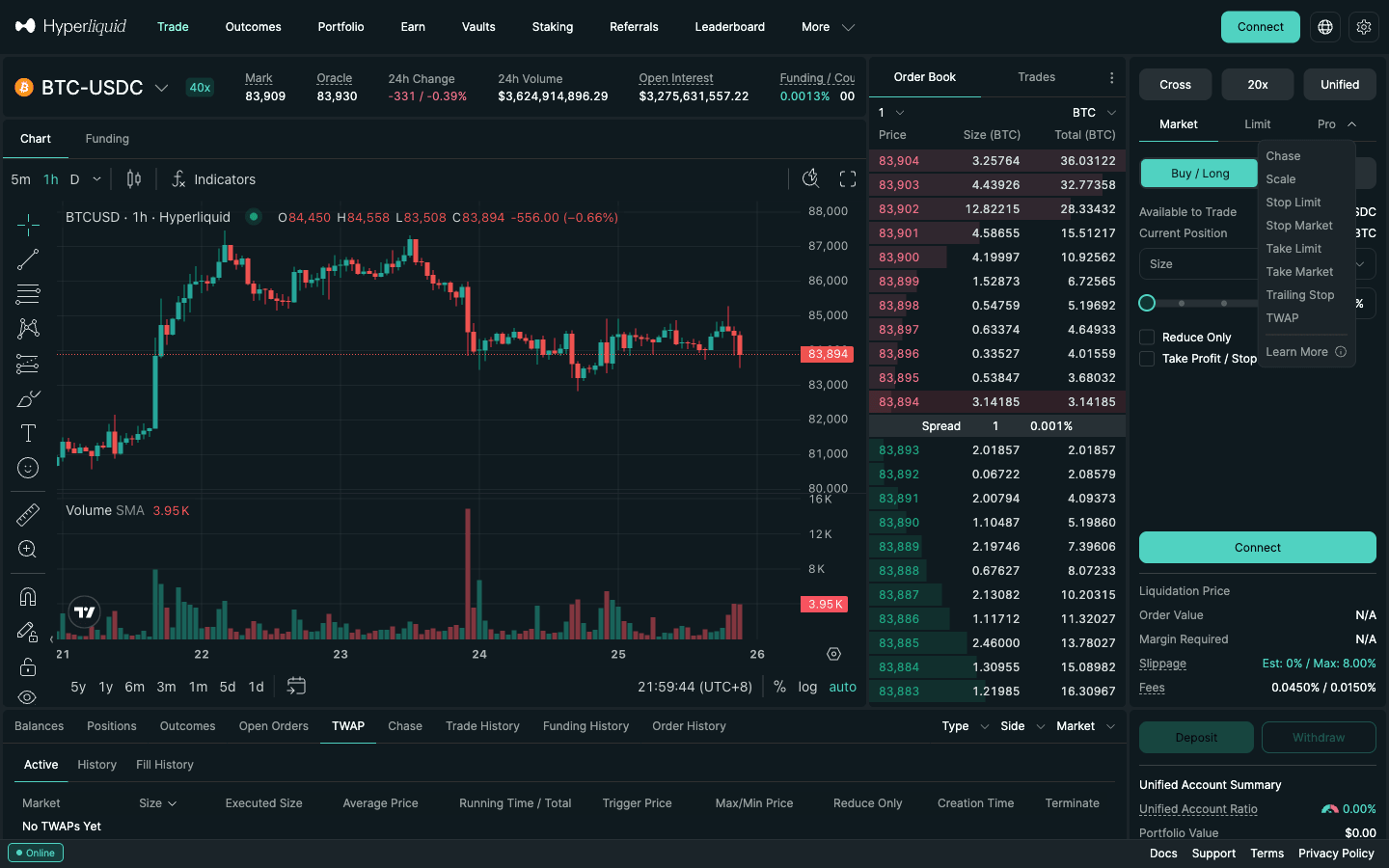
On Hyperliquid's ETH market at 14:08 UTC on September 30, 2026 the public API returned a mark of 2,703.0, an oracle of 2,702.7 and a mid of 2,702.25, and the latest trade printed at 2,702.7. Four numbers within 3 basis points of each other (1 bp = 0.01%), all updating every few seconds. Knowing which one applies to which rule is the point of this guide.
2. Why mark price and last price differ
On a deep market such as BTC or ETH the two sit a few basis points apart. They separate when:
- A single trade prints away from the book. A fat-finger market order or a liquidation sweeping a thin book sets a new last price instantly. The mark, built from bid, ask and outside prices, barely reacts.
- Other exchanges move first. When Binance, OKX and Bybit drop in a few seconds, the index and the mark follow them before this venue's traders do. The last price lags, sometimes for several seconds.
- The book is thin. On small markets, trades happen rarely, so the last price can be stale while the bid and ask have moved. In the live snapshot below, PURR's last trade sat 11 bp below its mark.
- The perp trades at a premium or discount to spot. The mark includes a smoothed basis, so it follows a persistent premium; it just does not jump with each trade.
Most venues trigger liquidation on the mark for exactly this reason. If liquidations ran on the last price, anyone with enough size could print one trade through a thin book and liquidate everyone behind it.
3. Which is better for your stop-loss: mark price or last price?
It depends on what the order is for, and on whether your venue lets you choose at all.
| Trigger on | Pros | Cons | Best for |
|---|---|---|---|
| Mark price | Ignores single-trade wicks and fat-finger prints; runs on the same price as your liquidation, so a stop placed before the liquidation price fires first | Can fire even though this venue's chart never printed your level (a move led by other exchanges); the fill still happens at book price | Stop-losses, and any exit that must happen before liquidation |
| Last price | Matches the candles you drew your levels on; reacts to exactly what traded here | One print on a thin book can trigger it; in a fast move led by other exchanges it can lag the mark, so liquidation (on mark) can come before your stop | Take-profits at chart levels, on venues that let you choose |
- Hyperliquid: always mark. The TP/SL docs say "the mark price is used to trigger TP/SL orders", and the same applies to stop market, stop limit, take orders, the trailing stop and the TWAP trigger. There is no last-price toggle. Market TP/SL orders fill with a slippage tolerance of 10%; a limit TP/SL lets you set your own. Step by step: Hyperliquid stop loss and take profit (TP/SL) and trailing stop tutorial.
- Lighter: mark. Stop-loss and take-profit orders fire when the mark price reaches the trigger (Lighter order types).
- Aster Pro: your choice. Each TP/SL leg has its own Mark or Last trigger (Aster order types guide).
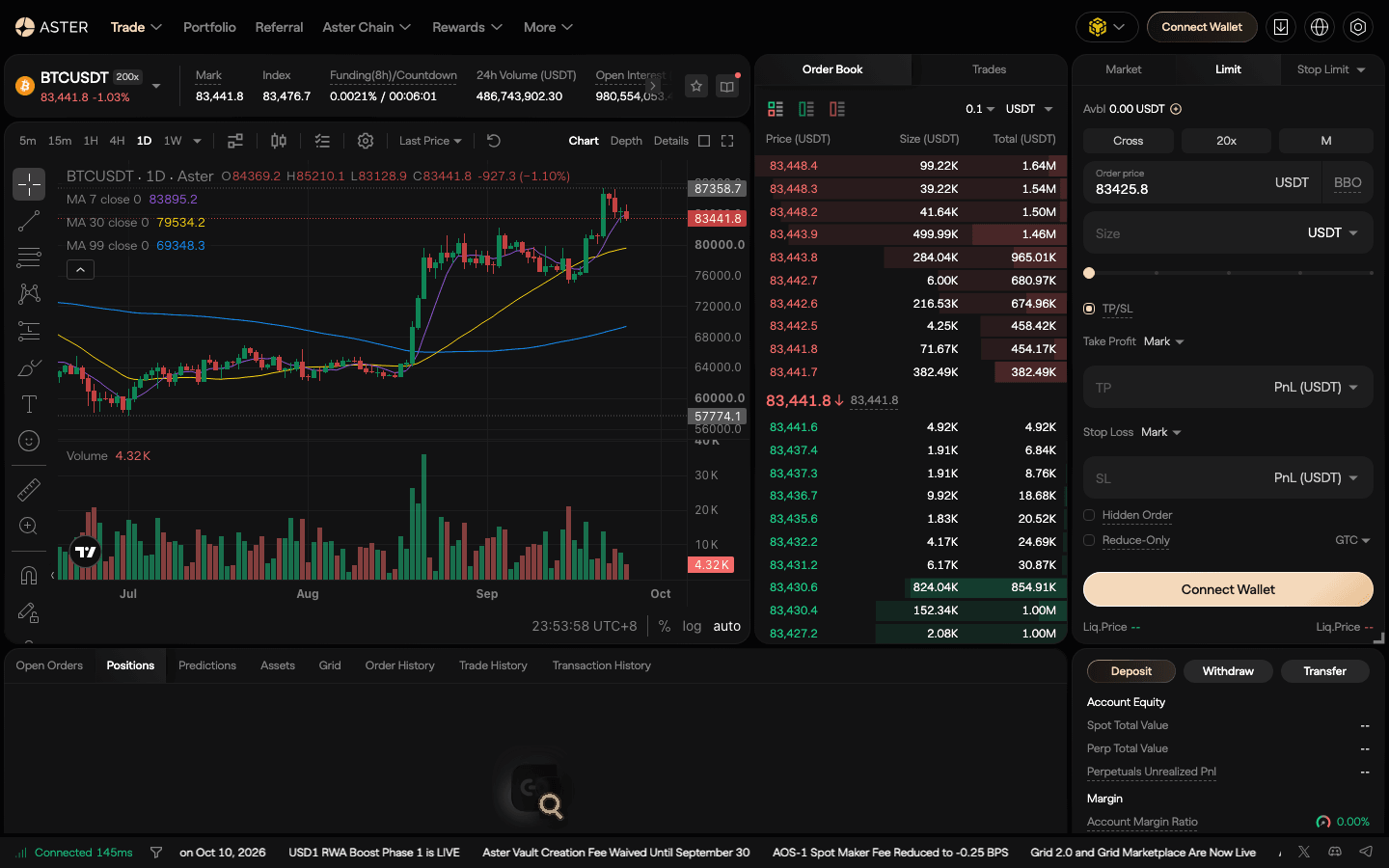
A practical rule set:
- Put the stop-loss on mark wherever you have the choice. A last-price stop can still be waiting for a print while the mark has already crossed your liquidation price.
- Compare your stop with the Mark figure in the header, not with the last candle. Place it well before the liquidation price, with more room on thin or HIP-3 markets, where our snapshot shows gaps of 10–30 bp between mark, oracle and last.
- Use a stop market for the exit that must happen, and a stop limit or take limit for profit-taking, where missing a fill is acceptable.
- Take-profits can trigger on last price on venues that allow it, if you want them to match a chart level exactly.
Why was I liquidated when the chart never touched my price?
The chart shows last-trade candles from one venue; liquidation is checked against the mark. Picture Binance, OKX and Bybit dropping 1% in a few seconds while Hyperliquid's book is slow to follow (worked example C below): the oracle and the CEX-perp input drop, the mark follows them, and a position whose liquidation price sits just under the old price is liquidated even though Hyperliquid never traded there. The liquidation then sends market orders to the book, so the fill can be worse than the mark that triggered it. How the level itself is computed: liquidation price guide, and where other traders' levels cluster: the Hyperliquid liquidation map.
4. How exchanges calculate the mark price
Almost every derivatives venue builds the mark in the same shape: index price + a smoothed basis, where the basis is a moving average of how far the perp trades above or below the index, then clamped or put into a median with other prices so that no single venue or trade can dominate. The averaging window, the clamp and the extra inputs are where exchanges differ, and most publish only a summary. Two perp DEXs publish the exact formula:
- Lighter: mark = median of (the impact price from its own book; index + an 8-minute EMA of the premium, clamped to ±0.5% of the index; the median of other exchanges' mark prices). Its index comes from Chainlink, Stork and Pyth.
- Hyperliquid: a three-input median described in the next two sections, including the exact weights and EMA constant.
Both follow the same logic: the index anchors the mark to spot, the basis EMA lets it follow a real premium slowly, and the median throws out whichever input has gone wrong. For how this protects against oracle attacks more broadly, see the DEX security and oracle-manipulation checklist.
5. How Hyperliquid's oracle (index) price is built
From the oracle page of the docs: the validators publish a spot oracle price for every perp asset every 3 seconds. Each validator computes a weighted median of spot mid prices on Binance (weight 3), OKX (2), Bybit (2), Kraken (1), KuCoin (1), Gate (1), MEXC (1) and Hyperliquid spot (1).
The price the clearinghouse actually uses is then the stake-weighted median of all validators' submissions, so no single validator can move it. Two exceptions matter:
- Assets whose main spot market is on Hyperliquid (the docs' example is HYPE) do not include external venues until those have sufficient liquidity. HYPE-USD and PURR-USD are also the only perps whose oracle is denominated in USDC.
- Assets whose main spot market is elsewhere (for example BTC) do not include Hyperliquid spot at all.
Every other perp is "USDC margined, USDT denominated": the oracle is quoted in USDT but you post USDC, with no conversion at the USDC/USDT rate. The docs call this a quanto contract. In practice, if USDT traded away from $1, your PnL would still be paid one-for-one in USDC.
6. How Hyperliquid's mark price is built
The mark price is the median of three inputs (robust-price-indices page, re-read September 30, 2026):
| Input | Definition | What it does |
|---|---|---|
| 1. Oracle + basis EMA | Oracle price plus a 150-second EMA of (Hyperliquid mid − oracle) | Tracks where Hyperliquid has been trading relative to spot, but smoothly |
| 2. Local book | Median of Hyperliquid best bid, best ask and last trade | Reacts to Hyperliquid itself, yet one odd last trade is outvoted by bid and ask |
| 3. CEX perps | Weighted median of Binance (weight 3), OKX (2), Bybit (2), Gate (1) and MEXC (1) perp mid prices | Anchors the mark to the big perp venues |
- Fallback. If exactly two of the three inputs exist, a 30-second EMA of input 2 (the local bid/ask/last median) is added so that the median still has three values. (Some AI summaries describe this fallback as if it were the whole formula; it is not.)
- The EMA. The docs give the update rule: numerator and denominator each decay by exp(−t / 2.5 minutes) and add the new sample weighted by the time since the last update. In plain words, recent minutes dominate and a burst of odd prints fades within a few minutes.
- Update speed. The mark is recomputed whenever validators publish new oracle prices, so both mark and oracle update about every 3 seconds.
The design goal, in the docs' words, is "an unbiased and robust estimate of the fair perp price". Because it is a median, one input can go wrong without dragging the result: a Hyperliquid book being pushed around is outvoted by the oracle-based input and the CEX perps; a stale CEX feed is outvoted by the other two. Note what is missing: the last trade on its own. It enters only inside input 2, next to the best bid and ask, which is why a single print cannot move Hyperliquid's mark.
7. Which price drives what on Hyperliquid
| Mechanism | Price used | Detail |
|---|---|---|
| Funding rate | Oracle | The premium is measured from impact bid/ask prices against the oracle, and the hourly payment is size × oracle × rate |
| Margin required to open | Mark | Initial margin = size × mark / leverage |
| Liquidations | Mark | Account value vs maintenance margin is evaluated with the mark price |
| Unrealized PnL | Mark | Side × (mark − entry) × size; the Positions table shows "Mark Price" |
| Realized (closed) PnL | Trade price | App tooltip: "Only trade prices are used for realized PNL" |
| TP/SL, stop and take triggers | Mark | Stated on the TP/SL and robust-price-indices pages; there is no last-price option |
| Trailing stop, TWAP trigger and Max/Min | Mark | Order-types page |
| Order fills | Order book | You always trade against real resting orders, never at mark or oracle |
| Order sanity check | Oracle | Orders priced too far away are rejected: "Order price too far from oracle" |
The split is deliberate. Funding pulls the perp toward spot, so it is measured against the spot oracle. Everything that can take your money away (margin checks, liquidation, your stop) uses the mark, which blends spot, Hyperliquid's own book and other perp venues. Fills are the only thing that happens at the book price. How funding is computed from the premium: Hyperliquid funding rate explained.
8. Live snapshot: mark, oracle and last
Mark, oracle and mid from the public API (metaAndAssetCtxs, main and xyz dexes) at 14:08 UTC on September 30, 2026, plus the latest trade for each market (recentTrades, fetched within the next 10 seconds). Gaps are in basis points:
| Market | Mark | Oracle | Mid | Last trade | Mark vs oracle | Last vs mark | Note |
|---|---|---|---|---|---|---|---|
| BTC | 84,272.0 | 84,301.5 | 84,270.5 | 84,255.0 | −3.5 bp | −2.0 bp | Deepest book |
| ETH | 2,703.0 | 2,702.7 | 2,702.25 | 2,702.7 | +1.1 bp | −1.1 bp | |
| SOL | 120.6606 | 120.695 | 120.645 | 120.65 | −2.9 bp | −0.9 bp | |
| HYPE | 86.0603 | 86.058 | 86.0465 | 86.042 | +0.3 bp | −2.1 bp | USDC-denominated; primary spot liquidity on Hyperliquid |
| ZEC | 1,473.0 | 1,472.3 | 1,471.55 | 1,473.3 | +4.8 bp | +2.0 bp | |
| PURR | 0.14465 | 0.14421 | 0.144515 | 0.14449 | +30.5 bp | −11.1 bp | 3x market; oracle from Hyperliquid spot |
| xyz:SP500 | 7,717.1 | 7,717.6 | 7,716.15 | 7,716.6 | −0.6 bp | −0.6 bp | HIP-3 (trade.xyz) |
| xyz:NVDA | 231.0 | 230.89 | 230.945 | 230.95 | +4.8 bp | −2.2 bp | HIP-3 |
| xyz:GOLD | 4,178.1 | 4,178.1 | 4,176.85 | 4,176.8 | 0 bp | −3.1 bp | HIP-3 |
| xyz:SMSN | 197.99 | 197.77 | 197.875 | 197.98 | +11.1 bp | −0.5 bp | HIP-3; largest mark–oracle gap among xyz markets with >$1M volume |
Among the 83 main-dex perps with more than $1M of 24h volume at that moment, the largest mark–oracle gaps were PURR (+30.5 bp), USELESS (+25.8 bp) and AZTEC (+22.8 bp), all 3x markets. Gaps change every few seconds; treat this as an illustration, not a constant.
The pattern is the one you would expect from the design. On BTC, ETH and SOL mark, oracle and last agree to within a few basis points. The gaps open where Hyperliquid's own book is thin or is the main source of price discovery: small 3x markets, PURR (whose oracle comes from Hyperliquid spot, and whose last trade sat 11 bp under the mark) and single-stock HIP-3 markets such as xyz:SMSN.
9. Worked examples
A. Funding is paid on the oracle
At 14:08 UTC on September 30 BTC's funding rate was the baseline 0.00125% per hour and the oracle was 84,301.5. A 1 BTC long paid 1 × 84,301.5 × 0.0000125 ≈ $1.05 for that hour. Using the mark (84,272.0) would give almost the same number here, but on a market where mark and oracle are 0.3% apart, the docs are explicit that the oracle is the one used, "not the mark price".
B. A single bad print moves the last price, not the mark
Imagine BTC with best bid 84,270, best ask 84,271 and a last trade of 84,270. A careless market sell then prints one trade at 83,430, 1% lower, and the book refills straight away. The last price is now 83,430. Input 2 of the mark is the median of 84,270, 84,271 and 83,430, which is 84,270: the outlier is discarded before it even reaches the three-way median, and inputs 1 and 3 do not care about one Hyperliquid trade at all. Your stop at 84,000 does not fire and nobody is liquidated. On a venue where your stop triggers on last price, the same print would have fired it.
C. A CEX-led move does move the mark, even if Hyperliquid lags
Now imagine Binance, OKX and Bybit all drop 1% in a few seconds while Hyperliquid's book is slow to follow. The oracle drops, so input 1 drops; the CEX perp input drops; only input 2 lags. The median follows the two inputs that moved, and a stop just below the old price can trigger even though Hyperliquid never traded there. This is the "liquidated but the chart never touched it" case, and why the TP/SL guide tells you to compare stops with the Mark in the header, not with the candles.
D. Unrealized (mark) vs realized (last trade) PnL
You bought 1 ETH at 2,690.00. With the mark at 2,703.0 the Positions table shows about +$13.00 unrealized (mark − entry). If you close with a market sell that fills at 2,702.7, the last trade in our snapshot, your realized PnL is +$12.70 before fees (0.045% taker, about $1.22), because realized PnL uses trade prices only. The difference is small on ETH; on a thin market the gap between mark and your actual exit fill can be much larger.
See mark, oracle and last move in real time
Open a BTC or ETH market and watch the Mark and Oracle figures in the header against the chart. Join with HOLYGRAIL first so every trade you make costs 4% less.
10. When mark and oracle diverge (and hyperps)
- Fast markets. The docs warn that "during times of high volatility or on highly leveraged positions, mark price may be significantly different from book price", and recommend the exact formula for precise liquidation monitoring. Leave more room between your stop and your liquidation price than the chart suggests.
- Persistent premium or discount. If Hyperliquid trades above spot for a while, input 1 (oracle + basis EMA) rises with it and the mark sits above the oracle. That same premium feeds funding, so longs pay more. A mark consistently above oracle is an early sign of positive funding pressure.
- Hyperliquid-native assets. Where the main spot market is Hyperliquid itself (HYPE, PURR), the oracle does not have outside venues to lean on, and on low-liquidity pairs such as PURR the gap can be tens of basis points, as in the snapshot above.
- Markets whose underlying is closed. On HIP-3 stock and commodity markets the external price freezes when the underlying market closes, and the deployer's internal pricing takes over (next section). Expect wider gaps at weekends and at the reopening.
- Liquidation behaviour. Liquidation sends market orders to the book and fills at book prices, which can be worse than the mark that triggered it. For positions above 100,000 USDC, only 20% of the position is sent to the book first; for the next 30 seconds any further market liquidation order is for the whole position.
Hyperps (Hyperliquid-only pre-launch perps) have no spot market, so their "oracle" is an exponential moving average (window: 8 hours) of the market's own minutely mark prices, capped at 4x the one-month average mark. Their mark is capped at 3x that mark EMA, and where the same token already has pre-launch perps on other exchanges, the mark is also capped at 1.5x the median of those external perp prices (the third mark input). Funding on hyperps can be extreme; read the contract before trading one.
11. HIP-3 markets: deployer oracles
HIP-3 lets builders deploy their own perp markets (stocks, commodities, indices; trade.xyz is the largest). The rules for prices are different, because the deployer is responsible for the oracle definition and for "setting oracle prices". Which deployers are live, what they must stake and how HIP-3 fees work is covered in what is HIP-3.
- How prices get in. The deployer (or an oracle updater it names) calls
setOraclewith oracle prices, optional mark-price inputs and external perp prices. Calls must be at least 2.5 seconds apart, and deployers are expected to call every 3 seconds even when nothing changes. If mark inputs go stale for 10 seconds, the mark falls back to the local book price (median of best bid, best ask and last trade). - How the mark is formed. The deployer's mark inputs are combined with the local book price in a median. Protocol clamps apply: all prices are limited to 10x the start-of-day value, and each mark update can move at most 1% from the previous mark.
- trade.xyz in practice. Per its docs, the xyz mark is the median of the oracle, the oracle plus a 150-second EMA of the mid-minus-oracle basis, and the local bid/ask/last median. Its relayer clamps each update to ±50 bps. While the underlying market is open the oracle is an external fair price; when it is closed, the oracle moves by a continuous-time EMA (τ = 30 minutes) of the impact-price difference and snaps back to the external price when data resumes. Details: trade.xyz stocks on Hyperliquid.
- Accountability. Deployers must keep 500,000 HYPE staked, and validators can slash it by stake-weighted vote for malicious operation, including during the unstaking queue (7 days). For cross-margin eligibility, validators review a deployer each time an asset's external perp price moves more than 50% from the start-of-day price.
The practical takeaway: on HIP-3 markets your stops and liquidations still run on a mark price, but that mark depends on one deployer's feed rather than on eight validator-weighted spot venues. Size positions on those markets with that in mind.
12. Where to see them in the app and API
- App header: Mark and Oracle sit next to 24h Change, 24h Volume, Open Interest and Funding / Countdown. The last price is what the chart and the Trades tab show.
- Positions table: the Mark Price column, next to Entry Price and Liq. Price. Its tooltip reads "Mark price is used to estimate unrealized PNL. Only trade prices are used for realized PNL."
- REST: POST to
https://api.hyperliquid.xyz/infowith{"type":"metaAndAssetCtxs"}. Each asset returnsmarkPx,oraclePx,midPx,impactPxs,premiumandfunding. Add"dex":"xyz"for trade.xyz markets. The last trade comes from{"type":"recentTrades","coin":"BTC"}. - WebSocket: subscribe to
activeAssetCtxfor one coin to stream the same fields, and totradesfor last prices. Note thatallMidsreturns mid prices, not marks.
Building a bot or a liquidation monitor? Start with the Hyperliquid API guide. New to perps altogether? What are perpetual futures covers funding, margin and leverage from zero.
FAQ
What is the difference between mark price and last price?
The last price is the price of the most recent trade on that exchange, so a single trade can move it. The mark price is the exchange's estimate of the contract's fair value, built from the index (a spot price across several exchanges) plus a smoothed premium and, on most venues, the order book. Exchanges use the mark price for liquidations, margin checks and unrealized PnL because it is much harder to manipulate than the last trade.
Which is better for a stop-loss, mark price or last price?
For a stop-loss, mark price is usually the better trigger: it ignores one-off wicks and fat-finger prints, and it is the same price your liquidation runs on, so a stop above your liquidation price fires first. Last price matches your chart and suits take-profits at chart levels. On Hyperliquid you do not choose: TP/SL, stop, take and trailing-stop orders all trigger on the mark price (market TP/SL fills with up to 10% slippage tolerance). Lighter also triggers on mark; Aster Pro lets you pick Mark or Last for each TP/SL.
What does mark price mean in crypto?
In crypto perpetual futures, the mark price is the fair price the exchange uses to value your position. It decides your unrealized PnL, how much margin you need and when you are liquidated. It is normally derived from the index price plus a moving average of the perp's premium over spot, and some venues take a median with order-book and other-exchange prices. You still trade at order-book prices; the mark only values the position.
What does last price mean (and what is "mark" in stocks)?
Last price is the price of the latest executed trade, the number a price chart plots. In stocks and options platforms such as thinkorswim, "mark" is used differently: it usually means the midpoint between the current bid and ask, which is a quick fair-value estimate for thinly traded options. In crypto futures, mark price is a formula-based fair value used for liquidations.
What is an index price, and how is it different from the mark price?
The index price is the input: a weighted average or median of spot prices on several major exchanges, so it reflects the underlying asset rather than the perp. The mark price is the output used for risk: index plus a smoothed basis, sometimes combined with the order book. Hyperliquid calls its index the oracle price; each validator computes a weighted median of Binance (weight 3), OKX (2), Bybit (2), Kraken (1), KuCoin (1), Gate (1), MEXC (1) and Hyperliquid spot (1) spot mids about every 3 seconds, and the protocol takes the stake-weighted median. Funding is paid on the oracle; liquidations use the mark.
How is mark-to-market (MTM) PnL calculated?
Mark-to-market values an open position at the current mark price: unrealized PnL = side × (mark price − entry price) × size, where side is +1 for a long and −1 for a short. Your account value is your collateral plus that unrealized PnL, and liquidation happens when it falls below maintenance margin. Realized PnL is different: it uses the price you actually traded at when you close.
Why was I liquidated when the chart never touched my liquidation price?
Because the chart plots last-trade prices on one venue, while liquidation is checked against the mark price. If other exchanges move first, or the book on your venue is thin, the mark can cross your liquidation price while the candles do not. The liquidation then sends market orders to the book, so the fill can be worse than the mark that triggered it. Keep your stop-loss well before the liquidation price and compare it with the Mark, not the candles.
What is the mark price on Hyperliquid?
Hyperliquid's mark price is the median of three inputs: the oracle price plus a 150-second EMA of the gap between Hyperliquid's mid and the oracle; the median of Hyperliquid's best bid, best ask and last trade; and a weighted median of Binance (weight 3), OKX (2), Bybit (2), Gate (1) and MEXC (1) perp mids. If only two inputs exist, a 30-second EMA of the local book median is added. It updates about every 3 seconds and is used for margining, liquidations, TP/SL triggers and unrealized PnL.
Does Hyperliquid liquidate on the mark price or the last price?
The mark price. A single trade far from the market changes only the last-trade value inside one of the three mark inputs, and even there it is outvoted by the best bid and ask, so it cannot liquidate anyone by itself. The docs warn that in volatile markets or on highly leveraged positions the mark can differ significantly from the book price.
Which price is used for funding on Hyperliquid?
The oracle price. The premium is computed from the impact bid and ask prices relative to the oracle, and the hourly payment is position size × oracle price × funding rate, not the mark price.
Where can I see the mark and oracle price?
In the app, the market header shows Mark and Oracle next to the 24h change, and the Positions table has a Mark Price column. Through the API, the info request metaAndAssetCtxs returns markPx, oraclePx, midPx, impactPxs, premium and funding for every perp, and the WebSocket subscription activeAssetCtx streams them for one coin.
How are HIP-3 market oracles set?
On HIP-3 markets the deployer is responsible for the oracle and pushes prices with the setOracle action, at least 2.5 seconds apart and expected every 3 seconds. Mark prices are then computed on-chain from the deployer's inputs and the local book, with protocol clamps (each mark update can move at most 1%). Deployers keep 500,000 HYPE staked, which validators can slash for malicious operation.
Trade where the rules are published
Documented mark and oracle formulas, gas-free orders, mark-price stops. Join with HOLYGRAIL for 4% off fees on your first $25M of volume.
Disclosure: HOLYGRAIL is our Hyperliquid referral code; we earn a share of referred accounts' fees at no extra cost to you. Price methodology is summarised from Hyperliquid's official documentation (oracle, robust price indices, TP/SL, funding, liquidations, contract specifications, hyperps, HIP-3), docs.trade.xyz and docs.lighter.xyz, all re-read on September 30, 2026; live figures come from the public API at 14:08 UTC on September 30, 2026. Leveraged trading can lose more than you expect; this is not investment advice.