
Short answer. Hyperliquid beats dYdX for almost every trader in 2026: about 160 times the volume ($8.06B vs $49.2M in the 24 hours to October 15, 2026), a lower base taker fee (0.045% vs 0.050%, or 0.0432% with code HOLYGRAIL) and far tighter fills (a $100,000 ETH market buy slipped about 0.002% vs 0.076%). dYdX’s edges are 50x leverage on BTC and ETH (vs 40x/25x), a lower base maker fee (0.010% vs 0.015%), a cheaper token-staking discount and a more evenly staked, fully open-source chain. In the market data this page was built with (October 20, 2026), Hyperliquid had 41.6% of 24-hour volume across the 20 perp DEXs we track; dYdX had 0.2%.
Pick dYdX only if you need 50x on BTC or ETH, you already stake DYDX, or you trade small resting limit orders on the three majors. Everyone else: Hyperliquid.
Hyperliquid vs dYdX at a glance (October 15, 2026)
| Hyperliquid | dYdX | |
|---|---|---|
| Taker / maker fee, base tier | 0.045% / 0.015%; 0.0432% taker with code HOLYGRAIL (first $25M) | 0.050% / 0.010% at tier 1; 0.040% / 0.005% if you join through an affiliate link (tier 3) |
| Max leverage | BTC 40x · ETH 25x · SOL 20x | BTC 50x · ETH 50x · SOL 20x; 43 of 73 markets at 5x |
| Markets | 178 perps, 336 spot pairs, HIP-3 stocks and commodities | 73 active perps (October 15, 2026), no spot |
| 24h volume | $7.62B (CoinGecko, October 20, 2026); $8.06B on core perps (API, October 15, 2026) | $36.1M (CoinGecko, October 20, 2026); $49.2M (indexer, October 15, 2026) |
| Open interest | $15B (CoinGecko); $11.2B (API) | $44.9M (CoinGecko); $40.2M (indexer) |
| Chain and custody | Own L1 (HyperCore + HyperEVM); self-custodial; USDC bridged from Arbitrum and other chains | dYdX Chain (Cosmos SDK); self-custodial; collateral is Noble USDC (the migration to Injective USDC had not happened on chain yet) |
| Token staking | HYPE staking cuts fees 5%–40%; rewards come from emissions | DYDX staking cuts fees up to 50%; stakers earn trading fees in USDC |
| Our referral code | HOLYGRAIL: 4% off fees | None (dYdX links on this page are plain links) |
Fees, leverage and staking discounts: the facts registry (Hyperliquid docs; dYdX chain parameters re-read October 15, 2026). Volume and open interest: CoinGecko derivatives data, fetched when this page was built (October 20, 2026); CoinGecko aggregates volume and open interest differently from the venues’ own APIs (for Hyperliquid it reports more than the sum of the core perp markets), so section 1 uses the APIs, read in the same minute. Market counts and collateral: dYdX indexer and chain REST, October 15, 2026.
Trade on Hyperliquid with 4% off
Join with code HOLYGRAIL to pay 0.0432% instead of 0.045% on market orders, on your first $25M of volume. The discount applies automatically.
We earn a commission when you sign up through our links; it never raises your fees.
1. Full side-by-side comparison
| Hyperliquid | dYdX | Edge | |
|---|---|---|---|
| 24h perp volume | $8.06B (October 15, 2026) | $49.2M | Hyperliquid (~160×) |
| Taker / maker, base tier | 0.045% / 0.015% (14-day volume under $5M) | 0.050% / 0.010% (30-day volume under $1M) | Taker: Hyperliquid · maker: dYdX |
| Max leverage | BTC 40x · ETH 25x · SOL 20x · HYPE 10x | BTC 50x · ETH 50x · SOL 20x · most others 5–10x | dYdX on BTC/ETH |
| Speed | 200 ms median end-to-end (900 ms p99), one-block finality, ~200,000 orders/s | ~1 s blocks per docs (0.64 s measured, Sep 26–Oct 15); order to trade ≥ 1 block (~800 ms) plus routing to the proposer | Hyperliquid |
| Live perp markets | 178 core perps (October 20, 2026), plus HIP-3 stock/commodity markets | 73 active (223 more in final settlement) | Hyperliquid |
| Spot trading | Yes, 336 pairs | No | Hyperliquid |
| Open interest | $11.2B | $40.2M | Hyperliquid |
| TVL (DefiLlama, October 15, 2026) | ≈ $6.97B | ≈ $70.4M (dYdX V4) | Hyperliquid |
| Protocol fees, last 30 days (DefiLlama) | $88.5M | $0.30M | — |
| Discounts | Referral 4% (first $25M); HYPE staking 5%–40% | DYDX staking up to 50%; affiliate referees start at tier 3 (0.040% / 0.005%) | Tie |
| Best tier | 0.024% / 0% above $7B; maker rebates to −0.003% | 0.025% / −0.011% at $200M+ | dYdX for large makers |
| Order types | Market, limit, stop, take-profit, TWAP, scale, trailing stop, chase; GTC / post-only / IOC, reduce-only | Market, limit, stop market/limit, take-profit market/limit; post-only, IOC, good-til-block/time | Hyperliquid |
| Margin modes | Cross (default), isolated; strict isolated on some assets | Cross, plus isolated markets and isolated positions | Tie |
| Withdrawal | 0.2 USDC fee + tiny gas, within 5 minutes to Arbitrum | Skip Go 1–5 min (~$0.1–$7 + gas); direct IBC ~30 s | Tie |
| Mobile app | Official Android app; no iOS app (web app in Safari) | Open-source iOS/Android apps; iOS app in some non-US App Stores, e.g. Japan (last update Nov 2025) | Tie |
| Chain | Own L1: HyperCore (order book, margin) + HyperEVM, HyperBFT consensus | dYdX Chain: Cosmos SDK + CometBFT app-chain | — |
| Where the order book lives | In chain state; every order and cancel is a transaction | In each validator’s memory (off chain); only matches go into blocks | Hyperliquid (transparency) |
| Validators | 27 active of 35; five Hyper Foundation validators hold 47.3% of stake | 21 active (the on-chain maximum); top four hold 37.4% of stake | dYdX (spread) |
| Funding | Hourly | Hourly | — |
| Collateral | USDC (Arbitrum, Ethereum, Base, Polygon); native BTC, ETH, SOL and more | USDC only: Noble USDC (the migration to Injective USDC had not happened on chain yet) | Hyperliquid |
| Gas | None on orders; 0.2 USDC + a tiny HyperEVM gas fee to withdraw USDC to Arbitrum | None for trading; small gas for transfers (USDC or DYDX) | Tie |
| LP vault | HLP: $179.1M, 3.5% APR (October 20, 2026) | MegaVault: $1.73M (October 15, 2026) | Hyperliquid |
Volume, open interest, market counts and MegaVault: api.hyperliquid.xyz and indexer.dydx.trade, read in the same minute on October 15, 2026, 04:48 UTC (Hyperliquid’s perp and spot counts and HLP are refreshed at build time). Fees, leverage, speed, order types and withdrawal times: each venue’s docs and on-chain parameters, checked October 15, 2026. TVL and protocol fees: DefiLlama, October 15, 2026. Volumes swing a lot by weekday; Hyperliquid usually trades $4–8B a day.
2. Architecture: HyperCore vs dYdX Chain
Both exchanges left general-purpose chains to run a central limit order book on their own chain. They made different trade-offs.
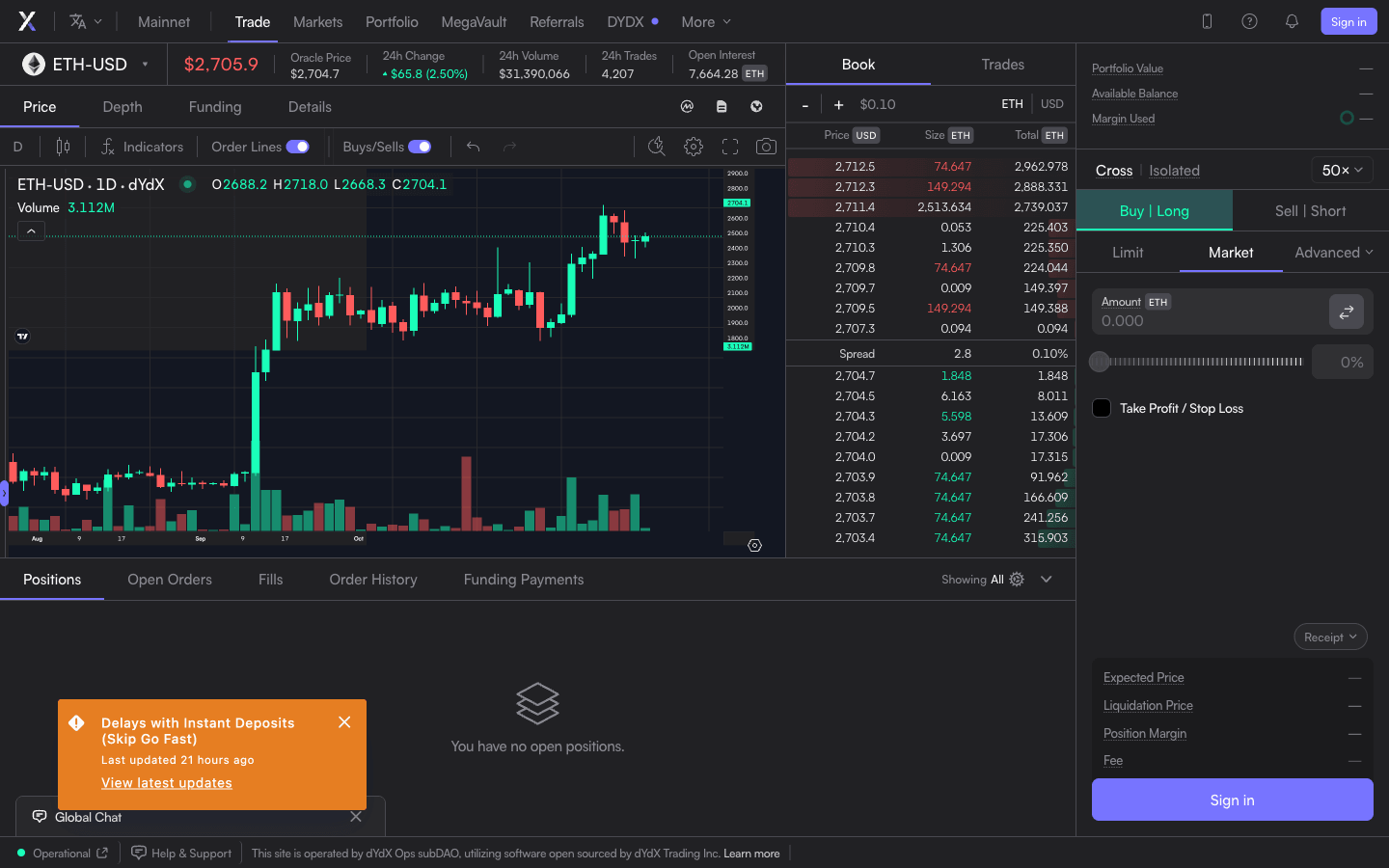
Hyperliquid is a layer 1 with two parts. HyperCore holds the order books, margin and liquidations in chain state, and HyperEVM is an Ethereum-compatible smart-contract layer that shares the same HyperBFT consensus. Every order, cancel and fill is part of the chain’s state and uses price-time priority, like a centralized exchange’s matching engine. None of it costs gas. Because perps, spot, vaults and EVM apps sit on one chain, collateral and data can move between them without a bridge.
dYdX Chain (dYdX “v4”) is a Cosmos SDK app-chain on CometBFT. Its docs say validators store orders “in an in-memory orderbook (i.e. off chain and not committed to consensus)”. The block proposer matches orders, puts the matched trades in its block, and the block is final once validators with two-thirds of the stake approve it. Only matches are written on-chain. That keeps order placement free and fast, but you cannot replay every resting order from chain history the way you can on HyperCore. dYdX’s chain, indexer, web app and mobile apps are all open source, and anyone can run them.
From StarkWare (v3) to dYdX Chain (v4) to Arcus
Several competing pages still describe dYdX as a StarkWare exchange, so the history matters. dYdX v3, the version that made it the largest DEX by volume in 2021, used Ethereum smart contracts and a StarkWare STARK rollup for settlement, while dYdX Trading ran the order book and matching engine on its own servers. dYdX Chain went live in 2023 to decentralize that last piece. v3 trading halted on October 28, 2024, and its Ethereum contract was frozen two days later so users could withdraw directly (DefiLlama still counts about $39M sitting in it on September 26, 2026). In June 2026 dYdX Labs moved its own focus to a new exchange, Arcus (section 8). Hyperliquid has no comparable history: it launched its own chain from the start and has not taken outside capital.
What this means for traders: both are self-custodial, and neither needs KYC or charges gas per order. Hyperliquid’s design puts more in one place (spot, perps, vaults, EVM). dYdX’s design is modular and more open, but its ecosystem is much smaller today. See AMM vs order book DEXs for why an order book matters for price.
3. Speed: latency, block time and throughput
Hyperliquid publishes its numbers. For an order sent from a co-located client, end-to-end latency (from sending the request to receiving the committed response) has a median of 200 ms and a 99th percentile of 900 ms. Every order, cancel, trade and liquidation gets one-block finality from HyperBFT, and mainnet supports about 200,000 orders per second; the docs name execution, not consensus, as the current bottleneck. A cancel or post-only (ALO) order shows about 380 ms end to end.
dYdX documents speed in blocks. Its FAQ gives a block time of about one second, and the chain is faster than that today: between September 26 and October 15, 2026 it produced 2,474,565 blocks (107,018,033 to 109,492,598) in about 18.4 days, an average of 0.64 s per block. Order-to-trade latency is the time your order takes to reach the current block proposer, which depends on where you and the proposer are, plus at least one block (the docs say “~0.8s”). Market orders are short-term orders that live only in validator memory for up to 20 blocks (about 30 seconds); limit orders from the web app are stateful orders, written to state and matched from the next block. dYdX publishes no network-wide throughput figure; its docs cite up to 1,500 orders per second through one self-hosted full node in load tests.
What it means: in a browser, both confirm a fill in well under a second. The difference shows up for bots and market makers. Hyperliquid’s latency is documented, and the API needs no node of your own. On dYdX, low latency means running a full node or using its Order Entry Gateway to reach the proposer directly. For most traders the bigger speed factor is fill quality, and there the order books below matter more than milliseconds.
4. Fees and discounts
Both venues charge a percentage of each fill’s notional: a taker fee for market orders, a maker fee for resting limit orders. Hyperliquid tiers use your rolling 14-day volume, with spot volume counting double. dYdX uses 30-day volume.
| Hyperliquid (14-day volume) | Taker / maker | dYdX (30-day volume) | Taker / maker |
|---|---|---|---|
| Tier 0: under $5M | 0.045% / 0.015% | Tier 1: under $1M | 0.050% / 0.010% |
| Over $5M | 0.040% / 0.012% | Tier 2: $1M+ | 0.045% / 0.010% |
| Over $25M | 0.035% / 0.008% | Tier 3: $5M+ (or affiliate referee) | 0.040% / 0.005% |
| Over $100M | 0.030% / 0.004% | Tier 4: $25M+ | 0.035% / 0% |
| Over $500M | 0.028% / 0% | Tier 5: $50M+ | 0.030% / 0% |
| Over $2B | 0.026% / 0% | Tier 6: $100M+ | 0.025% / −0.007% |
| Over $7B | 0.024% / 0% | Tier 7: $200M+ | 0.025% / −0.011% |
Hyperliquid: docs trading/fees. Hyperliquid also pays maker rebates of −0.001% to −0.003% to makers with more than 0.5% of total maker volume. dYdX: on-chain perpetual_fee_params. Both checked October 15, 2026.
Discounts
- Hyperliquid: a referral code takes 4% off fees on your first $25M of volume. Staked HYPE adds 5% (10 HYPE) up to 40% (500,000 HYPE). Both stack with the volume tier. Details are in our Hyperliquid fees guide.
- dYdX: staked DYDX cuts positive fees by up to 50%: 25% with 3,000 DYDX or 50% with 20,000 DYDX at tier 1, with smaller discounts at higher tiers (governance proposal 310). Accounts that sign up through an affiliate link start at tier 3 (0.040% / 0.005%). The on-chain trading-rewards multiplier was 0 on October 15, 2026, so don’t expect DYDX rebates on top.
Worked example: $10,000 round trip
If you open and close a $10,000 position with market orders, you pay $9.00 on Hyperliquid, or $8.64 with a referral code. On dYdX you pay $10.00 at tier 1, $8.00 as an affiliate referee at tier 3, and $7.50 at tier 1 with 3,000 DYDX staked. For limit orders on both legs, you pay $3.00 on Hyperliquid and $2.00 on dYdX ($1.00 at tier 3). On fees alone, then, a dYdX referee or a small DYDX staker can pay less than a Hyperliquid base-tier trader. That changes once you count slippage.
5. Liquidity, TVL and a live slippage test
Volume is where the two have split furthest. In the 24 hours to 04:48 UTC on October 15, 2026 (a Thursday) Hyperliquid traded $8.06B across 178 perp markets. BTC alone was $3.85B, ETH $1.73B and SOL $465M. dYdX traded $49.2M across 73 active markets. ETH ($33.3M), BTC ($9.4M) and SOL ($5.9M) were almost all of it, and the next market, TAO, traded about $92,000. Open interest was $11.2B vs $40.2M. Single-day ratios move with the day of the week: about 120 times on Friday, September 25 and about 220 times on Saturday, September 26 ($2.84B vs $12.9M), so the change to about 160 times is not a trend on its own. dYdX’s indexer still lists 296 markets, but 223 of them are in final settlement (delisted), up from 218 in September.
TVL tells the same story. DefiLlama counted about $6.97B on Hyperliquid (its L1 plus the Arbitrum bridge) and about $70.4M on dYdX V4 on October 15, 2026. By 24-hour volume, Hyperliquid held 41.6% of the perp DEX market we track on October 20, 2026, dYdX 0.2%.
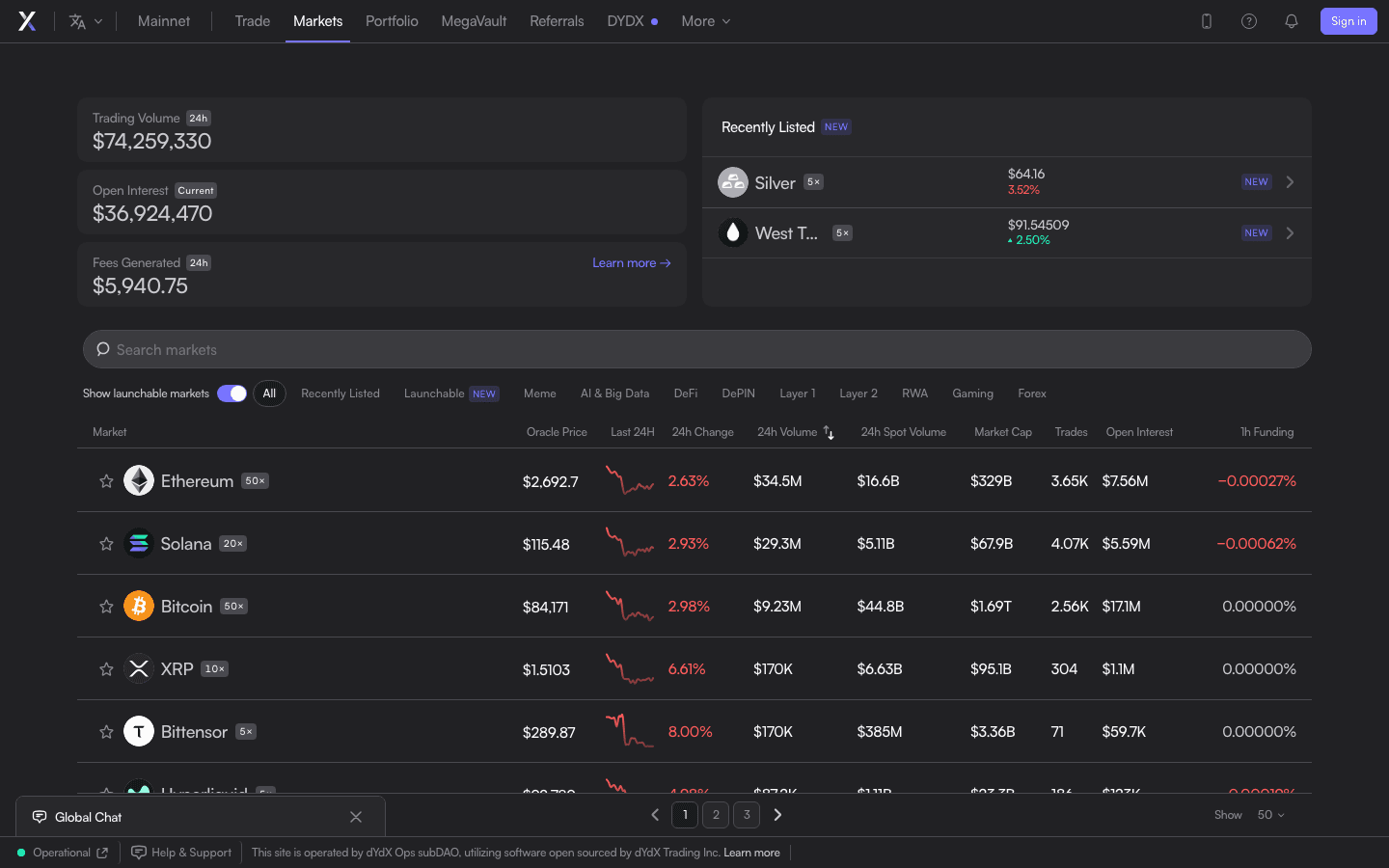
Volume only matters because it tells you how deep the order book is. So we tested the books directly, again. We took both order books at 04:49 UTC on October 15, 2026 (within about a second of each other) and calculated the average fill of a market buy against the mid price. The first run, on September 25, gave the same picture; the numbers below replace it:
| Market | Hyperliquid: $10k / $100k / $1M | dYdX: $10k / $100k / $1M | Spread HL | Spread dYdX |
|---|---|---|---|---|
| BTC | 0.0006% / 0.0006% / 0.0006% | 0.030% / 0.066% / 0.096% | 0.12 bp | 6.0 bp |
| ETH | 0.002% / 0.002% / 0.009% | 0.044% / 0.076% / 0.118% | 0.42 bp | 8.8 bp |
| SOL | 0.005% / 0.007% / 0.029% | 0.038% / 0.069% / 0.142% | 0.96 bp | 7.7 bp |
Average fill vs mid for a market buy, fees excluded, October 15, 2026 04:49 UTC. Hyperliquid l2Book (20 levels per side) and indexer.dydx.trade/v4/orderbooks. One snapshot. Books change by the second, so treat these as orders of magnitude. dYdX’s quoted spreads were wider than in September (BTC 6.0 bp vs 1.3 bp), so even a $10,000 order pays about 0.03% there.
What that costs. Take a $100,000 ETH position opened and closed with market orders:
| $100,000 ETH round trip | Hyperliquid | dYdX |
|---|---|---|
| Taker fees (open + close) | $90.00 ($86.40 with HOLYGRAIL) | $100.00 at tier 1 · $80.00 at tier 3 |
| Slippage vs mid (open + close) | ≈ $4 | ≈ $150 |
| Total | ≈ $90–94 | ≈ $230–250 |
Fees differ by $13.60 at most, and a dYdX tier-3 referee actually pays less than a Hyperliquid base-tier trader. The slippage gap is about $150 (sell side included: about $4 on Hyperliquid and $150 on dYdX for the round trip). On dYdX, a $10,000 BTC, ETH or SOL order fills at a few basis points. Larger orders move the price, and outside those three markets the books are thin. The protocol’s MegaVault, which quotes liquidity across markets, held about $1.73M on October 15, 2026; Hyperliquid’s HLP vault held $179.1M (October 20, 2026). For live venue-by-venue numbers see our perp DEX ranking.
6. Leverage, margin and liquidation
dYdX sets max leverage as 1 ÷ initial margin fraction. BTC-USD and ETH-USD have a 2% IMF, which is 50x. SOL-USD is 5% (20x), 27 markets are 10x and 43 are 5x, including HYPE-USD (indexer, October 15, 2026). Initial margin also rises as a market’s open interest grows. If your account value falls below maintenance margin (1.2% on BTC and ETH), the liquidation engine closes positions against the book. The penalty goes to the insurance fund and is capped at 1.5%. Margin is cross by default, and isolated markets and isolated positions keep a single position’s collateral separate.
Hyperliquid caps BTC at 40x (20x above $150M of position), ETH at 25x (15x above $100M), SOL and XRP at 20x, and many large alts at 10x. You choose cross (the default) or isolated margin per position; some assets are strict isolated, where margin cannot be removed. Maintenance margin is half the initial margin at max leverage, so 1.25% on BTC. A liquidation sends market orders to the book first, and any collateral left after the fill stays yours. There is no clearance fee. Only if equity falls below two-thirds of maintenance margin does the HLP liquidator take the position over. Per-asset limits are in Hyperliquid leverage limits, and the maths is in the liquidation price calculator.
Does 50x matter? At 50x a 2% move against you wipes out your initial margin, and you are liquidated before that. Most traders never use the cap. If you do want 50x on ETH, only dYdX offers it here.
Deeper books, lower taker fee
Hyperliquid had about 160× dYdX’s volume on October 15, 2026. Code HOLYGRAIL takes 4% off every fee on your first $25M.
7. HYPE vs DYDX: staking and token economics
| HYPE (Hyperliquid) | DYDX (dYdX Chain) | |
|---|---|---|
| Supply | 998.9M total (1B max, reduced by burns; September 25) | 1B |
| Price (October 15, 2026) | ≈ $79.65 | ≈ $0.122 |
| Staked (October 15, 2026) | 439.9M HYPE (≈ $35B) | 285.9M DYDX (≈ $35M) |
| Staking reward source | Future-emissions reserve; ≈ 2.12%–2.24% APR on October 15, 2026 | Trading fees (USDC) and gas, minus validator commission |
| Unstaking | 1-day delegation lockup, then a 7-day unstaking queue | 21-day unbonding |
| Where trading fees go | HLP and the assistance fund, which buys HYPE; none to a team treasury | Stakers and validators, with shares routed to MegaVault and treasury subDAOs by governance |
| Fee discount from staking | 5% (10 HYPE) to 40% (500,000 HYPE) | 25% with 3,000 DYDX or 50% with 20,000 DYDX at tier 1 |
The two tokens work in opposite ways. HYPE stakers are paid from a fixed emissions reserve. The docs say the rate falls as more HYPE is staked (about 2.37% at 400M). Hyperliquid’s fee revenue ($88.5M over the 30 days to October 15, 2026 on DefiLlama) goes to HLP and to buying HYPE through the assistance fund, not to stakers directly. DYDX stakers are paid in USDC from trading fees, so their yield depends on volume. dYdX earned $0.30M in fees over the same 30 days.
Is either token a good investment? We don’t forecast prices. The useful question is where the money comes from: HYPE’s value is tied to buybacks funded by the largest fee stream in the perp DEX market, while DYDX staking yield is a share of fees at a venue that now trades a fraction of what it did. Supply, unlocks and buybacks are in our HYPE token guide.
For a trader the practical question is the fee discount. At October 15, 2026 prices, 3,000 DYDX (about $366) gets you 25% off at tier 1. On Hyperliquid, 10 HYPE (about $797) gets you 5% and 100 HYPE (about $7,965) gets you 10%. If you would hold the token anyway, the discount is a bonus. Buying a token only for the discount means taking on its price risk. Hyperliquid’s referral discount has no such risk. More on staking in Hyperliquid staking.
8. Decentralization and risk
- Validators. dYdX runs 21 active validators, the on-chain maximum. The top four hold about 37.4% of bonded stake (October 15, 2026). Hyperliquid has 27 active validators out of 35, and the five Hyper Foundation validators hold about 47.3% of stake (the top four about 45%). So dYdX’s stake is spread more evenly, while Hyperliquid runs more validators but relies more on its foundation.
- Open source. dYdX’s chain, indexer and front-ends are open source and can be deployed by anyone. The dydx.trade front-end is operated by the dYdX Ops subDAO. Hyperliquid publishes its docs, API and SDKs, and the core node software is run by its validators.
- Where dYdX is heading. On June 30, 2026 dYdX Labs launched Arcus, a new exchange built with Robinhood Crypto on Robinhood Chain. It said it is “100% focused” on Arcus and that “dYdX v4 will continue to be supported”. dYdX Chain is now best read as a community-run chain rather than the team’s flagship.
- Collateral change. Circle stopped new USDC minting on Noble, the source of dYdX’s USDC, on October 13, 2026, and pauses it fully on January 12, 2027. dYdX plans to move to Injective USDC, but on October 15, 2026 the chain’s asset module still listed Noble USDC as its only collateral. Use the app’s deposit flow and don’t send tokens manually until the app confirms the route. Details and the incident history are in our dYdX review.
- Hyperliquid’s risks are about concentration. Its biggest markets and its validator stake sit with a few actors, and the HLP vault is the backstop for liquidations. The auto-deleveraging guide explains what happens in extreme moves.
9. Onboarding, deposits, withdrawals and apps
- Sign-in. Hyperliquid: an EVM wallet or email login, then “Enable Trading”, a gasless signature. dYdX: Google, email, EVM, Solana (Phantom) or Cosmos wallets. EVM and Solana wallets sign to create a dYdX Chain address. Neither needs KYC or a centralized exchange account, though each venue’s terms exclude some regions (Hyperliquid: the US, Ontario and sanctioned regions; dYdX: the US, Canada, the UK and sanctioned regions). See our no-KYC exchange guide for what “no KYC” does and does not mean.
- Deposits. Hyperliquid takes USDC from Arbitrum, Ethereum, Base and Polygon (5 USDC minimum), plus native BTC, ETH, SOL and other assets. See the deposit guide. dYdX takes USDC through its built-in Skip Go bridge from Ethereum, Arbitrum, Optimism, Base, Polygon, Avalanche, Solana or Cosmos chains. On a first deposit it keeps 1.25 USDC in your wallet for gas.
- Withdrawals. Hyperliquid charges 0.2 USDC plus a tiny HyperEVM gas fee to withdraw USDC to Arbitrum, and the app says withdrawals arrive within 5 minutes (how to withdraw from Hyperliquid). On dYdX, regular Skip Go withdrawals take about 1–5 minutes and cost about $0.10–$7 plus destination-chain gas; a direct IBC transfer to another Cosmos chain takes about 30 seconds.
- Order types. dYdX has six: market, limit, stop market, stop limit, take-profit market and take-profit limit, with post-only, IOC and good-til-block/time options. Hyperliquid has the same core set plus TWAP, scale, trailing-stop and chase orders, reduce-only, and TP/SL attached to a position. See Hyperliquid order types.
- Mobile. Hyperliquid has an official Android app and no iOS app; on an iPhone you use the web app in Safari (Hyperliquid app guide). dYdX’s iOS and Android apps are open source; the iOS app “dYdX: Trade 200+ DeFi Markets” is listed in some App Stores outside the US, such as Japan’s, but not in the US or UK store (last updated November 2025). More in DEX mobile apps compared.
- Beyond perps. Hyperliquid has 336 spot pairs, user vaults, HIP-3 stock and commodity perps, and HyperEVM apps. dYdX is perps only, plus MegaVault.
- Bots and API. Both have public REST and WebSocket APIs. Hyperliquid’s books are deep enough to execute systematic strategies at size, and its latency is documented (section 3). See the Hyperliquid API guide and DEX trading bots.
10. Referral and affiliate programs
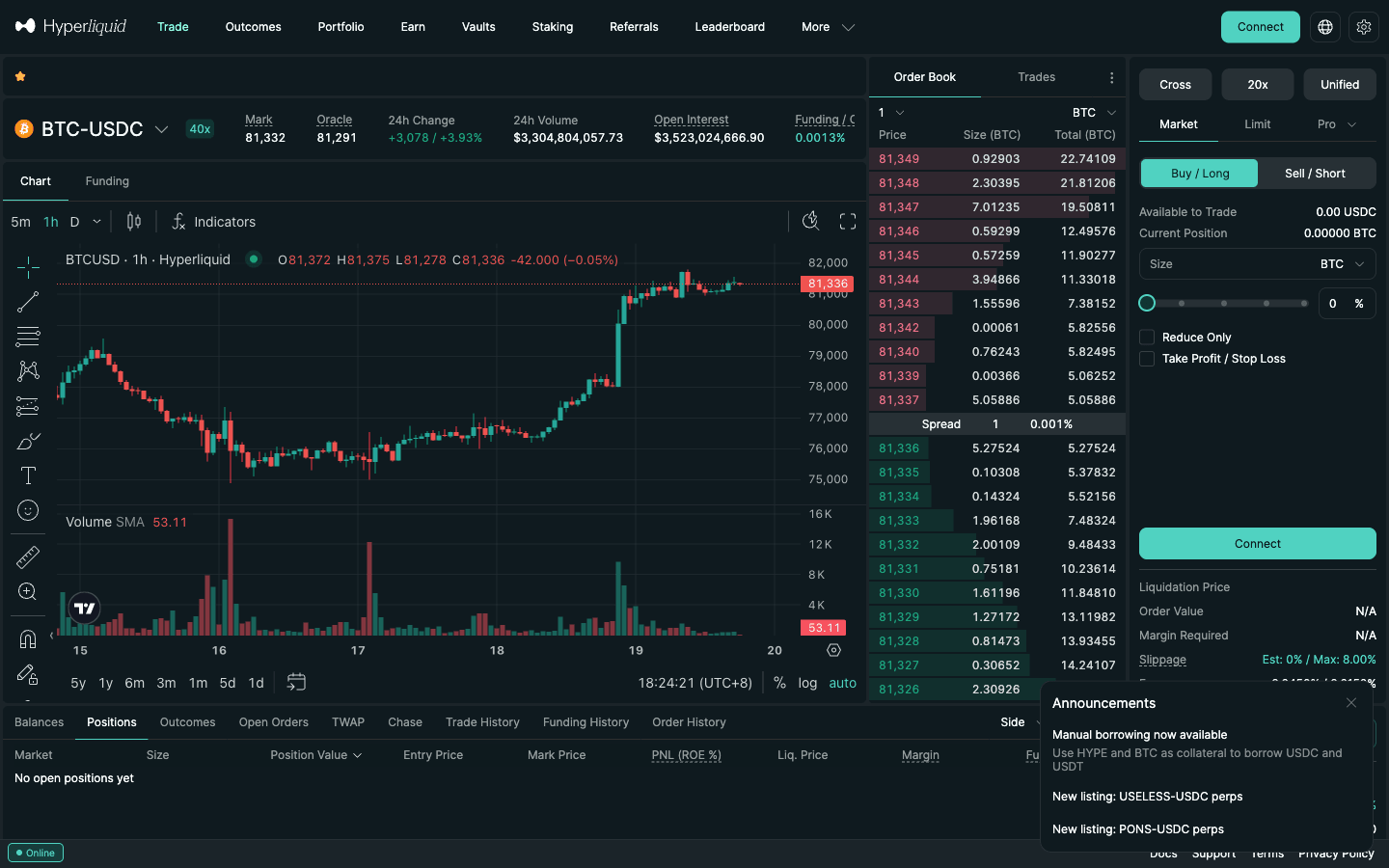
Hyperliquid: a referred account gets 4% off trading fees on its first $25M of volume. The referrer earns 10% of the referee’s Hyperliquid fees (not of an app’s builder fee). You can enter a code at app.hyperliquid.xyz/referrals or join through a link. The discount also applies to orders placed through third-party apps that attach a builder code and that you connect with the same wallet, such as Based or Liquid (not fomo, which creates its own account, so a code cannot apply there): the 4% comes off Hyperliquid’s part of the fee, while the app’s builder fee is charged in full. A code cannot be entered after $10,000 of volume, and apps such as Phantom often set their own Hyperliquid referral code on accounts that have none, so enter a code on Hyperliquid before you start using an app. Our code is HOLYGRAIL.
dYdX: the affiliate program is enforced on-chain. After $10,000 of your own volume you can create a link. Affiliates earn 30% of referees’ taker fees, rising to 40% above $1M and 50% above $10M of referred 30-day volume. The payout is in USDC, capped at $2M of volume and $10,000 of commission per referee per 30 days. Referees start at fee tier 3. We do not hold a dYdX code, so our dYdX links go straight to dydx.trade. If you run a community, dYdX pays affiliates a much larger share than Hyperliquid. Compare programs in DEX referral programs compared.
11. Which should you choose?
Choose Hyperliquid if you…
- trade with market orders, or more than a few thousand dollars at a time (lower taker fee, far less slippage)
- want coins beyond BTC, ETH and SOL (178 core perps vs 73 active on dYdX)
- want spot, vaults, HIP-3 stock perps and perps in one account
- run a bot and want documented latency without running a node
- want a fee discount without buying a token (code HOLYGRAIL, 4% off)
Trade-offs: 40x / 25x caps on BTC/ETH, higher base maker fee, stake concentrated in the foundation, no iOS app.
Choose dYdX if you…
- specifically want 50x on BTC or ETH
- place small resting limit orders (0.010% maker, or 0.005% at tier 3)
- already hold DYDX and can use the staking discount
- prefer a fully open-source Cosmos stack with a more even validator set
- trade only BTC, ETH or SOL in sizes around $10,000
Trade-offs: under 1% of Hyperliquid’s volume, thin books outside three markets, dYdX Labs now focused on Arcus, a USDC collateral migration still pending.
If neither fits, our Hyperliquid alternatives guide compares every venue that competes with Hyperliquid on fees, leverage and markets. Start with how to use Hyperliquid. Other match-ups: Hyperliquid vs GMX, Hyperliquid vs Lighter, Hyperliquid vs Binance, and the whole field on best DEXs in 2026. New to this? Start with what is a DEX.
12. FAQ
Is Hyperliquid cheaper than dYdX?
For market orders at the base tier, yes: 0.045% taker on Hyperliquid versus 0.050% on dYdX, and a Hyperliquid referral code brings it to 0.0432%. Two exceptions: dYdX’s base maker fee is lower (0.010% vs 0.015%), and accounts that join dYdX through an affiliate link start at tier 3 (0.040% taker). In practice the bigger cost is slippage: in our October 15, 2026 order-book test a $100,000 ETH market buy moved about 0.002% on Hyperliquid and 0.076% on dYdX, which outweighs any fee difference.
Which has more liquidity, Hyperliquid or dYdX?
Hyperliquid, by roughly 160 times: $8.06B of 24-hour perp volume and $11.2B of open interest on October 15, 2026, against $49.2M and $40.2M on dYdX (both APIs read in the same minute). On dYdX, ETH, BTC and SOL make up almost all of the volume; the fourth-busiest market, TAO, traded about $92,000 that day. One-day ratios swing a lot (about 120 times on Friday, September 25, about 220 times on Saturday, September 26), so read any single figure as a snapshot.
Is Hyperliquid faster than dYdX?
On paper, yes. Hyperliquid documents a median end-to-end latency of 200 ms (900 ms at the 99th percentile) for an order from a co-located client, one-block finality and about 200,000 orders per second. dYdX’s docs give a block time of about one second (it averaged 0.64 s between September 26 and October 15, 2026 by our block-height count) and an order-to-trade latency of at least one block (about 800 ms) plus the time for your order to reach the block proposer. Both feel instant in a browser; the difference matters for bots and market makers.
Which offers higher leverage?
dYdX on the majors: BTC-USD and ETH-USD have a 2% initial margin fraction, so 50x. Hyperliquid caps BTC at 40x (20x above $150M of position) and ETH at 25x. SOL is 20x on both. For most other coins Hyperliquid is higher (10x on many markets, versus 5x on 43 of dYdX’s 73 active markets).
Is dYdX more decentralized than Hyperliquid?
It depends on what you measure. dYdX has 21 active validators with the top four holding about 37.4% of stake, and its front-end, indexer and chain are open source and can be run by anyone. Hyperliquid has 27 active validators, but the five Hyper Foundation validators hold about 47.3% of stake. On the other hand, Hyperliquid puts every order in chain state, while dYdX keeps the order book in validator memory and only commits matched trades.
What is dYdX?
dYdX is a decentralized exchange for perpetual futures. Since 2023 it has run on dYdX Chain, its own Cosmos SDK blockchain, where validators run the order book and matching engine and DYDX is the staking and governance token. Trading is self-custodial, needs no KYC and is settled in USDC. dYdX Labs, the original developer, launched a separate exchange (Arcus) in June 2026 but says dYdX v4 will continue to be supported.
Does dYdX still use StarkWare?
No. The old dYdX v3 exchange ran on Ethereum smart contracts with a StarkWare STARK rollup for settlement and a central order book run by dYdX Trading. Trading on v3 halted on October 28, 2024 and its contract was frozen two days later so users could withdraw. Today’s dYdX (v4) is its own Cosmos chain with no StarkWare component.
HYPE vs DYDX: which token captures more value?
We do not make price predictions. What differs is how value reaches holders. Hyperliquid’s fees (about $88.5M over the 30 days to October 15, 2026, DefiLlama) go to HLP and to the assistance fund, which buys HYPE; HYPE stakers are paid from a future-emissions reserve (about 2.12%–2.24% APR). dYdX’s fees ($0.30M over the same 30 days) are paid to DYDX stakers in USDC, so staking yield depends directly on dYdX’s much smaller volume. Our HYPE token guide covers supply, unlocks and buybacks.
Which is better for a trading bot?
Hyperliquid for most bots: documented 200 ms median latency for co-located clients, a cancel or post-only order at about 380 ms, an official Python SDK, and books deep enough to fill size across 178 perp markets. dYdX has open-source Python and TypeScript clients and short-term orders built for market makers, but for low latency it expects you to run your own full node or use its order-entry gateway, and outside BTC, ETH and SOL the books are thin.
Can I use Hyperliquid or dYdX without a centralized exchange account or KYC?
Yes. Both are self-custodial: you connect a wallet (or log in with email, or Google on dYdX), and neither asks for ID. You do need USDC or another supported asset in a wallet to deposit (Hyperliquid’s minimum is 5 USDC), which most people first buy on an exchange or on-ramp. “No KYC” is not anonymity, since positions are public on-chain, and each venue’s terms still exclude some regions (Hyperliquid: the US, Ontario and sanctioned regions; dYdX: the US, Canada, the UK and sanctioned regions).
What are the best DeFi trading platforms for perpetuals?
By volume, Hyperliquid leads the perp DEX market with about 41.6% of 24-hour volume across the 20 venues we track (October 20, 2026); Variational Omni, Lighter, Aster and Pacifica followed on that day, and dYdX is now a small venue (0.2%). The right pick depends on fees, leverage and the markets you trade; our perp DEX ranking updates the numbers every build and our Hyperliquid alternatives guide compares the venues that compete with it.
Is dYdX shutting down?
No. In a June 30, 2026 post dYdX Labs launched Arcus, a new exchange built with Robinhood Crypto on Robinhood Chain, and said it is “100% focused” on it, while stating that “dYdX v4 will continue to be supported” and funds and positions remain accessible; the dYdX blog has published nothing since. Separately, Circle stopped new USDC minting on Noble on October 13, 2026 and fully pauses Noble USDC on January 12, 2027. dYdX plans to move its collateral to Injective USDC, but on October 15, 2026 the chain’s only collateral asset was still Noble USDC, so use the in-app deposit flow and do not send Injective USDC manually.
Do you have a dYdX referral code?
No. dYdX pays affiliates 30–50% of referred taker fees, but we do not hold a dYdX code, so our dYdX links are plain links. For Hyperliquid, code HOLYGRAIL gives 4% off trading fees on your first $25M of volume.
Open your Hyperliquid account
178 perp markets (as of October 20, 2026), no gas on orders and 4% off fees with HOLYGRAIL.
Want 50x on ETH? dYdX (plain link, since we have no dYdX code).
Disclosure: HOLYGRAIL is our Hyperliquid referral code, and we earn a share of referred accounts’ fees at no cost to you. We have no dYdX affiliate code. Figures come from the Hyperliquid API and docs, the dYdX indexer, dydx.trade, dYdX on-chain parameters, docs.dydx.xyz, CoinGecko and DefiLlama, checked on October 15, 2026. Volumes, prices and parameters change constantly. Not investment advice.