
Short version. Hyperliquid’s trailing stop has four inputs: Retracement (% or USDC), Size, Reduce Only and an optional Activation Price. A sell trail follows the highest mark price, a buy trail the lowest, and the trigger never moves back. When it fires you get a market order, so the fill can be worse than the trigger in a fast move. It can close a position or open one (a “trailing entry”). Keep it well inside your liquidation price: an isolated BTC long at 40x is liquidated after a drop of only about 1.27%.
A trailing stop that fires pays a taker fee. Pay 4% less.
Open Hyperliquid with code HOLYGRAIL: a triggered trailing stop costs 0.0432% instead of 0.045% on your first $25M of volume.
We earn a commission when you sign up through our links; it never raises your fees.
1. Does Hyperliquid have a trailing stop? Native, apps or bots
Hyperliquid announced “New order type: Trailing stop” in the app on September 21, 2026: “Trailing stops are now available for perp markets. They can be found in the ‘Pro’ dropdown of the order form or as a new option to close a position.” Before that date there was no native option, and traders relied on bots and third-party terminals. That is why the search results still mix launch news with older threads and videos that say there is no trailing stop. Here is what each route offers, checked on September 27, 2026:
| Route | Trailing stop? | How it works | Cost |
|---|---|---|---|
| Hyperliquid app, perps | Yes, native since September 21, 2026 | Pro → Trailing Stop, or the close option on a position. Runs on Hyperliquid itself and triggers on the mark price. | Normal taker fee (0.045%), 0.0432% with a referral code |
| Hyperliquid app, spot | No | The spot order form has no trailing stop. Move a stop by hand, scale out with a TWAP, or use a bot. | — |
| Hyperliquid API | No trailing order type | Orders are limit or trigger only. A bot has to emulate the trail by re-pricing a trigger order. | Normal fees; your bot must stay online |
| Based app (Hyperliquid front end) | Yes, "Trailing Stop Loss" | Based documents a trail by Percentage or Fixed Amount with an optional activation price, triggering on the mark price. | Hyperliquid fee + Based builder fee 0.025% |
| WunderTrading terminal | Yes (advertised) | Third-party terminal connected through an API (agent) wallet; the trail is managed by WunderTrading, off Hyperliquid. | Builder fee 0.035% |
| TradingView scripts | Indicator only | Scripts such as "ATR Trailing Stops for Hyperliquid Spot + Perps" draw a trail and fire alerts. Orders need a webhook bridge. | Depends on the bridge |
Sources: Hyperliquid docs (order-types, trailing-stops, exchange endpoint) and live app; Based, WunderTrading and TradingView pages, all read September 27, 2026. Builder-fee apps: the referral discount also applies to orders placed through apps with a builder code. Hyperliquid’s 4% comes off Hyperliquid’s part of the fee, and the app’s builder fee is added on top. Note that apps such as Phantom often set their own Hyperliquid referral code on accounts that have none, so enter a code on Hyperliquid before you start using an app.
For perps, the native order is the one to use: it runs on Hyperliquid itself (no bot to keep online, no API key to hand out), and there is no builder fee on top. Third-party tools matter for spot and for rules the native order cannot express, such as ATR-based trails.
2. How Hyperliquid’s trailing stop works
The official definition is a market order “activated when the mark price retraces from its best level by the selected distance or percentage.” The support docs name four moving parts:
- Activation price (optional): tracking begins when the mark price reaches this level, or at once if you leave it empty.
- Watermark: the highest mark price since activation for a sell trailing stop, the lowest for a buy trailing stop.
- Retracement: how far the mark must reverse from the watermark, as a fixed price distance (USDC) or a percentage.
- Trigger price: where the market order is sent. It moves only when a new watermark is recorded and stays put during a reversal.
| Order side | Watermark | Trigger (distance) | Trigger (percentage) |
|---|---|---|---|
| Sell trailing stop (closes a long or opens a short) | Highest mark price since activation | Watermark − distance | Watermark × (1 − rate) |
| Buy trailing stop (closes a short or opens a long) | Lowest mark price since activation | Watermark + distance | Watermark × (1 + rate) |
Source: Hyperliquid docs, support/faq/trailing-stops (re-read September 27, 2026). The docs call the sell side a “short” trailing stop because it sells.
Two consequences are easy to miss. The order can open a position as well as close one (Example 2 below). And because it becomes a market order, you get execution certainty, not price certainty.
3. How to set a trailing stop on Hyperliquid, step by step
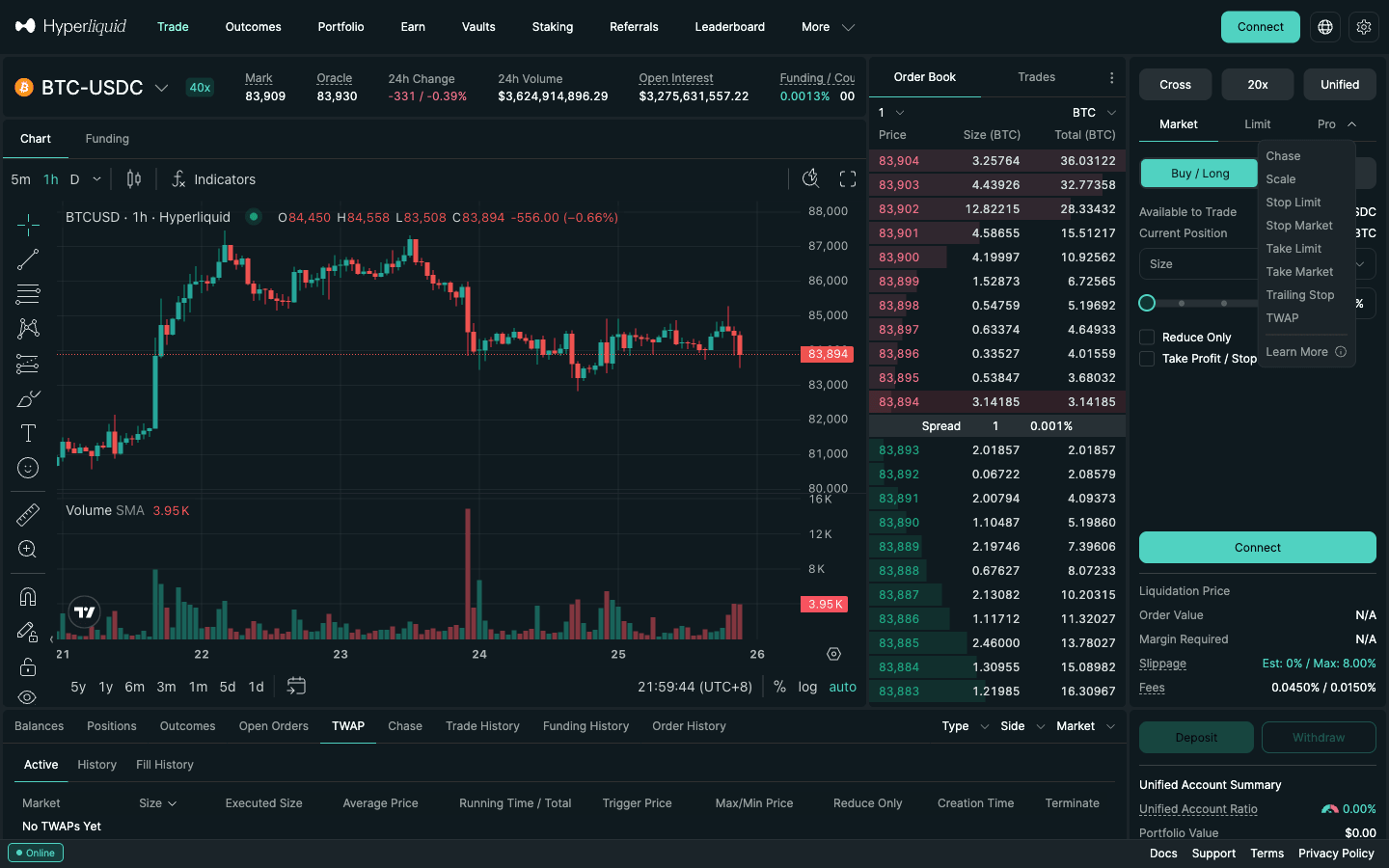
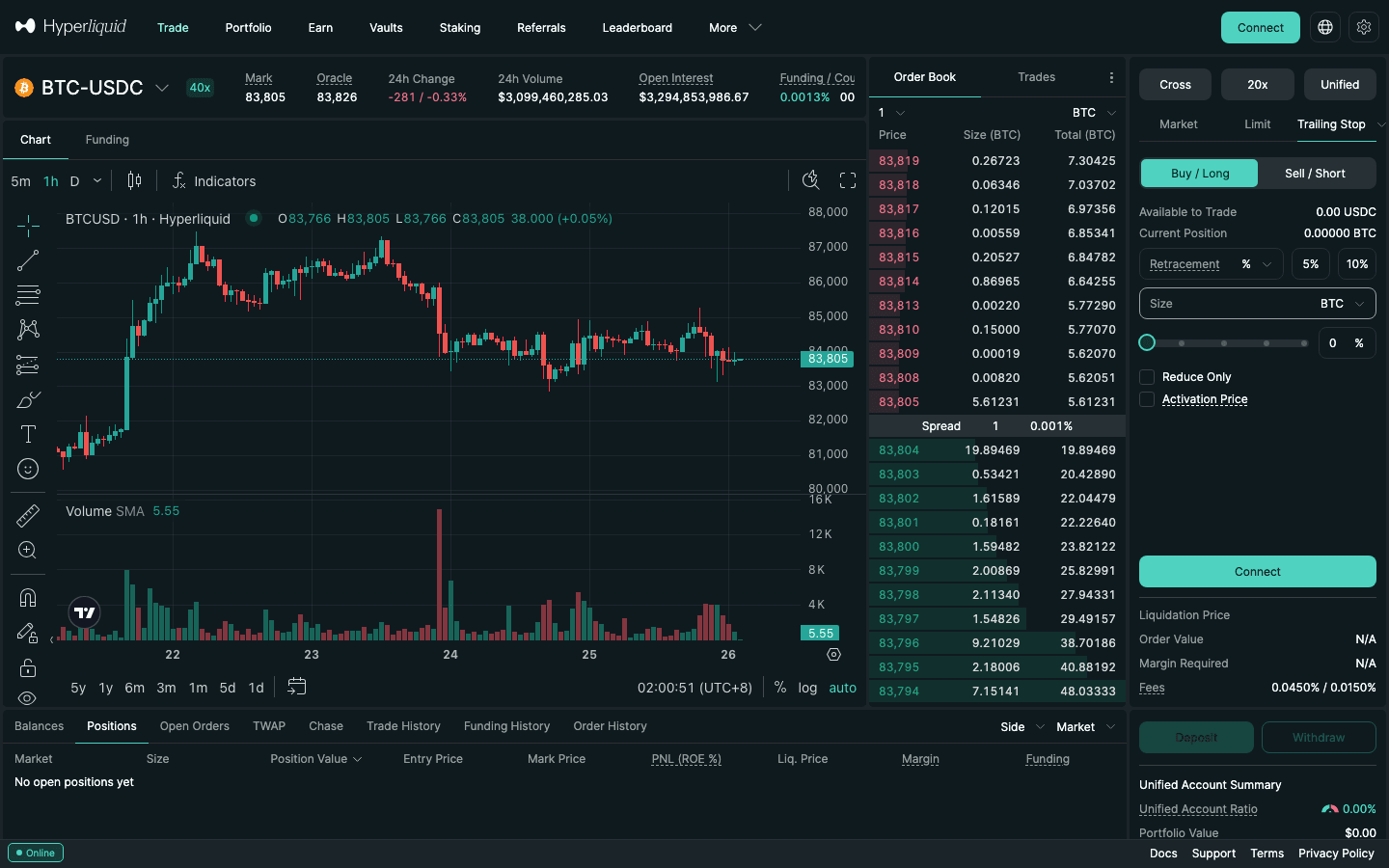
- Open a perp market at app.hyperliquid.xyz/trade (for example BTC-USDC). Trailing stops do not appear on spot pairs.
- Choose Pro → Trailing Stop in the order form (tabs Market / Limit / Pro).
- Pick the side. To protect a long, choose Sell / Short; to protect a short, Buy / Long. For a trailing entry, choose the side you want to open.
- Enter the Retracement. Pick the unit (% or USDC) from the list next to the field, then type a value or tap the 5% or 10% preset.
- Enter the Size in coins (BTC) or as a percentage.
- Tick Reduce Only when the order is meant to close. It can then only shrink your position and never flips you into a new one if you have already closed by hand.
- Optional: tick Activation Price and enter a level (above the market for a sell trail on a long, below for a buy trail on a short) if you only want to trail once the trade is in profit.
- Submit and check Open Orders. The order sits there with its trigger; the trigger moves only when the mark makes a new best level.
From an open position: the announcement adds the trailing stop as a close option on the position itself, so you can attach it from the Positions tab without choosing the side or size by hand.
4. Example 1: a 5% trail with an activation price
On September 27, 2026 at 04:07 UTC, BTC’s mark price on Hyperliquid was 84,421. Say you open a 0.1 BTC long at 84,400 (notional $8,440) and want to ride a breakout without trailing inside today’s noise. You place a sell trailing stop, Retracement 5%, Activation Price 87,000, Reduce Only, plus a separate fixed stop loss at 82,000 (−2.8%). The path below is hypothetical:
| Mark price | Watermark | Trigger (5%) | What happens |
|---|---|---|---|
| 84,400 (you open the long) | — | — | Waiting: mark is below the 87,000 activation price. Only your fixed stop at 82,000 protects you. |
| 87,000 | 87,000 | 82,650 | Activated: tracking starts |
| 89,500 | 89,500 | 85,025 | New high raises the trigger |
| 91,000 | 91,000 | 86,450 | New high raises the trigger |
| 89,000 | 91,000 | 86,450 | Pullback: trigger does not move |
| 86,450 | 91,000 | 86,450 | Triggered: market sell for your size |
Exit at about 86,450 on 0.1 BTC is $205 before fees; taker fees on the round trip are about $7.69 (0.045% in and out), $7.38 with a referral code. The moment the trail activates, its trigger (82,650) already sits above your fixed stop (82,000), so you can cancel the fixed stop then. The lesson of the first row: an activation price means no protection until it is hit.
5. Example 2: trailing entry with a USDC distance
The docs’ third example uses a trailing stop to open a position. It works like “buy the bounce”: instead of guessing the bottom with a limit order, you let the market fall, then buy once it has turned up by a set amount. Here it is with a fixed price distance. BTC is at 84,400; you place a buy trailing stop, Retracement 1,500 USDC, Activation Price 82,000, Reduce Only off:
| Mark price | Lowest mark | Trigger (+1,500) | What happens |
|---|---|---|---|
| 84,400 | — | — | Waiting: mark is above the 82,000 activation price. Nothing is tracked yet. |
| 82,000 | 82,000 | 83,500 | Activated: tracking the lowest mark |
| 80,800 | 80,800 | 82,300 | New low lowers the trigger |
| 81,600 | 80,800 | 82,300 | Bounce, but not far enough: trigger stays |
| 82,300 | 80,800 | 82,300 | Triggered: market buy opens your long |
You buy about 1,500 above the low (80,800), but only after the fall has stopped. A limit buy at 82,000 would have filled on the way down and sat through the extra drop to 80,800. Use USDC distance when you think in price levels (scalps, a known support zone); use % for holds of several days, where the price level changes a lot. Attach a stop loss right after the entry fills, since the new position starts unprotected.
Try the trailing stop on a small position first
Join with HOLYGRAIL for 4% off every fill, trailing stops included, on your first $25M of volume.
6. Trailing stop strategy: 5%, 10% or custom
A trail tighter than the market’s normal noise gets hit by noise. We measured Hyperliquid’s own perp candles over the 90 UTC days to September 26, 2026, and simulated a sell trailing stop started at each day’s open (no activation price) to count how often it fired before the day ended:
| Coin | Avg daily range | Avg 1-hour range | 2% trail hit same day | 5% trail hit | 10% trail hit | Deepest pullback, 90 days |
|---|---|---|---|---|---|---|
| BTC | 2.86% | 0.51% | 36 / 90 | 1 / 90 | 0 / 90 | 9% |
| ETH | 3.91% | 0.69% | 52 / 90 | 8 / 90 | 0 / 90 | 11.6% |
| SOL | 4.46% | 0.81% | 68 / 90 | 11 / 90 | 1 / 90 | 16% |
| HYPE | 5.74% | 1.11% | 74 / 90 | 28 / 90 | 1 / 90 | 29.9% |
Hyperliquid info API (candleSnapshot 1d and 1h), 2026-06-29 to 2026-09-26, fetched September 27, 2026. Ranges are high−low as % of the open. Hits use hourly last-trade candles, not the mark price, so they are approximate. BTC’s 14-day ATR was 2.95% of price.
- 5% preset: almost never hit by an ordinary day on BTC (1 of 90 days), occasionally on ETH and SOL, but on 28 of 90 days on HYPE. A sensible swing-trade trail for majors; too tight for HYPE unless you want a quick exit.
- 10% preset: for multi-day trend holds and volatile alts. It rarely fires on intraday noise, but you give back more at the exit. BTC’s deepest pullback in the whole window was 9%, so a 10% trail started at the window’s open would still be open.
- Custom 1–2%: intraday only. A 2% trail was hit on 36 of 90 days on BTC and 74 on HYPE: closer to a coin flip than a stop.
- Rule of thumb: 1.5–3× the average range of the time frame you trade, and never wider than your liquidation distance allows (section 9). Activation Price is the other lever: start the trail only once the trade is in profit by about one average range.
7. Pair it with a fixed stop loss
A trailing stop is an exit for a trade that works; a fixed stop loss is the exit for one that doesn’t. Two points are specific to trailing stops:
- Keep a fixed stop until the trail activates. With an Activation Price, the trail does nothing until that level trades. Once its trigger is above your fixed stop (Example 1), the fixed stop is redundant.
- The trailing stop always fires a market order. There is no limit-price option, so there is no way to cap the fill price. If you need a limit exit at a fixed level, use a stop limit or take limit instead.
How to place the fixed stop (on the order ticket, on the position, or as a stand-alone stop market or stop limit order) is covered in our guide to Hyperliquid stop loss and take profit. For scaling out, a fixed-size take-profit for half the position plus a trailing stop for the rest is a common setup (partial closes and TP ladders).
8. Mark price, wicks and fills
Trailing stops, TP/SL orders and liquidations all use the mark price, updated about every 3 seconds. It is the median of three inputs: the oracle price plus a 150-second EMA of Hyperliquid’s mid-minus-oracle gap; the median of Hyperliquid’s best bid, best ask and last trade; and a weighted median of perp mid prices on other exchanges (Binance (weight 3), OKX (2), Bybit (2), Gate (1) and MEXC (1)). This has two effects on a trailing stop:
- Watermark: a thin-book spike on Hyperliquid alone may not become the watermark, so your trigger can sit lower than the highest wick you see on the last-trade chart.
- Trigger: a brief wick on Hyperliquid alone rarely fires the stop, but a real move across the large CEXs does. When it fires, the market order fills against Hyperliquid’s book, so in a fast drop the fill can be below the trigger. Market TP/SL orders use a slippage tolerance of up to 10%.
The header shows Mark and Oracle side by side. The mark price guide explains the formula in detail.
9. Liquidation comes first
A trailing stop that sits beyond your liquidation price never fires. Maintenance margin is half the initial margin at the asset’s max leverage (1.25% for BTC at 40x). For an isolated 0.1 BTC long at 84,400 ($8,440 notional):
| Leverage | Initial margin | Maintenance margin | Liquidation price | Distance |
|---|---|---|---|---|
| 40x (max) | $211 | $106 | 83,332 | 1.27% |
| 20x | $422 | $106 | 81,195 | 3.80% |
| 10x | $844 | $106 | 76,922 | 8.86% |
| 5x | $1,688 | $106 | 68,375 | 18.99% |
| 3x | $2,813 | $106 | 56,979 | 32.49% |
At 40x a 5% trail is useless: the position is gone first. A practical rule is to keep the trail within about half of the liquidation distance. That allows a 5% trail up to about 8x and a 10% trail up to about 4x on BTC. Cross positions use account value, so their liquidation price moves with every other trade (cross vs isolated margin, liquidation price calculator).
10. API, spot, apps and bots
API. The exchange endpoint accepts only limit orders and trigger orders (isMarket, triggerPx, tpsl), with reduce-only r and grouping na / normalTpsl / positionTpsl. There is no trailing type, so a bot emulates one: subscribe to the mark price over WebSocket, and when a new extreme prints, re-price a reduce-only trigger order with modify. Because the docs only allow a trigger order as the new order when always_place is true, the bot must set it; keep the order reduce-only so a duplicate cannot open a position. Trigger orders are rejected by the fast cancel flag, and scheduleCancel works as a dead-man’s switch (at least 5 seconds ahead, at most 10 triggers a day). See the API bot guide.
Spot. No trailing stop. Ratchet a normal sell order by hand on candle closes, or scale out with a reduce-only TWAP (sub-orders no more often than every 30 seconds, 3% slippage cap each, 5 minutes to 7 days, $100 minimum), or use a bot.
Apps and bots. The Based app documents its own “Trailing Stop Loss”: Percentage or Fixed Amount trail, optional activation price, triggers on the mark price. It is a Hyperliquid front end with its own referral program (code HOLYGRAIL on Based), and it adds a 0.025% builder fee on perps. WunderTrading advertises a trailing stop in its Hyperliquid terminal, connected through an API wallet, with a 0.035% builder fee. TradingView scripts such as “ATR Trailing Stops for Hyperliquid Spot + Perps” compute volatility-based trails and send alerts, which need a webhook bridge to become orders (TradingView and Hyperliquid). A trail run by a third party stops working when its server does. Hyperliquid’s 4% referral discount still applies to orders placed through these apps, so join Hyperliquid with HOLYGRAIL before your first trade and before connecting an app: a code cannot be entered once an account has traded more than $10,000. For perps, the native order is simpler and cheaper; compare bots in best DEX trading bots.
11. Lighter and Aster
Lighter has stop-loss and take-profit orders and TWAP, but no trailing stop in its order-type docs (checked September 27, 2026). To trail there, you move the stop-loss order by hand as the price moves; its Standard account charges 0% taker fees on market and limit orders (code 718610TD). Aster has a native trailing stop in Pro mode (order-book perps), set as a percentage “callback rate” with a market order on trigger (code DTLpLc). Compare the venues in Hyperliquid vs Lighter.
12. Mistakes that cost money
- Trail beyond liquidation. Check the Liq. Price on the position before choosing the trail width.
- Activation price without a fixed stop. Until activation the trail does nothing.
- Trail tighter than the noise. A 2% trail on HYPE fired within the day on 74 of 90 days.
- Forgetting Reduce Only. A closing trail on a position you already closed by hand opens a new position the other way.
- Wrong side. Sell / Short protects a long; Buy / Long protects a short. Without Reduce Only, the wrong side is a trailing entry that adds to your position.
- Using it on spot. It is not there; do not assume a bot’s trail is running unless you can see its orders.
- Size set in coins, then adding to the position. The added size is not covered until you update the order.
- Ignoring funding on long holds. Hourly funding moves PnL and, on cross margin, the liquidation price (funding guide).
New to Hyperliquid? Start with how to use Hyperliquid and Hyperliquid order types, or read what a DEX is and the best DEX comparison.
13. FAQ
Does Hyperliquid have a trailing stop?
Yes. Since September 21, 2026, Trailing Stop is a native order type on Hyperliquid perp markets, in the Pro menu of the order form and as an option to close a position. It sends a market order when the mark price pulls back from its best level (the watermark) by the distance or percentage you set. Spot markets do not have it, and the API has no trailing order type. Reddit threads, videos and guides from before September 21, 2026 that say "no trailing stop" are out of date.
How do I set a trailing stop on Hyperliquid?
On a perp market, choose Pro → Trailing Stop, pick the side that closes your position (Sell / Short for a long), enter the Retracement (type a value or tap the 5% or 10% preset), enter the Size, tick Reduce Only, optionally tick Activation Price and enter a level, then submit. The order sits in Open Orders, and its trigger moves only when a new watermark prints.
Can I set the retracement as a price instead of a percentage?
Yes. The unit list next to Retracement offers % and USDC. USDC means a fixed price distance: a 1,500 USDC trail on BTC fires when the mark falls 1,500 below its highest level since activation (for a sell trail).
What is the Activation Price on a Hyperliquid trailing stop?
An optional level at which tracking starts. Without it, tracking starts at once from the current mark price. With it, the order waits and tracks nothing until the mark reaches that level, so it gives no protection before then. Keep a normal stop loss in place until the trailing stop activates.
Can a trailing stop open a position on Hyperliquid?
Yes. Without Reduce Only, a buy trailing stop with an activation price below the market opens a long once the price stops falling and bounces by your retracement ("trailing entry"). A sell trailing stop can open a short the same way after a rally stalls.
Can I use a trailing stop on Hyperliquid spot or through the API?
Not natively. Spot has no trailing stop, and the exchange API only has limit and trigger orders. Bots emulate a trail by watching the mark price and re-pricing a trigger order (modify with always_place set to true). Third-party tools such as the Based app and WunderTrading offer their own trailing stops, at an extra builder fee.
Is a trailing stop loss a good idea?
For trend trades, usually yes: it locks in part of a move without you watching the screen. It works badly when the trail is tighter than normal noise. Over the 90 days to September 26, 2026, a 2% trail started at each day's open was hit within the same day on 36 days on BTC and 74 on HYPE, so size the trail to the coin's volatility and your time frame.
What does a 25% trailing stop mean?
The order fires when the price falls 25% from its highest point since activation (for a sell trail). If BTC peaks at 90,000, a 25% trail triggers at 67,500. On Hyperliquid that only makes sense with low leverage: on BTC an isolated long is liquidated before a 25% drop at anything above about 3x.
Can I do a trailing stop on TradingView?
Hyperliquid's chart is built on TradingView, but the trailing stop is set in Hyperliquid's order form, not on the chart. TradingView scripts can draw a trailing stop and fire alerts; turning those alerts into Hyperliquid orders needs a webhook service (for example WunderTrading), which emulates the trail off Hyperliquid.
Why did my trailing stop fill below the trigger price?
When the trigger is hit, Hyperliquid sends a market order, so you get execution, not a price. In a fast move the fill can be worse than the trigger; market TP/SL orders use a slippage tolerance of up to 10%. The trigger also uses the mark price, which can differ from the last trade you see on the chart.
Trade Hyperliquid with 4% lower fees
Open Hyperliquid with code HOLYGRAIL; the discount applies automatically to your first $25M of volume, including every trailing stop that fills.
Disclosure: HOLYGRAIL (Hyperliquid and Based), 718610TD and DTLpLc are our referral codes; we earn a share of referred accounts’ fees at no cost to you. Order behaviour is quoted from Hyperliquid’s documentation, in-app announcement and live order form, re-checked on September 27, 2026. Price paths in examples are hypothetical unless dated. Not investment advice.