
Short version. Shorting on a perp DEX = opening a sell position on a perpetual contract. PnL = (entry − exit) × size, minus fees and funding. On Hyperliquid at the base tier fees are 0.045% taker / 0.015% maker; funding is hourly, and a positive rate means longs pay you. An isolated BTC short is liquidated about +18.5% above entry at 5x and +8.6% at 10x. Use isolated margin, 1–3x for swing shorts, a reduce-only stop at entry, and never short a coin just because it has already fallen.
Short BTC on the deepest DEX order book
Hyperliquid lists 178 perps (as of October 20, 2026), charges no gas per order and pays funding hourly. Join with HOLYGRAIL before you trade for 4% off fees on your first $25M of volume.
We earn a commission when you sign up through our links; it never raises your fees.
9 ways to short crypto, compared
Every method below makes money when the price falls; they differ in what it costs to hold the short, how much you can lose, and who is allowed to use them. For most traders outside the US, a perpetual future is the cheapest and most liquid: one order, no borrowing, and no expiry.
| Method | How the short works | Cost to hold | Most you can lose | Who can use it |
|---|---|---|---|---|
| 1. Perpetual futures on a DEX | Sell a perp on Hyperliquid, Lighter or Aster; no borrowing | Trading fee (Hyperliquid 0.045% taker) + hourly funding, often received by shorts | Your margin (liquidation) | No KYC; not for US residents on Hyperliquid |
| 2. Futures on a CEX or broker | Sell perpetual or dated futures (Binance, Bybit, CME, Coinbase Derivatives) | Fees (Binance 0.05% taker) + funding or basis | Your margin | KYC account; US: CFTC-regulated venues only |
| 3. Spot margin | Borrow the coin, sell it, buy it back later | Borrow interest (Kraken: rollover every 4 hours) | Margin (liquidation) | KYC; Kraken up to 10x for eligible clients |
| 4. DeFi borrow-and-sell | Deposit USDC on Aave, borrow WBTC, sell it, repay later | Variable borrow APR + gas + swap fees | Collateral (health factor < 1) | Wallet only; slower, more steps |
| 5. Put options | Buy the right to sell at a strike price | The premium (time decay) | Premium only | Options venue or broker |
| 6. Inverse ETF / ETP | Buy a fund that targets −1x the daily BTC move (ProShares BITI) | Expense ratio (BITI 1.01% a year) + daily-reset drift | What you invested | Ordinary brokerage account (US) |
| 7. CFDs | Open a “sell” contract for difference with a broker | Spread + overnight financing | Your margin | Not for US residents; banned for UK retail |
| 8. Prediction markets | Buy “BTC below $X on date” shares | Price of the share | Stake only | Polymarket-style venues; region rules apply |
| 9. Inverse / leveraged tokens | Hold a token that rebalances daily to −1x…−3x | Management fee + rebalancing decay | What you invested | Some exchanges; availability shrinking |
Fees from each venue’s official page (Hyperliquid, Binance, Kraken, ProShares), read September 25–27, 2026. BITI targets −1x the daily move, so over weeks its return can differ from −1x the bitcoin move. Borrow-and-sell on Aave and prediction markets carry smart-contract and venue risk on top of price risk.
Two of these deserve a sentence more because they come up on forums. DeFi borrow-and-sell is the on-chain version of a classic short: you post USDC as collateral on a lending market such as Aave, borrow WBTC, sell it for USDC, and later buy WBTC back to repay. You pay a variable borrow rate, and if BTC rises far enough your health factor drops below 1 and the collateral is liquidated. It works, but a perp does the same in one click with deeper liquidity. Inverse tokens and daily-reset ETFs lose value in choppy markets because they rebalance every day, which is why they suit short holding periods.
How shorting works on perpetual futures
Short selling means profiting from a falling price. In stocks you borrow shares, sell them and buy them back later. A perpetual future skips the borrowing: it is a contract that tracks the coin’s price with no expiry, and either side can open it. A short gains exactly what a long of the same size loses:
Short PnL = (entry price − exit price) × size − fees ± funding
Example: short 0.1 BTC at $83,886. If BTC falls to $79,692 (−5%), the gross profit is 0.1 × $4,194 = $419.40. If it rises 5% instead, you lose the same amount. Your collateral is USDC on Hyperliquid and Lighter (USDT and other assets on Aster), and the position is marked against the mark price, which Hyperliquid builds from external exchange prices and its own order book. New to perps? Start with what a DEX is and perps vs spot.
Long vs short at a glance
| Long | Short | |
|---|---|---|
| You profit when | Price rises | Price falls |
| Opening order | Buy / Long | Sell / Short |
| Maximum profit | Unlimited in theory | Price going to zero (−100%) |
| Maximum loss | Your margin (or what you paid, unleveraged) | Unlimited in theory; your margin on a perp, because of liquidation |
| Liquidation price | Below entry | Above entry |
| Funding on Hyperliquid (positive rate) | Pays | Receives |
ETH, SOL and memecoins. The steps are identical for any market; only the leverage cap and the funding sign change. On Hyperliquid, BTC goes up to 40x, ETH to 25x, SOL to 20x and HYPE to 10x, and many small caps and memecoins are capped at 3x or 5x because they move and squeeze faster. Memecoin shorts are where funding most often turns negative, so check the rate in the header before you hold overnight.
How to short Bitcoin on Hyperliquid, step by step
Button names below are the English labels in the Hyperliquid web app, checked on September 25, 2026.
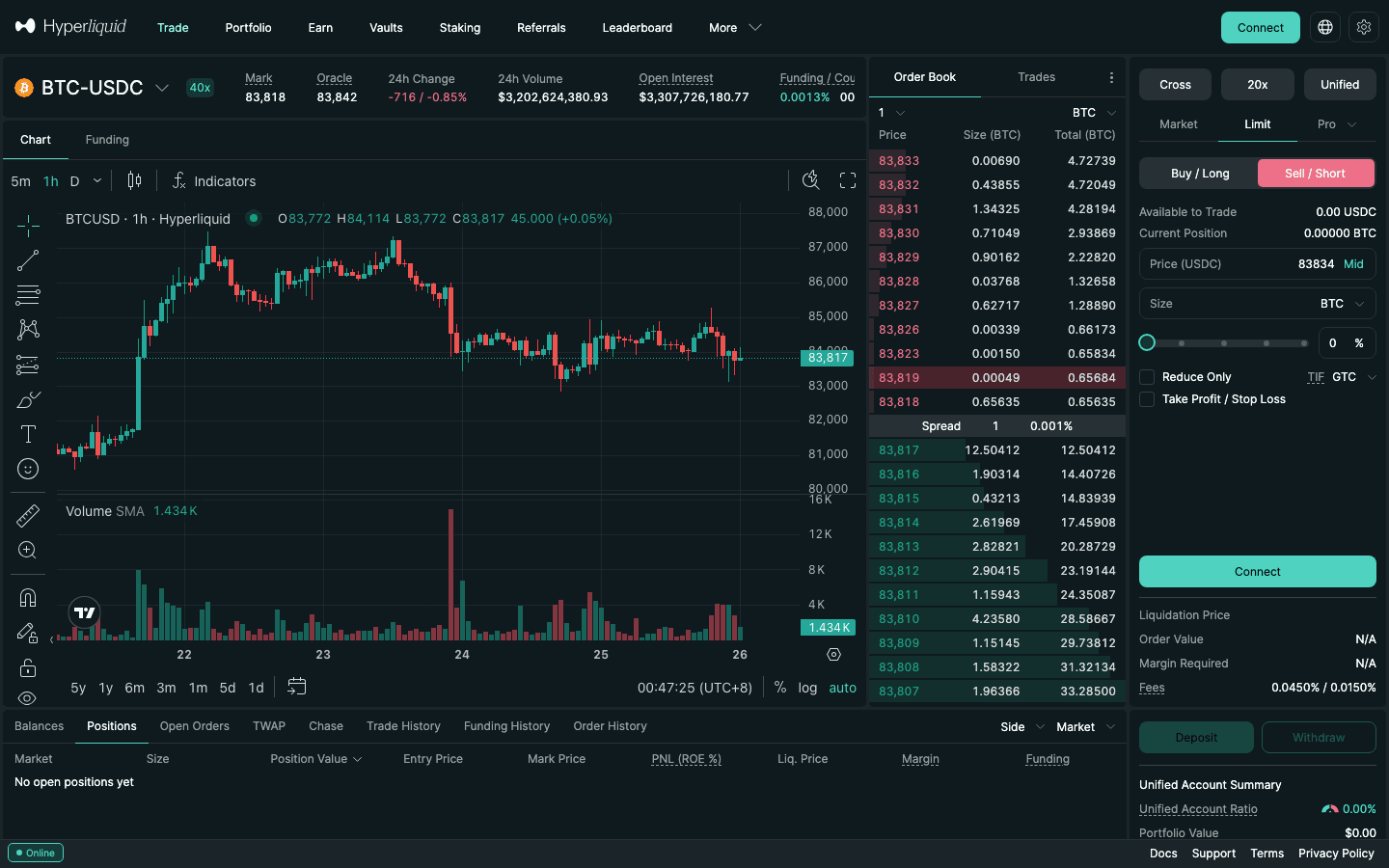
- Connect and enable trading. Open app.hyperliquid.xyz (ideally through a referral link such as app.hyperliquid.xyz/join/HOLYGRAIL, because codes are refused after $10,000 of volume), click Connect, log in with an EVM wallet or email, then click Enable Trading and sign the gas-free message.
- Deposit USDC. With a wallet login the route is USDC on Arbitrum; the minimum is 5 USDC and smaller deposits are lost. Details: deposit guide.
- Pick the market. Choose BTC-USDC in the market selector. Check the Funding Rate and countdown in the header before you start.
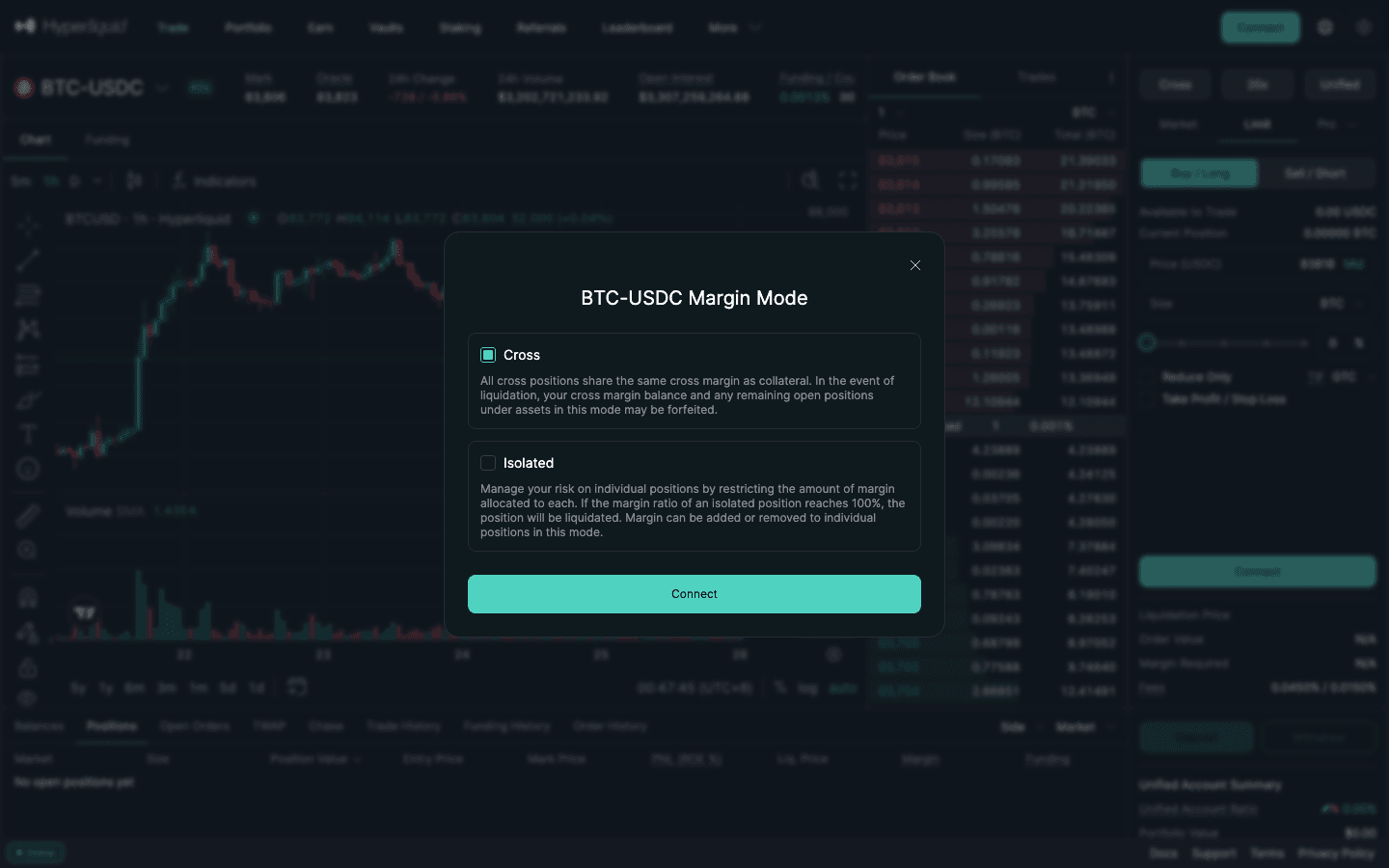
- Set margin mode and leverage. Click the margin button to open BTC Margin Mode and choose Isolated; then open Adjust Leverage and pick a low number (1–3x for a swing short).
- Choose Sell / Short. Select Sell / Short at the top of the order form, then the Limit tab (maker fee 0.015% if it rests on the book) or Market (taker 0.045%).
- Enter the size and your stop. Type the size from your risk calculation (position size calculator), tick Take Profit / Stop Loss and set the stop above entry and the target below.
- Check the summary. The form shows Order Value, Margin Required and Liquidation Price. The liquidation price should be well above your stop, at least twice the stop distance.
- Place Order, then manage it in the Positions tab, which shows its Unrealized PNL, liquidation price and funding. Close with Limit Close or Market Close, or with a reduce-only buy.
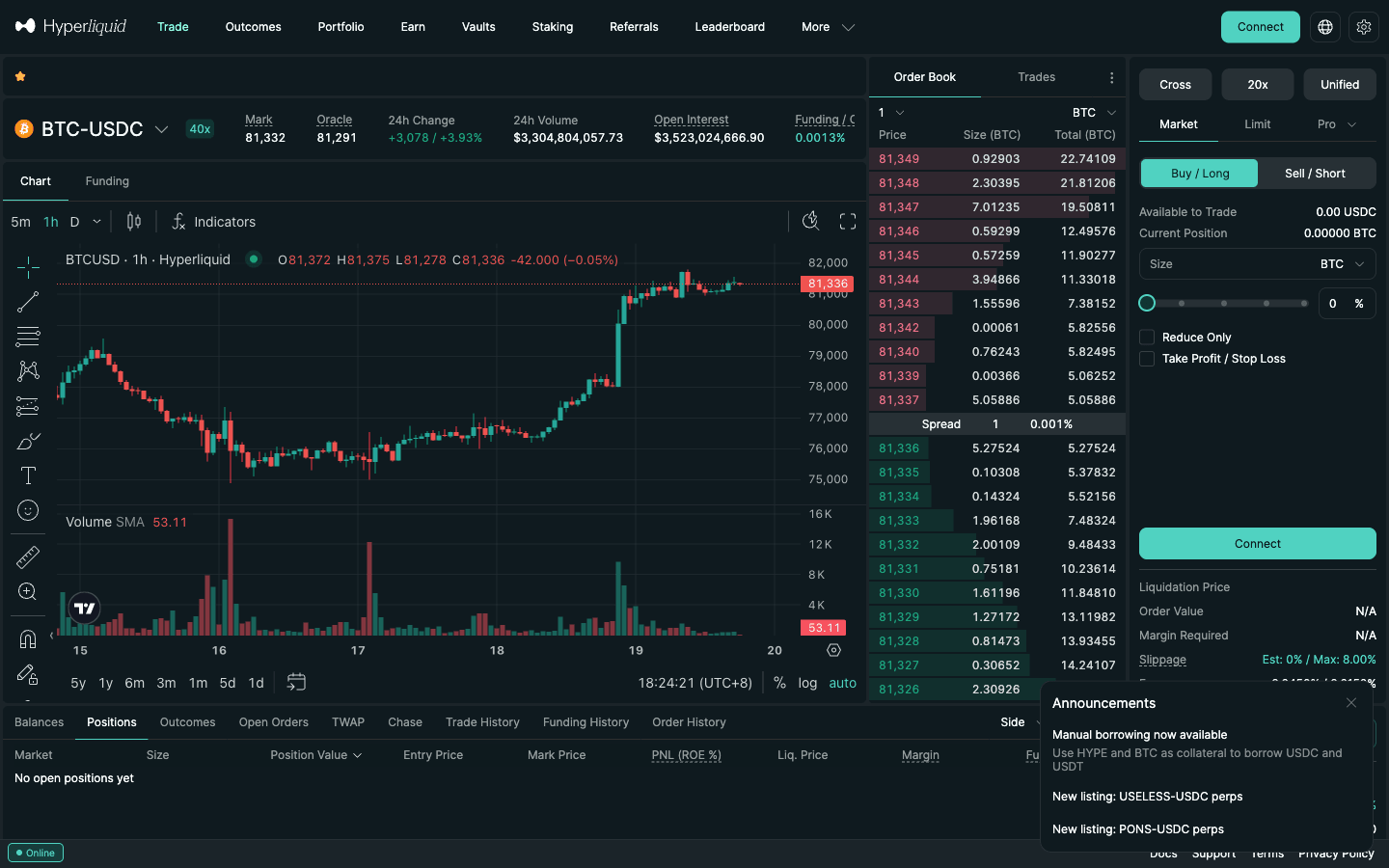
On Lighter and Aster the flow is the same: choose the sell side in the order ticket. Lighter’s Standard account charges 0% maker and taker; Aster’s order-book USDT perps charge 0.04% taker and 0% maker. Order types in depth: Hyperliquid order types.
How much money do you need to short crypto?
Less than most guides suggest. On Hyperliquid the minimum order value is $10 and the minimum USDC deposit is 5 USDC. Margin is order value ÷ leverage, so the smallest possible BTC short needs $10 of margin at 1x or $1 at 10x. There is no account minimum and no KYC step.
The useful minimum is set by risk, not by the exchange. If you risk 1% of the account per trade and your stop is 4% above entry, a $500 account can hold a $125 short (a $5 loss at the stop). Below a few hundred dollars, fees and the $10 minimum start to dominate. Work it out with the position size calculator.
Where can you short crypto? Coinbase, Binance, Kraken, the US and your phone
- Hyperliquid (DEX, no KYC). Perps on BTC up to 40x, 0.045% / 0.015% base fees, hourly funding. Its interface terms (last updated June 15, 2026, §1.6) exclude residents of the United States and Ontario, Canada, and sanctioned jurisdictions, and forbid disguising your location. Everywhere else, you are responsible for checking that derivatives trading is legal where you live.
- Coinbase. A spot buy/sell cannot be a short; on Coinbase you short through futures. Coinbase Derivatives runs a US futures exchange with dated futures and US Perpetual-Style Futures (“perpetual futures contracts available to US customers”), which it describes as compliant with CFTC regulations. You trade them through the futures brokers it lists, such as Coinbase Financial Markets, Interactive Brokers, NinjaTrader, Tradovate and Webull. That is the main answer to “how to short crypto in the US” on a futures account.
- Kraken. Spot-margin shorting (borrow, sell, buy back) up to 10x on eligible pairs for eligible clients in most supported regions, with a rollover fee every 4 hours on the borrowed amount. In the US it is provided through Kraken Derivatives US, a CFTC-registered futures commission merchant; Canada and New Zealand are among the excluded regions.
- Binance and Bybit. USDⓈ-M perps (0.05% taker at Binance’s Regular tier) and spot margin, behind a KYC account and each exchange’s country restrictions. See Hyperliquid vs Binance.
- Stock brokers. In a normal brokerage account you can buy an inverse bitcoin ETF such as ProShares BITI (1.01% expense ratio) or buy puts where options are offered. No margin liquidation, but also no funding income.
- From your phone. Several wallet and trading apps are front-ends to Hyperliquid’s order book and add a small builder fee: Phantom charges 0.05% on top of Hyperliquid’s fee. Based adds 0.025% (about 0.07% all-in as a taker) and gives you the same Sell / Short ticket on mobile: open Based with code HOLYGRAIL. Comparison: mobile DEX apps.
Funding when you are short: who pays whom
Funding keeps the perp near the spot price. Hyperliquid’s docs: when the perp trades above the oracle price the rate is positive and longs pay shorts; when it trades below, the rate is negative and shorts pay longs. It is settled every hour at one-eighth of the 8-hour rate and capped at 4% an hour. The rate also contains a fixed interest component of 0.01% per 8 hours (0.00125% an hour), which the docs call “11.6% APR paid to short”. So when the market is calm, a short on Hyperliquid collects a small income.
| Market | Hourly rate, Sep 25, 2026 16:01 UTC | 30-day total to 16:00 UTC | On a $10,000 short, 30 days | Direction |
|---|---|---|---|---|
| BTC | +0.00125% | +0.7664% | +$76.64 | Short received |
| ETH | +0.00125% | +0.8278% | +$82.78 | Short received |
| SOL | +0.00125% | +0.5998% | +$59.98 | Short received |
| HYPE | −0.00076% | +0.7460% | +$74.60 | Received over 30 days, paying at the snapshot |
| XAI | −0.01582% | — | — | Short pays about 0.38% a day at this rate |
Hyperliquid API fundingHistory and metaAndAssetCtxs. Positive = longs pay shorts. BTC funding was negative in only 7.1% of the last 720 hours.
Two practical rules. First, check the sign before you hold: a crowded short on a small coin can cost far more than it earns. XAI at −0.0158% an hour costs a short about 0.38% a day. Second, funding is taken from or added to your margin, so on an isolated position it moves the liquidation price. Longer read: Hyperliquid funding explained and funding rates across exchanges.
Liquidation price for shorts: formula and worked example
Hyperliquid publishes the formula: liq_price = price − side × margin_available ÷ position_size ÷ (1 − l × side), where side is −1 for a short and l is the maintenance margin rate (1.25% for BTC, half the initial margin at 40x). For an isolated short this simplifies to:
Short liquidation price ≈ entry × (1 + 1/leverage) ÷ (1 + maintenance rate)
| Isolated BTC short at $83,886 | Liquidation price | Rise needed |
|---|---|---|
| 1x | $165,701 | +97.5% |
| 2x | $124,276 | +48.1% |
| 3x | $110,467 | +31.7% |
| 5x | $99,420 | +18.5% |
| 10x | $91,135 | +8.6% |
| 20x | $86,993 | +3.7% |
| 40x | $84,922 | +1.2% |
Our calculation; BTC mark $83,886 on September 25, 2026 16:01 UTC. Funding and fees move the real value slightly.
Worked example. Short 0.1 BTC at $83,886 (notional $8,388.60) at 5x isolated. Margin required: $1,677.72; maintenance margin: $104.86. Liquidation: about $99,420 (+18.5%). Put the stop at +4% ($87,241): if it triggers, the loss is about $335.50 plus roughly $7.70 of taker fees on the way in and out, and the liquidation price is still more than four times further away. At 10x the liquidation price drops to $91,135 (+8.6%), closer than the one-day rally BTC printed in February 2026 (below).
On cross margin the whole account backs the short. With $5,000 of USDC in the account, the same 0.1 BTC short would be liquidated around $132,233; with $2,000, around $102,603. Further away, but a cross liquidation takes the entire cross balance. On isolated margin, Hyperliquid’s docs state that a liquidation of that position leaves your cross margin and other positions untouched, and there is no margin call asking you to deposit more: the most you lose is the margin assigned to the short. More in the liquidation price calculator and cross vs isolated margin.
Hedging spot holdings with a short
If you hold coins you do not want to sell, a perp short of the same size neutralises the price exposure while you keep them. Example: you hold 0.5 BTC in a wallet ($41,943 at $83,886). Short 0.5 BTC on Hyperliquid, isolated at 2x (margin about $20,972, liquidation about +48.1%, near $124,276). If BTC falls 20%, the coins lose about $8,389 and the short gains about the same; if BTC rises, the reverse. Opening costs about $18.87 as a taker ($6.29 as maker). Over the 30 days to September 25, 2026 the short would also have received about $321 of funding (0.7664%).
Watch three things: the hedge’s liquidation price (the coins in your wallet cannot top up the short’s margin), funding turning negative, and re-sizing if you add or sell coins. Full walkthrough: how to hedge crypto with perpetuals.
Ready to open your first short?
Hyperliquid: Sell / Short in one click, isolated margin, native TP/SL, hourly funding shown in the header. Code HOLYGRAIL = 4% off fees on your first $25M. Prefer zero fees? Lighter Standard is 0%/0%, and 718610TD rebates your first Premium week.
Open Lighter → · Open Aster → · Short on your phone with Based →
Bear-market shorting playbook (with 2025–2026 data)
The last bear market is in Hyperliquid’s own candles. From daily closes:
| Market | Peak close | Trough close | Decline | BTC-window funding, Oct 6, 2025 – Jun 30, 2026 |
|---|---|---|---|---|
| BTC | $124,711 (Oct 6, 2025) | $58,603 (Jun 30, 2026) | −53.0% | +3.55% (shorts received) |
| ETH | $4,834.8 (Aug 22, 2025) | $1,566.6 (Jun 25, 2026) | −67.6% | +3.81% (shorts received) |
| SOL | $247.72 (Sep 18, 2025) | $62.16 (Jun 6, 2026) | −74.9% | −2.11% (shorts paid) |
Hyperliquid candleSnapshot (1d) and fundingHistory, fetched September 25, 2026. Funding summed over the same window for all three.
What the data says, and what to do with it:
- Funding did not punish BTC and ETH shorts. Even in a 53% decline, BTC funding summed to +3.55% over the window (negative in 23.5% of hours), so shorts were net paid. SOL was different: −2.11%, negative in 45.3% of hours. Crowded alt shorts pay; check the sign per market.
- Bear markets rally hard. BTC closed higher on 121 of the 267 days, rose 12.1% in one day (February 5 to 6, 2026: $62,894 to $70,516) and 15.1% in two weeks (April 3 to 17). A 10x short (liquidated at +8.6%) would not have survived that day. Keep swing shorts at 1–3x.
- Sell rallies, do not chase breakdowns. Enter on a failed bounce into resistance with the stop above it, rather than market-selling after a big red candle into thin books.
- Take profits in steps. Scale out at prior support; see partial close and TP ladders.
- Respect the calendar. CPI, FOMC and jobs data move BTC 2–3% in an hour; reduce size before them.
- Hedge rather than short outright if you hold coins long-term, and track correlated shorts as one bet (BTC/ETH daily-return correlation was 0.88 over the 90 days to September 24, 2026).
Should you short BTC right now? A five-point check
No page can tell you whether to short today, and one that claims to is selling something. What works is running the same five checks before every short:
- Trend. Is the daily chart making lower highs and lower lows? Shorting a rising market is a bet against the trend; size it smaller or skip it.
- Funding sign. Positive funding pays you to wait; strongly negative funding means the trade is crowded and squeeze-prone.
- Invalidation. Name the price that proves you wrong (above the last lower high) and put the stop there.
- Liquidation distance. The liquidation price must be at least twice as far from entry as the stop. If not, lower the leverage.
- Calendar. CPI, FOMC, jobs reports and weekends with thin books move BTC fastest; enter after the event, not before. See best times to trade crypto.
If all five line up, the bear-market playbook above covers entries and exits.
Which way to short should you choose?
- You want the cheapest, most liquid short with no account: a perp on Hyperliquid, isolated at 1–3x. Funding has favoured BTC shorts there over the past year (+5.95% over 12 months to September 25, 2026).
- You want a hard cap on the loss: a put option or an inverse ETF. You pay for the cap through the premium or the expense ratio and daily-reset drift.
- You are in the US: CFTC-regulated futures through a futures broker (including Coinbase Derivatives’ perpetual-style futures), Kraken Pro spot margin through Kraken Derivatives US where you are eligible, or an inverse ETF in a brokerage account. Hyperliquid is not available to US residents.
- You want to hold a short for months at a known cost: spot margin on a centralized exchange, where you pay borrow interest (Binance margin VIP0 BTC 0.001165% a day, Bybit spot margin BTC 0.0000507% an hour, public APIs, September 25, 2026). Hyperliquid’s borrow/lend market lends only USDC and USDT, so on Hyperliquid you short through perps.
- You live in Japan: domestic registered exchanges let you sell first at up to 2x, with a leverage fee such as GMO Coin’s 0.04% a day per position; our Japanese edition compares them.
Compared in depth: perps vs spot margin.
Risks of short selling crypto
- Upside has no ceiling. Your loss is capped only by liquidation, which is why the stop comes first.
- Negative funding. A crowded short pays every hour; at −0.0158% an hour that is 0.38% a day.
- Auto-deleveraging. In extreme moves an exchange can reduce profitable positions when liquidations cannot be absorbed; Aster’s docs rank by profit and effective leverage, and Lighter’s backstop pool (LLP) comes first. See insurance funds and ADL.
- Venue and wallet risk. Self-custody means your security is your job: security checklist.
Short squeezes
When many traders are short, a rally hits their stops and liquidation prices, and every forced buy pushes the price higher, which liquidates the next layer. Small caps are most exposed; many Hyperliquid alts are capped at 3x or 5x for a reason. The warning signs are funding that is deeply negative (shorts paying longs every hour), open interest that keeps rising while the price stops falling, and a coin that has already fallen hard. BTC’s 12.1% one-day rally in February 2026 happened in the middle of a bear market.
Is short selling crypto legal?
Shorting itself is legal in most countries; what is regulated is who may offer leverage and derivatives to you. In the US, derivatives for US persons go through CFTC-regulated venues, and Hyperliquid’s terms exclude US and Ontario residents. The UK’s FCA bans firms acting in or from the UK from selling crypto derivatives (CFDs, options and futures) to retail consumers. Japan caps retail crypto leverage at 2x. Never use a VPN to get around a venue’s restrictions: Hyperliquid’s terms (§3.1.5) list it as prohibited circumvention. Not legal advice.
Taxes on short profits
Profits from closing a short, and funding you receive, are taxable in most countries; the treatment depends on the instrument and where you live. A DEX sends no tax form, so export your trade and funding history. See DEX tax reporting.
Everything above plugs into one framework in our risk management guide; common errors are listed in crypto trading mistakes.
FAQ
How do you short crypto?
There are nine common ways: perpetual futures on a DEX or CEX, dated futures, spot margin, DeFi borrow-and-sell, put options, inverse ETFs, CFDs, prediction markets and inverse tokens. The simplest is to sell a perpetual future. On a perp DEX such as Hyperliquid you deposit USDC as collateral, pick a market, choose Sell / Short, set size, margin mode and leverage, and place the order. If the price falls you profit; if it rises you lose, and if it rises far enough the position is liquidated. You never borrow or deliver the coin.
Can I short crypto on Coinbase?
Not with a spot buy/sell. You short on Coinbase through futures: Coinbase Derivatives runs a US futures exchange with dated futures and US Perpetual-Style Futures (perpetual futures available to US customers) that it describes as compliant with CFTC regulations. You reach its contracts through the futures brokers it lists, such as Coinbase Financial Markets, Interactive Brokers, NinjaTrader, Tradovate and Webull. Outside the US, perp DEXs such as Hyperliquid are the no-KYC alternative.
Is it legal to short sell crypto?
In most countries shorting crypto is legal, but who may offer it is regulated. In the US, derivatives for US persons go through CFTC-regulated venues, and Hyperliquid’s terms exclude US and Ontario residents. The UK FCA bans firms in or from the UK from selling crypto derivatives (CFDs, options, futures) to retail consumers. Japan caps retail crypto leverage at 2x. Check your own country’s rules; this is not legal advice.
What is the safest way to short crypto?
The ones where your loss is capped at what you pay: buying a put option (you lose only the premium), buying an inverse ETF such as BITI (you lose at most what you invested), or a prediction-market share. With perps and margin, the safe version is isolated margin at 1–3x with a stop above entry, so a spike costs the stop, not the account.
How much money do you need to short crypto?
Very little. Hyperliquid’s minimum order value is $10 and the minimum USDC deposit is 5 USDC, so a $10 BTC short needs $10 of margin at 1x or $1 at 10x. The practical minimum is what lets you place a stop without being liquidated first; many traders start with $100–$500 and risk 1% of it per trade.
Can you short Bitcoin on a DEX without KYC?
Yes. On Hyperliquid, Lighter and Aster you connect a wallet (or log in with email on Hyperliquid) and trade without identity verification, because the exchange never holds an account in your name. That does not make it anonymous or tax-free: activity is public on-chain, and restricted regions listed in each venue’s terms still apply.
Do shorts pay or receive funding?
It depends on the sign. On Hyperliquid, when the funding rate is positive longs pay shorts, and when it is negative shorts pay longs; funding is settled every hour. The baseline rate includes an interest component of 0.00125% an hour that the docs describe as 11.6% APR paid to shorts. Over the 30 days to September 25, 2026 a $10,000 BTC short received about $77.
Where is the liquidation price of a short?
Above your entry. For an isolated short on Hyperliquid it is roughly entry × (1 + 1/leverage) ÷ (1 + maintenance margin rate). At a BTC price of $83,886 that is $99,420 at 5x (+18.5%) and $91,135 at 10x (+8.6%). On cross margin the whole account balance backs the short, so the liquidation price is further away but the whole balance is at risk.
What is the maximum you can lose on a short?
In theory there is no ceiling on how high a price can go, which is why a short without a stop is dangerous. On a perp DEX the loss is limited in practice to the margin behind the position (the isolated margin, or your whole cross balance), because the position is liquidated first. During the 2025–2026 bear market BTC still had a one-day rally of 12.1%, enough to liquidate a 10x short.
Can crypto have a short squeeze?
Yes, and often. When many traders are short, a rally triggers their stops and liquidations, and each forced buy pushes the price higher. Warning signs are deeply negative funding (shorts paying longs every hour) and rising open interest while the price stops falling. Small caps squeeze hardest; size down or stay out when a coin’s funding is strongly negative.
Should I short BTC right now?
Nobody can answer that for you, but you can run the same check every time: is the trend down on the daily chart, is funding positive (you get paid to wait) or negative (you pay), where is your invalidation level and is the liquidation price at least twice as far, and is CPI, FOMC or a jobs report due? If any answer is wrong, wait. Our bear-market data section shows why: even a 53% decline had a 12.1% one-day rally.
Do you pay taxes on shorting crypto?
In most countries, yes: profits from closing a short and funding you receive are taxable, and the treatment depends on the country and the instrument (a perp, a regulated future, an option or an ETF can be taxed differently). In Japan, profits from crypto margin trading are miscellaneous income under aggregate taxation. Keep your trade and funding history; a DEX does not send you a tax report.
How do I hedge my spot crypto with a short?
Open a perp short equal to the spot amount you want to protect: for 0.5 BTC held in a wallet, short 0.5 BTC. Price moves then roughly cancel out, and you keep the coins. Use isolated margin at 1–3x so the short’s liquidation price is far away, and watch funding, which you receive when it is positive and pay when it is negative.
Is it better to short in a bear market?
Shorting with the trend is easier than fighting it, but bear markets have violent rallies. From October 2025 to June 2026 BTC fell 53% on Hyperliquid daily closes, yet 121 of 267 days closed higher and one two-week rally reached 15.1%. Short smaller, with a stop, and add only after a failed bounce rather than chasing a falling price.
Short with the lowest costs
Open Hyperliquid through HOLYGRAIL before your first $10,000 of volume: 4% off fees on your first $25M, no KYC, shorts that collect funding when the rate is positive. Compare every venue in our best DEX guide.
Disclosure: HOLYGRAIL (Hyperliquid and Based), 718610TD (Lighter) and DTLpLc (Aster) are our referral codes; we earn a share of referred accounts’ fees at no cost to you. UI labels, fees, funding and liquidation rules re-checked on September 27, 2026; bear-market figures and liquidation prices are our calculations from Hyperliquid’s public API. Educational content, not investment advice. Short selling can lose more than you expect.