
Short version. Hold 1 BTC and want to stop caring about the price for a while? Short 1 BTC of the BTC perpetual. Size in coins, not dollars. Use isolated margin at 1–3x: on Hyperliquid a 3x BTC short survives a rise of about 32%, while a 10x short is liquidated after about 9%. Not ready to be fully flat? A 50% hedge halves both the loss and the gain. Funding was mostly income for shorts: BTC +5.95%, ETH +6.34%, HYPE +9.79% over 12 months, but SOL −0.17%. The same position held for yield is a delta-neutral carry; the fixed-expiry version is the basis trade.
Open your hedge on the deepest perp DEX
Hyperliquid: 0.045% taker / 0.015% maker, hourly funding, no gas on orders. Join through code HOLYGRAIL for 4% off fees on your first $25M of volume.
We earn a commission when you sign up through our links; it never raises your fees.
1. What is hedging?
Hedging means holding a second position that gains when your main position loses, so a bad move hurts less. Think of it as paying for a seatbelt: it costs something to wear and you hope you never need it, but it limits the damage in a crash. You still own the coins; you have only reduced how much their price can hurt you, for as long as the hedge is open.
The key idea is delta: how much a position gains or loses when the coin moves by one unit. Holding 1 BTC is a delta of +1. A 1 BTC short perpetual is a delta of −1. Together they are delta-neutral, net 0: if BTC falls 10%, the coins lose 10% and the short gains the same amount. A 50% hedge (short 0.5 BTC against 1 BTC) leaves a delta of +0.5, so you keep half the exposure in both directions.
Hedging vs selling vs a stop-loss. Selling ends the exposure for good and may be a taxable event; buying back later costs another fee. A stop-loss does nothing until price hits your level, then sells, and it can fill badly in a fast drop. A hedge is active from the moment you open it, keeps the coins in your wallet (staked, locked or in cold storage) and can be removed in one click when you want the exposure back.
A perpetual (“perp”) is a futures contract without an expiry date. It tracks spot through funding, a payment between longs and shorts. On Hyperliquid it is paid every hour, and the exchange keeps nothing from it (docs, trading/funding). That makes a perp a cheap, open-ended hedge: no expiry to roll and no borrowing of coins. If you want to bet on a fall rather than protect coins you hold, that is shorting, covered in how to short crypto.
2. Crypto hedging strategies: 7 ways to hedge, compared
Every method trades cost against what you keep. The short perp is the focus of this guide, but it is not always the right tool.
| Method | What it costs | Pros | Cons |
|---|---|---|---|
| Short perpetual (this guide) | Taker fee each way (0.045% on Hyperliquid), plus or minus hourly funding | Keeps the coins and staking; no expiry; funding has mostly been income for shorts on majors | Short leg needs USDC margin and can be liquidated; funding can flip; caps the upside while open |
| Short a dated future (CME, CEX quarterly) | Fees; the basis is locked at entry | Known cost or return up front; regulated venues | Expiry to roll; KYC and a futures broker or CEX account; contract sizes can be large |
| Buy a put option | Premium, paid up front | Keeps all the upside; cannot be liquidated | Premium can be expensive in volatile markets; few on-chain venues. Worked put-vs-perp example: perpetual futures vs options |
| Move part to stablecoins | One spot fee (0.070% taker on Hyperliquid spot) | Simple; no margin, no liquidation | Upside gone on that part; can be a taxable sale; a stablecoin can depeg and depends on its issuer and reserves |
| Stop-loss on spot | Nothing until triggered | Full upside until the stop | Protects only below the stop; can fill badly in a gap; becomes a sale |
| Reduce or diversify | Spot fees | No derivatives needed | Crypto assets tend to fall together in sell-offs, so diversifying within crypto protects less than it seems |
| CFDs or margin short selling | Spread, overnight or borrow fees | Available at some brokers and CEXs | Borrow can be recalled; CFDs are unavailable in some countries, including the US; KYC account needed |
A perp hedge suits three situations: you expect a drawdown but want the coins back afterwards; you cannot or do not want to move the coins (they are staked, locked or in cold storage); or you want the funding income as a carry trade. If you simply no longer want the exposure, selling is cleaner.
3. Worked example: $10,000 of BTC at −20%, 0 and +20%
You hold $10,000 of BTC and hedge it for 30 days on Hyperliquid, either fully (short the same coin count) or by half. Fees are the base taker rate on open and close; funding is what a BTC short actually received over the 30 days to September 30, 2026 (+0.72%).
| BTC move over 30 days | Unhedged | 50% hedge (net) | 100% hedge (net) |
|---|---|---|---|
| −20% | −$2,000 | −$968 | +$63 |
| −10% | −$1,000 | −$468 | +$63 |
| 0% | $0 | +$32 | +$63 |
| +10% | +$1,000 | +$532 | +$63 |
| +20% | +$2,000 | +$1,032 | +$63 |
Net = spot P&L + short P&L − taker fees ($9.00 for a full round trip at 0.045% per side) + funding ($72.19 for the full hedge). Fees and funding are computed on the $10,000 entry notional; a coin-sized short’s notional moves with price, so both scale slightly with it. Ignores the spread and price slippage. Funding: Hyperliquid fundingHistory, 720 hourly rates to 13:00 UTC on September 30, 2026.
How to read it: the full hedge turns every outcome into roughly the same small result, here a gain, because shorts were paid funding. The 50% hedge halves the loss in a fall and halves the gain in a rally. In a month where funding is negative, the “net” column becomes a small cost instead. SOL shorts paid in six of the last twelve 30-day blocks (section 7).
4. Step by step: hedge a spot bag with a short perp
Example: you hold 0.5 BTC in a wallet. BTC was about $83,570 on Hyperliquid’s oracle at 14:11 UTC on September 25, 2026, so the bag was worth about $41,800.
- Check you may use the venue. Hyperliquid’s Terms (§1.6) exclude persons in the United States and Ontario and in sanctioned regions; see Hyperliquid restricted countries. US residents can hedge with regulated futures (CME or a US futures broker) instead.
- Decide the hedge ratio. 100% (short 0.5 BTC) makes you flat. 50% (short 0.25 BTC) halves both the downside and the upside. See section 5.
- Size in coins. Enter the size in BTC, not USD. A dollar-sized short drifts out of balance as price moves; a coin-sized short stays matched to your coins.
- Deposit margin. Hyperliquid perps are margined in USDC. The minimum deposit is 5 USDC (deposit guide). For a 0.5 BTC short at 2x you need about $20,900 of USDC as margin, plus a buffer.
- Set the order form. On the BTC-USDC page choose Isolated margin and a leverage of 1–3x, select Sell / Short, enter 0.5 BTC and check the Liquidation Price line before you place the order. A limit order that rests on the book pays the 0.015% maker fee instead of 0.045%.
- Record the entry. Note the entry price, the funding rate and the date. You need them for your P&L and taxes (DEX tax guide).
- Close with Reduce Only. When you no longer need the hedge, buy back 0.5 BTC with Reduce Only ticked, or close from the Positions table.
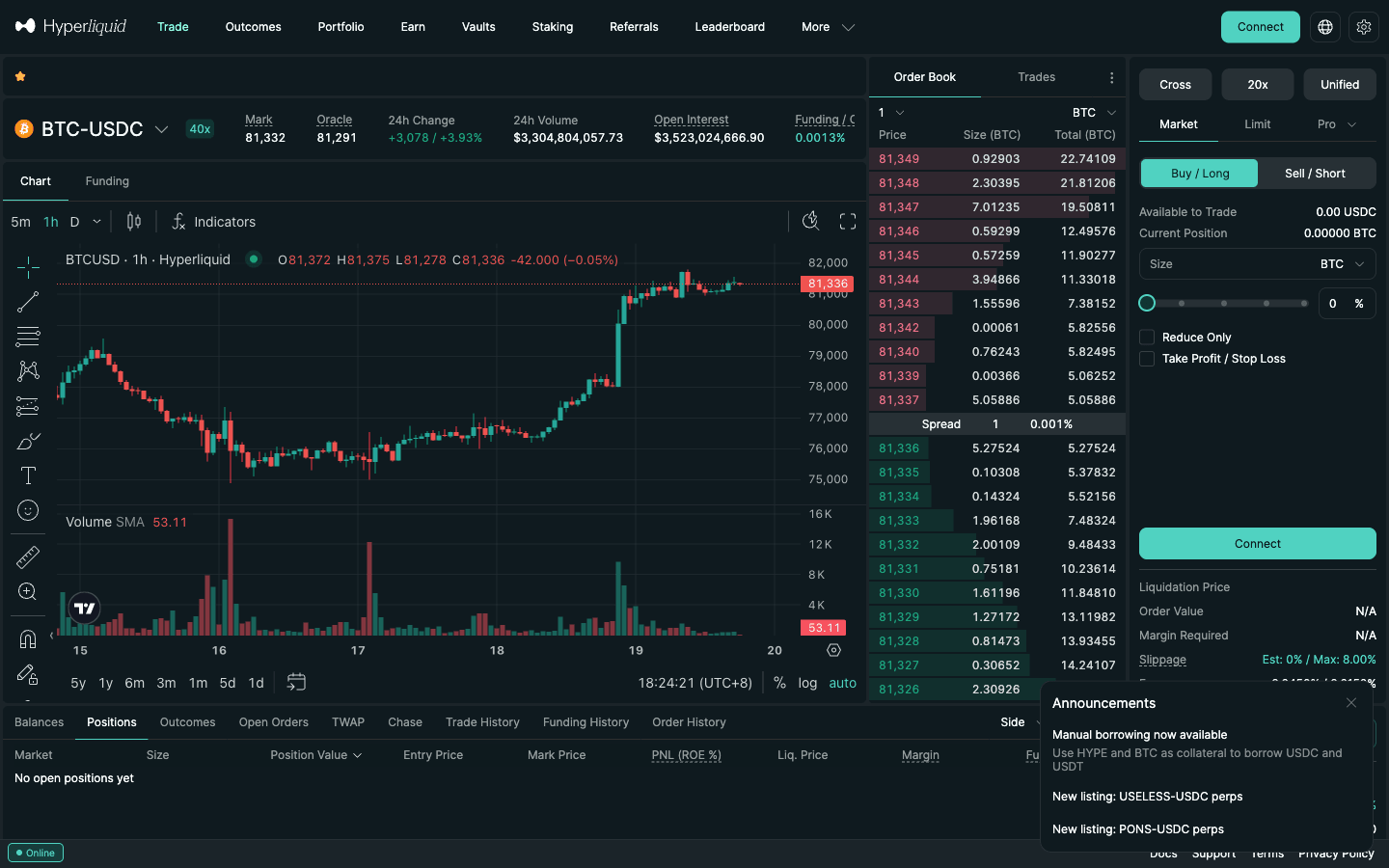
Costs of this example. Opening and closing $41,800 as a taker costs 2 × 0.045% = $37.62 ($36.12 with the 4% referral discount). As a maker it is $12.54. Funding is paid on the oracle price times the position size (docs), so a 0.5 BTC short receives about $0.52 an hour at the 0.00125% hourly baseline, about $12.54 a day. BTC funding was at exactly that baseline at 13:00 UTC on September 30, 2026.
Hedging a position you already hold on Hyperliquid. Hyperliquid is one-way: one net position per market per account, so a short on the same market simply reduces your long. To hold both at once you need a sub-account (available after $100,000 of volume) or another venue; see Hyperliquid hedge mode and sub-accounts. Spot coins held in your wallet or in Hyperliquid spot are separate from the perp position, so the method above works as is.
5. How much to hedge: hedge ratio and partial hedges
The hedge ratio is the share of your holding you offset. You do not have to choose between all or nothing:
- 100%: you are flat. Use it around an event you cannot sit through (a court ruling, a token unlock, a holiday away from screens), or when you plan to collect funding.
- 25–50%: the usual choice when you are cautious but not bearish. On $10,000 of BTC, a 50% hedge turns a 20% fall from a $2,000 loss into about $1,000, and a 20% rally from a $2,000 gain into about $1,000 (table in section 3).
- Laddered: add to the hedge in steps as price falls through levels you choose in advance, and remove it in steps as it recovers. Each step costs a fee, so keep the number of steps small.
Altcoins without their own perp. You can short BTC or ETH instead, sized by the altcoin’s measured beta (for example 1.3 × the position if the coin has moved 1.3 times as much as BTC over the last 60–90 days). Treat it as rough: correlations change most in sell-offs. First check the Hyperliquid pairs list: 178 perpetual markets were live on October 20, 2026.
Re-check the ratio weekly or after a big move. A coin-sized hedge on the same coin stays matched; anything else drifts.
6. Leverage and liquidation on the short leg
This is where most hedges fail. Your spot coins do not protect the short. In Hyperliquid’s default unified account the short is margined in USDC. If BTC rallies 40%, your coins gain 40%, but the short’s margin loses 40% of notional. If that margin runs out, the short is liquidated and you are left unhedged at the top. (Only portfolio margin counts BTC and HYPE balances as collateral. It needs more than $10,000 of account value or more than $5M of weighted volume; see the perps vs spot margin guide.)
Hyperliquid’s maintenance margin is half the initial margin at the asset’s maximum leverage: 1.25% for BTC (40x), 2% for ETH (25x), 5% for HYPE (10x). Using the documented formula liq_price = price − side × margin_available / position_size / (1 − l × side), an isolated short is liquidated after these rises:
| Short leverage (isolated) | BTC (max 40x) | ETH (max 25x) | HYPE (max 10x) |
|---|---|---|---|
| 1x | +97.5% | +96.1% | +90.5% |
| 2x | +48.1% | +47.1% | +42.9% |
| 3x | +31.7% | +30.7% | +27.0% |
| 5x | +18.5% | +17.6% | +14.3% |
| 10x | +8.6% | +7.8% | +4.8% |
Price rise from entry that reaches the liquidation price, ignoring fees and funding. Our calculation from Hyperliquid’s trading/liquidations formula and each asset’s maximum leverage. Large positions get lower maximum leverage and liquidate sooner.
At 1x the short is effectively safe. At 2–3x it needs a 30–50% rally, and you can add margin before that; isolated positions allow adding margin after opening (docs, margining). Hyperliquid charges no clearance fee on liquidations sent to the book, and you keep any margin left over. But if equity falls below two-thirds of maintenance margin before the book can close the position, the liquidator vault takes it over and the maintenance margin is not returned (docs, trading/liquidations). That is another reason not to run a hedge near the edge. Details: cross vs isolated margin and liquidation price calculator.
7. Funding: cost or income? 12 months of data
Hyperliquid’s funding formula includes a fixed interest component of 0.01% per 8 hours, which the docs describe as 0.00125% an hour or “11.6% APR paid to short”. When the perp trades close to the oracle, funding sits at exactly that baseline and longs pay shorts. It turns negative only when the perp trades at a discount big enough to overcome it. We pulled every hourly rate for the last year from the public API:
| Market | Short received, 30 days | Short received, 12 months | Hours negative | Negative 30-day blocks | Worst 7 days |
|---|---|---|---|---|---|
| BTC | +0.72% | +5.95% | 19% | 1 of 12 | −0.13% |
| ETH | +0.84% | +6.34% | 16% | 0 of 12 | −0.24% |
| SOL | +0.60% | −0.17% | 37% | 6 of 12 | −0.91% |
| HYPE | +0.75% | +9.79% | 9% | 0 of 12 | −0.23% |
Hyperliquid fundingHistory, 8,760 hourly rates from 14:00 UTC on September 30, 2025 to 13:00 UTC on September 30, 2026, summed. Positive = paid to shorts. The last 360 days are split into twelve 30-day blocks. BTC’s one negative block was 3 April to 3 May 2026 (−0.032%). SOL was negative in six blocks, worst 2 February to 4 March 2026 (−1.28%).
In dollars: a $10,000 BTC hedge received $72.19 over the last 30 days, $218.49 over 90 days and $595.30 over 12 months, against $9.00 of taker fees for the round trip. Hedging majors on Hyperliquid has mostly been paid, not a cost. SOL shows the other side: over the same year a SOL short paid about $17 per $10,000, with a month where it paid about 1.3%. Always look at the live rate and its recent history. The Hyperliquid funding guide covers the formula; our funding rate arbitrage guide has a week of realised rates across Hyperliquid, Lighter, Aster, edgeX and Binance.
8. Delta-neutral: the hedge as a yield trade
If shorts are paid, you can build the hedge on purpose: buy spot, short the same amount of perp, collect funding. This is the delta-neutral carry, also called cash-and-carry. It is the same position as a hedge; the only difference is that you bought the coins for the trade instead of already holding them. Delta-neutral is not risk-free: funding can turn negative, the short leg can be liquidated, and each venue can fail. Our funding rate arbitrage guide covers the yield trade in depth, with live spreads on five venues and a 7-day cross-venue worked example; here is the single-venue version.
Worked example, HYPE on Hyperliquid (fees from the registry, funding for the 12 months to September 30, 2026):
- Buy $10,000 of HYPE/USDC spot: 0.070% taker = $7.00. Short $10,000 of HYPE perp at 2x isolated: 0.045% = $4.50, plus $5,000 of USDC margin.
- Past income: HYPE funding paid shorts +9.79% over the last 12 months, with no negative 30-day block. On $10,000 that is $978.60.
- Exit costs: another $11.50. All-in fees ≈ $23.00.
- Capital used: $15,000 (spot + margin), so the historical return was about 6.4% a year on capital. That compares with about 2.8–2.9% for supplying USDC on Hyperliquid’s lending market and a 2.0–2.2% predicted staking APR on HYPE (readings on September 25, 2026), and 3.5% (as of October 20, 2026) for the HLP vault. All three move daily. The spread is your pay for running the risks below.
Two variants. Staked carry: stake the spot HYPE as well and keep the staking yield. Unstaking to spot takes 7 days, so you cannot unwind both legs at once. Cross-venue carry: long the perp where funding is low and short it where funding is high. This pays two taker fees and runs two liquidation engines. Lighter’s Standard account charges 0% maker and 0% taker, which helps high-turnover legs; Aster charges 0% maker / 0.04% taker.
Ready to place the short leg?
Open Hyperliquid with HOLYGRAIL: 0.045% → 0.0432% taker on your first $25M. On the $41,800 BTC hedge above that is $1.50 saved per round trip, every time you re-hedge. Apply the code before your account passes $10,000 of volume; joining through the link does it for you.
Prefer a zero-fee perp leg? Lighter with code 718610TD (first week of Premium fees rebated).
9. Basis and contango: perps vs dated futures
Basis is the gap between a futures price and spot. When futures trade above spot the market is in contango; below spot it is in backwardation. A dated future converges to spot at expiry, so its basis is a return you lock in at entry. A perp never expires, so its basis is paid out continuously as funding, and its price stays very close to spot. Over the 30 days to September 25, 2026, the BTC perp’s hourly close was a median 0.8 bp below Hyperliquid spot (UBTC), and 90% of hours fell between −6.0 and +7.9 bp.
| Instrument (BTC) | Premium to spot | Days to expiry | Annualized | Source, Sept 25, 2026 |
|---|---|---|---|---|
| Binance quarterly, Dec 25, 2026 | +1.24% | 90.7 | ≈ 5.0% | fapi mark vs index, 14:11 UTC |
| Binance quarterly, Mar 26, 2027 | +2.53% | 181.7 | ≈ 5.1% | fapi mark vs index, 14:11 UTC |
| CME Bitcoin futures, Oct 2026 | +0.55% | 35 | ≈ 5.8% | CME quote vs Hyperliquid oracle, ~11:00 UTC |
| Hyperliquid BTC perp (funding to shorts) | Paid hourly | None | 9.3% (30 days to Sept 25), 5.95% (12 months to Sept 25) | fundingHistory |
How to read it: a dated-futures basis trade (long spot, short the December contract) locked in about 5% a year that day, known in advance, with no risk of the rate turning negative. The perp carry has paid more in recent months, but the rate floats every hour and can flip. Dated contracts need KYC at a regulated broker or CEX; CME crypto futures trade 24/7 since May 29, 2026. Perps on a DEX need only a wallet, where the venue’s terms allow you to use it. A mixed approach also exists: hedge with the perp while funding is rich, switch to the dated future when it compresses. Full comparison: crypto perpetuals vs CME futures.
Backwardation (negative funding on a perp) flips the trade. Shorts pay, so a hedge becomes a cost, and the carry version would be short spot plus long perp. That is hard to do on-chain. Hyperliquid’s lending market lends only USDC and USDT (against HYPE or BTC collateral), so you cannot borrow coins to short spot there.
10. Risks that break a hedge
- Liquidation of the short leg. Section 6. The spot gain elsewhere does not save a thinly margined short. Keep leverage at 1–3x, use isolated margin, and set a price alert near the liquidation price.
- Funding flips. A hedge that pays can start to cost. SOL shorts paid in six of the last twelve 30-day blocks. Decide in advance at what rate you will close or resize.
- Basis and mismatch. A beta hedge on a different coin, a dollar-sized short, or a perp that trades away from the price of the coins you hold all leave a gap between the two legs. Re-check the ratio weekly or after big moves.
- Venue and custody risk. The perp leg depends on Hyperliquid’s chain, oracle and clearinghouse. In extreme cases profitable positions can be auto-deleveraged (HLP, insurance and ADL). The spot leg depends on where it sits: your wallet, a CEX, or Hyperliquid spot, where native BTC arrives as UBTC through Unit, a 2-of-3 MPC guardian network.
- Transfer costs. Orders are gas-free, but moving margin is not: Hyperliquid charges a 0.2 USDC fee (plus a tiny HyperEVM gas fee) per USDC withdrawal, plus whatever the bridge or your CEX charges on the way in. Small hedges that are opened and moved often lose a noticeable share to this.
- Execution gap. Opening the two legs minutes apart leaves you unhedged in between. Place them back to back, or use limit orders on both.
- Third-party app fees. Mobile front-ends add a builder fee on top of Hyperliquid’s (for example +0.025% to +0.10% on perps). Even so, the referral discount also applies to orders placed through apps with a builder code: the 4% comes off Hyperliquid’s part of the fee, not the app’s, so the official web app is still the cheapest place for the short leg. If you do use an app, order matters: apps such as Phantom often set their own Hyperliquid referral code on accounts that have none, so enter a code on Hyperliquid before you start using an app (a code can only be added before $10,000 of volume).
- Regulation and access. Hyperliquid’s Terms (§1.6) restrict US persons, Ontario and sanctioned regions (details). Use a venue you are allowed to use; do not work around geo-restrictions.
- Taxes. Closing the short at a profit realises a gain even while the spot coins show an unrealised loss, and the reverse. Timing across tax years matters; see the DEX tax guide. Not tax advice.
11. Checklist before you open
- Coin count of what you hold, and the hedge ratio you want (100%, 50%…).
- You are allowed to use the venue where you live (§1.6 of Hyperliquid’s Terms).
- Market exists as a perp with enough volume (Hyperliquid BTC traded ~$3.75B in the 24 hours to 14:11 UTC on September 25, 2026).
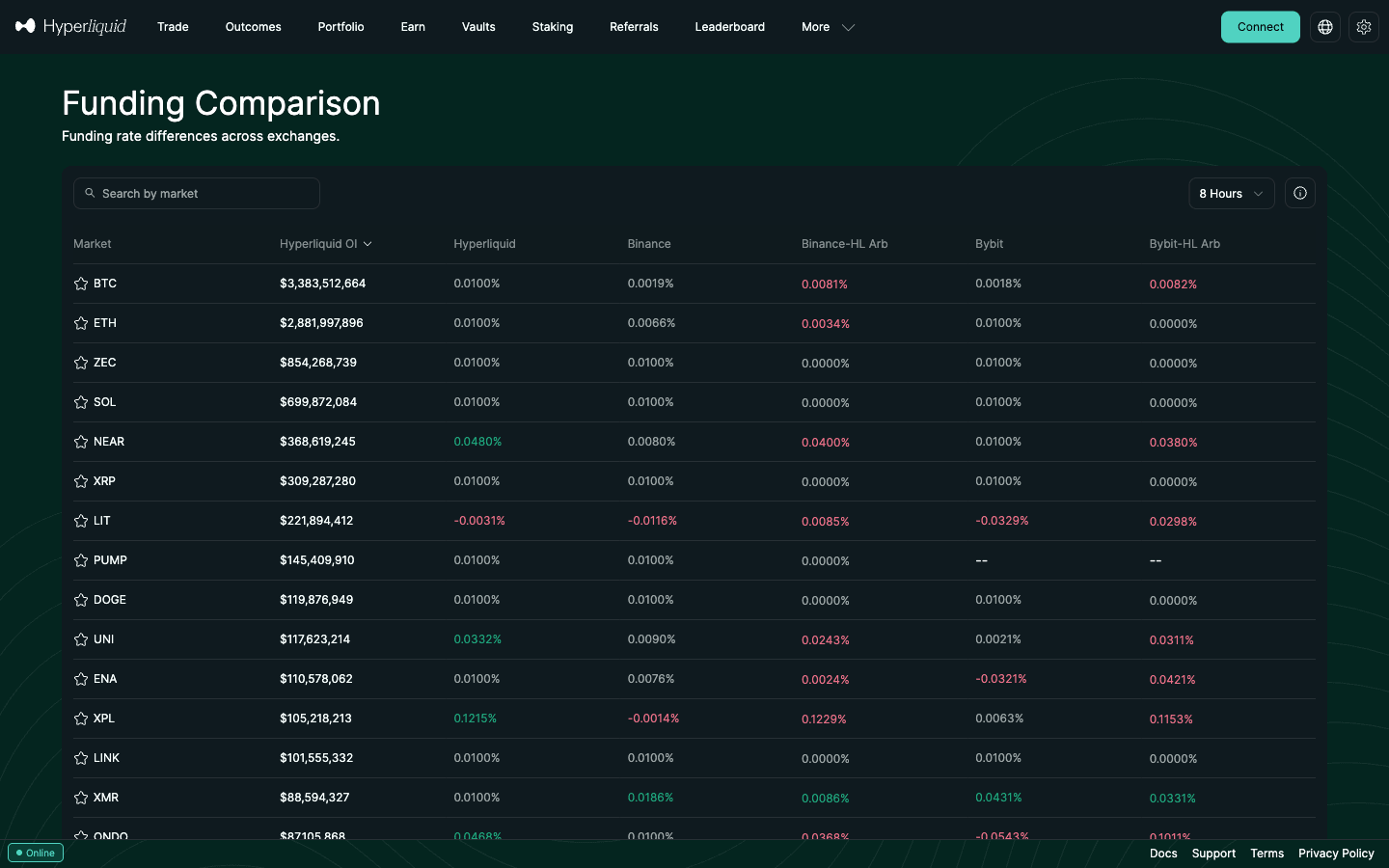
- Current funding (trade-page header or the Funding Comparison page, which also shows Binance and Bybit) and its recent history (the public API’s fundingHistory, or the table in section 7).
- Isolated margin, 1–3x, liquidation price written down, alert set.
- Spare USDC to top up margin if price rallies.
- Exit rule: the date, the funding level or the event after which you remove the hedge.
- Referral code applied before $10,000 of volume, and records exported for taxes (trade and funding history export).
12. FAQ
How do I hedge crypto?
Take a position that gains when your coins lose. The four common ways are: short a perpetual or dated future on the same coin, buy a put option, move part of the holding into stablecoins, or simply hold less. For most holders the short perp is the most practical: short the same number of coins you hold, on isolated margin at 1–3x leverage, and price moves cancel out. What is left is funding (paid or received every hour on Hyperliquid) and the trading fee to open and close (0.045% per side at Hyperliquid’s base taker tier).
What is the best or simplest way to hedge crypto?
The simplest is to sell part of your holding into a stablecoin: one trade, no margin, no liquidation risk, but you give up the upside and a sale can be taxable. If you want to keep the coins, the simplest instrument hedge is a short perpetual for the same coin count at low leverage. A put option protects the downside and keeps the upside, but you pay the premium up front and on-chain options markets are thin. There is no single best way; it depends on whether you want to keep the coins and how long you need protection.
Does hedging eliminate risk?
No. A hedge swaps price risk for smaller, different risks: the short leg can be liquidated in a sharp rally if its margin is thin, funding can turn from income into a cost, a hedge sized in dollars or on a different coin drifts out of balance, and the exchange holding each leg can fail. A full hedge also removes your upside for as long as it is open.
Futures or options: which is better for hedging?
Futures and perpetuals cost little to open (0.045% taker per side on Hyperliquid) but cap your upside and need margin that can be liquidated. A put option costs a premium paid up front, keeps all the upside and cannot be liquidated, so it suits protection against a crash you think is unlikely. Futures suit a hedge you expect to hold for a while at low cost; options suit a defined, time-limited worst case.
Does hedging with a short perp cost money?
Over the last year it mostly paid. On Hyperliquid, a BTC short received +5.95% of its notional in funding over the 12 months to September 30, 2026 (ETH +6.34%, HYPE +9.79%), because longs paid shorts in most hours. SOL was the exception: a SOL short paid 0.17% over the same year. Add 0.09% of notional for a taker round trip. Past funding is no guarantee; check the live rate before you open.
What leverage should I use on a hedge?
Low. A hedge only needs enough margin to survive the rally that would hurt it. On Hyperliquid an isolated BTC short at 1x is liquidated only after a rise of about 98%, at 3x after about 32%, and at 10x after about 9%. The coins you are hedging do not top up the short’s USDC margin (except under portfolio margin), so a 10x hedge can be liquidated while your overall position is flat.
What does delta mean in crypto, and what is delta-neutral?
Delta is how much a position’s value changes when the coin’s price moves by one unit. One BTC held has a delta of +1; a 1 BTC short perpetual has a delta of −1; together they are delta-neutral (net 0), so a price move leaves the total unchanged. A delta-neutral position earns or loses only from funding, fees and basis, not direction.
Is a delta-neutral strategy profitable?
It can be, but it is not risk-free. Long spot plus an equal short perp on Hyperliquid would have collected +9.79% on HYPE and +5.95% on BTC over the 12 months to September 30, 2026, before fees and on the short notional only. SOL shorts paid over the same year. Returns shrink when funding falls, and the short leg can still be liquidated. For cross-venue versions and live spreads see our funding-rate arbitrage guide.
Should I hedge or just sell?
Selling removes the risk permanently and costs one spot fee (0.070% taker on Hyperliquid spot). A hedge keeps the coins (useful if you want to keep staking them, avoid moving them, or defer a taxable sale) and can be removed in one click. Hedge when you expect to want the exposure back soon; sell when you do not.
Can I hedge altcoins that have no perpetual market?
Only approximately. You can short BTC or ETH in proportion to the altcoin’s measured sensitivity (beta), but correlations break down exactly in sell-offs, so the hedge can fail when you need it most. Check first whether your coin has its own market: Hyperliquid listed 178 perpetuals as of October 20, 2026.
Hedge on Hyperliquid for 4% less
Connect a wallet or log in with email, where Hyperliquid’s Terms allow you to use it. Code HOLYGRAIL takes 4% off both maker and taker fees on your first $25M of volume.
Disclosure: HOLYGRAIL and 718610TD are our Hyperliquid and Lighter referral codes; we earn a share of referred accounts' fees at no cost to you. Funding comes from Hyperliquid's public API (to September 30, 2026); prices, basis and lending readings from Hyperliquid's and Binance's APIs on September 25, 2026; fees and limits from our facts registry, checked against the official docs. Past funding does not predict future funding. Not investment or tax advice.