Hyperliquid vs Bybit (2026): Fees, Leverage, KYC and Which Is Better for Perps
Short answer. Hyperliquid is cheaper for most retail traders, needs no KYC and keeps funds in your own wallet. Bybit wins on leverage, contract count, fiat on-ramps, copy trading and VIP rates, but excludes many countries and offboarded Japanese residents in 2026.
Pick Hyperliquid if you pay Bybit’s Non-VIP rate today: 0.045% taker / 0.015% maker against 0.055% / 0.02%, a wallet or email login, and no account that can be frozen.
Pick Bybit if you need more than 40x on BTC (Bybit lists 150x on BTCUSDT and 150x on ETHUSDT), qualify for VIP 1 (taker 0.04%, below Hyperliquid’s tier 0), or want a card, fiat deposits or one-click copy trading, and you live where Bybit operates.
Use both if you start from fiat: keep Bybit as the on-ramp, withdraw USDC to your own wallet and trade perps on Hyperliquid. Join Hyperliquid with HOLYGRAIL before you connect any trading app, because apps often attach their own code to accounts that have none (fomo creates its own account, so HOLYGRAIL cannot apply there).
$10,000 market-order round trip (open + close, entry-tier rates checked October 6, 2026): Hyperliquid $9.00 · with HOLYGRAIL $8.64 · Bybit Non-VIP $11.00 ($9.90 paying in MNT).
We earn a commission when you sign up through our links; it never raises your fees. We have no affiliate relationship with Bybit.
Hyperliquid is the largest on-chain perpetuals exchange; Bybit is one of the largest centralized derivatives venues. This comparison uses each side’s official fee schedule, public API, help center and terms, with every figure dated.
Crypto only (USDC, BTC, ETH, SOL…); min 5 USDC; USDC withdrawal 0.2 USDC flat + tiny gas
Fiat, card and P2P plus crypto; withdrawal fee set per coin and network
Account
EVM wallet or email login, no KYC
Account with identity verification
Custody
Your own address; you sign withdrawals
Bybit holds assets; Proof of Reserves page
Copy trading / passive
Vaults (leader takes 10% of profits), HLP, HYPE staking
Copy trading, trading bots, Bybit Earn, Launchpad
Practice mode
Testnet with 1,000 USDC mock USDC (needs a mainnet deposit first)
Demo Trading account for every user (spot and derivatives)
Mobile
Web app on any phone; official Android app; no official iOS app
Native iOS and Android app
Support
Docs and community Discord; no account support desk
Help Center and 24/7 support tickets
Restricted
US, Ontario, sanctioned regions
US, mainland China, HK, Singapore, Canada, France, UK, Dubai and others; Japan residents offboarded in 2026
Hyperliquid: official docs, public API (24h volume about 07:30 UTC, September 25, 2026; market counts refreshed on October 20, 2026) and Terms of Use §1.6. Bybit: fee page and help center, public v5 API (market counts and volume about 07:33 UTC, September 25; leverage and funding caps 19:10 UTC, September 26, 2026), General Terms & Conditions (last updated January 23, 2026). The table scrolls sideways on phones.
2. Is Hyperliquid cheaper than Bybit? Fees and cost examples
Yes, at retail size. Hyperliquid’s tier 0 is 0.045% taker / 0.015% maker; Bybit’s Non-VIP rate is 0.0550% / 0.0200%. The order flips only once you reach Bybit VIP 1. Both venues charge fees on the notional value of the position, not on your margin: $1,000 of margin at 10x leverage is a $10,000 position, and you pay the fee on $10,000.
What a small trader actually pays
Venue and rate
$10,000 round trip, market orders
$10,000 round trip, limit (maker) orders
$100,000 a month, taker
Per year, taker
Hyperliquid, tier 0
$9.00
$3.00
$45.00
$540.00
Hyperliquid, tier 0 with a referral code
$8.64
$2.88
$43.20
$518.40
Bybit Non-VIP
$11.00
$4.00
$55.00
$660.00
Bybit Non-VIP, fees paid in MNT (−10%)
$9.90
$3.60
$49.50
$594.00
A round trip is one opening and one closing trade, so the fee is charged twice. “$100,000 a month” means five $10,000 round trips. Rates: Hyperliquid docs; Bybit fee page and MNT FAQ (the MNT discount does not apply to API orders, trading bots or copy-trading followers). Spread, slippage and funding are extra on both venues.
At $100,000 of monthly taker volume the gap is about $11.80 a month in Hyperliquid’s favour with a referral code. That is small money, but it compounds with trading frequency, and maker orders cut the bill by about two thirds on both venues. Plug in your own numbers with the DEX fee calculator.
Fee schedules
Hyperliquid sets your tier on rolling 14-day weighted volume, with spot counting double. Tier 0 is 0.045% taker / 0.015% maker, falling to 0.024% / 0% above $7B. Two discounts stack on top: HYPE staking (5–40% depending on stake) and the referral discount (4% for your first $25M of volume). Orders, cancels and funding carry no gas. Full schedule: Hyperliquid fees explained.
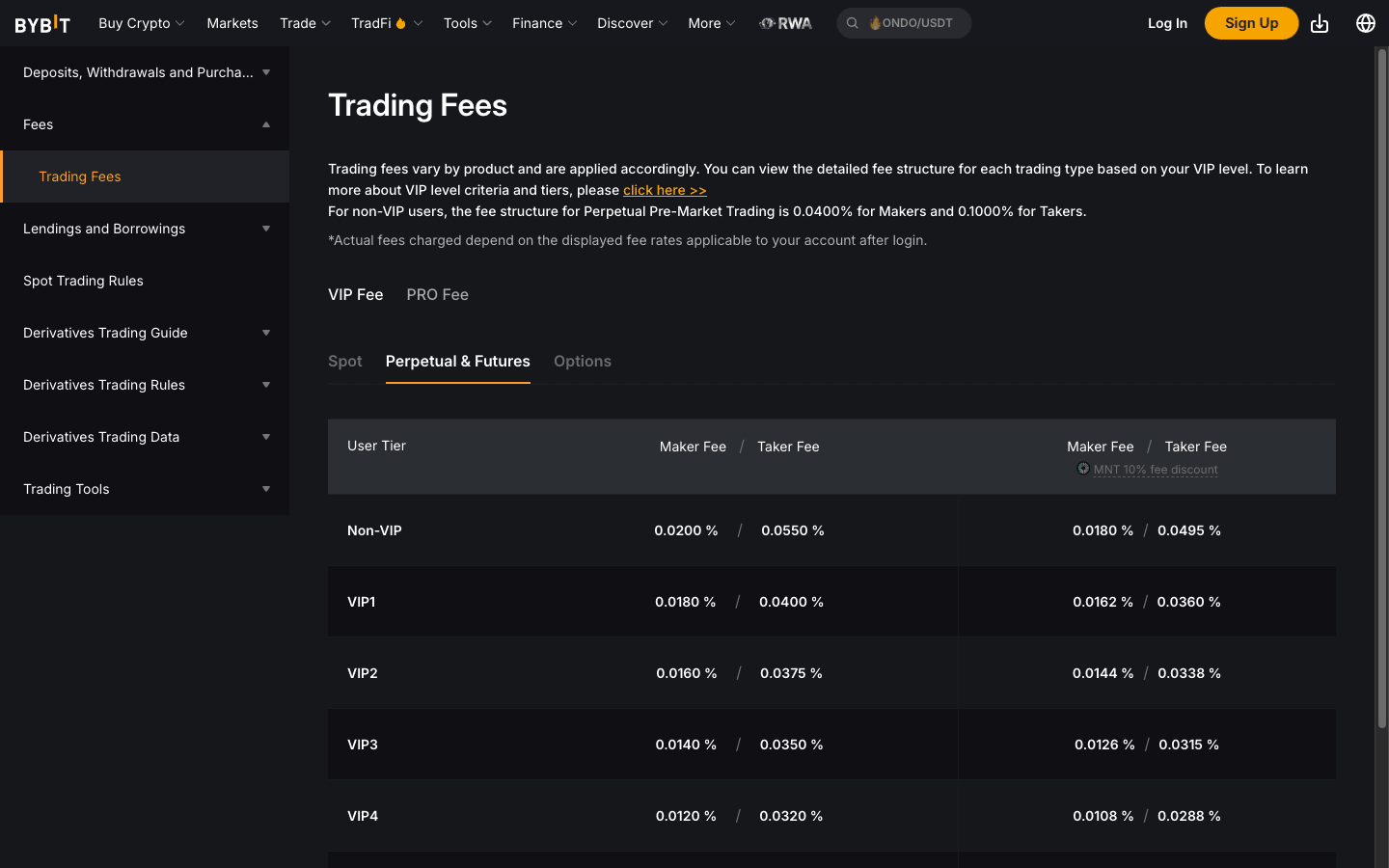
Bybit's official fee page, Perpetual & Futures tab, checked September 25, 2026: Non-VIP 0.0200% maker / 0.0550% taker, falling with VIP tier; the right-hand column is the MNT-discount rate.
Bybit publishes these perpetual and futures rates (checked September 25, 2026):
Bybit tier
Maker
Taker
Non-VIP
0.0200%
0.0550%
VIP 1
0.0180%
0.0400%
VIP 2
0.0160%
0.0375%
VIP 3
0.0140%
0.0350%
VIP 4
0.0120%
0.0320%
VIP 5
0.0100%
0.0320%
Supreme VIP
0.0000%
0.0300%
Bybit also shows an MNT fee-discount column (Non-VIP 0.0180% / 0.0495%) and charges 0.0400% / 0.1000% on pre-market perpetuals for Non-VIP users. Bybit says actual fees depend on the rates shown in your account after login. Spot is 0.1000% / 0.1000% for Non-VIP crypto pairs.
Higher volumes
$1M of taker volume a month, entry level: Hyperliquid $450 ($432 with a referral code); Bybit Non-VIP $550. Saving: $100–118 a month.
$1M of maker volume: Hyperliquid $150 ($144 with a referral code); Bybit Non-VIP $200.
Silver HYPE staker (1,000+ HYPE) with a referral code: 0.045% × 0.85 × 0.96 = 0.0367% taker, or about $367 per $1M.
Where Bybit wins: once you qualify for Bybit VIP 1, its taker rate (0.0400%) is below Hyperliquid’s tier 0 (0.045%), and Supreme VIP makers pay 0%. Hyperliquid’s own tiers only reach 0.040% taker above $5M of 14-day volume. High-volume traders should compare their actual tier on both venues.
Deposit and withdrawal costs
Hyperliquid: deposits are crypto only. The USDC minimum is 5 USDC; smaller deposits through the bridge are lost, so never send less. A USDC withdrawal to Arbitrum costs a flat 0.2 USDC plus a tiny HyperEVM gas fee and should arrive within 5 minutes. See how to withdraw from Hyperliquid.
Bybit: accepts fiat (bank, card, P2P) as well as crypto. Crypto withdrawal fees are set per coin and per network and are shown in the withdrawal window before you confirm; on September 27, 2026 Bybit’s public fee pages listed trading fees only, so check the network fee there.
How to cut fees on each
Lever
Hyperliquid
Bybit
Maker orders
0.015% instead of 0.045%: the biggest saving
0.0200% instead of 0.0550%: the biggest saving
Sign-up discount
Referral code: −4% on your first $25M
None on fees (Bybit runs bonus campaigns instead)
Holding the native token
Stake HYPE: −5–40%
Pay fees in MNT: −10% on futures, −25% on spot. Not for API orders, bots or copy trading
Volume
7 tiers on 14-day volume, down to 0.024% / 0%
VIP 1–5 and Supreme VIP; a separate Pro fee schedule for Pro accounts
3. How often is funding paid? Hourly vs every 8 hours
Funding is not an exchange fee on either venue; it flows between longs and shorts to keep the perp price near spot. The two venues differ in how often it settles and how far it can go:
Hyperliquid computes an 8-hour rate and pays one eighth of it every hour. The common baseline of 0.01% per 8 hours becomes 0.00125% per hour. Funding is capped at 4% per hour for every asset.
Bybit settles BTCUSDT, ETHUSDT, SOLUSDT and HYPEUSDT every 8 hours, and its API caps BTCUSDT at ±0.333% per interval.
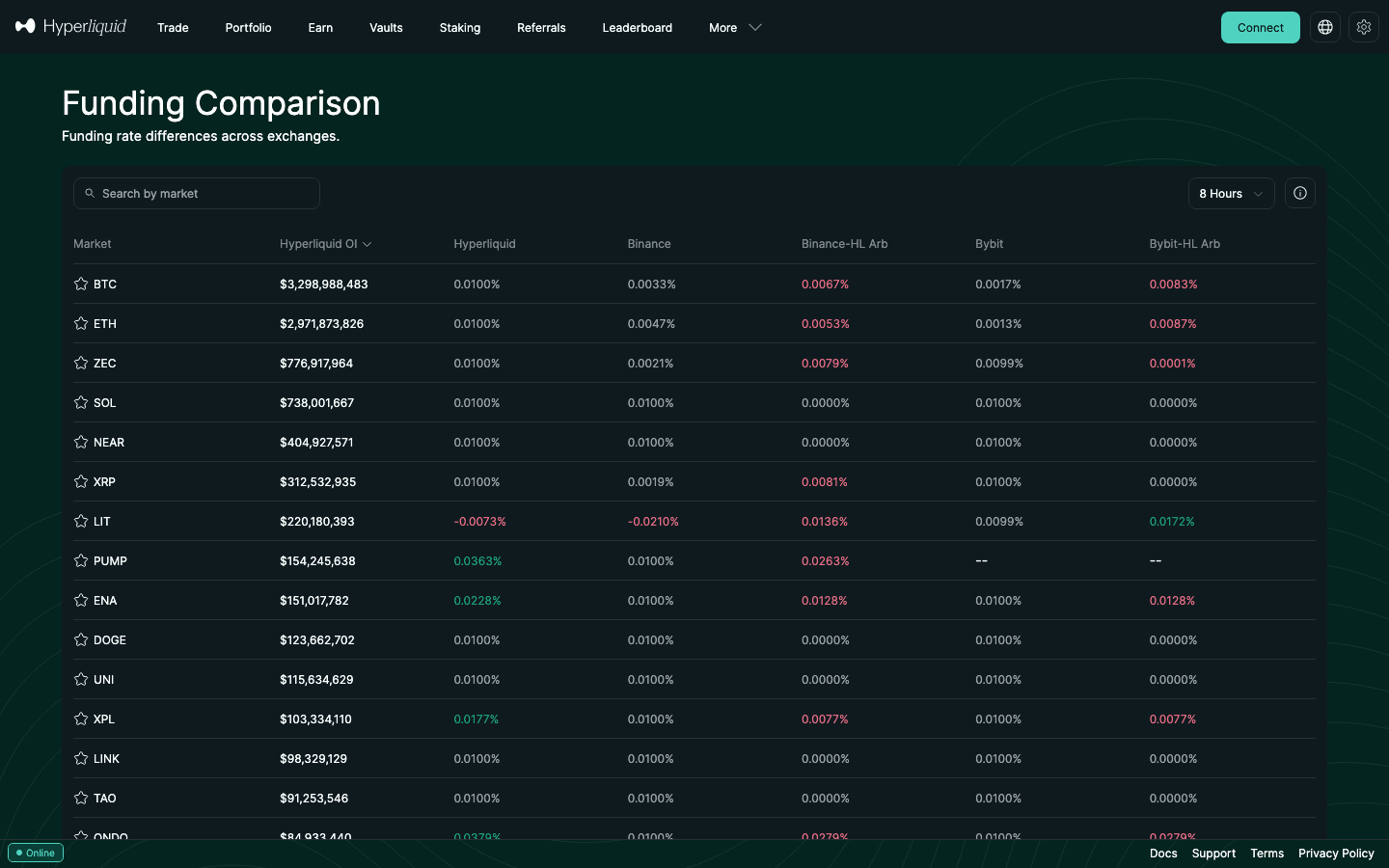
Over a full day, holding costs are similar when rates are similar. Hourly settlement means you pay or receive funding even on a position held for an hour or two, while on Bybit a trade opened and closed between two funding timestamps pays none. To compare the two directly, Hyperliquid publishes an official Funding Comparison page that puts Hyperliquid, Binance and Bybit side by side on an 8-hour basis.
Hyperliquid’s Funding Comparison page on September 25, 2026: funding per coin on an 8-hour basis for Hyperliquid, Binance and Bybit, with the gap columns arbitrageurs watch.
Bybit’s public instrument data lists maximum leverage of 150x on BTCUSDT and 150x on ETHUSDT, 100x on SOLUSDT and 75x on HYPEUSDT (September 26, 2026). Many articles still quote Bybit at 125x; the API figure is higher. Hyperliquid caps BTC at 40x (20x on notional above $150M), ETH at 25x, SOL at 20x and HYPE at 10x; most altcoins are lower. See the leverage limits by asset.
Higher maximum leverage is not the same as a better deal. On Hyperliquid, maintenance margin is half the initial margin at maximum leverage, so BTC’s maintenance margin is 1.25%. At 40x your liquidation sits about 1.25% away after fees; at 150x it is well under 1%, and a single wick can close you out. Hyperliquid supports cross and isolated margin per position and runs one net position per market per account; to hold both sides you use a sub-account.
If you want more than 40x on a DEX, Lighter offers 50x on BTC and ETH, and edgeX 100x.
5. Which has more markets?
Bybit: 885 linear contracts (845 perpetuals and 40 dated futures; 817 USDT-margined and 68 USDC-margined), 26 inverse contracts, options, and 530 spot pairs. Bybit decides listings centrally and runs a listing-application process.
Hyperliquid: 178 validator-operated perps (as of October 20, 2026), plus HIP-3 markets deployed by third parties. The largest, trade.xyz, listed 124 assets (US stocks, indices, commodities) on September 24, 2026; see trading stocks on Hyperliquid. It also has 336 spot pairs. Listing is permissionless: spot tokens via the HIP-1 auction and perps via HIP-3 deployments, so new assets can appear without the exchange’s approval. That also means more low-quality markets, so check depth before you trade.
6. Which has more volume and liquidity? (September 25, 2026)
24h snapshot, ~07:30 UTC
Hyperliquid
Bybit
Perp volume
$8.16B (all perps)
$17.39B (USDT/USDC linear)
BTC perp volume
$3.83B
$6.11B (BTCUSDT)
Sources: Hyperliquid metaAndAssetCtxs; Bybit /v5/market/tickers?category=linear. Hyperliquid volume swings between about $4B and $8B+ a day with the week. Treat these as one reading, not an average.
Why we leave open interest out. Headlines such as “Hyperliquid’s open interest passed Bybit’s” compare figures built differently. Bybit’s API reports BTCUSDT open interest both two-sided ($5.06B) and single-sided ($2.53B), and Hyperliquid does not document which convention its figure uses. Depending on which Bybit number you pick, the comparison can flip, so a side-by-side OI number would mislead.
Bybit trades about twice Hyperliquid’s perp volume overall and about 1.6 times on BTC. For market orders up to a few hundred thousand dollars on BTC or ETH, both books are deep enough that fees matter more than slippage. For very large orders or thin altcoins, check the book depth on both before you choose. Live DEX volumes are in our perp DEX ranking.
7. Is Bybit safe, and is Hyperliquid safer? Custody, reserves and the 2025 hack
Is Bybit safe? It is a custodial exchange: your deposit becomes a balance on Bybit’s books, and Bybit holds the coins. Its VIP page states: “We maintain a 1:1 reserve ratio on all user assets,” with a link to its Proof of Reserves page. Its General Terms & Conditions let Bybit freeze, hold or restrict access to funds and suspend accounts in the situations listed in its suspension clause.
Custody also concentrates risk. The FBI attributed the theft of approximately $1.5 billion in virtual assets from Bybit, on or about February 21, 2025, to North Korean actors it calls “TraderTraitor” (FBI IC3 PSA, February 26, 2025). Did clients lose money? According to Bybit’s own incident timeline, the attackers drained a single Ethereum cold wallet; its CEO said the same day that Bybit was solvent and that client assets remained backed 1:1; withdrawals were not halted (it reported 99.994% of over 350,000 withdrawal requests processed within 10 hours); and an updated Proof of Reserves report from the auditor Hacken found the ETH shortfall in client assets closed within 72 hours, funded by bridge loans, deposits and OTC purchases. That is Bybit’s account of events, and it held up, but it shows that the safety of a custodial balance rests on the exchange’s balance sheet.
Hyperliquid is self-custodial. Your balance sits at your own address on HyperCore, and withdrawals require your wallet’s signature; there is no operator account to freeze. That does not make it risk-free:
Bridges: USDC arrives through Hyperliquid’s bridge, and BTC/ETH/SOL through Unit’s 2-of-3 MPC network.
Validator concentration: Hyper Foundation validators held about 47.3% of stake in September 2026.
Your keys: a leaked seed phrase or a malicious signature cannot be reversed by support.
Hyperliquid’s fees go to HLP, the Assistance Fund (which buys and burns HYPE) and deployers, not to a company treasury. A fuller risk review is in our Hyperliquid review.
8. Who can use them? KYC and restricted countries
Hyperliquid: no identity verification. Connect an EVM wallet (Rabby, MetaMask, WalletConnect, Coinbase Wallet) or log in with your email and a 6-digit code, click Enable Trading and deposit. Its Terms of Use (§1.6) exclude persons in the United States and Ontario, and sanctioned regions; the exact wording and who counts are in our Hyperliquid restricted countries guide. Respect these limits and do not use VPNs to get around them.
Bybit: accounts go through identity verification. Its General Terms & Conditions are issued by Bybit Virtual Asset Platform Operator L.L.C. S.P.C (last updated January 23, 2026) and list excluded jurisdictions including the United States, mainland China, Hong Kong, Singapore, Canada, France, the United Kingdom, Dubai, North Korea, Cuba, Iran, Uzbekistan, Russian-controlled regions of Ukraine, Sudan and Syria, “or any other jurisdictions” Bybit decides to terminate. So Bybit is not available to US residents.
Japan: Bybit offboarded Japanese residents. New registrations stopped on October 31, 2025, accounts went close-only on March 23, 2026, and open positions were force-closed on July 22, 2026. Users were identified by Japanese ID, a Japanese proof of address or a Japanese IP address. Its notices asked users to complete Identity Verification Level 2 (proof of address).
More on how DEXs work without KYC, and what “no KYC” does not mean, in our no-KYC exchange guide.
Switch to self-custody perps
Hyperliquid: 0.045% / 0.015% base fees, no KYC, your keys. Code HOLYGRAIL takes 4% off your first $25M.
9. Can you copy trade on both? Vaults, bots and API
This is where the two venues differ most in practice.
Bybit: copy trading and exchange-hosted bots
Bybit runs copy trading and trading bots inside the exchange: you pick a lead trader or a grid/DCA bot, Bybit executes it in your custodial account, and you never touch code. Follower trades cannot use the MNT fee discount. Bybit’s v5 REST and WebSocket API uses API keys created in the account; its market-data endpoints are public, and this article’s Bybit numbers came from them.
Hyperliquid: vaults, HLP and agent wallets
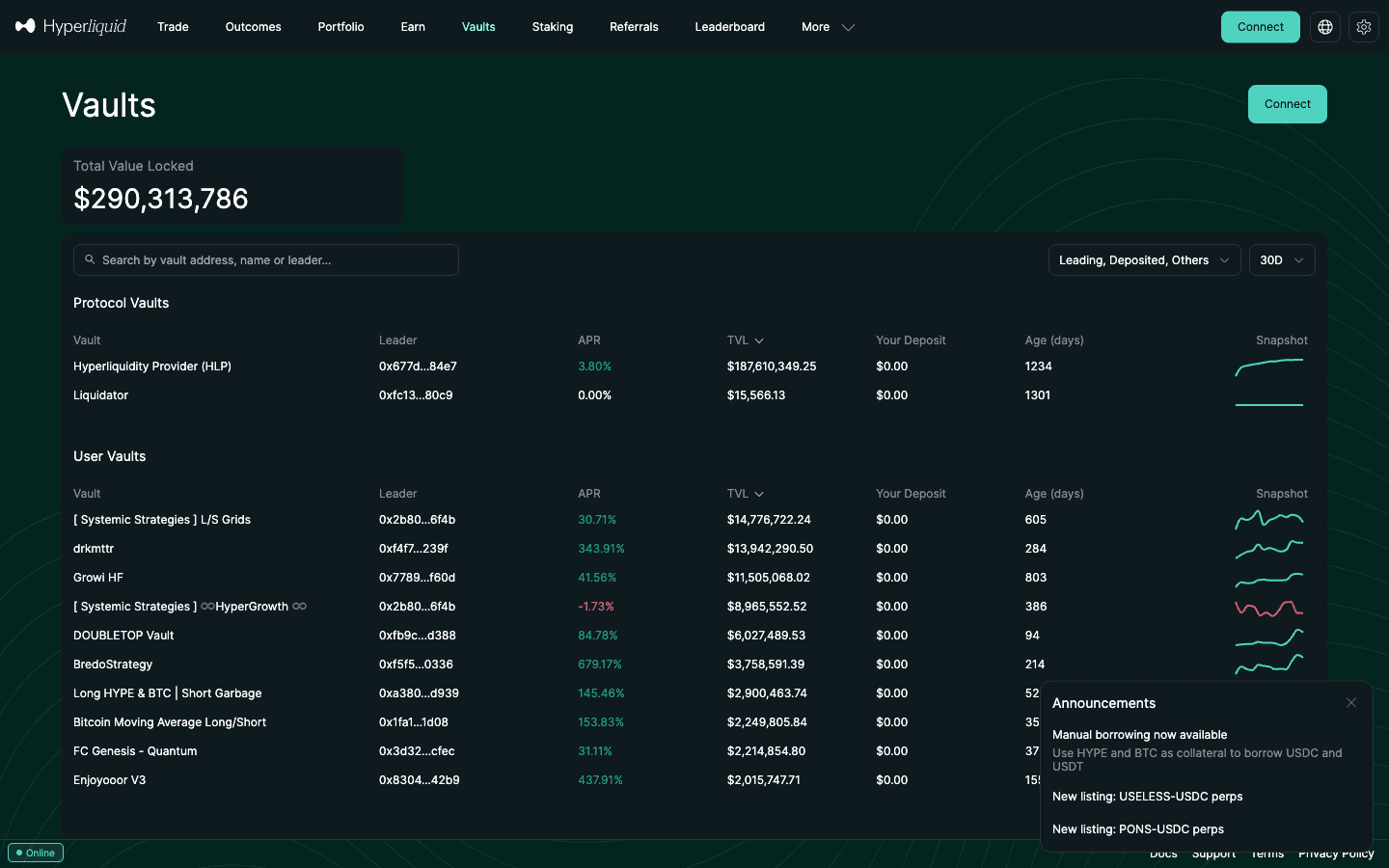
app.hyperliquid.xyz/vaults (September 2026): the protocol vault HLP on top, user vaults sorted by TVL below. Every position and trade in a vault is public.
User vaults are Hyperliquid’s version of copy trading: you deposit into a leader’s vault and share its PnL. The leader takes 10% of profits and must keep at least 5% of the vault; deposits are locked for 1 day after your latest deposit. Unlike Bybit, every position and fill is on-chain, so you can audit a leader before you join.
HLP, the protocol’s market-making vault, held $179.1M on October 20, 2026; withdrawals open 4 days after your latest deposit. It can lose money.
Agent (API) wallets let a bot or a third-party copy-trading app sign orders for you without being able to withdraw. An account can approve one unnamed and up to 3 named agent wallets. Orders and cancels cost no gas, IP limits are 1,200 request-weight per minute for REST, and every order sits on a public, on-chain book. Guides: Hyperliquid API, Hyperliquid vaults and copy trading on Hyperliquid.
10. Can you earn yield on either?
Bybit offers Bybit Earn (savings and structured products), Launchpad token sales, the Bybit Card, and frequent sign-up and deposit campaigns. Yields and bonuses change often and are paid by Bybit, so read each product’s terms.
Hyperliquid has no bonus campaigns. Staking HYPE earns staking rewards and lowers your trading fees by 5–40%; HLP and user vaults share in trading PnL. There is no points programme today; the November 2024 HYPE airdrop is history, so do not trade on Hyperliquid expecting another one.
11. Which is easier for beginners? Demo vs testnet, mobile app, support
Practice: Bybit gives every user a Demo Trading account with simulated funds for spot and derivatives, reached from the profile menu; its data is cleared after 30 days without access. Hyperliquid’s equivalent is its testnet: the faucet gives 1,000 USDC mock USDC, but only to an address that has already deposited on mainnet.
Mobile: Bybit has native iOS and Android apps. Hyperliquid runs in any phone browser, has an official Android app on Google Play, and had no official iOS app when we checked the App Store on September 27, 2026 (on iPhone, add the web app to your Home Screen). Details and third-party apps: Hyperliquid app guide.
Support: Bybit has a Help Center and a ticket form that promises “dedicated 24/7 customer support”. Hyperliquid has documentation and a community Discord, but no account support desk: nobody can reverse a transaction or reset your keys.
Order tools: Hyperliquid has TradingView charts; market, limit, stop, take-profit, scale, chase, trailing-stop and TWAP orders; cross and isolated margin; sub-accounts; and spot, including native BTC/ETH/SOL through Unit. It has no fiat on-ramp, card or options. Bybit adds options, P2P, one-click buy and a card. Order-type details: Hyperliquid order types.
Open Hyperliquid first via app.hyperliquid.xyz/join/HOLYGRAIL, so the 4% referral discount is attached before your first trade. Connect a wallet or log in with email. Do this before anything else: Hyperliquid stops accepting a code after $10,000 of volume, and apps such as Phantom often set their own Hyperliquid referral code on accounts that have none, so enter a code on Hyperliquid before you start using an app.
Pick a deposit route. Withdraw USDC from Bybit to your own wallet on a network Hyperliquid accepts (Arbitrum, Ethereum, Base or Polygon; check which of these Bybit offers for USDC and its fee in the withdrawal window), then deposit it on Hyperliquid (minimum 5 USDC). Or withdraw BTC on the Bitcoin network straight to the Unit deposit address shown in Hyperliquid’s deposit window (minimum 0.0003 BTC; it arrives as UBTC, which you can sell for USDC). Always check the network name and send a small test first. Deposit guide.
Set leverage deliberately. Hyperliquid’s caps are lower than Bybit’s, and positions settle funding every hour.
Rebuild your stops. Use take-profit and stop-loss orders from the order form, and keep maintenance margin in mind.
13. Which should you choose?
Choose Hyperliquid if
You pay retail-tier fees today: 0.045% / 0.015% beats Bybit Non-VIP, and the referral and staking discounts go further.
You want to hold your own keys and avoid exchange freezes and exchange-level hacks.
You cannot or do not want to submit identity documents, or you live somewhere Bybit excludes that Hyperliquid does not.
You run bots and like gas-free orders on a public, verifiable order book, or want to copy traders whose every fill is on-chain.
Choose Bybit if
You need leverage above 40x on BTC or 25x on ETH.
You qualify for Bybit VIP rates, or need inverse contracts, dated futures or options.
You rely on one-click copy trading, grid bots, a demo account, a card or a fiat on-ramp.
You are in a jurisdiction Bybit serves and accept custodial risk and KYC.
Not sure Bybit is the right replacement? Our Hyperliquid alternatives guide compares eight perp DEXs and the CEX route by the reason you want to switch.
At the entry level, yes. Hyperliquid charges 0.045% taker and 0.015% maker on perps; Bybit charges 0.0550% taker and 0.0200% maker for Non-VIP accounts. A $10,000 market-order round trip costs $9.00 on Hyperliquid ($8.64 with a referral code) against $11.00 on Bybit. Bybit VIP 1 and above (taker 0.0400% or less) undercut Hyperliquid's tier 0 taker rate.
How much does Bybit charge on futures?
Non-VIP accounts pay 0.0200% maker and 0.0550% taker on perpetuals and futures, charged on the position's notional value. Paying fees in MNT takes 10% off futures fees (0.0180% / 0.0495%); the 25% MNT discount applies to spot only. VIP levels go down to 0% maker and 0.0300% taker (Supreme VIP). Pre-market perpetuals cost 0.0400% / 0.1000% for Non-VIP users.
Which crypto exchange has the lowest futures fees?
It depends on your volume. For a retail trader without VIP status, Hyperliquid's 0.045% / 0.015% (0.0432% / 0.0144% with a referral code) is below Bybit Non-VIP. Some DEXs charge less: Lighter's Standard account charges no trading fee. High-volume traders on Bybit or Binance VIP tiers can pay less than Hyperliquid's lower tiers. Our DEX vs CEX fee comparison lists all of them.
How often is funding paid on Hyperliquid and Bybit?
Hyperliquid settles funding every hour and pays one eighth of an 8-hour rate each time, capped at 4% per hour. Bybit settles BTCUSDT, ETHUSDT, SOLUSDT and HYPEUSDT every 8 hours, with BTCUSDT capped at ±0.333% per interval. Funding is paid between traders, not to the exchange. Multiply a Hyperliquid hourly rate by 8 before comparing it with Bybit.
Does Hyperliquid require KYC like Bybit?
No. Hyperliquid has no identity verification: you connect an EVM wallet or log in with an email code and deposit. Bybit accounts go through identity verification, and its own notices refer to KYC levels such as Level 2 proof of address.
What is the maximum leverage on Hyperliquid vs Bybit?
Bybit's public API lists 150x on BTCUSDT and 150x on ETHUSDT, 100x on SOLUSDT and 75x on HYPEUSDT (September 26, 2026); many older articles still say 125x. Hyperliquid caps BTC at 40x (20x above $150M notional), ETH at 25x, SOL at 20x and HYPE at 10x.
Is Bybit safe?
Bybit is a large, custodial exchange with a Proof of Reserves page and a stated 1:1 reserve ratio. It was hacked on February 21, 2025: the FBI attributed the theft of about $1.5 billion to North Korea. Bybit's own timeline says only one ETH cold wallet was hit, withdrawals were not halted, its CEO said client assets remained backed 1:1, and an auditor's Proof of Reserves update found the ETH gap closed within 72 hours. The remaining risks are the ones every custodial exchange carries: account freezes under its terms and concentrated custody.
Is Hyperliquid safer than Bybit?
They carry different risks. Bybit concentrates custody in one company. Hyperliquid removes custodial risk but adds on-chain risks such as bridge contracts, validator concentration (Hyper Foundation validators held about 47.3% of stake in September 2026) and losing your own keys.
Is Bybit legal in the US? Who operates Bybit?
Bybit does not serve the United States. Its General Terms & Conditions, issued by Bybit Virtual Asset Platform Operator L.L.C. S.P.C (last updated January 23, 2026), exclude the US, mainland China, Hong Kong, Singapore, Canada, France, the UK, Dubai and several sanctioned regions. Hyperliquid also excludes US persons, Ontario and sanctioned regions in its Terms of Use.
Can I use both Bybit and Hyperliquid? How do I move funds?
Yes, many traders do: a CEX for fiat on-ramp, Hyperliquid for perps. To move funds, withdraw USDC from Bybit to your own wallet on a network Hyperliquid accepts (such as Arbitrum), then deposit at least 5 USDC on Hyperliquid; or send BTC on the Bitcoin network to the Unit deposit address in Hyperliquid's deposit window. Send a small test first.
Can Bybit freeze my funds? Can Hyperliquid?
Bybit’s terms allow it to freeze, hold or restrict access to funds in an account under the conditions set out in its suspension clause. On Hyperliquid your balance sits at your own address and withdrawals are signed by your wallet; the protocol has no account-freeze button, but you still carry smart-contract, bridge and key-management risk.
Is Bybit available in Japan?
No longer for Japanese residents. Bybit stopped accepting new registrations from Japan on 2025-10-31 at 21:00 JST, then announced on 2026-01-22 that accounts identified as Japanese residents would switch to close-only mode from 2026-03-23 12:00 JST and that open positions would be force-closed on 2026-07-22 12:00 JST. On 2026-07-24 it said it had completed its Japan remediation; asset conversion (to BTC, ETH or USDC only), crypto withdrawals and fiat withdrawals remain available for leftover balances.
Open Hyperliquid
The largest on-chain perp exchange: 178 markets (as of October 20, 2026), gas-free orders, 4% off fees with HOLYGRAIL.
Disclosure: HOLYGRAIL is our Hyperliquid referral code; we earn a share of referred accounts' fees at no cost to you. We have no relationship with Bybit. Hyperliquid figures come from its docs, public API and Terms; Bybit figures from its fee page, help center, public v5 API, General Terms & Conditions and announcements, checked September 25–27, 2026. Leverage trading can lose more than you expect; this is not investment or legal advice.