
Lighter vs Hyperliquid: the short answer
What is Lighter (lighter.xyz)? A zero-fee perpetual and spot exchange on its own zk-rollup that settles on Ethereum. It is Hyperliquid's closest on-chain order-book rival, a separate exchange and not part of Hyperliquid. More in our Lighter DEX review.
Lighter is the cheaper exchange and Hyperliquid is the deeper one. Lighter charges 0% on a Standard account and allows 50x on BTC and ETH. Hyperliquid charges 0.045% taker / 0.015% maker at the base tier and caps BTC at 40x, but on 15 Oct 2026 it traded about 3.6× Lighter's perp volume and carried 21× its BTC open interest.
Size, altcoins, spot, or apps like Based and Liquid on the same account → Hyperliquid
Join Hyperliquid withHOLYGRAIL, 4% off → Join with HOLYGRAIL before your first trade: 4% off your first $25M. It can't be added after $10,000 of volume.
Small market orders, free resting limits, proof-based custody → Lighter
Open a free Lighter account →Standard charges 0% maker and 0% taker on regular orders, so code 718610TD mostly matters on Premium (10% off the fees you pay, rebated weekly).
| If you… | Pick |
|---|---|
| send small market orders (under about $5k a clip) or rest limit orders for hours | Lighter Standard: 0% maker and taker, 300 ms taker delay |
| move six-figure size on BTC or ETH | Hyperliquid: about 21× Lighter's BTC open interest (15 Oct 2026) |
| trade mid-cap altcoins | Hyperliquid: 148 of Lighter's 213 perps traded under $1M in 24 hours (15 Oct 2026) |
| want the most leverage on BTC / ETH | Lighter: 50x vs 40x / 25x |
| want spot, vaults and third-party apps (Based, Liquid) on one account | Hyperliquid: 336 spot pairs, HLP |
| want proof-based custody with an Ethereum exit | Lighter: zk-rollup with an escape hatch (L2BEAT Stage 0) |
Live, from CoinGecko's derivatives feed (Tue, 20 Oct 2026 00:59 UTC): Hyperliquid $7.62B of 24h volume and $15.02B of open interest; Lighter $1.96B and $1.10B, plus $604M of volume on its Robinhood Chain instance. CoinGecko also counts Hyperliquid's HIP-3 builder markets, so its Hyperliquid totals run above the core-perp API figures in section 4. CoinGecko's Lighter open interest is about 2.2× the exchange API's figure ($0.51B on 15 Oct 2026); it appears to count both sides of each position. The ratios on this page use the exchange APIs.
Can you use both? Yes, and it is the cheapest setup: Hyperliquid for size and altcoins, Lighter for small taker orders and free resting limits. The accounts are separate, so each gets its own code.
HOLYGRAIL takes 4% off your Hyperliquid fees on the first $25M of volume. Enter it before you connect an app such as Based or Liquid, because apps often attach their own code to accounts that have none. Lighter's Standard account is already free, so its code only pays off on Premium: 10% off the fees you pay, and its docs also list a first week of Premium rebated. Details: Hyperliquid referral code HOLYGRAIL, Lighter referral code 718610TD, and for a third venue the Aster referral code DTLpLc.
We earn a commission when you sign up through our links; it never raises your fees.
Short version. Lighter is free, 0% maker and taker on a Standard account, but adds 300 ms to taker orders. It settles with validity proofs on Ethereum, so you can exit without the operator's help. Hyperliquid charges 0.045% / 0.015% at the base tier (less with HYPE staking and code HOLYGRAIL). In return it has about 3.6× the perp volume, about 21× the BTC open interest (15 Oct 2026), 336 spot pairs (as of October 20, 2026) and a full DeFi layer. Lighter gives you 50x on BTC and ETH; Hyperliquid caps them at 40x / 25x. Pick Lighter for fee-sensitive limit-order and swing trading and for proof-based custody. Pick Hyperliquid for size, breadth, spot and the most liquid books in DeFi. Neither is open to US residents.
1. Lighter vs Hyperliquid: who wins, category by category
| Category | Winner | Why |
|---|---|---|
| Trading fees | Lighter | 0% maker and taker on a Standard account vs 0.045% / 0.015% at Hyperliquid tier 0 |
| Liquidity and depth | Hyperliquid | about 3.6× the 24h perp volume and 21× the BTC open interest (APIs, 15 Oct 2026) |
| Execution speed | Hyperliquid (vs Standard) | 0.2 s median; Lighter Standard adds 300 ms to taker orders, Premium 140 ms |
| Leverage on BTC / ETH | Lighter | 50x vs 40x / 25x |
| Custody and exit guarantees | Lighter | validity proofs on Ethereum and an escape hatch you can trigger yourself (L2BEAT Stage 0) |
| Transparency | Hyperliquid | every order, fill and liquidation is public on its L1 |
| Markets, spot and DeFi | Hyperliquid | 336 spot pairs, vaults, HyperEVM |
| Stocks and other RWA perps | Tie | Lighter lists them itself at 0%; Hyperliquid through HIP-3 builder markets |
| Mobile | Split | Lighter has the official iOS + Android app; Hyperliquid has official Android plus third-party iOS apps |
Hyperliquid takes four categories and Lighter three, with two draws, but the count matters less than the weight. Lighter wins everything that is about cost and guarantees: fees, leverage on the majors and the ability to exit through Ethereum. Hyperliquid wins everything that is about scale: depth, breadth and a public record of every trade. For a small account trading BTC and ETH with limit orders, Lighter's edge is real money. Once your orders are big enough to move a thin book, Hyperliquid's depth is worth more than its fee. The sections below give the numbers behind each row. For a third option, see our Hyperliquid vs Lighter vs Aster comparison. We don't repeat Aster here.
2. Lighter vs Hyperliquid at a glance
| Hyperliquid | Lighter | |
|---|---|---|
| Architecture | Own L1 (HyperCore order book + HyperEVM), HyperBFT, 27 active validators (15 Oct 2026) | zk-rollup: validity proofs and state anchored on Ethereum; exits via Ethereum (L2BEAT Stage 0) |
| Base taker / maker | 0.045% / 0.015% (tier 0) | 0% / 0% (Standard); 0.028% / 0.004% (Premium) |
| Order latency | Median 0.2 s end-to-end (co-located), p99 0.9 s | 300 ms taker, 300 ms cancel, no delay on maker orders (Standard); 140 ms taker (Premium) |
| Perp markets (15 Oct 2026) | 178 | 213 active |
| 24h perp volume (15 Oct 2026) | ≈ $7.9B | ≈ $2.2B |
| Open interest (15 Oct 2026) | ≈ $11.1B (BTC ≈ $3.3B) | ≈ $0.51B (BTC ≈ $0.16B, 1,930 BTC) |
| Spot markets | 336 pairs (as of October 20, 2026) | 11 listed, 10 active (15 Oct 2026) |
| Max leverage BTC / ETH / SOL | 40x / 25x / 20x | 50x / 50x / 25x |
| Funding interval | Hourly | Hourly (peer-to-peer, no exchange cut) |
| Gas on orders | None | None |
| Non-crypto markets | HIP-3 builder perps (stocks, commodities, indices) | RWA perps: US equities, indices, pre-IPO, forex, gold |
| Token | HYPE (staking discounts 5–40%) | LIT (Premium discounts 2.5–30%, 6% staking APR) |
| Login / KYC | EVM wallet or email; no KYC | EVM wallet or email; no KYC |
| Mobile app | Official Android app; no iOS app from Hyperliquid (iPhone: web app or Based / Liquid / fomo) | Lighter Mobile on iOS and Android (trading in "selected supported regions"); mobile web |
| Restricted by the Terms | US, Ontario (Canada), sanctioned territories and their citizens | US, Canada, UK, China, Russia, Ukraine and 8 others, plus sanctioned jurisdictions |
| Referral code | HOLYGRAIL (4% off first $25M) | 718610TD (first week of Premium fees rebated) |
Both are non-custodial central-limit order books with no KYC and no gas on order placement. The architectural difference matters more than it looks. Hyperliquid is its own Layer 1 — HyperCore for matching and clearing, HyperEVM for smart contracts — so it settles on itself and bridges assets in from other chains. Lighter is a zk-rollup: every batch of trades produces a succinct proof that is verified on Ethereum before the state root updates, deposits and forced exits go through Ethereum contracts, and the docs' design goals include that "users must always be able to exit securely and independently". Lighter's pitch is verifiable order matching and liquidations — every match is proven, not just recorded.
Is Lighter on Arbitrum? No, though some summaries say so. Arbitrum is one of about a dozen networks you can deposit from, and it is the route for Lighter's fast USDC withdrawals. Trading, balances and proofs live on Lighter's own rollup, and its contracts are on Ethereum. And the Robinhood link? Robinhood took part in Lighter's $68M funding round (Fortune, November 2025). Lighter also runs a separate exchange instance on Robinhood Chain, with its own order books, USDG collateral, fees and points. That instance is not the Robinhood app, and it is unrelated to Hyperliquid.
3. Hyperliquid vs Lighter fees: zero vs low, with a latency catch
Lighter's headline is unambiguous: Standard accounts pay nothing on perps or spot (re-read from the Trading Fees page on October 19, 2026). The price you pay instead is time — Standard accounts get 300 ms taker and 300 ms cancel latency (maker orders are not delayed), and up to four sub-accounts. Opting into a Premium account removes the delay (140 ms taker, no added latency on cancels or post-only orders) and starts charging 0.028% taker / 0.004% maker, discounted 2.5% at 1,000 LIT staked up to 30% at 500,000 LIT. A third Plus account charges 0.5 bp both sides with 300 ms taker / 200 ms maker latency but much higher API rate limits (4,000 sendTx per minute).
Hyperliquid charges everyone, but the schedule falls with 14-day weighted volume (spot counts double) and stacks two discounts: HYPE staking (5–40% off) and the referral discount (4% off your first $25M). Maker rebates of −0.001% to −0.003% exist but require more than 0.5% of exchange-wide maker volume.
| Account / tier | Taker | Maker | $10k market order | $10k limit fill |
|---|---|---|---|---|
| Hyperliquid tier 0 (< $5M / 14d) | 0.045% | 0.015% | $4.50 | $1.50 |
| Hyperliquid tier 0 + referral (−4%) | 0.0432% | 0.0144% | $4.32 | $1.44 |
| Hyperliquid tier 0 + Gold staking (−20%) + referral | 0.0346% | 0.0115% | $3.46 | $1.15 |
| Hyperliquid tier 3 (> $100M / 14d) | 0.030% | 0.004% | $3.00 | $0.40 |
| Hyperliquid tier 4 (> $500M / 14d) | 0.028% | 0% | $2.80 | $0 |
| Lighter Standard | 0% | 0% | $0 | $0 |
| Lighter Premium (0 LIT staked) | 0.028% | 0.004% | $2.80 | $0.40 |
| Lighter Premium (10,000 LIT, −10%) | 0.0252% | 0.0036% | $2.52 | $0.36 |
| Lighter Premium (500,000 LIT, −30%) | 0.0196% | 0.0028% | $1.96 | $0.28 |
| Lighter Plus | 0.005% | 0.005% | $0.50 | $0.50 |
Worked examples by trader profile
| Profile | Hyperliquid | Lighter | Verdict |
|---|---|---|---|
| Swing trader, $200k/month, mostly limit | Hyperliquid ≈ $42 ($40 with HOLYGRAIL) | Lighter Standard $0 | Lighter; latency irrelevant |
| Active taker, $1M/month | $450 ($432 with referral) | Standard $0 · Premium $280 | Lighter on fees; Hyperliquid on fill quality |
| Scalper, 50 × $1,000 taker trades/day | $22.50/day ($7.50 if all maker) | Standard $0 · Premium $14/day | Lighter Standard if 300 ms is survivable |
| Bot, 5,000 orders/day, rate-limit bound | Tier by volume | Plus: 0.005% both sides, 4,000 sendTx/min | Depends on order-to-fill ratio |
| Desk above $100M / 14 days | 0.030% / 0.004% | Premium 0.028% / 0.004% (0 LIT) | Even; LIT staking tips it to Lighter |
What this means in practice. The fee gap is real, but so is the latency gap: if you scalp with market orders, 300 ms is long enough for the book to move against you, and a few basis points of slippage on a fast market costs more than 4.3 bp of fees. If you trade with resting limit orders and hold for hours or days, the latency is irrelevant and Lighter Standard is simply cheaper. One nuance on where fees go: Hyperliquid routes protocol fees to HLP, the assistance fund that buys and burns HYPE, and market deployers; Lighter's docs say LIT is bought back with fee revenue via daily TWAPs, which on a mostly-free exchange means Premium and Plus fees fund the buyback.
How does Lighter make money with 0% fees?
Lighter makes its money from the traders who pay for speed and scale, not from the free accounts. Four sources are documented:
- Premium and Plus accounts. Market makers, HFT desks and latency-sensitive traders pay 0.028% / 0.004% (Premium) or 0.005% both sides (Plus) to remove the Standard delay or raise their rate limits.
- Front-end order flow. From September 14, 2026, Lighter's Partner Attribution program rejects trades from Standard accounts. Third-party apps that route users to Lighter must therefore use Plus or Premium accounts.
- A few paid order types on Standard. perpRFQ block orders carry a 0.01% "points fee", and the app's order ticket showed 0.01% on TWAP orders.
- Where the money goes. The LIT Utility page says LIT "is bought back by the protocol using trading fee revenue" through daily 24-hour TWAPs. Liquidation fees of up to 1% go to the LLP insurance fund and are not protocol revenue.
The scale gap is large. DefiLlama counted about $5.9M of Lighter fees over the 30 days to the UTC day of 14 October 2026, against about $88.5M for Hyperliquid, roughly 15× more. The zero-fee model is a deliberate trade: Lighter gives up most of its fee revenue to win flow. Keep that in mind when you compare the tokens in section 8.
Take rate: what each venue charges per $1M traded
"Take rate" here means the fees traders pay per $1M of volume; where that money goes is a separate question, covered below. On list prices the gap is the whole story of this comparison: a tier-0 Hyperliquid taker pays $450 in fees on every $1M traded, and a Lighter Standard account pays nothing. Fees per $1M of notional, from the same registry as the fee table above:
| Account / tier | Taker, per $1M | Maker, per $1M | Round trip (taker in and out) |
|---|---|---|---|
| Hyperliquid tier 0 | $450 | $150 | $900 |
| Hyperliquid tier 0 + HOLYGRAIL (−4%) | $432 | $144 | $864 |
| Hyperliquid tier 3 (> $100M / 14d) | $300 | $40 | $600 |
| Lighter Standard | $0 | $0 | $0 |
| Lighter Premium (0 LIT) | $280 | $40 | $560 |
| Lighter Premium (500,000 LIT, −30%) | $196 | $28 | $392 |
| Lighter Plus | $50 | $50 | $100 |
What the venues actually collect is lower than the list price, because makers, high tiers and (on Lighter) free Standard accounts drag the average down. For the UTC day of 14 October 2026, DefiLlama counted about $3.32M of Hyperliquid perp fees, which include its HIP-3 builder markets and builder fees, and $144k of perp fees on Lighter's main exchange (without its spot markets and the Robinhood Chain instance). Set against 24-hour perp volume for the same markets, read from the APIs the next morning ($7.9B core plus $4.7B HIP-3 for Hyperliquid, $2.2B for Lighter), that is roughly 2.6 basis points for Hyperliquid and 0.6 for Lighter, or about $263 versus $65 per $1M. The fee and volume windows overlap by about 19 hours, so treat both as estimates. For a trader the lesson is simple: on Hyperliquid you are the revenue, so the 4% HOLYGRAIL discount and staking tiers matter; on a Lighter Standard account you are the flow that paying accounts trade against. Where the fees go: Hyperliquid's docs say fees are "entirely directed to the community (HLP, the assistance fund, and deployers)", with the assistance fund converting fees to HYPE and burning it. Lighter's docs say LIT "is bought back by the protocol using trading fee revenue".
4. Lighter vs Hyperliquid volume, open interest and liquidity
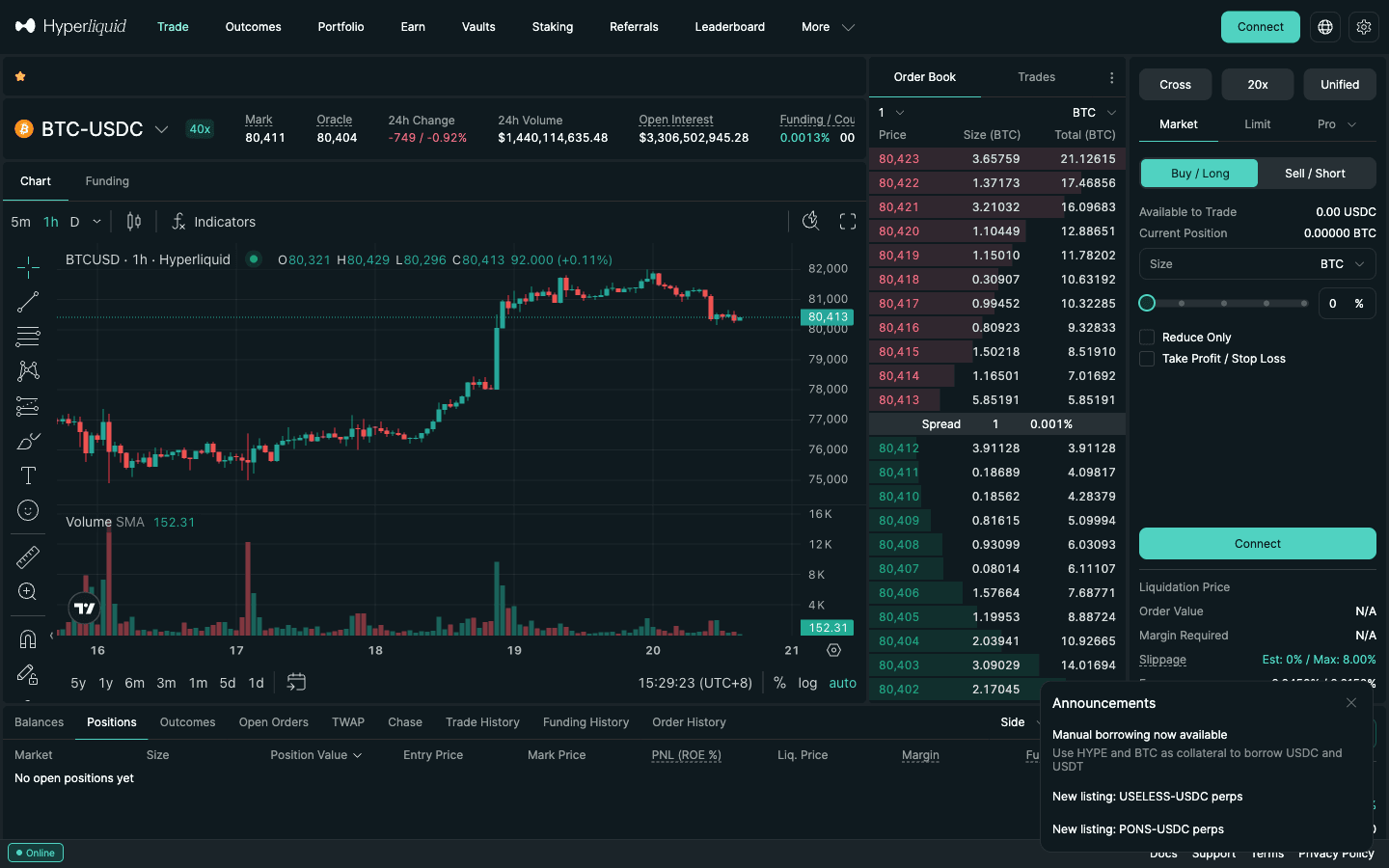
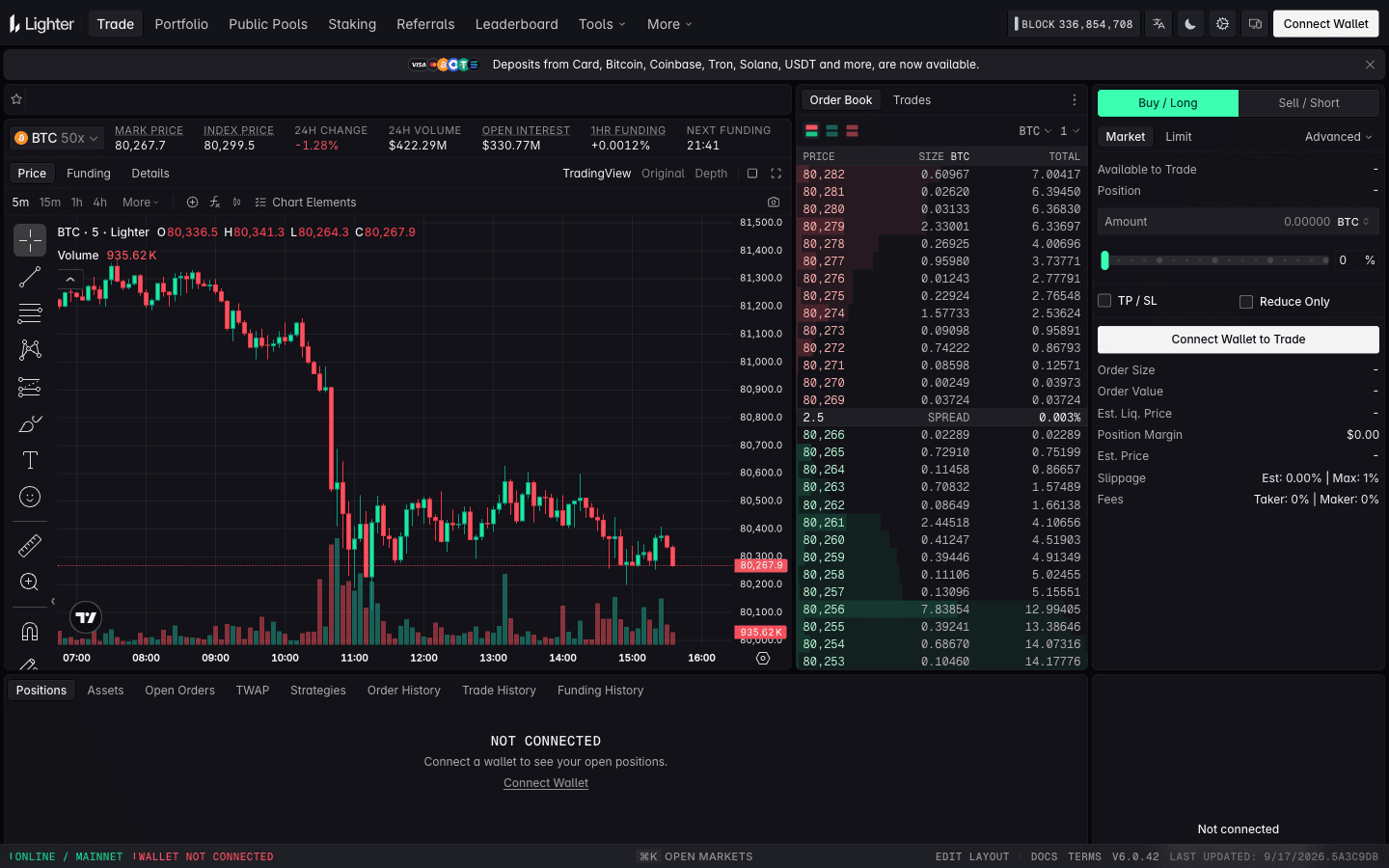
We read volume two ways. First, the same third-party source for every venue — CoinGecko's derivatives feed converted to USD at Hyperliquid's BTC mid — refreshed on every build of this page. Note that CoinGecko tracks Lighter's Robinhood Chain deployment as a separate venue:
| Venue | Rank among 20 perp DEXs | 24h volume | Open interest | Listed perps |
|---|---|---|---|---|
| Hyperliquid | #1 | $7.62B | $15.02B | 341 |
| Lighter | #3 | $1.96B | $1.10B | 202 |
| Lighter (Robinhood Chain) | #7 | $604M | $419M | 58 |
Ranking data as of Tue, 20 Oct 2026 00:59 UTC; rebuilt automatically every 6 hours. CoinGecko's Lighter open interest is about 2.2× the exchange API's figure ($0.51B on 15 Oct 2026); it appears to count both sides of each position.
Second, each exchange's own API, read on Thursday 15 October 2026 at about 04:26 UTC (rolling 24 hours; Hyperliquid's figures cover its validator-operated perps only, without HIP-3 builder markets):
| Metric (24h, 15 Oct 2026) | Hyperliquid | Lighter |
|---|---|---|
| Perp volume | ≈ $7.91B | ≈ $2.23B |
| BTC volume / open interest | ≈ $3.75B / $3.28B | ≈ $1.07B / $0.16B (1,930 BTC; 956,293 trades) |
| ETH volume / open interest | ≈ $1.72B / $2.50B | ≈ $0.50B / $0.07B (29,293 ETH) |
| SOL volume / open interest | ≈ $0.46B / $0.60B | ≈ $0.08B / $0.02B |
| Next largest markets | HYPE $0.47B, ZEC $0.35B, NEAR $0.24B | ZEC $0.07B, HYPE $0.06B, US100 (Nasdaq-100) $0.05B |
| Total open interest | ≈ $11.1B | ≈ $0.51B (sum of per-market figures) |
| Live perp markets | 178 | 213 active (148 under $1M / day) |
| Spot markets | 332 (≈ $205M) | 11 listed, 10 active (≈ $4.3M) |
| BTC funding (8-hour equivalent) | 0.0100% (paid hourly) | 0.0096% (paid hourly) |
Two takeaways. First, Lighter lists more perp tickers than Hyperliquid but turns over less than a third of the notional and carries about 1/22 of the open interest, so its long tail is thin: 148 of its 213 markets printed under $1M in the 24 hours we checked. Second, on BTC and ETH both venues are liquid enough for retail and mid-size orders. For six- and seven-figure clips Hyperliquid's book is the safer one, and open interest, which is harder to inflate than volume, says so more clearly than volume does. Funding is not a deciding factor: both venues pay it hourly between traders, with no cut for the exchange, and BTC funding sat close to the 0.01% per 8 hours baseline on both venues the morning we checked. If you hold overnight, compare the two before you choose a side (how funding rates work). Hyperliquid also has a real spot exchange and the HyperEVM DeFi layer; Lighter's spot listing is minimal, though its RWA perps (US equities, indices, pre-IPO, gold, forex) are a genuine differentiator for a Standard account paying 0%.
5. Latency, execution and order types
Hyperliquid's docs quote a median 0.2 s end-to-end (99th percentile 0.9 s) for a co-located client, with mainnet handling roughly 200k orders per second and cancels prioritised. Lighter publishes latency per account type rather than a network figure: 300 ms taker and 300 ms cancel on Standard (no delay on maker orders), 140 ms taker on Premium. So a Premium Lighter account and a well-placed Hyperliquid client are in the same 140–200 ms range; a Standard Lighter account is deliberately slower. Neither venue charges gas.
| Feature | Hyperliquid | Lighter |
|---|---|---|
| Time-in-force | GTC, IOC, ALO (post-only) | Good-til-time, IOC, post-only |
| Reduce-only | Yes | Yes (market and limit) |
| Stop / take-profit | Stop market/limit, TP/SL on mark price | SL / TP market and limit, triggered on mark price |
| Trailing stop | Yes | Not listed in the docs |
| Auto re-pricing | Chase (ALO tracking best bid/ask) | Chase limit orders |
| Algorithmic | TWAP (30 s min interval), Scale | TWAP and advanced TWAP; atomic (basket) orders; perpRFQ for blocks |
| Cancel latency | Prioritised | 300 ms (Standard); none added (Premium) |
For scalpers: on Lighter Standard a 50-trade day of $1,000 market orders costs $0 versus $22.50 on Hyperliquid at tier 0 ($7.50 if every order rests as maker), but each taker order eats a 300 ms delay and the BTC book carries about 1/21 of the open interest. Premium closes the latency gap at 0.028% — still below Hyperliquid's 0.045% — and code 718610TD rebates the first week so you can measure whether the extra speed pays for itself. Hyperliquid answers with a trailing stop (Lighter's docs list none), ALO plus Chase for makers, and enough depth that a $50k market order barely moves BTC. Rule of thumb: under $5,000 per clip, Lighter's zero fee outweighs a tick of slippage; above it, Hyperliquid's depth wins. Track fill rate and slippage per venue — that decides it, not the fee table. More: Hyperliquid order types, Lighter order types, best DEX for scalping.
6. Leverage: Lighter 50x vs Hyperliquid 40x on BTC
| Asset | Hyperliquid max | Lighter max |
|---|---|---|
| BTC | 40x (≤ $150M notional; 20x above) | 50x (2% initial margin) |
| ETH | 25x (≤ $100M notional; 15x above) | 50x |
| SOL | 20x | 25x |
| HYPE | 10x | 20x |
| XRP / BNB | 20x / 10x | 20x / 20x |
| ARB / OP | 10x / 5x | 15x / 15x |
| Most other alts | 3x–10x | 3x–10x |
Lighter wins on paper for majors (50x BTC/ETH vs 40x/25x) and on HYPE (20x vs 10x); its contract specifications set BTC and ETH at 2% initial, 1.2% maintenance and 0.8% close-out margin. Hyperliquid additionally reduces max leverage by notional — BTC drops to 20x above $150M and ETH to 15x above $100M — and sets maintenance margin at half the initial margin at max leverage. Both use cross and isolated margin with hourly funding; Lighter also offers multi-asset margin and up to four sub-accounts, while Hyperliquid supports sub-accounts, vaults and portfolio margin. Liquidation on Lighter runs through a three-level waterfall (pre-liquidation, partial, full) into the LLP insurance pool; on Hyperliquid through the book, then the liquidator vault, then ADL. Per-asset detail for both venues: DEX leverage tiers compared.
7. Security and custody: who controls your collateral?
This is the question L2BEAT's July 2, 2026 Lighter vs Hyperliquid research note put on the table, and it deserves a section rather than a footnote.
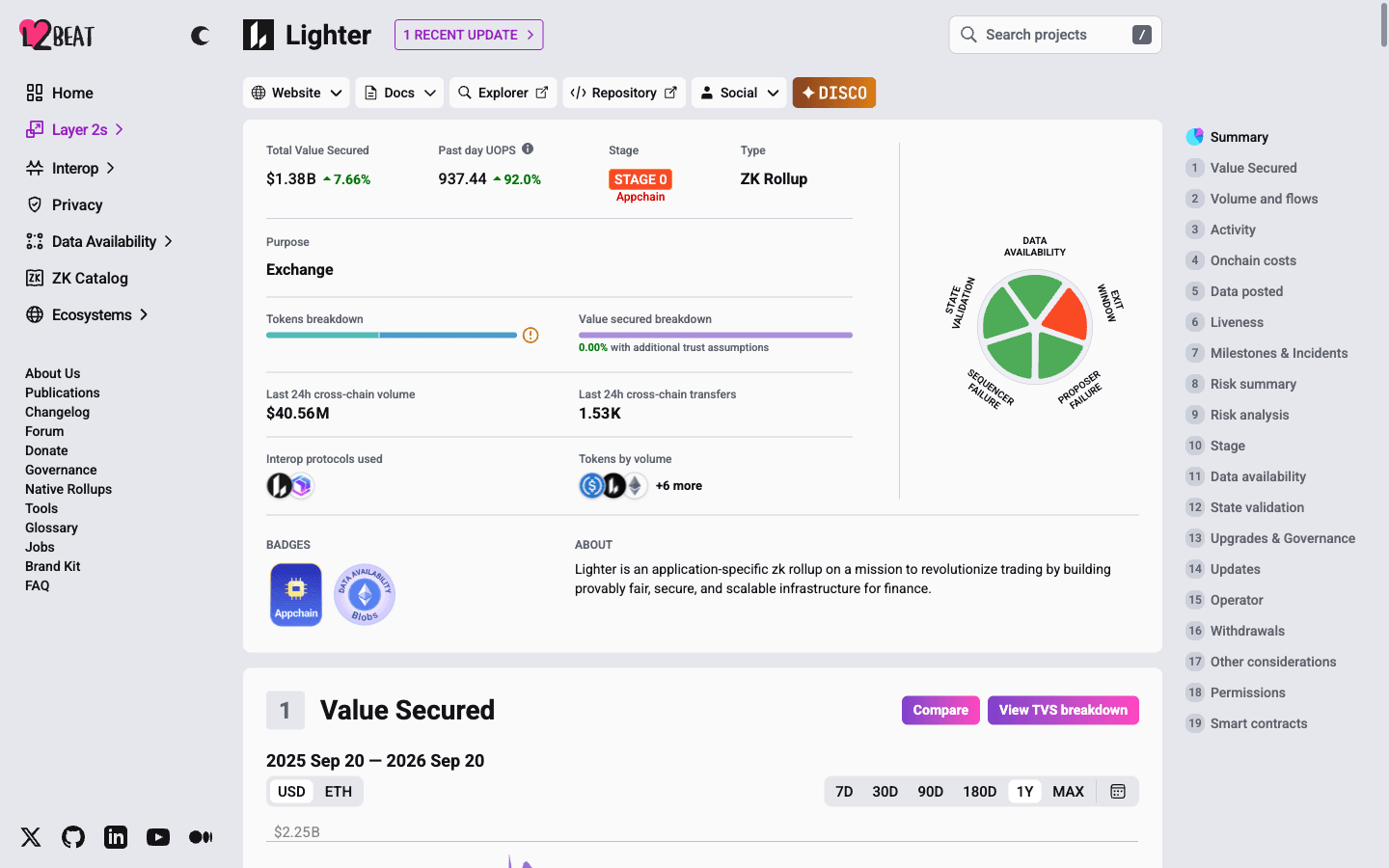
- Lighter holds deposits in Ethereum smart contracts alongside the canonical state root. Because every batch is proven before the root updates, the operator cannot execute an order you did not sign, mint balances, change fills after the fact or block the accounting from reconciling. The caveat is upgradeability: L2BEAT rates Lighter Stage 0, with an exit window of "None", because the team can still upgrade the contracts, including the proof verifier, with no delay. On 15 October 2026 L2BEAT showed $1.10B of value secured, $0.61B of it in stablecoins and $0.46B in Lighter's own LIT token.
- Hyperliquid's state is whatever its validators agree on. On 15 October 2026 the API listed 35 validators, 27 active, with about 440M HYPE staked. The five Hyper Foundation validators held 47.3% of active stake, and the four largest validators 44.7%. That set has intervened before: the JELLY market was delisted and force-settled in 2025 to protect HLP. Everything is public, though: every order, fill, position and liquidation is on-chain, which is why whale-tracking works and why Hyperliquid's transparency is the feature that offsets its trust model.
The escape hatch: can you get your money out without the team?
On Lighter, yes, by design. Its architecture docs (read 15 October 2026) describe a priority request queue on Ethereum: you can submit a withdrawal, a public-pool exit or a reduce-only IOC order directly on Ethereum, and the sequencer must process it within a set time. If it does not, the contract switches to Escape Hatch mode and freezes, and you rebuild your account from the data Lighter has posted to Ethereum, prove your balance and positions, and withdraw on Ethereum with no help from the operator. L2BEAT's risk summary puts the trigger at 14 days of sequencer censorship or downtime. Two limits apply. Open positions are cash-settled at the last published mark price when that mode starts, which L2BEAT flags as a risk if the operator picks the moment. And the upgrade key above could change the rules first.
On Hyperliquid, there is no equivalent. USDC is now minted natively on the Hyperliquid L1 through Circle's CCTP, and the docs say the legacy Arbitrum bridge holds less than 10% of HyperCore's USDC. L2BEAT's note describes that bridge's withdrawals as signed by 8 permissioned validators (2 sets of 4), with no proof system. Either way, your balance exists because the validators say it does, and nothing lets you withdraw on another chain if they stop. In practice Hyperliquid's protection is the size and visibility of its validator set, and Lighter's is maths on Ethereum plus a team that still holds the upgrade key.
Neither has lost user funds. If "can the operator touch my collateral" is your first criterion, Lighter's design answers it better; if "can I see exactly what the exchange is doing" is, Hyperliquid's does. Both publish audits (Lighter's Security Audits page lists nine reports for its contracts and circuits). For the checklist, see DEX security checklist.
8. LIT vs HYPE: token, buybacks and points
"LIT vs HYPE" is really three questions: what each token does for a trader, where each exchange's fee money goes, and whether either still has points to farm.
What each token does
HYPE is Hyperliquid's native asset: it pays HyperEVM gas, secures the chain through staking, and, for traders, unlocks fee discounts from 5% (10+ HYPE staked) to 40% (500,000+). More: HYPE token guide.
LIT (Lighter Infrastructure Token) is a utility and staking token. Per the docs, staking earns a fixed 6% APR (3-day unstake lock) and is the only way into the Lighter Liquidity Pool (up to 10 USDC of LLP deposit per LIT staked). It also gives Premium accounts fee discounts (2.5% at 1,000 LIT up to 30% at 500,000), and LIT Fee Credits let you rent a fee tier. On a free Standard account, LIT changes nothing about your costs.
Supply and buybacks: the numbers (15 Oct 2026)
| Metric | HYPE (Hyperliquid) | LIT (Lighter) |
|---|---|---|
| Price | $78.85 | $3.00 |
| Market cap | $17.54B | $0.75B |
| Fully diluted valuation | $75.32B | $3.00B |
| Circulating / total supply | 222.4M / 955.3M (23%) | 250M / 1,000M (25%) |
| Protocol fees, last 30 days | $88.5M | $5.9M |
| Protocol revenue, last 30 days | $71.6M | $4.9M |
| Buybacks, last 30 days (DefiLlama) | $71.6M (100% of revenue) | $2.8M (57% of revenue) |
| Buybacks, last 12 months (DefiLlama) | $692.1M | $30.3M |
| Market cap ÷ 12-month revenue | ≈ 25× | ≈ 12× |
| How the buyback works | The assistance fund converts fees to HYPE automatically and burns it | Daily 24-hour TWAP buybacks from trading-fee revenue; burns announced separately |
Prices and supply: CoinGecko, October 15, 2026 (04:30 UTC). Fees, revenue and buybacks ("holders revenue"): DefiLlama, through the UTC day of 14 October 2026; Lighter's figures include Lighter Spot and its Robinhood Chain perps.
The fee-share difference is the real story. Hyperliquid's docs say its fees are "entirely directed to the community (HLP, the assistance fund, and deployers)", and the HYPE that the assistance fund buys is burned, removing it from the circulating and total supply. DefiLlama counts all of Hyperliquid's revenue as buybacks. Lighter buys LIT back with trading-fee revenue through daily TWAPs. By June 30, 2026 it had bought back about 15.5M LIT, and on July 10, 2026 it burned 15,638,702 LIT (CoinGecko still lists a 1B total supply). On DefiLlama's count, buybacks took 57% of Lighter's 30-day revenue. Unlocks matter for both. Team and investors hold 26% + 24% of LIT (1-year lock, then 3-year linear vesting, counted from the December 30, 2025 launch), and only 25% of LIT and 23% of HYPE's total supply circulates.
Points: none on Hyperliquid, Robinhood Chain on Lighter
The Hyperliquid (HYPE) airdrop happened on 29 November 2024 and there is no active Hyperliquid points program. Lighter's Seasons 1 and 2 (12,500,000 points) became the LIT airdrop, worth 25% of the fully diluted supply. Its docs still disagree on whether Season 2 is over: the retail page describes 200,000 points a week, while the market-maker page says Season 2 ended on 26 December 2025 (both re-read on 15 October 2026).
The program that is clearly live runs on Lighter's separate exchange instance on Robinhood Chain. It has its own order books and USDG collateral, and its own points. Per the docs, points are "calculated and awarded in real time", with an extra weekly drop every Friday since August 21, 2026, under terms effective August 10, 2026. Wash trading, self-referrals and multi-account farming are excluded, and 18 countries, including the US, UK, Canada, Singapore, Switzerland and the UAE, cannot trade or earn there. CoinGecko tracked $604M of 24-hour volume on that instance (Tue, 20 Oct 2026 00:59 UTC). How the weekly drops are weighted and whether points convert into LIT is not published. Our guide to Lighter on Robinhood Chain points and Lighter's earlier seasons tracks both programs, and the perp DEX airdrop ranking covers the other venues.
HYPE vs LIT as investments (not advice)
Half of the results for this search answer a different question: which token to buy. We don't give investment advice, but the table above holds the figures people compare. Hyperliquid's market cap is about 23× Lighter's, and it collected about 15× the fees over the same 30 days. Measured against trailing revenue, LIT is priced lower than HYPE. That gap has a reason: most Lighter volume pays nothing, so LIT's value depends on paid accounts and partner flow growing, while HYPE is priced as the market leader's cash flow. Treat both as high-risk assets.
9. Referral programs compared
| Hyperliquid | Lighter | |
|---|---|---|
| Referee benefit | 4% off fees on first $25M volume | First week of Premium fees rebated (cap $10M volume) |
| Referrer earns | 10% of referees' fees on their first $1B volume | 10% / 20% of referees' gross fees, i.e. Premium and Standard advanced-order fees (Bronze / Silver 15+ active); the app says up to 30%, with no published requirement |
| Applies to | All perp and spot fees (not vaults or sub-accounts) | Premium account fees only — Standard is already free |
| Requirement to refer | $10,000 lifetime volume | None stated; attribution is permanent |
| Payout | Claimable on the referrals page | Weekly (Monday), $1 minimum |
| Our code | HOLYGRAIL | 718610TD |
For a new trader the Hyperliquid discount is the more valuable of the two because it applies to every fee you pay for a long time; Lighter's referral only bites if you opt into Premium, and then only for a week. Enter the Hyperliquid code before your first trade so every fill is discounted — Hyperliquid stops accepting a code once your account passes $10,000 of volume.
10. Onboarding, deposits and withdrawals
- Hyperliquid: connect Rabby / MetaMask / WalletConnect / Coinbase Wallet or sign in with an email code, click "Enable Trading", then deposit USDC from Arbitrum, Ethereum, Base or Polygon — or native BTC, ETH, SOL and other supported assets, which land in your spot balance. Many CEXs withdraw straight to Hyperliquid. Withdrawals to Arbitrum cost a flat 0.2 USDC plus a tiny HyperEVM gas fee. Guide: Hyperliquid deposits.
- Lighter: wallet or email login at app.lighter.xyz, deposit through the Ethereum-anchored bridge (or via Robinhood Chain for that deployment), and trade with a Standard account by default; Premium and Plus are opt-in switches in the account menu. Withdrawals are L2 transfers finalised through Ethereum, and the forced-exit path exists if the sequencer ever stalls. Guide: Lighter deposits and withdrawals.
11. Mobile apps: Lighter Mobile vs Hyperliquid on your phone
Lighter has the stronger official app. Lighter Mobile is on the App Store (publisher Elliot Technologies, Inc.; version 1.1.4 released September 25, 2026; English only) and on Google Play (package com.zklighter.app). The App Store description limits wallet-based trading to "selected supported regions"; elsewhere the app works as a market viewer. On any phone, app.lighter.xyz in the browser gives you the full order ticket at the same 0% Standard fee. Details: Lighter app guide.
Hyperliquid publishes an official Android app on Google Play (developer Hyperliquid Corp) but no iOS app. A search of the US App Store for "Hyperliquid" on September 26, 2026 returned only third-party apps. On an iPhone you can add app.hyperliquid.xyz to your home screen, or use a third-party front-end that trades on Hyperliquid's order book:
| App | Platforms | Builder fee (perps) | All-in taker | Referral |
|---|---|---|---|---|
| Based (review) | iOS and Android | +0.025% | 0.07% | HOLYGRAIL — Based's own program; no referee discount documented |
| Liquid (review) | iOS (not in the Japanese App Store) and Android | +0.05% | 0.095% | JV2EN2CX — 10% off Liquid's fee for life |
| fomo (review) | iOS and Android | +0.05% | 0.095% | DailyWiseKite — 10% off fomo's fee |
Two caveats. Builder fees are charged on top of Hyperliquid's own 0.045%. And your Hyperliquid referral code carries over only if it is set first: the referral discount also applies to orders placed through apps with a builder code (the 4% comes off Hyperliquid's part of the fee, not the app's), but apps such as Phantom often set their own Hyperliquid referral code on accounts that have none, so enter a code on Hyperliquid before you start using an app. Hyperliquid also stops accepting a code after $10,000 of volume. So sign up on Hyperliquid directly with HOLYGRAIL before your first app trade, then connect apps such as Based and Liquid with the same wallet as a convenience layer that keeps your discount (not fomo, which creates its own account, so HOLYGRAIL cannot apply there). Liquid also routes some markets to Lighter. More: Hyperliquid app guide, DEX mobile trading comparison.
12. Who can use Hyperliquid and Lighter? Restricted countries and KYC
Neither exchange asks for ID: you connect a wallet (or use an email login) and trade. That is how self-custodial venues work, and it does not mean everyone may use them. Both sets of Terms exclude the United States, and Lighter's list is much longer. We read both documents on September 26, 2026:
| Hyperliquid | Lighter | |
|---|---|---|
| Document | Terms of Use, last updated June 15, 2026 (§1.6) | Terms of Service, last updated December 29, 2025 |
| Who is excluded | Persons in the United States or Ontario (Canada), persons in sanctioned territories, and citizens of sanctioned territories wherever they live | Persons in the US, Canada, the UK, China, North Korea, Russia, Ukraine, Cuba, Iran, Venezuela, Sudan, Belarus, Myanmar and Syria, plus comprehensively sanctioned jurisdictions |
| US residents | Not allowed | Not allowed |
| Canada | Ontario excluded | All of Canada excluded |
| United Kingdom | Not on the Terms list, but its X profile says it is "not directed at UK persons" | Excluded |
| Japan and EU member states | Not on the list | Not on the list |
| Identity verification (KYC) | None | None |
The separate Lighter instance on Robinhood Chain has a wider list for its perps and points. Besides the main list, it also excludes Singapore, Switzerland, the United Arab Emirates and South Sudan. If you are on a restricted list, do not use the service, and do not use a VPN or any other workaround. "No KYC" also does not mean anonymous: deposits and withdrawals are public on-chain, and profits are taxable where you live. Check your local rules on leveraged derivatives before you start. The wider picture: trading on DEXs without KYC.
13. Lighter or Hyperliquid: which one should you choose?
| Trader type | Pick | Why |
|---|---|---|
| Limit-order / swing trader | Lighter | 0% / 0%; 300 ms is irrelevant on a multi-hour horizon |
| Size on BTC / ETH (six figures+) | Hyperliquid | ≈ 21× the BTC open interest (15 Oct 2026); less impact per clip |
| Mid-cap altcoin trader | Hyperliquid | 148 of Lighter's 213 markets did under $1M / day (15 Oct 2026) |
| Scalper, small clips (< $5k) | Lighter Standard | Zero fee beats a tick of slippage |
| Scalper, larger clips or latency-bound | Hyperliquid (or Lighter Premium) | 0.2 s median, trailing stops, deepest touch |
| Fee-free bot within rate limits | Lighter Standard / Plus | 0% or 0.5 bp with 4,000 sendTx/min |
| Wants 50x on BTC / ETH | Lighter | 50x vs 40x / 25x |
| Proof-based custody, Ethereum exit | Lighter | Validity proofs, escape hatch (Stage 0 caveat) |
| Spot, vaults, HyperEVM DeFi in one account | Hyperliquid | 336 spot pairs (as of October 20, 2026), HLP and user vaults |
| US equities / pre-IPO / gold perps at 0% | Lighter | RWA perps on a Standard account |
| Trades mostly on an iPhone | Lighter Mobile, or Hyperliquid via Based / fomo | Hyperliquid has no iOS app of its own; the apps add a builder fee |
| Lives in Canada outside Ontario | Hyperliquid | Lighter's Terms exclude all of Canada; Hyperliquid's exclude only Ontario (check your province's rules) |
Choose Lighter if you trade with limit orders or on multi-hour horizons where 300 ms is irrelevant, want to run a fee-free bot at the rate limits Standard allows, want 50x on BTC/ETH, or want your collateral in Ethereum contracts with a proof-based exit. Open Lighter with 718610TD; the code only matters if you plan to use Premium, because that is where you pay fees.
Choose Hyperliquid if you move size on majors, trade mid-cap alts where Lighter's books are thin, want spot markets and the HyperEVM ecosystem in the same account, or run latency-sensitive strategies against the most active on-chain book. Join Hyperliquid with HOLYGRAIL for the 4% referral discount, and stake 100+ HYPE for another 10% off if you trade every day. The rest of the venue (vaults, HyperEVM, safety record) is in our Hyperliquid review.
Use both if you are serious: park swing entries as free limit orders on Lighter, execute urgent or large orders on Hyperliquid, and compare funding across the two before holding overnight. Related: Hyperliquid vs Lighter vs Aster, Lighter fees, Lighter vs Jupiter.
Other Hyperliquid alternatives
Lighter is the closest match to Hyperliquid's order-book model, but it is not the only one. Aster is the other high-volume challenger; the fee, leverage and ownership trade-offs are in our Aster vs Hyperliquid comparison. GTE ("The Global Token Exchange") comes up in the same searches, but on 15 October 2026 gte.xyz showed only a waitlist and its app was password-protected, so there is nothing to compare yet. For the full field, with volume, fees and who can use each, see our list of Hyperliquid alternatives.
Trade Hyperliquid with 4% lower fees
Join with code HOLYGRAIL — the discount applies automatically to your first $25M in volume.
Try Lighter's zero-fee book
Sign up with code 718610TD — Standard accounts trade free; if you switch to Premium, your first week of fees is rebated.
Lighter vs Hyperliquid FAQ
Lighter vs Hyperliquid — which one should you choose?
Choose Lighter if you trade with limit orders or on multi-hour horizons, want 0% fees on a Standard account, want 50x on BTC and ETH, or care that your collateral sits in Ethereum contracts with a proof-based exit. Choose Hyperliquid if you move size (about 21× Lighter's BTC open interest on 15 October 2026), trade mid-cap alts, need the lowest published latency, or want spot, vaults and HyperEVM in one account. Many traders run both: free resting orders on Lighter, execution on Hyperliquid.
What is Lighter (lighter.xyz)?
Lighter is a decentralized perpetual and spot exchange at app.lighter.xyz (also reachable at lighter.exchange), run on its own zk-rollup that settles on Ethereum. Its docs describe it as a zero-fee trading platform with verifiable order matching and liquidations: a sequencer matches orders, every batch is proven with a zero-knowledge proof, and the proof is verified on Ethereum before balances update. Standard accounts pay 0%; its token is LIT. It is a competitor to Hyperliquid, not part of it.
Is Lighter really free to trade?
Yes for Standard accounts: 0% maker and 0% taker on every perp and spot market, with no gas on orders, re-read from docs.lighter.xyz on October 19, 2026. The trade-off is added latency: 300 ms on taker orders and 300 ms on cancels, while maker orders are not delayed. Premium accounts pay 0.028% taker / 0.004% maker at 0 LIT staked, discounted up to 30% at 500,000 LIT, in exchange for 140 ms taker latency and no added delay on cancels or post-only orders. Plus accounts pay 0.005% both sides for higher rate limits.
Which has more liquidity, Hyperliquid or Lighter?
Hyperliquid. On Thursday 15 October 2026 (04:26 UTC) its API reported about $7.9B of 24-hour perp volume, $11.1B of open interest and $3.28B of BTC open interest; Lighter reported about $2.2B of volume across 213 active perps, $0.51B of open interest, $0.16B of it on BTC and $0.07B on ETH. 148 of Lighter's 213 markets printed under $1M that day. Both are deep enough on BTC and ETH for retail size; the gap widens fast on alts.
Which offers higher leverage?
Lighter on the majors: 50x on BTC and ETH (2% initial margin) and 25x on SOL, versus 40x, 25x and 20x on Hyperliquid, which also steps BTC down to 20x above $150M of notional. HYPE is 20x on Lighter versus 10x on Hyperliquid. Most altcoins are capped at 10x or less on both venues.
Is Lighter safer than Hyperliquid?
Different trust models. Lighter posts validity proofs to Ethereum, so the operator cannot execute unsigned orders, alter balances or rewrite history. If the sequencer ignores your withdrawal request, its escape hatch lets you withdraw from Ethereum with a proof of your own balance (L2BEAT: after 14 days of censorship or downtime). L2BEAT still rates it Stage 0, because the team can upgrade the contracts, verifier included, with no delay. Hyperliquid's state is set by its validators: 27 active with about 440M HYPE staked on 15 October 2026, 47.3% of it on the five Hyper Foundation validators. USDC is now minted natively on Hyperliquid through Circle, and there is no proof-based exit you can trigger on your own. Neither has lost user funds, but Lighter's guarantees are cryptographic and Hyperliquid's are social.
Do I need KYC on either exchange?
Neither requires identity verification to trade. Both let you sign in with an EVM wallet or an email login. Deposits are on-chain: USDC on Arbitrum, Ethereum, Base or Polygon (plus native BTC, ETH, SOL and others) for Hyperliquid; the Ethereum-anchored bridge for Lighter, or Robinhood Chain for the Lighter deployment there.
What do the referral codes actually give me?
Hyperliquid code HOLYGRAIL: 4% off taker and maker fees on your first $25M of volume. Lighter code 718610TD: your first week of Premium-account fees is rebated (up to $10M of volume). Lighter Standard accounts already pay nothing, so the Lighter referral only matters if you opt into Premium.
Is Lighter the same as Hyperliquid?
No. They are two separate exchanges that compete for the same traders. Lighter is run by Elliot Technologies, Inc. (per its Terms of Service) on its own zk-rollup anchored on Ethereum; it is not built on Hyperliquid and it is not an Arbitrum app (Arbitrum is only one of its deposit networks and the route for fast USDC withdrawals). Hyperliquid is its own Layer 1 with the HyperCore order book and HyperEVM. Accounts, balances, tokens (LIT vs HYPE) and referral codes are all separate.
How does Lighter make money if trading is free?
From the traders who pay for speed and scale. Premium accounts pay 0.028% taker / 0.004% maker and Plus accounts 0.005% on both sides; since September 14, 2026 Lighter's Partner Attribution program rejects trades from Standard accounts, so third-party front-ends must route through paying accounts; and Standard accounts pay 0.01% on perpRFQ block orders. Per the LIT Utility docs, trading-fee revenue funds daily TWAP buybacks of LIT. DefiLlama counted about $5.9M of Lighter fees over the 30 days to the UTC day of 14 October 2026, against about $88.5M for Hyperliquid.
What is the take rate of Hyperliquid vs Lighter?
Take rate here means the fees traders pay per $1M of volume. On list prices, a tier-0 Hyperliquid taker pays $450 per $1M ($150 as maker), while a Lighter Standard account pays $0 and a Premium account $280 taker. In practice, DefiLlama's perp fee count for the UTC day of 14 October 2026, set against 24-hour perp volume for the same markets, works out to roughly 2.6 basis points for Hyperliquid (core and HIP-3 markets, builder fees included) and 0.6 for Lighter's main exchange, because most Lighter volume pays nothing. Neither exchange keeps these fees as company profit: Hyperliquid's go to HLP, the assistance fund and market deployers, and Lighter's fund LIT buybacks.
Is LIT a good crypto to buy compared with HYPE?
We do not give investment advice, but these are the numbers people compare. On October 15, 2026 (04:30 UTC) CoinGecko showed LIT at $3.00 with a $0.75B market cap ($3.00B fully diluted, 25% of supply circulating) and HYPE at $78.85 with $17.54B ($75.32B fully diluted). DefiLlama put 12-month revenue at about $64.4M for Lighter and $692.1M for Hyperliquid, so LIT trades at roughly 12× trailing revenue and HYPE at 25×. Both buy back their token with fee revenue: DefiLlama counts 100% of Hyperliquid's 30-day revenue as buybacks (the assistance fund, which burns the HYPE) against 57% of Lighter's. Most Lighter volume pays no fee, so LIT's case depends on paid accounts growing. Treat both as high-risk assets.
Do Hyperliquid or Lighter still have points or an airdrop?
Hyperliquid airdropped HYPE on November 29, 2024 and has no active points program. Lighter's Season 1 ended on September 30, 2025, and Seasons 1 and 2 became the LIT airdrop on December 30, 2025 (25% of the fully diluted supply). Its docs still contradict each other on Season 2: the market-maker page says it ended on December 26, 2025, while the retail page still describes 200,000 points a week (both re-read on 15 October 2026). The live program is Lighter on Robinhood Chain: points accrue in real time, with a weekly drop every Friday since August 21, 2026, and 18 countries, including the US, UK, Canada, Singapore, Switzerland and the UAE, are excluded. None of it is a good reason to trade more than you otherwise would.
Does Lighter have spot trading?
Yes, but it is small. On October 15, 2026 Lighter listed 11 spot markets (10 active, about $4.3M of 24-hour volume), charged 0% on them for Standard accounts, against 336 spot pairs on Hyperliquid (as of October 20, 2026). Some comparison sites still say Lighter has no spot market; that is out of date.
Can I use Hyperliquid or Lighter from the US?
No. Hyperliquid's Terms of Use (§1.6, updated June 15, 2026) exclude persons in the United States and Ontario, sanctioned territories and their citizens. Lighter's Terms of Service (updated December 29, 2025) exclude the US, Canada, the UK, China, Russia, Ukraine and several sanctioned countries. Neither asks for KYC, but that does not make access permitted; do not use a VPN to get around either list.
Is there a Lighter or Hyperliquid mobile app?
Lighter has an official app, Lighter Mobile, on the App Store (Elliot Technologies, Inc.; version 1.1.4, September 25, 2026, English only) and Google Play; wallet-based trading in it is limited to "selected supported regions". Hyperliquid has an official Android app on Google Play (Hyperliquid Corp) but no iOS app; on an iPhone you use app.hyperliquid.xyz in the browser or a third-party front-end such as Based, Liquid or fomo, which add a builder fee.
Disclosure: HOLYGRAIL and 718610TD are our referral codes; we earn a share of referred accounts' fees. Volume, open interest, market counts, funding and validator figures were read from each exchange's public API on 15 October 2026 (04:26–04:30 UTC) and change continuously; the ranking table and the live line in the verdict refresh on every build. Fee, leverage, latency and referral terms render from our facts registry and were last re-checked against the official documentation on October 19, 2026; the Stage 0 rating, risk summary and value secured were re-read on l2beat.com on 15 October 2026, and the HYPE/LIT, fee-revenue and buyback figures come from CoinGecko and DefiLlama the same day. Terms and app-store listings were read on September 26, 2026.