
Lighter vs Aster: Lighter is the better pick for most traders, because market orders cost 0% on its default Standard account (Aster charges 0.04% taker) and every trade is proven on Ethereum. Aster wins if you mostly post limit orders (0% maker at every tier), trade altcoins (604 perps versus 213) or want more than 50x on a small position. Liquidity is close: 24-hour volume was higher on Lighter, about $1.96B on Lighter and $1.43B on Aster (CoinGecko, October 20, 2026), and in our October 15, 2026 order-book pulls both BTC books held about $8–11M within 0.05% of the mid price. For swing trades held a week, Lighter was also cheaper than Aster once funding is counted (fees plus funding).
Who should pick which
Market orders, majors, gold, FX or indices → Lighter
Open a free Lighter account →Standard charges 0% maker and 0% taker on regular orders (with a 300 ms taker delay). Code 718610TD mostly matters if you move to Premium: 10% off the fees you pay.
Limit orders, small caps or high leverage on small size → Aster
Open Aster with code DTLpLc →Maker fills are 0% at every tier; takers pay 0.04%, and code DTLpLc pays 5% of the Perps fees you do pay (taker fills) back the next day; 0% maker fills earn nothing back.
| If you… | Pick |
|---|---|
| mostly send market orders | Lighter: 0% taker on Standard vs 0.04% |
| trade BTC, ETH, gold, FX or US indices | Lighter: 0% taker on every market, gold, FX and indices included; 50x on BTC / ETH at any size |
| mostly post limit orders | Aster: 0% maker at every tier |
| hunt small-cap altcoins | Aster: 604 perps vs 213 |
| want more than 50x on a small position | Aster: 150x on BTC up to $300,000 |
| move six-figure orders, or need depth on mid-cap alts | Hyperliquid: the deepest on-chain book |
If you need deeper liquidity: Hyperliquid, 4% off with code HOLYGRAIL → (on your first $25M of volume; compare in Hyperliquid vs Lighter and Aster vs Hyperliquid).
We earn a commission when you sign up through our links; it never raises your fees.
Lighter vs Aster at a glance
| October 2026 | Lighter | Aster | Edge |
|---|---|---|---|
| What it is | Order-book perp DEX on its own zk-rollup (an Ethereum L2); matching and liquidations proven on Ethereum | Order-book perp DEX on its own L1 (Aster Chain), plus 1001x, Shield and spot modes | — |
| Taker fee (crypto perps) | 0% (Standard) · 0.028% (Premium) | 0.04% (VIP 1) → 0.016% at VIP 6 | Lighter |
| Maker fee (crypto perps) | 0% (Standard) · 0.004% (Premium) | 0% at every tier | Tie |
| Speed on the cheapest tier | 300 ms taker delay on Standard | No advertised speed bump | Aster |
| 24h perp volume (October 20, 2026) | ~$1.96B | ~$1.43B | Lighter |
| Active perp markets | 213 (+10 spot) | 604 | Aster |
| BTC max leverage | 50x at any size | 200x to $400, 150x to $300k, then stepping down | Aster below $3M |
| Settlement and custody | zk proofs verified on Ethereum; Escape Hatch withdrawals | Aster Chain validators (3 of 4 deposits, 2 of 3 withdrawals) | Lighter |
| Order ticket | Lean; TWAP, Atomic, Iceberg, RFQ | Binance-style; trailing stop, hidden orders | Aster |
| Collateral | USDC (ETH, XAUT as extra margin via multi-asset margin) | USDT or USD1 (multi-asset mode available) | — |
| Funding interval | 1 hour | 8 hours on BTC/ETH/SOL (1–4 h on many alts) | — |
| Token | LIT (Premium fee discounts, staking, LLP access) | ASTER (5% spot-fee discount, VIP tiers, airdrop points) | — |
| Operator and governing law | Elliot Technologies, Inc.; Florida (US) law | no legal entity named (just “Aster”); Hong Kong law, HKIAC arbitration | — |
| Japanese UI | Yes (web app) | Yes | — |
| Our referral code | 718610TD | DTLpLc | — |
Fees and Aster’s BTC leverage brackets re-read in the official docs and public bracket data on October 15, 2026; terms of service checked September 27, 2026; 24h volume from CoinGecko (October 20, 2026, refreshed on every site rebuild); market counts from the exchange APIs on October 14, 2026. Live figures change daily. Scroll sideways on mobile.
Pros and cons
Lighter
Pros
- Free Standard account: 0% maker and 0% taker on every perp, gold and US indices included
- Matching and liquidations proven on Ethereum, with an Escape Hatch if the operator stops
- 50x on BTC and ETH at any position size, no brackets
- Best fee without volume tiers or token holdings
Cons
- Standard taker orders wait 300 ms and cancels 300 ms
- Paying for speed costs 0.028% taker on Premium
- 213 perps: far fewer altcoins
- No trailing stop, OCO or hidden orders
Aster
Pros
- 0% maker fee at every VIP tier, no paid account needed
- 604 perps, hundreds of altcoins Lighter does not list
- 150x on BTC up to $300,000 (200x up to $400)
- Binance-style ticket: trailing stops, hidden orders; 1001x and Shield modes
- A points program (Stage 6) that feeds an ASTER airdrop
Cons
- 0.04% taker until VIP 2 ($5M of 14-day volume and 500 ASTER)
- The 5% pay-in-ASTER discount is for spot only, not perps
- Withdrawals depend on the Aster Chain validator set; no escape hatch found in the docs
- Headline leverage drops quickly as the position grows
- The terms name no legal entity (Hong Kong law, HKIAC arbitration)
Choose Lighter if you mostly use market orders, trade BTC, ETH, gold, FX or US indices, or want Ethereum-verified settlement. Choose Aster if you mostly use limit orders, hunt small caps, or want high leverage on positions under a few hundred thousand dollars. Use both if you are cost-sensitive: send market orders to Lighter and limit orders to Aster.
Try both, keep the cheaper one
Lighter with code 718610TD (a free Premium trial week from sign-up) and Aster with code DTLpLc.
We earn a commission when you sign up through our links; it never raises your fees.
Common mistakes in other comparisons (checked October 15, 2026)
- “Lighter runs on zkSync Era.” It does not. Lighter is its own zk-rollup, an Ethereum Layer 2 in its own terms; its proofs are verified on Ethereum.
- “Lighter charges a taker fee.” Only on the opt-in Premium account (0.028%). The default Standard account is 0% maker and 0% taker; the price is a 300 ms delay.
- “Lighter lists about 30 markets and caps leverage at 20x.” It lists 213 active perps, and BTC and ETH go to 50x at any size.
- “Aster’s taker fee is 0.045%” or “Aster offers 125x.” Aster Pro charges 0% maker and 0.04% taker at VIP 1. BTC leverage is bracketed: 200x only up to $400, 150x up to $300,000. The 1001x figure is a separate pool-based mode.
- “Pay fees in ASTER to save 5%.” That discount applies to spot trading only. Aster’s perpetuals fee pages list no ASTER discount.
The two are the most common “second DEX” choices after Hyperliquid, which cleared about $4.03B (as of October 20, 2026) of perp volume in 24 hours (the other contenders are ranked in our Hyperliquid alternatives list). They reach similar volume from opposite starting points. Lighter is a lean order book with a curated market list, no volume tiers and a free default account. Aster is a product suite: an order book with Binance-style VIP tiers, a 1001x mode, a private Shield mode, spot trading and an airdrop points program. That difference shows up in every section below.
Fee table: Lighter vs Aster
| Fee | Lighter Standard | Lighter Premium (0 LIT) | Aster Pro (VIP 1) | Aster at higher tiers |
|---|---|---|---|---|
| Crypto perps, taker | 0% | 0.0280% | 0.040% (VIP 1) | 0.035% at VIP 2 → 0.016% at VIP 6 |
| Crypto perps, maker | 0% | 0.0040% | 0% | 0% at every tier |
| Small-cap “Group B” perps (Aster) | n/a | n/a | 0.10% taker | VIP discounts apply |
| RWA perps (gold, stocks, FX), taker | 0% | 0.0280% | 0.0125% (1.25 bps) | Same at every tier |
| TWAP / Chase / Iceberg / RFQ (Lighter) | 0.01% | Premium rates | Normal rates | — |
| Discount levers | — | Stake LIT: up to −30% (0.0196% / 0.0028%) | VIP tiers; pay in ASTER −5% on spot only | VIP needs volume AND ASTER held |
Sources: docs.lighter.xyz “Trading Fees” and the Lighter app; docs.asterdex.com “Fees” and “VIP Program”; fee pages re-read October 15, 2026 (unchanged since September 25). Every Aster rate, including VIP 2–6 and Group B, is in our Aster DEX fees guide. Aster’s USD1-quoted crypto perps also pay 0.04% taker; USD1 RWA perps 1.25 bps. Scroll sideways on mobile.
What you pay at $10K, $100K and $1M a month
The fee table in dollars. Each column is one month of trading volume (count both the open and the close), all of it on crypto perps. Even $1M a month is far below Aster’s VIP 2 bar of $5M in 14 days, so Aster’s VIP 1 rates apply throughout. Hyperliquid is included as the reference venue.
| Account and order type | Rate | $10K / month | $100K / month | $1M / month |
|---|---|---|---|---|
| Lighter Standard, taker or maker | 0% | $0 | $0 | $0 |
| Lighter Premium, taker (0 LIT) | 0.028% | $2.80 | $28 | $280 |
| Lighter Premium, maker (0 LIT) | 0.004% | $0.40 | $4 | $40 |
| Aster Pro VIP 1, taker | 0.04% | $4 | $40 | $400 |
| Aster Pro, maker (any tier) | 0% | $0 | $0 | $0 |
| Hyperliquid tier 0 + code HOLYGRAIL, taker | 0.0432% | $4.32 | $43.20 | $432 |
| Hyperliquid tier 0 + code HOLYGRAIL, maker | 0.0144% | $1.44 | $14.40 | $144 |
Fee rates from each venue’s docs, re-read October 15, 2026; Hyperliquid tier 0 with the 4% referral discount of code HOLYGRAIL. Funding, spread and slippage excluded.
The table makes the choice mechanical. If most of your volume is market orders, Lighter Standard costs nothing and Aster costs $40 per $100,000. If most of it is limit orders, Aster and Lighter Standard both cost nothing, and Lighter Premium is the only line that charges a maker fee. The one reason to accept a fee on Lighter is speed: Premium removes the 300 ms taker delay for $28 per $100,000.
How Lighter charges: account types
Lighter has no volume tiers. You choose an account type, and the trade-off is speed:
- Standard (default): 0% maker / 0% taker on every perp and spot market. Taker orders wait 300 ms and cancels 300 ms; maker orders are not delayed. The only paid items are execution tools: the app showed TWAP, Chase, Iceberg and RFQ orders at 0.01% on Standard.
- Premium (opt-in): 0.004% maker / 0.028% taker with 0 staked LIT, 140 ms taker latency and no added delay on cancels and post-only orders. Staking LIT cuts both fees: 2.5% off at 1,000 LIT, 10% at 10,000, 15% at 30,000, 20% at 100,000 and 30% at 500,000 LIT (0.0028% / 0.0196%).
- Plus (opt-in): 0.005% on both sides, 300 ms taker and 200 ms maker/cancel latency, and higher API limits (4,000 sendTx per minute). Built for bots that send many requests but are not racing.
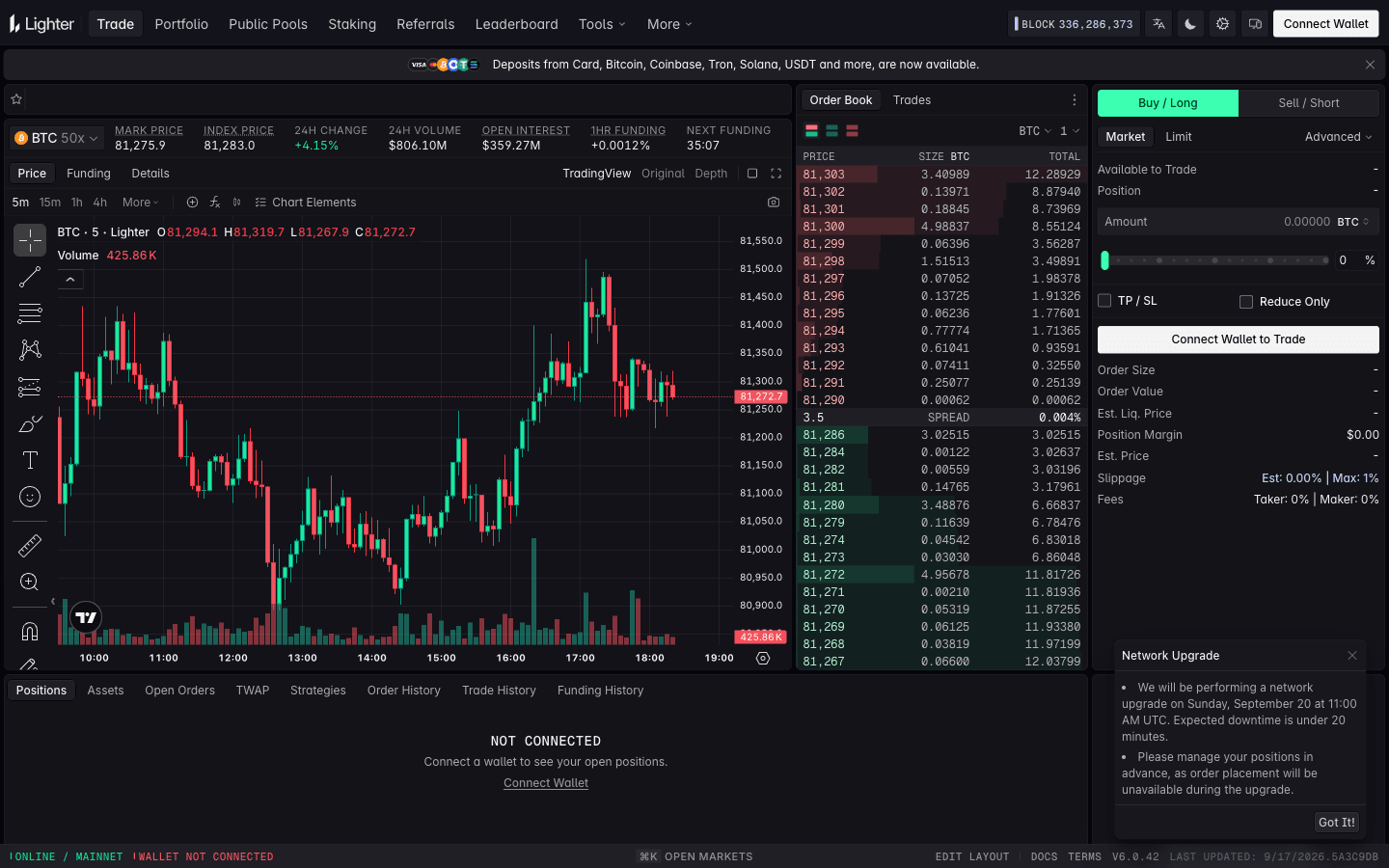
The full breakdown, including what “free” leaves out, is in our Lighter fees guide; everything else Lighter offers is in Lighter DEX features.
How Aster charges: VIP tiers, RWA and Group B
Aster’s order-book perpetuals (“Pro”) use a Binance-style VIP schedule with two twists: maker fees are 0% at every tier (since February 2, 2026), and a VIP tier needs both 14-day volume and a daily-average ASTER balance (spot + perp + staking).
| Tier | 14-day volume (spot or perp) | ASTER held | Taker fee, Crypto General perps |
|---|---|---|---|
| VIP 1 | < $5M | 0 | 0.040% |
| VIP 2 | ≥ $5M | ≥ 500 | 0.035% |
| VIP 3 | ≥ $25M | ≥ 2,500 | 0.033% |
| VIP 4 | ≥ $100M | ≥ 25,000 | 0.023% |
| VIP 5 | ≥ $500M | ≥ 250,000 | 0.020% |
| VIP 6 | ≥ $1B | ≥ 2,500,000 | 0.016% |
Source: Aster VIP Program page (fee table image), September 25, 2026. Maker fee is 0 bps at every tier. VIP status is assessed daily at 23:59 UTC.
- RWA perps (gold, US stocks and other real-world assets) pay a flat 1.25 bps (0.0125%) taker at every VIP level, effective September 7, 2026 (older sources say 0.009%). RWA maker volume counts 10× toward VIP tiers.
- Group B small caps (1000NEX, AEON, MEME, OKB, SKHYNIX and others, 21 pairs in total) pay 0.1% taker.
- Paying in ASTER takes 5% off spot fees only; Aster’s perpetuals fee docs list no ASTER discount, so perp takers pay 0.04% until VIP 2.
The full schedule, with examples per VIP tier, is in our Aster DEX fees guide.
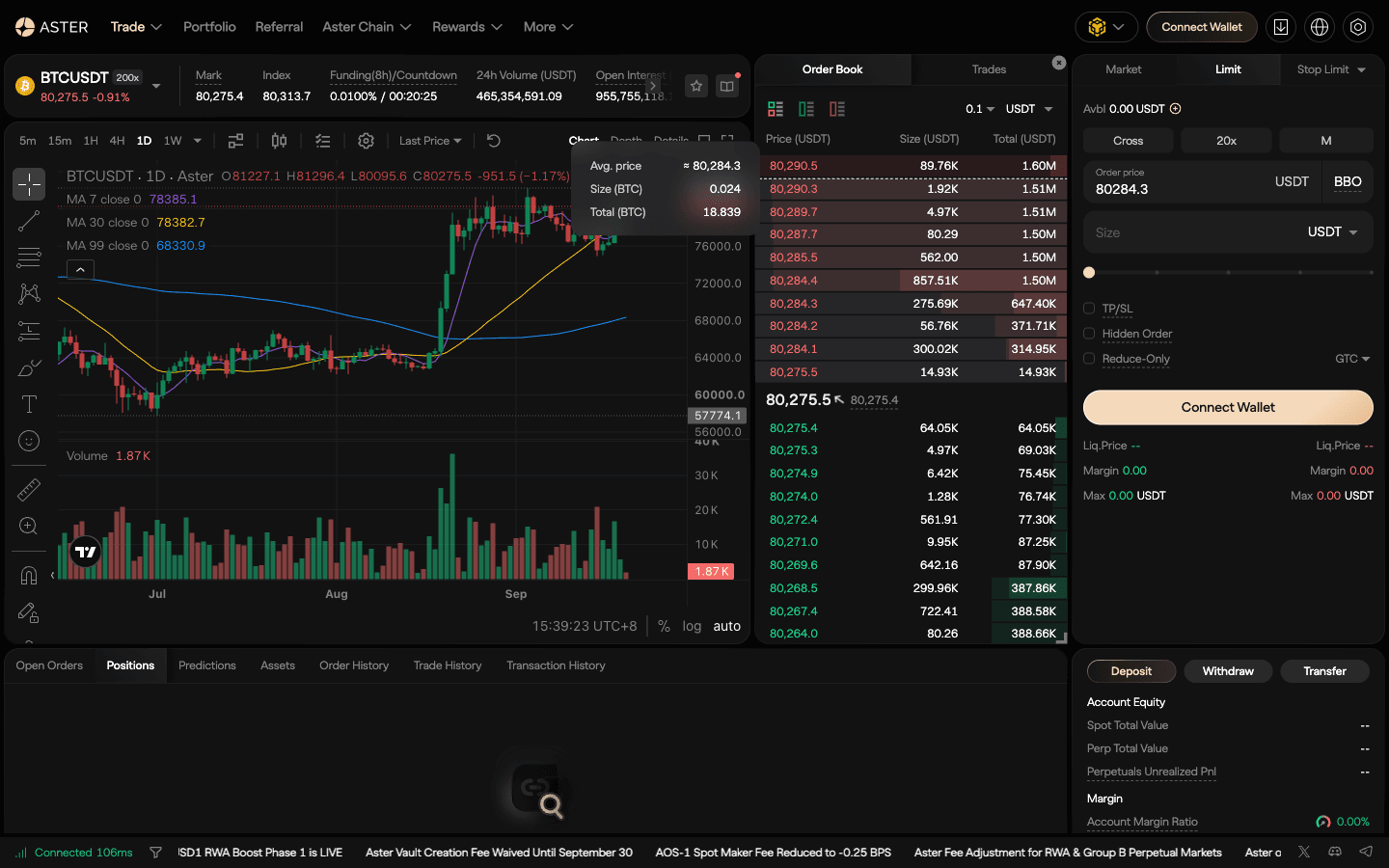
Aster’s 1001x and Shield modes
Aster also runs products with completely different fee models. Compare them with Lighter only if you actually trade that way:
- 1001x mode (pool-based, not the order book): below 500x leverage, 0.08% to open and 0.08% to close (forex 0.02%); ETH goes to 250x, other crypto to 75x, forex to 200x. At 500x, 750x and 1001x on BTC/USD there is no opening fee; the closing fee is the larger of (profit × 15%) ÷ notional or 0.03% of notional, and net profit is capped around 500% of margin (500x/750x) or 300% (1001x). An execution fee of $0.50 on BNB Chain or $0.20 on Arbitrum is charged when opening.
- Shield mode (private, AMM-style): a flat 0.03% on open and close, or a 15–20% share of profits with nothing charged on losing trades; the docs also mention a limited-time zero-fee event.
Example: $100 of margin at 1001x is about $100,100 of BTC exposure. Closing it costs at least 0.03% of that, about $30, plus the $0.50 execution fee, which is 30% of your margin before any price move. On Lighter the same BTC exposure needs about $2,002 of margin at 50x and costs $0 on Standard or about $56 round trip as a Premium taker. The Aster leverage guide covers the risks.
Worked examples by trading style
| Trader | Lighter Standard | Lighter Premium (0 LIT) | Aster Pro (VIP 1) |
|---|---|---|---|
| Scalper, taker: 20 round trips/day of $10,000 ($400k/day) | $0 (300 ms delay) | $112/day | $160/day |
| Scalper, maker-only: same volume with post-only orders | $0 | $16/day | $0 |
| Swing trader: one $5,000 taker round trip a week | $0 | $2.80/week | $4.00/week |
| Grid bot: $2M/month, all maker | $0 | $80/month | $0 |
| Gold trader: $50,000 taker round trip on XAU | $0 | $28 | $12.50 |
| Execution: one $100,000 TWAP | $10 | Premium rates on slices | $40 if all slices are taker |
Fee rates re-read October 15, 2026; a round trip = one open plus one close at the same notional. Funding, spread and slippage excluded here; the swing-trader section below adds funding.
Scalpers
Twenty $10,000 round trips a day is $400,000 of daily volume, or $5.6M over 14 days, which clears Aster’s VIP 2 volume bar; with 500 ASTER held, the taker fee drops to 0.035% and the daily cost to $140. Lighter Premium is still cheaper at $112, and Lighter Standard is free if 300 ms of delay on every market order is acceptable. If you scalp with post-only limit orders, the picture flips: Aster charges $0 and Lighter Premium $16 a day. The cheapest scalping setup is maker orders on Aster or on Lighter Standard, with the caveat that Standard’s 300 ms cancel delay makes your resting orders easier to pick off. Our best DEX for scalping guide adds Hyperliquid and latency to this comparison.
Swing traders: which perp DEX is cheapest once funding is counted?
Of the three perp DEXs compared here, Lighter was the cheapest for swing trading in the week of October 8–15, 2026, in three of our four cases. A $5,000 BTC long held seven days cost $2.55 on Lighter Standard (no trading fee, $2.55 of funding paid), $5.78 on Aster and $9.57 on Hyperliquid with code HOLYGRAIL. The exception: ETH shorts were cheaper on Hyperliquid ($0.41 against $1.18), where the funding shorts collected covered most of the fee.
For a few trades a week the fee difference alone is a few dollars: $0 on Lighter Standard, $2.80 on Lighter Premium and $4.00 on Aster for a $5,000 round trip. Once you hold for days, funding is the other half of the bill, so the table adds the funding that was actually paid on each venue in the same week.
| $5,000 position, held 7 days (October 8–15, 2026) | Lighter Standard | Aster Pro VIP 1 | Hyperliquid + HOLYGRAIL |
|---|---|---|---|
| BTC long | $2.55no fees, $2.55 funding paid | $5.78$4.00 fees, $1.78 funding paid | $9.57$4.32 fees, $5.25 funding paid |
| BTC short | −$2.55no fees, $2.55 funding received | $2.22$4.00 fees, $1.78 funding received | −$0.93$4.32 fees, $5.25 funding received |
| ETH long | −$1.18no fees, $1.18 funding received | $6.17$4.00 fees, $2.17 funding paid | $8.23$4.32 fees, $3.91 funding paid |
| ETH short | $1.18no fees, $1.18 funding paid | $1.83$4.00 fees, $2.17 funding received | $0.41$4.32 fees, $3.91 funding received |
Fees: one market-order open and close at 0% (Lighter Standard), 0.04% (Aster VIP 1) and 0.0432% (Hyperliquid tier 0 with the 4% code discount). Funding: the sum of every payment from 04:00 UTC October 8 to 04:00 UTC October 15, 2026, from each exchange’s public funding history (168 hourly payments on Lighter and Hyperliquid, 21 eight-hour payments on Aster), on a constant $5,000 notional. A negative total means the funding you received exceeded the fees; the cheapest venue in each row is highlighted. Hyperliquid is priced with code HOLYGRAIL’s discount; Aster’s code DTLpLc pays 5% of your fees back the next day, which would cut Aster’s $4.00 of fees to $3.80 and change no row’s cheapest venue. Past funding does not predict next week’s.
Two things decide the result. Lighter Standard charges no trading fee, so its cost is funding alone, and Aster’s 0.04% taker fee costs $4 per round trip before any funding. Funding then swings with the market: in this week longs paid on BTC everywhere, while ETH longs on Lighter were paid. If your swing trades go both ways, the zero-fee account wins on average. Open a free Lighter Standard account (code 718610TD) →
Bots
A maker-only grid pays nothing on either Aster or Lighter Standard. The difference is infrastructure: Aster’s API allows 1,200 orders per minute per account; a Lighter Standard account is limited to 60 API requests per minute, so busier Lighter bots need Plus (0.005%) or Premium. Details in our Lighter trading bot guide and Aster automated trading guide.
Gold and stock traders
Both venues list gold, silver and US stock perps that stay open around the clock (outside US regular hours Aster rejects stock-perp limit orders more than 5% through the mark price and fills market orders only within 5%). On gold, a $50,000 taker round trip costs $0 on Lighter Standard, $12.50 on Aster (1.25 bps each side) and $28 on Lighter Premium. On leverage it is the other way round: Lighter allowed 25x on XAU, while Aster’s brackets allowed 100x on XAUUSDT (for positions up to $50,000 of notional) and 20x on XAUUSD1, the gold pair with most of Aster’s gold volume.
Liquidity: a dated order-book snapshot
Volume tells you how much trades; depth tells you what your order costs. We pulled both public order books five times between 06:56 and 07:00 UTC on October 15, 2026 (Lighter’s orderBookOrders endpoint, 250 resting orders per side, and Aster’s depth endpoint, 1,000 levels) and measured the spread, the resting size within 0.05% of the mid price, and the average fill of a simulated market buy.
| Snapshot, Oct 15, 2026 (06:56–07:00 UTC) | Lighter | Aster (USDT perps) |
|---|---|---|
| BTC: best bid/ask spread | $0.10–$1.80 (0.01–0.22 bp) | $0.10 (0.01 bp) |
| BTC: resting size within ±0.05% of mid | $8.4M–$10.8M | $7.7M–$10.4M |
| BTC: $100k market buy, avg. price vs mid | +0.2 to +0.4 bp | +0.0 to +1.2 bp |
| BTC: $1M market buy, avg. price vs mid | +0.7 to +1.0 bp | +0.2 to +1.7 bp |
| ETH: best bid/ask spread | $0.01–$0.14 (0.04–0.59 bp) | $0.01–$0.17 (0.04–0.72 bp) |
| ETH: resting size within ±0.05% of mid | $5.7M–$7.1M | $1.2M–$2.8M |
| ETH: $100k market buy, avg. price vs mid | +0.1 to +0.9 bp | +1.0 to +1.2 bp |
| ETH: $1M market buy, avg. price vs mid | +1.1 to +2.2 bp | +1.9 to +3.8 bp |
| Open interest, BTC / ETH (one side) | ~$157M / ~$64.1M | ~$449M / ~$203M |
| Minimum order | $10 notional (BTC 0.00007) | $5 notional; BTC 0.001 (~$81) |
Ranges show the lowest and highest of the five pulls. “Avg. price vs mid” includes the half-spread and walks the resting asks; 1 bp = 0.01%. Open interest from Lighter orderBookDetails and Aster openInterest at 06:55 UTC, converted at the last price; minimum orders from the same endpoints and Aster exchangeInfo. Books change second by second; treat this as an order of magnitude, not a guarantee. In our first test on September 25, 2026, Aster’s BTC book filled $1M slightly better (0.4–0.5 bp against 0.9–1.4 bp).
Three conclusions follow:
- For orders under $100,000, depth is not the deciding factor. A $100k BTC market buy cost at most about 1 basis point on either book. Aster’s 0.04% taker fee is 4 bp, several times the depth difference, so a taker’s real cost gap is the fee, not the book.
- At $1M, BTC was a draw (0.7–1.0 bp on Lighter, 0.2–1.7 bp on Aster, depending on the pull). Add the fees and Lighter Standard wins clearly: about 1 bp in total against roughly 5 bp on Aster.
- ETH favoured Lighter: two to five times Aster’s resting size within 0.05% of the mid, and a $1M buy cost 1.1–2.2 bp against 1.9–3.8 bp on Aster.
Small accounts can ignore depth altogether on BTC and ETH: a $500 or $5,000 order fills at the touch on either venue. Where depth does bite is on small caps, and there the comparison is lopsided because Aster lists hundreds of alts Lighter does not. For those, open the book before you size up; our slippage guide shows how to read it.
Markets and volume
| October 2026 | Lighter | Aster |
|---|---|---|
| 24h volume, all perps (CoinGecko, October 20, 2026) | ~$1.96B | ~$1.43B |
| Open interest (CoinGecko, October 20, 2026) | ~$1.1B | ~$2.42B |
| 24h volume, BTC perp (Oct 15, 06:55 UTC) | ~$1.1B | ~$774M (BTCUSDT) |
| 24h volume, ETH perp (Oct 15, 06:55 UTC) | ~$533M | ~$530M (ETHUSDT) |
| Active perp markets (October 14) | 213 (+10 spot) | 604 (USDT-, USD1- and U-quoted) |
| Non-crypto perps | US stocks and indices (US100, US500, SPY, NVDA…), forex (EURUSD 50x), gold and silver, pre-IPO names (e.g. OPENAI, ANTHROPIC) | Gold, silver, oil, US and Korean stock perps (on October 15, 2026 gold XAUUSD1 was #3 by volume, SNDKUSD1 #4 and SKHYNIXUSD1 #5) |
| Settlement / collateral | USDC (ETH, XAUT as extra margin) | USDT or USD1 (multi-asset mode available) |
| Chain | ZK rollup on Ethereum | Aster Chain (own L1) |
Totals: CoinGecko’s derivatives feed, fetched when this page was built (October 20, 2026); in a same-minute check (06:55 UTC, October 15, 2026) CoinGecko’s open interest was about 2.0× (Lighter) and 1.8× (Aster) the one-sided figures in the next section, so compare the two venues with each other, not with that table. Per-market rows: Lighter orderBookDetails and Aster ticker/24hr at 06:55 UTC on October 15, 2026. The volume lead changes hour to hour.
By volume the two are close, and both sit well behind Hyperliquid. Lighter concentrates volume in BTC (about half of its total) and a short list of majors and RWAs; Aster spreads it across hundreds of alts. If your strategy lives on a specific small cap, check Aster first; if you mostly trade BTC, ETH, gold or US indices, Lighter covers you. Live rankings are in our perp DEX ranking, and the full market lists in Lighter trading pairs and Aster trading pairs.
Is the volume real? Volume vs open interest
Wash-trading accusations follow both venues: a public Dune dashboard that ranks Hyperliquid, Aster and Lighter flags Aster’s volume, and in February 2026 the data site CoinGlass was reported accusing Aster and Lighter of inflating theirs while describing Hyperliquid’s activity as closer to real demand. Nobody outside an exchange can audit its order flow, but you can run the check those dashboards rely on: divide 24-hour volume by open interest. The more times the same open positions turn over in a day, the more of the volume is churn (market makers, bots, points farmers or self-trading) rather than new risk.
| 06:55 UTC, October 15, 2026 | 24h perp volume | Open interest (one side) | Volume ÷ OI |
|---|---|---|---|
| Lighter | $2.32B | $499M | 4.65× |
| Aster | $2.63B | $1.28B | 2.05× |
| Hyperliquid (reference) | $8.65B | $10.9B | 0.79× |
Volume: Lighter orderBookDetails (sum of the active perps), Aster ticker/24hr across its trading perps, Hyperliquid metaAndAssetCtxs (core perps). Open interest, one side: Lighter orderBookDetails (open interest × price, matching DefiLlama within 0.3%), DefiLlama for Aster, Hyperliquid metaAndAssetCtxs. All pulled the same minute on a Thursday. Our earlier check (00:50 UTC, Saturday, September 27, 2026) gave the same order: Lighter 1.08×, Aster 0.55×, Hyperliquid 0.22×.
- Aster sits between the two. It turns its positions over more often than Hyperliquid but less often than Lighter, and it carries more than twice Lighter’s open interest, so on this check its current volume does not stand out as inflated. Its terms forbid wash trading, and its referral program pays no commission on self-trade volume.
- Lighter turns its open interest over most often. That fits its model: the Standard account charges nothing, so high-frequency and bot trading costs nothing either. DefiLlama’s normalized figure for Lighter was 26% below its reported volume on September 26, 2026 (DefiLlama’s own 24-hour window, so not directly comparable with the table above: $1.51B vs $2.05B).
- What matters for you is depth at your size. In our order-book test above, both BTC books held millions of dollars within 0.05% of the mid price. Headline volume is a popularity contest; the book is what fills your order.
Taker-heavy? Start on Lighter
0% on Standard, 0.028% on Premium. Code 718610TD makes your first week from sign-up a free Premium trial.
Leverage and margin
The two exchanges set leverage in different ways, and the difference matters more than the headline number.
Lighter: one fraction per market, at any size. Each market has an initial (IMR), maintenance (MMR) and close-out (CMR) margin fraction. BTC and ETH are 2% / 1.2% / 0.8%, which is 50x, and the API showed no size-based tiers. Across the 213 active perps on October 19, 2026: 7 markets at 50x (BTC, ETH, EURUSD, US500, SPY and two others), 2 at 30x (including US100), 9 at 25x (SOL, XAU, XAG…), 25 at 20x (HYPE, XRP, BNB, ZEC, NVDA…), 84 at 10x, and the rest at 3–15x.
Aster: brackets by position size. Aster’s docs say maintenance margin “is based on the total size of your position rather than the leverage you select”, with higher rates for larger positions. The public bracket table for BTCUSDT:
| BTCUSDT position notional | Max leverage | Maintenance margin rate |
|---|---|---|
| $0 – $400 | 200x | 0.25% |
| $400 – $300,000 | 150x | 0.33% |
| $300,000 – $800,000 | 100x | 0.50% |
| $800,000 – $3M | 75x | 0.66% |
| $3M – $12M | 50x | 1.00% |
| $12M – $70M | 25x | 2.00% |
| $70M – $100M | 20x | 2.50% |
Source: Aster public leverage-bracket data, re-read October 15, 2026 (unchanged since September 25). ETHUSDT uses the same brackets up to $12M. Across all 604 trading symbols (October 14, 2026), the first-bracket maximum was 300x for 1 (HYPEUSDT, up to $1,000 of notional), 200x for 6, 100x for 7, 50–75x for 47, 20x for 141, 10x for 64 and 5x for 322.
So “Aster offers 200x” is true only for a $400 position. For a $10,000 BTC position the real comparison is 150x (Aster) versus 50x (Lighter); for a $5M position it is 50x on both. A 150x position is liquidated after a move of roughly 0.67% (initial margin) minus 0.33% (maintenance), about 0.33% against you, before fees. At Lighter’s 50x the same calculation gives 2% − 1.2% = 0.8%. High leverage shrinks the distance to liquidation much faster than it grows your profit. Our DEX leverage tiers comparison lines these up with Hyperliquid, edgeX and dYdX.
Liquidation mechanics are close cousins. Lighter moves accounts through pre-liquidation (risk-reducing trades only), partial liquidation with IOC orders (up to a 1% fee to its LLP insurance pool), then a takeover by the LLP below close-out margin, and auto-deleveraging last (Lighter insurance fund and ADL). Aster cancels your open orders, sends one large IOC order, and if that is not enough closes the rest at the bankruptcy price and hands it to its insurance fund (Aster liquidation mechanics).
Costs that are not fees: funding, latency, gas
- Funding schedule. Lighter settles funding every hour (capped at 0.5% per hour); Aster’s BTC, ETH and SOL perps settle every 8 hours (00:00, 08:00 and 16:00 UTC), and many alts every 4 or 1 hours. Funding is paid between traders, not to the exchange, but on a leveraged position held for days it can cost more than the trading fee. Over October 8–15, 2026, a BTC long paid 0.0509% of its notional on Lighter, 0.0355% on Aster and 0.1049% on Hyperliquid; the swing-trader table turns that into dollars. Compare live rates in our funding rate tracker.
- Latency. Lighter Standard’s 300 ms taker delay is a real cost for fast traders: the price can move before your order arrives. Aster does not advertise a speed bump on its order book.
- Gas. Neither charges gas per order. Withdrawals cost network fees: Aster deducts gas set by the destination chain (as low as about 1 USDT), and Lighter fast withdrawals via Arbitrum need at least 4 USDC; secure withdrawals go through Ethereum. See the Lighter and Aster deposit guides.
Order types, apps and API
| Feature (September 2026) | Lighter | Aster Pro |
|---|---|---|
| Order ticket | Market, Limit, Advanced: Conditional, TWAP, Scale, Atomic (multi-market), Chase Limit, Iceberg | Market, limit, stop limit, stop market, trailing stop, post-only, TWAP, scaled; hidden-order checkbox; native Chase order |
| Post-only / IOC / reduce-only | Yes / yes / yes | Yes / yes / yes |
| Trailing stop | No named trailing stop or OCO | Yes |
| Hidden orders | No (Iceberg shows part of the size) | Yes |
| Login | Wallet connection | Web3 wallet (Rabby, MetaMask, Binance Wallet, WalletConnect) or email |
| Mobile | Lighter Mobile (iOS/Android); trading only in selected regions, English only | Mobile apps available |
| Sub-accounts | Standard 4, Plus 16, Premium 64 | 10 at VIP 1–2, up to 20 at VIP 5–6 |
| API limits | Standard 60 requests/min; Premium/Plus 24,000 weighted/min | 2,400 weight/min per IP; 1,200 orders/min per account |
From the Lighter app (v6.0.46) and apidocs.lighter.xyz, the Aster trading page, docs and exchangeInfo, checked September 25, 2026; API limits re-read October 15, 2026 (Aster exchangeInfo rateLimits unchanged).
For a manual trader, Aster’s ticket feels like Binance Futures (trailing stops, hidden orders); Lighter’s is leaner but has execution tools Aster lacks (Atomic multi-market orders, perpRFQ for block trades). Lighter’s Chase and Iceberg run in your browser tab, so they stop if you close it. See Lighter order types and Aster advanced order types.
Where these numbers come from: the public endpoints
Every live number on this page comes from public endpoints you can call yourself, without an API key (the per-account and bulk-history items marked below need authentication):
| Data | Lighter (mainnet.zklighter.elliot.ai/api/v1/) | Aster (fapi.asterdex.com/fapi/v1/) |
|---|---|---|
| Order book | orderBookOrders?market_id=1&limit=250 (BTC; ETH is market 0) | depth?symbol=BTCUSDT&limit=1000 |
| 24h volume and open interest | orderBookDetails, exchangeStats | ticker/24hr, openInterest?symbol=BTCUSDT |
| Funding history | fundings?market_id=1&resolution=1h | fundingRate?symbol=BTCUSDT |
| Liquidations | Liquidation fills appear in the public trade feed; the liquidations endpoint is per account and needs an auth token | Public WebSocket streams <symbol>@forceOrder and !forceOrder@arr push the latest liquidation per symbol each second; the REST forceOrders list covers only your own account (signed) |
| Historical data | Candles and funding by time range; full trade history as daily files via export/historicalTrades (needs an auth token and a one-time in-app transfer of 100 LIT; see the API guide) | Candles (klines) and funding history by time range |
Request formats, rate limits and a worked Python example are in our Lighter order book and market data API guide, which covers Lighter historical data in its own section; individual accounts and batches can be looked up in the Lighter explorer. For trading through Aster’s API, see the Aster API guide.
Custody, security and who runs them
Both are self-custodial: you connect a wallet, no KYC, and the exchange does not hold an account in your name. The trust model underneath is different:
- Lighter is a zk-rollup. Its sequencer orders transactions, and zero-knowledge proofs of matching and liquidation are verified on Ethereum before the state updates. If the operator stopped processing, users can force requests through a priority queue on Ethereum, and an Escape Hatch freezes the contract and lets users withdraw with proofs. The docs publish nine audit reports covering the smart contracts and circuits.
- Aster runs its own chain (Aster Chain L1, launched March 16, 2026). Cross-chain deposits need confirmations from 3 of 4 validators; withdrawals are batched and need 2 of 3. You therefore trust that validator set to process withdrawals. The audit page lists reports for AsterVault, AsterEarn, asBNB, USDF/asUSDF and asCAKE; we did not find a forced-withdrawal path comparable to Lighter’s Escape Hatch in the docs we read.
Neither design removes oracle, liquidation or smart-contract risk. If Ethereum-level settlement guarantees matter to you, that is Lighter’s strongest argument; if you value privacy, Aster’s encrypted orders and hidden orders are its answer.
Who you are dealing with. Lighter’s terms of service (last updated December 29, 2025) name the operator of its interface, Elliot Technologies, Inc., and choose Florida (US) law with arbitration. Aster’s terms and conditions (last updated February 25, 2026) name no company, only “Aster”, and send disputes to Hong Kong law, HKIAC arbitration. Both exclude some countries: Lighter lists the US, Canada, the UK, China, North Korea, Russia, Ukraine, Cuba, Iran, Venezuela, Sudan, Belarus, Myanmar and Syria, plus sanctioned regions; Aster lists the US, Canada, the UK, China, North Korea, Russia, Ukraine, Cuba, Iran, Venezuela and Syria, plus sanctioned regions. If you live in one of them, neither is for you. For the wider picture on wallet-only exchanges, see trading on a DEX without KYC.
Tokens and points
- LIT (Lighter): staking LIT discounts Premium fees (up to 30%), is required to deposit into the LLP pool (up to 10 USDC per staked LIT), and earns a fixed 6% APR with a 3-day unstaking period. Lighter runs daily buybacks from fee revenue. LIT Fee Credits let you rent a fee tier instead of staking.
- ASTER (Aster): a BEP-20 token on BNB Chain with a maximum supply of 8 billion. Paying spot fees in ASTER takes 5% off (spot only), VIP tiers above VIP 1 require holding it, and it can be used as margin.
- Points: Aster’s docs describe Stage 6 (“Aster Convergence”): weekly epochs, points from trading fees, maker liquidity, positions held, ASTER-asset margin and PnL, with undisclosed weights, accumulating toward an ASTER airdrop share at the end of the stage. Check the Rewards Hub to confirm the stage is still running. Lighter’s docs conflict: one page says Points Season 2 ended on December 26, 2025, while the retail page still describes 200,000 points a week. We would not choose either exchange for points alone.
Background: Aster points guide and Lighter points guide.
Referral codes: what they actually do
- Lighter
718610TD: if you sign up through a referral link, you are offered one free week of Premium: it starts at sign-up, and the Premium fees you pay that week are rebated (paid back every Monday, on up to $10M of volume). On the free Standard account there is nothing to rebate, so the code only matters if you try Premium. See Lighter referral code. - Aster
DTLpLc: you get 5% of your Aster Perps fees back as a next-day rebate. Aster’s default referral commission is 10% of the referee’s fees and we split it with you; check the rebate history on the referral page after you trade. The relationship lasts 365 days. See Aster referral code.
Verdict: who should pick which
Overall pick: Lighter, for the typical trader who uses market orders on BTC, ETH and the majors. It is free on the default account, gives 50x on BTC at any size and settles on Ethereum. Aster is the specialist’s pick: the better venue for limit-order traders, altcoin hunters and anyone who wants high leverage on a small position.
- Choose Lighter if you mostly take liquidity, trade BTC, ETH, gold, FX or US indices, hold swing positions (no trading fee, so you pay only funding; cheaper than Aster in our one-week test), or want matching and liquidations proven on Ethereum with an escape hatch.
- Choose Aster if you mostly post limit orders (0% maker at any size without paying for a Premium account), want more than 50x on a small position, need trailing stops or hidden orders, trade small caps Lighter does not list, or want to collect airdrop points.
- Use both if you are cost-sensitive: splitting flow by order type (taker on Lighter, maker on Aster) is the cheapest combination. Neither charges gas per order, so two small balances cost nothing beyond the deposits.
- Neither if you want the deepest book and the most altcoin liquidity in one place: that is Hyperliquid (compare in Hyperliquid vs Lighter and Aster vs Hyperliquid). The three-way view is in Hyperliquid vs Lighter vs Aster, and all venues are ranked in our best DEX guide.
FAQ
Is Lighter or Aster better?
For most traders, Lighter: market orders cost 0% on its default Standard account versus Aster’s 0.04% taker fee, and its matching and liquidations are proven on Ethereum. Aster is the better pick if you mostly post limit orders (0% maker at every tier), trade altcoins (604 perps versus 213) or want more leverage on small positions (150x on BTC up to $300,000). 24-hour volume was higher on Lighter on October 20, 2026: about $1.96B on Lighter and $1.43B on Aster (CoinGecko).
Which perp DEX is cheapest for swing trading?
Of the three perp DEXs compared here, Lighter was the cheapest for swing trading in the week of October 8–15, 2026, in three of our four cases. A $5,000 BTC long held seven days cost $2.55 on Lighter Standard (no trading fee, $2.55 of funding paid), $5.78 on Aster and $9.57 on Hyperliquid with code HOLYGRAIL. The exception: ETH shorts were cheaper on Hyperliquid ($0.41 against $1.18), where the funding shorts collected covered most of the fee. With no trading fee on its Standard account, Lighter’s cost of a swing trade is almost entirely funding; Aster adds $4 of taker fees per $5,000 round trip. Funding changes direction and size week to week, so check the current rates before you hold for days.
Is Lighter cheaper than Aster?
For taker orders on crypto perps, yes: the Lighter Standard account pays 0%, and even Premium’s 0.028% is below Aster’s 0.04% base taker fee. For maker orders, Aster and Lighter Standard are both 0%, while Lighter Premium makers pay 0.004%. For RWA perps like gold, Lighter Standard is 0% and Aster charges 1.25 bps (0.0125%) taker since September 7, 2026, which is cheaper than Lighter Premium’s 0.028%.
What chain are Lighter and Aster on? Is Lighter on zkSync?
No, Lighter is not on zkSync. It runs its own zk-rollup, which its terms describe as a Layer 2 on Ethereum: a sequencer matches orders and zero-knowledge proofs of every state update are verified on Ethereum. Aster runs its own Layer 1, Aster Chain (live since March 16, 2026); you can connect a wallet from any of BNB Chain, Ethereum, Arbitrum, Robinhood, Arc and Solana, and its ASTER token is a BEP-20 token on BNB Chain.
Which has more liquidity, Lighter or Aster?
On BTC they are even: in five order-book pulls on October 15, 2026 both books held about $8–11M within 0.05% of the mid price, and a $1M market buy cost under 2 basis points on either. On ETH Lighter was deeper, with two to five times Aster’s resting size near the mid and cheaper fills at $100,000 and $1M. Aster carries more BTC and ETH open interest (about $449M and $203M versus $157M and $64.1M on Lighter). For orders under $100,000 the depth difference is about a basis point at most, far smaller than the fee gap.
How much leverage do Lighter and Aster allow?
Lighter uses one margin fraction per market: 50x on BTC and ETH at any position size (2% initial, 1.2% maintenance), 25x on SOL and gold, 10x on most alts. Aster uses size brackets: BTCUSDT allows 200x only up to $400 of notional, 150x up to $300,000, 100x up to $800,000 and 50x from $3M to $12M. Aster’s separate 1001x mode goes up to 1001x on BTC/USD with a different fee model.
Is Lighter’s or Aster’s trading volume real?
Nobody outside the exchanges can prove it either way, but the usual check is volume divided by open interest. At 06:55 UTC on October 15, 2026, Lighter turned over 4.65× its open interest in 24 hours, Aster 2.05× and Hyperliquid 0.79×. Lighter’s higher ratio fits its free Standard fees, which make high-frequency and bot trading cheap; DefiLlama also discounts about 26% of Lighter’s reported volume in its normalized figure. Both order books held real resting size on BTC in our depth test, which matters more to you than the headline volume.
Where do the volume, depth and funding numbers on this page come from?
From each exchange’s public market-data API, which needs no key: Lighter’s REST API (orderBookOrders for the order book, orderBookDetails and exchangeStats for volume and open interest, fundings for hourly funding) and Aster’s Binance-style futures API at fapi.asterdex.com (depth, ticker/24hr, openInterest, fundingRate). Every figure is dated, because volume, open interest and funding change by the hour. Request formats and code examples are in our Lighter API guide and Aster API guide.
Why would anyone pay for Lighter Premium when Standard is free?
Speed and limits. Standard taker orders wait 300 ms and cancels 300 ms, and API users get 60 requests a minute. Premium cuts taker latency to 140 ms, removes the delay on post-only orders and cancels, and raises order limits into the thousands per minute, which matters for scalpers, market makers and bots.
Are Lighter and Aster safe? Who holds my funds?
Both are self-custodial exchanges you use from a wallet, but the trust models differ. Lighter is a zk-rollup: state updates are proven and verified on Ethereum, and an Escape Hatch lets users withdraw with proofs if the operator stops. Aster runs its own chain: deposits are confirmed by 3 of 4 validators and batched withdrawals need 2 of 3, so you rely on that validator set. Neither removes smart-contract, oracle or liquidation risk.
Do Lighter and Aster require KYC? Where are they blocked?
Neither asks for ID to trade: you connect a wallet, and the exchange never opens an account in your name. Both exclude some countries in their terms. Lighter: the US, Canada, the UK, China, North Korea, Russia, Ukraine, Cuba, Iran, Venezuela, Sudan, Belarus, Myanmar and Syria, plus sanctioned regions. Aster: the US, Canada, the UK, China, North Korea, Russia, Ukraine, Cuba, Iran, Venezuela and Syria, plus sanctioned regions. If you live in one of those places, do not use them. No KYC does not mean anonymous: every deposit and withdrawal is on a public chain, and taxes still apply.
Do Lighter or Aster have points or airdrops?
Aster’s docs describe Stage 6 (“Aster Convergence”), a weekly points program that accumulates toward an ASTER airdrop share, with undisclosed weights. Lighter’s docs contradict themselves: one page says Points Season 2 ended on December 26, 2025, another still describes 200,000 points a week. Treat points as a possible bonus, never as the reason to pick an exchange.
Do the Lighter and Aster referral codes lower my fees?
Lighter code 718610TD gives you a free Premium trial week starting at sign-up (Premium fees paid that week are rebated, up to $10M of volume); it changes nothing on the free Standard account. On Aster, code DTLpLc gives you 5% of your Aster Perps fees back as a next-day rebate (the default referral commission is 10% of the referee’s fees and we split it with you); maker fills are free, so the rebate comes from taker fees. We earn a commission from both.
Open both accounts
Lighter 718610TD for free taker trading; Aster DTLpLc for 0% maker, more markets and high leverage.
Want the deepest book of all? Hyperliquid with code HOLYGRAIL takes 4% off fees on your first $25M (Hyperliquid fees, code details). New to perps? Start with what a DEX is.
Disclosure: 718610TD (Lighter), DTLpLc (Aster) and HOLYGRAIL (Hyperliquid) are our referral codes. On Lighter we earn a share of Premium fees and Standard advanced-order fees paid by referred users (nothing on free Standard trading); on Aster a share of referred users’ fees. Fee pages, Aster’s leverage brackets, volumes, open interest and order-book depth were checked in each exchange’s docs and public APIs on October 15, 2026; Aster’s VIP tier thresholds and the app features on September 25, 2026.